 ### Myth: Aadhaar is based fully on consent.
Fact: You may have to compulsorily enrol under Aadhaar, despite your privacy concerns.
If a service agent asks for Aadhaar mandatorily, then as a beneficiary, citizens have no option but to get an Aadhaar number.
The new Aadhaar Act does not incorporate a categorical clause saying Aadhaar will be voluntary, or that it will NOT be made mandatory. Instead, it broadens the scope of Aadhaar. In parliament in March, Finance Minister Arun Jaitley said the Aadhaar Act will allow the government to ask a citizen to produce an Aadhaar number to avail of any "government subsidy".
But section 7 of the Bill is phrased more broadly, and refers to not just subsidies but any "subsidy, benefit or service" for which expense is incurred on the Consolidated Fund of India, or the government treasury. This is a sweeping scope, and we are seeing the impact in the notifications issued by the government in the past few weeks: government is demanding Aadhaar, or proof of enrolment in Aadhaar, from everyone from trafficked women seeking assistance to children in government schools for getting their school meals.
Section 7 of Aadhaar Act says:
> "Provided that if an Aadhaar number is not assigned to an individual, the individual shall be offered alternate and viable means of identification for delivery of the subsidy, benefit or service."
In the recent notifications, Government has got around the proviso for an "alterntate" ID, by making the proof of applying for enrolment in Aadhaar itself as the alternate ID it will recognise! Talk of arm-twisting citizens.
Aadhaar law allows private companies too use it, such as an application used by a company doing authentication for those applying to jobs, even if a prospective employee or tenant shares his/her Aadhaar number, it does not amount to free consent since getting a job or a house may hinge on providing the Aadhaar number.
### Myth: Aadhaar is based fully on consent.
Fact: You may have to compulsorily enrol under Aadhaar, despite your privacy concerns.
If a service agent asks for Aadhaar mandatorily, then as a beneficiary, citizens have no option but to get an Aadhaar number.
The new Aadhaar Act does not incorporate a categorical clause saying Aadhaar will be voluntary, or that it will NOT be made mandatory. Instead, it broadens the scope of Aadhaar. In parliament in March, Finance Minister Arun Jaitley said the Aadhaar Act will allow the government to ask a citizen to produce an Aadhaar number to avail of any "government subsidy".
But section 7 of the Bill is phrased more broadly, and refers to not just subsidies but any "subsidy, benefit or service" for which expense is incurred on the Consolidated Fund of India, or the government treasury. This is a sweeping scope, and we are seeing the impact in the notifications issued by the government in the past few weeks: government is demanding Aadhaar, or proof of enrolment in Aadhaar, from everyone from trafficked women seeking assistance to children in government schools for getting their school meals.
Section 7 of Aadhaar Act says:
> "Provided that if an Aadhaar number is not assigned to an individual, the individual shall be offered alternate and viable means of identification for delivery of the subsidy, benefit or service."
In the recent notifications, Government has got around the proviso for an "alterntate" ID, by making the proof of applying for enrolment in Aadhaar itself as the alternate ID it will recognise! Talk of arm-twisting citizens.
Aadhaar law allows private companies too use it, such as an application used by a company doing authentication for those applying to jobs, even if a prospective employee or tenant shares his/her Aadhaar number, it does not amount to free consent since getting a job or a house may hinge on providing the Aadhaar number.
 ### Myth: Aadhaar law has privacy protections comparable to the best in the world.
Fact: Aadhaar Act allows authorities to share your personal data in the 'interest of national security', a term that remains undefined.
The Aadhaar law allows sharing your ID information and all authentication record in interest of "national security", even as the phrase "national security" is undefined in the present bill, as well as the General Clauses Act. Thus, the circumstances in which an individual's information may be disclosed remains open to interpretation.
Aadhaar Act allows sharing your ID information, all authentication records on direction of an authorised officer of rank of Joint Secretary.
Section 33(1) permits the disclosure of an individual's demographic information following an order by a district judge. It says that in such a matter, prior hearing will be given to the UIDAI , NOT the person whose data is being disclosed!
Section 33(2), which permits disclosure of your data "in interest of national security", says such disclosures will be for three months initially, and a fresh renewal can be granted for another three months, with NO limitation on the number of such renewals.
This can lead to a user being under continuous surveillance, and without ANY notification to the user even after the surveillance ceases, violating one of [necessary and proportionate principles on communications surveillance related to user notification](http://www.ohchr.org/Documents/Issues/Privacy/ElectronicFrontierFoundation.pdf) and right to effective remedy. In some countries, this principle has been incorporated in law. For example, in Canada, the law limits the time of wiretapping surveillance, and imposes an obligation to notify the person under surveillance within 90 days of the end of the surveillance, extendable to a maximum of three years at a time.
Aadhaar also lacks provisions on giving notice to a person in case of breach of information, in case of third party use of data, or change in purpose of use of data, which were recommended by the Justice Shah Committee on Privacy in 2012.
### Myth: Aadhaar law has privacy protections comparable to the best in the world.
Fact: Aadhaar Act allows authorities to share your personal data in the 'interest of national security', a term that remains undefined.
The Aadhaar law allows sharing your ID information and all authentication record in interest of "national security", even as the phrase "national security" is undefined in the present bill, as well as the General Clauses Act. Thus, the circumstances in which an individual's information may be disclosed remains open to interpretation.
Aadhaar Act allows sharing your ID information, all authentication records on direction of an authorised officer of rank of Joint Secretary.
Section 33(1) permits the disclosure of an individual's demographic information following an order by a district judge. It says that in such a matter, prior hearing will be given to the UIDAI , NOT the person whose data is being disclosed!
Section 33(2), which permits disclosure of your data "in interest of national security", says such disclosures will be for three months initially, and a fresh renewal can be granted for another three months, with NO limitation on the number of such renewals.
This can lead to a user being under continuous surveillance, and without ANY notification to the user even after the surveillance ceases, violating one of [necessary and proportionate principles on communications surveillance related to user notification](http://www.ohchr.org/Documents/Issues/Privacy/ElectronicFrontierFoundation.pdf) and right to effective remedy. In some countries, this principle has been incorporated in law. For example, in Canada, the law limits the time of wiretapping surveillance, and imposes an obligation to notify the person under surveillance within 90 days of the end of the surveillance, extendable to a maximum of three years at a time.
Aadhaar also lacks provisions on giving notice to a person in case of breach of information, in case of third party use of data, or change in purpose of use of data, which were recommended by the Justice Shah Committee on Privacy in 2012.
 ### Myth: Aadhaar is meant to "target subsidies."
Fact: Aadhaar was opened up for use by private companies — airlines, telecom, insurance, real estate — well beyond welfare delivery.
During the [debate in Lok Sabha](http://164.100.47.132/newdebate/16/7/11032016/12To1pm.pdf) in March, Congress MP Rajeev Satav, raised a question on clause 57 of the Aadhaar Bill which permits private entities – airlines, telecom, insurance, real estate companies – to use the Aadhaar number. Finance minister Jaitley did not respond to the question.
UIDAI's founder chairperson software billionaire Nilekani in an interview in 2012 spoke about creating a "thriving application system" using Aadhaar for both the public and private sector.
In fact, the authority entered into agreements with private companies well before the Aadhaar law was passed in Parliament. The companies were running ahead of legislation in a space unbounded by law, and the [UIDAI supported them](https://scroll.in/article/805467/how-the-government-gains-when-private-companies-use-aadhaar).
Rajya Sabha passed an amendment was to drop use of Aadhaar authentication by private companies and businesses in clause 57 entirely. This clause said that the Bill does not prevent the wider use of Aadhaar number of users by other bodies including private companies. Even while Bill was in parliament, there were instances of private companies advertising that they can use Aadhaar to [collate information about citizens at a price](https://scroll.in/article/805201/the-future-is-here-a-private-company-claims-to-have-access-to-your-aadhaar-data).
## FAQs
### Why should you care about privacy when you have nothing to hide?
## What does surveillance have to do with being free?
American abolitionist Wendell Phillips said:
*"Eternal vigilance is the price of liberty".*
The right to live freely with dignity and self-determination has been won and lost repeatedly through history. Monarchs, dictators, the military and democratically elected governments have exploited and even oppressed the citizens of their states for thousands of years. I am only the second generation of India's citizens born free.
So freedom needs to be constantly defended and protected every time a government changes and every time a new technology appears. This is the first reason why we should care about unfettered surveillance. Unfettered, it provides individuals, governments and businesses the opportunity and technology to monitor and interfere with how we spend or don't spend our money, where we go, whom we visit and talk to, what information we seek, even when we wake and sleep.
### Myth: Aadhaar is meant to "target subsidies."
Fact: Aadhaar was opened up for use by private companies — airlines, telecom, insurance, real estate — well beyond welfare delivery.
During the [debate in Lok Sabha](http://164.100.47.132/newdebate/16/7/11032016/12To1pm.pdf) in March, Congress MP Rajeev Satav, raised a question on clause 57 of the Aadhaar Bill which permits private entities – airlines, telecom, insurance, real estate companies – to use the Aadhaar number. Finance minister Jaitley did not respond to the question.
UIDAI's founder chairperson software billionaire Nilekani in an interview in 2012 spoke about creating a "thriving application system" using Aadhaar for both the public and private sector.
In fact, the authority entered into agreements with private companies well before the Aadhaar law was passed in Parliament. The companies were running ahead of legislation in a space unbounded by law, and the [UIDAI supported them](https://scroll.in/article/805467/how-the-government-gains-when-private-companies-use-aadhaar).
Rajya Sabha passed an amendment was to drop use of Aadhaar authentication by private companies and businesses in clause 57 entirely. This clause said that the Bill does not prevent the wider use of Aadhaar number of users by other bodies including private companies. Even while Bill was in parliament, there were instances of private companies advertising that they can use Aadhaar to [collate information about citizens at a price](https://scroll.in/article/805201/the-future-is-here-a-private-company-claims-to-have-access-to-your-aadhaar-data).
## FAQs
### Why should you care about privacy when you have nothing to hide?
## What does surveillance have to do with being free?
American abolitionist Wendell Phillips said:
*"Eternal vigilance is the price of liberty".*
The right to live freely with dignity and self-determination has been won and lost repeatedly through history. Monarchs, dictators, the military and democratically elected governments have exploited and even oppressed the citizens of their states for thousands of years. I am only the second generation of India's citizens born free.
So freedom needs to be constantly defended and protected every time a government changes and every time a new technology appears. This is the first reason why we should care about unfettered surveillance. Unfettered, it provides individuals, governments and businesses the opportunity and technology to monitor and interfere with how we spend or don't spend our money, where we go, whom we visit and talk to, what information we seek, even when we wake and sleep.
 ## I have nothing to hide so why should I care about surveillance?
On March 11, the Aadhaar Bill was [passed](http://scroll.in/article/804995/contentious-aadhaar-bill-passed-with-only-73-of-545-members-present-in-lok-sabha) by 73 of the 545 members of the Lok Sabha, the lower house of Parliament, after three hours of discussion. It sanctions the bulk collection and centralisation of biometric and demographic data by the government and private businesses. Many people argue that the controversial Bill contains inadequate provisions to protect the privacy of Indian citizens.
The [debate](http://scroll.in/article/804922/seven-reasons-why-parliament-should-debate-the-aadhaar-bill-and-not-pass-it-in-a-rush) around Aadhaar highlights the need to evaluate what privacy means to us in the face of continual technological change and to inform our elected representatives of the balance we want to achieve between surveillance and security. Here are my thoughts on the frequently asked questions about surveillance that I have encountered and that have been debated in the media.
**1. What does surveillance have to do with being free?**
American abolitionist Wendell Phillips said: "Eternal vigilance is the price of liberty". The right to live freely with dignity and self-determination has been won and lost repeatedly through history. Monarchs, dictators, the military and democratically elected governments have exploited and even oppressed the citizens of their states for thousands of years. I am only the second generation of India's citizens born free.
So freedom needs to be constantly defended and protected every time a government changes and every time a new technology appears. This is the first reason why we should care about unfettered surveillance. Unfettered, it provides individuals, governments and businesses the opportunity and technology to monitor and interfere with how we spend or don't spend our money, where we go, whom we visit and talk to, what information we seek, even when we wake and sleep.
You may not be making bombs, hiding weapons, selling illegal drugs or participating in other unlawful activities in your home, but that doesn't mean you are willing to let the police enter and search it at any time of night or day without your permission, or a good legal reason and a search warrant.
The reason we don't allow the state and its representatives to enter and search our homes and offices at will is because, one, this is an invasion of our privacy and two, this gives them unrestricted power to interfere with our lives and potentially misuse their authority. Most people would agree that many injustices are witnessed in military states or times of Emergency when these privacy laws are relaxed.
Your phone, your computer, the many private accounts you set up online are an important part of your private home and work life. There is no reason why the same rules of privacy should not apply to these relatively new parts of your personal life as they do to your home and land. The decision is yours to take and you can say "no" to the state and to businesses.
Another way to think about this is as US National Security Agency whistleblower and privacy campaigner Edward Snowden [puts it](http://mic.com/articles/119602/in-one-quote-edward-snowden-summed-up-why-our-privacy-is-worth-fighting-for):
> "Arguing that you don't care about the right to privacy because you have nothing to hide is no different than saying you don't care about free speech because you have nothing to say".
The fundamental right to freedom of speech is yours and is protected whether you exercise it or not. "Nobody needs to justify why they 'need' a right," said Snowden. "The burden of justification falls on the one seeking to infringe upon the right." He added: "You can't give away the rights of others because they're not useful to you… the majority cannot vote away the natural rights of the minority."
## I have nothing to hide so why should I care about surveillance?
On March 11, the Aadhaar Bill was [passed](http://scroll.in/article/804995/contentious-aadhaar-bill-passed-with-only-73-of-545-members-present-in-lok-sabha) by 73 of the 545 members of the Lok Sabha, the lower house of Parliament, after three hours of discussion. It sanctions the bulk collection and centralisation of biometric and demographic data by the government and private businesses. Many people argue that the controversial Bill contains inadequate provisions to protect the privacy of Indian citizens.
The [debate](http://scroll.in/article/804922/seven-reasons-why-parliament-should-debate-the-aadhaar-bill-and-not-pass-it-in-a-rush) around Aadhaar highlights the need to evaluate what privacy means to us in the face of continual technological change and to inform our elected representatives of the balance we want to achieve between surveillance and security. Here are my thoughts on the frequently asked questions about surveillance that I have encountered and that have been debated in the media.
**1. What does surveillance have to do with being free?**
American abolitionist Wendell Phillips said: "Eternal vigilance is the price of liberty". The right to live freely with dignity and self-determination has been won and lost repeatedly through history. Monarchs, dictators, the military and democratically elected governments have exploited and even oppressed the citizens of their states for thousands of years. I am only the second generation of India's citizens born free.
So freedom needs to be constantly defended and protected every time a government changes and every time a new technology appears. This is the first reason why we should care about unfettered surveillance. Unfettered, it provides individuals, governments and businesses the opportunity and technology to monitor and interfere with how we spend or don't spend our money, where we go, whom we visit and talk to, what information we seek, even when we wake and sleep.
You may not be making bombs, hiding weapons, selling illegal drugs or participating in other unlawful activities in your home, but that doesn't mean you are willing to let the police enter and search it at any time of night or day without your permission, or a good legal reason and a search warrant.
The reason we don't allow the state and its representatives to enter and search our homes and offices at will is because, one, this is an invasion of our privacy and two, this gives them unrestricted power to interfere with our lives and potentially misuse their authority. Most people would agree that many injustices are witnessed in military states or times of Emergency when these privacy laws are relaxed.
Your phone, your computer, the many private accounts you set up online are an important part of your private home and work life. There is no reason why the same rules of privacy should not apply to these relatively new parts of your personal life as they do to your home and land. The decision is yours to take and you can say "no" to the state and to businesses.
Another way to think about this is as US National Security Agency whistleblower and privacy campaigner Edward Snowden [puts it](http://mic.com/articles/119602/in-one-quote-edward-snowden-summed-up-why-our-privacy-is-worth-fighting-for):
> "Arguing that you don't care about the right to privacy because you have nothing to hide is no different than saying you don't care about free speech because you have nothing to say".
The fundamental right to freedom of speech is yours and is protected whether you exercise it or not. "Nobody needs to justify why they 'need' a right," said Snowden. "The burden of justification falls on the one seeking to infringe upon the right." He added: "You can't give away the rights of others because they're not useful to you… the majority cannot vote away the natural rights of the minority."
 ## Government will not bother me because I am unimportant to them, it is only interested in monitoring certain types of people such as terrorists, anti-nationals, spies.
Let's hope that this remains true. Let's hope that the government remains uninterested in us. Let's hope that we never say or do anything that unsettles the government or any of their friends. But if this means that we need to censor what we say so as not to upset the government and its friends, then giving up our privacy will in effect curtail our right to freedom of speech. So how sure are you that the government will not interfere with you no matter what you say? And to what extent are you willing to give up your fundamental right to free speech in order to avoid interference (in the absence of privacy laws)? These are the questions that face every one of us.
## What does surveillance have to do with the right to dissent? Why would I need to dissent?
Dissent is not confined to signing public petitions or marching together. Dissent is every time you disagree with something in thought or action. And sometimes that disagreement means taking action that is more personally costly than signing public petitions or expressing your views via social media. Sometimes dissent means that you have to take the government or a business to court for denying you your legal rights. Land disputes when the government acquires land, discrimination at educational institutions, tax and pensions disputes are only a few examples.
## Government will not bother me because I am unimportant to them, it is only interested in monitoring certain types of people such as terrorists, anti-nationals, spies.
Let's hope that this remains true. Let's hope that the government remains uninterested in us. Let's hope that we never say or do anything that unsettles the government or any of their friends. But if this means that we need to censor what we say so as not to upset the government and its friends, then giving up our privacy will in effect curtail our right to freedom of speech. So how sure are you that the government will not interfere with you no matter what you say? And to what extent are you willing to give up your fundamental right to free speech in order to avoid interference (in the absence of privacy laws)? These are the questions that face every one of us.
## What does surveillance have to do with the right to dissent? Why would I need to dissent?
Dissent is not confined to signing public petitions or marching together. Dissent is every time you disagree with something in thought or action. And sometimes that disagreement means taking action that is more personally costly than signing public petitions or expressing your views via social media. Sometimes dissent means that you have to take the government or a business to court for denying you your legal rights. Land disputes when the government acquires land, discrimination at educational institutions, tax and pensions disputes are only a few examples.
 With unfettered surveillance, every time you disagree with the state, they can take advantage of the huge imbalance of information between them and you. They can put you under pressure to concede or use information that you did not even know they possessed to embattle you in court. And their story need not be true. The availability of mass data does not automatically reveal the truth. The truth has to be extracted from it. The details of your phone calls, movements, purchases, demographics and social interactions can be used to construct any number of different truths. So how comfortable are you with having the intimate details of your life in the hands of unknown people who can interpret them as they wish?
## Governments need to monitor some citizens for reasons of national security so surveillance is necessary, isn't it?
There are cases where governments might surveil people but to do so they need to provide good reason and obtain time limited warrants. If governments are surveilling us illegally, without good reason and warrants, then they should be held accountable just like anyone else who breaks the law.
This need not be an all or nothing game. Just like the state needs a warrant to enter our homes, we can have laws that say that they should need one to also enter our phones, computers or any other private online accounts. Surveillance can be made a legal option once the state provides good evidence that someone is suspected of wrongdoing. And it can be made time-limited. At the moment we could be subject to mass surveillance indefinitely whether or not we have ever broken the law or been suspected of it.
## How come I have never felt the effects of surveillance on my personal life if it has been going on for years?
We are increasingly comfortable assuming that we are being monitored on CCTV cameras or that our movements can be traced via the [metadata](https://e-responsible.com/tag/metadata/) our mobile phone activity. Have you ever thought twice about performing an innocent educational Internet search on a controversial topic (for instance, on how to make explosives) because you fear attracting the attention of the powers that be? Is such self-censorship an effect of surveillance?
Besides the use of personal data by the state, there is also the question of how our data is used by private businesses. Think of the number of times you have seen a personalised advertisement online, experienced increases in your junk mail when you signed up to a website or made an online purchase, or received unsolicited phone calls or text messages from unknown businesses. Your personal data is already being shared amongst many businesses and organisations. Much of this data may not be used to individually target you but it is being used to analyse and understand large-scale patterns of behaviour and subtly manipulate the information you receive.
Surveillance is becoming more powerful and frequent. The introduction of biometric data collection such as with Aadhaar and the ongoing attempts to legalise and expand surveillance by many governments including in the [USA](http://www.bbc.co.uk/news/world-us-canada-32955048), [UK](http://www.bbc.co.uk/news/uk-politics-34715872) and [India](http://scroll.in/article/804577/the-government-has-introduced-a-bill-on-aadhaar-and-it-is-not-good-news) attest to that. Surveillance is increasing, not disappearing. The belief that the debates around it do not apply to us and are led by conspiracy theorists and fantasists may prove to be costly self-deception.
With unfettered surveillance, every time you disagree with the state, they can take advantage of the huge imbalance of information between them and you. They can put you under pressure to concede or use information that you did not even know they possessed to embattle you in court. And their story need not be true. The availability of mass data does not automatically reveal the truth. The truth has to be extracted from it. The details of your phone calls, movements, purchases, demographics and social interactions can be used to construct any number of different truths. So how comfortable are you with having the intimate details of your life in the hands of unknown people who can interpret them as they wish?
## Governments need to monitor some citizens for reasons of national security so surveillance is necessary, isn't it?
There are cases where governments might surveil people but to do so they need to provide good reason and obtain time limited warrants. If governments are surveilling us illegally, without good reason and warrants, then they should be held accountable just like anyone else who breaks the law.
This need not be an all or nothing game. Just like the state needs a warrant to enter our homes, we can have laws that say that they should need one to also enter our phones, computers or any other private online accounts. Surveillance can be made a legal option once the state provides good evidence that someone is suspected of wrongdoing. And it can be made time-limited. At the moment we could be subject to mass surveillance indefinitely whether or not we have ever broken the law or been suspected of it.
## How come I have never felt the effects of surveillance on my personal life if it has been going on for years?
We are increasingly comfortable assuming that we are being monitored on CCTV cameras or that our movements can be traced via the [metadata](https://e-responsible.com/tag/metadata/) our mobile phone activity. Have you ever thought twice about performing an innocent educational Internet search on a controversial topic (for instance, on how to make explosives) because you fear attracting the attention of the powers that be? Is such self-censorship an effect of surveillance?
Besides the use of personal data by the state, there is also the question of how our data is used by private businesses. Think of the number of times you have seen a personalised advertisement online, experienced increases in your junk mail when you signed up to a website or made an online purchase, or received unsolicited phone calls or text messages from unknown businesses. Your personal data is already being shared amongst many businesses and organisations. Much of this data may not be used to individually target you but it is being used to analyse and understand large-scale patterns of behaviour and subtly manipulate the information you receive.
Surveillance is becoming more powerful and frequent. The introduction of biometric data collection such as with Aadhaar and the ongoing attempts to legalise and expand surveillance by many governments including in the [USA](http://www.bbc.co.uk/news/world-us-canada-32955048), [UK](http://www.bbc.co.uk/news/uk-politics-34715872) and [India](http://scroll.in/article/804577/the-government-has-introduced-a-bill-on-aadhaar-and-it-is-not-good-news) attest to that. Surveillance is increasing, not disappearing. The belief that the debates around it do not apply to us and are led by conspiracy theorists and fantasists may prove to be costly self-deception.
 ## Governments have been monitoring citizens for a long time so what does it matter whether I care or not, they are going to do it anyway.
Yes, governments will continue to **legally** employ mass surveillance if we do not tell them that they cannot. But if we say "no" and demand privacy laws that make their activities **illegal** then that is the beginning of change.
Just like we have created laws that stop the police from entering our homes without our permission or legal justification, there is no reason to think that we cannot achieve the same with the new technologies we use. The technology to stop the government from snooping on us exists and the more we demand it, not only from the government but also the businesses to which we give our information, the more such encryption and security protocols will be developed and strengthened. Recent [reports](http://www.theguardian.com/technology/2016/mar/14/facebook-google-whatsapp-plan-increase-encryption-fbi-apple) suggest that Facebook, Google and WhatsApp plan to increase the encryption of user data in light of Apple's recent conflict with the Federal Bureau of Investigation in the US.
Sure, it is tiring to maintain freedom, but it will be even more tiring to wrest it back once it is lost. The choice is between investing a little of our time and energy into maintaining the rights we have now versus having little control over our time and energy in the future.
(First published by Scroll.in on March 21, 2016.)
*Shakti Lamba is an Economic and Social Research Council Research Fellow & Senior Lecturer in Human Behavioural Ecology at the University of Exeter, UK.*
## Governments have been monitoring citizens for a long time so what does it matter whether I care or not, they are going to do it anyway.
Yes, governments will continue to **legally** employ mass surveillance if we do not tell them that they cannot. But if we say "no" and demand privacy laws that make their activities **illegal** then that is the beginning of change.
Just like we have created laws that stop the police from entering our homes without our permission or legal justification, there is no reason to think that we cannot achieve the same with the new technologies we use. The technology to stop the government from snooping on us exists and the more we demand it, not only from the government but also the businesses to which we give our information, the more such encryption and security protocols will be developed and strengthened. Recent [reports](http://www.theguardian.com/technology/2016/mar/14/facebook-google-whatsapp-plan-increase-encryption-fbi-apple) suggest that Facebook, Google and WhatsApp plan to increase the encryption of user data in light of Apple's recent conflict with the Federal Bureau of Investigation in the US.
Sure, it is tiring to maintain freedom, but it will be even more tiring to wrest it back once it is lost. The choice is between investing a little of our time and energy into maintaining the rights we have now versus having little control over our time and energy in the future.
(First published by Scroll.in on March 21, 2016.)
*Shakti Lamba is an Economic and Social Research Council Research Fellow & Senior Lecturer in Human Behavioural Ecology at the University of Exeter, UK.*
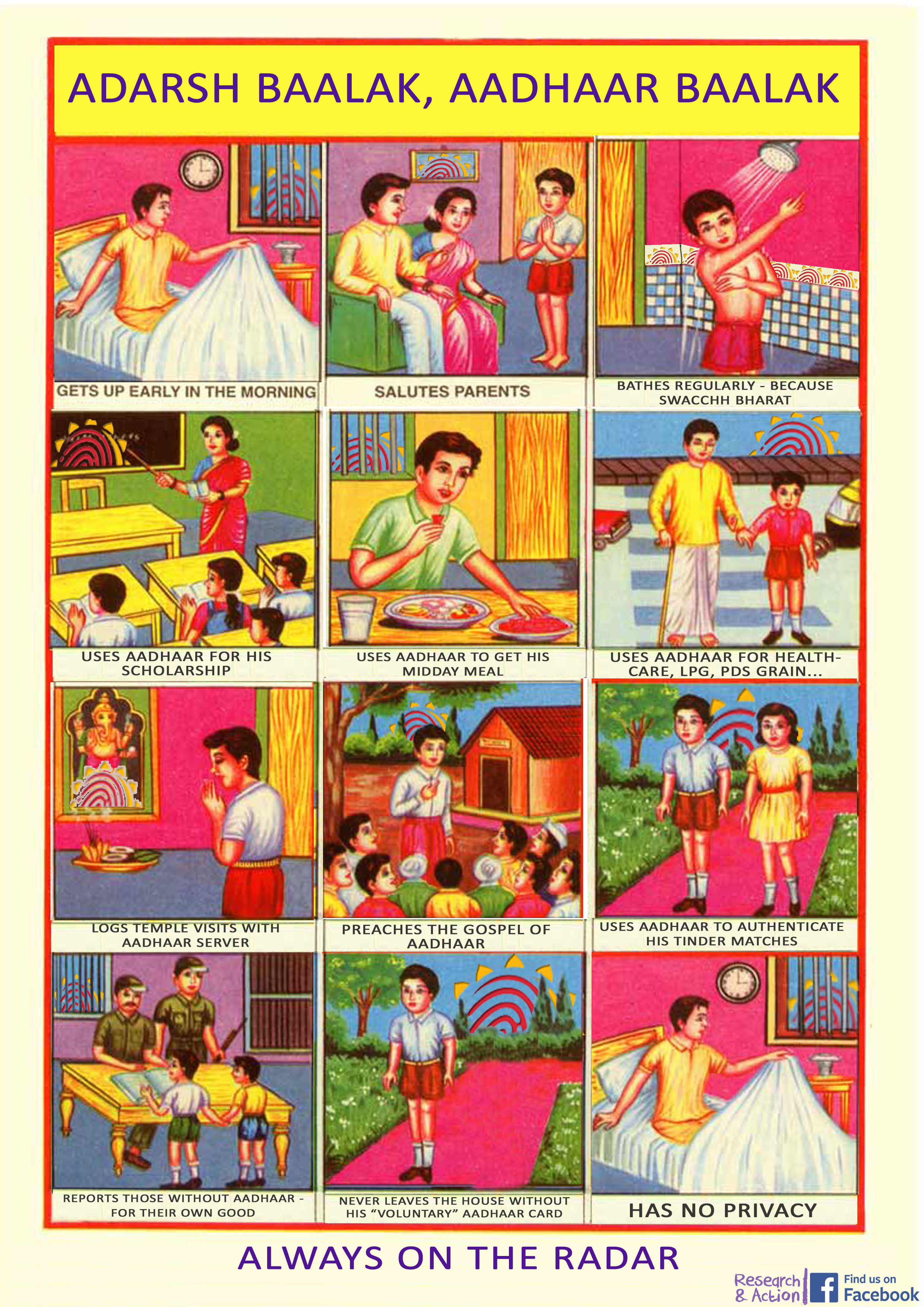 *An Ideal Boy - via Research and Action*
### Does welfare actually need Aadhaar?
## Has Aadhaar given identity to those who lacked one?
One of the claims made by UIDAI and GoI is that Aadhar has empowered people who did not have an ID by providing them one. However, these claims are bogus since Aadhaar ID has been allocated based on existing IDs themselves. To get Aadhaar, one has to submit Proof of identity and Proof of address.
**In fact, 99.97% of those who have Aadhaar, used existing identity cards and proof of address to get it.**
In response to a Right to Information application in 2015, UIDAI replied that only 0.03% of those who had got the Aadhaar number got it without showing proof of identity and address. The rest had showed two existing proofs of identity and address.
## Did the presumed lack of ID prevent access to benefits and subsidies?
One of the most appealing claims of the UIDAI project initially was to enable inclusion of the millions of Indians into various government programmes from which they are wrongly excluded. However, the UIDAI did not provide any data on how many Indian residents are without ID documents. **There is no reliable estimate of this even today**.
In a small survey of 2200 rural households in ten states in 2013, development economists Reetika Khera and Jean Dreze asked about possession of different identity cards (such as a voter ID, ration card, NREGA job card, etc.). They found between 85-95% of respondent households already had one of these IDs. Just over 80% had either a bank or post office passbook. (At that time, only around 15% had Aadhaar numbers.)
UIDAI'S reasoning that the lack of an identity document is the root cause of social exclusion is not backed by any evidence and is based on a flawed understanding of welfare programs.
*An Ideal Boy - via Research and Action*
### Does welfare actually need Aadhaar?
## Has Aadhaar given identity to those who lacked one?
One of the claims made by UIDAI and GoI is that Aadhar has empowered people who did not have an ID by providing them one. However, these claims are bogus since Aadhaar ID has been allocated based on existing IDs themselves. To get Aadhaar, one has to submit Proof of identity and Proof of address.
**In fact, 99.97% of those who have Aadhaar, used existing identity cards and proof of address to get it.**
In response to a Right to Information application in 2015, UIDAI replied that only 0.03% of those who had got the Aadhaar number got it without showing proof of identity and address. The rest had showed two existing proofs of identity and address.
## Did the presumed lack of ID prevent access to benefits and subsidies?
One of the most appealing claims of the UIDAI project initially was to enable inclusion of the millions of Indians into various government programmes from which they are wrongly excluded. However, the UIDAI did not provide any data on how many Indian residents are without ID documents. **There is no reliable estimate of this even today**.
In a small survey of 2200 rural households in ten states in 2013, development economists Reetika Khera and Jean Dreze asked about possession of different identity cards (such as a voter ID, ration card, NREGA job card, etc.). They found between 85-95% of respondent households already had one of these IDs. Just over 80% had either a bank or post office passbook. (At that time, only around 15% had Aadhaar numbers.)
UIDAI'S reasoning that the lack of an identity document is the root cause of social exclusion is not backed by any evidence and is based on a flawed understanding of welfare programs.
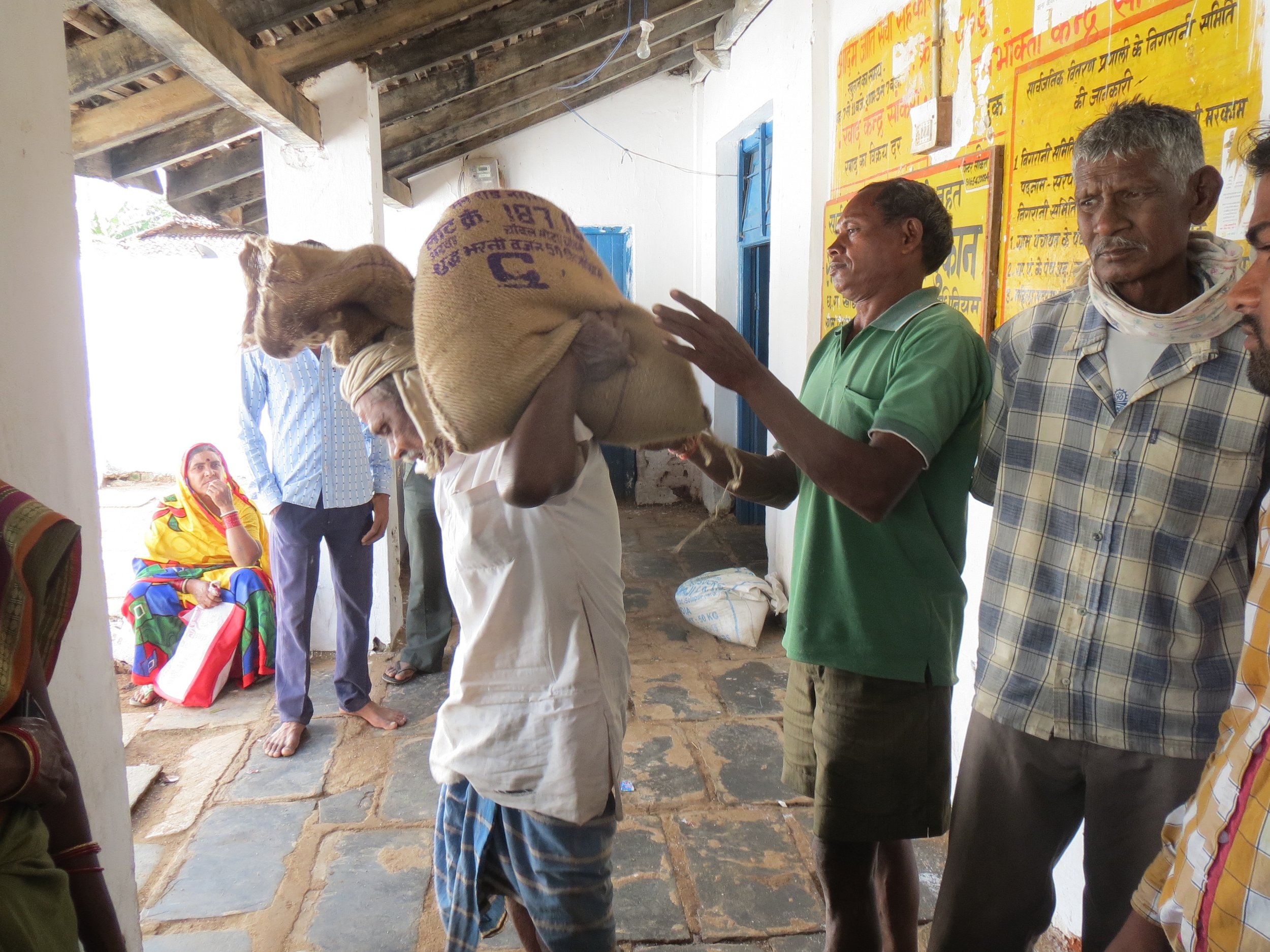 *Ram Lal, a ration card holder in Dhamtari, Chhattisgarh takes his ration of 35 kilo rice home.*
## Does having an Aadhaar make the poor eligible for welfare?
Possession of *any* ID, including an Aadhaar now, does not guarantee inclusion into any welfare program.
In fact, every welfare program has its particular eligibility criteria. For example, as per central government norms, to get national old age pension of Rs 200 a month from the central government, the elderly are required to produce proof of age of being over 60 years of age, and of belonging to a household living below the poverty line. A widow is required to show a death certificate of her husband. A widow who, say, has an Aadhaar number, but does not have her husband's death certificate will continue to be excluded from widow pension even now.
Further, even among those who did have these documents, a major source of exclusion – perhaps more than the lack of ID documents – is that the size of social welfare programmes is capped by the government. Even if a person meets the eligibility criteria and subits all the necessary ID documents, they are put on a "waiting list" instead of being included because the government may have already exhausted its target coverage or quota for that particular scheme.
The Centre's contribution per pensioner has remained a meagre Rs 200/month since 2006. For widows and disabled, this has stagnated at Rs 300. In principle, the National Social Assistance Programme or social pension is meant to cover all eligible persons in the below poverty line population, but the freezing of the central allotment has meant that even those eligible cannot get pensions. In the financial year 2015-16, social pensions benefits went to 2.3 crore individuals while the elderly in India constitute about 10 crore, making the coverage only about 25% of what it should be.
The cure, then, is to expand these schemes. What the government is doing instead is to additionally make it mandatory for them to enroll into a biometrics-based identity program to get the welfare benefits they are already eligible for.
*Ram Lal, a ration card holder in Dhamtari, Chhattisgarh takes his ration of 35 kilo rice home.*
## Does having an Aadhaar make the poor eligible for welfare?
Possession of *any* ID, including an Aadhaar now, does not guarantee inclusion into any welfare program.
In fact, every welfare program has its particular eligibility criteria. For example, as per central government norms, to get national old age pension of Rs 200 a month from the central government, the elderly are required to produce proof of age of being over 60 years of age, and of belonging to a household living below the poverty line. A widow is required to show a death certificate of her husband. A widow who, say, has an Aadhaar number, but does not have her husband's death certificate will continue to be excluded from widow pension even now.
Further, even among those who did have these documents, a major source of exclusion – perhaps more than the lack of ID documents – is that the size of social welfare programmes is capped by the government. Even if a person meets the eligibility criteria and subits all the necessary ID documents, they are put on a "waiting list" instead of being included because the government may have already exhausted its target coverage or quota for that particular scheme.
The Centre's contribution per pensioner has remained a meagre Rs 200/month since 2006. For widows and disabled, this has stagnated at Rs 300. In principle, the National Social Assistance Programme or social pension is meant to cover all eligible persons in the below poverty line population, but the freezing of the central allotment has meant that even those eligible cannot get pensions. In the financial year 2015-16, social pensions benefits went to 2.3 crore individuals while the elderly in India constitute about 10 crore, making the coverage only about 25% of what it should be.
The cure, then, is to expand these schemes. What the government is doing instead is to additionally make it mandatory for them to enroll into a biometrics-based identity program to get the welfare benefits they are already eligible for.
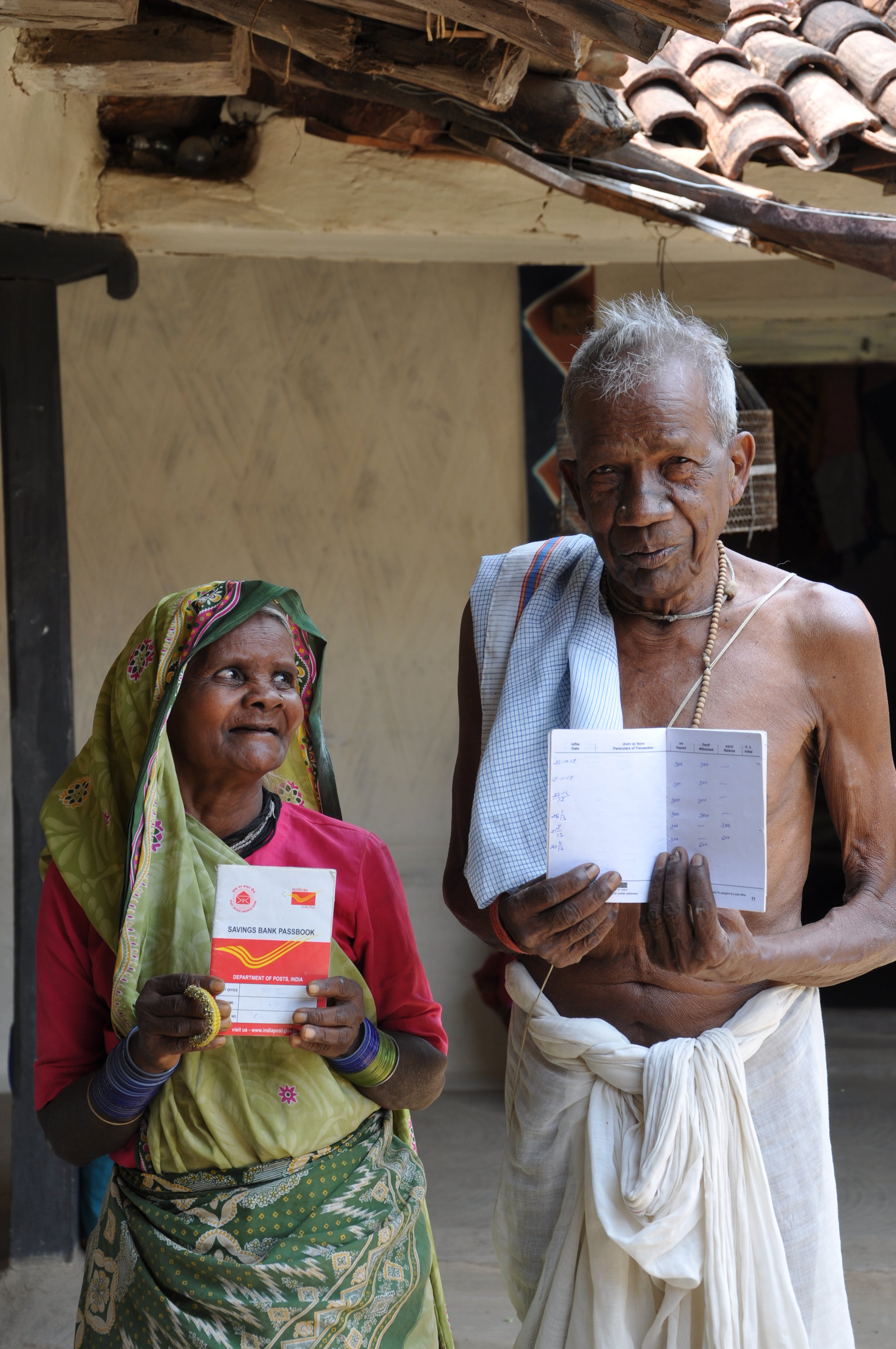 *Kunti and Surajman receive monthly pensions of Rs 300 each in Sarguja, Chhattisgarh under National Social Assistance Programme. Central government has frozen pension coverage at 25% of what it should be, and not increased its contribution of Rs 200/monthly since 2006.*
## Is Aadhaar an apt technology for welfare?
This is how the Aadhaar-based system works in welfare: To get Aadhaar, a 12-digit number, residents are required to submit biometrics and demographic information to private enrolling agencies hired by the state governments. Biometrics include the scan of all fingerprints, face, and the iris of both eyes. The demographic information includes name, date of birth, gender, residential address.
The information is then sent to the Unique Identity Authority of India's Central Information Data Repository where it is compared against every other person who has previously enrolled. This is called "de-duplication".
When the government requires Aadhaar number in a particular program, the information a resident has provided to the Programme Department (for example, rural development department in case of pensions, or food department in case of rations) along with Aadhaar number is "seeded" or matched with the information that person has provided to UIDAI. After this, every time a resident accesses the welfare program, they are authenticated based on data stored against their Aadhaar number. Under the public distribution system or rations, for instance, a ration beneficiary must place a finger on a "point of sale" machine, which uses the internet to match the individual's fingerprints against data stored on the centralised Aadhaar database. Once the beneficiary's identity is confirmed, the ration shop owner hands over the rations at the prescribed rate.
This system requires multiple fragile technologies to work at the same time: the point of sale machine, the biometrics, the Internet connection, remote servers, and often other elements such as the local mobile network. Further, it requires at least some household members to have an Aadhaar number, correctly seeded in the PDS database.
In rural India, especially in the poorest States, even in State capitals, network failures and other glitches routinely disable this sort of technology. Note that Internet dependence is inherent to Aadhaar since there is no question of downloading the biometrics.
In villages with poor connectivity, the Aadhaar-based system is beginning to *exclude* thousands of users. Biometrics have consistently failed for people who depend on manual labour for a living as their fingerprints get omitted. In Rajasthan, thousands of elderly were wrongly declared "dead", and their pension stopped because one or many of these technologies did not work well. Many of them are *still* trying to get the administration to recognise them as "living". Thousands others were wrongly excluded and denied rations in the middle of a drought earlier this year. Imposing a technology that does not work on people who depend on it for survival is a grave injustice.
*Kunti and Surajman receive monthly pensions of Rs 300 each in Sarguja, Chhattisgarh under National Social Assistance Programme. Central government has frozen pension coverage at 25% of what it should be, and not increased its contribution of Rs 200/monthly since 2006.*
## Is Aadhaar an apt technology for welfare?
This is how the Aadhaar-based system works in welfare: To get Aadhaar, a 12-digit number, residents are required to submit biometrics and demographic information to private enrolling agencies hired by the state governments. Biometrics include the scan of all fingerprints, face, and the iris of both eyes. The demographic information includes name, date of birth, gender, residential address.
The information is then sent to the Unique Identity Authority of India's Central Information Data Repository where it is compared against every other person who has previously enrolled. This is called "de-duplication".
When the government requires Aadhaar number in a particular program, the information a resident has provided to the Programme Department (for example, rural development department in case of pensions, or food department in case of rations) along with Aadhaar number is "seeded" or matched with the information that person has provided to UIDAI. After this, every time a resident accesses the welfare program, they are authenticated based on data stored against their Aadhaar number. Under the public distribution system or rations, for instance, a ration beneficiary must place a finger on a "point of sale" machine, which uses the internet to match the individual's fingerprints against data stored on the centralised Aadhaar database. Once the beneficiary's identity is confirmed, the ration shop owner hands over the rations at the prescribed rate.
This system requires multiple fragile technologies to work at the same time: the point of sale machine, the biometrics, the Internet connection, remote servers, and often other elements such as the local mobile network. Further, it requires at least some household members to have an Aadhaar number, correctly seeded in the PDS database.
In rural India, especially in the poorest States, even in State capitals, network failures and other glitches routinely disable this sort of technology. Note that Internet dependence is inherent to Aadhaar since there is no question of downloading the biometrics.
In villages with poor connectivity, the Aadhaar-based system is beginning to *exclude* thousands of users. Biometrics have consistently failed for people who depend on manual labour for a living as their fingerprints get omitted. In Rajasthan, thousands of elderly were wrongly declared "dead", and their pension stopped because one or many of these technologies did not work well. Many of them are *still* trying to get the administration to recognise them as "living". Thousands others were wrongly excluded and denied rations in the middle of a drought earlier this year. Imposing a technology that does not work on people who depend on it for survival is a grave injustice.
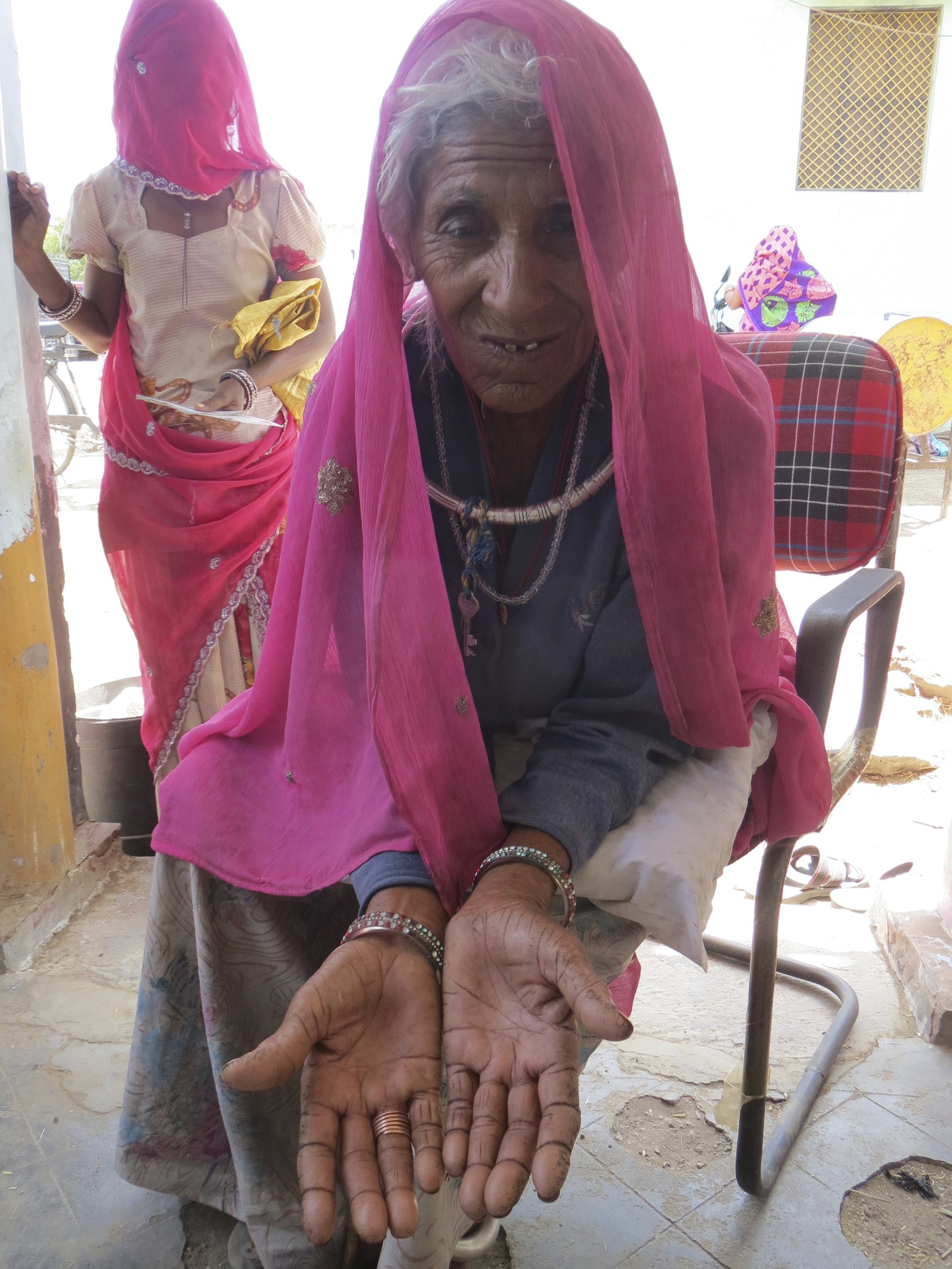 *Hanja Devi, a ration card holder in Daulatpura in Ajmer, Rajasthan had made three trips that month to the ration shop in an effort to get her fingrprints authenticated in Aadhaar. Her fingerprints mismatch repeatedly.*
## Is Aadhaar necessary to do Direct Benefit Transfers?
**Is Aadhaar is necessary to do Direct Benefit Transfers – subsidies given directly to people through their bank accounts -- and will lack of Aadhaar mean lakhs of beneficiaries who are already on it will face severe problems, with their wages, pensions payments adversely affected?**
On October 15, 2015, during the Supreme Court on Aadhaar, the government claimed that Aadhaar is used to provide wages to 1 crore workers under the national rural employment guarantee scheme and to reach 30 lakh pensioners.
Disrupting this system now by limiting it to voluntary use, the government claimed, will disrupt payments to a large section of the population. It requested the court to instead permit it to make Aadhaar mandatory in 80 social schemes.
But Direct Benefit Transfers – subsidies given directly to people through their bank accounts – was at that time mostly being carried out through the National Electronic Funds Transfer(NEFT), not through Aadhaar. Even now, Direct Benefit Transfer do not need Aadhaar, they can be done through NEFT very successfully.
In March 2015, 98.3% of MNREGA workers received wages through simple NEFT bank transfers. Only 1.6% of wages were paid through the Aadhaar Payment Bridge System, and 0.1% through another system, called the Public Financial Management System, which again doesn't require Aadhaar.
For social pensions, the government had made 92.6% of Direct Benefits Transfers through NEFT, and only 5.2% through the Aadhaar Payment Bridge System and it can continue to pay pensions directly into bank accounts without Aadhaar.
## Does Aadhaar save time and improve efficiency?
Many people are being deprived of their food rations because they have no Aadhaar number; or because their Aadhaar number has not been correctly "seeded"; or because their biometrics do not work, or simply because the "point of sale" machine returns various error messages.
Even those for whom the system works face huge inconvenience. Often they have to make repeated trips to the ration shop, or send different members in turn, until the machine cooperates. Sometimes schoolchildren are asked to skip classes and try their luck at the ration shop. This unreliable system causes a colossal waste of time for everyone.
Despite this, the Central government continues to push for compulsory Aadhaar-based biometric authentication in ration system in violation of Supreme Court orders. The court did allow the use of Aadhaar in the public distribution, but not making it compulsory for users. Nor can the government invoke the Aadhaar Act to justify this move: the relevant sections of the Act are yet to be notified.
*Hanja Devi, a ration card holder in Daulatpura in Ajmer, Rajasthan had made three trips that month to the ration shop in an effort to get her fingrprints authenticated in Aadhaar. Her fingerprints mismatch repeatedly.*
## Is Aadhaar necessary to do Direct Benefit Transfers?
**Is Aadhaar is necessary to do Direct Benefit Transfers – subsidies given directly to people through their bank accounts -- and will lack of Aadhaar mean lakhs of beneficiaries who are already on it will face severe problems, with their wages, pensions payments adversely affected?**
On October 15, 2015, during the Supreme Court on Aadhaar, the government claimed that Aadhaar is used to provide wages to 1 crore workers under the national rural employment guarantee scheme and to reach 30 lakh pensioners.
Disrupting this system now by limiting it to voluntary use, the government claimed, will disrupt payments to a large section of the population. It requested the court to instead permit it to make Aadhaar mandatory in 80 social schemes.
But Direct Benefit Transfers – subsidies given directly to people through their bank accounts – was at that time mostly being carried out through the National Electronic Funds Transfer(NEFT), not through Aadhaar. Even now, Direct Benefit Transfer do not need Aadhaar, they can be done through NEFT very successfully.
In March 2015, 98.3% of MNREGA workers received wages through simple NEFT bank transfers. Only 1.6% of wages were paid through the Aadhaar Payment Bridge System, and 0.1% through another system, called the Public Financial Management System, which again doesn't require Aadhaar.
For social pensions, the government had made 92.6% of Direct Benefits Transfers through NEFT, and only 5.2% through the Aadhaar Payment Bridge System and it can continue to pay pensions directly into bank accounts without Aadhaar.
## Does Aadhaar save time and improve efficiency?
Many people are being deprived of their food rations because they have no Aadhaar number; or because their Aadhaar number has not been correctly "seeded"; or because their biometrics do not work, or simply because the "point of sale" machine returns various error messages.
Even those for whom the system works face huge inconvenience. Often they have to make repeated trips to the ration shop, or send different members in turn, until the machine cooperates. Sometimes schoolchildren are asked to skip classes and try their luck at the ration shop. This unreliable system causes a colossal waste of time for everyone.
Despite this, the Central government continues to push for compulsory Aadhaar-based biometric authentication in ration system in violation of Supreme Court orders. The court did allow the use of Aadhaar in the public distribution, but not making it compulsory for users. Nor can the government invoke the Aadhaar Act to justify this move: the relevant sections of the Act are yet to be notified.
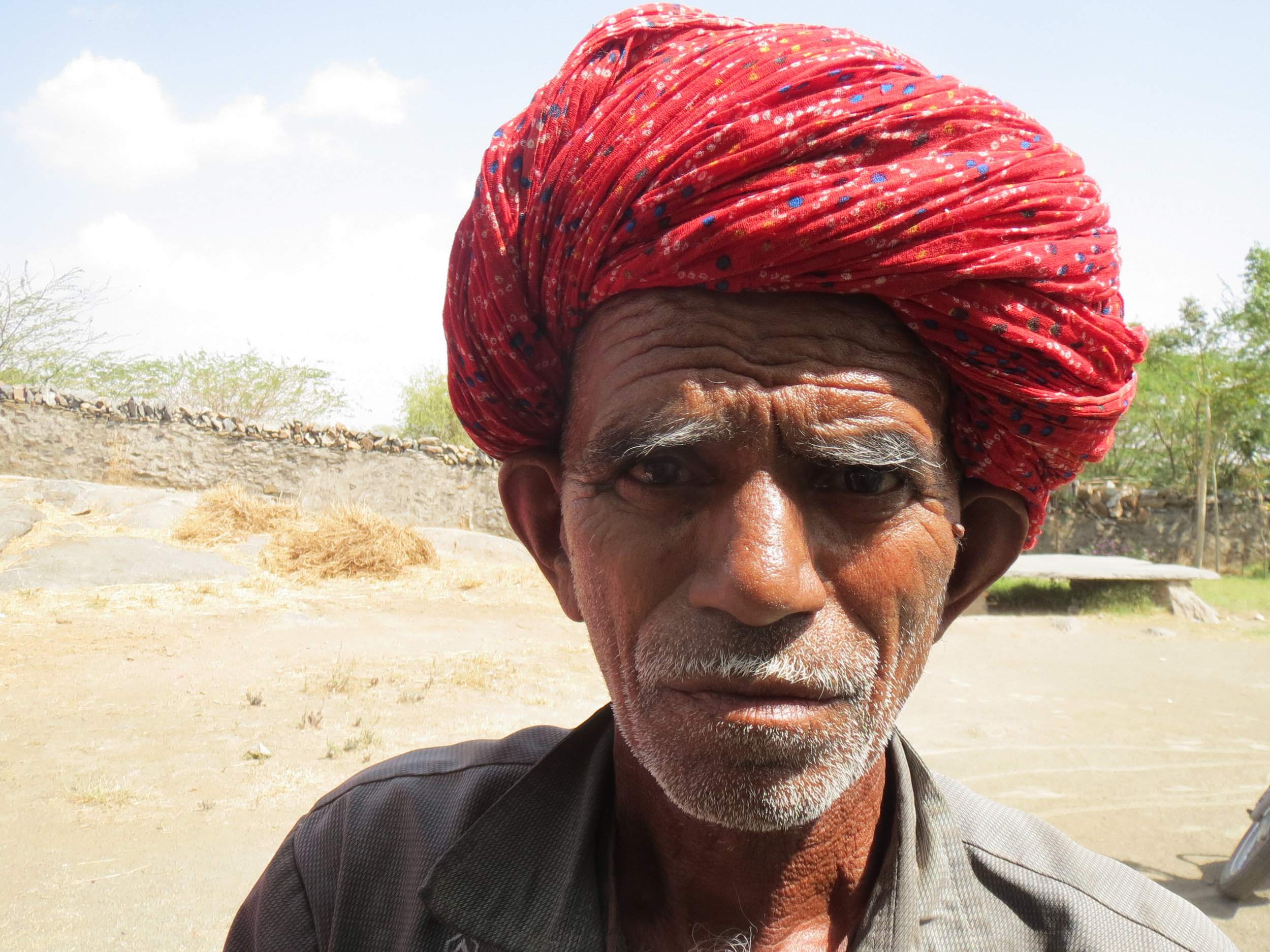 *Anada Singh, in Daulatpura, Ajmer, whose Aadhaar authentication does not work reliably.*
## Does Aadhaar reduce corruption?
It is not clear to what extent as government does not publish disaggregated data on this even in case of ration system. In several instances, the new system has created more confusion and corruption. Since December 2015, the Government of Rajasthan has tried hard to enforce the system. The use of "point of sale" machines is compulsory and every ration shop has one. Yet, according to official data compiled by the Mazdoor Kisan Shakti Sangathan, only 61 per cent of Rajasthan's foodgrain allocation found its way through the point of sale system in July 2016, with a similar figure (63 per cent) for August.
The rest is either siphoned off or delivered using the old "register" system — which of the two is hard to say since utter confusion prevails about the permissibility of using registers as a fallback option.
In Jharkhand, after the Aadhaar-based point of sale system was made compulsory, in July 2016, ration cardholders in Ranchi district received less than half of their foodgrain entitlements through that system, according to the state website. The situation was much the same in August.
A "dual system", where food grains go partly through the point of sale system and partly through the fallback register system, is the worst. Because only dealers know whether and when the manual register system is permissible, and they have no incentive to share that information with the cardholders.
Further, continuing with the ration example, the Aadhaar system fails to check "quantity fraud": ration dealers often give people less than what they are entitled to, and pocket the rest. Point of sale machines are ineffective in preventing this.
Yet, Aadhaar is proceeding like a juggernaut, without paying serious attention to the collateral damage to welfare systems. Instead, the Central government peddles bogus figures of Aadhaar-enabled financial savings to justify further imposition of Aadhaar technology.
*Anada Singh, in Daulatpura, Ajmer, whose Aadhaar authentication does not work reliably.*
## Does Aadhaar reduce corruption?
It is not clear to what extent as government does not publish disaggregated data on this even in case of ration system. In several instances, the new system has created more confusion and corruption. Since December 2015, the Government of Rajasthan has tried hard to enforce the system. The use of "point of sale" machines is compulsory and every ration shop has one. Yet, according to official data compiled by the Mazdoor Kisan Shakti Sangathan, only 61 per cent of Rajasthan's foodgrain allocation found its way through the point of sale system in July 2016, with a similar figure (63 per cent) for August.
The rest is either siphoned off or delivered using the old "register" system — which of the two is hard to say since utter confusion prevails about the permissibility of using registers as a fallback option.
In Jharkhand, after the Aadhaar-based point of sale system was made compulsory, in July 2016, ration cardholders in Ranchi district received less than half of their foodgrain entitlements through that system, according to the state website. The situation was much the same in August.
A "dual system", where food grains go partly through the point of sale system and partly through the fallback register system, is the worst. Because only dealers know whether and when the manual register system is permissible, and they have no incentive to share that information with the cardholders.
Further, continuing with the ration example, the Aadhaar system fails to check "quantity fraud": ration dealers often give people less than what they are entitled to, and pocket the rest. Point of sale machines are ineffective in preventing this.
Yet, Aadhaar is proceeding like a juggernaut, without paying serious attention to the collateral damage to welfare systems. Instead, the Central government peddles bogus figures of Aadhaar-enabled financial savings to justify further imposition of Aadhaar technology.
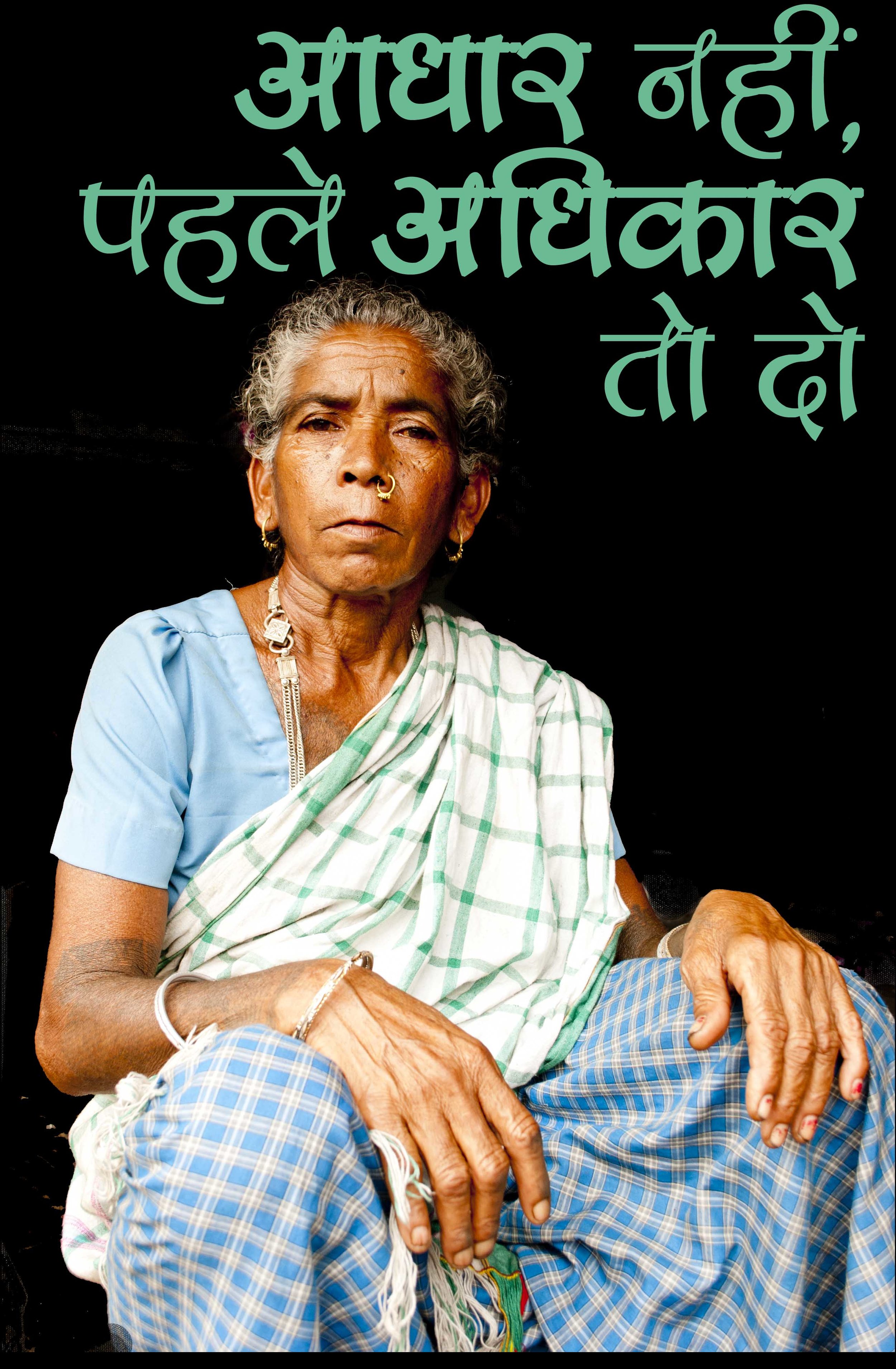 *via. Research and Action*
### Has anyone actually died because of Aadhaar?
Yes, and this is not a rhetorical claim. The Right to Food Campaign and independent reporters have documented dozens of starvation deaths tied directly to Aadhaar. The first was Santoshi Kumari, an eleven‑year‑old in Jharkhand, in September 2017, after her family's ration card was cancelled for not being seeded with Aadhaar.
The pattern is recognisable across cases: a fingerprint that no longer reads on the Point of Sale machine, a name spelt slightly differently between the ration card and the Aadhaar database, a server outage at the dealer's shop, a card de‑duplicated and cancelled without notice. Each of these is, in policy language, a "technical failure". For the household at the receiving end, it is the loss of a month's grain, and repeatedly, of a life.
We have collected names, dates and circumstances on our [testimonials page](/testimonials). The underlying reports, including the Right to Food Campaign's investigations, are catalogued in our [resources](/resources). These deaths are not historical; the most recent cases are from this year.
### Isn't Aadhaar just like the US Social Security Number?
Social Security Number (SSN), the nine-digit number, which is used widely by government agencies in the US, is often used as an example of an advance economy successfully doing something similar to India's unique identity project. But there are important differences between the two, starting with the fact that the Social Security Number is, well, not an identity number.
## Aadhaar is an identification number. Social Security Number is not.
The Social Security Number has its origins in the years of the Great Depression. During this period of economic recession in the US, the Roosevelt government launched the "New Deal", a series of programmes to provide relief and employment to the poor.
In 1936, under the Social Security Act, it began using a nine-digit number, the Social Security Number, to track the earnings of workers and compute the amount of social security benefits to be credited to their accounts.
Over the years, the ease of using the number led more government agencies to incorporate it in their records. In 1961, for instance, the Internal Revenue Service began using the Social Security Number for taxpayer identification, similar to the Permanent Account Number in India.
With no legal restrictions on use of the Social Security Number by private companies, several businesses such as credit bureaus started asking individuals for their Social Security Number and storing it.
But in 1977, the Carter administration clarified that while it may used to be verify whether an individual had the legal permit to work, the Social Security Number could not serve as an identification document.
The Social Security Administration website states in a 2009 bulletin: "The card was never intended to serve as a personal identification document – that is, it does not establish that the person presenting the card is actually the person whose name and SSN appear on the card."
By contrast, Aadhaar has been designed as a single, universal, digital identity number that any registered entity, whether public or private, can use to "authenticate" an Indian resident. Anyone who has lived in India for 182 days can enroll in Aadhaar for proof of identity, while only citizens and those authorised to work in the US can obtain a Social Security Number.
## Aadhaar captures biometrics. The Social Security Number does not.
Aadhaar collects biometrics, which include the scan of all fingerprints, face and the iris of both eyes. Aadhaar Act's section 2(g) states that "other biological attributes" may be collected in the future, a provision that was intensely debated in Parliament.
In contrast, when the Social Security Number was created in the 1930s, the US government decided not to collect fingerprints. "The use of fingerprints was associated in the public mind with criminal activity, making this approach undesirable," notes the Social Security Administration website. The Social Security Number is thus printed on a small paper card and does not carry even a photograph.
In recent years too, the Social Security Administration has restrained from collecting biometrics of residents. In 2007, when the Intelligence Reform and Terrorism Prevention Act asked the SSA to improve the security of Social Security Number cards, the SSA considered adding the holder's photograph or biometrics to the card but eventually decided against it.
"A biometric identifier, such as a fingerprint, can be an effective and highly accurate way to establish the identity of an individual, but it can also facilitate a much higher degree of tracking and profiling than would be appropriate for many transactions," said Marc Rotenberg, the president of Electronic Privacy Information Center, a research organisation, in a testimony to the House of Representatives.
He added: "The problems that will arise when biometric identifiers are compromised are severe. What will happen at the point that your biometric identifiers no longer identify you?"
Around 2011, American authorities considered introducing a new biometrics-linked identity card for work authorisation for residents. Called the Biometric Enrollment, Locally-stored Information, and Electronic Verification of Employment or BELIEVE card, it aimed capture fingerprints or scans of veins on the back of hands.
BELIEVE card supporters presented it as necessary for immigration reform but many opposed it. "We pointed out that a biometrics ID system would be expensive, intrusive and ineffective, and requiring such an ID card would fundamentally transform the information demands the US government places on its citizens," said Michael Froomkin, a professor of law at Miami University.
Ultimately, the proposal was dropped.
(First appeared in [Scroll.in](https://scroll.in/) on December 20, 2016.)
### Didn't the Supreme Court already settle the Aadhaar question?
The 2018 Constitution Bench judgment in *Justice K. S. Puttaswamy v. Union of India* did not give Aadhaar a clean bill of health. It struck down Section 57 of the Aadhaar Act, meaning private companies cannot demand Aadhaar, and held that Aadhaar may only be required for benefits and subsidies funded out of the Consolidated Fund of India. It also barred mandatory Aadhaar for school admission, board exams, mobile connections and bank accounts.
In practice, those limits have been worked around. Aadhaar continues to be demanded, formally or informally, for school enrolment, for new SIM cards, for opening accounts, for receiving scholarships and pensions, and now for [a growing range of welfare and identity systems](/take-action). The court's narrowing has been treated by the executive as an inconvenience to route around, not a constitutional ceiling to respect.
The judgment is also internally divided. The majority accepted Aadhaar's "minimal" architecture. Justice D. Y. Chandrachud's dissent, which we view as the more accurate reading, found the entire scheme unconstitutional for the harms it inflicts on welfare entitlements and the surveillance architecture it enables. For the legal background, see the primers in our [resources](/resources).
### What is India Stack?
"India Stack" is the umbrella term that the IT industry, through **iSPIRT** and allied actors, uses to brand the bundle of state systems built on top of Aadhaar from around 2012 onwards. The pieces include Aadhaar identity and Aadhaar‑based biometric authentication (ABBA), the UPI and Aadhaar‑enabled payment rails (AePS), e‑KYC, eSign, DigiLocker, the Account Aggregator framework, FASTag (mandatory by law), the Ayushman Bharat Digital Mission, ONDC and a growing list of "Digital Public Infrastructure" (DPI) layers in welfare, health, education and commerce.
We view Aadhaar, and therefore India Stack, as a failed and objectionable model that should not be replicated in other countries. The case is set out in full in our Campaign 2025 statement; in short:
- **A centralised database of biometrics and demographics** is a dangerous tool of social control, especially in the hands of an authoritarian government.
- **The coercive "seeding"** of Aadhaar into ration cards, job cards, pension lists, bank accounts and voter rolls magnifies the danger of profiling, surveillance and exclusion. It has produced real harm to lakhs of people, including [Aadhaar‑linked starvation deaths](/testimonials).
- **Biometric failures and database errors** are a permanent source of exclusion: for the elderly, for manual workers whose fingerprints have worn smooth, and for marginalised people who never received a working Aadhaar in the first place.
- **Aadhaar has been a law unto itself**, rolled out without any legal backing, passed through Parliament by bypassing the Upper House, and routinely defying Supreme Court orders.
What is being exported under the brand "India Stack" is this same architecture, dressed up in the language of "open public infrastructure". We urge the greatest caution from countries considering its replication, for the same reasons we resist its use here.
→ Read our full statement: [**Beware of Aadhaar — A Warning on India's Biometric Identity Model**](/campaign2025) (Campaign 2025, released on Human Rights Day, 10 December 2025).
→ Further reading on the architectural critique: [**India Stack Watch**](https://indiastack.in/) — a structured framework (Five Tests, Evidence, Components, Framework) examining India Stack as Digital Public Infrastructure. CC0; fork-able.
### Can I just opt out of Aadhaar?
There is no statutory route to delete an existing Aadhaar number, and the UIDAI has built no functioning opt‑out mechanism. A child enrolled before turning five can technically be opted out at majority, but in practice the request is rarely entertained. For everyone else, the realistic question is not "how do I delete it" but "where do I refuse to use it, and how do I help others who are being shut out."
Refusal still matters. Every fresh demand for Aadhaar, at a school, a bank, a hospital, a service counter, is a place to push back, cite the Supreme Court's limits in *Puttaswamy* (2018), and ask for the alternative documents that the law continues to recognise. Documenting refusals, denials and exclusions, and making that documentation public, is itself part of the campaign.
The most useful thing most people can do is collective, not individual: sign on, write to MPs, support people who have been excluded from rations or pensions, and amplify the documented harms. Concrete steps are listed on our [Take action](/take-action) page.
## Updates
### 1 Jun 2026 — Newsletter: Invasive Technologies, Human Costs
> Newsletter | January - May, 2026
Technology in the first half of 2026 has grown more invasive across nearly every domain, and with it, new forms of exclusion have emerged. This newsletter gathers recent developments, ground reporting, and analyses that illuminate what unfolds behind the headlines: biometric surveillance and facial recognition, the reshaping of labour by AI, and the legal battles now catching up to both. As always, please pass these readings along to your networks.
**Newsletter | January - May, 2026**
*Technology in the first half of 2026 has grown more invasive across nearly every domain, and with it, new forms of exclusion have emerged. This newsletter gathers recent developments, ground reporting, and analyses that illuminate what unfolds behind the headlines: biometric surveillance and facial recognition, the reshaping of labour by AI, and the legal battles now catching up to both. As always, please pass these readings along to your networks.*\
\
Two important legal developments recognising our rights:
* **Odisha High Court says [APAAR ID is not mandatory for students](https://www.thehindu.com/news/national/odisha/orissa-hc-asks-centre-to-allow-opt-out-option-in-apaar-id-consent-forms/article70392054.ece):** A parent from Odisha challenged the lack of an opt-out clause or the option to refuse consent in the form requesting parents’ consent to create an APAAR ID. The model consent form further states that the information gathered through the APAAR framework will be shared with other entities. The Odisha High Court has directed the State Government to consider amending the form to include an option to opt out or refuse consent. For more, please see our previous explainer on Apaar ID [here.](https://rethinkaadhaar.in/blog/2025-10-28-re-post-apaar-id-raises-concerns-worsening-exclusion/)
* **Bombay High Court intervenes on Aadhaar updation roadblocks:** The Bombay High Court issued significant **[directions to UIDAI about how to deal with complaints of technical or biometric issues with a person’s Aadhaar](https://indianexpress.com/article/legal-news/bombay-high-court-uidai-aadhaar-biometric-mismatch-guidelines-twin-brothers-10680096/)**, specifically directing that UIDAI must “adopt a fair, humane and citizen-centric approach while dealing with cases involving students, senior citizens, persons with disabilities, economically weaker sections and other genuine residents facing technological or biometric difficulties.” The High Court noted that people cannot be left in “indefinite administrative limbo.”
* The Court was dealing with a common problem: two brothers from Pune who had been enrolled for Aadhaar as minors sought to update their biometrics upon turning 18 in 2022, but instead faced the familiar bureaucratic nightmare that has come to characterise the process. They were forced to make several applications, personally visit the Regional Office in Bombay twice, told that the rules had changed after they duly followed the procedure, and got no responses from UIDAI – leaving them effectively without any remedy over **three years**. Their higher education hung in the balance as colleges refused to confirm their admission without Aadhaar.
* The High Court held that (i) whenever a person approaches UIDAI with a grievance about their Aadhaar records, UIDAI must give them a written status update of the record and the correct remedy; (ii) “genuine applicants” should not have to visit the offices repeatedly and should get proper updates about their application; (iii) A permissible fresh enrolment must be facilitated and cannot be rejected merely on the ground that an earlier Aadhaar number was suspended or cancelled; (iv) UIDAI must try to process requests for updation, correction, etc. **within four weeks** from the application. These directions should be implemented in the right spirit by all UIDAI officials to make the system “citizen-centric”. The full Bombay High Court judgment dated 6 May, 2026 is available [here](https://www.livelaw.in/pdf_upload/2026/05/08/rohit-bandu-nikalje-vs-the-regional-officer-uidai-672694.pdf).
## However, Aadhaar coercion for everything remains the goal for the government
* The government’s new Aadhaar app which would enable private companies to access people’s data even more than they already do, without any corresponding increase in safety of the database or remedies for breach or misuse. [Rethink Aadhaar voiced concerns to TechCrunch in this piece](https://techcrunch.com/2026/02/09/india-makes-aadhaar-more-ubiquitous-but-critics-say-privacy-concerns-remain/). Fortunately, the government’s proposal that the app should be pre-installed on every mobile phone – a blanket non-consensual invasion of privacy – was [rejected](https://www.medianama.com/2026/04/223-aadhaar-app-preinstall-proposal-dropped/).
* **Karnataka proposes Aadhaar for social media:** The draft policy for Responsible Digital Use Among Students proposes [linking social media accounts to Aadhaar](https://www.thenewsminute.com/karnataka/karnatakas-draft-digital-use-for-students-policy-calls-for-aadhar-enabled-sign-up) to ensure age, authenticity and restrict fake or multiple accounts, and has been criticised for the serious invasion of [privacy and surveillance](https://www.thenewsminute.com/karnataka/karnatakas-draft-digital-use-for-students-policy-calls-for-aadhar-enabled-sign-up).
* In a rare instance of institutional pushback, the [Parliamentary Standing Panel on Rural Development and Panchayati Raj](https://m.economictimes.com/news/india/make-aadhaar-based-payment-system-optional-under-mgnregs-parliamentary-panel/articleshow/129853760.cms) has recommended making the Aadhaar-Based Payment System [optional for wage transfers](https://www.business-standard.com/india-news/too-early-for-mandatory-aadhaar-based-payment-system-in-mgnregs-parl-panel-124121700992_1.html) under MGNREGA and shifting to other alternatives because of low biometric authentication success in remote areas and for the elderly. Read more about how MGNREGA was systematically dismantled [here](https://thewire.in/government/restrict-dismantle-repeal-how-modi-government-killed-mgnrega-before-vb-g-ram-g-was-tabled).
## Listen
* [Nikhil Dey](https://ainowinstitute.org/publications/accountability) explains the drawbacks of framing accountability as a technocratic process where people are merely treated as data points. He describes how real accountability can be achieved by publicising important information as was done by the Right to Information campaign led by peasants and workers with MKSS.
* Mila Samdub, Astha Kapoor, and Usha Ramanathan [discuss the origins of Aadhaar](https://www.themaybe.org/podcast/the-vaporstate-id-in-india), how it has largely shaped India’s digital public infrastructure and the political implications of this digital IT system.
## Digital identity verification continues to hurt basic human rights
* Aadhaar enrolment is still impossible for many:
* A report on the [hurdles to enrolment in Adivasi areas](https://thewire.in/rights/why-aadhaars-missing-middle-is-causing-an-identity-crisis-in-indias-adivasi-areas) shows how the system still ignores and neglects the most vulnerable citizens.
* Reports of people braving [brutal heat for Aadhaar corrections](https://www.tribuneindia.com/news/amritsar/applicants-at-aadhaar-centre-rue-lack-of-facilities/) in Amritsar, and skipping [work and school for days in Uttarakhand](https://timesofindia.indiatimes.com/city/dehradun/long-queues-delays-in-aadhaar-updation-leaving-people-frustrated/articleshow/126587449.cms), reinforces the need to make the rectification and updating process citizen-centric.
* **More evidence on how the NMMS app for rural employment attendance hurts workers instead of stopping corruption:**
* A report on the working of the National Mobile Monitoring System (NMMS) shows how it has [exacerbated the conditions that workers have to meet](https://thewire.in/labour/nmms-didnt-end-corruption-in-mgnrega-it-changed-its-shape-and-locked-workers-out): “For five hours, around 30 workers stood at a worksite in Raichur district of Karnataka, waiting – not for work, but for their attendance to be recorded. Despite repeated attempts, only one worker’s attendance was successfully captured over nearly 45 minutes. Many eventually left without having their presence recorded.”
* In an absurd story from Telangana, a MGNREGA worker from Komatipalli village stood next to a female co-worker and covered his head using her hair when [the NMMS attendance app failed to recognize his face](https://x.com/revathitweets/status/2060237141247242456?s=20) because he had tonsured his head.
* Persons with Disabilities (PWDs) face aggravated burdens: A comprehensive [report](https://theprint.in/ground-reports/verification-disabled-udid-system/2922267/) in The Print details how the Unique Disability ID (UDID) project, which has been mandatory since 2024 for PWDs to access disability schemes, has in fact aggravated the burden of proving disability. Applicants are now forced to go through numerous layers of verification, documentation and medical assessment to acquire the UDID card. Despite being a system created for PWDs, the intended beneficiaries continue to face stigma, unawareness, and inefficient bureaucracy.
* **Fact-finding report confirms KYC dehumanization:** After Jitu Munda carried the skeletal remains of his sister to a bank in the Keonjhar district of Odisha, a few publications finally highlighted the bureaucratic neglect and state apathy that many from marginalized communities continue to face. (*[The New Indian Express](https://www.newindianexpress.com/editorial/2026/May/03/jitu-munda-case-shows-how-customers-become-data-for-modern-banks), [The Indian Express](https://indianexpress.com/article/opinion/columns/jitu-munda-odisha-bank-sister-kalara-munda-skeleton-bureaucracy-10666007/), [Down to Earth](https://www.downtoearth.org.in/governance/institutional-neglect-pushed-odisha-man-to-carry-sisters-remains-to-bank-says-fact-finding-team), [The Hindu](https://www.thehindu.com/news/national/odisha/tribal-man-from-odisha-throws-community-feast-under-threat-of-social-boycott/article70947468.ece))*.
* A [fact-finding report](https://drive.google.com/file/d/1piF5J8fwrcYl1p-VVK1wpoN8t13XD2Uj/view) and [press statement ](https://rethinkaadhaar.in/blog/2026-05-14-fact-finding-jitu-munda-faced-systemic-neglect-for-weeks/)released by the Right to Food Campaign and Rethink Aadhaar revealed that in the absence of a biometrics-linked Aadhaar ID, he was denied a ration card and old-age pension. A four-member team visited Dianali village to document a prolonged chain of institutional neglect and how Kalra Munda, Jitu’s sister, had been denied her own funds even during the last few weeks of her illness. The Right to Food Campaign has since urged the Cooperation Department and the Odisha Gramin Bank to[ issue a standard operating procedure](https://www.newindianexpress.com/cities/bhubaneswar/2026/May/15/right-to-food-campaign-seeks-sop-for-rural-banks-after-odisha-tribal-mans-proof-of-death-protest) (SOP) for rural branches, including doorstep banking, simplifying nomination procedures, and ensuring humane handling of legal heir claims.
* In a disturbing incident and recurring pattern of denial of right to life, last week Hindi national daily Dainik Bhaskar reported that Ranveer Singh, an elderly man, died after denial of treatment at the Chakri Dadri hospital in Haryana. He was advised to get a CT scan but the hospital staff told him no scan could be done unless he produced his Aadhaar, and he passed away struggling on the hospital floor. Report in Hindi below:

The hospital civil surgeon Narendra Kumar has since [contested](https://www.etvbharat.com/hi/state/elderly-man-dies-at-charkhi-dadri-civil-hospital-for-not-having-aadhaar-card-cmo-clarifies-hrs26052304522) the allegations and stated that the elderly man had died of cardiac arrest while waiting and de-linked his death from not being able to prove identification.
* **Biometric verification at mandis causing unnecessary distress for farmers:** Farmers in Haryana have been protesting a new rule requiring [Aadhaar-based biometric verification at *mandis* before selling their crops](https://indianexpress.com/article/explained/haryana-biometric-crop-sale-rule-protests-10633794/). With each crop arrival, the farmer’s fingerprint must match with data previously collected and stored on a farm portal, [creating barriers in procurement due to mismatches](https://indianexpress.com/article/cities/chandigarh/haryana-farmers-mock-new-procurement-rules-10628819/). Additionally, the entire mandi area - including procurement centres and warehouses - is geofenced, meaning that there is a virtual perimeter within which the Government is monitoring crop and vehicle movement. Tractors are photographed and their vehicle numbers recorded, and only registered tractors are permitted to enter, preventing older vehicles from entering.
* This technological process is a hugely disproportionate response to a 2025 scam in which gate passes were issued to tractors not carrying any crops due to collusion with officials: “Samyukta Kisan Morcha (SKM) leader Suresh Koth from Hisar [said](https://indianexpress.com/article/cities/chandigarh/haryana-farmers-mock-new-procurement-rules-10628819/), “How many times do we have to prove we are genuine farmers? First, we register on the Meri Fasal-Mera Byora portal, then we wait for our turn in the mandi, and once there, we face biometric checks, tractor photos, and endless questions. This has become a Mahabharat for us.”
* **Birth certificate barrier to Aadhaar for tribal children:** 166 tribal children in Chamarajanagar district, Karnataka were [unable to enrol for Aadhaar](https://timesofindia.indiatimes.com/city/mysuru/166-tribal-children-miss-aadhaar-due-to-lack-of-birth-certificates/articleshow/130425148.cms) because they lacked birth certificates. Earlier, most births took place in hamlets, leaving no official records of dates of birth. Since Aadhaar is now mandatory to gain access to welfare, students are unable to access educational and other important state support programmes.
* **Facial recognition blocks essential access to maternity healthcare:** Embedding AI-powered facial recognition into the [Integrated Child Development Services (ICDS) is risking the health of pregnant women](https://www.boomlive.in/decode/ai-facial-recognition-is-denying-food-to-pregnant-women-across-india-30878), lactating mothers, and young children by cutting them off from supplementary nutrition.
* Anumeha Yadav on the [human cost of imposing AI-based facial recognition tools](https://thewire.in/rights/no-match-rajasthans-push-for-facial-authentication-on-pensioners-leaves-many-behind) on the elderly, with data on authentication attempts in Rajasthan.
* An overview of how the digital welfare system is resulting in [life-altering exclusions](https://idronline.org/article/rights/indias-digital-welfare-system-is-quietly-eroding-peoples-basic-rights/) by prioritising administrative control over constitutional guarantees of access and dignity.
* **Zero record-keeping, zero accountability: Despite these documented instances of suffering, the Government refuses to even acknowledge the failure of authentication and denial of access. In response to [two](https://sansad.in/getFile/annex/270/AU1154_MLgUOq.pdf?source=pqars) [questions](https://sansad.in/getFile/annex/270/AU1159_ZCJRbI.pdf?source=pqars) in the Rajya Sabha’s Budget Session 2026, the Government repeated that it does not have any “State-wise reports of denial of foodgrains to entitled beneficiaries” due to Aadhaar based eKYC, biometric authentication failure, server downtime, or other digital verification issues.**
## Over-digitisation in education without safeguards and accountability causes large-scale failures
Recent examples highlight the problems with rushed, large-scale digitisation without any offline options or human intervention:
* The 2026 [CBSE class 12 exams](https://indianexpress.com/article/explained/cbse-on-screen-marking-system-student-concerns-10707263/) have been discredited after it was discovered that the digital system of scanning answer sheets and using software to calculate marks has resulted in serious inaccuracies due to mismatched answer sheets, unevaluated supplementary sheets, and blurry scans. Student researchers have found [multiple vulnerabilities in the portal](https://www.newslaundry.com/amp/story/2026%2F05%2F29%2Feasy-to-tamper-with-marks-how-a-teen-researcher-exposed-cbses-security-gaps) used by CBSE – a clear example of rushed and untested digitisation with serious consequences for children’s education.
* Applications for the 2026 UGC-NET examination were also disrupted by forced digitisation, causing students to request [extension of the application deadline](https://thewire.in/education/as-supreme-court-hauls-up-nta-parliamentary-panel-summons-officials-trouble-with-net-portal). Relying solely on an online portal and forcing verification through Digilocker resulted in applicants being unable to complete the process for no fault of their own.
## Artificial intelligence, human costs
* Censorship of reportage on the Hidden Costs of India’s Push for Data Centres: Dalit communities in Andhra Pradesh are being forced to surrender their hard-won farm lands to Google for an AI data center – and the Environmental Reporting Collective’s video report on this story has been blocked on Instagram after it got over 2 million views. [The report is still accessible on YouTube](https://youtu.be/p2DQpWe4hVw?si=OWgpTBGjcPefuSCy).
* The same Google project – which will be the company’s largest outside the United States – raises [serious concerns about the environmental impact](https://scroll.in/article/1092827/water-energy-use-concerns-grow-with-more-india-data-centres-in-the-pipeline). The Environmental Clearance issued to the 1 GW data centre does not mention either the source of water for its operations or the amount of water required for cooling, nor does it state the amount of energy it will consume and what proportion will be renewable.
* Protests are ramping up: [Local activists and farmers are protesting](https://scroll.in/article/1092311/indias-data-centre-push-runs-into-farmers-resistance) against the construction of data centres as they continue to face pressure to give up their land. Activists are challenging the opaque land acquisition procedures that have shut out farmers and local self-governance bodies while handing over land to large tech companies.
* Cheap labour and weak worker protections power AI from India: Karen Hao, author of *Empire of AI*, investigates the [hidden workforce](https://x.com/MorePerfectUS/status/2052750027039101088) that is powering the rise of AI in the US. In India, factory workers wearing head-mounted cameras are recording hours of “egocentric” or first-person data that is being used to train AI systems and robots (See: *[The Indian Express](https://indianexpress.com/article/business/workers-india-training-robots-replace-factory-10698712/)*, *[Scroll.in](https://scroll.in/article/1092960/how-big-tech-is-harnessing-the-data-of-indian-factory-workers-to-train-robots)*, *[Business Standard](https://www.business-standard.com/india-news/workers-helping-train-ai-robots-india-jobs-robotics-training-ai-job-losses-tech-industry-126052101031_1.html)*, *[TechCrunch](https://techcrunch.com/2026/05/26/human-archive-taps-into-indias-services-startups-to-collect-data-for-physical-ai/)*). Cheap labour availability and weak worker protections is making India a hub for such data collection. This raises ethical questions around surveillance and consent while triggering workers’ anxieties that these machines might eventually replace them.
## Digitisation of land records raises risks for vulnerable communities
* In Karnataka, the government has updated the Kaveri 2.0 portal to implement a paperless registration system for property in Chamarajanagar district on an experimental basis, to stop the creation and registration of fake documents. The Karnataka State Stamps and Registration Department Authorised Licensed Document Writer’s Union has criticized the move for [security loopholes that can enable land grabbing](https://www.newindianexpress.com/states/karnataka/2026/May/03/paperless-property-registration-system-triggers-concern-in-karnataka) and leave illiterate residents and title-holders prone to exploitation.
* A [report in PARI by journalist Sushmita](https://ruralindiaonline.org/article/in-the-land-of-birsa-mundas-rebellion-a-new-dispossession) explains how the digitisation of land records is shrinking the landholdings of Jharkhand’s most vulnerable.Digitised land records were intended to deliver conclusive land titles across India. However, Adivasis in Jharkhand complain that their land records have been manipulated through digitisation. The entire process is rigged with errors, where most don't know how to log into the revenue department’s land records website to verify if their land has been correctly recorded.
For monthly news, see updates on our website for [April](https://rethinkaadhaar.in/blog/2026-04-30-news-update-april-2026/) and [March](https://rethinkaadhaar.in/blog/2026-03-31-news-updates-indias-digital-welfare-system-is-producing-life-altering-exclusions/).
We are able to compile these updates because readers send us relevant information. If you think something is worth sharing widely, please send it to us and we will try to include it in the updates. Email: contact@rethinkaadhaar.in Twitter: @no2UID\
\
Until next time!
In solidarity,
Rethink Aadhaar.
### 14 May 2026 — Fact-finding report: Denied access to family funds after sister's death, Jitu Munda faced systemic neglect for weeks
> We demand accountability and urgent structural action. The Right to Food Campaign and Rethink Aadhaar Campaign present a four-member fact-finding report on the institutional neglect that left Jitu Munda, an Adivasi from Keonjhar, Odisha, with no choice but to carry his deceased sister's skeletal remains to a bank to access their joint savings.
Original: https://rethinkaadhaar.in/blog/2026/5/14/fact-finding-denied-access-to-family-funds-after-sisters-death-jitu-munda-faced-systemic-neglect-for-weeks
**WE DEMAND ACCOUNTABILITY AND URGENT STRUCTURAL ACTION**
We co-organised a press meet this afternoon of the fact-finding report on Jitu Munda's case. On April 27th, Shri Jitu Munda carried the skeletal remains of his deceased sister, Smt. Kalra Munda, to the Odisha Gramin Bank, Malliposhi branch, in an attempt to access their savings lying in the account.
**Full report:** Fact-finding conducted on May 8, 2026 in Erendei Gram Panchayat, Keonjhar district — [download from Drive](https://drive.google.com/file/d/1piF5J8fwrcYl1p-VVK1wpoN8t13XD2Uj/view?usp=sharing). Please share it widely.
## Press release
The Right to Food Campaign and Rethink Aadhaar have released a fact-finding report on the circumstances that led Shri Jitu Munda — an Adivasi from Dianali village, Keonjhar district, Odisha — on 27 April 2026 to carry the skeletal remains of his deceased sister, Smt. Kalra Munda, to the Odisha Gramin Bank, Malliposhi branch, in an attempt to access money lying in her account. Meeting the family, village residents, the bank officials, and community health centre staff, the team traced a prolonged chain of institutional neglect, administrative indifference, and systemic denial of basic survival entitlements that reduced an already destitute family to a condition of complete abandonment by the State.
The four-member fact-finding team in their visit to Dianali village in Keonjhar, Odisha found that Kalra Munda — a landless widow — and her brother Jitu, both elderly and ailing, were denied their savings of Rs. 19,600 (painstakingly accumulated by selling the two bullocks they owned) during several weeks of Kalra's illness, and subsequently, even after her death.
The team records that after Smt. Kalra Munda died on 26 January 2026, her death certificate was withheld for more than three months despite the death being known to local officials. Jitu Munda was also denied a ration card and old-age pension because he could not produce his biometrics-linked Aadhaar ID, even though his identity, residence, age, and destitution were well known in the village. The death certificate, ration card, pension, and bank-related assistance were all processed within days after the incident received public attention. This is the strongest evidence of what was possible all along, but was simply not done.
### The Right to Food Campaign and Rethink Aadhaar demand these immediate actions
1. A time-bound judicial or independent administrative inquiry into: the delay in issuing Kalra Munda's death certificate; the conduct of Odisha Gramin Bank officials; the denial of food security and pension entitlements to Jitu Munda; and the actions of local administrative authorities responsible for welfare delivery.
2. Immediate state-wide directions ensuring that ration cards, pensions, and welfare benefits are not withheld on Aadhaar-related procedural grounds.
3. Mandatory registration and certification of deaths within seven days in all cases involving pensioners, ration-card holders, elderly persons, widows, and vulnerable communities.
4. Framing of humane banking procedures for those bedridden, the elderly, destitute, and deceased account holders, including doorstep banking and simplified legal-heir access mechanisms.
5. An inquiry into the conduct of police personnel who failed to arrange transport or humanitarian assistance for Jitu Munda despite his visibly distressed condition.
6. Immediate continuation of food security, pension, healthcare, and housing support for Jitu Munda and his surviving family members, including intervention for other severely malnourished members of the household identified during the fact-finding visit.
The Campaign emphasises that the incident exposes serious gaps in the delivery of social security, healthcare, banking access, and welfare protections for the most vulnerable citizens. Access to survival entitlements and institutional dignity cannot depend upon public outrage, media attention or the spectacle of human suffering.
For more details, please email Manoranjan at [m19swain@gmail.com](mailto:m19swain@gmail.com) or [contact@rethinkaadhaar.in](mailto:contact@rethinkaadhaar.in).
**Issued by:** Right to Food Campaign, Rethink Aadhaar Campaign
---
## प्रेस विज्ञप्ति
**जीतू मुंडा को महीनों तक व्यवस्थागत उपेक्षा का सामना करना पड़ा: तथ्य-जांच रिपोर्ट**
**ओडिशा फैक्ट फाइंडिंग टीम ने बहन की मृत्यु के बाद जीतू मुंडा को बैंक द्वारा परेशान किए जाने के मामले में जवाबदेही और तत्काल संरचनात्मक कार्रवाई की मांग की।**
खाद्य अधिकार अभियान और रीथिंक आधार ने एक तथ्य-जांच रिपोर्ट जारी की है, की किन परिस्थितियों के कारण ओडिशा के क्योंझर जिले के डियानाली गांव के आदिवासी श्री जीतू मुंडा को 27 अप्रैल, 2026 को अपनी दिवंगत बहन श्रीमती कालरा मुंडा के कंकाल को लेकर ओडिशा ग्रामीण बैंक जाना पड़ा। मुंडा कई हफ़्ते से मल्लिपोशी बैंक शाखा में उनके खाते में जमा धन निकालने के लिए प्रयास कर रहे थे पर असफल रहें। रिपोर्ट में संस्थागत उपेक्षा, प्रशासनिक उदासीनता और बुनियादी जीवन-यापन अधिकारों से वंचित किए जाने की एक लंबी श्रृंखला का दस्तावेजीकरण किया गया है, जिसने मुंडा, उनके परिवार, गाँव, बैंक कर्मचारी आदि से बातचीत कर यह साफ़ है की बैंक घटना से पहले से ही मुंडा परिवार को सरकार द्वारा पूर्णतः उपेक्षित स्थिति में पहुंचा दिया।
ओडिशा के क्योंझर जिले के डियानाली गांव में चार सदस्यीय तथ्य-जांच दल ने पाया कि भूमिहीन विधवा कालरा मुंडा और उनके भाई जीतू, दोनों बुजुर्ग और बीमार थे, उनकी 19,600 रुपये की बचत, जो उन्होंने अपने दो बैल बेचकर बड़ी मेहनत से जमा की थी, कालरा की बीमारी के कई हफ्तों के दौरान और बाद में उनकी मृत्यु के बाद भी नहीं दी गई।
फैक्ट फाइंडिंग टीम ने पाया कि श्रीमती कालरा मुंडा की 26 जनवरी 2026 को मृत्यु हो जाने के बाद, स्थानीय अधिकारियों को मृत्यु की जानकारी होने के बावजूद, उनका मृत्यु प्रमाण पत्र तीन महीने से अधिक समय तक रोक कर रखा गया। जीतू मुंडा को भी राशन कार्ड और वृद्धावस्था पेंशन से वंचित कर दिया गया क्योंकि वे अपना बायोमेट्रिक्स से जुड़ा आधार आईडी प्रस्तुत नहीं कर सके, जबकि उनकी पहचान, निवास स्थान, आयु और गरीबी गांव में सर्वविदित थी।
घटना के सार्वजनिक होने के कुछ ही दिनों के भीतर मृत्यु प्रमाण पत्र, राशन कार्ड, पेंशन और बैंक संबंधी सहायता की प्रक्रिया पूरी कर दी गई। यह इस बात का सबसे बड़ा और स्पष्ट प्रमाण है कि जो सरकार के लिए संभव था, वह अफसरों ने नहीं किया।
### खाद्य अधिकार अभियान और रीथिंक आधार की मांग है कि निम्नलिखित तत्काल कार्रवाई की जाए
1. समयबद्ध न्यायिक या स्वतंत्र प्रशासनिक जांच: कालरा मुंडा के मृत्यु प्रमाण पत्र जारी करने में देरी; ओडिशा ग्रामीण बैंक के अधिकारियों का आचरण; जीतु मुंडा को खाद्य सुरक्षा और पेंशन के हक से वंचित करना; कल्याणकारी सेवाओं के लिए जिम्मेदार स्थानीय प्रशासनिक अधिकारियों की कार्रवाई।
2. तत्काल राज्यव्यापी निर्देश जारी किए जाएं ताकि आधार संबंधी प्रक्रियात्मक आधारों पर राशन कार्ड, पेंशन और कल्याणकारी लाभों को रोका न जाए।
3. पेंशनभोगियों, राशन कार्ड धारकों, बुजुर्गों, विधवाओं और कमजोर समुदायों से जुड़े सभी मामलों में सात दिनों के भीतर मृत्यु का अनिवार्य पंजीकरण और प्रमाणीकरण किया जाए।
4. बिस्तर पकड़े हुए बीमार व्यक्ति, बुजुर्गों, बेसहारा लोगों और मृत खाताधारकों के लिए मानवीय बैंकिंग प्रक्रियाएं तैयार की जाएं, जिनमें घर-घर जाकर बैंकिंग सेवा और कानूनी उत्तराधिकारियों के लिए सरल पहुंच तंत्र शामिल हों।
5. जीतु मुंडा की दयनीय स्थिति के बावजूद उनके लिए परिवहन या मानवीय सहायता की व्यवस्था न करने वाले पुलिसकर्मियों के आचरण की जांच की जाए।
6. जीतू मुंडा और उनके परिवार के बचे हुए सदस्यों के लिए खाद्य सुरक्षा, पेंशन, स्वास्थ्य सेवा और आवास सहायता को तत्काल जारी रखा जाए, साथ ही तथ्य-जांच यात्रा के दौरान पहचाने गए परिवार के अन्य गंभीर रूप से कुपोषित सदस्यों के लिए हस्तक्षेप किया जाए।
इन अभियान में इस बात पर ज़ोर दिया गया है कि इस घटना से सबसे कमज़ोर नागरिकों के लिए सामाजिक सुरक्षा, स्वास्थ्य सेवा, बैंकिंग सुविधा और कल्याणकारी सुरक्षा प्रदान करने में मौजूद गंभीर कमियाँ उजागर होती हैं। जीवनयापन के लिए आवश्यक अधिकारों और संस्थागत गरिमा तक पहुँच सार्वजनिक आक्रोश, मीडिया के ध्यान या मानवीय पीड़ा के तमाशे पर निर्भर नहीं हो सकती।
अधिक जानकारी के लिए कृपया मनोरंजन (Mob-7873808883, [m19swain@gmail.com](mailto:m19swain@gmail.com)) पर संपर्क करें।
[परिशिष्ट](https://drive.google.com/file/d/1piF5J8fwrcYl1p-VVK1wpoN8t13XD2Uj/view?usp=sharing): 8 मई, 2026 को क्योंझर जिले की एरेन्डेई पंचायत में आयोजित तथ्य-जाँच।
**जारीकर्ता:** खाद्य अधिकार अभियान, रीथिंक आधार अभियान
### 30 Apr 2026 — News Update: Harrassed over onerous paperwork after sister's death, Jitu Munda compelled to carry her body to a bank in Odisha
> Jeetu Munda, an Adivasi from Odisha’s Mallipasi village in Keonjhar felt no choice but to exhume and carry his sister Kalra Munda’s skeletal remains to prove to the bank that she was no more. Munda’s sister had passed away three months earlier in January. Her husband and child had also died earlie
Original: https://rethinkaadhaar.in/blog/2026/4/30/news-update-april-2026
*via. Research and Action*
### Has anyone actually died because of Aadhaar?
Yes, and this is not a rhetorical claim. The Right to Food Campaign and independent reporters have documented dozens of starvation deaths tied directly to Aadhaar. The first was Santoshi Kumari, an eleven‑year‑old in Jharkhand, in September 2017, after her family's ration card was cancelled for not being seeded with Aadhaar.
The pattern is recognisable across cases: a fingerprint that no longer reads on the Point of Sale machine, a name spelt slightly differently between the ration card and the Aadhaar database, a server outage at the dealer's shop, a card de‑duplicated and cancelled without notice. Each of these is, in policy language, a "technical failure". For the household at the receiving end, it is the loss of a month's grain, and repeatedly, of a life.
We have collected names, dates and circumstances on our [testimonials page](/testimonials). The underlying reports, including the Right to Food Campaign's investigations, are catalogued in our [resources](/resources). These deaths are not historical; the most recent cases are from this year.
### Isn't Aadhaar just like the US Social Security Number?
Social Security Number (SSN), the nine-digit number, which is used widely by government agencies in the US, is often used as an example of an advance economy successfully doing something similar to India's unique identity project. But there are important differences between the two, starting with the fact that the Social Security Number is, well, not an identity number.
## Aadhaar is an identification number. Social Security Number is not.
The Social Security Number has its origins in the years of the Great Depression. During this period of economic recession in the US, the Roosevelt government launched the "New Deal", a series of programmes to provide relief and employment to the poor.
In 1936, under the Social Security Act, it began using a nine-digit number, the Social Security Number, to track the earnings of workers and compute the amount of social security benefits to be credited to their accounts.
Over the years, the ease of using the number led more government agencies to incorporate it in their records. In 1961, for instance, the Internal Revenue Service began using the Social Security Number for taxpayer identification, similar to the Permanent Account Number in India.
With no legal restrictions on use of the Social Security Number by private companies, several businesses such as credit bureaus started asking individuals for their Social Security Number and storing it.
But in 1977, the Carter administration clarified that while it may used to be verify whether an individual had the legal permit to work, the Social Security Number could not serve as an identification document.
The Social Security Administration website states in a 2009 bulletin: "The card was never intended to serve as a personal identification document – that is, it does not establish that the person presenting the card is actually the person whose name and SSN appear on the card."
By contrast, Aadhaar has been designed as a single, universal, digital identity number that any registered entity, whether public or private, can use to "authenticate" an Indian resident. Anyone who has lived in India for 182 days can enroll in Aadhaar for proof of identity, while only citizens and those authorised to work in the US can obtain a Social Security Number.
## Aadhaar captures biometrics. The Social Security Number does not.
Aadhaar collects biometrics, which include the scan of all fingerprints, face and the iris of both eyes. Aadhaar Act's section 2(g) states that "other biological attributes" may be collected in the future, a provision that was intensely debated in Parliament.
In contrast, when the Social Security Number was created in the 1930s, the US government decided not to collect fingerprints. "The use of fingerprints was associated in the public mind with criminal activity, making this approach undesirable," notes the Social Security Administration website. The Social Security Number is thus printed on a small paper card and does not carry even a photograph.
In recent years too, the Social Security Administration has restrained from collecting biometrics of residents. In 2007, when the Intelligence Reform and Terrorism Prevention Act asked the SSA to improve the security of Social Security Number cards, the SSA considered adding the holder's photograph or biometrics to the card but eventually decided against it.
"A biometric identifier, such as a fingerprint, can be an effective and highly accurate way to establish the identity of an individual, but it can also facilitate a much higher degree of tracking and profiling than would be appropriate for many transactions," said Marc Rotenberg, the president of Electronic Privacy Information Center, a research organisation, in a testimony to the House of Representatives.
He added: "The problems that will arise when biometric identifiers are compromised are severe. What will happen at the point that your biometric identifiers no longer identify you?"
Around 2011, American authorities considered introducing a new biometrics-linked identity card for work authorisation for residents. Called the Biometric Enrollment, Locally-stored Information, and Electronic Verification of Employment or BELIEVE card, it aimed capture fingerprints or scans of veins on the back of hands.
BELIEVE card supporters presented it as necessary for immigration reform but many opposed it. "We pointed out that a biometrics ID system would be expensive, intrusive and ineffective, and requiring such an ID card would fundamentally transform the information demands the US government places on its citizens," said Michael Froomkin, a professor of law at Miami University.
Ultimately, the proposal was dropped.
(First appeared in [Scroll.in](https://scroll.in/) on December 20, 2016.)
### Didn't the Supreme Court already settle the Aadhaar question?
The 2018 Constitution Bench judgment in *Justice K. S. Puttaswamy v. Union of India* did not give Aadhaar a clean bill of health. It struck down Section 57 of the Aadhaar Act, meaning private companies cannot demand Aadhaar, and held that Aadhaar may only be required for benefits and subsidies funded out of the Consolidated Fund of India. It also barred mandatory Aadhaar for school admission, board exams, mobile connections and bank accounts.
In practice, those limits have been worked around. Aadhaar continues to be demanded, formally or informally, for school enrolment, for new SIM cards, for opening accounts, for receiving scholarships and pensions, and now for [a growing range of welfare and identity systems](/take-action). The court's narrowing has been treated by the executive as an inconvenience to route around, not a constitutional ceiling to respect.
The judgment is also internally divided. The majority accepted Aadhaar's "minimal" architecture. Justice D. Y. Chandrachud's dissent, which we view as the more accurate reading, found the entire scheme unconstitutional for the harms it inflicts on welfare entitlements and the surveillance architecture it enables. For the legal background, see the primers in our [resources](/resources).
### What is India Stack?
"India Stack" is the umbrella term that the IT industry, through **iSPIRT** and allied actors, uses to brand the bundle of state systems built on top of Aadhaar from around 2012 onwards. The pieces include Aadhaar identity and Aadhaar‑based biometric authentication (ABBA), the UPI and Aadhaar‑enabled payment rails (AePS), e‑KYC, eSign, DigiLocker, the Account Aggregator framework, FASTag (mandatory by law), the Ayushman Bharat Digital Mission, ONDC and a growing list of "Digital Public Infrastructure" (DPI) layers in welfare, health, education and commerce.
We view Aadhaar, and therefore India Stack, as a failed and objectionable model that should not be replicated in other countries. The case is set out in full in our Campaign 2025 statement; in short:
- **A centralised database of biometrics and demographics** is a dangerous tool of social control, especially in the hands of an authoritarian government.
- **The coercive "seeding"** of Aadhaar into ration cards, job cards, pension lists, bank accounts and voter rolls magnifies the danger of profiling, surveillance and exclusion. It has produced real harm to lakhs of people, including [Aadhaar‑linked starvation deaths](/testimonials).
- **Biometric failures and database errors** are a permanent source of exclusion: for the elderly, for manual workers whose fingerprints have worn smooth, and for marginalised people who never received a working Aadhaar in the first place.
- **Aadhaar has been a law unto itself**, rolled out without any legal backing, passed through Parliament by bypassing the Upper House, and routinely defying Supreme Court orders.
What is being exported under the brand "India Stack" is this same architecture, dressed up in the language of "open public infrastructure". We urge the greatest caution from countries considering its replication, for the same reasons we resist its use here.
→ Read our full statement: [**Beware of Aadhaar — A Warning on India's Biometric Identity Model**](/campaign2025) (Campaign 2025, released on Human Rights Day, 10 December 2025).
→ Further reading on the architectural critique: [**India Stack Watch**](https://indiastack.in/) — a structured framework (Five Tests, Evidence, Components, Framework) examining India Stack as Digital Public Infrastructure. CC0; fork-able.
### Can I just opt out of Aadhaar?
There is no statutory route to delete an existing Aadhaar number, and the UIDAI has built no functioning opt‑out mechanism. A child enrolled before turning five can technically be opted out at majority, but in practice the request is rarely entertained. For everyone else, the realistic question is not "how do I delete it" but "where do I refuse to use it, and how do I help others who are being shut out."
Refusal still matters. Every fresh demand for Aadhaar, at a school, a bank, a hospital, a service counter, is a place to push back, cite the Supreme Court's limits in *Puttaswamy* (2018), and ask for the alternative documents that the law continues to recognise. Documenting refusals, denials and exclusions, and making that documentation public, is itself part of the campaign.
The most useful thing most people can do is collective, not individual: sign on, write to MPs, support people who have been excluded from rations or pensions, and amplify the documented harms. Concrete steps are listed on our [Take action](/take-action) page.
## Updates
### 1 Jun 2026 — Newsletter: Invasive Technologies, Human Costs
> Newsletter | January - May, 2026
Technology in the first half of 2026 has grown more invasive across nearly every domain, and with it, new forms of exclusion have emerged. This newsletter gathers recent developments, ground reporting, and analyses that illuminate what unfolds behind the headlines: biometric surveillance and facial recognition, the reshaping of labour by AI, and the legal battles now catching up to both. As always, please pass these readings along to your networks.
**Newsletter | January - May, 2026**
*Technology in the first half of 2026 has grown more invasive across nearly every domain, and with it, new forms of exclusion have emerged. This newsletter gathers recent developments, ground reporting, and analyses that illuminate what unfolds behind the headlines: biometric surveillance and facial recognition, the reshaping of labour by AI, and the legal battles now catching up to both. As always, please pass these readings along to your networks.*\
\
Two important legal developments recognising our rights:
* **Odisha High Court says [APAAR ID is not mandatory for students](https://www.thehindu.com/news/national/odisha/orissa-hc-asks-centre-to-allow-opt-out-option-in-apaar-id-consent-forms/article70392054.ece):** A parent from Odisha challenged the lack of an opt-out clause or the option to refuse consent in the form requesting parents’ consent to create an APAAR ID. The model consent form further states that the information gathered through the APAAR framework will be shared with other entities. The Odisha High Court has directed the State Government to consider amending the form to include an option to opt out or refuse consent. For more, please see our previous explainer on Apaar ID [here.](https://rethinkaadhaar.in/blog/2025-10-28-re-post-apaar-id-raises-concerns-worsening-exclusion/)
* **Bombay High Court intervenes on Aadhaar updation roadblocks:** The Bombay High Court issued significant **[directions to UIDAI about how to deal with complaints of technical or biometric issues with a person’s Aadhaar](https://indianexpress.com/article/legal-news/bombay-high-court-uidai-aadhaar-biometric-mismatch-guidelines-twin-brothers-10680096/)**, specifically directing that UIDAI must “adopt a fair, humane and citizen-centric approach while dealing with cases involving students, senior citizens, persons with disabilities, economically weaker sections and other genuine residents facing technological or biometric difficulties.” The High Court noted that people cannot be left in “indefinite administrative limbo.”
* The Court was dealing with a common problem: two brothers from Pune who had been enrolled for Aadhaar as minors sought to update their biometrics upon turning 18 in 2022, but instead faced the familiar bureaucratic nightmare that has come to characterise the process. They were forced to make several applications, personally visit the Regional Office in Bombay twice, told that the rules had changed after they duly followed the procedure, and got no responses from UIDAI – leaving them effectively without any remedy over **three years**. Their higher education hung in the balance as colleges refused to confirm their admission without Aadhaar.
* The High Court held that (i) whenever a person approaches UIDAI with a grievance about their Aadhaar records, UIDAI must give them a written status update of the record and the correct remedy; (ii) “genuine applicants” should not have to visit the offices repeatedly and should get proper updates about their application; (iii) A permissible fresh enrolment must be facilitated and cannot be rejected merely on the ground that an earlier Aadhaar number was suspended or cancelled; (iv) UIDAI must try to process requests for updation, correction, etc. **within four weeks** from the application. These directions should be implemented in the right spirit by all UIDAI officials to make the system “citizen-centric”. The full Bombay High Court judgment dated 6 May, 2026 is available [here](https://www.livelaw.in/pdf_upload/2026/05/08/rohit-bandu-nikalje-vs-the-regional-officer-uidai-672694.pdf).
## However, Aadhaar coercion for everything remains the goal for the government
* The government’s new Aadhaar app which would enable private companies to access people’s data even more than they already do, without any corresponding increase in safety of the database or remedies for breach or misuse. [Rethink Aadhaar voiced concerns to TechCrunch in this piece](https://techcrunch.com/2026/02/09/india-makes-aadhaar-more-ubiquitous-but-critics-say-privacy-concerns-remain/). Fortunately, the government’s proposal that the app should be pre-installed on every mobile phone – a blanket non-consensual invasion of privacy – was [rejected](https://www.medianama.com/2026/04/223-aadhaar-app-preinstall-proposal-dropped/).
* **Karnataka proposes Aadhaar for social media:** The draft policy for Responsible Digital Use Among Students proposes [linking social media accounts to Aadhaar](https://www.thenewsminute.com/karnataka/karnatakas-draft-digital-use-for-students-policy-calls-for-aadhar-enabled-sign-up) to ensure age, authenticity and restrict fake or multiple accounts, and has been criticised for the serious invasion of [privacy and surveillance](https://www.thenewsminute.com/karnataka/karnatakas-draft-digital-use-for-students-policy-calls-for-aadhar-enabled-sign-up).
* In a rare instance of institutional pushback, the [Parliamentary Standing Panel on Rural Development and Panchayati Raj](https://m.economictimes.com/news/india/make-aadhaar-based-payment-system-optional-under-mgnregs-parliamentary-panel/articleshow/129853760.cms) has recommended making the Aadhaar-Based Payment System [optional for wage transfers](https://www.business-standard.com/india-news/too-early-for-mandatory-aadhaar-based-payment-system-in-mgnregs-parl-panel-124121700992_1.html) under MGNREGA and shifting to other alternatives because of low biometric authentication success in remote areas and for the elderly. Read more about how MGNREGA was systematically dismantled [here](https://thewire.in/government/restrict-dismantle-repeal-how-modi-government-killed-mgnrega-before-vb-g-ram-g-was-tabled).
## Listen
* [Nikhil Dey](https://ainowinstitute.org/publications/accountability) explains the drawbacks of framing accountability as a technocratic process where people are merely treated as data points. He describes how real accountability can be achieved by publicising important information as was done by the Right to Information campaign led by peasants and workers with MKSS.
* Mila Samdub, Astha Kapoor, and Usha Ramanathan [discuss the origins of Aadhaar](https://www.themaybe.org/podcast/the-vaporstate-id-in-india), how it has largely shaped India’s digital public infrastructure and the political implications of this digital IT system.
## Digital identity verification continues to hurt basic human rights
* Aadhaar enrolment is still impossible for many:
* A report on the [hurdles to enrolment in Adivasi areas](https://thewire.in/rights/why-aadhaars-missing-middle-is-causing-an-identity-crisis-in-indias-adivasi-areas) shows how the system still ignores and neglects the most vulnerable citizens.
* Reports of people braving [brutal heat for Aadhaar corrections](https://www.tribuneindia.com/news/amritsar/applicants-at-aadhaar-centre-rue-lack-of-facilities/) in Amritsar, and skipping [work and school for days in Uttarakhand](https://timesofindia.indiatimes.com/city/dehradun/long-queues-delays-in-aadhaar-updation-leaving-people-frustrated/articleshow/126587449.cms), reinforces the need to make the rectification and updating process citizen-centric.
* **More evidence on how the NMMS app for rural employment attendance hurts workers instead of stopping corruption:**
* A report on the working of the National Mobile Monitoring System (NMMS) shows how it has [exacerbated the conditions that workers have to meet](https://thewire.in/labour/nmms-didnt-end-corruption-in-mgnrega-it-changed-its-shape-and-locked-workers-out): “For five hours, around 30 workers stood at a worksite in Raichur district of Karnataka, waiting – not for work, but for their attendance to be recorded. Despite repeated attempts, only one worker’s attendance was successfully captured over nearly 45 minutes. Many eventually left without having their presence recorded.”
* In an absurd story from Telangana, a MGNREGA worker from Komatipalli village stood next to a female co-worker and covered his head using her hair when [the NMMS attendance app failed to recognize his face](https://x.com/revathitweets/status/2060237141247242456?s=20) because he had tonsured his head.
* Persons with Disabilities (PWDs) face aggravated burdens: A comprehensive [report](https://theprint.in/ground-reports/verification-disabled-udid-system/2922267/) in The Print details how the Unique Disability ID (UDID) project, which has been mandatory since 2024 for PWDs to access disability schemes, has in fact aggravated the burden of proving disability. Applicants are now forced to go through numerous layers of verification, documentation and medical assessment to acquire the UDID card. Despite being a system created for PWDs, the intended beneficiaries continue to face stigma, unawareness, and inefficient bureaucracy.
* **Fact-finding report confirms KYC dehumanization:** After Jitu Munda carried the skeletal remains of his sister to a bank in the Keonjhar district of Odisha, a few publications finally highlighted the bureaucratic neglect and state apathy that many from marginalized communities continue to face. (*[The New Indian Express](https://www.newindianexpress.com/editorial/2026/May/03/jitu-munda-case-shows-how-customers-become-data-for-modern-banks), [The Indian Express](https://indianexpress.com/article/opinion/columns/jitu-munda-odisha-bank-sister-kalara-munda-skeleton-bureaucracy-10666007/), [Down to Earth](https://www.downtoearth.org.in/governance/institutional-neglect-pushed-odisha-man-to-carry-sisters-remains-to-bank-says-fact-finding-team), [The Hindu](https://www.thehindu.com/news/national/odisha/tribal-man-from-odisha-throws-community-feast-under-threat-of-social-boycott/article70947468.ece))*.
* A [fact-finding report](https://drive.google.com/file/d/1piF5J8fwrcYl1p-VVK1wpoN8t13XD2Uj/view) and [press statement ](https://rethinkaadhaar.in/blog/2026-05-14-fact-finding-jitu-munda-faced-systemic-neglect-for-weeks/)released by the Right to Food Campaign and Rethink Aadhaar revealed that in the absence of a biometrics-linked Aadhaar ID, he was denied a ration card and old-age pension. A four-member team visited Dianali village to document a prolonged chain of institutional neglect and how Kalra Munda, Jitu’s sister, had been denied her own funds even during the last few weeks of her illness. The Right to Food Campaign has since urged the Cooperation Department and the Odisha Gramin Bank to[ issue a standard operating procedure](https://www.newindianexpress.com/cities/bhubaneswar/2026/May/15/right-to-food-campaign-seeks-sop-for-rural-banks-after-odisha-tribal-mans-proof-of-death-protest) (SOP) for rural branches, including doorstep banking, simplifying nomination procedures, and ensuring humane handling of legal heir claims.
* In a disturbing incident and recurring pattern of denial of right to life, last week Hindi national daily Dainik Bhaskar reported that Ranveer Singh, an elderly man, died after denial of treatment at the Chakri Dadri hospital in Haryana. He was advised to get a CT scan but the hospital staff told him no scan could be done unless he produced his Aadhaar, and he passed away struggling on the hospital floor. Report in Hindi below:

The hospital civil surgeon Narendra Kumar has since [contested](https://www.etvbharat.com/hi/state/elderly-man-dies-at-charkhi-dadri-civil-hospital-for-not-having-aadhaar-card-cmo-clarifies-hrs26052304522) the allegations and stated that the elderly man had died of cardiac arrest while waiting and de-linked his death from not being able to prove identification.
* **Biometric verification at mandis causing unnecessary distress for farmers:** Farmers in Haryana have been protesting a new rule requiring [Aadhaar-based biometric verification at *mandis* before selling their crops](https://indianexpress.com/article/explained/haryana-biometric-crop-sale-rule-protests-10633794/). With each crop arrival, the farmer’s fingerprint must match with data previously collected and stored on a farm portal, [creating barriers in procurement due to mismatches](https://indianexpress.com/article/cities/chandigarh/haryana-farmers-mock-new-procurement-rules-10628819/). Additionally, the entire mandi area - including procurement centres and warehouses - is geofenced, meaning that there is a virtual perimeter within which the Government is monitoring crop and vehicle movement. Tractors are photographed and their vehicle numbers recorded, and only registered tractors are permitted to enter, preventing older vehicles from entering.
* This technological process is a hugely disproportionate response to a 2025 scam in which gate passes were issued to tractors not carrying any crops due to collusion with officials: “Samyukta Kisan Morcha (SKM) leader Suresh Koth from Hisar [said](https://indianexpress.com/article/cities/chandigarh/haryana-farmers-mock-new-procurement-rules-10628819/), “How many times do we have to prove we are genuine farmers? First, we register on the Meri Fasal-Mera Byora portal, then we wait for our turn in the mandi, and once there, we face biometric checks, tractor photos, and endless questions. This has become a Mahabharat for us.”
* **Birth certificate barrier to Aadhaar for tribal children:** 166 tribal children in Chamarajanagar district, Karnataka were [unable to enrol for Aadhaar](https://timesofindia.indiatimes.com/city/mysuru/166-tribal-children-miss-aadhaar-due-to-lack-of-birth-certificates/articleshow/130425148.cms) because they lacked birth certificates. Earlier, most births took place in hamlets, leaving no official records of dates of birth. Since Aadhaar is now mandatory to gain access to welfare, students are unable to access educational and other important state support programmes.
* **Facial recognition blocks essential access to maternity healthcare:** Embedding AI-powered facial recognition into the [Integrated Child Development Services (ICDS) is risking the health of pregnant women](https://www.boomlive.in/decode/ai-facial-recognition-is-denying-food-to-pregnant-women-across-india-30878), lactating mothers, and young children by cutting them off from supplementary nutrition.
* Anumeha Yadav on the [human cost of imposing AI-based facial recognition tools](https://thewire.in/rights/no-match-rajasthans-push-for-facial-authentication-on-pensioners-leaves-many-behind) on the elderly, with data on authentication attempts in Rajasthan.
* An overview of how the digital welfare system is resulting in [life-altering exclusions](https://idronline.org/article/rights/indias-digital-welfare-system-is-quietly-eroding-peoples-basic-rights/) by prioritising administrative control over constitutional guarantees of access and dignity.
* **Zero record-keeping, zero accountability: Despite these documented instances of suffering, the Government refuses to even acknowledge the failure of authentication and denial of access. In response to [two](https://sansad.in/getFile/annex/270/AU1154_MLgUOq.pdf?source=pqars) [questions](https://sansad.in/getFile/annex/270/AU1159_ZCJRbI.pdf?source=pqars) in the Rajya Sabha’s Budget Session 2026, the Government repeated that it does not have any “State-wise reports of denial of foodgrains to entitled beneficiaries” due to Aadhaar based eKYC, biometric authentication failure, server downtime, or other digital verification issues.**
## Over-digitisation in education without safeguards and accountability causes large-scale failures
Recent examples highlight the problems with rushed, large-scale digitisation without any offline options or human intervention:
* The 2026 [CBSE class 12 exams](https://indianexpress.com/article/explained/cbse-on-screen-marking-system-student-concerns-10707263/) have been discredited after it was discovered that the digital system of scanning answer sheets and using software to calculate marks has resulted in serious inaccuracies due to mismatched answer sheets, unevaluated supplementary sheets, and blurry scans. Student researchers have found [multiple vulnerabilities in the portal](https://www.newslaundry.com/amp/story/2026%2F05%2F29%2Feasy-to-tamper-with-marks-how-a-teen-researcher-exposed-cbses-security-gaps) used by CBSE – a clear example of rushed and untested digitisation with serious consequences for children’s education.
* Applications for the 2026 UGC-NET examination were also disrupted by forced digitisation, causing students to request [extension of the application deadline](https://thewire.in/education/as-supreme-court-hauls-up-nta-parliamentary-panel-summons-officials-trouble-with-net-portal). Relying solely on an online portal and forcing verification through Digilocker resulted in applicants being unable to complete the process for no fault of their own.
## Artificial intelligence, human costs
* Censorship of reportage on the Hidden Costs of India’s Push for Data Centres: Dalit communities in Andhra Pradesh are being forced to surrender their hard-won farm lands to Google for an AI data center – and the Environmental Reporting Collective’s video report on this story has been blocked on Instagram after it got over 2 million views. [The report is still accessible on YouTube](https://youtu.be/p2DQpWe4hVw?si=OWgpTBGjcPefuSCy).
* The same Google project – which will be the company’s largest outside the United States – raises [serious concerns about the environmental impact](https://scroll.in/article/1092827/water-energy-use-concerns-grow-with-more-india-data-centres-in-the-pipeline). The Environmental Clearance issued to the 1 GW data centre does not mention either the source of water for its operations or the amount of water required for cooling, nor does it state the amount of energy it will consume and what proportion will be renewable.
* Protests are ramping up: [Local activists and farmers are protesting](https://scroll.in/article/1092311/indias-data-centre-push-runs-into-farmers-resistance) against the construction of data centres as they continue to face pressure to give up their land. Activists are challenging the opaque land acquisition procedures that have shut out farmers and local self-governance bodies while handing over land to large tech companies.
* Cheap labour and weak worker protections power AI from India: Karen Hao, author of *Empire of AI*, investigates the [hidden workforce](https://x.com/MorePerfectUS/status/2052750027039101088) that is powering the rise of AI in the US. In India, factory workers wearing head-mounted cameras are recording hours of “egocentric” or first-person data that is being used to train AI systems and robots (See: *[The Indian Express](https://indianexpress.com/article/business/workers-india-training-robots-replace-factory-10698712/)*, *[Scroll.in](https://scroll.in/article/1092960/how-big-tech-is-harnessing-the-data-of-indian-factory-workers-to-train-robots)*, *[Business Standard](https://www.business-standard.com/india-news/workers-helping-train-ai-robots-india-jobs-robotics-training-ai-job-losses-tech-industry-126052101031_1.html)*, *[TechCrunch](https://techcrunch.com/2026/05/26/human-archive-taps-into-indias-services-startups-to-collect-data-for-physical-ai/)*). Cheap labour availability and weak worker protections is making India a hub for such data collection. This raises ethical questions around surveillance and consent while triggering workers’ anxieties that these machines might eventually replace them.
## Digitisation of land records raises risks for vulnerable communities
* In Karnataka, the government has updated the Kaveri 2.0 portal to implement a paperless registration system for property in Chamarajanagar district on an experimental basis, to stop the creation and registration of fake documents. The Karnataka State Stamps and Registration Department Authorised Licensed Document Writer’s Union has criticized the move for [security loopholes that can enable land grabbing](https://www.newindianexpress.com/states/karnataka/2026/May/03/paperless-property-registration-system-triggers-concern-in-karnataka) and leave illiterate residents and title-holders prone to exploitation.
* A [report in PARI by journalist Sushmita](https://ruralindiaonline.org/article/in-the-land-of-birsa-mundas-rebellion-a-new-dispossession) explains how the digitisation of land records is shrinking the landholdings of Jharkhand’s most vulnerable.Digitised land records were intended to deliver conclusive land titles across India. However, Adivasis in Jharkhand complain that their land records have been manipulated through digitisation. The entire process is rigged with errors, where most don't know how to log into the revenue department’s land records website to verify if their land has been correctly recorded.
For monthly news, see updates on our website for [April](https://rethinkaadhaar.in/blog/2026-04-30-news-update-april-2026/) and [March](https://rethinkaadhaar.in/blog/2026-03-31-news-updates-indias-digital-welfare-system-is-producing-life-altering-exclusions/).
We are able to compile these updates because readers send us relevant information. If you think something is worth sharing widely, please send it to us and we will try to include it in the updates. Email: contact@rethinkaadhaar.in Twitter: @no2UID\
\
Until next time!
In solidarity,
Rethink Aadhaar.
### 14 May 2026 — Fact-finding report: Denied access to family funds after sister's death, Jitu Munda faced systemic neglect for weeks
> We demand accountability and urgent structural action. The Right to Food Campaign and Rethink Aadhaar Campaign present a four-member fact-finding report on the institutional neglect that left Jitu Munda, an Adivasi from Keonjhar, Odisha, with no choice but to carry his deceased sister's skeletal remains to a bank to access their joint savings.
Original: https://rethinkaadhaar.in/blog/2026/5/14/fact-finding-denied-access-to-family-funds-after-sisters-death-jitu-munda-faced-systemic-neglect-for-weeks
**WE DEMAND ACCOUNTABILITY AND URGENT STRUCTURAL ACTION**
We co-organised a press meet this afternoon of the fact-finding report on Jitu Munda's case. On April 27th, Shri Jitu Munda carried the skeletal remains of his deceased sister, Smt. Kalra Munda, to the Odisha Gramin Bank, Malliposhi branch, in an attempt to access their savings lying in the account.
**Full report:** Fact-finding conducted on May 8, 2026 in Erendei Gram Panchayat, Keonjhar district — [download from Drive](https://drive.google.com/file/d/1piF5J8fwrcYl1p-VVK1wpoN8t13XD2Uj/view?usp=sharing). Please share it widely.
## Press release
The Right to Food Campaign and Rethink Aadhaar have released a fact-finding report on the circumstances that led Shri Jitu Munda — an Adivasi from Dianali village, Keonjhar district, Odisha — on 27 April 2026 to carry the skeletal remains of his deceased sister, Smt. Kalra Munda, to the Odisha Gramin Bank, Malliposhi branch, in an attempt to access money lying in her account. Meeting the family, village residents, the bank officials, and community health centre staff, the team traced a prolonged chain of institutional neglect, administrative indifference, and systemic denial of basic survival entitlements that reduced an already destitute family to a condition of complete abandonment by the State.
The four-member fact-finding team in their visit to Dianali village in Keonjhar, Odisha found that Kalra Munda — a landless widow — and her brother Jitu, both elderly and ailing, were denied their savings of Rs. 19,600 (painstakingly accumulated by selling the two bullocks they owned) during several weeks of Kalra's illness, and subsequently, even after her death.
The team records that after Smt. Kalra Munda died on 26 January 2026, her death certificate was withheld for more than three months despite the death being known to local officials. Jitu Munda was also denied a ration card and old-age pension because he could not produce his biometrics-linked Aadhaar ID, even though his identity, residence, age, and destitution were well known in the village. The death certificate, ration card, pension, and bank-related assistance were all processed within days after the incident received public attention. This is the strongest evidence of what was possible all along, but was simply not done.
### The Right to Food Campaign and Rethink Aadhaar demand these immediate actions
1. A time-bound judicial or independent administrative inquiry into: the delay in issuing Kalra Munda's death certificate; the conduct of Odisha Gramin Bank officials; the denial of food security and pension entitlements to Jitu Munda; and the actions of local administrative authorities responsible for welfare delivery.
2. Immediate state-wide directions ensuring that ration cards, pensions, and welfare benefits are not withheld on Aadhaar-related procedural grounds.
3. Mandatory registration and certification of deaths within seven days in all cases involving pensioners, ration-card holders, elderly persons, widows, and vulnerable communities.
4. Framing of humane banking procedures for those bedridden, the elderly, destitute, and deceased account holders, including doorstep banking and simplified legal-heir access mechanisms.
5. An inquiry into the conduct of police personnel who failed to arrange transport or humanitarian assistance for Jitu Munda despite his visibly distressed condition.
6. Immediate continuation of food security, pension, healthcare, and housing support for Jitu Munda and his surviving family members, including intervention for other severely malnourished members of the household identified during the fact-finding visit.
The Campaign emphasises that the incident exposes serious gaps in the delivery of social security, healthcare, banking access, and welfare protections for the most vulnerable citizens. Access to survival entitlements and institutional dignity cannot depend upon public outrage, media attention or the spectacle of human suffering.
For more details, please email Manoranjan at [m19swain@gmail.com](mailto:m19swain@gmail.com) or [contact@rethinkaadhaar.in](mailto:contact@rethinkaadhaar.in).
**Issued by:** Right to Food Campaign, Rethink Aadhaar Campaign
---
## प्रेस विज्ञप्ति
**जीतू मुंडा को महीनों तक व्यवस्थागत उपेक्षा का सामना करना पड़ा: तथ्य-जांच रिपोर्ट**
**ओडिशा फैक्ट फाइंडिंग टीम ने बहन की मृत्यु के बाद जीतू मुंडा को बैंक द्वारा परेशान किए जाने के मामले में जवाबदेही और तत्काल संरचनात्मक कार्रवाई की मांग की।**
खाद्य अधिकार अभियान और रीथिंक आधार ने एक तथ्य-जांच रिपोर्ट जारी की है, की किन परिस्थितियों के कारण ओडिशा के क्योंझर जिले के डियानाली गांव के आदिवासी श्री जीतू मुंडा को 27 अप्रैल, 2026 को अपनी दिवंगत बहन श्रीमती कालरा मुंडा के कंकाल को लेकर ओडिशा ग्रामीण बैंक जाना पड़ा। मुंडा कई हफ़्ते से मल्लिपोशी बैंक शाखा में उनके खाते में जमा धन निकालने के लिए प्रयास कर रहे थे पर असफल रहें। रिपोर्ट में संस्थागत उपेक्षा, प्रशासनिक उदासीनता और बुनियादी जीवन-यापन अधिकारों से वंचित किए जाने की एक लंबी श्रृंखला का दस्तावेजीकरण किया गया है, जिसने मुंडा, उनके परिवार, गाँव, बैंक कर्मचारी आदि से बातचीत कर यह साफ़ है की बैंक घटना से पहले से ही मुंडा परिवार को सरकार द्वारा पूर्णतः उपेक्षित स्थिति में पहुंचा दिया।
ओडिशा के क्योंझर जिले के डियानाली गांव में चार सदस्यीय तथ्य-जांच दल ने पाया कि भूमिहीन विधवा कालरा मुंडा और उनके भाई जीतू, दोनों बुजुर्ग और बीमार थे, उनकी 19,600 रुपये की बचत, जो उन्होंने अपने दो बैल बेचकर बड़ी मेहनत से जमा की थी, कालरा की बीमारी के कई हफ्तों के दौरान और बाद में उनकी मृत्यु के बाद भी नहीं दी गई।
फैक्ट फाइंडिंग टीम ने पाया कि श्रीमती कालरा मुंडा की 26 जनवरी 2026 को मृत्यु हो जाने के बाद, स्थानीय अधिकारियों को मृत्यु की जानकारी होने के बावजूद, उनका मृत्यु प्रमाण पत्र तीन महीने से अधिक समय तक रोक कर रखा गया। जीतू मुंडा को भी राशन कार्ड और वृद्धावस्था पेंशन से वंचित कर दिया गया क्योंकि वे अपना बायोमेट्रिक्स से जुड़ा आधार आईडी प्रस्तुत नहीं कर सके, जबकि उनकी पहचान, निवास स्थान, आयु और गरीबी गांव में सर्वविदित थी।
घटना के सार्वजनिक होने के कुछ ही दिनों के भीतर मृत्यु प्रमाण पत्र, राशन कार्ड, पेंशन और बैंक संबंधी सहायता की प्रक्रिया पूरी कर दी गई। यह इस बात का सबसे बड़ा और स्पष्ट प्रमाण है कि जो सरकार के लिए संभव था, वह अफसरों ने नहीं किया।
### खाद्य अधिकार अभियान और रीथिंक आधार की मांग है कि निम्नलिखित तत्काल कार्रवाई की जाए
1. समयबद्ध न्यायिक या स्वतंत्र प्रशासनिक जांच: कालरा मुंडा के मृत्यु प्रमाण पत्र जारी करने में देरी; ओडिशा ग्रामीण बैंक के अधिकारियों का आचरण; जीतु मुंडा को खाद्य सुरक्षा और पेंशन के हक से वंचित करना; कल्याणकारी सेवाओं के लिए जिम्मेदार स्थानीय प्रशासनिक अधिकारियों की कार्रवाई।
2. तत्काल राज्यव्यापी निर्देश जारी किए जाएं ताकि आधार संबंधी प्रक्रियात्मक आधारों पर राशन कार्ड, पेंशन और कल्याणकारी लाभों को रोका न जाए।
3. पेंशनभोगियों, राशन कार्ड धारकों, बुजुर्गों, विधवाओं और कमजोर समुदायों से जुड़े सभी मामलों में सात दिनों के भीतर मृत्यु का अनिवार्य पंजीकरण और प्रमाणीकरण किया जाए।
4. बिस्तर पकड़े हुए बीमार व्यक्ति, बुजुर्गों, बेसहारा लोगों और मृत खाताधारकों के लिए मानवीय बैंकिंग प्रक्रियाएं तैयार की जाएं, जिनमें घर-घर जाकर बैंकिंग सेवा और कानूनी उत्तराधिकारियों के लिए सरल पहुंच तंत्र शामिल हों।
5. जीतु मुंडा की दयनीय स्थिति के बावजूद उनके लिए परिवहन या मानवीय सहायता की व्यवस्था न करने वाले पुलिसकर्मियों के आचरण की जांच की जाए।
6. जीतू मुंडा और उनके परिवार के बचे हुए सदस्यों के लिए खाद्य सुरक्षा, पेंशन, स्वास्थ्य सेवा और आवास सहायता को तत्काल जारी रखा जाए, साथ ही तथ्य-जांच यात्रा के दौरान पहचाने गए परिवार के अन्य गंभीर रूप से कुपोषित सदस्यों के लिए हस्तक्षेप किया जाए।
इन अभियान में इस बात पर ज़ोर दिया गया है कि इस घटना से सबसे कमज़ोर नागरिकों के लिए सामाजिक सुरक्षा, स्वास्थ्य सेवा, बैंकिंग सुविधा और कल्याणकारी सुरक्षा प्रदान करने में मौजूद गंभीर कमियाँ उजागर होती हैं। जीवनयापन के लिए आवश्यक अधिकारों और संस्थागत गरिमा तक पहुँच सार्वजनिक आक्रोश, मीडिया के ध्यान या मानवीय पीड़ा के तमाशे पर निर्भर नहीं हो सकती।
अधिक जानकारी के लिए कृपया मनोरंजन (Mob-7873808883, [m19swain@gmail.com](mailto:m19swain@gmail.com)) पर संपर्क करें।
[परिशिष्ट](https://drive.google.com/file/d/1piF5J8fwrcYl1p-VVK1wpoN8t13XD2Uj/view?usp=sharing): 8 मई, 2026 को क्योंझर जिले की एरेन्डेई पंचायत में आयोजित तथ्य-जाँच।
**जारीकर्ता:** खाद्य अधिकार अभियान, रीथिंक आधार अभियान
### 30 Apr 2026 — News Update: Harrassed over onerous paperwork after sister's death, Jitu Munda compelled to carry her body to a bank in Odisha
> Jeetu Munda, an Adivasi from Odisha’s Mallipasi village in Keonjhar felt no choice but to exhume and carry his sister Kalra Munda’s skeletal remains to prove to the bank that she was no more. Munda’s sister had passed away three months earlier in January. Her husband and child had also died earlie
Original: https://rethinkaadhaar.in/blog/2026/4/30/news-update-april-2026
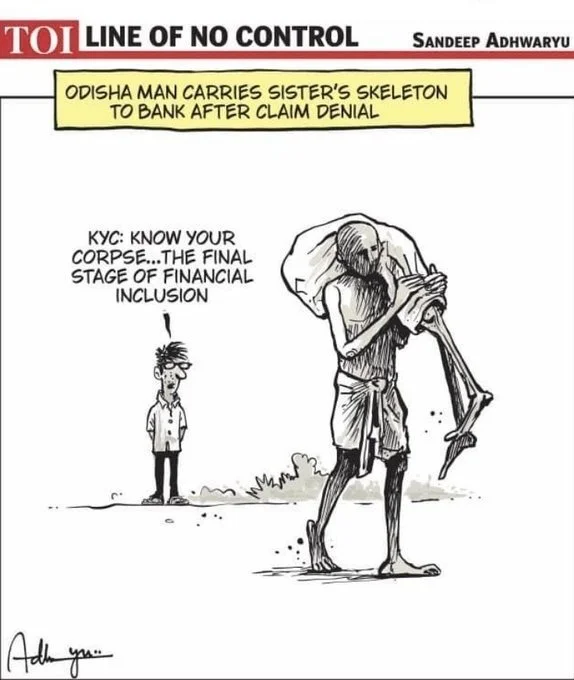
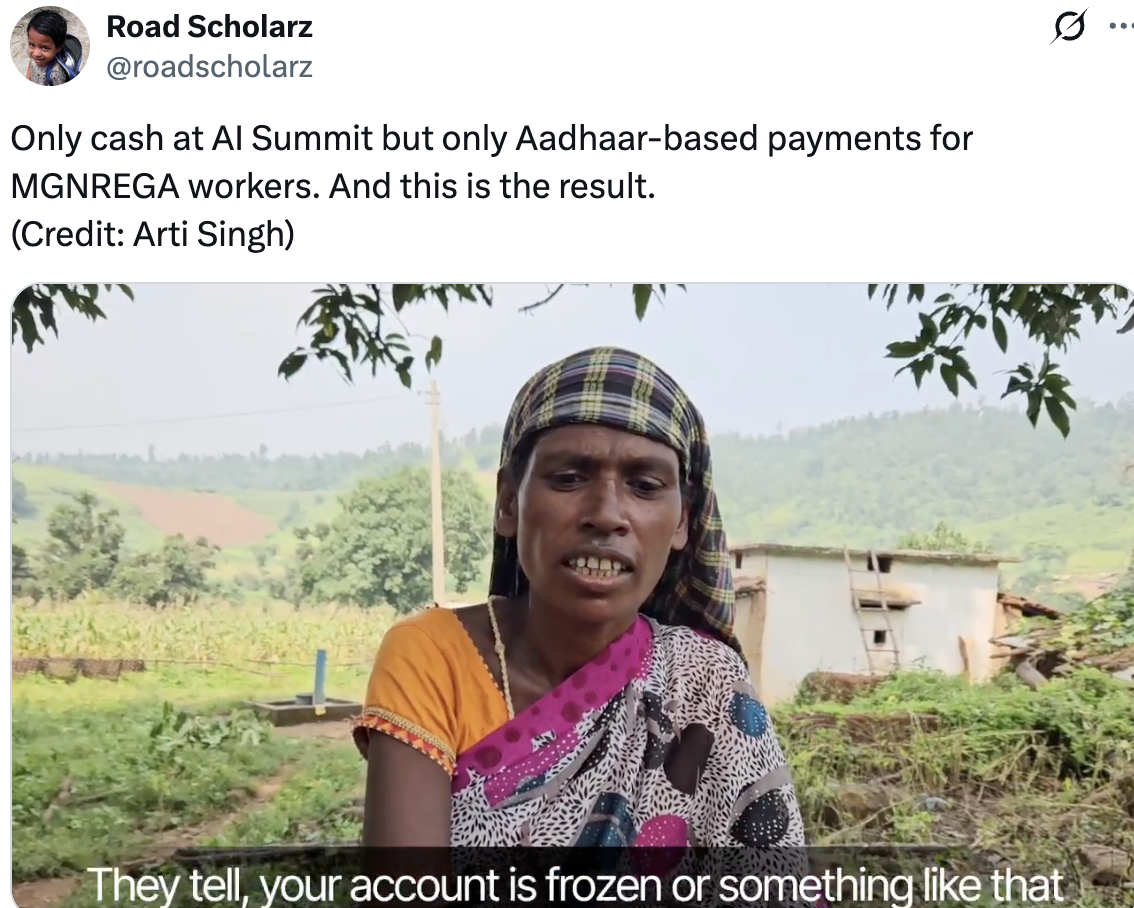

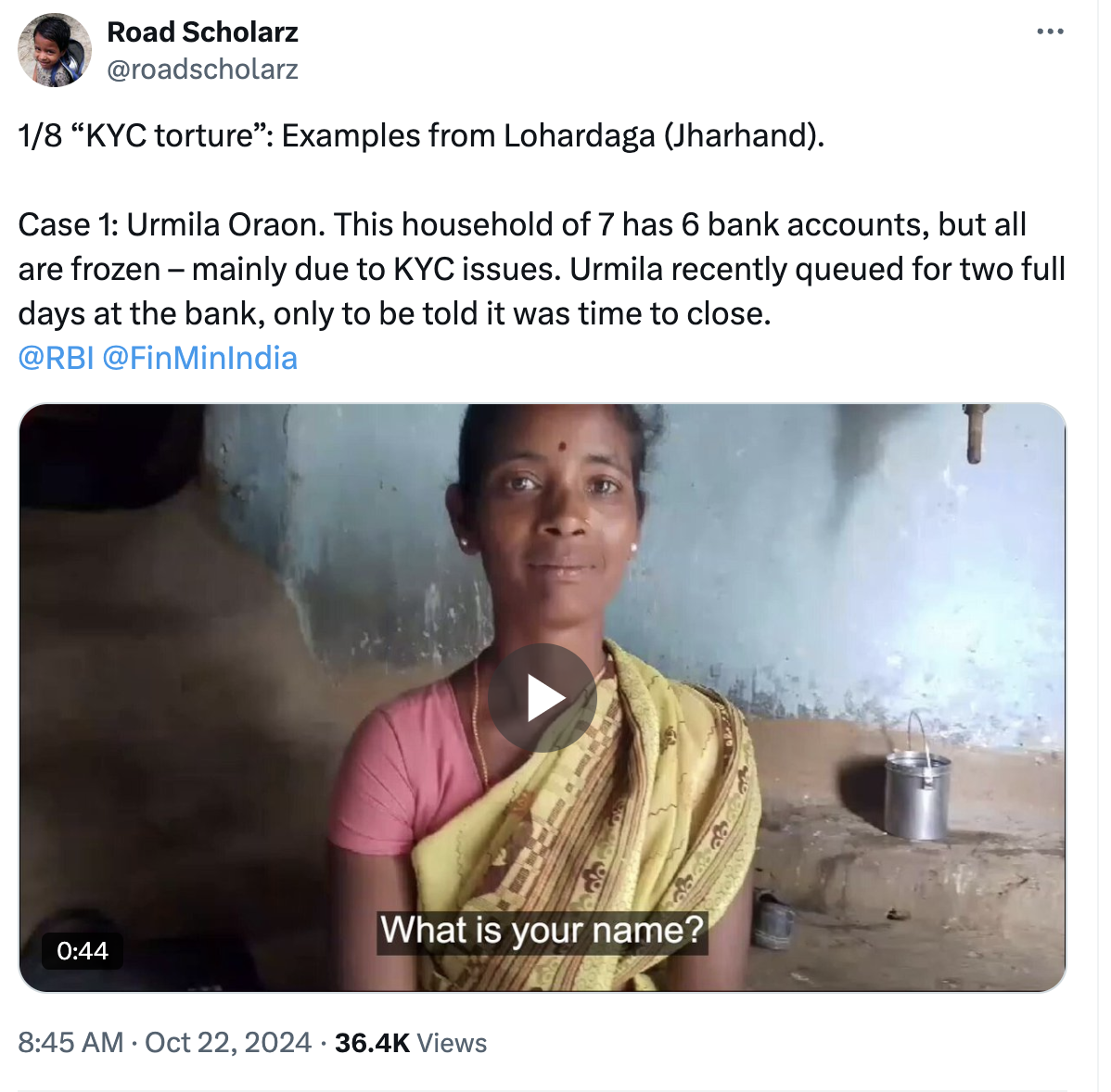
The victims of this mass freezing of bank accounts include elderly pensioners who depend on their meagre pensions, children who receive scholarships, and women entitled to Rs.1,000 per month under Jharkhand’s new Maiya Samman Yojana.
KYC (Know Your Customer) refers to identity verification formalities in the banking system. These formalities are not easy to complete for poor people. They require biometric verification of Aadhaar number at a Pragya Kendra, taking the verification certificate to the bank, filling a form there, and submitting both with the requisite documents. After that, the customer is at the mercy of the bank for timely reactivation of the account. This can take months.
Overcrowding in rural banks is making things worse. In both survey areas, there were long queues at the local banks. The crowds consist largely of people trying to complete KYC, or women who are looking for their Maiya Samman Yojana money.
The survey teams went from door to door in three small villages of Manika Block in Latehar District (Dumbi, Kutmu and Uchvabal) and four villages of Bhandra and Senha Blocks in Lohardaga District (Booti, Dhanamunji, Kandra and Palmi). In these 7 villages, 60% of the 244 households we were able to meet had at least one frozen bank account. In some households, all accounts were frozen.
Some cases of frozen bank accounts were truly shocking. Examples: (1) Urmila Oraon’s family in Kandra has 6 bank accounts, but all are frozen. (2) Also in Kandra, Bhola Oraon and Basant Oraon’s accounts have been frozen for years because their names are misspelt ‘Bhoula Oraon’ and ‘Basnt Oraon’ in their Aadhaar cards. (3) Many people have repeatedly applied for KYC, without success; some of them have given up and are opening new accounts. (4) When Sora Oraon of Dhanamunji went to the bank for KYC, she had to stand in queue the whole day just to get a “token” for an appointment on 27 December 2024!
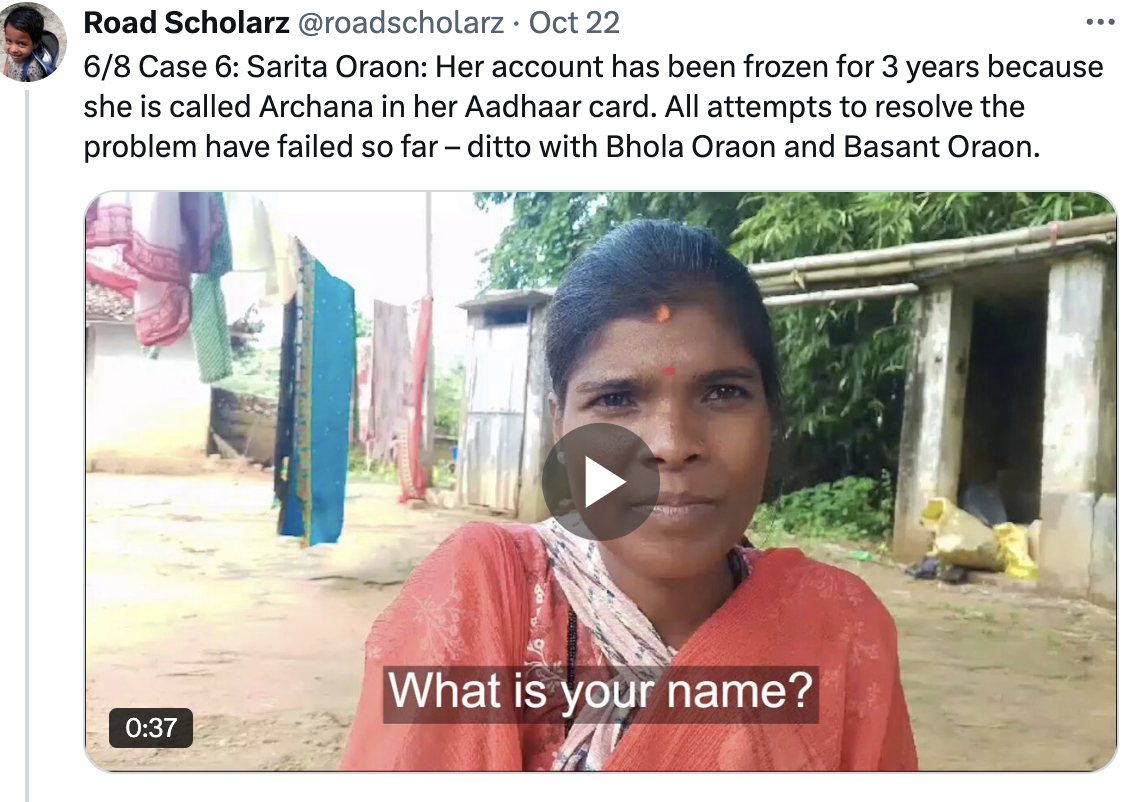
This crisis reflects the growing insistence of banks on periodic KYC, under pressure from the Reserve Bank of India. One local bank manager explained that he had a backlog of 1,500 KYC applications, against a processing capacity of just 30 KYCs per day.
Poor people generally have an Aadhaar-linked account with a maximum balance of Rs 1 lakh. What is the need for such tight KYC every few years? This entire process needs urgent review.
For photos, videos and testimonies of persons with frozen bank accounts, see this folder and the Annexure to this press release.
For further information, please contact Paran (8296887106), Jean (9471130049), Pachathi (Latehar – 7765063311) or Devanti (Lohardaga - 8252383567).
Annexure: Case studies of Frozen Accounts and KYC Problems
[For photos, see link]
Case 1: Ashok Parhaiya’s (Uchwabal, Latehar) three children are unable to withdraw their scholarships - their bank accounts are frozen because KYC is due. Ashok took help from a CSC operator and paid Rs 150 per child to get the KYC done but nothing changed. He has given copies of the children’s Aadhaar and passbook to the operator, but whenever he enquires, the operator asks him to wait or check with the bank. For the time being, Ashok has given up.
Case 2: Sangeeta Devi from Kutmu in Latehar district is barely making it through each month. She has two kids with her visually impaired husband, whose bank account has been frozen due to KYC issues. Without money to bribe the CSC operator, it is difficult for her children to get Aadhaar cards. She has already paid a heavy bribe of Rs 1000 to fix a mistake in her own Aadhaar card.
Case 3: Somwati Devi from Sadhwadih (Latehar district) describes the ordeals involved in resolving KYC issues. She says that each time she visits the bank, it is so crowded that some people are turned away. It took her 15 days to get her KYC done. However, her husband Nirmal did not succeed and has opened up a new account at Punjab National Bank in Latehar.
Case 4: Bhola Ram who lives in Kandra (Lohardaga district) is in a thick soup. His name is correctly spelled in his bank passbook, but mis-spelt “Bhoula Ram” in his Aadhaar card. He was told by the bank manager that KYC requires 100% match between his passbook name and Aadhaar name. Until now, he has been unable to resolve the issue because none of his identity documents match each other. His account has been frozen for the last three years.
Case 5: Urmila Oraon is a resident of Kandra in Lohardaga district. Her family has 7 members, out of which 6 have bank accounts - all of them are frozen due to KYC issues. She recently stood in queue for two full days at the bank, but nothing came out of it. She was simply told to go back home.
Case 6 Sora Oraon lives in Dhanamunji, Lohardaga. She has a family of five out of which three have bank accounts that are frozen. When Sora applied for KYC, she had to queue for a long time and then stand at the counter while the staff were chatting forever on the phone. In the end, the bank gave her a paper ‘token’ with an appointment for 27 December 2024.
Case 7 Sarita Oraon lives in Kandra, Lohardaga district. She has an Aadhaar card where her name has been written as Archana. Because of this she is unable to get her KYC done. Her bank account has been frozen for 3 years. She has no idea what to do.
Case 8 Basant Oraon lives in Kandra, Lohardaga district. His name has been spelled correctly on his passbook but incorrectly in his Aadhaar as “Basnt”. Because of this, he has not been able to get his KYC done and his bank account is frozen. Unfortunately, he has no help from the administration.
For video testimonies and further material, see Twitter threads below:
Latehar:
(Eng - https://x.com/roadscholarz/status/1845660835798307119,
Hindi - https://x.com/roadscholarz/status/1845660994917617846)
Lohardaga:
(Eng - https://x.com/roadscholarz/status/1848563748614901880
Hindi - https://x.com/roadscholarz/status/1848564887188013423)
Chhattisgarh:
(Eng - https://x.com/roadscholarz/status/1846024844695224334
Hindi - https://x.com/roadscholarz/status/1846032175457816791)
Case study: Bhola Oraon (Village Kandra, Lohardaga)
(Eng - https://x.com/roadscholarz/status/1848922947781595303
Hindi - https://x.com/roadscholarz/status/1849042674596151796)
26.09.2023 को सुप्रीम कोर्ट की संविधान पीठ द्वारा आधार निर्णय (के एस पुट्टास्वामी और अन्य बनाम भारत संघ और अन्य (2019) 1 एससीसी 1) को सुनाए हुए आधा दशक हो गया है। ऐसा प्रतीत होता है कि एक सुविधाजनक भूलने की बीमारी हमारी सरकार को प्रभावित करती है क्योंकि यह आधार अधिनियम में नए नियम और ऐसे संशोधन बनाती है जो उस निर्णय द्वारा आधार के उपयोग पर लगाई गई सीमाओं को नज़र अंदाज करते हैं। निर्णय का लिंक यहां है
संक्षेप में: आधार के उपयोग पर पाँच महत्वपूर्ण सीमाएँ जिन्हें बहुमत के फैसले ने मान्यता दी:
आधार को केवल कल्याणकारी योजनाओं के लिए अनिवार्य बनाया जा सकता है (पृष्ठ 389, पैरा 320 - 322 देखें)। यह विशेष रूप से अभिनिर्धारित किया गया था कि आधार को पेंशन जैसे अर्जित लाभों के लिए अनिवार्य नहीं बनाया जा सकता है। बहुमत के फैसले में यह भी कहा गया है, "साथ ही, हम आशा करते हैं कि उत्तरदाता 'सब्सिडी, सेवाओं और लाभों' के दायरे का अनुचित विस्तार नहीं करेंगे, जिससे आधार का दायरा बढ़ेगा, जहां इसकी अन्यथा अनुमति नहीं है।" (पृ. 391)
निजी कंपनियां आधार का इस्तेमाल नहीं कर सकतीं. आधार अधिनियम की धारा 57 जो निजी कंपनियों द्वारा आधार प्रमाणीकरण के उपयोग की अनुमति देती है, असंवैधानिक है (पैरा 219 (ई), 412, 447(1)(डी))।
आधार को बच्चों के स्कूल में प्रवेश या सर्व शिक्षा अभियान के तहत लाभ के लिए अनिवार्य नहीं बनाया जा सकता है। आधार की कमी के कारण बच्चों को लाभ से वंचित नहीं किया जा सकता है (पृष्ठ 393, पैरा 325; पृष्ठ 401, पैरा 332 देखें)।
आधार (प्रमाणीकरण) विनियम, 2016 के विनियम 26 के अन्तर्गत अधिप्रमाणन संव्यवहार डेटा का संचयन अस्वीकार्य माना गया था। (पैरा 219 (बी))
आधार (प्रमाणीकरण) संव्यवहार डेटा का प्रतिधारण छह महीने की अवधि से अधिक नहीं रखा जाना चाहिए (पैरा 219 (ए))
फैसले द्वारा स्थापित सीमाओं की घोर उपेक्षा करते हुए, सरकार मौलिक अधिकारों की कीमत पर यूआईडी को बढ़ावा देने के लिए आधार के उपयोग का विस्तार जारी रखे हुए है।
मूडीज क्रेडिट रेटिंग एजेंसी ने आधार की आलोचना की
इस बीच, एक अनुस्मारक - बायोमेट्रिक्स अविश्वसनीय हैं। यह व्यापक रूप से बताया गया है कि क्रेडिट रेटिंग एजेंसी, मूडीज़ ने एक रिपोर्ट जारी की है जिसमें आधार के साथ चिंताओं को उजागर किया गया है, जिसमें कहा गया है कि "इस प्रणाली के परिणामस्वरूप अक्सर सेवा से इनकार हो जाता है, और मैनुअल मजदूरों के लियें बायोमेट्रिक प्रौद्योगिकियों की विश्वसनीयता, विशेष रूप से गर्म, आर्द्र जलवायु में कम हो जाती है। सरकार ने रिपोर्ट का खंडन किया है और किये गए दावों को “निराधार” बताया है।
दुनिया में सबसे भरोसेमंद आईडी
मूडीज को जवाब देते हुए मोदी सरकार ने अविश्वसनीय दावा किया है कि आधार दुनिया में सबसे भरोसेमंद डिजिटल आईडी है। वहीँ अपराधी, किसी भी खेल से हमेशा दो कदम आगे रहते हैं, इस सबसे भरोसेमंद आईडी के साथ धोखाधड़ी करने के नए तरीके खोजने में बेहद नवीन और आविष्कारशील रहे हैं। हमारी एक व्यक्तिगत पसंदीदा कहानी यूपी गैंग की थी जो आधार कार्ड बनाने के लिए पैर की उंगलियों के निशान (टो प्रिंट) का इस्तेमाल करता था, जिसका इस्तेमाल धोखाधड़ी से बैंक ऋण लेने वाले कई लोगों द्वारा किया जाता था।
डिकोड ने इस महीने रिपोर्ट दी थी - ''बिहार पुलिस आधार सक्षम भुगतान प्रणाली के माध्यम से धोखाधड़ी से थक गई है।” यह रिपोर्ट आधार सक्षम भुगतान प्रणाली (AePS) की व्याख्या करती है। आधार सक्षम भुगतान प्रणाली (AePS) के तहत लोगों को अपने खाते से पैसा निकालने के लिए अपने बॉयोमीट्रिक्स (उंगलियों के निशान) का उपयोग करना पड़ता है। लोगों को बैंक जाने या एटीएम कार्ड रखने की आवश्यकता नहीं है, वे बैंक द्वारा नियुक्त बिजनेस कॉरेस्पोंडेंट (या CSP) के पास जा सकते हैं। वे बिजनेस कॉरेस्पोंडेंट को अपना आधार नंबर देते हैं, पीओएस (POS) मशीन पर अपना अंगूठा लगाते हैं। यदि उनके उंगलियों के निशान वेरीफाई हो जाते है, तो वे पैसे निकाल सकते हैं। रिपोर्ट में लिखा है कि - “इस साल जुलाई में, नवादा पुलिस ने दो लोगों को गिरफ्तार करने के लिए एक विशेष जांच दल का गठन किया और प्लास्टिक जैसे पदार्थों से बने 512 क्लोन अंगूठे के निशान बरामद किए।” विस्तृत कहानी देखें जिसमें पुलिस अधिकारियों के साक्षात्कार शामिल हैं जो बताते हैं कि वे कैसे मानते हैं कि धोखाधड़ी हुई है।
महीने की शुरुआत में, द हिंदू ने रिपोर्ट किया था कि गुजरात में दो लोगों को कथित तौर पर आधार और पैन कार्ड जैसे दो लाख पहचान प्रमाण दस्तावेज़ों को जाली बनाने और प्रत्येक को ₹15 से ₹200 में बेचने के आरोप में गिरफ्तार किया गया था।
डिजिटल व्यक्तिगत डेटा संरक्षण अधिनियम, 2023
आप सभी आधार पर नजर रखने वालों के लिए डेटा संरक्षण अधिनियम का क्या मतलब है? आधार परियोजना किसी कानून के अभाव में 2009 में शुरू हुई। लगभग दस साल बाद, आधार मामले में बहस के दौरान सरकार ने सुप्रीम कोर्ट से वादा किया था कि वह डेटा सुरक्षा कानून पारित करेगी। अंततः, भारत में अब तक एक सबसे बड़े डेटा उल्लंघनों से के कुछ ही सप्ताह बाद, केंद्र सरकार ने डिजिटल पर्सनल डेटा प्रोटेक्शन बिल, 2023 पारित किया। जो बाद मैं राष्ट्रपति की अनुमति के बाद 11 अगस्त को अधिनियम बना
यह कानून हमें पर्याप्त डेटा सुरक्षा प्रदान करने में विफल है, यह सरकार के लिए छूट भी बनाता है। इसका मतलब यह है कि व्यक्तिगत डेटा संरक्षण अधिनियम आधार परियोजना पर भी लागू नहीं होगा (धारा 17 देखें)। यह उस प्रश्न का उत्तर देता है जो हममें से कुछ लोगों ने कुछ साल पहले उठाया था - क्या आधार परियोजना डेटा संरक्षण अधिनियम के साथ मौजूद हो सकती है? इसका उत्तर हाँ है, क्योंकि डेटा संरक्षण अधिनियम इस पर लागू नहीं होता है।
आधार डेटा साझा करने के बारे में आधार अधिनियम क्या कहता है?
आधार अधिनियम 2016 की धारा 29 में कहा गया है कि मूल बायोमेट्रिक जानकारी कभी भी किसी के साथ साझा नहीं की जा सकती है और इसका उपयोग केवल आधार संख्या उत्पन्न करने और प्रमाणीकरण के लिए किया जा सकता है। धारा 29 (2) कहता है कि “ इस अिधिनयम के अधीन संगृहीत या सृजित कोर बायोमैक सूचना से भिन्न पहचान सम्बन्धी सूचना, केवल इस अधिनियम के उपबंधों के अनुसार और ऐसी रीति से, जो विनियमों द्वारा विनिर्दिष्ट की जाए, साझा की जा सकेगी।” इसका मतलब है कि कोर बोमेट्रिक इनफार्मेशन सिर्फ आधार अधिनियम के तहत इकठ्ठा की गयी है वह सिर्फ इसी अधिनयम और विनियमों के अनुसार ही साझा की सकेगी.
धारा 29 (3 ) कहता है कि “ पहचान संबंधी जानकारी जो की अनुरोध करने वाली इकाई या ऑफ़लाइन सत्यापन चाहने वाली इकाई के पास उपलब्ध होगी-
(क) का उपयोग, प्रमाणीकरण या ऑफ़लाइन सत्यापन के लिए कोई भी जानकारी जमा करते समय व्यक्ति को लिखित रूप में सूचित किए गए उद्देश्यों के अलावा, किसी भी उद्देश्य के लिए उपयोग नहीं किया जाएगा ; या
(ख) का खुलासा, प्रमाणीकरण या ऑफ़लाइन सत्यापन के लिए कोई भी जानकारी जमा करते समय व्यक्ति को लिखित रूप में सूचित किए गए उद्देश्यों के अलावा, किसी भी उद्देश्य के लिए नहीं किया जाएगा।
बशर्ते यह कि खंड (ए) और (बी) के तहत उद्देश्य व्यक्ति को समझने योग्य स्पष्ट और सटीक भाषा में होंगे।
डेटा सरंक्षण अधिनियम 2023 के अंतर्गत छूट आधार अधिनियम की अवहेलना नहीं करती है. ऐसा प्रतीत होता है कि आधार अधिनियम की धारा 29 के तहत नोटिस की आवश्यकता अभी भी अधिनियम के तहत एकत्र और उपयोग की जाने वाली "मुख्य बायोमेट्रिक जानकारी" के अलावा किसी भी पहचान जानकारी पर लागू होनी चाहिए। साथ ही आधार (सूचना की सहभाजित) विनियम, 2016. क्या कभी किसी को अपनी पहचान संबंधी जानकारी साझा करने के बारे में प्राधिकरण या अनुरोधकर्ता इकाई से कोई नोटिस मिला है? यदि हाँ तो हमें बताएं!
निजता का उल्लंघन और पुलिस आपको कैसे ट्रैक कर सकती है
दो दिलचस्प मामले जी की आधार और पुलिस की लोगों को ट्रैक करने की क्षमता पर सवाल उठाते हैं। दोनों मामले लापता ऐसे व्यक्तियों से संबंधित हैं जो खोजे नहीं जाना चाहते थे। दिनाँक 01.09.2023 को, टाइम्स ऑफ इंडिया ने रिपोर्ट किया कि, “धोबे गांव के किसान भोला यादव अपने बेटे को जाने नहीं देना चाहता, जिसके साथ वह सात साल बाद गुरुवार को फिर से मिला था। हालाँकि, बेटे ने कहा कि वह कभी घर लौटना ही नहीं चाहता था। बेटा 15 साल की उम्र में लापता हो गया और पुलिस ने उसके आधार नंबर को ट्रैक करके उसे ढूंढ लिया। रिपोर्ट में कहा गया है कि “जांच के दौरान पुलिस टीम को लापता युवक के आधार नंबर से जुड़ा एक बैंक खाता मिला। फिर उन्होंने खाते से जुड़े उसके सेल फोन को ट्रैक किया और उसे ढूंढने में कामयाब रहे.”
टाइम्स ऑफ इंडिया की एक अन्य रिपोर्ट जो कि दिनाँक 14.09.2023 को प्रकाशित हुई थी उसमें कहा गया है कि 2018 में एक महिला लापता हो गई और उसका गायब होना उसके पति के साथ विवाद से जुड़ा था। वर्षों की खोज के बाद, जांचकर्ताओं को पता चला कि उसने अपना आधार कार्ड अपडेट कर लिया है। रिपोर्ट में कहा गया है कि "चेहरे की पहचान और डिजिटल जांच तकनीकों का उपयोग करके, पुलिस ने सफलतापूर्वक उसे गोवा तक ट्रैक किया जहां वह पाई गई जहाँ वह एक नया जीवन जी रही थी।"
पुलिस ने इन लोगों को इनका आधार नंबर का प्रयोग करके कैसे खोजा? क्या पुलिसकर्मी एक ही आधार नंबर का उपयोग करके कई लिंक किए गए डेटाबेस तक पहुंचने में सक्षम हैं? क्या डेटाबेस एकल आधार संख्या के लिए खोजे जाने योग्य हैं? लोगों की आधार से जुड़ी जानकारी तक पहुंचने के लिए पुलिस किस सॉफ्टवेयर और तकनीक का उपयोग कर रही है? क्या चेहरे की पहचान तकनीक को आधार से जोड़ा जा रहा है और निवासियों को ट्रैक करने के लिए इसका उपयोग किया जा रहा है?
महात्मा गाँधी नरेगा और आधार
लिबटेक इंडिया के मित्रों ने मनरेगा में आधार की शुरूआत और योजना से श्रमिकों के नाम हटाने से संबंधित एक महत्वपूर्ण अध्ययन प्रकाशित किया है। एक वर्ष से अधिक समय तक मनरेगा में विलोपन पर नज़र रखते हुए, उन्होंने अक्टूबर 2022 और जून 2023 के बीच 600 से अधिक श्रमिकों का साक्षात्कार किया, और दिसंबर 2022 और मई 2023 के बीच में मनरेगा से जुड़े अधिकारियों का साक्षात्कार लिया। उन्होंने आंध्र प्रदेश (एपी), गुजरात, झारखंड, ओडिशा और तेलंगाना सहित विभिन्न राज्यों को कवर किया। वे इकनोमिक एंड पोलिटिकल वीकली में लिखते हैं की, ““हमारा तर्क है कि आधार-आधारित हस्तक्षेपों की जटिलता और उनके कार्यान्वयन के तरीके का विलोपन की घटनाओं के साथ संबंध है। हम आधार हस्तक्षेपों को खोलकर और उनके औचित्य और जटिलता का आकलन करके शुरुआत करते हैं। हम आगे इस बात पैर भी चर्चा करते हैं कि आधिकारिक मनरेगा दस्तावेज़ विलोपन के बारे में क्या कहते हैं, और जमीनी स्तर पर विलोपन प्रथाओं और समाधान प्रक्रियाओं की संक्षेप में जांच करते हैं। अंत में, हम केंद्र सरकार की तकनीकी-समाधानवादी प्रवृत्तियों के एक लक्षण के रूप में आधार अनिवार्यता पर टिप्पणी करते हैं।”
रिमाइंडर! याद रखे आधार का वोटर पहचान पत्र से लिंक करना अनिवार्य नहीं है! इसको आगे तक पहुँचाइये!
जबकि आधार को लगभग हर चीज के लिए लगभग अनिवार्य बताया जा रहा है, इस बात को आगे तक शेयर करना न भूले कि - आपके आधार को अपने मतदाता पहचान पत्र के साथ जोड़ना अनिवार्य नहीं है, और इस बात को चुनाव आयोग ने भी सुप्रीम कोर्ट में स्पष्ट किया है।
हम किधर जा रहे हैं?
पांच साल पहले भारत के सर्वोच्च न्यायालय की संविधान पीठ ने कहा था कि आधार का उपयोग केवल कल्याण कार्यों के लिए किया जा सकता है। एक अलग फैसले में इसने आधार और पैन कार्ड को अनिवार्य रूप से जोड़ने की अनुमति दी थी। आर्टिकल 21 ट्रस्ट के मित्रों ने 2016 के बाद से यूआईडी परियोजना में विकास की एक संक्षिप्त सूची भी तैयार की है। आज, केंद्र सरकार आधार को हमारे दैनिक जीवन के हर क्षेत्र और पहलू में शामिल करने की कोशिश कर रही है, और इसने एक डेटा सरंक्षण कानून भी बनाया जो कि सरकार और इसके द्वारा चुने गए किसी भी व्यक्ति को देटा सरंक्षण अधिनियम 2023 के अनुपालन से छूट देता है।
प्रौद्योगिकी को लेकर चर्चा खोखली बनी हुई है। एक तरफ जहाँ हम से अपेक्षा की जाती है कि हम आधार योजना को राष्ट्रीय गौरव के प्रतीत के रूप में स्वीकृत करें तो वहीँ दूसरी ओर आधार को भूख से होने वाली मौतों और धोखा धरी से भी जोड़ कर देखा जा रहा है.
यह खोखला राष्ट्रवाद इंडिया स्टैक प्रोजेक्ट में उत्पन्न हुआ है, जिसकी बुनियाद और शुरुआत आधार है। इंटरनेट गवर्नेंस प्रोजेक्ट ने इंडिया स्टैक पर जो एक निजी कंपनी है जो सार्वजनिक रूप से रखे गए संसाधनों का उपयोग करती है, एक गहन रिपोर्ट प्रकाशित की है. एक नए "डिजिटल सार्वजनिक बुनियादी ढांचे" के रूप में आधार की पुनः ब्रांडिंग विशेष रूप से चिंताजनक है क्योंकि यह बेहद भ्रामक है, जो इस परियोजना के तहत जबरदस्ती और बहिष्करण के इतिहास को अस्पष्ट करता है। यह सार्वजनिक बुनियादी ढांचा किसके लिए है? कैसे लाखों भारतियों का डेटा का उपयोग किया जाएगा? आधार फैसले के पांच साल बाद, भविष्य गरिमा, निजता और स्वतंत्रता के लिए नई चुनौतियों से भरा दिख रहा है।
हम सभी को शुभकामनाएँ जो अभी भी विरोध कर रहे हैं, लिख रहे हैं, सोच रहे हैं! हम उम्मीद करते हैं कि इस सप्ताह तत्काल अपडेटस के लिए एक व्हाट्सएप चैनल लॉन्च करेंगे जिसके बारे आप सभी को सूचित किया जाएगा।
जैसा कि हम आधार फैसले के बाद के पांच वर्षों पर विचार करते हैं और भविष्य की ओर देखते हैं, हम खुद को याद दिलाते हैं कि हमारी आलोचनाएं और हमारा प्रतिरोध मजबूत बना हुआ है। और साथ ही प्रौद्योगिकी, सत्ता के केंद्रीकरण, राज्य और हमारी अपनी स्वतंत्रता के बारे में दस्तावेजीकरण और चिंतन का कार्य जारी है।
एकजुटता में,

Today 26.09.2023, marks half a decade since a Constitution bench of the Supreme Court delivered the Aadhaar judgment (KS Puttaswamy & Anr. v. Union of India & Anr. (2019) 1 SCC 1). It appears that a convenient amnesia affects our government as it creates new rules and amendments to the Aadhaar Act that ignore and forget the limitations placed on the use of Aadhaar by that judgment. A link to the judgment is here.
To recap: Five significant limitations on the use of Aadhaar that the majority judgment recognised:
Aadhaar can only be made mandatory for welfare schemes (see Pg. 389, para 320 - 322). It was specifically held that Aadhaar cannot be made mandatory for earned benefits, like pension. The majority judgment also stated “At the same time, we hope that the respondents shall not unduly expand the scope of ‘subsidies, services and benefits’ thereby widening the net of Aadhaar, where it is not permitted otherwise.” (Pg. 391).
Private companies cannot use Aadhaar. Section 57 of the Aadhaar Act which allowed the use of Aadhaar authentication by private companies (body corporates) is unconstitutional (para 219 (e), 412, 447(1)(d)).
Aadhaar cannot be made mandatory for children’s admission to school or for benefits under the Sarva Shiksha Abhiyan. Children cannot be denied benefits for lack of Aadhaar (See Pg. 393, para 325; Pg. 401, para 332).
The storage of transaction data as per Regulation 26 of the Aadhaar (Authentication) Regulations, 2016, was considered impermissible. (para 219 (b))
Authentication records are not to be kept beyond a period of six months (para 219 (a))
In blatant disregard of the limitations established by the judgment, the government continues to expand the use of Aadhaar to promote the UID at the cost of fundamental rights.
Moody’s criticizes Aadhaar
Meanwhile, a reminder - biometrics are inaccurate. It has been widely reported that the credit ratings agency, Moody’s has released a report which highlights concerns with Aadhaar stating that “The system often results in service denials, and the reliability of biometric technologies, especially for manual laborers in hot, humid climates, is questionable”. The government has rebutted the report and says that the claims made are “baseless”.
Most Trusted ID in the world
While rebutting Moody's, the Modi government has made the incredible claim that Aadhaar is the most trusted Digital ID in the world. Criminal groups, always two steps ahead of any game, have been wildly innovative and inventive finding new ways to commit fraud with this most trusted ID. A personal favourite of ours was the UP gang which used toe prints to forge Aadhaar cards, then used by several people fraudulently taking bank loans.
Decode reported this month - “The Bihar police is tired of frauds through the Aadhaar Enabled Payment System. In July this year, the Nawada police formed a special investigating team to arrest two people and recovered 512 cloned thumb impressions made of plastic like substances”. Check out the in depth story which includes interviews with police officials who explain how they believe the frauds are committed.
Earlier in the month, the Hindu reported that in Gujarat two persons were arrested allegedly for having forged two lakh identity proof documents like Aadhaar and PAN cards and sold them for ₹15 to ₹200 each. Just remember, there’s no need to panic because we have a 13ft wall which protects the Aadhaar compound.
Personal Data Protection Act, 2023
What does the Data Protection Act mean for all you Aadhaar watchers out there? Five years after promising the Supreme Court that it would introduce a privacy bill, fourteen years after the cabinet note which led to the beginning of the Unique Identification project, and just a few weeks after one of the largest data breaches India has witnessed yet, the government passed the Digital Personal Data Protection Bill, 2023, which fails to provide us with adequate data protection and creates blanket exemptions for the state and therefore the Aadhaar programme (see Section 17), answering the question that some of us had posed some years ago - Can the Aadhaar project exist along with a Data Protection Act? The answer is yes, because the Data Protection Act does not apply to it.
What does the Aadhaar Act say about sharing Aadhaar data?
Section 29 of the Aadhaar Act 2016, states that core biometric information can never be shared with anyone and can only be used for generation of Aadhaar numbers and authentication. S. 29 (2) says that “The identity information, other than core biometric information, collected or created under this Act may be shared only in accordance with the provisions of this Act and in such manner as may be specified by regulations”. S. 29 (3) states that no identity information available with a requesting entity or offline verification-seeking entity shall be—
used for any purpose, other than the purposes informed in writing to the individual at the time of submitting any information for authentication or offline verification; or
disclosed for any purpose, other than purposes informed in writing to the individual at the time of submitting any information for authentication or offline verification:
Provided that the purposes under clauses (a) and (b) shall be in clear and precise language understandable to the individual.
Exemptions under the DPDP Act do not override the Aadhaar Act. It would appear that the requirement for notice under S. 29 of the Aadhaar Act must still apply to any identity information other than “core biometric information” collected and used under the Act. As well as the Aadhaar (Sharing of Information) Regulations, 2016. Has anyone ever received any notice from the UIDAI or a Requesting Entity about the sharing of their identity information? Let us know if you have!
Violations of privacy and how the police can track you
Two interesting cases raise questions about Aadhaar and the ability of the police to track people. Both cases relate to missing persons who did not want to be found. On 01.09.2023, the Times of India reported “Bhola Yadav, a farmer of Dhobe village, would not let go of his son with whom he was reunited on Thursday after seven years. However, the son said that he never wanted to return home”. The son went missing at the age of 15 and the police traced him by tracking his Aadhaar number. The report says that “During the probe, the police team found a bank account linked with the missing youth’s Aadhaar number. They then tracked his cell phone linked with the account and managed to find him…”
Another report dated 14.09.2023 from the Times of India states that a women went missing in 2018 and her disappearance was linked to a dispute with her husband. After years of pursuit, investigators discovered she had updated her Aadhaar card. The report states that “Police successfully tracked her to Goa where she was found, leading a new life, utilising facial recognition and digital investigation techniques.”
How did the police trace these people using their Aadhaar numbers? Are police personnel able to access multiple linked databases using a single Aadhaar number? Are databases searchable for single Aadhaar numbers? What software and technology is the police using to access people’s Aadhaar linked information? Is facial recognition technology being linked with Aadhaar and used to track residents?
NREGA and Aadhaar
Friends at Libtech India have published an important study correlating the introduction of Aadhaar and deletion of workers names from the MGNREGA. Tracking deletions in the MGNREGA for over a year, they have interviewed over 600 workers between October 2022 and June 2023, and interviewed officials between December 2022 and May 2023. They covered various states, including Andhra Pradesh (AP), Gujarat, Jharkhand, Odisha, and Telangana. They write in the Economic and Political Weekly - “We argue that the complexity of Aadhaar-based interventions and the manner of their rollout has a correlation with the spate of deletions. We begin by unpacking the Aadhaar interventions and assessing their rationale and complexity. We further discuss what official MGNREGA documents say about deletions, and briefly examine deletion practices and resolution procedures on the ground. Finally, we comment on the Aadhaar mandate as a symptom of the union government’s techno-solutionist tendencies.”
Libtech India’s working paper titled '“Assessment of wage payment delays for Aadhaar-based payments and impact on delays due to payments trifurcation by caste” examines technological interventions in the MGNREGA. They write “Many of these interventions were introduced without any consultation or scientific piloting. Consequently, some have violated the clauses of the Act, adversely afecting programme implementation. We demonstrate how two such digital technological interventions in MGNREGA - segregation of wage payments by caste, and Aadhaar-Based Payment System (ABPS) - have violated MGNREGA clauses. Our analysis is based on 31.36 million transactions across 10 states from Financial Year 2021-22 crawled from the programme’s Management Information System (MIS). 63% wage payments were delayed beyond the mandated 7 days by the union government and 42% were delayed beyond 15 days. We use the percentage of transactions processed within the mandated time by the union government as the metric to assess the performance. Notwithstanding delays in wage payments, we find there is a statistically significant diference in the time taken to process payments across caste. This is also the first large-scale data-based evidence demonstrating no statistically significant difference in the time taken to process wage payments through ABPS compared with traditional account-based payments.” This study demonstrates that the Aadhaar based payments system did not make improvements in MGNREGA payments.
Reminder! Spread the word! Aadhaar Voter ID linking is not mandatory!
While Aadhaar continues to be pushed as mandatory for almost everything, remember to spread the word - it is not mandatory to link your UID with your Voter ID, as the Election Commission has so helpfully clarified to the Supreme Court.
Where are we heading?
Five years ago the Constitution Bench of the Supreme Court of India said that Aadhaar could only be made mandatory for welfare. In a separate judgment it had allowed the mandatory linking of Aadhaar and PAN cards. Friends at the Article 21 Trust have compiled a brief list of developments in the UID project since 2016. Today, the Union Government continues to try to thrust Aadhaar into every sphere and aspect of our daily lives, as it creates a data protection law that exempts itself and anyone it chooses from compliance.
The discourse around technology remains hollow. We are expected to treat the Aadhaar programme as a source of national pride while it continues to be linked to hunger deaths and fraud. This hollow nationalism is evoked in the India Stack project, of which Aadhaar forms the basis and beginning. The Internet Governance Project has published an in-depth report on the India Stack, "a set of APIs and associated platforms that operate across three critical sectors: identity, payments, and data". The report documents the use of Aadhaar in the creation of a structure of digital India through private companies that use publicly held resources. The re-branding of Aadhaar as a new “digital public infrastructure” is particularly concerning as it is deeply misleading, obfuscating the history of coercion and exclusion that the project carries. Who is this public infrastructure for? How will the data of millions of Indian residents be used? Five years after the Aadhaar judgment, the future looks full of novel challenges to dignity, privacy and liberty.
All the best to all of us still resisting, writing, thinking
This week we hope to launch a WhatsApp channel for more immediate updates and will keep all of you informed.
As we reflect on five years since the Aadhaar judgment and look to the future, we remind ourselves that our critiques and our resistance remain strong. The work of documenting and thinking about technology, concentration of power, the state and our own liberty continues.
In solidarity,

साथियों,
हम आपको एक आवश्यक अपडेट के साथ लिख रहे हैं
पिछले कुछ वर्षों में आधार संबधित परियोजना के दस्तावेज़ीकरण और जानकारी एकत्रित हुए हमने पाया के अनिवार्य आधार परियोजना ने हाशिये पर, कमज़ोर ग़रीबों को बुरी तरह, क्रूरता के साथ प्रभावित किया है! बहुतों को एक छोटी बच्ची संतोषी की २०१७ मौत याद होगी जिनके परिवार को राशन नहीं इस लिए नहीं मिल सका क्योंकि उनका आधार राशन कार्ड से जुड़ा हुआ नहीं था.
2018 में राइट टू फूड कैंपेन ने रिपोर्ट दी थी कि "कम से कम 19 मौतें सीधे आधार से जुड़ी थीं: मृतको सरकार द्वारा संचालित राशन की दुकानों ने भोजन राशन से इनकार कर दिया क्योंकि या तो उनके राशन कार्ड आधार के साथ लिंक या "सीडेड" नहीं थे या आधार -आधारित बायोमेट्रिक प्रमाणीकरण विफल हो आगये थे ।
हम आज आपको ओडिशा के जाजपुर में एक और बच्चे की मौत की भयावय खबर के साथ लिख रहे हैं।
इस साल मार्च में कुपोषण के कारण एक बच्चे की मौत की खबरों के बाद, स्थानीय कार्यकर्ताओं, सामाजिक वैज्ञानिकों और पत्रकारों की एक तथ्यान्वेषी टीम ने घाटिसही गांव का दौरा किया। उनकी तथ्यान्वेषी रिपोर्ट यहां देखी जा सकती है।
रिपोर्ट में पाया गया हेंब्रम तकरीबन ११ वर्ष का था जब उसकी ३ मार्च २०२३ सुबह मृत्यु हुई। उसके माता-पिता बांकू और तुलसी मजदूर के रूप में काम करते हैं। बांकू ट्रैक्टर चालक एवं दिहाड़ी मजदूर के रूप में काम करता है; तुलसी कृषि मजदूर और दिहाड़ी मजदूर के रूप में काम करती हैं। वह परिवार की प्रमुख आय कमाने वाली है। परिवार एक कमरे के प्रधानमंत्री आवास भवन में रहता है, जो कि बांकू के पिता को मिला था। परिवार के पास न तो कृषि भूमि है और न ही उनके पास कोई पशु है। जबकि बांकू और उनकी पत्नी तुलसी के पास आधार है, अर्जुन सहित उनके किसी भी बच्चे के पास आधार संख्या नहीं है। फैक्ट फाइंडिंग टीम ने यह भी पाया कि बच्चे के परिवार को 21 महीने से पीडीएस के माध्यम से राशन नहीं मिला था. अर्जुन की मां तुलसी यह नहीं समझ पा रही थीं कि उनका राशन कार्ड क्यों रद्द कर दिया गया था, टीम ने पाया कि उनके नाम की वर्तनी आधार कार्ड और उनके राशन कार्ड पर अलग-अलग लिखी गई थी, जिससे संभवतः राशन कार्ड और आधार को लिंक करने के की कोशिश में रद्द किया गया था।
टीम ने पाया कि अर्जुन हेम्ब्रम विकलांग बच्चा था, हालांकि उसके नाम पर कोई विकलांगता पेंशन नहीं मिली थी। वह स्थानीय स्कूल में नामांकित नहीं था और मध्याह्न भोजन तक भी उसकी पोहोंच नहीं थी। तथ्यान्वेषी रिपोर्ट में कहा गया है कि - "प्रभावित परिवार को विभिन्न सामाजिक सुरक्षा कार्यक्रम से कई बार बहिष्करण का शिकार होना पढ़ा है। परिवार के पास खेती योग्य भूमि नहीं है और वे पात्र होने के बाद भी राशन प्राप्त नहीं कर पाए हैं। और उन्हें शुरू में राशन कार्ड मिला था, मृतक समेत तीन बच्चो को विकलांगता पेंशन से बाहर रखा गया था, उनके [माता-पिता] मनरेगा जॉब कार्ड निरस्त कर दिए गए थे और इसका कारण स्पष्ट नहीं है, जिसके कारण उन्हें मनरेगा के काम से वंचित होना पढ़ा और पीएम-आवास योजना के तहत घर नहीं मिल रहा है। सरपंच के अनुसार कुछ समय के लिए मनरेगा का काम रुका हुआ है और उन्होंने कहा कि एनएमएमएस ऐप के साथ लोगों की अनिच्छा इसका कारण है।
कुपोषण और भुखमरी से होने वाली मौतें कई कारकों की जटिल परस्पर क्रिया के कारण होती हैं, और हमने पाया है कि आधार को लागू करने से मौजूदा समास्याएं बढ़ जाती है।
आधार कार्यक्रम के भीतर के मुद्दों को टेक्नोलॉजी से परिचित शब्द दिए गए हैं जो कार्यक्रम की लागत को हल्का और अस्पष्ट करते हैं। जब लोग राशन कार्ड और आधार में नाम बेमेल होने के कारण दोनो को लिंक करने में असमर्थ होते हैं, या जब इंटरनेट विफल हो जाता है, या जब उंगलियों के निशान काम नहीं करते हैं, तो हमे कहां जाता हैं की यह समस्याएं बिलकुल वैसी ही हैं जैसा कि एक बच्चा अभी ठोस भोजन खाना सीख रहा है बजाए राज्य के स्वम्मित्व वाले कार्यक्रम के की जिसको आबादी पर अनिवार्य रूप से थोपा गया है और जो कई लोगों को उनके मौलिक अधिकारों और अधिकारों से बाहर करता है। बहिष्करण को जनसंख्या के प्रतिशत में मापा जाता है, जिसे नगण्य या कार्रवाई के लिए पर्याप्त महत्वपूर्ण नहीं माना जाता है, और कार्यक्रम के कामकाज के लिए केंद्रीय मुद्दों को कार्यान्वयन के मुद्दों के रूप में देखा जाता है, न कि कार्यक्रम की आंतरिक विफलताओं के कारण जिसकी वजह से भुखमरी, मृत्यु की स्थिति पैदा होती है।
जब सुप्रीम कोर्ट ने आदेश दिया कि आधार सलंगन को अनिवार्य करना कल्याणकारी नामावली में शामिल लोगों के लिए उचित है, तो इसनेआधार को जोड़ने से होने वाले बड़े बहिष्करण संबंधी नुकसानों पर पर्याप्त रूप से विचार नहीं किया था।
2021 में, सुप्रीम कोर्ट 3 करोड़ राशन कार्डों को हटाने को चुनौती देने वाली एक जनहित याचिका की सुनवाई पर सहमति जताई, क्योंकि वे आधार से जुड़े नहीं थे। याचिका झारखंड, यूपी, ओडिशा, कर्नाटक, एमपी, महाराष्ट्र, बिहार, छत्तीसगढ़, पश्चिम बंगाल, आंध्र प्रदेश, तेलंगाना में भुखमरी से होने वाली मौतों का ज़िक्र करती है। इन हटाए गए राशन कार्डो के बारे में शुरू में यह कहकर जश्न मनाया गया व उन्हें हटाना उचित ठहराया गया की वे नक़ली राशन कार्ड थे, हालाँकि बाद की जांच से पता चला कि राशन कार्ड धारकों को कभी नोटिस नहीं दिया गया था। बाद की रिपोर्टों ने भी निष्कर्ष निकाला कि राशन कार्ड असली थे। मामला अभी भी सुप्रीम कोर्ट में लंबित है।
हम यूआईडीएआई के वरिष्ठ अधिकारियों से जवाबदेही की मांग करते हैं जो आधार कार्यक्रम का संचालन और कार्यान्वयन करते हैं, साथ ही साथ राष्ट्रीय खाद्य सुरक्षा अधिनियम, 2013 के तहत संबंधित अधिकारीयों से, जिनकी ज़िम्मेदारी यह सुनिश्चित करना है कि लोग भोजन के अपने मौलिक अधिकार का उपयोग करने में सक्षम हैं
रिथिंक आधार सिविल सोसाइटी फोरम ऑन ह्यूमन राइट्स (सीएसएफएचआर), ओडिशा खाद्य अधिकार अभियान और जन स्वस्त अभियान द्वारा की गई प्रमुख मांगों के समर्थन में है, जिनकी रूपरेखा नीचे दी गई है:
• बिना आधार वाले बच्चों को पीडीएस से बाहर रखना इस समुदाय के लिए चिंता का विषय है। सभी छूटे हुए बच्चों और वयस्कों को तुरंत पीडीएस में शामिल करने के लिए कदम उठाए जाने चाहिए और आधार जमा करने का दायित्व समुदाय पर नहीं छोड़ा जाना चाहिए। प्रशासन को यह सुनिश्चित करने के लिए कदम उठाने चाहिए कि आधार के अभाव में एक भी व्यक्ति सिस्टम से बाहर न रहे।
• भारतीय सर्वोच्च न्यायालय के पीयूसीएल बनाम यूनियन ऑफ इंडिया एंड अदर (सिविल रिट पेटिशन 196 साल 2001) अंतरिम आदेशों के अनुसार और नई शिक्षा नीति, 2023, सरकार समर्थित सामाजिक सुरक्षा और खाद्य और पोषण सुरक्षा योजनाओं और कार्यक्रमों का लाभ उठाने के लिए आधार सीडिंग आवश्यक / अनिवार्य नहीं है। आधार सीडिंग संबंधी मुद्दों के कारण किसी भी बच्चे/परिवार को उनके अधिकारों से वंचित नहीं किया जाना चाहिए।
• जिला प्रशासन को सभी क्षेत्रों के आंगनबाड़ी केंद्रों में सभी बच्चों का वजन करने की आवश्यकता है ताकि कुपोषण से पीड़ित बच्चों की पहचान की जा सके और बच्चों में कुपोषण के सामुदायिक प्रबंधन के लिए तत्काल कदम उठाए जा सकें। प्रत्येक माह विवेकपूर्ण ढंग से बच्चों का वजन एवं कुपोषण मापन किया जाना चाहिए तथा सभी आंगनवाड़ी केन्द्रों को नियमित निगरानी के साथ आवश्यक उपकरण एवं प्रशिक्षण प्रदान किया जाना चाहिए।
• टीम ने जाना कि स्कूल में मिड डे मील समुदाय के बच्चों के लिए पहला और प्राथमिक भोजन है। प्रशासन को स्कूलों में पौष्टिक नाश्ता कार्यक्रम शुरू करने के लिए कदम उठाने चाहिए जिन्हें डीएमएफ के तहत समर्थन दिया जा सकता है। साथ ही समुदाय के परिवार तथा विशेष रूप से बच्चे गर्मी की छुट्टियों के दौरान अत्यधिक भोजन संकट से गुजरते हैं, यह सुनिश्चित करने के लिए कदम उठाए जाने चाहिए कि बच्चों के लिए गर्मियों की छुट्टियों के दौरान भी एमडीएम जारी रहे।
• एक सार्वभौमिक पात्रता दृष्टिकोण के तहत भी, वृद्ध और विकलांग लोगों, दलितों और जनजातीय समूहों को भोजन, स्वास्थ्य सेवाओं और लाभों के विशिष्ट बिना शर्त समर्थन की आवश्यकता हैं सामुदायिक रसोई अनिश्चित भोजन और पोषण की स्थिति वाले परिवारों के लिए एक सामंजस्यपूर्ण समाधान प्रदान कर सकती है।
• स्कूल न जाने वाले बच्चे सबसे कमजोर होने के बावजूद स्कूल भोजन कार्यक्रम से बाहर रह जाते हैं; उन्हें बिना किसी शर्त के सभी खाद्य कार्यक्रमों तक पहुंचने की अनुमति दी जानी चाहिए।
• मृतक के परिवार से तीन विकलांग बच्चे, हालांकि सामाजिक सुरक्षा पेंशन के लिए पात्र हैं, उन्हें टीम विजिट के समय तक योजना के तहत नहीं जोड़ा गया है। सभी आंगनवाड़ी केंद्रों में विकलांग बच्चों के बारे में विवरण है, जिला प्रशासन द्वारा आवश्यक दस्तावेजों की व्यवस्था करने और पेंशन योजना के तहत विकलांग बच्चों और वयस्कों को शामिल करने के लिए कदम उठाए जाने चाहिए। सभी पात्र लेकिन छूटे हुए परिवारों को जल्द से जल्द पेंशन योजना के तहत शामिल किया जाना चाहिए जिससे परिवारों की वित्तीय और खाद्य सुरक्षा मजबूत होगी।
• वृद्धावस्था पेंशन लाभार्थियों की संख्या को पेंशन योजना में नकदी से बैंक हस्तांतरण में परिवर्तन के बाद समस्याओं का सामना करना पड़ रहा है। इससे वृद्ध व्यक्तियों में अत्यधिक कठिनाई और भुखमरी हो सकती है। राज्य को यह सुनिश्चित करने के लिए कदम उठाने चाहिए कि कोई भी पेंशन लाभार्थी इस परिवर्तन के कारण बाहर न हो या पेंशन प्राप्त करना बंद न करे और उन्हें जल्द से जल्द नकद राशि दी जाए।
• मनरेगा जो लगातार ग्रामीण कार्य और आय सुरक्षा के मामले में संजीवनी साबित हुई है, टीम को बताया गया कि एनएमएमएस ऐप में समस्या के कारण योजना के तहत काम रोक दिया गया है। इस मुद्दे को तुरंत हल करने के लिए कदम उठाए जाने चाहिए और सभी परिवारों को जॉब कार्ड प्रदान किए जाने चाहिए और गांव को आवश्यक संख्या में काम आवंटित किया जाना चाहिए। जिला खनिज निधि (डीएमएफ) और मनरेगा निधियों का उपयोग निजी कृषि भूमि और सामुदायिक भूमि के विकास के लिए किया जा सकता है, विशेष रूप से मिट्टी और जल संरक्षण, ग्रामीण बुनियादी ढांचे और सामुदायिक संपत्तियों के विकास के लिए। मनरेगा की शुरुआत समुदाय में एक कार्यात्मक क्रेच भी होनी चाहिए जो माँ को सार्वजनिक कार्य कार्यक्रमों के तहत काम करने के लिए मुक्त करेगी।
• टीम ने यह भी जाना कि किसी भी परिवार के पास कृषि योग्य भूमि नहीं है, परिवारों को एफआरए के तहत शामिल करने के लिए आवश्यक कदम उठाए जाने चाहिए और अधिनियम के तहत व्यवहार्यता को देखते हुए भूमि आवंटित की जानी चाहिए।
• पंचायती राज संस्थाओं (पीआरआई) के सदस्यों को पभूख और कुपोषण, गुणवत्तापूर्ण शिक्षा का अधिकार, स्वास्थ्य सेवाओं और लाभ, खाद्य और पोषण सुरक्षा, सामाजिक सुरक्षा लाभ और मजदूरी रोजगार के मुद्दों को संबोधित करने के लिए अधिक सक्रिय भूमिका निभाने की जरूरत है, विषेश रूप से वर्ष के लिए पीरियड में। ब्लॉक और जिला प्रशासन के साथ बेहतर समन्वय की अधिक आवश्यकता है।
जिन कंपनियों ने भूमि और प्राकृतिक संसाधनों से लाभ उठाया है, उन्होंने कठिनाई और प्रदूषण के अलावा समुदायों को वापस देने के लिए शायद ही कोई उपाय किया है। वे यह सुनिश्चित करने के लिए प्रशासन से कम जवाबदेह नहीं हैं कि उनके आसपास कोई परिवार भूख से न रहे। टाटा स्टील और अन्य जैसी कंपनियों को आवश्यक संसाधनों का आवंटन करना चाहिए और एक स्पष्ट एकीकृत और समग्र विकास रणनीति विकसित करनी चाहिए और जाजपुर जिले के आदिवासी क्षेत्रों में एक मिशन मोड पर लागू करना चाहिए। समुदायों की खाद्य और आय सुरक्षा सुनिश्चित करने के लिए खाद्य और पोषण सुरक्षा, लैंगिक समानता और महिला सशक्तीकरण, जलवायु-लचीली पुनर्योजी कृषि प्रणालियों और प्रथाओं को बढ़ावा देने पर ध्यान दिया जाना चाहिए।
### 19 Apr 2023 — Aadhaar-related failures claim another victim: 11-year old child dies of malnourishment in Odisha > In the last few years of documenting and collecting information about the Aadhaar project we have witnessed the impact of mandatory Aadhaar which has grievously, disproportionately and cruelly affected those who are poor, marginalised, or vulnerable. Many will remember the death of a young child Santoshi in 2017 whose Original: https://rethinkaadhaar.in/blog/odishahungedeathIn the last few years of documenting and collecting information about the Aadhaar project we have witnessed the impact of mandatory Aadhaar which has grievously, disproportionately and cruelly affected those who are poor, marginalised, or vulnerable. Many will remember the death of a young child Santoshi in 2017 whose family could not get rations as their Aadhaar was not linked to their ration card. In 2018, the Right to Food Campaign had reported that “At least 19 deaths were directly linked to Aadhaar: the deceased were denied food rations from government-run ration shops either because their ration cards were not linked or “seeded” with Aadhaar, or because of a failure of Aadhaar-based biometric authentication.”
We write to you today with sadness of the news of the death of another child, in Jajpur, Odisha.
Following news reports that a child had died in March of this year due to malnutrition, a fact-finding team of local activists, social scientists and journalists visited Ghatisahi village. Their fact-finding report can be found here.
The report found that Arjun Hembram was around 11 years old when he died on the morning of the 3rd of March, 2023. His parents Banku and Tulasi work as labourers. Banku works as a tractor driver cum daily wage labour; Tulasi works as an agricultural labour and daily wage labour. She is the major bread earner of the family. The family stays in a one-room Pradhan Mantri Awas building, which was sanctioned to Banku’s father. The family has neither agricultural land nor livestock. While Banku and his wife Tulasi have Aadhaar numbers, none of the children, including Arjun have Aadhaar numbers. The fact-finding team also found that the child’s family had not received rations through the PDS for 21 months. While Arjun’s mother Tulasi was not able to understand why her ration card had been cancelled, the team found that her name was spelt differently on her Aadhaar card and on her ration card, likely leading to the cancellation of the ration card in the process of attempting to link both.
The team found that Arjun Hembram was a child with a disability, however, no disability pension was received in his name. He was not enrolled in the local school and had no access to mid-day meals. The fact-finding report notes that – “the affected household faces multiple exclusion from different social protection programmes the family is without cultivable land and has been excluded from receiving ration for even after being eligible and were initially got a ration card, three children including the deceased were excluded from disability pension, their [the parents’] MGNREGA job card was deleted and reason for which is unclear leading to they being denied from MGNREGA work and not getting a house under PM-Awas scheme. According to the Sarpanch the MGNREGA work was stopped for some time being and he cited people's reluctance with NMMS app being one of the reasons for the same.”
Malnutrition and starvation deaths are caused by a complex interaction of many factors, and we have found that the imposition of Aadhaar exacerbates existing vulnerabilities.
Issues within the Aadhaar programme are given terms familiar to technological innovation that lighten and obscure the cost of the programme. When people are unable to link Aadhaar with ration cards due to a mismatch in their names on both, or when the internet fails, or when fingerprints don’t work, we are told to call these “teething problems” bringing to mind a small toddler who is just learning to eat solid food, rather than a state-owned programme mandatorily imposed on population which excludes many from their fundamental rights and entitlements. Exclusion is measured in the percentage of the total population, which is downplayed as being insignificant or not significant enough for action, and issues central to the functioning of the programme are seen as implementation issues rather than intrinsic failures of the programme leading to situations of crises, starvation, death and the destruction of welfare. Every instance of exclusion comes at a grave human cost.
When the Supreme Court held that mandating Aadhaar linkage was acceptable for people on welfare programmes, it had not adequately considered the vast exclusionary harms Aadhaar seeding caused.
In 2021, the Supreme Court agreed to hear a public interest petition, challenging the deletion of 3 crore ration cards, because they were not linked to Aadhaar. The petition documents starvation deaths taking place in Jharkhand, U.P., Odisha, Karnataka, M.P., Maharashtra, Bihar, Chhattisgarh, West Bengal, Andhra Pradesh, Telangana. These deleted cards were initially justified (and celebrated) as being due to fake ration cards, but subsequent investigation showed that the ration card holders were never given notice. Subsequent reports also concluded that the ration cards were genuine. The case is still pending in the Supreme Court.
We demand accountability from senior officials of the UIDAI who administer and implement the Aadhaar programme, as well as the relevant authorities under the National Food Security Act, 2013, whose mandate is to ensure that people are able to access their fundamental right to food.
Rethink Aadhaar stands in support of the key demands made by the Civil Society Forum on Human Rights (CSFHR), Odisha Khadya Adhikar Abhijan and Jan Swasta Abhiyan, outlined below:
Exclusion of children without Aadhaar from PDS is an issue of concern in this community. Steps must be taken to ensure all left out children and adults are added to the PDS immediately and the onus of submitting Aadhaar should not be left to the community. Administration must take steps to ensure not a single person is excluded from the system for want of Aadhaar.
As per the Hon’ble Supreme Court of India’s interim orders on the PUCL Vs. Union of India and others (Civil Writ Petition 196 of 2001) and also the New Education Policy, 2023, Aadhaar seeding is not necessary/mandatory for availing Government supported social security and food and nutritional security schemes and programmes. No child/family should be excluded from their entitlements due to Aadhaar seeding related issues.
The district administration needs to initiate weighing of all children in the AWCs across the regions in a mission mode to identify children suffering from malnutritionand take immediate steps for community management of malnutrition amongst children. The weighing and malnutrition measurement of children should be done every month judiciously and all AWCs should be provided with necessary equipment and training with regular monitoring.
The team understood that Mid Day Meal in the school is the first and primary meal for the children in the community. The administration must take steps to introduce nutritious breakfast programmes in the schools which can be supported under DMF. Also the families especially the children go through extreme food crises during summer holidays, steps must be taken to ensure MDM is continued even during summer breaks for the children.
Even under a universal entitlement approach, aged and disabled people, dalits, and tribal groups would need specific unconditional support of food, health services and benefits. Community kitchens could provide a cohesive solution for families with precarious food and nutrition conditions.
Out-of-school children are left out of the school meal programme, despite being the most vulnerable; they should be allowed to access all feeding programmes unconditionally.
Three children with disability from the deceased’s family, though eligible for social security pension, have not been added under the scheme till the time of visit. All AWCs have details regarding children with disability, steps must be taken by the district administration to arrange necessary documents and include children and adults with disability under the pension scheme. All eligible but left out families must be included under the pension scheme as soon as possible which would strengthen financial and food security of the families.
Numbers of old age pension beneficiaries are said to be facing problems after the transition in the pension scheme from cash in hand to bank transfer. This can lead to extreme hardship and hunger among the aged persons. State must take steps to ensure no pension beneficiaries are excluded or cease to receive pension due to the transition and they are given cash in hand as soon as possible.
The MGNREGA which has consistently proved to be a lifeline when it comes to rural work and income security, the team was told that work under the scheme has been put on hold due to the problem faced with the NMMS app. The steps must be taken to sort out the issue immediately and all households must be provided with job cards and necessary numbers of work is allocated to the village. District Mineral Fund (DMF) and MGNREGS funds can be utilized for developing private agricultural lands and community lands, especially for soil and water conservation, development of village infrastructure and community assets. The initiation of MGNREGA should also be with a functional crèche in the community which would free the mother to work under public work programs.
The team also understood that none of the households have cultivable agricultural land, necessary steps must be taken to include the households under FRA and land is being allocated looking at the feasibility under the Act.
Panchayati Raj Institutions (PRI) members need to play a more proactive role to address issues of chronic hunger and malnourishment, right to quality education, health services and benefits, food and nutritional security, social security benefits and wage employment, especially during the lean periods of the year. There is a greater need for better co-ordination with the Block and District administration.
The companies which have benefited from the land and natural resources have hardly taken any measures to give back to the communities other than hardship and pollution. They are no less accountable than the administration to ensure no family lives with hunger in their vicinity. The companies like Tata Steel and others must allocate necessary resources and develop a clear integrated and overall development strategy and implemented on a Mission mode in the tribal pockets of Jajpur district. Focus should be on food and nutritional security, gender equality and women’s empowerment, promotion of Climate-resilient regenerative agriculture systems and practices to ensure food and income security of the communities.
Dear all,
We are pleased to announce our partnership with the good folks at One Vote to bring you more news, updates and thoughts about Aadhaar, and how we can reimagine our digital futures.This update focuses on two things we’re worried about: the proposed Aadhaar Voter-ID linkage, and the recent announcement on Aadhaar-linked UPI payments.
But first - the Comptroller and Auditor General’s Report on the UIDAI.
CAG Report confirms criticism of Aadhaar
Time to end project?
On April 6th, 2022, the Comptroller & Auditor General released a Report on the functioning of the UIDAI which confirmed what scholars, activists have been warning about Aadhaar: it is a badly designed system, with security risks, and places an unacceptable burden on people, without accountability systems or grievance redress.
The UID was promised as a robust identification card that would “solve” the problem of duplicates and corruption, becoming the only trusted ID card any citizen needs. However, the CAG audit report shows that the UID is not a trustworthy ID, and that enormous flaws persist because of the imposition of the UID.
The report is an assessment of the Enrolment and Update Ecosystems as well as the Authentication Ecosystems of the UIDAI for the period from 2014-15 to 2018-19. It begins by stating that, “Various Ministries/Departments of the Government as well as other entities such as banks, mobile operators, rely upon Aadhaar for the identity of the applicant.” However, we note that it fails to mention thefunction creep of Aadhaar and how it continues to be made mandatory for a host of services, outside the limited uses which were permitted by the Supreme Court in its 2018 Aadhaar judgement.
It did, however, note the problems created by UIDAI's (lack of) governance, and its negligent oversight of the private parties contracted by it. Some excerpts:
"UIDAI is maintaining one of the largest biometric databases in the world; but did not have a data archiving policy."
“...UIDAI had not ensured that the client applications used by its authentication ecosystem partners were not capable of storing the personal information of the residents, which put the privacy of residents at risk. The Authority had not ensured security and safety of data in Aadhaar vaults. They had not independently conducted any verification of compliance to the process involved.”
“There were flaws in the management of various contracts entered into by UIDAI. The decision to waive off penalties for biometric solution providers was not in the interest of the Authority giving undue advantage to the solution providers, sending out an incorrect message of acceptance of poor quality of biometrics captured by them.”
The CAG report also notes the huge volume of biometric failures. Biometrics are, as we have been saying, a probabilistic technology. When UIDAI started collecting biometrics in 2010, it was untested at this scale. The report noted high numbers of poor quality biometrics in the Aadhaar database:
“Aadhaar numbers with poor quality biometrics induces authentication errors. UIDAI takes no responsibility for it and transfers the onus of updating the biometrics to the resident and also charges fees for it. Issue of Bal Aadhar to minor children below five years was largely focused towards expanding the Aadhaar footprint, without establishing uniqueness of identity of the children. Costs to the Government for issue of these Bal Aadhar numbers were at best avoidable”...
The CAG found that the huge volume of"voluntary" updates indicated that the quality of data captured to issue Aadhaar numbers was not good enough to establish unique identities. The burden of this poor quality data (and the UIDAI's biometric experiment on India) was borne by people, who were faced with denial of services because their biometrics did not match, and who were made to ensure their records were accurate.
“Troublingly, the onus of ensuring records were accurate was placed on people themselves. “During 2018-19 more than 73 per cent of the total 3.04 Crore biometric updates were voluntary updates done by residents for faulty biometrics after payment of charges.”
The CAG report recommends that “UIDAI may levy penalties on Biometric Service Providers for deficiencies in their performance in respect of biometric de-duplication (FPIR/ FNIR) and biometric authentication (FMR/ FNMR). Agreements in this regard should be modified, if required (Paragraph 4.4.1) This is perhaps an attempt to introduce some accountability for biometric failures, the fact that CAG recommends the levy of penalties on providers of this technology for failures, makes it evident that biometric authentication does not work.
The report also excoriated the UIDAI for poor grievance redress mechanisms, finding:
“The grievance redressal system at the UIDAI Hqrs and Regional Offices was ineffective and was plagued with delays in redressal of grievances.”
While highlighting thevarious issues that plague the UID system, Chapter 6 of the report titled ‘Redressal of Customers Grievances’ finds that, “UIDAI caters to the entire population of India and hence Customer Relationship Management (CRM) is an important aspect of its functioning.” This confirms the criticism raised by civil society over the last decade, although it fails to recognise that UIDAI was thrust onto citizens who were forced to enrol in an evidently poorly designed and executed database project. We are not customers, we are citizens for whom some of the most basic rights have become contingent on having an Aadhaar card and successfully “authenticating” our biometrics.
The government and UIDAI must recognise that a functional and accountable grievance redress system - and system for accountability and transparency - must be at the heart of this project upon which access to basic rights has become contingent, and that began as a coercive experiment. Its recommendation for a centralised grievance redressal system will not address the problem of lack of sufficient capacity, transparency and accountability for issues within Aadhaar. As this piece from last year explains, existing grievance redress mechanisms were incapable of answering a simple question of how a person was to retrieve a misplaced Aadhaar number. ( https://indianexpress.com/article/opinion/columns/flaw-in-aadhaar-architecture-uidai-card-enrolment-7389133/ )
While the CAG report highlights the poor quality of the UID database and related issues, it is important to remind ourselves of the human cost of this faulty and coercive program including denial of school admissions, denial of pension for the elderly, denial of food under the PDS, which are just a few instances in a much larger and longer list. We reiterate our concerns with the UID project. We call upon the government to end mandatory Aadhaar linking, and to re-evaluate the viability of the project itself.
We encourage you to read the report yourselves. You can read our statement here. Please see also two articles explaining it, one by Usha Ramanathan here and one by Reetika Khera and Ria Singh Sawhney, here.
____________________________
Linking Aadhaar and Voter ID for voter verification
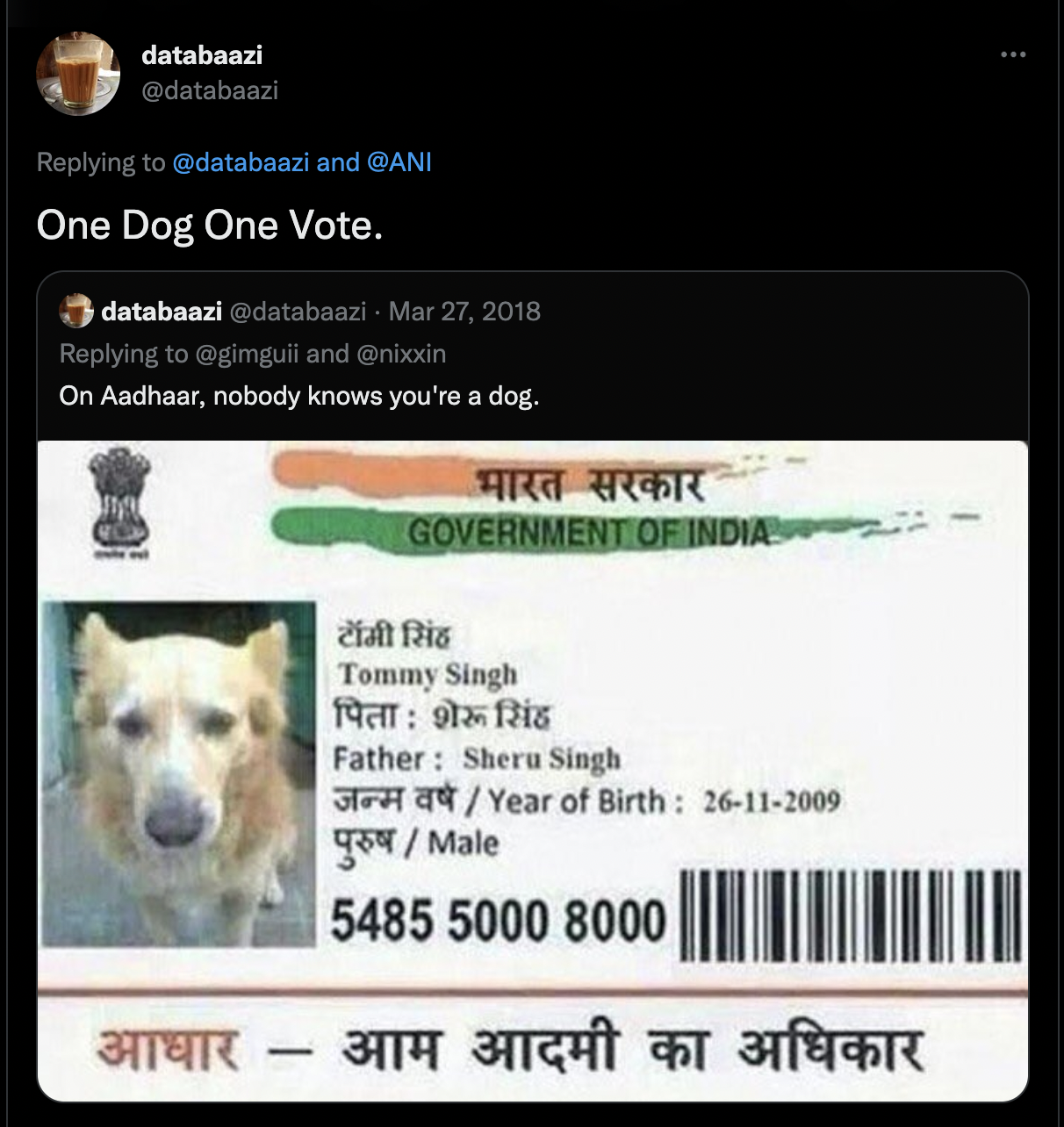
"On Aadhaar, nobody knows you're a dog"
In December 2021, the Indian Parliament passed The Election Laws (Amendment) Bill, 2021 with provision for “voluntary” Voter ID-Aadhaar linkage, despite all the evidence of Aadhaar contributing to marginalisation of already vulnerable communities. What new vulnerabilities will be created by linking proof of citizenship to Aadhaar? This runs counter to experts’ recommendation and is a step towards greater technological intervention in elections.
The linkage was proposed and passed under the guise of deduplication of electoral rolls. However, no research has been conducted to demonstrate how this can be done. Maansi Verma’s excellent article highlights the stakes of this operation. Rethink Aadhaar firmly opposes the linking of Aadhaar and voter ID. Our statement on the same is available here. For more background, read this comprehensive article by The Wire, and this piece written by Ajit Ranade.
In related news, it was recently reported that the 2021 Bihar Panchayat Elections conducted Aadhaar biometric verification for voting. The exercise was mandatory. And since Aadhaar data is inherently insecure, voters were subject to mass bank fraud. State Election Commissions are increasingly enthusiastic about premature technological interventions, at the cost of voters’ privacy, safety, and franchise. This MediaNama article has the details.
____________________________
Aadhaar - UPI Linkage
In what appears to be a loss of all common sense, the National Payments Corporation of India (NPCI) is seeking to enable a feature which will allow users to set up a UPI account using their Aadhaar-based OTP authentication number, instead of a debit card issued to their bank accounts.
In addition to existing social engineering / screen sharing based UPI frauds, this feature when enabled might give anyone having a brief physical / remote access to setup UPI PIN without the knowledge of the user leading to massive risk to those who have linked Aadhaar and mobile number to their bank account.
____________________________
What we’re watching, reading, thinking about
(Yes, PAN-Aadhaar linking "deadline" has been extended yet again to 2023)
A series of webinars organized by One Vote and the Jindal School of Journalism and Communication on how data is sourced, used, and manipulated for elections.
This article by a collective of election technologists from Pakistan, discussing how remote voting and online voting can swing election results: and why that is not reason enough to jump into the wagon of e-voting.
The Wire ran a series of articles by Ornit Shani, S.Y. Quraishi and Siddharth Ganguly to mark the first elections held in India in 1952. These articles highlight the history of elections in India, and the comprehensive imagination of democracy and the citizen-subject in our Constitution.
This excellent essay on how UIDAI reduced the idea of consent to an absurdity, in the New AI Now Lexicon: Consent – A New AI Lexicon “While the phrase ‘consent is broken’ has become almost ubiquitous, governments continue to rely upon consent to protect privacy and regulate new technologies.”
____________________________
Connect with us!
Ask friends and family to subscribe to Rethink Aadhaar. Please email us to sign up to Rethink Aadhaar's mailing list.
Please also follow One Vote on Twitter for regular updates and to amplify our message! You can also subscribe to our project page.
Rethink Aadhaar Campaignhttps://rethinkaadhaar.in
For signing up for Rethink Aadhaar mailing list, please click: https://lists.riseup.net/www/subscribe/rethink-aadhaar
Twitter: @No2UID
Facebook: https://www.facebook.com/no2uid/Write to us at: contact@rethinkaadhaar.in
On April 6th, 2022, the Comptroller & Auditor General released a Report on the functioning of the UIDAI which confirmed what scholars, activists have been warning about Aadhaar: it is a badly designed system, with immense surveillance risks, which places an unacceptable burden on people, and violates fundamental rights.
The UID was promised as a robust identification card that would “solve” the problem of duplicates and corruption, becoming the only trusted ID card any citizen needs. However, the CAG audit report shows that the UID is not a trustworthy ID, and that enormous flaws continue to persist, and difficulties are created by the imposition of the UID.
The report is an assessment of the Enrolment and Update Ecosystems as well as the Authentication Ecosystems of the UIDAI for the period from 2014-15 to 2018-19. It begins by stating that, “Various Ministries/Departments of the Government as well as other entities such as banks, mobile operators, rely upon Aadhaar for the identity of the applicant.” However, we note that it fails to mention the function creep of Aadhaar and how it continues to be made mandatory for a host of services, outside the limited uses which were permitted by the Supreme Court in its 2018 Aadhaar judgement.
While highlighting the various issues that plague the UID system, Chapter 6 of the report titled ‘Redressal of Customers Grievances’ begins: “UIDAI caters to the entire population of India and hence Customer Relationship Management (CRM) is an important aspect of its functioning.” Although confirming the criticism raised by civil society over the last decade, this fails to recognise that UIDAI was thrust onto citizens who were forced to enrol in an evidently poorly designed and executed database project. We are not customers, we are citizens for whom some of the most basic of rights have become contingent on having an Aadhaar card and successfully “authenticating” our biometrics.
The government and UIDAI must recognise that a functional and accountable grievance redress system must be at the heart of this project upon which access to basic rights has become contingent, and that began as a coercive experiment. The recommendation for a centralised grievance redressal system will not address the issues of lack of sufficient capacity, transparency and accountability for issues within Aadhaar. As this piece from last year explains, existing grievance redress mechanisms were incapable of answering a simple question of how a person was to retrieve a misplaced Aadhaar number. “The combined might of all Aadhaar assistance facilities in Bihar proved unable to help Reena Devi, a poor widow who had lost her Aadhaar card in the process of applying for a change of address after marriage. It took special access to a sympathetic official at the regional office of the Unique Identification Authority of India (UIDAI) in Ranchi – 400 kilometres away from Reena’s residence – to retrieve her lost number.”
Key findings of the CAG Report:
I. Poor Data Quality
“Aadhaar numbers with poor quality biometrics induces authentication errors. UIDAI takes no responsibility for it and transfers the onus of updating the biometrics to the resident and also charges fees for it. Issue of Bal Aadhar to minor children below five years was largely focused towards expanding the Aadhaar footprint, without establishing uniqueness of identity of the children. Costs to the Government for issue of these Bal Aadhar numbers were at best avoidable”.
There is no assurance that Aadhaar enrollment was limited to those actually resident in India.
The database continues to have duplicates, despite attempts to clean up the system. UIDAI had to cancel more than 4.75 lakh Aadhaars (November 2019) for being duplicate.
Issuing Aadhaar to minors (below the age of 5) without confirming the uniqueness of their biometrics goes against the intention of the Aadhaar Act.
Aadhaar numbers were not paired with the documents relating to personal information of their holders.
Over nearly ten years, the UIDAI could not identify the exact extent of mismatch.
II. The UIDAI continues to be plagued by systemic issues and lack of accountability
"UIDAI is maintaining one of the largest biometric databases in the world; but did not have a data archiving policy."
UIDAI, responsible for ensuring the licensed requesting entities comply with regulations and comply with annual information system audit of operations, failed to take any action on > 50% entities which have never submitted their annual compliance reports.
“Moreover, UIDAI had not ensured that the client applications used by its authentication ecosystem partners were not capable of storing the personal information of the residents, which put the privacy of residents at risk. The Authority had not ensured security and safety of data in Aadhaar vaults. They had not independently conducted any verification of compliance to the process involved.”
“There were flaws in the management of various contracts entered into by UIDAI. The decision to waive off penalties for biometric solution providers was not in the interest of the Authority giving undue advantage to the solution providers, sending out an incorrect message of acceptance of poor quality of biometrics captured by them.”
UIDAI does not have a system to analyse the factors leading to authentication errors.
III. Placed the burden of ensuring correctness on residents
“Troublingly, the onus of ensuring records were accurate was placed on people themselves. “During 2018-19 more than 73 per cent of the total 3.04 Crore biometric updates were voluntary updates done by residents for faulty biometrics after payment of charges.”
The huge volume of voluntary updates indicated that the quality of data captured to issue initial Aadhaar was not good enough to establish uniqueness of identity.
IV. Grievance Redress
“The grievance redressal system at the UIDAI Hqrs and Regional Offices was ineffective and was plagued with delays in redressal of grievances.”
V. Accuracy of biometrics
The CAG report recommends that “UIDAI may levy penalties on Biometric Service Providers for deficiencies in their performance in respect of biometric de-duplication (FPIR/ FNIR) and biometric authentication (FMR/ FNMR). Agreements in this regard should be modified, if required (Paragraph 4.4.1)”
While perhaps an attempt to introduce some accountability for biometric failures, the fact that CAG recommends the levy of penalties on providers of this technology for failures, makes it evident that biometric authentication does not work. Biometrics are, as we have been saying, a probabilistic technology. When UIDAI started collecting biometrics in 2010, it was an untested technology at this scale.
While the CAG report highlights the poor quality of the UID database and related issues, it is important to remind ourselves of the human cost of this faulty and coercive program including denial of school admissions, denial of pension for the elderly, denial of food under the PDS, which are just a few instances in a much larger and longer list. We reiterate our concerns with the UID project. We call upon the government to end mandatory Aadhaar linking, and to re-evaluate the viability of the project itself.
### 19 Dec 2021 — Oppose the Election Laws Amendment Bill - Oppose linking Voter ID and Aadhaar > Rethink Aadhaar joins thirteen other prominent civil rights, electoral reform, academic and digital rights groups including the Association for Democratic Reforms, Bahujan Economists, the People’s Union for Civil Liberties, the Internet Freedom Foundation, MKSS and National Alliance of People’s Move Original: https://rethinkaadhaar.in/blog/2021/12/19/oppose-the-election-laws-amendment-bill-oppose-linking-voter-id-and-aadhaarRethink Aadhaar joins thirteen other prominent civil rights, electoral reform, academic and digital rights groups including the Association for Democratic Reforms, Bahujan Economists, the People’s Union for Civil Liberties, the Internet Freedom Foundation, MKSS and National Alliance of People’s Movements, to oppose the Election Laws Amendment Bill, which proposes linking Aadhaar and voter ID cards.
The Election Laws Amendment Bill is listed for introduction in Lok Sabha tomorrow. As per the announcement of the Minister of Parliamentary Affairs in Parliament on Friday, 17th December, the Bill may be taken up for consideration and passing in the coming week. Among other things, the Bill may contain provisions for linking Voter ID and Aadhaar as several media reports have confirmed that this proposal has received Cabinet’s approval.
The ongoing Winter Session of Parliament is scheduled to run till 23rd December, raising concerns that the Government might push for the Bill without proper consultations and discussions and in haste, before the session ends. This would be highly improper as any proposals to link Aadhaar and Voter ID is a serious matter requiring careful consideration and considerable public consultation. It is also improper that the Government is aiming to bring this Bill and provide for Aadhaar and Voter ID linking while the Parliament Standing Committee on Law and Justice is currently studying this subject and is yet to submit a report on the same.
Given that the current government has a dismal record on sending Bills to Standing Committees for study, this attempt to bring a Bill on a subject that is currently under consideration of a Committee is indicative of the scant regard the Government has for parliamentary procedures and conventions which must be resisted.
While the Ministry of Law and Justice and Election Commission of India have been going back and forth on the proposal of linking Aadhaar with Voter ID, there has been no public consultation on this proposal.
Rigorous identification requirements which act as a barrier to people being able to exercise their right to vote, are rightly termed as voter suppression measures which strike at the heart of a democracy, and should not be allowed in a democracy. The right to political participation is, at least, a constitutional right, and a right under international human rights law.
Although reports indicate that this proposal is being pushed in the name of ‘reforms,’ and that any linking will be ‘voluntary’ in nature, we are concerned that it will almost certainly lead to mass disenfranchisement, could increase voter fraud, and could violate people’s right to privacy by enabling voter profiling through the linkage of data sets, as well as impede the guarantee of secrecy of the ballot.
Earlier this year, we had issued a statement endorsed by more than 500 prominent organizations and concerned citizens strongly opposing the proposal to link Aadhaar and voter ID. In the statement, we had highlighted the following harms that may arise from this proposal:
Aadhaar is not a proof of citizenship and cannot be legally used as a basis to verify or delete a citizen’s name from the voter rolls.
Earlier efforts to ‘purify’ voter rolls using Aadhaar have led to unfair and mass disenfranchisement of voters as seen in Andhra Pradesh and Telangana. In 2015, the exercise undertaken through the National Election Roll Purification and Authentication Programme (NERPAP) was stayed by the Supreme Court while hearing the clutch of petitions challenging the Aadhaar program and was never permitted in its final judgment, thus making its revival, in a different form, a violation of the Supreme Court’s orders on Aadhaar linkage.
Previous attempts to ‘clean up’ databases using Aadhaar, as seen in the MNREGA or PDS beneficiaries database, have led to the deletion of genuine beneficiaries, leading to their exclusion from welfare schemes. Additionally, if biometric authentication is made a requirement, it will almost certainly lead to exclusion.
The Aadhaar database has many data quality issues which are likely to seep into the Voter database affecting its quality and sanctity, making it more prone to frauds. In fact, it has been found that UIDAI had been intensively lobbying for this proposal as a way to provide legitimacy to the Aadhaar project, which has been mired in controversy.
Linking the voter database with Aadhaar will be a frontal attack on voters’ privacy, enabling voter profiling and surveillance which would be particularly detrimental to minorities. As some previous experience indicates, this could be used to disenfranchise those opposed to a party or its ideology.
Linking Aadhaar numbers to voter rolls could also pave the way to undermine the secrecy of the ballot, which is the hallmark of our constitutional democracy.
The promise of voluntariness is a chimera. In the past, as we saw with bank accounts, a ‘voluntary’ linking of Aadhaar practically means that persons will be compelled to do so, often at the threat of being excluded from availing a service.
The linking of Aadhaar and Voter ID will also be unconstitutional as it doesn’t meet the test of proportionality laid down by the Supreme Court in its Puttaswamy judgment. For it to be proportional, the government needs to show that it is a necessary means in pursuance of a legitimate aim. There are neither verifiable estimates to show the extent to which duplication errors exist in the voter database, nor has any evidence been placed to show that linking Aadhaar with voter id will reduce such errors. The government also hasn’t shown why its traditional and time tested methods of verification are not working, or what other less intrusive means have been used for the same; nor how privacy and exclusionary harms resulting from such an exercise are proportionate to any gain that may arise from such exercise.
Call to action
As many concerned groups have said before, linking Voter ID and Aadhaar is an ill-thought, illogical, and unnecessary move which could undermine our electoral democracy, and impact voters’ trust in the electoral system. Indians’ right to vote cannot be imperilled by irresponsibly linking databases and using an opaque algorithm to “verify” identities. Technological solutions cannot replace responsible administration. Timely door-to-door verification of voters remains the most effective method of updating electoral rolls and ensuring accuracy of voter data.
We demand that the government withdraw the proposal. We also appeal to our lawmakers to push the government to not to introduce the Bill without proper deliberations or even if introduced, to ensure it is immediately sent to the Parliament Standing Committee for study and review. Hasty legislation with such wide import is detrimental to our democratic principles. Aadhaar and Voter ID linking must be resisted until a careful and impartial analysis of its advantages and disadvantages is undertaken.
***
Signed by:
Article 21 Trust
All India Peoples Science Network (AIPSN)
Association for Democratic Reforms
ASEEM, Hyderabad
Amnesty International India
Bahujan Economists
Chetna Andolan
Citizens Forum For Civil Liberties (CFCL)
Internet Freedom Foundation
Jharkhand Janadhikar Mahasabha
Rethink Aadhaar
Right to Food Campaign
Maadhyam
Mazdoor Kisan Shakti Sangathan (MKSS)
National Alliance of People’s Movements (NAPM)
V Suresh, General Secretary, National People's Union for Civil Liberties (PUCL)
The One Vote Project
### 26 Sep 2021 — Statement to ECI: Resist Plans to link Voter ID and Aadhaar > September 26, 2021 Three years ago today, on September 26, 2018, the Supreme Court of India delivered its final judgment in the cases challenging the constitutionality of the Aadhaar/UID programme. In its judgment, the Court circumscribed the Aadhaar project’s scope to a limited number o Original: https://rethinkaadhaar.in/blog/2021/9/26/press-release-resist-linking-voter-id-and-aadhaarSeptember 26, 2021
Three years ago today, on September 26, 2018, the Supreme Court of India delivered its final judgment in the cases challenging the constitutionality of the Aadhaar/UID programme. In its judgment, the Court circumscribed the Aadhaar project’s scope to a limited number of purposes, finding it constitutional only by reading it down. The Court permitted the use of Aadhaar authentication solely to welfare programmes (where Aadhaar continues to cause mass exclusions) and to link with PAN numbers for income tax (which continues to be extended).
Today, more than 500 prominent citizens and organisations have written to the Election Commission of India, strongly opposing a fresh proposal to the Law Ministry to link voter ID cards (and the "EPIC" database) with Aadhaar, as violative of the Supreme Court's judgment and detrimental to our right to privacy and right to vote, and calling for it to be withdrawn.
The statement, which calls this proposal a “dangerous idea that can disenfranchise people and fundamentally alter the structure of our democracy,” has been endorsed by 24 campaigns and organisations, including electoral reform group, Association for Democratic Reforms; civil rights groups from across the country including the Peoples’ Union of Civil Liberties, Mazdoor Kisaan Shakti Sangathan (MKSS), People’s Union for Democratic Rights, and the National Alliance of Peoples’ Movement (NAPM) Jharkhand; and digital rights groups such as Rethink Aadhaar, Article 21 Trust, Internet Freedom Foundation, the Bachao Project, and the Free Software Movement of India. It has also been signed by 480 prominent individuals, including former civil servants, journalists, lawyers, social activists, researchers, and students.
The Election Commission has claimed that this will help clean up voter rolls, and that any linkage will be “voluntary”. As previous representations have noted, including a recent one made by the Constitutional Conduct Group, the proposal raises concerns of mass disenfranchisement, increased voter fraud, given the large number of documented discrepancies in the Aadhaar database, and of violating citizens’ right to privacy by enabling voter profiling through the linkage of datasets.
The right to vote cannot be imperilled by irresponsibly linking databases and using an opaque algorithm to “verify” identities. Technological solutions cannot replace responsible administration. Timely door-to-door verification of voters remains the most effective method of updating electoral rolls and ensuring accuracy of voter data.
Jagdeep Chhokar, former Professor and Dean of IIM, Ahmedabad, and a founding member of the Association of Democratic Reforms, said, “The insistence of the Election Commission on linking the voter ID data with Aadhaar is quite surprising, because, in the past, at least two former Chief Election Commissioners have cautioned against this linkage. The UIDAI seems to be pressuring the Election Commission for this linkage, seemingly to gain legitimacy for the Aadhaar scheme. It seems finally the then-incumbent Chief Election Commissioner caved in and agreed to do this. This was stopped by the Supreme Court in 2015 as soon as it came to the attention of the Supreme Court. Now again, the Election Commission, in collaboration with the Law Ministry seems to be trying to circumvent the Supreme Court’s directions, which is inappropriate and not acceptable. It is hoped that the Supreme Court will not take kindly to this attempt to circumvent its instructions, by a sleight of hand, or a play on words.”
Reetika Khera, development economist and Associate Professor at IIT, Delhi, and expert on the impact of technology on welfare pointed out: “Remember that during UPA-2, Aadhaar was peddled as inclusive and transformational for welfare programmes. This was done on the basis of a claim, unsubstantiated at the time and proven false later, that the ration, and NREGA databases were infested with ghosts and duplicates. The same is being repeated now. Where Aadhaar has been forcibly integrated (e.g., in the PDS, NREGA, social security pensions, scholarships, etc.), people struggle to retain or regain access to entitlements. Technocratic unaccountability has been added to bureaucratic red tape, spending money on rectifying demographic errors in the Aadhaar database. They have fallen victim to fraud, and in extreme cases, outright excluded from their legal entitlements. The same issues - fraud, corruption, exclusion - will crop up if Aadhaar is allowed in the voting process in any manner.”
Maansi Verma, of Article 21 Trust said: “The Election Commission’s proposal to link Aadhaar and voter IDs violates the Supreme Court’s judgement, and is detrimental to our right to privacy, and our right to vote."
READ THE FULL STATEMENT AND LIST OF SIGNATORIES BELOW:
Resist linking Voter ID and Aadhaar!
The Election Commission of India has moved a proposal to the Law Ministry to link voter ID cards (and the "EPIC" database) with Aadhaar. This is a dangerous idea which can fundamentally alter the structure of our democracy.
Rethink Aadhaar joins almost 500 prominent individuals, including former civil servants, journalists, social activists, researchers and students to strongly oppose this proposal, and call on the Election Commission of India to withdraw its plans. The signatories to the statement include electoral reform group, Association for Democratic Reforms; civil rights groups from across the country such as the Peoples’ Union of Civil Liberties, MKSS, Adivasi Women’s Network, Chetna Andolan, and NAPM Jharkhand; and digital rights groups including Rethink Aadhaar, Article 21 Trust, the Internet Freedom Foundation, the Bachao Project, and the Free Software Movement of India.
Linking Voter ID and Aadhaar is an ill-thought, illogical, and unnecessary move which could undermine our electoral democracy, and impact voters’ trust in the electoral system. Indians’ right to vote cannot be imperilled by irresponsibly linking databases and using an opaque algorithm to “verify” identities. Technological solutions cannot replace responsible administration. Timely door-to-door verification of voters remains the most effective method of updating electoral rolls and ensuring accuracy of voter data.
The Election Commission has claimed that this will help clean up voter rolls, and that any linkage will be “voluntary”. As we noted in our earlier representation, and as the Constitutional Conduct Group has recently noted, we are deeply concerned that this will almost certainly lead to mass disenfranchisement, could increase voter fraud, given the mass discrepancies in the Aadhaar database, and could violate people’s right to privacy by enabling voter profiling through the linkage of data sets. This proposal would violate the judgment of the Supreme Court of India in Justice K.S. Puttaswamy (retd.) & Anr. v. Union Of India (Aadhaar judgment) which limited the use of Aadhaar authentication solely to welfare programmes and to link with PAN numbers for the purposes of income tax. Any proposal to link the UID with Voter IDs must be rejected.
We are concerned about the following harms from such a proposal
First, Aadhaar is not proof of the right to vote. Aadhaar is not, and was never meant to serve as proof of citizenship, which is why Aadhaar numbers were issued to all residents and not citizens. Under the Representation of Peoples’ Act, only citizens who are resident in India have the right to vote. Linking the two is senseless, and would be without any basis - in addition to being a colossal waste of public funds. Deletion of voters based on whether their records in the EPIC database corresponds to Aadhaar records has no legal basis.
Second, such a proposal will almost certainly cause mass disenfranchisement. This is not the first time that the government has tried to link Voter ID and Aadhaar to “purify” the electoral rolls. In 2015, the Central government introduced the National Election Roll Purification and Authentication Programme (NERPAP), and during the Aadhaar challenge, the Supreme Court passed an interim order on August 11th 2015, asking the ECI to suspend Aadhaar voter linkage. As this was never permitted by the Supreme Court in its final judgement and order, proceeding with this would be in violation of the Supreme Court’s judgement. Despite this, there was rampant misuse of Aadhaar data. In 2018, the chief electoral officer of Telangana and Andhra Pradesh linked Aadhaar data with voter identity cards. In 2018, during the Telangana Assembly Election, people found out that at least 55 lakh voters had been arbitrarily disenfranchised. It was only after public outrage around these arbitrarily deletions, that the government rolled this back.
Previous attempts to use Aadhaar to “clean-up” databases of other government registries, like MGNREGA and PDS, have resulted in mass disenfranchisement, and thousands of citizens have been arbitrarily deleted from systems without any notice. For example, a study from Jharkhand found that 90% of ration cards cancelled as “bogus” during Aadhaar linking were real. In 2018, even the CEO of UIDAI admitted that authentication failure for government services was as high as 12% - this translates into millions of affected persons. A recent J-PAL study in Jharkhand also found that Aadhaar based verification “either did not reduce errors of inclusion or leakage or did so at the cost of increased exclusion error”, with a high error rate of between 22% and 34% of reduced disbursals. Once lost, Aadhaar has been found to be almost impossible to retrieve; whereas for voter IDs there are simpler and more well defined ways to replace a misplaced voter ID card.
Third, such a proposal is more likely to increase voter fraud. Linking Aadhaar would dilute the sanctity of the Voter ID database. As we pointed out in 2019, self-reported errors in Aadhaar data are reportedly one-and-one-half times higher than errors in the electoral database. The assumption behind the proposal to link the two databases is that the authenticity of people’s records in the Aadhaar database will be used to determine the authenticity of a record in the Voter ID/ EPIC database. However, given widespread data quality issues in the Aadhaar database, this exercise would diminish the sanctity of records in the Voter ID database. Data quality issues in the Aadhaar database – a result of inadequate enrolment practices and lack of effective correction mechanisms – have been extensively documented - including fake entries and incorrect details. The UIDAI has itself admitted this, before various courts, and multiple Courts have refused to accept Aadhaar as proof of birth, or of identification. More recent research has also shown that Aadhaar-PAN linking has introduced fraudulent entries into the system.
Fourth, Biometric authentication for voting must not become a requirement. There are numerous reports of starvation deaths across states due to a lack of Aadhaar linkage, biometric failures, absence of adequate infrastructure and lack of adequate grievance redressal mechanisms in UIDAI’s implementation which has been painstakingly exposed by the Right to Food campaign. Fingerprints don't work for many people, especially those who work with their hands and older persons, and facial authentication is inaccurate and error-prone. The UIDAI has sought to circumvent the inaccuracy and issues in biometric authentication through an ill-conceived "nominee system", and OTPs in the case of welfare programs. How will this work in the case of voting? Will we have to send family members to vote instead, if our fingerprints don’t work? It’s also pertinent to mention that election booths are sometimes set up in remote locations, where voting has to be processed manually. Even EVMs are not connected to an internet connection, to prevent any kind of tampering. In such locations, how will biometric verification work in absence of the internet?
Fifth, linking these two databases would be an attack on the right to privacy, and scope for misuse. We have serious concerns that such a proposal would violate our constitutional and fundamental right to privacy, and the secrecy of the vote. India currently has no data protection law, and the current personal data protection bill has wide exceptions for the government. Any attempts to link Aadhaar to the voter IDs, would lead to demographic information which has been linked to Aadhaar, being linked to the voter database. This creates the possibilities for disenfranchisement based on identity, of increased surveillance, and targeted advertisements and commercial exploitation of private sensitive data. In 2019, the Cambridge Analytica scandal demonstrated the disastrous impact that deep and invasive voter profiling had on individuals and on democracies. We have seen this in India: most recently, the Madras HC has asked the Election Commission to look into allegations against the Bharatiya Janata Party that it was illegally using Aadhaar data of voters in Puducherry for making political gains in the Assembly elections. In 2019, an investigation revealed that data could have been taken from the UID database in order to delete voter names in Andhra Pradesh - names were taken from the voter lists. This could be particularly harmful against minorities - a 2018 report found that 20% of Muslim adults were missing from electoral lists in Karnataka. We have learnt from other countries how a single form of identification for voting, leads to greater disenfranchisement. In some cases, onerous identity requirements are used to block disenfranchised persons from voting.
Finally, we cannot trust the ECI’s promise of “voluntariness”. The ECI’s claim that this would be based on "voluntariness". This is a grossly inadequate safeguard. We have seen how throughout the Aadhaar project “voluntary” on paper translates to a coercive mechanism in practice; and how this changes with time and in practice.
Any proposal to link the UID with Voter IDs must be rejected.
I. Organisations
Adivasi Women's Network
Association for Democratic Reforms
Article 21 Trust
The Bachchao Project
BlockSurvey, Inc.
Center for Women and Children Solidarity Network
Forum Against Oppression of Women
Forum for Electoral Integrity
Free Software Movement of India
Honavar Foundation
Internet Freedom Foundation
J&K RTI Movement
Maadhyam
Mazdoor Kisan Shakti Sangathan (MKSS)
NAPM, Jharkhand
National Platform for the Rights of the Disalbed 17. Oddjoint Art
OpenSpace
People's Union for Civil Liberties
People's Union for Civil Liberties, Karnataka
People's Union for Civil Liberties, Maharashtra
People's Union for Civil Liberties, Rajasthan
People’s Union for Democratic Rights (signed by Radhika Chitkara, Vikas Kumar, Secretaries)
Rethink Aadhaar
Socialist Party (India) Telangana
Individuals
Aarti
Aavishkar Rangari
Abani K Bhuyan, PSU
Abbasbhai
Abdul
Abha Rao
Abhayraj Naik, Azim Premji University
Abhi
Abhijit Nagendranath
Abhijith S
Abhilash Paul
Abhimanyu Chandra
Abhishek Gupta
Abhishek Sagar
Abhradip Acharya
Adaikala Regan
Aditi Chowdhury
Aditi Mehta, Constitutional Conduct Group
Aditi P. Kaur
Aditya Banerjee, Conservation Initiatives
Aditya Panwar
Aditya Vikram
Adv. Manoj, Manoj Harit & Co
Adv. Milind Babar
Advait Dharap
Afreen Khan
Afried Raman
Agnibesh Mukherjee
Ahesanali
Ajesh Narayanan
Alagammai
Alstrin Cyrus, Kofluence
Alwyn D'Souza
Ameya
Ameya Kelkar
Amina Yasmeen
Amit kumar
Amit Prakash Ambasta
Amitadyuti Kumar, APDR
Amitava Choudhury, Information and Action for Peoples' Right
Amogh Barakol
Amrita Johri, SNS
Amrita Shodhan
Anand Arni
Ananya Jain
Aneesh Correa
Angela
Anil Sadgopal, All India Forum for Right to Education
Anilkumar
Anirudh
Anita Das, Infosys
Anjali Bhardwaj, SNS
Ankita Aggarwal
Annapurna Menon, University of Westminster
Annie T
Anubhav
Anupama Datta, HelpAge India
Anushka
Anwesha Bhattacharya, Harvard Kennedy School
Apurva Bamezai
Archana Dwivedi
Archismita Choudhury, Internet Freedom Foundation
Ardhendu Sen
Arnav Mathur
Aroon Mohan
Aroon Raman
Arun Agnihotri
Arun I
Aruna Burte
Aruna Rodrigues
Arundhati Dhuru, NAPM
Arup Kumar Sen
Arvind
Ashish Asgekar
Ashish M
Ashok Choudhary, AIUFWP
Ashok Nehru
Ashok Sharma, Constitutional Conduct Group
Ashwin Santhosh
Ashwini
Ayush
Ayushi
Baba Fakruddin
Balaji
Bandish Soparkar
Barath N
Beena Choksi
Bernard D'Mello
Bharat Varma
Bharati Jagannathan
Bhaskar
Bidisha M
Bishakha
Bishakha Bhanja
Boma
Brindaalakshmi K
Brinelle D'souza
Britts
C B
C. Balakrishnan, Retired from the Govt of India
Chaitali Dixit
Chandrasekar R
Chantal
Chayanika Shah, Forum Against Oppression of Women
Chetan
Chhavi Sachdev
Daniel Umi
Danish Mukadam
David Bodapati, The Cedars
Deb Mukharji
Deepak Kaushik
Deepak Sanan, Constitutional Conduct Group
Deepthi
Denice Mathew Thomas
Deonis Baghwar
Derick
Divij Joshi
Divya
Divyangi
Diwan Singh
Dr V Rukmini Rao
Dr. Yogitha S, GFGC, Saragur
Dr. Mira Shiva
Dr. Shakeel
Dr. Suvajeet Duttagupta
Dr. Tony PM, Social Research and Training Centre Ranchi
Dr.Deepak Viswanath
Dr.Sudhir Vombatkere
Dunu Roy, Hazards Centre
Eesha
Elsa Muttathu
Fareeha Jabeen
Firoz Ahmad
Francis Colaso
Francis Parmar
Gabriele Dietrich, NAPM
Garima
Gaurav
Gautam Chaudhury
Gautam Mukhopadhaya
Gautam Sonti
Gayatri Singh, Sr Advocate, Bombay High Court
Geo Peter Tharappel
Gopal Krishna Pillai, Rerd. Government Officer
Gopalan Balagopal
Goutham
Gudu Sharma
Hamid Ansari
Hannan Mollah, All India Kisan Sabha
Hardik
Harikumar TP
Haritha P.E
Hemal
Himan
Himmat Singh Ratnoo
Hiren Gandhi, Darshan
I Pillai
Ibrahim
Imrana Qadeer
Indranee Dutta
Irfan Engineer
Ishwari
Jagdeep Chhokar
Jahnavi Visvanathan
Jairus Banaji
James Herenj, Convenor, Jharkhand NREGA Watch
Jaskaran Singh
Jayan
Jayati Ghosh, University of Massachusetts Amherst, USA
Jibraan Mansoor
Jitesh Gautam
Jittu Varghese
John Varghese
Jomy Joseph
Joseph
Jyoti Punwani
K Paul
K S Gopal
K. Sudhir, Peoples' Architectural Commonwealth
Kabir
Kalyani Menon Sen, Independent researcher
Kamayani Bali Mahabal
Kannalmozhi Kabilan, The New Indian Express
Karan
Karan Garg
Kartar K Sainani
Karthik Govil
Karthik Narayana V, Sahyadri College of Engineering and Management
Kaushik Tadvi
Kaushiki Rao
Kaustubh Mangam
Kavita Srivastava, People's Union for Civil Liberties
Keerti bhandary
Kiara
Kingshuk Dasgupta
Kingshuk Roy
Kinshuk Goyal
Koninika Ray, National Federation of Indian Women
Krishnadarsan
Kumkum Roy
Laavanya, LibTech India
Lakshmi Venkatesan
Lapanoha
Lavneet
Leon Morenas
Lizmary BC
M B Nataraj
Madhava Prasad
Madhu Bhaduri
Madhura Chakraborty, Activist
Madhura Padhye
Mahinder Pal singh
Mahua Kamat
Malaika Mathew Chawla
Malay Tewari, CPI (ML) Liberation
Malvika, Matterhorn Projects LLP
Manan
Manpreet
Mansi Mehta
Manu
Maqbool Saleem
Maria Aurora Couto, Writer
Mayuresh Vaidya
Meena Gupta
Meera Dewan
Meera. R
Megha
Megha Singh
Melroy C F Fernandes
Mit
Mohini Mullick
Mona Ambegaonkar
Mrinalini Nayak
Mubeen
Mukesh
Mukesh Malik
Mukta Srivastava
Murugu
Nafisa Barot, Utthan
Nakul Kishore Dumblekar
Nandini Nayak, Ambedkar University Delhi
Narayan Rao
Nasruddin Shaikh
Natashia Gonsalves, SUCDEN
Navamita Chandra
Navdha Malhotra
Naveen Purushothaman
Nayonika Bose
Nazar Mohammad Shavadi
NB Murthy
Neela D’सूजा
Neelakantan
Neha
Neha Chopra
Neha Das
Neil Fernandes
Nidhi
Nihar
Nikhil
Nilanjan Dutta
Nimmi
Niranjani Iyer
Nirvan, WIPRO
Nisha Biswas
Nishant Kumar
Nishi Sharma
Nitin
Nivedh
Omkar
P Chaudhuri
P K Mahesh
P. R. Dasgupta, IAS Pensioner
Padma Srinivasan
Padma Velaskar
Pallavi Sobti Rajpal
Parampath Joy Oommen
Paranjoy Guha Thakurta, Independent journalist, author, publisher, documentary film-maker and teacher
Paras Katiyar
Parmu Singh
Parul Soni
Pascal Alan Nazareth
Pat
Pervin Jehangir
Phani
Philip Pinto
Piyush
Pooja Monani
Poorna
Praavita
Prabhat Patnaik, Jawaharlal Nehru University
Pracheta
Prajit Basu
Pranami Rajb
Prasad Chacko
Praveen, Times
Preeti Sampat
Prema
Primus Kerketta
Pritha Taraphder
Priti
Pritom Ghosh
Priyam
Priyanka Singh
Priyesh Pavithran
Procheta Mallik
Prof. K Satchidanandan, Indian Writers Forum
Prof.Mohan Rao
Purwa Bharadwaj
Pushkar Raj
Pushpendra, Tata Institute of Social Sciences
R K Grandhi
R Ravishankar
Rabin Chakraborty
Radha Holla
Raghavendra Rao
Raghunandan Hegde
Ragvendra Gadage
Rahul Nair, Delhi University
Rahul Saunik, Quikr India Private Limited
Rajdeep Singh Puri
Rajendran Narayanan, Azim Premji University, Bangalore
Rajesh Krishnan
Rajesh Mehar
Raju Sharma, Retired Civil Servant
Rakesh Shekhawat
Rakhi Sehgal
Ram
Ramani Atkuri, Public Health Professional
Ramani Venkatesan, Retired Civil Servant
Ramesh Tikamdas Bajaj
Ramyak Rohan Mohanty
Ranabir Chakravarti
Ranjeet Verma
Raufa Shaikh, Students for Liberty
Ravi Theja
Revathi
Ricky Saldanha
Rishav Kundu, IIIT Hyderabad
Rita Puthenkalam
Riyaz
RK Singh, Save Democracy
Rohan Mathew
Rohini Hensman
Rohini Lakshané
Rohith
Roja Mathew
Romar Correa, University of Mumbai
Roop Kaur Brar
Rosamma Thomas
Roshan
Raju
Rudi Warjri, Constitutional Conduct Group
Rupa
Rupsa Mallik
S Bharatwaj
S.Durga Bhavani
Sabih Ahmad
Sadhna Arya, University of Delhi
Sagar
Sahil Gupta
Sakina Dhorajiwala, LibTech India
Samali Banerjee
Sameet Panda, Odisha Khadya Adhikar Abhijan
Samrudha Surana
Samyak Jain, Advocate
Sandeep Kumar Pattnaik
Sandeep Manudhane
Sandeep Yadav
Sandhya Gokhale, Forum Against Oppression of Women
Sandip
Saniya Khan Golandaz
Sanjay Palshiakar, University of Hyderabad
Sanjay Upadhyay, SWORD
Sanket
Sanketh D S
Sarada Mahesh
Sarath, Motherleaf
Sarika sinha
Sarosh
Satyabhama, IAS Retired CMD NSC Ministry of Agriculture
Saudha Kasim
Saumya
Saumya Kaul
Sautabh
Sayantan Chaudhuri
Shadab Ahmad
Shahvir Aga
Shaleen Jain
Shankar Gopalakrishnan, Chetna Andolan, Uttarakhand
Shantha Sinha
Sharachchandra Lele
Sharad Chandra Behar
Sharada Ganesh
Shardul Gopujkar, Parichay Legal Clinic
Shashi
Sheetal Fernandes
Shekar
Shevon Abraham Samuel
Shewli Kumar, Tata Institute of Social Sciences
Shilpaa Anand, BITS-Pilani Hyderabad Campus
Shirish B Patel, Shirish Patel & Associates
Shiv
Shivangi, Amity Law School, Delhi
Shivani Yadav
Shobhit Sinha
Shounak Dewal
Shubham
Siddharth K J
Sikandar Warsi
Simrandeep
Siraj Dutta, Right to Food Campaign Jharkhand
Snehan Kekre, Streamlit, Inc
Solomon
Sonia Soni, SK Finance Ltd.
Sowjanya Chandrasekhar
Sowmya Dechamma, UoH
Soumya Chakraborty
SP Ambrose, Constitutional Conduct Group
Spandana L P
Sravya D
Sreechand
Sreedev Krishnkumar
Sreeharsha Thanneeru, Rythu Swarajya Vedika
Srishti
Srujana Bej
Stuti Guha
Subhodip Mukherjee
Sudeshna Sengupta
Sudha N
Sudipto GhoshSuhail Ahmad
Suhas Kolhekar
Suhasini Mulay
Sujata Patel, Kerstin Hesselgren Visiting Professor, Umea University
Sujay Monga
Sujay Naik, Zephyr
Sukla SenSumender
Sunaina
Sundar Burra, Member, Constitutional Conduct Group
Sunil Thamizh Kumar
Suprateek Bose
Suranjan Sinha, Independent researcher
Susan Dhavle
Sushant
Swati Bishnoi
Swati Narayan, Right to Food Campaign
Syed Ali Mujtaba
Syeda Hameed, Muslim Womens Forum
T Ramakrishnan
Taj Aingh
Tamanna Khan
Tanima Xavier
Tarangini, Azim Premji University
Teesta Setalvad
Tony, ATC
Tousif Tamboli
Tushar
Uma Shankari
Upendra R
Usha Raman, University of Hyderabad
V.P.Raja, Retd. IAS officer
Vandana Prabha
Varada Balachandran
Varsha Harisubramaniam
Varun
Vasudha Verma
Vasundhar, Exceleron
Venkat
Veronica Dungdung, Samajik Seva Sadan
Vicky Rathore
Vidya Subramanian
Vidyut Gore
Vignesh Balaji Velu
Vijay Bharatiya
Vijayendra Mohanty
Vinayak Varma
Vindhya
Vinish Gupta, Centre for Holistic Learning
Vir Bharat talwar
Vishal Talreja
Visvanathan V
Vivek
Vivek Dandekar
Vivek Jindal
Vivek Mathur
Yash Marwah, Let India Breathe
Yashasvi Karnena
Zakir Husain Memaya
Zishan
Zuber
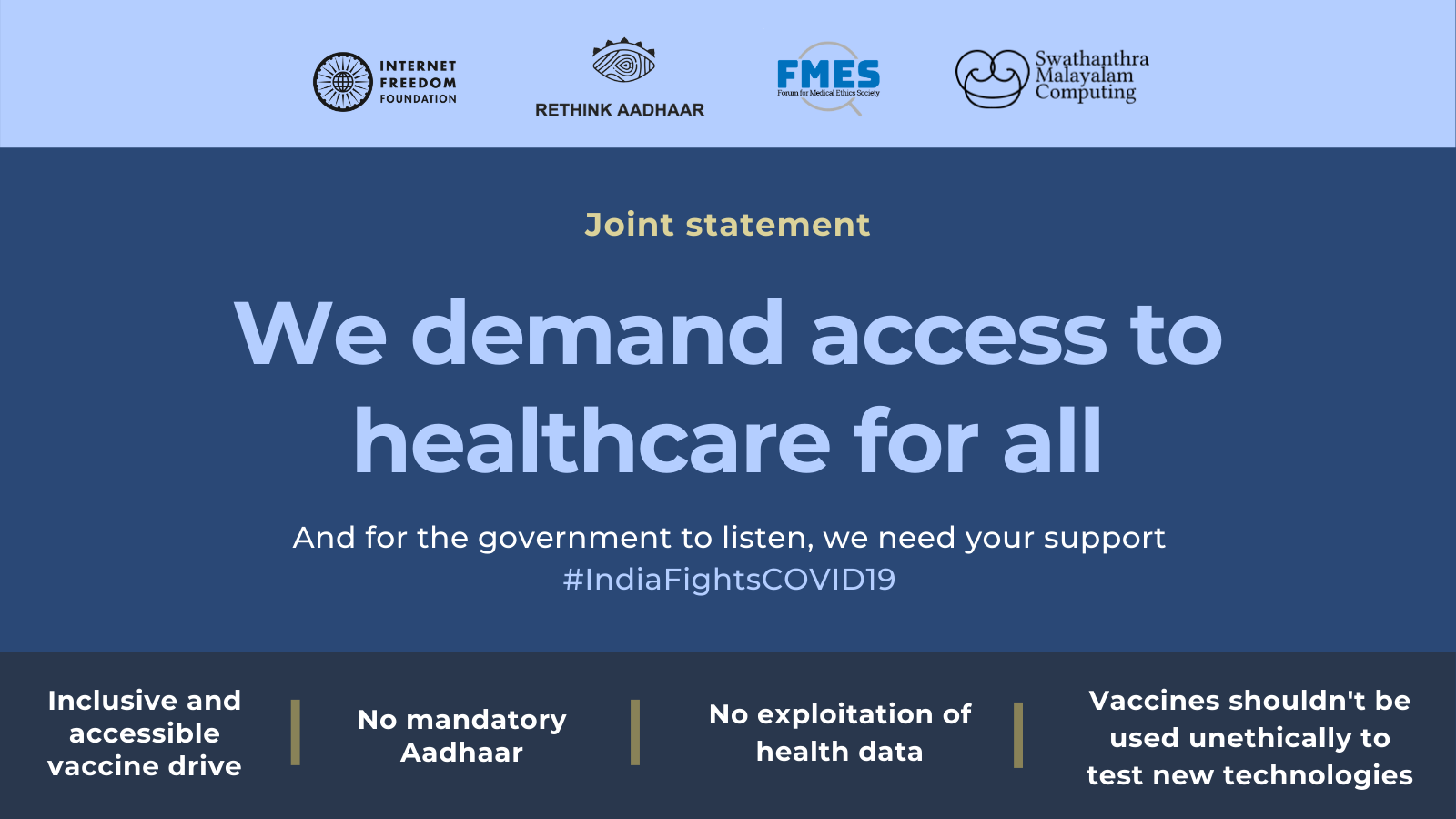
COVID-19 has wreaked havoc on India, as the second wave of the pandemic continues to ravage India's health infrastructure. In such desperate times, ensuring equitable, fast and easy access to healthcare, medicines and the vaccines is fundamental. Rethink Aadhaar joins the Internet Freedom Foundation, the Forum For Medical Ethics Society, and Swathanthra Malayalam Computing to make this joint statement.
We urge all government and administrative authorities to ensure that:
1) The vaccination drive is inclusive, equitable, and accessible,
2) The manacles of Aadhaar are not imposed as a condition for accessing critical healthcare services,
3) The vaccination programme is not used as a laboratory to test new technologies, and
4) Health data is not exploited under the pretenses of the pandemic.
We need your support for the government to listen to us! Please sign the statement by filling up this form and share it with your friends and family to help the citizens of India gain better and equitable access to healthcare services! Read the entire statement here.
### 14 Apr 2021 — Dangers of Aadhaar FRT for vaccine delivery > Join human rights and digital rights organisations and individuals across India, including those from the public health community in expressing their deep concern on the National Health Authority’s plans to use facial recognition for “contactless” COVID-19 vaccine delivery . Sign on here ! Original: https://rethinkaadhaar.in/blog/2021/4/14/joint-statement-facial-recognition-cannot-be-used-for-the-covid-19-vaccineJoin human rights and digital rights organisations and individuals across India, including those from the public health community in expressing their deep concern on the National Health Authority’s plans to use facial recognition for “contactless” COVID-19 vaccine delivery. Sign on here!
R.S. Sharma, the current head of the National Health Authority, and former chief of UIDAI said in a recent statement that the “Aadhaar-based facial recognition system could soon replace biometric fingerprint or iris scan machines at Covid-19 vaccination centres across the country in order to avoid infections.” This has given rise to considerable concern and anxiety for many who are yet to be vaccinated. FRT deployment would result in a drastic change in existing government policy for an inclusive rollout of the vaccination process. As per stated government policy, note that biometric authentication is not currently being used in the vaccination process. The Ministry of Health and Family Welfare clarified in the Lok Sabha that Aadhaar is not mandatory to receive the vaccine, and the ICMR’s guidelines on the vaccination process are clear that multiple forms of ID will be accepted. However in fresh guidelines released in early April, Aadhaar was indicated as the "preferred" mode of identity verification. The introduction of FRTs will only exacerbate the privacy and exclusionary concerns of such a move.
Facial recognition technologies (FRT) pose a grave threat to human rights, including privacy, and are being rolled out in the absence of a valid legal basis. Their unchecked rollout increases the risk of unchecked government surveillance, and mission creep. Evidence has shown that FRTs are not accurate and linking this untested technology to the vaccination roll-out will only exclude persons from the vaccine delivery system.
As India careens into a “second wave” of COVID-19, it is crucial that the government’s focus stays on increasing the speed, range and efficacy of vaccine delivery, and not use it to test out privacy harming technologies. The pandemic offers the Centre and State governments an opportunity to expand peoples’ access to healthcare as a matter of right, ensure healthcare is accessible and affordable, and that accessibility is not limited by imposing conditionalities such as enrolment in digital identification projects, or being coerced to use privacy harming technologies.
The joint statement calls on the Government of India and public officials, specifically Shri R.S. Sharma to :
Issue a public statement clearly stating that compliance will be ensured with existing government policies for vaccination that focus on universal and inclusive delivery rather than making Aadhaar and FRT based authentication as a basis, or pre-condition for availing it.
Transparently disclosing all technical and financial details of the FRT based system, whether any pilot studies are being conducted or being considered for the rollout of FRT based system. We urge that such necessary disclosure must be facilitated with open sourcing the algorithm for the proposed FRT based system.
As part of any potential pilot programme, conduct an independent human rights and equity audit that includes a privacy impact assessment of the FRT based system.
Read the Internet Freedom Foundation’s blogpost here, and the full statement here.
COVID-19, Co-WIN and curtailing the constant hunger for data
In this round-up of Aadhaar related updates, we cover the issues related to Aadhaar and vaccine delivery; the continued expansion of Aadhaar; what’s wrong with the proposed ONOR scheme (a lot); how Kerala is forcing Aadhaar upon people who want to access e-governance measures, and the Supreme Court’s recent decision in the Aadhaar review petition.
Aadhaar and the Vaccine
First, what’s happening with the government's proposal to link Aadhaar to the Co-WIN app, for vaccine delivery?
While the government has clarified that Aadhaar usage for authentication will be voluntary, states are being pushed to use Aadhaar as the “preferred mode.” According to Medianama, the Government has been recommending that States and Union Territories use Aadhaar in the COVID-19 vaccine rollout in order to “weed out proxies”.
A few weeks into its debut, there have already been complaints of glitches in the Co-WIN application, which has slowed down the vaccination drive. The experience with Aadhaar has taught us that the word voluntary can mean its exact opposite. Last week, Rethink Aadhaar released a statement expressing it’s concerns with this proposal.
India has a steady track record of vaccine delivery; and routing all vaccinations through an application, and introducing Aadhaar as a “voluntary but preferred” mode of authentication creates a dependance on technology, and forces citizens to hand over their privacy in exchange for a fundamental right.
The vaccine drive can turn into a large-scale data collection process for the Government, and connected private players. The link between data collection and the upcoming Digital Health ID system remains to be seen.
Beyond glitches, privacy violations abound
The entire process is rife with privacy violations. Neither the trial nor the Co-WIN application have privacy policies, which puts the health data of citizens from the world’s largest vaccination drive at risk.There have been reports of hospital administrations sharing Aadhaar details (without consent) of its staff to register them on the Co-WIN application.
Distinct extremely sensitive data silos are being integrated without any safeguards. For instance, the Election Commission of India has agreed to provide the Ministry of Home Affairs with electoral data for the vaccine drive. The Commission claims it will only provide “booth-wise information of voters above the age of 50”, directly to the respective states, as opposed to handing the entire data to one Ministry. While it is a welcome step that an attempt is being made to limit the extent of data being shared, the usage of voter data without adequate safeguards or notice, threatens their right to privacy.
Any intrusion into the fundamental right to privacy has to be necessary and proportionate. Voters have not given their consent to use their data in this manner; and this decision has been made without consulting relevant stakeholders. According to established data sharing principles, and the provisions of the Personal Data Protection Bill, 2019, data collected for a particular purpose must be used for that purpose only. Usage for any other reason can only be done after getting the informed consent of the data subjects (in this case, the voters whose IDs are going to be transferred).
There has been a rise in the number of Aadhaar enrollments ahead of the COVID-19 vaccine rollout (4.5 million registrations in December and 2.9 million in January). According to a news report by the Economic Times, this came right after the Prime Minister’s announcement in which it was said that the Aadhaar would be used to identify people for the vaccination. An official went so far as to call Aadhaar the ‘backbone of the vaccination’.
Rethink Aadhaar firmly stands against the pressure being put on citizens to link their Aadhaar numbers. When the Aarogya Setu application was made mandatory in 2020, many pushed back against this illegal surveillance mechanism, with some success when the Government, and Courts took a step back and decided that it could not be made a condition for exercising basic rights like the freedom of movement.
There is a need for a similarly strong community push to encourage people to stand firm and exercise their right to provide other identity cards as proofs, like the voter ID or a drivers license, in line with the objectives of purpose limitation, data privacy and the fundamental right to privacy of all citizens.
II. The Threat of “One Nation One Ration”
A parliamentary panel is being set up to discuss how to take forward the One Nation, One Ration (ONOR) scheme. The scheme aims to modify the current Public Distribution System (PDS), which currently allows ration cards holders to get subsidies only from the ration shops located in their States, to permit them access to other states. The government claims that the lack of “portability” affects communities like inter-state migrant workers, who are left to fend for themselves when they move to another State for employment. The Central government proposes to seed the Aadhaar number with ration cards, enforce biometric authentication of beneficiaries across the board, and “automate” fair price shops located across the country. As the experience with Aadhaar showed us, this would be a recipe for disaster.
While the idea for the scheme has been on the cards for some years now, the urgency of its implementation was expressed during the lockdown that began in March 2020 - as scores of migrants were left to fend for themselves. The benefits of the scheme however, are overstated. It promises more than it can deliver.
It is important to pose the following questions:
How are the logistical and supply chain management issues that are likely to arise to be fixed? Not all states offer the same PDS entitlements.
It ignores the realities of migration where often only one person from a family - usually a male member - migrates. Who will benefit from ONOR?
This will only apply to existing ration card holders. Remember that in 2020 the government temporarily added 8 crore migrants to the PDS lists - an indication that scores of vulnerable people have been left out of the PDS.
As with Aadhaar, ONOR promises a big-ticket, big-database without studies on migration patterns, and in place of less intrusive alternatives. You can read more about it in our explainer here.
Universalization of the PDS (i.e. wherein any citizen can walk in to buy subsidized grains from the PDS) is far more important than implementing a technologically intensive system of portability (ONOR).
For migrant workers who are in urban areas, community kitchens like Amma Canteens have proved to be a vital source of support, and a much more viable solution.
A bleak reminder of how Aadhaar continues to affect peoples’ lives
The excellent team at Roadscholarz has put together a summary of the exclusions caused because of Aadhaar.
Please also see this report on how JAM has impacted pensions and PDS delivery in Odisha.
As we know Aadhaar has enabled a whole parallel industry of frauds.
The latest story is how a 26-year old man from Bareily learnt how to clone fingerprints and hacked nearly 500 bank accounts.
The team at Roadscholarz have pulled together video-testimonies of victims of Aadhaar-enabled fraud through the Aadhaar-enabled payment scheme.
III. Updates from the Courts
Disappointingly, the Supreme Court in S.G. Vombatkere and Another versus Union of India and Others (Writ Petition (Civil) No. 829 of 2013) dismissed a petition asking for a review of the Aadhaar judgement (2018). Justice Chandrachud was the only judge on the Bench to dissent.
The majority felt that no grounds for review were made out as a “change in the law or subsequent decision/judgment of a coordinate or larger Bench by itself cannot be regarded as a ground for review.” This ignored all the other grounds raised in the review petition.
Justice Chandrachud in his dissent referred to the judgement in Rojer Mathew v. South Indian Bank Ltd. in which it was held that decisions of the Speaker on whether a Bill is a money bill (Article 110 (3) of the Constitution) is subject to judicial review. The bench in the Aadhaar judgement however did not deal with the issue of what the repercussions would be if the Bill was found not to satisfy the necessary conditions of Article 110.
It is important to remember that the Bench strength in the Rojer Mathew case and in the Aadhaar judgement were the same - constitution benches (5 judges). Thus, this unanswered issue posed a conflict between two coordinate judgements. The Rojer Mathew judgment decided that the issue would be referred to a larger bench in the Supreme Court for its consideration.
One of the main points that the review petitions challenged was the question of whether the Aadhaar Act constituted a Money Bill or not. Justice Chandrachud observed that it was a constitutional error to think that there was no grounds for review. While the larger Bench’s eventual judgement on the above question would be impactful, it was equally important for this Bench to decide on the current issue. He relied on the judgement in Kantaru Rajeevaru v Indian Young Lawyers Association, (which was decided by a nine judge bench in the Supreme Court) - instead of dismissing the review petitions, they could be kept pending until the judgement of the larger Bench comes through.
IV. Kerala: Aadhaar as Gatekeeper
In August 2020, Kalyani Menon-Sen and Bezwada Wilson had sent the Kerala Government a representation challenging the use of Aadhaar for user registration for the Integrated Local Self Governance Management System (ILGMS), an portal to access e-governance services.
The Kerala Government responded saying that there were alternate means through which citizens could apply through offline means, such as for instance, by visiting the local body in person.
Kalyani’s response raises some pertinent questions about how Aadhaar is being used as a gatekeeper to mediate the citizen’s right to the internet, and to access governance services remotely:
If Aadhaar is not required for the offline mode, then why make it mandatory for the online mode of registration?
Due to the pandemic, it might be difficult for citizens to physically go to the offline centres. In that case, applying through the e-filing mechanism might be a more convenient option for them. By making the Aadhaar number mandatory, it may act as an obstacle for citizen users.
In 2019, the Hon’ble High Court of Kerala recognized the right to access internet as a fundamental right. By making Aadhaar number mandatory for the e-filing process, it might restrict a citizen to completely enjoy this right. If they do not have an Aadhaar number they will not be able to register with the website.
Alternate IDs like the voter ID can be made an option for the e-filing registration. These IDs can also be used to authenticate the user.
V. What we’re watching, reading, thinking about
This excellent excerpt of an essay by Sandeep Mertia from a book titled ‘Lives of Data’ - 14 essays on the computational culture in India. The foreword has been written by Ravi Sundaram, from the Institute of Network Cultures. Please also look for Anumeha Yadav’s summary of her years documenting the impact of Aadhaar, in the same book which is available to download.
Usha Ramanathan’s talk on the need to reimagine what tech can do for us.
Jean Dreze, Reetika Khera, Isabel Pimenta, and Prankur Gupta spoke to the Economic and Political Weekly about the problem of food security in India, and what Aadhaar has got to do with it.
Whose Data? Our Data!
India has claimed that FastTag will be made mandatory from February 16, 2021, while we have a minimal understanding of how this data is going to be used. In February 2021, the Government admitted that it made Rs. 11 crore from selling peoples’ vehicle data to private parties.
Get in touch!
Please write to us if you have stories of Aadhaar-related coercion to share - schools, private employers, or for accessing essential services.
Engage with our legislators:
We encourage you to send in questions or issues related to Aadhaar or data protection which can be raised in Parliament during the Budget Session. (From March 8 to April 8, 2021) You can email Maadhyam at maadhyam.connect@gmail.com.
Ask friends and family to subscribe!
Please email <rethink-aadhaar-subscribe@lists.riseup.net> to sign up to Rethink Aadhaar's mailing list.
On January 16, 2020, the Government of India initiated a country-wide COVID vaccination drive, which will be facilitated via the COVID-19 Vaccine Intelligence Network (Co-WIN).
Rethink Aadhaar is concerned that the requirement in the Co-WIN vaccine delivery system, that Aadhaar authentication is to be the “preferred mode” for authentication, creates an impermissible barrier to access the vaccine and will violate the right to health. Additionally, Rethink Aadhaar is concerned about the lack of transparency around how the government plans to store and use the data that will be collected as part of the vaccine delivery process.
Co-WIN is a platform and app that has been developed by the Government of India, to track the delivery of the COVID-19 vaccine.
As per reports, the app will require citizens to “self-register” in order to get the COVID-19 vaccine. According to the Health Secretary, Aadhaar-based authentication will be the “preferred mode” to verify the identity of beneficiaries. Additionally, according to the Operational Guidelines on COVID-19 Vaccination (point 7.2.3) issued by the Ministry of Health and Family Welfare, the production of an Aadhaar number will be mandatory to receive the vaccination certificate issued once the vaccination is complete.
The guidelines state that the platform will be used to track the beneficiaries health on a “real-time basis” after they receive the vaccination. After the beneficiary receives both doses of the vaccine, the Co-WIN application will generate a “QR certificate”, which will be stored in the Government’s DigiLocker application. A DigiLocker account can be accessed either using the unique ID (an ID specific to Digilocker which is linked to the person’s Aadhaar number) or the registered mobile number of the account holder.
The Aadhaar details of persons who receive the vaccine will be used to create a Unique Health ID for them, albeit only for “willing beneficiaries”.
Thus, it appears that data collected for the vaccine delivery system will be used to populate the Digital Health ID database, and people’s vaccine certificates will be stored on DigiLocker. Collating people’s health information in this manner, even as India lacks a legal framework to safeguard citizens’ data or health information, is a dangerous step.
This raises serious concerns:
Making the vaccine or subsequent certification conditional on Aadhaar authentication or linkage, would go against all tenets of medical ethics, is a violation of the basic and fundamental right to health, and would also be poor public policy as the roll-out of the vaccine should be focused on universal access to the vaccine.
The Central government’s requirement that Aadhaar authentication is be the “preferred mode” for authentication of identities, as well as the requirement that mobile phone numbers be linked to Aadhaar to pre-register on the app, will exclude citizens. Any requirement to mandatorily link mobile numbers with Aadhaar – as some reports have indicated could be the case – would violate the Supreme Court’s judgement on the constitutionality of Aadhaar. As recent report by Medianama shows, as of August 2020, nearly 11% of India’s population still does not have an Aadhaar number. Errors happen frequently in the huge and complicated Aadhaar infrastructure, leading to authentication failures. Conditioning the vaccine to Aadhaar authentication will repeat the mass exclusion already seen after Aadhaar was linked to essential services and entitlements to food, pensions, scholarships.
The lack of privacy safeguards, either in the app or in the vaccine delivery system as a whole, is a serious violation of the right to privacy.
Details on where the data related to vaccination will be shared/stored are not addressed in the app’s consent form, which only makes a blanket statement about “maintaining the privacy and confidentiality of the information provided”. Neither the website nor the application have privacy policies that address how the health data will be protected. Data related to health is sensitive data and should be accorded the highest level of protection. The Karnataka High Court’s recent interim order on Aarogya Setu, reiterated the importance of ensuring health-related data collected to track the spread of COVID-19 is safeguarded. It held that medical information or data is a category of data to which there is a reasonable expectation of privacy, and “the sharing of health data of a citizen without his/her consent will necessarily infringe his/her fundamental right of privacy under Article 21 of the Constitution of India.”
The vaccine delivery system is being used to populate the database for the Digital Health ID and to coerce people to use Digilocker.
This is a coercive step which is being taken without due deliberation or public scrutiny, and with no consideration for privacy rights. This would also violate the fundamental principle of purpose limitation, that data collected for one purpose (for the vaccine) cannot be reused for another (for the creation of the Digital Health ID system) without an individual’s explicit consent and the option to opt-out with no adverse implications of doing so. There are worrying reports of hospital administrations sharing Aadhaar details of its staff to register them on the Co-WIN application, even without their consent. The vaccine delivery should not be used as a cover to create a Digital health ID without sufficient public debate, and safeguards to ensure that people are free to choose not to enroll.
Rethink Aadhaar urges the Government to:
Adopt all possible measures to ease access to the vaccine, investing resources to improve health services, and delink the requirement of Aadhaar for the vaccine. A notification must be issued reiterating the point that multiple IDs, apart from Aadhaar, can be submitted to get access to the vaccination.
Clearly establish the privacy policies of the Co-WIN application, particularly with respect to the protection of the health data of the beneficiaries. More particularly, assurances must be provided that the vaccine delivery system will not be used to populate the database for the Digital Health ID or used to coerce people to use Digilocker.
Ensure that adequate safeguards are taken against making a health ID mandatory, including issuing a notification in line with the Health Data Management Policy which states that “no individual shall be denied access to any health facility or service, or any other right in any way merely by reason of not being in possession of a Health ID or for not opting to participate in the NDHE.”
The Indian public health system has administered large scale vaccine programs in the past with relative efficiency, without such restrictions and conditions, and should trust its public health systems to do so for COVID as well, without making it restrictive, conditional or linked to a digital health system which is in its infancy and surrounded by legal and ethical concerns. The vaccine delivery should not be used as a cover to create Digital Health IDs without sufficient public debate, and without enough safeguards to ensure that people are free to choose not to enroll.
### 25 Nov 2020 — Aadhaar DBT Scam > Aadhaar-based Scholarships Scam in Jharkhand Shows How Aadhaar Leaks Public Funds, Deprives Citizens In a recent investigation of scholarship schemes in Jharkhand, Many ways to dupe a poor student , the Indian Express brought to light how social security benefits be Original: https://rethinkaadhaar.in/blog/2020/11/25/yet-another-aadhaar-enabled-scam-when-will-the-government-wake-upAadhaar-based Scholarships Scam in Jharkhand Shows How Aadhaar Leaks Public Funds, Deprives Citizens
In a recent investigation of scholarship schemes in Jharkhand, Many ways to dupe a poor student, the Indian Express brought to light how social security benefits being transferred via the Aadhaar-based Direct Benefit Transfer (“DBT”) system are being siphoned off by a nexus of business correspondents, agents, banking staff and school staff, with beneficiaries completely left in the dark.
The leaks and malpractice along the chain in the Aadhaar-based Direct Benefit Transfer of scholarships exposed by The Indian Express are not isolated instances but are an inevitable part of the design of the Aadhaar-based DBT system, as several features of this system enable these types of scams or “diverted payments”.
Three successive governments in India have pushed for mandatory Aadhaar enrolment and linking to bank accounts, even in the absence of an adequate legal framework and a corresponding electronic and bank infrastructure, claiming it would make welfare delivery better targeted, efficient, and free of middlemen. Yet, there is silence when corruption and theft of public funds enabled by the Aadhaar-DBT system are brought to light with increasing frequency. Such scams have been seen multiple times, including the “LPG scam” which was widely reported in 2017. People’s LPG subsidies were diverted, via the Aadhaar-linked DBT process, to unrelated Airtel payment banks that they had no access to. Despite being written about extensively, no action has been taken to fix the systemic issues that enable these scams.
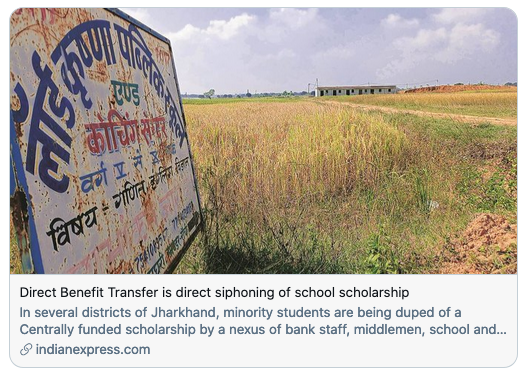
With the Aadhaar-based DBT system, beneficiaries are unaware of how and when their personal details, including Aadhaar numbers, are used to divert payments. Often real beneficiaries complain about not receiving the amount transferred via DBT in their bank accounts, as government departments create multiple bank accounts to transfer subsidies to, without the knowledge of the person in whose name the account has been created. This method, of creating new accounts without the consent of beneficiaries in order to transfer subsidies, has made it easy for scammers to replace the bank account numbers of actual beneficiaries with unrelated accounts that beneficiaries have no access to. When DBTs are transferred to bank accounts, there is no reliable and accurate system to check if it went to the intended beneficiary.
However, neither the UIDAIs nor the cabinet secretariat that supervises the DBT Mission have taken responsibility to provide transparent and credible redress methods, clear public information on who is responsible for solving these errors, or compensation for those affected by these systemic flaws.
"Direct Benefit" to Scammers
Technological systems, praised as transparency measures, are often opaque and do not allow either beneficiaries or the public to evaluate them. The administration’s push to adopt these systems has already cost the lives of scores of citizens who were not able to access their PDS entitlements because of Aadhaar-linkage based errors.
The “Aadhaar Payments Bridge” the payment mode used for Aadhaar-based DBT transfers, has altered the way in which money is transferred from the Consolidated Fund of India to the bank account of an individual beneficiary, by adding additional layers to the transaction, with no additional checks for transparency or accountability.
In the older system of Direct Benefit Transfers, conducted through a NEFT transaction, the Reserve Bank of India was the sole “middle layer” between banks. In contrast, in the new system, the National Payments Corporation of India (NPCI), a private organisation, operates as the “clearing house,” using the "Aadhaar Payments Bridge system".
Under the Aadhaar Payments Bridge system, Aadhaar numbers replace bank accounts as the “financial address” of the beneficiary. The “Aadhaar mapper,” created and managed by the NPCI, links the Aadhaar number to the bank account number, to facilitate the transfer of incoming funds. However, this linkage is done arbitrarily to the “last linked” bank account, and with no way of checking whose account it is. Although beneficiaries’ consent is supposed to be a prerequisite to this linking or mapping”, it is totally absent in practice, leaving beneficiaries in the dark about which accounts have been created in their names or linked to their Aadhaar numbers.
This has introduced an additional layer of complexity and opaqueness into the payments system, as the bank account(s) linked to the Aadhaar number are only available with NPCI, a private organization, with no way of alerting the beneficiary whose Aadhaar number has been used.
Additionally, multiple central authorities taking over the role of clearing payments directly to the bank accounts of beneficiaries has detrimental implications on federalism and the basic tenets of decentralization, as state governments and elected representatives at the District, Block and Gram Panchayat level have no authority or control to manage DBT payments.
This has been amply demonstrated in the case of Jharkhand where middlemen and corrupt officials succeeded in abusing the systemic faults in the Aadhaar-based DBT system to siphon scholarships meant for students from minority families. They were able to create fake beneficiaries, multiple bank accounts and incorrectly seed bank accounts to Aadhaar numbers. It has clearly demonstrated the total ineffectiveness of the Aadhaar-based DBT architecture in checking corruption, and the urgent need for reform.
We make the following demands to the DBT Mission under the union Cabinet Secretariat, the UIDAI, and the Controller General of Accounts:
Aadhaar-linked DBT be made optional for welfare schemes.
The Central Government must develop an accountability framework for the implementation of DBT schemes, including:
provisions for citizens to file grievances through multiple modes;
dated acknowledgement of grievances;
time-bound redress of grievances through a decentralized mechanism
an independent appellate mechanism to oversee its credible compliance.
The Central Government lays down norms to pinpoint accountability across Government Departments, autonomous bodies, statutory authorities, parastatal organizations and private agencies for violation of citizens’ rights to entitlements.
The DBT Mission should permit social audits, as per the Auditing Standards of Social Audit laid down by the Comptroller and Auditor General of India, of the implementation of DBT schemes, particularly with regard to the processes of beneficiary identification, and the verification of payment transfers in order to ensure that the systems meet the highest standards of transparency and accountability.
The DBT mission and Controller General of Accounts must publish all details relating to the implementation of DBT schemes suo moto in the public domain, as mandated by Section 4 of the Right to Information Act. Information disclosed should contain details regarding the number of applicants, the status of heard applications, status of payments, and the list of payments that have failed.
—
Read more in Length of the Last Mile, published in November 2020 by LibTech India, about the last mile challenges faced by NREGA workers in accessing their wages, after wages have been credited to the workers’ bank or postal accounts. "Roughly one in twenty wage payment transactions get rejected due to technical errors such as incorrect account number or incorrect linking of Aadhaar with bank accounts."
### 2 Oct 2020 — Report of the People's Tribunal on Aadhaar Related Issues > Date: 2nd October, 2020 Press Release Launch of the Jury Report from the People’s Tribunal on Aadhaar-related Issues In August 1906, the Asiatic Law Amendment Ordinance was signed into law in the Transvaal, in South Africa. It was a humiliating and discriminating law, forci Original: https://rethinkaadhaar.in/blog/2020/10/2/report-of-the-peoples-tribunal-on-aadhaar-related-issues-1Date: 2nd October, 2020
Press Release
Launch of the Jury Report from the People’s Tribunal on Aadhaar-related Issues
In August 1906, the Asiatic Law Amendment Ordinance was signed into law in the Transvaal, in South Africa. It was a humiliating and discriminating law, forcing Indians in the Transvaal to register with the ‘registrar of Asiatics,’ submit to physical examinations, provide fingerprints, and carry a registration certificate at all times. Rebelling against this was the first act of non-violent political resistance that Mahatma Gandhi engaged in.
Today, on Gandhi Jayanti, we commemorate Gandhi’s resistance to fingerprinting, with the launch of the Jury Report from the People’s Tribunal on Aadhaar-related Issues which was formally released virtually today on 2nd October, 2020.
The Jury report comprises the responses and opinions of the four members who adjudicated the People’s Tribunal on Aadhaar-related issues, viz. Dr. Subhashis Banerjee (IIT Delhi), Dr. Tarangini Sriraman (Azim Premji University), Ms. Patricia Mukhim (Shillong Times), and Mr. Ram Sundaram (TerraPay). It also contains a summary of the proceedings and, along with the Aadhaar Tribunal Evidence Book, forms a timely critique of the Aadhaar project ten years since its inception and two years since the Supreme Court significantly curtailed the scope of the Aadhaar project.
The People’s Tribunal on Aadhaar-related Issues was held on 29 February and 1 March, 2020, in New Delhi. Over the two days of the Tribunal, we witnessed a host of depositions and presentations on critical aspects of the Aadhaar project by presenters speaking about various grassroots campaigns and movements. The discussions covered the Aadhaar project’s impact on welfare, its information security architecture, issues with legislative and judicial oversight, as well as the project’s function creep. A video summary of the Tribunal can be found here.
Dr. Reetika Khera (Development Economist), Dr. Sunita Bandewar (Health rights activist expert on health ethics), and Sr. Adv. Meenakshi Arora (Senior Advocate, Supreme Court) were the panelists speaking at the release of the Jury report. The entire panel discussion can be viewed here.
Dr. Reetika Khera observed that the Aadhaar project has failed to solve the problem of corruption in welfare, but poor people have paid the price of the failings of the program. She argued that the denial of benefits and exclusion has been deemed acceptable by the government while, in the garb of ‘voluntary’ use, Aadhaar continues to be expanded further. She pointed out how Aadhaar is an admission of government failure, and is based on a misunderstanding - or refusal to acknowledge - how corruption works. A ration dealer can force a person to authenticate their fingerprint for 35kg instead of signing a register, but still give the person only 30kg - mandating fingerprint authentication cannot solve this problem. According to Dr. Khera, the privacy and data protection concerns which have been expressed with Aadhaar are applicable to other technologies, which are now getting noticed. “What took 7 years for Aadhaar,” she said, “happened within 7 days in the case of Aarogya Setu”. Thanks to the rapid furore around the Aarogya Setu app, the government had to backtrack on making it mandatory. She concluded her remarks by saying that the next “scene of contest” will be the data protection laws, and there is a need to take these conversations to a wider set of people.
Sr. Adv. Meenakshi Arora initiated her remarks by reiterating the capability of the Aadhaar project to enable “360o surveillance” via allowing the linking of data silos, which to her was akin to living in a glass box. She also pointed out how, despite the Supreme Court’s judgment prohibiting it, the private sector continues to use and access Aadhaar data. Drawing on her arguments before the Constitution Bench in the Aadhaar hearings, she spoke of a case from the United Kingdom wherein the European Court of Human Rights struck down the powers of the police to retain data related to the criminal antecedents of a person. The ECHR called this a deep and serious intrusion of privacy. In contrast, the Indian Supreme Court failed to adopt a similar reasoning around Aadhaar-linked databasing. She also recounted another case relating to telecommunication data in which the Constitutional Court of Germany struck down a 6-month data retention period, stating that there was a “reasonable apprehension” that the data may be misused. This reasoning wasn’t accepted by the Indian Supreme Court either. She concluded her remarks by pointing out the leeway given to the government for the Aadhaar project, and that the government’s overdrive to link Aadhaar to various activities amounted to losing whatever little was gained by the Supreme Court’s judgment.
Dr. Sunita Bandewar opened her remarks by commenting on how the lack of public consultation on technological projects like Aadhaar doesn’t bode well for a democracy. In the absence of open and transparent conversations around the ‘buts’ and ‘caveats’ of technological projects, she said, they are reduced to mere “technocratic fixes,” which are not robust. She observed how in its response to the COVID-19 pandemic, the central government as well as several state governments launched several contact tracking apps without fully understanding the “social determinants” on the ground. With respect to the private interests in pushing for technological solutions, she referred to NITI Aayog’s whitepaper on Artificial Intelligence (AI) in different sectors, noting that private players with a stake in digital technology and AI played a vital role in drafting the whitepaper. Further, the whitepaper itself keeps referring to the economics of AI, with only passing mentions of ethical considerations. Concluding her remarks, she stated that data sharing is a valuable exercise, for instance in the bioethics domain especially with respect to clinical trials where good datasets are needed to understand the gendered impact of Covid-19. But in contrast, data collection and sharing of the Aadhaar database has not happened in a transparent manner, through proper public engagement.
The Jury Report launch and panel discussion concluded with brief remarks from Ms. Usha Ramanathan who argued that technology policies need to be critically analyzed from the perspective of the vested interests they serve, by creating a perception that people are inefficient, corrupt, and replaceable by technology.
------
For further information about the Jury Report and the People’s Tribunal on Aadhaar-related Issues, please contact Rethink Aadhaar at contact@rethinkaadhaar.in, and Article 21 Trust at art21ind@gmail.com.
### 28 Sep 2020 — Rethinking Aadhaar: Two Years After Supreme Court's Judgement > Despite the Supreme Court's order, the use of Aadhaar continues to proliferate, causing hardship, exclusion and shoring up the surveillance capabilities of the state. Original: https://rethinkaadhaar.in/blog/2020/9/28/5tesn475qe4vwaepok94t876vkuwpdSaturday, 26th September 2020, marked two years since the Supreme Court’s 2018 judgement in KS Puttaswamy v Union of India (2019 10 SCC 1), on the constitutionality of the Aadhaar project. Building on the constitutional rights to privacy, a clear red line was drawn to contain the Aadhaar project, while Justice Chandrachud’s dissent stuck the project down in its entirety. Courts in Kenya and Jamaica have subsequently relied on Justice Chandachud’s dissent, while containing or striking down similar national ID systems. Private parties were expressly ruled out, and mandatory Aadhaar authentication was only permitted for welfare services and PAN-Aadhaar linkage. However, the spread of Aadhaar continued. This primer laid out what was and wasn’t allowed by the Supreme Court's judgement. Despite the Supreme Court’s judgement, the use of Aadhaar continues to proliferate, though the push-back, too, continues.
In 2019, some of the petitioners in the Aadhaar petition challenged the Aadhaar Amendment Act, 2019. The Amendment permits private parties to continue to use Aadhaar authentication, albeit on a “voluntary basis”. The challenge to the Act is pending consideration by the Supreme Court.
Several notifications, permitting private parties including health insurance companies to use Aadhaar have been issued over the last few months.
Review petitions challenging the 2018 Aadhaar judgement are also pending.
In August of this year, the Aadhaar Authentication for Good Governance (Social Welfare, Innovation, Knowledge) Rules, 2020 were released. These expand the permissible uses for Aadhaar authentication for digital platforms for good governance, to "prevent dissipation of social welfare benefits" and to "enable innovation and spread of knowledge”. This widens the scope of Aadhaar beyond permissible limits and needs to be challenged.
As we go through various types of lockdowns and unlockdowns, this quarterly update from Rethink Aadhaar is to share stories, research and resistance, and ask for your support and continued resistance as we challenge state and corporate efforts that want surveillance and techno-solutionism to take over our lives.
It has been several months since our last update, and like everyone else, we at Rethink Aadhaar have been trying to understand the impact of the COVID-19 pandemic, the subsequent lockdown, and its immense financial and economic impact. The country has been brought to a standstill, lakhs of people without jobs, without access to income, social security or care. Migrant workers were particularly impacted, and thousands were left stranded away from their homes and sources of income.
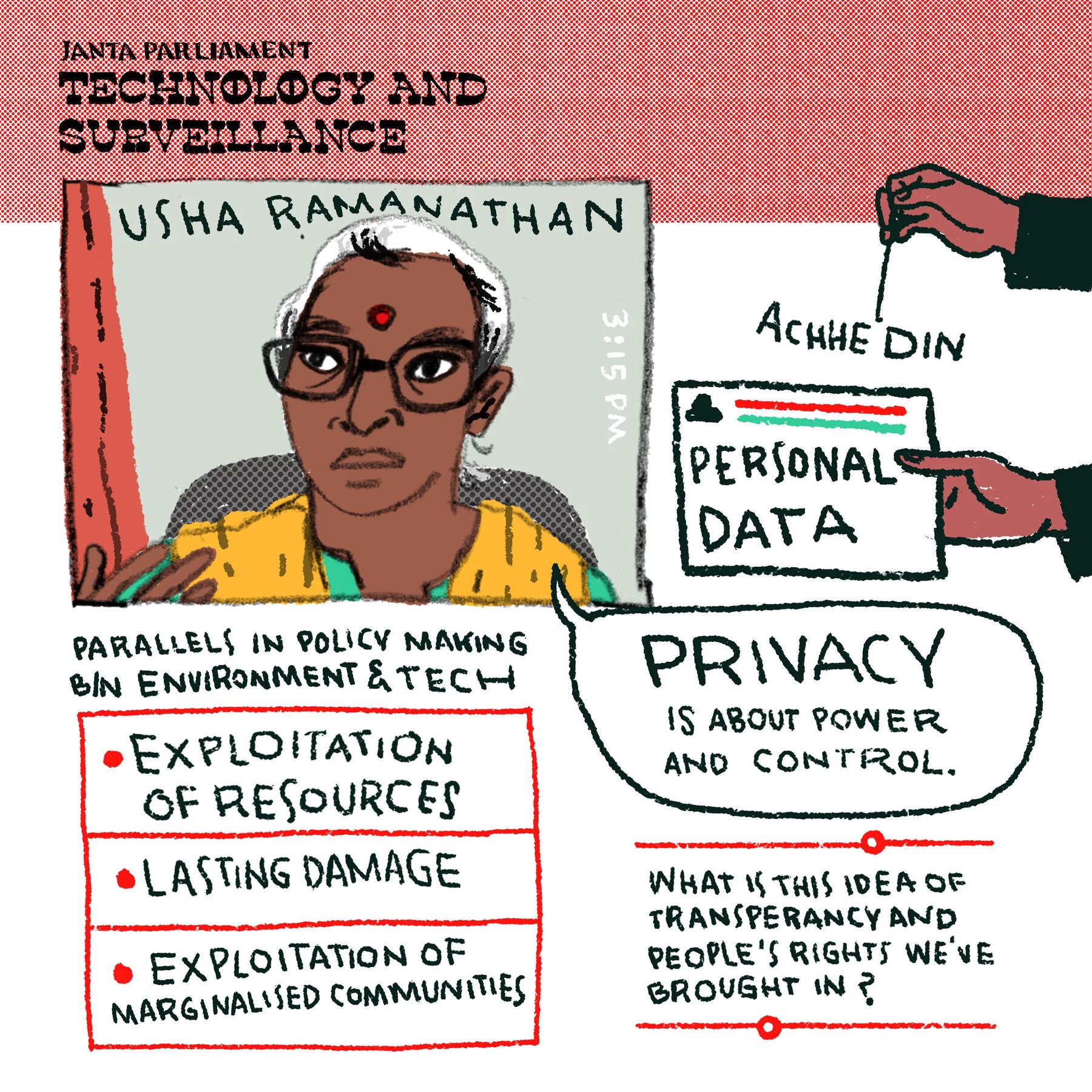
Image by Kruttika Susarla, for Rethink Aadhaar
A term that has captured the imagination of our time is that it was unprecedented. But a term closer to its impact is how it has exacerbated existing fault lines of caste, race, class, gender and location. It’s fairly easy to trace over those fault lines to see who has been worst affected by the pandemic: who is able to work from home, who is able to access basic resources, stay home in safety, and who is able to have access to pleasure, community and joy.
The pandemic has made it clear that safety nets, including welfare and social security play a vital role in not just enhancing peoples’ lives, but ensuring their survival, and how unthinkingly adopted technological “solutions,” perpetuate inequities with tragic results. In July 2020, 46-year-old Dukhi Jani, a tribal widow from Odisha died of starvation. Despite the existence of several central and state schemes, Dukhi had no safety net. The Right to Food Campaign, Odisha’s fact-finding team found that she had been struck off the lists for state entitlements, due to non-seeding of Aadhaar number with her ration card. She would not have died if there was even a modicum of accountability and transparency. Bureaucratic apathy is being enabled by technology’s opacity. It’s easier than ever to say: I don’t know. The system doesn’t permit it.
One would think this could be a moment of collective, social and political introspection, but instead we’re seeing a rush towards more techno-solutionism, with “surveillance capitalists” crawling out of the woodwork. Eerily reminiscent of Naomi Klein’s description in the Shock Doctrine, the public’s disorientation after the disaster is being used to push through radical pro-corporate measures.
COVID-19 and Aadhaar
“Digitization is being used to reduce the number of beneficiaries”
On 23rd March, 2020 the Prime Minister announced a national lockdown with four hours notice, leading to chaos on the streets and across the country. The Right to Food Campaign has collated details of various measures adopted by the Central and state governments here.
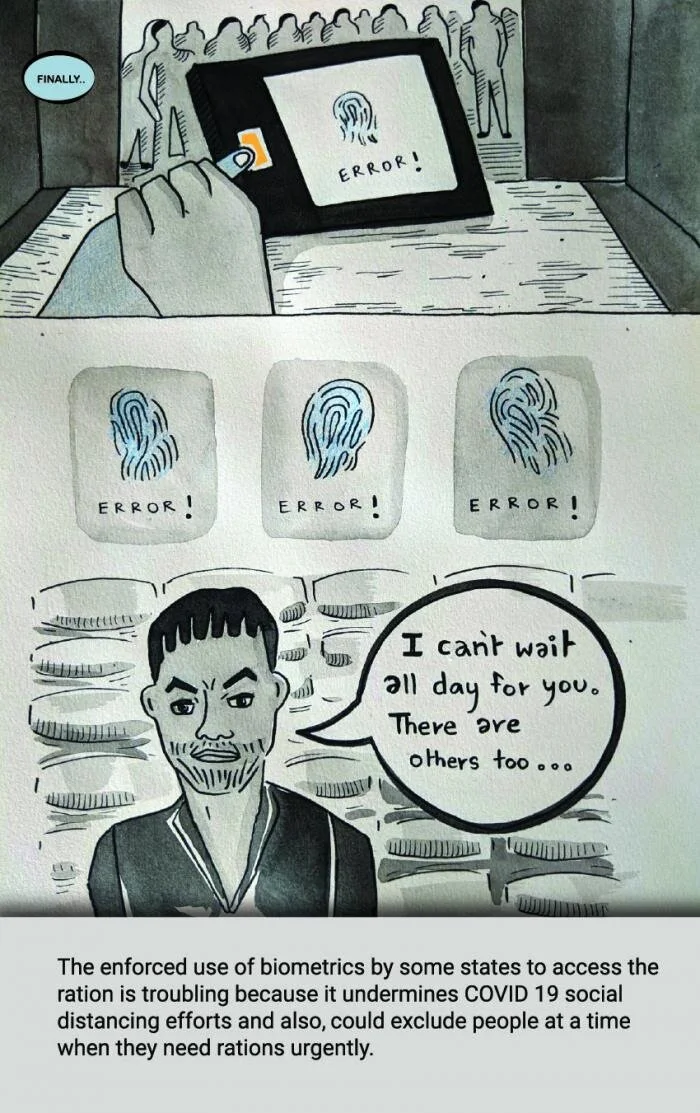
Image by Shoili Kanungo, for Newsclick
The PDS, social security pensions, and NREGA are vital sources of support, and Aadhaar linkages in all three have been a source of disruption and exclusion. Tragically, across the country, hundreds of deaths have been caused by starvation, during the pandemic. These are times where the rigidity embodied in technologies like Aadhaar strongly resist the urgent need for empathetic and flexible social policy. In fact, even when the Aadhaar technology “works”, the objectives it supposedly achieves (like ‘efficiency’, ‘targeting’) are the exact opposite of what a government should be aiming for in the middle of a humanitarian crisis.
Migrant workers, who had already waited weeks to find a way to leave the cities they were working in, were being asked for Aadhaar to board trains. Some were denied rations. Identity verification only added to the abominable indignity they were already facing.
Social security pensions are a vital source of support for the most marginalised. Rethink Aadhaar joined the Right to Food campaign, Odisha to condemn the Odisha Government’s decision restricting the payment of social security pensions to those whose accounts are linked to Aadhaarm pointing out that an estimated 11 lakh beneficiaries are likely to be deprived of their pensions as a consequence. While temporary relief was given by a follow-up notification specifying that pensions were to be disbursed regardless of Aadhaar enrollment the root problem, that an opaque Aadhaar seeding process was being carried out to remove “ghost accounts,” remains. For more details, see Sweta Dash’s piece on Aadhaar-based exclusion in the PDS and pension schemes in Odisha.
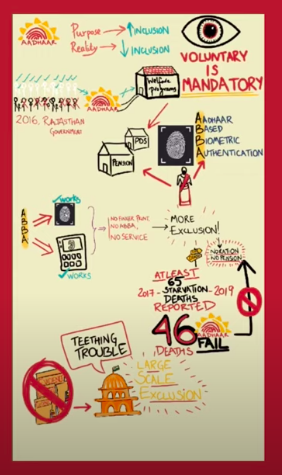
Digitalising the bureaucracy: digilocker to e-governance
Rethink Aadhaar joined other digital rights organisations to endorse a legal notice to the Kerala government, for its integrated Local Governance Management System (ILGMS) that mandates Aadhaar. These linkages need to be explored in greater detail, including Digilocker and e-governance linkages to Aadhaar.
Destruction of the payments systems
Even before the pandemic, Aadhaar linkages had ruined existing payment systems, causing delayed payments, enabling the creation of “ghost accounts” and resulting in misdirected payments. As expected, these problems have continued. The Aadhaar-Enabled Payments System (AePS) is the most common reason for delays in payment. An estimated 5.3 crore construction workers experienced delayed payments because their bank details weren’t linked to their Aadhaar numbers. At least two reports suggested that the surge in AePS transactions during the lockdown resulted in a large share of transaction failures.
Despite this, AEPS and the Aadhaar Payments Bridge Systems (APBS) continues to be used for many Aadhaar-based DBT transfers by the Government. In the MGNREGA, there have been problems related to these payments, with many payments getting rejected with workers not getting the due payment timely. Similarly, transfers related to the PM Kisan Samman Nidhi saw a drop in numbers once Aadhaar Based Payment was introduced. The reasons for this failure are often unclear -- for instance, a mismatch in names in Land Records, bank accounts and the Aadhaar database, might cause payments to fail.
Several important studies have drawn out the roots and consequences of Aadhaar-related failures in the payments system:
This case study by Rajendran Narayanan and Sakina Dhorajiwala documents a particularly distressing case of two women in Jharkhand, with the same name who found out they had the same bank account and the same branch.
Sakina Dhorajiwala has also drawn out the lack of accountability in the rollout of technology, particularly for the most marginalised. The digitisation of welfare delivery systems has happened at the cost of the marginalised, who continue to bear the brunt of the government’s techno-fetishism.
The failures of the ABPS have also been documented here, by Jean Dreze and Sakina.
The Analog impacts of Digital Solutions
Aadhaar and other digital IDs threaten privacy, and limit access to health care
Linking health to Aadhaar raises serious concerns about surveillance, privacy, confidentiality and ethics related to the collection, storage and sharing of health data of patients. The pandemic offers an opportunity for national and State governments to expand peoples’ access to healthcare as a matter of right, to ensure healthcare is accessible and affordable, and accessibility is not limited by imposing conditionalities such as enrolment in digital identification projects.
Contact tracing
The lockdown guidelines initially made the Aarogya Setu app mandatory. This was later reduced to a direction to ensure that this is rolled out on a “best effort basis”. The app’s design raised concerns of excessive data collection, with a lack of clarity around how this sensitive health and location data it was collecting would be used, particularly given the absence of a data protection law, or even a law governing the use of the app. It was also inaccessible to the majority of Indians, who don’t own smartphones. A constitutional challenge to Aarogya Setu is pending in the Karnataka High Court.
Mandatory Aadhaar for testing and drugs
Several states announced Aadhaar for COVID-19 related tests and medicines. In Karnataka, officials reportedly said Aadhaar cards were mandatory to access health care. Rethink Aadhaar joined JSA Rajasthan and other digital rights organisations to condemn this. In August 2020, the government of Rajasthan clarified that Aadhaar was not mandatory for any COVID-19 related tests. This is a much needed - though limited - win! Aadhaar needs to be withdrawn from all health services.
Things to watch out for
Disaster capitalism and more
One Nation One Ration Card: a nation wide overhaul of the Public Distribution System (“One Nation One Ration Card”) is being proposed, which will be rolled out by March 2021, or beyond. While a system to ensure PDS rations can be accessed across the country is important, the requirement to “seed” existing ration cards with Aadhaar numbers will only make this exercise exclusionary. The experience of the past few months have shown that universalizing the PDS is much more urgent than implementing a technologically-intensive system of portability. Reetika Khera has written about this in 2018.
The Personal Data Protection Bill continues to be under review by a Joint Parliamentary Committee, and law enforcement agencies have reportedly argued for wider exemptions.
Health IDs The Government has rushed to develop a health data policy and is advocating the use of Health IDs (under the National Digital Health Mission). The short time frame for consultation has been challenged in the Delhi High Court. The push for the digitisation of health records, is related to the development of a Health Stack which was first described in a 2019 Niti Ayog report, which plans to create a unique ID similar to Aadhaar, for healthcare. Several commercial actors are interested in this, many of whom have been linked to iSpirt. The Scroll carried a handy explainer.
Non-personal data The Non-Personal Data Committee released its report, which encourages wider sharing of non-personal data to derive economic value, and for other purposes like national security, dealing with pandemics and preventing crimes. This threatens to increase surveillance. The government also initiated a consultation on a "Non-Personal Data Governance Framework", which lays out measures to derive economic value and other purposes, including national security. Access Now's submission was a good summary of the privacy, surveillance and other digital rights issues that this framework raises.
Another database to keep an eye out for is the proposed National Migrant Information System.
Good news (kind of)
PAN linking: The last date for this has been postponed once again, to March 2021.
NPR: The NPR exercise has been pushed to next year. However, this will still require critique and engagement.
Aadhaar Tribunal: In March 2020, when meeting in person was still possible, we had the privilege of joining other social movements to present evidence of Aadhaar’s many failures before an eminent jury. The Jury Report will be out on the 2nd of October, 2020!
Janta Parliament: Rethink Aadhaar and Article 21 also anchored the session on technology and surveillance at the Janta Parliament held over August 15th - 20th, 2020. You can read a summary here.
Other readings
The security challenges with Aadhaar continue. The instances are too numerous to detail, but Anmol Somanchi has been putting together a useful database of Aadhaar Fakes and Fraudulent Transactions (DAAFT). Just an illustrative example: in August 2020, Altnews reported on the world of facebook groups where on-demand Aadhaar cards are sold and “edited”.
We’re excited to read the AI Now Institute’s report on Regulating Biometrics, examining the global spread of biometrics, and measures to regulate it.
To see global trends in the fight against digital identity, see Privacy International released a guide to litigating national identity systems. Also check out the Center for Internet and Society’s report on judicial trends.
Call to action
The people united will never be defeated
As we move forward, we want to collect information about violations of the Supreme Court’s final judgement and order limiting Aadhaar.
Please do write to us if you know of, or have faced any mandatory demands for Aadhaar in any field not related to government subsidies (such as exams, school admission, pension (even govt. pensions), etc.). We can be found at rethink.uid@gmail.com and contact@rethinkaadhaar.in.
You can use this draft letter of objection if you are asked for your Aadhaar number for any service that isn't related to a government subsidy or benefit.
Finally, Rethink Aadhaar is run by a team of volunteers. Please write to us if you would like to help out, want to share information, or if you have suggestions on what we should be focussing on!
### 9 Sep 2020 — Odisha Government rolls back order on Aadhaar-Pension: But is that enough? > On 27th August 2020, the Government of Odisha rolled back its plans to link Aadhaar to social pensions, clarifying in a notification that Aadhaar numbers were not needed for pensions in this round, stating that “Aadhaar collection is an ongoing process”. The order followed sustained advo Original: https://rethinkaadhaar.in/blog/2020/9/9/odisha-government-rolls-back-order-on-aadhaar-pension-but-is-that-enoughOn 27th August 2020, the Government of Odisha rolled back its plans to link Aadhaar to social pensions, clarifying in a notification that Aadhaar numbers were not needed for pensions in this round, stating that “Aadhaar collection is an ongoing process”. The order followed sustained advocacy by the Right to Food Campaign, Right to Food Campaign Odisha, and Rethink Aadhaar, who pointed out that close to 11 lakh of the most vulnerable would be affected by Aadhaar linkage. The government appears to have paid heed to these concerns, and resolved not to repeat the tragic story of Dukhi Jani who died of starvation after Aadhaar-failures removed her from social security nets.
However, the Aadhaar-seeding process has not been stopped in its entirety. To the contrary, in the same notification, State officials have been given instructions to enrol more people into Aadhaar. RTF Odisha and Rethink Aadhaar condemn these half measures. Ensuring only a month’s relief is merely cosmetic relief. An order of the High Court of Odisha (dated 26.08.2020 ), in WP (C) No. 20711 of 2020, directed the government to ensure that ex-gratia payments under the pension scheme were not to be denied because of lack of Aadhaar.
Linking social security schemes, whether pensions or the PDS, to Aadhaar causes a multitude of problems, and hardship to the most marginalised. It causes high rates of biometric failure at the point of sale, although biometric authentication is currently limited due to the pandemic. Enrolment in Aadhaar is also difficult for many people. Adding to the difficulties is the fact that updating Aadhaar now costs Rs.100, which puts a price on citizenship rights.
Neither Aadhaar seeding nor Aadhaar-based payments systems work satisfactorily. Wherever Aadhar has been linked to systems, it has caused multiple failures. These failures are often centralised and hidden behind an “black box,” depriving local administration of remedial powers. Aadhaar threatens the stability of well-functioning systems.
The pension schemes in Odisha are known for their progressive scope and for being people-friendly. They are a lifeline for a wide range of beneficiaries. Aadhaar-seeding would disrupt a well-working system, with no apparent gains. The most vulnerable will be arbitrarily struck off lists, with no mechanisms to appeal, and no clarity on who can help them.
We urge the government to continue its efforts to support the most vulnerable. If the pandemic and the resultant hardship has made anything clear, it’s that the imperative must be to broaden and deepen the coverage of social support. Rethink Aadhaar and the Right to Food campaign, Odisha will continue to support the state and its people to ensure that food security is available as a matter of right. The Government of Odisha must ensure that every last person is included. We call on the Government of Odisha to totally delink Aadhaar from the pension scheme.
### 25 Aug 2020 — Statement Against Mandating Aadhaar for COVID-19 Tests > Rethink Aadhaar stands in solidarity with JSA Rajasthan , JSA Mumbai and JSA Maharashtra, to condemn the recent decisions taken by state governments to mandate Aadhaar for drugs in Maharashtra and for COVID-19 tests in Rajasthan. On 29 July 2020, the medical and health department of Ra Original: https://rethinkaadhaar.in/blog/2020/8/25/statement-against-mandating-aadhaar-for-covid-19-testsRethink Aadhaar stands in solidarity with JSA Rajasthan, JSA Mumbai and JSA Maharashtra, to condemn the recent decisions taken by state governments to mandate Aadhaar for drugs in Maharashtra and for COVID-19 tests in Rajasthan.
On 29 July 2020, the medical and health department of Rajasthan announced in directions for COVID-19 testing that it was mandatory for patients to produce an Aadhaar card before collecting their samples, which would be inputed into the RCT-PCR app. Earlier in July, there were also reports that the Food and Drug Administration department of the Government of Maharashtra had mandated, via a notification, the production of an Aadhaar card to purchase two drugs, being used on an experimental basis to combat COVID-19, Remdesivir and Tocilizumab.
The right to health is a basic and fundamental human right, recognized in the Indian constitution and in international human rights law. Healthcare should be accessible, available and affordable to all unconditionally. Linking it to an exclusionary technology or conditionalities violates this basic principle. Conditioning access to healthcare on Aadhaar will increase the risk that patients will be denied drugs or access to tests because they don’t possess Aadhaar numbers or have Aadhaar “cards”., This would also violate medical professional ethics which mandate that people should not be turned away, when services are available. In a pandemic, restricting access to drugs and testing during a pandemic is epidemiologically unwarranted, and could increase risks to the entire community.
Over the years, various attempts to link Aadhaar to health services have faced widespread condemnation. In 2018, the Ayushman Bharat healthcare insurance scheme rolled back attempts to mandate Aadhaar for this scheme. Despite this, across the country in public and private hospitals, mandatory Aadhaar has continued to deny people access to their rights including blocking women’s access to safe abortions. As per the "saturation figures" published by the UIDAI, in Rajasthan about 84.8% of the total population may have an Aadhaar, and in Maharashtra the figure may be 92.4% — which makes exclusion, a certainty.
Linking health to Aadhaar also raises extremely serious concerns about surveillance, privacy, confidentiality and ethics related to the collection, storage and sharing of health data of patients. Linking this data to Aadhaar and centralized storage, increases the risk of unethical use and could facilitate the exploitation of the data for profit. Today, India lacks a data protection law or any oversight mechanism to ensure that Aadhaar, linked with health data, will not result in its use beyond the consent sought initially. In the absence of any institutional process to ensure the safety of personal data, gathering Aadhaar along with health data poses a clear hazard to persons.
The Aadhaar Act itself mandates that demographic information collected under the Act shall not include “medical history”. The 2017 Right to Privacy judgement reaffirmed the right to privacy as a constitutional right, and defined its contours as the right to bodily autonomy. Medical records and history are “sensitive personal data,” under the S.43A of the Information Technology Act, 2000, and can not be collected without the informed consent of individuals. However these provisions only apply to body corporates, and contain wide exceptions permitting government agencies to collect this data for, inter alia, verification of identities.
The disclosure of personal health information has the potential to reinforce stigma, discrimination and marginalization of those seeking health care, leading to its denial and threat to lives especially for diseases such as Tuberculosis, HIV, and processes such as abortions. The disclosure of the names of patients afflicted with COVID-19, and the disastrous consequences of public shaming which ensued are illustrative of this.
It is also pertinent to mention that the stated reason behind collecting or recording Aadhaar numbers is to keep track of persons who test positive for COVID-19. However, the Aadhaar database was created on the basis of self-authenticated documents, and the UIDAI has admitted in the Supreme Court that no system of checking was adopted by it during enrolment, to validate the authenticity of the data submitted to it. In light of this, relying on such a database to check the spread of the pandemic goes against the very aims it is trying to achieve.
The pandemic has hastened the digitalisation of many systems, without adequate support or systemic reform that could address the root causes of lack of access to health. At a time when access to healthcare is even more urgent, restricting access because of Aadhaar enrolment is short-sighted and repugnant to human rights and dignity.
The pandemic offers an opportunity for national and State governments to expand peoples’ access to healthcare as a matter of right, to ensure healthcare is accessible and affordable, and accessibility is not limited by imposing conditionalities such as enrolment in digital identification projects. We call on governments to adopt all possible measures to ease access to health services, such as free and additional testing, relaxing testing criteria, investing resources to improve health services, and delink the requirement of Aadhaar for testing or care.
The letter that Rethink Aadhaar has written to the government of Rajasthan is here.
### 24 Aug 2020 — janta parliament surveillance and technology > Rethink Aadhaar and Article 21 Trust anchored a Session on Technology and Surveillance at the Janta Parliament on 18 August 2020. At the sixth session of the Janta Parliament, the House resolved to urge the government to frame a people-centric digital rights law upholding “people’s right to p Original: https://rethinkaadhaar.in/blog/2020/8/24/surveillance-and-technology-session-at-janta-parliament-18-august-2020Rethink Aadhaar and Article 21 Trust anchored a Session on Technology and Surveillance at the Janta Parliament on 18 August 2020.
At the sixth session of the Janta Parliament, the House resolved to urge the government to frame a people-centric digital rights law upholding “people’s right to personhood, dignity, equality, privacy, and self-determination”.
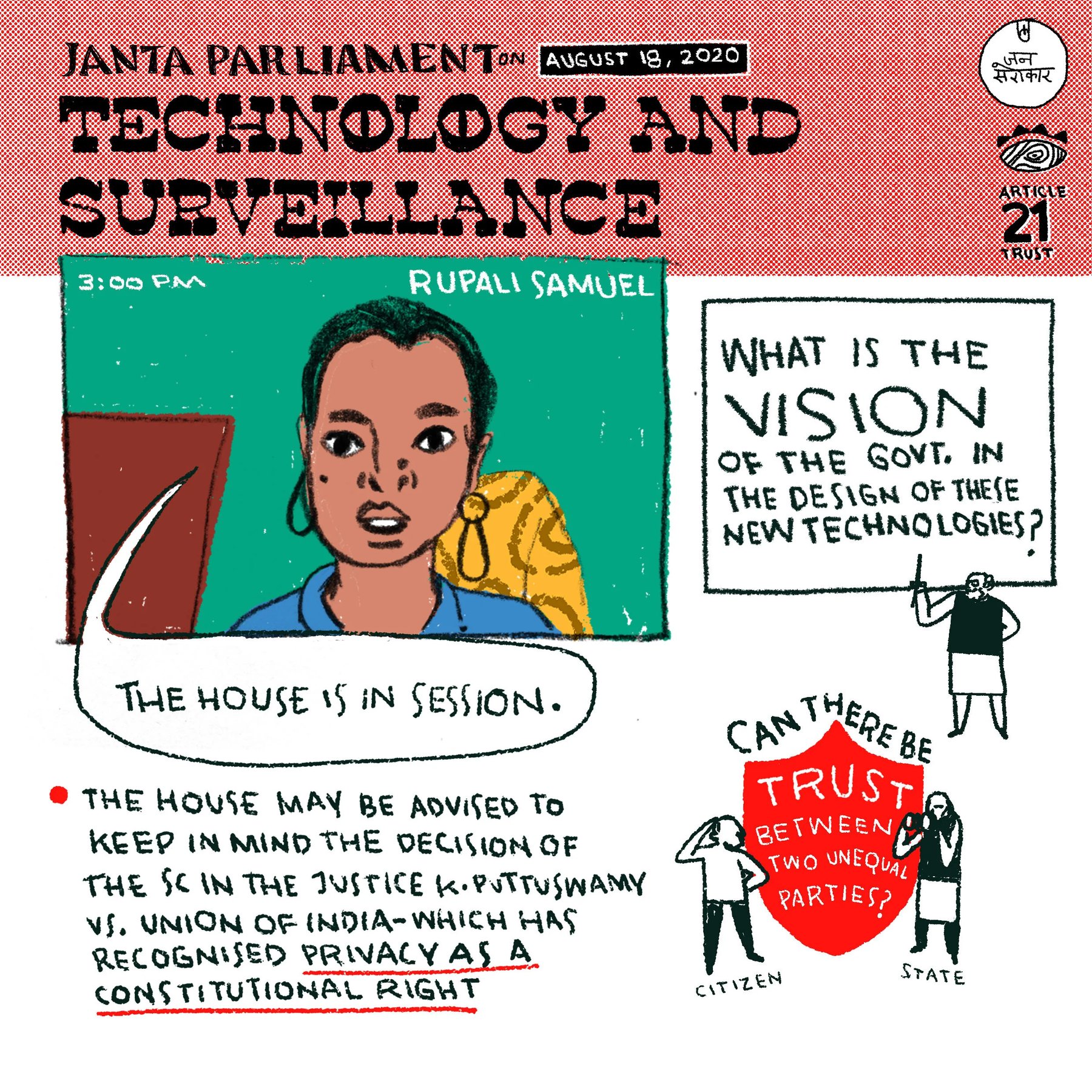
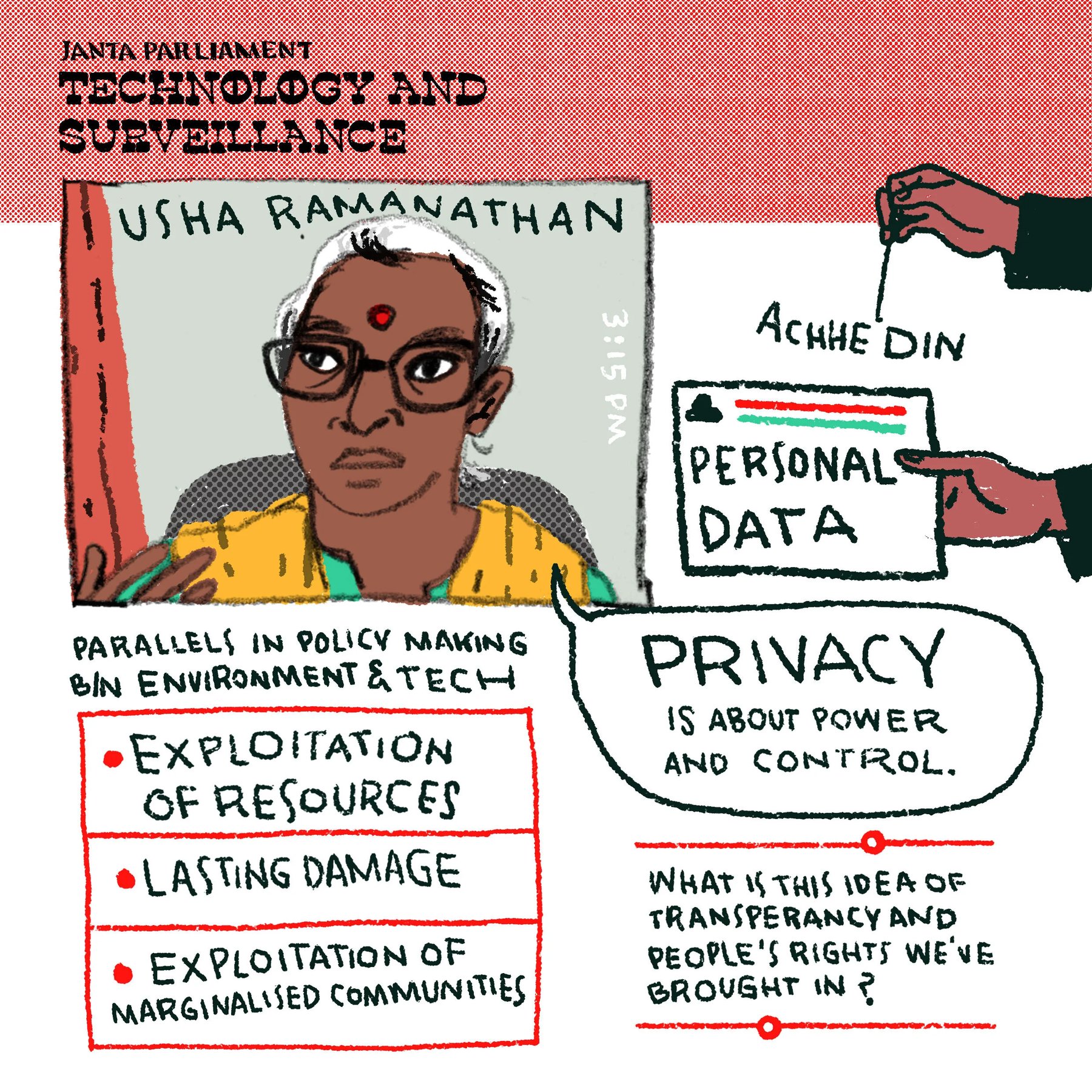
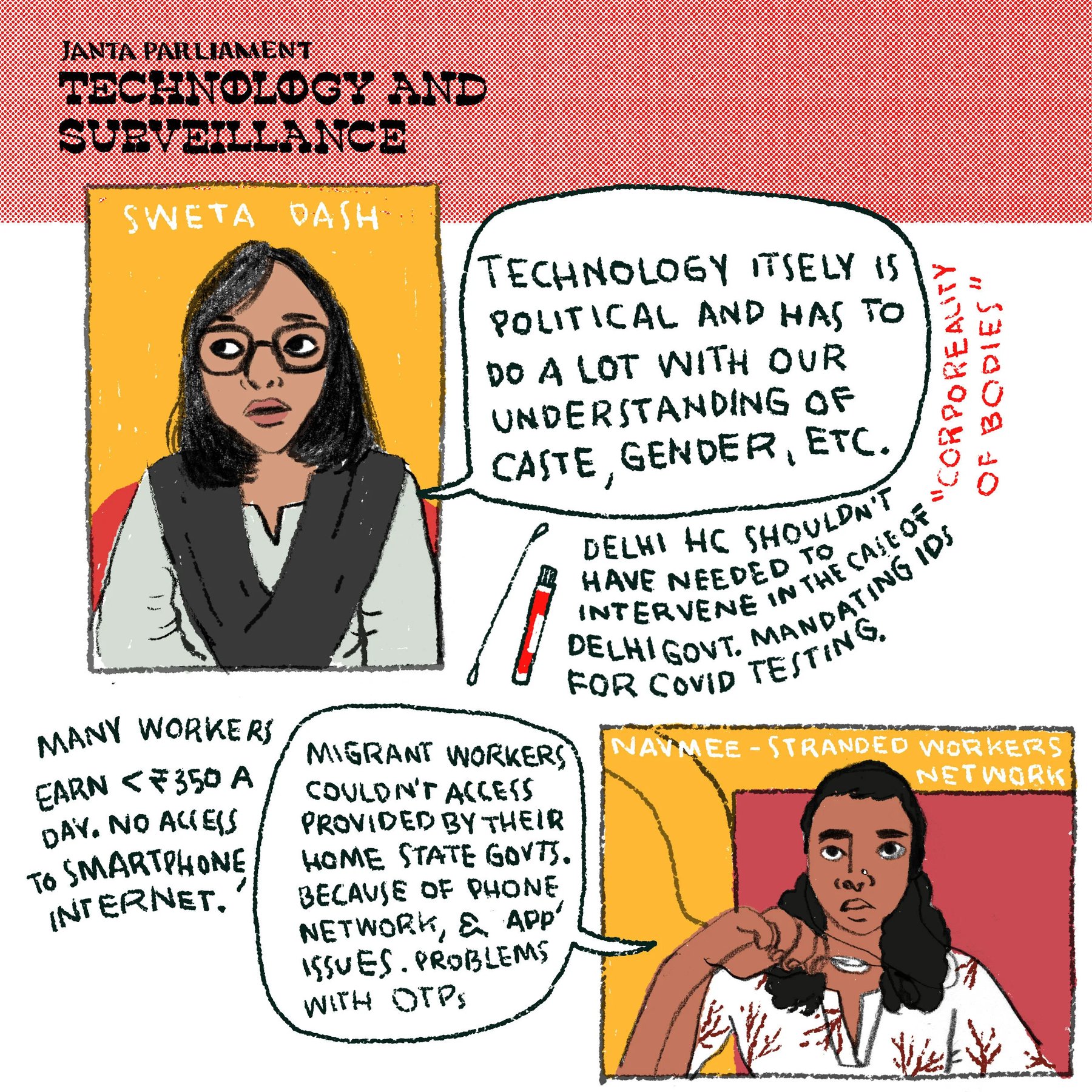
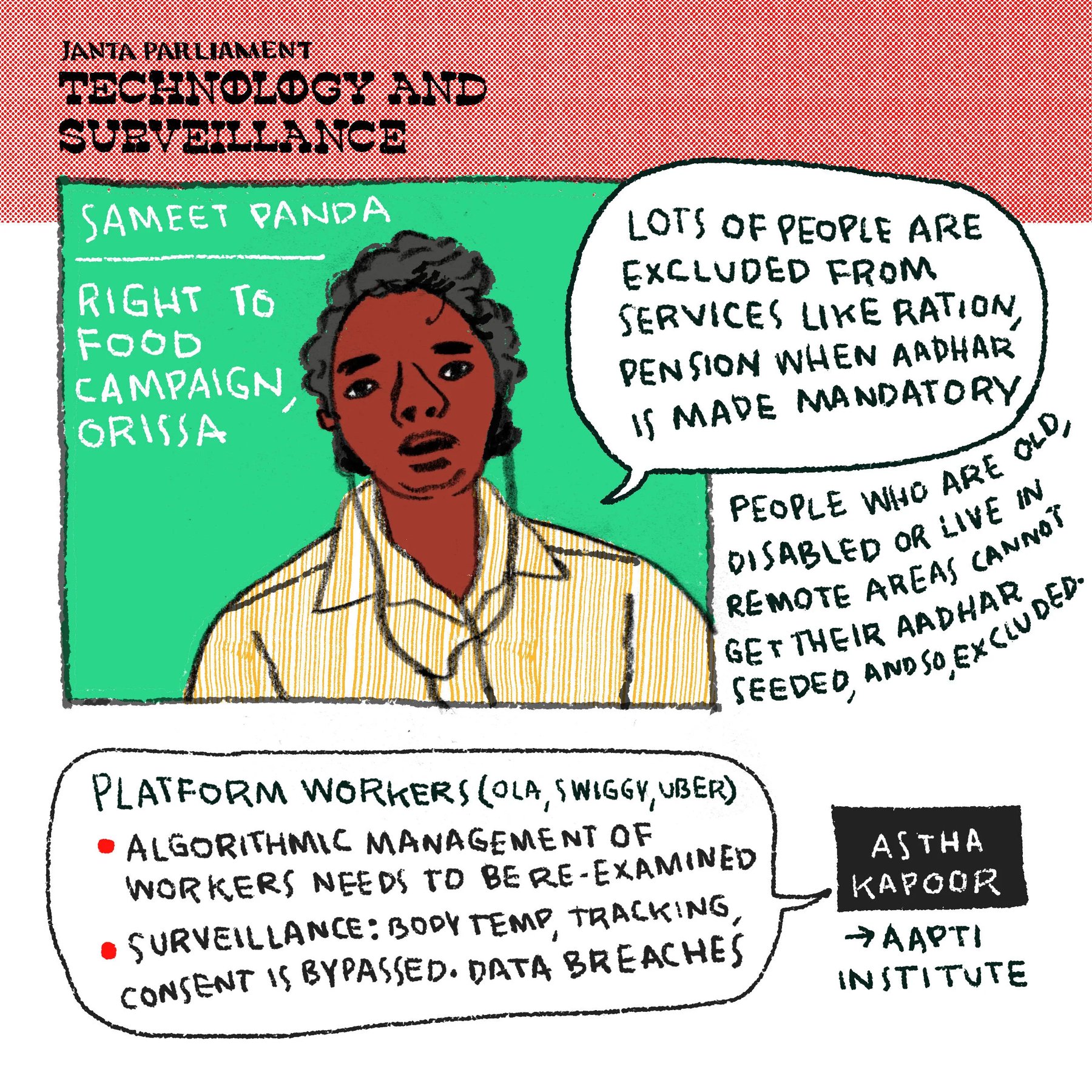
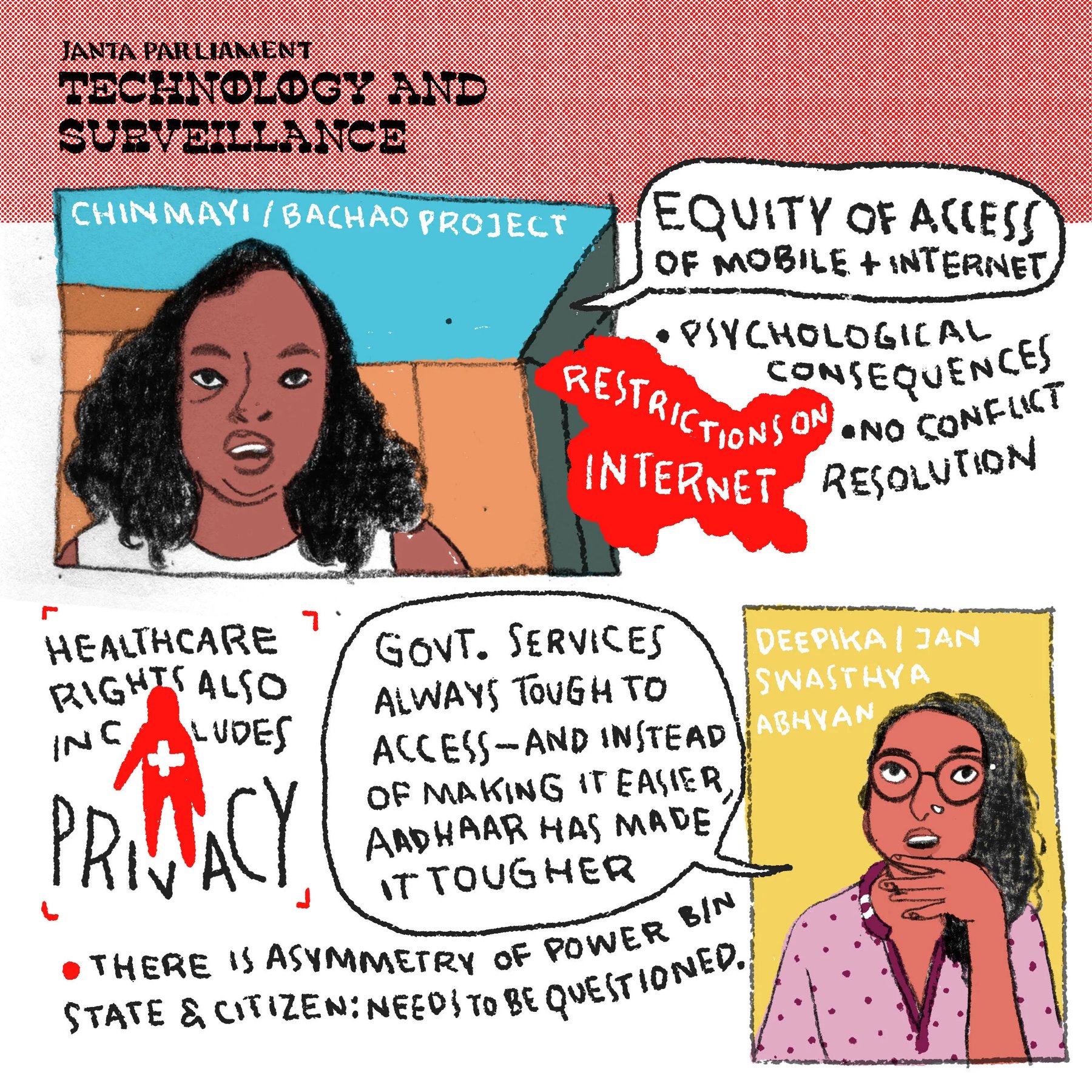
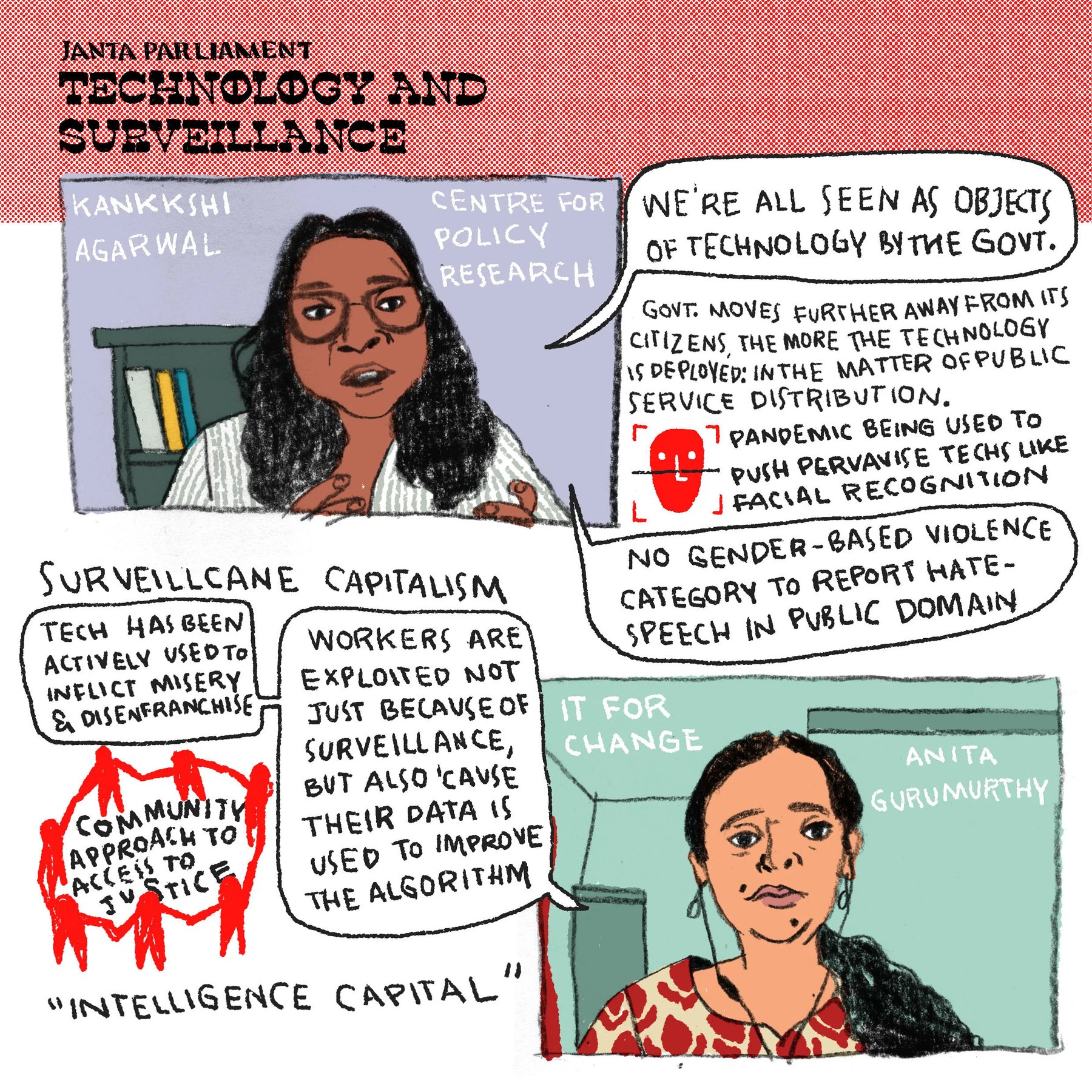
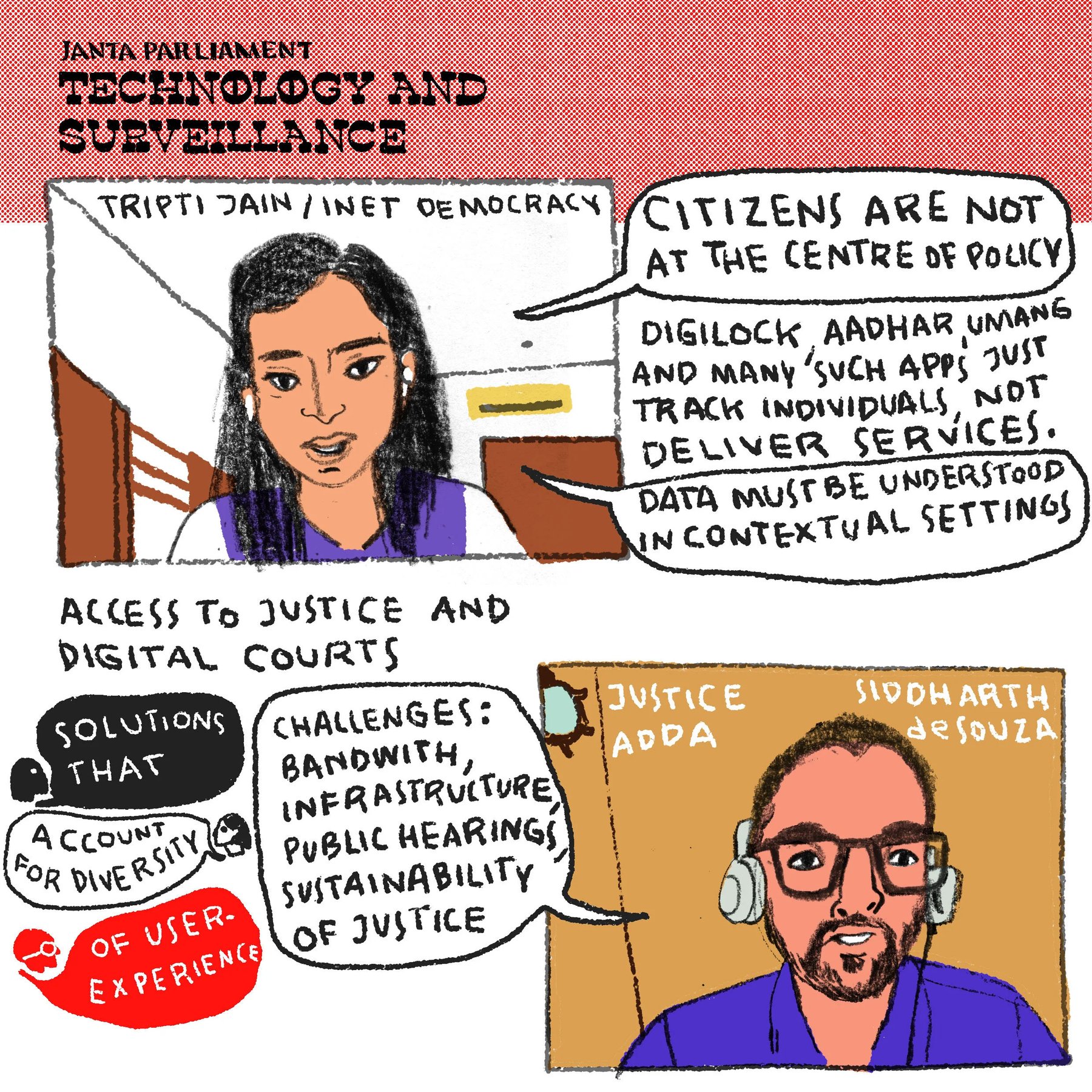
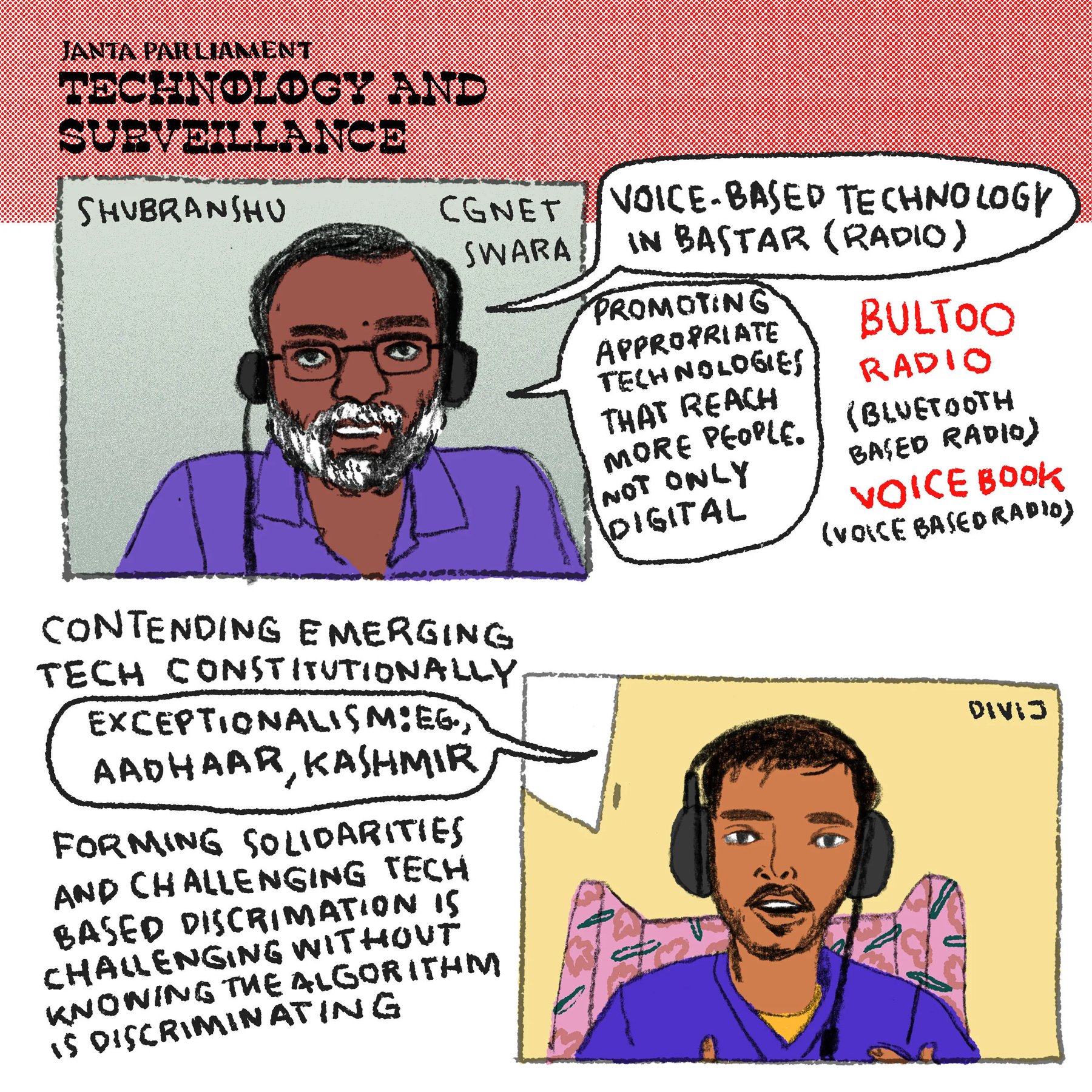
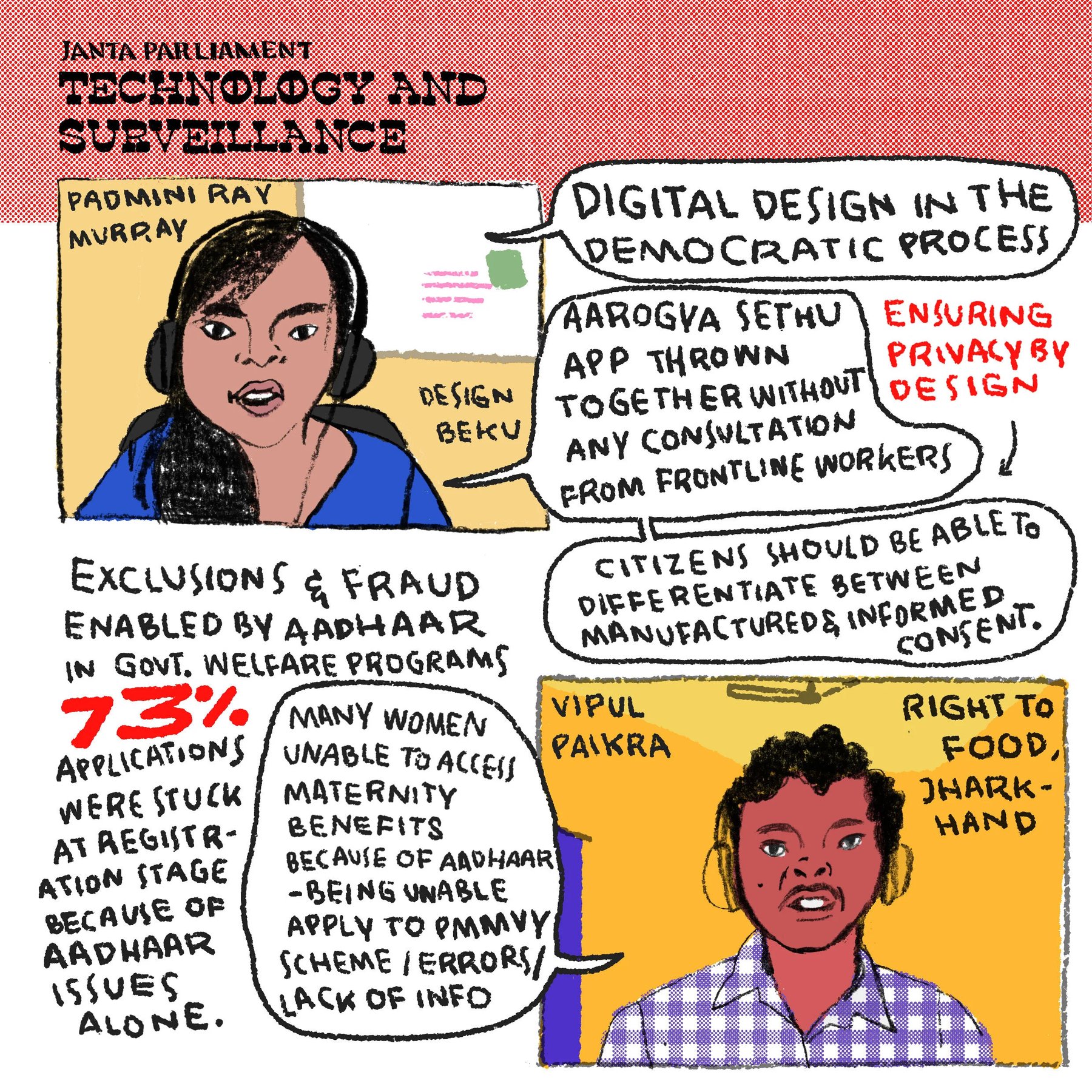
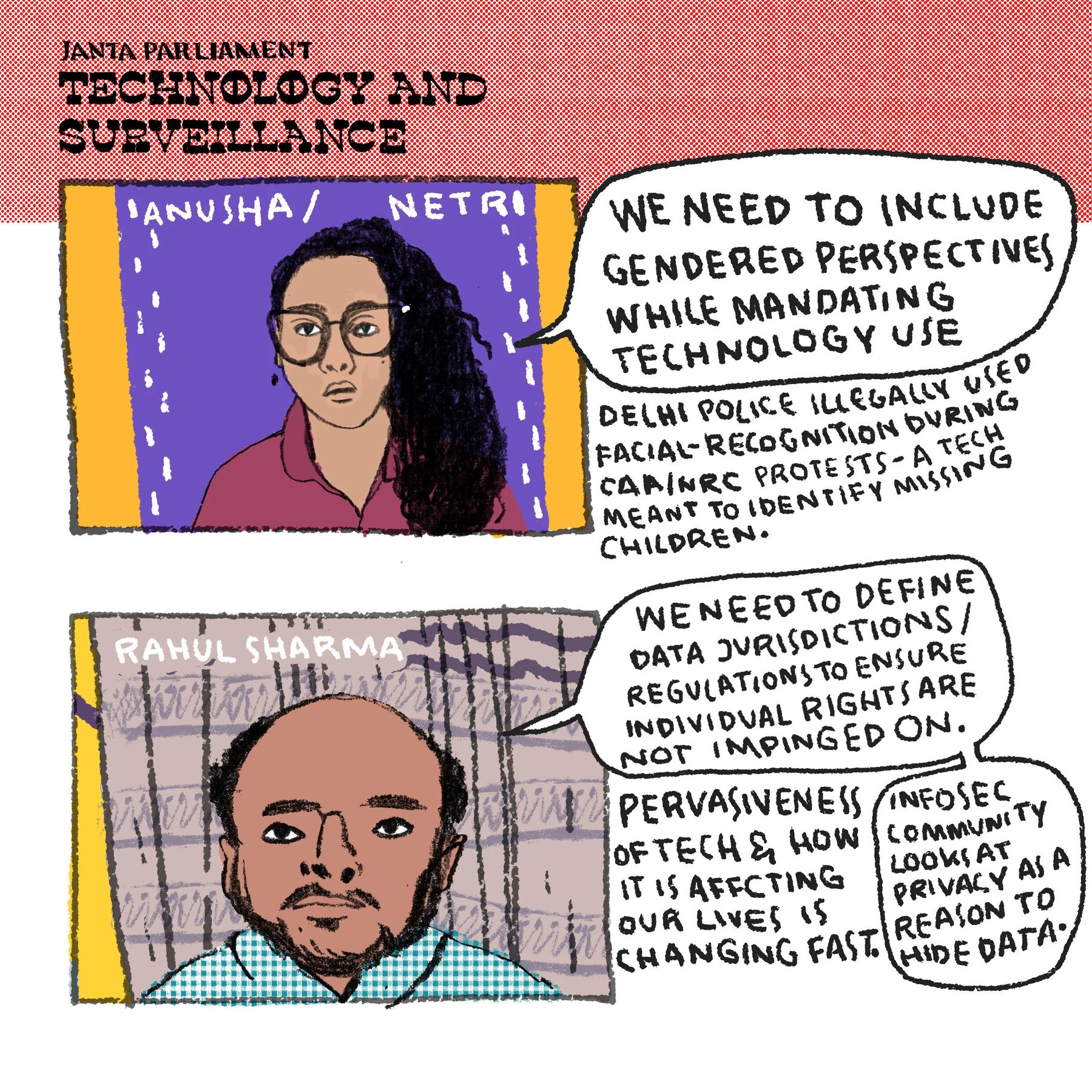
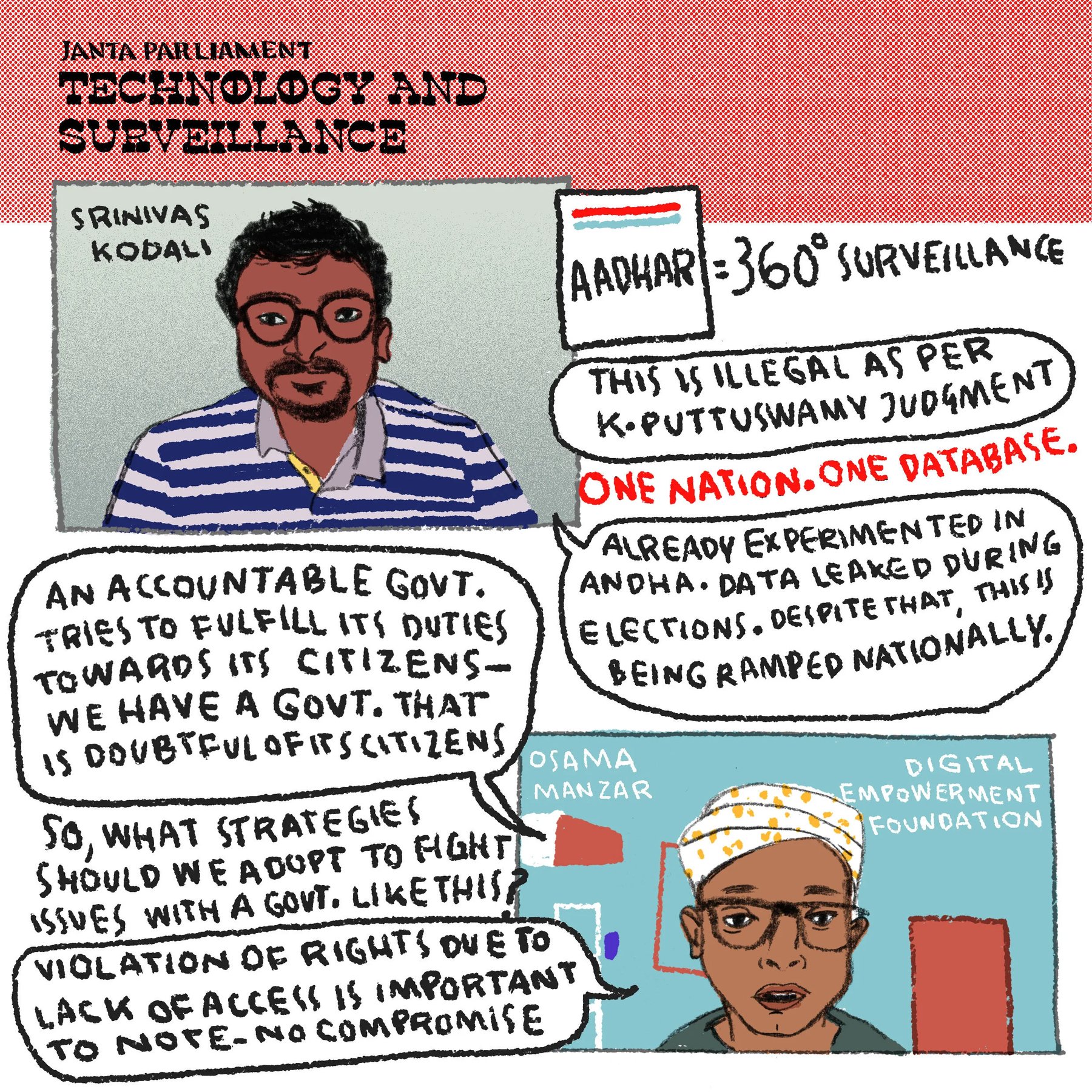
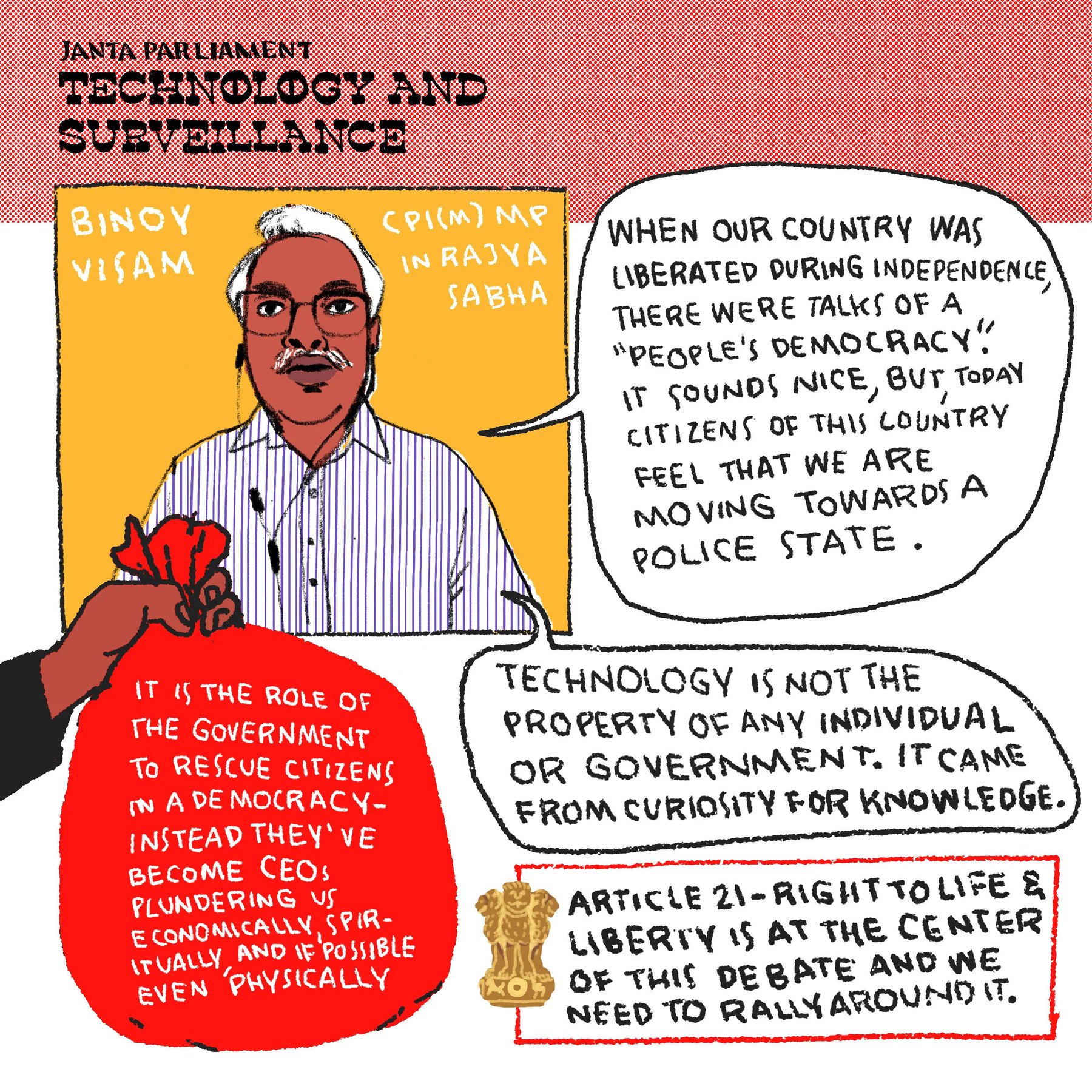
Members of the Peoples’ House resolved to urge the government to curtail unlawful and unconstitutional mass surveillance, and to bring all surveillance agencies under strict parliamentary and judicial scrutiny. Expressing concern on the gaping digital divide, the House urged the government to develop and promote people-friendly technological tools, and ensure that access to the Internet and other communication technologies is ensured for everyone in an equitable manner.
During the session, the session’s speakers, who represented diverse backgrounds and perspectives, critically appraised the use of technology in governance, justice, and welfare as well as the interaction of various communities with technology. The session was formally opened and presided over by Rupali Samuel, Advocate, Supreme Court of India, whose introductory remarks highlighted the “mass ostracization and harassment” faced by individuals who had their personal information regarding health status and travel history released in the public domain. She brought into sharp focus the legitimate demand of “trust” between people and the government.
Pushback on data commodification and invasion of privacy
The session opened with a keynote address delivered by Usha Ramanathan, legal researcher on law and poverty, who drew parallels between the exploitation of natural resources and the collection of data. She asserted that the understanding between state and corporate entities to promote use of certain data extractive business practices, with minimum regulatory oversight, needs to be critically examined, especially during times of crisis when people can be coerced to part with their data. She concluded by saying that the idea of transparency has been turned on its head where people are expected to reveal everything about themselves even as the government becomes more opaque with carrying out mass surveillance activities.
Astha Kapoor of the Aapti Institute highlighted the legitimate demands of platform workers who provide an essential public service during the pandemic but have no control or bargaining power - either individual or collective - over the data gathered about them. Asserting the need to understand data in its contextual setting and to resist from reducing humans to data points, Tripti Jain, of the Internet Democracy Project, made the case for data protection to go beyond digital rights to ensure bodily autonomy. Cautioning against furthering a regime of exceptionalism regarding technology and data collection practices in order to fuel the information economy, independent researcher Divij Joshi argued for the need to formulate “‘coordinated responses to algorithmic systems that create or use proxy information to discriminate against us in new and old ways”. Rahul Sharma from The Perspective highlighted the growing trend of referring to data as ‘oil’, ‘gold’, ‘uranium’, etc. and argued that the focus of data-related regimes needs to be brought back from economic growth to individual rights and decision-making autonomy.
Critical appraisal of access to and through technology
Navmee, a volunteer with the Stranded Workers Action Network, provided evidence through her work to show how migrant workers found it difficult to access government welfare schemes which were made available through website or app registrations, making owning a smartphone or otherwise having access to the Internet a precondition to avail emergency relief. An example of a woman living in a remote corner of northeastern India was cited by The Bachao Project’s Chinmayi SK to highlight how poor Internet access and inadequate communication infrastructure create barriers for people at a time when services ranging from education to banking are being moved online. Chinmayi also expressed concern over the restrictions on Internet and communications services experienced by the people of Jammu and Kashmir in the past year, stating that prolonged Internet deprivation had an impact on not just education and business opportunities but also on psychological well-being. Siddharth deSouza, Founder of Justice Adda, highlighted access concerns for those seeking justice as courts across India physically closed down and went virtual. He argued that virtual court management needs to be made people-centric and reviewed and redesigned taking into consideration concerns of all stakeholders especially litigants. Making a strong case for reconsidering regulations around use of a wider range of possibly more accessible forms of communication mediums such as Radio and BlueTooth, Shubhranshu Choudhary of CGNet Swara spoke of how, in the lesser developed parts of India, people rely on voice-based and other technologies which work even in areas without mobile or Internet connectivity.
Citing the example of how the Aarogya Setu app was designed without seeking inputs from the ASHA workers who were at the forefront of the efforts to track and contain the spread of Covid-19, Design Beku founder Padmini Ray Murray argued for greater scrutiny of the impact of digital design on service delivery. Osama Manzar of the Digital Empowerment Foundation concluded the session’s arguments expressing his concerns over inequitable access by arguing that the private sector’s involvement for the most part in providing Internet access infrastructure has meant that people are treated solely as consumers rather than citizens, with the government bearing no responsibility or accountability. He further argued that, by adopting an interrogatory approach to citizens, the government seems to be interested only in extracting accountability from the people who are always under doubt.
Aadhaar’s Continuing Strangehold
Highlighting Aadhaar’s stranglehold of welfare programs Sameet Panda, with the Right to Food Campaign, Odisha, elaborated how despite evidence of denial of ration to people due to non-seeding or incorrect seeding of Aadhaar numbers, the Odisha government recently mandated Aadhaar linking for availing pensions, which will mar an otherwise well run welfare program. Arguing that already weak public health delivery systems of the country were further weakened by pushing for mandatory Aadhaar linkages, Deepika Joshi of Jan Swasthya Abhiyan, criticized the fact that fetters to accessing health services during the pandemic were not removed. She provided the example of making Aadhaar mandatory to avail COVID-19 testing and drugs in Rajasthan and Maharashtra which raises issues around access and privacy for sensitive health data. Vipul Paikra, Right to Food Campaign, Jharkhand, shared stories from the ground in Jharkhand, concluding that the Aadhaar project which has been peddled to people as a ‘panacea’ has led to women being deprived of maternity benefits under the Pradhan Mantri Matru Vandana Yojana and has enabled scams leading to siphoning off of funds meant for Pre-metric Scholarships.
Tackling Rampant Surveillance
Expressing caution around the rampant surveillance, and asserting that technology is political, Sweta Dash, an independent researcher & journalist, highlighted that not just bodies, but their actions, speeches and dissent are subject to surveillance and vulnerable to persecution. Kanksshi Agarwal, Centre for Policy Research, highlighted serious concerns with unregulated use of facial recognition technologies in law enforcement or in election related activities as used in a recently held municipal elections in Telangana with grave potential of violations of rights.
Arguing that Section 35 of the Personal Data Protection Bill granting powers to the Central Government to exempt any government agencies from certain provisions of Bill helps perpetuate unregulated surveillance practices, Anita Gurumurthy (co-Executive Director, IT for Change), called this “undermining of institutions a process of de-democratization”. While proposing a resolution for enacting a framework law on digital rights, she further argued that we need to move towards “an indivisible and integrated approach to digital rights” or what can be termed as “digital constitutionalism”. She also pointed out the need to recognise the cornering of the “intelligence premium,” to understand the social crisis we’re witnessing of how economic production is organised, due to Big Data and AI. She ended her intervention calling on civil society to engage with the idea of data as a resource, and that in the fight against neoliberal capital, and jingoism and state impunity, ensuring that there isn’t a denial of the idea that value inheres in data – but a recognition of its multivalence and that this value can be private, public or social. A crucial engagement is creating the boundaries to nurture the social, preserve the public and limit the private.
In the context of unregulated use of facial recognition technology by law enforcement agencies against women protestors, originally meant to be used for tracking missing children, Anusha Ravishankar of NETRI Foundation called for greater regulation on use and commercialization of such technologies. Arguing that the conceptualization of Aadhaar was not from a welfare perspective but from the capitalist idea of creating an information economy, Srinivas Kodali, an independent researcher, cautioned against the potential of Aadhaar infrastructure creating a 360 o degree profiling and surveillance mechanism by being linked to databases like the public credit registry or the National Health Stack.
Closing Remarks
In his closing remarks, Binoy Viswam (Member of Parliament, Rajya Sabha) Appreciating convening the Janta Parliament as a means to actualize ‘people’s democracy’, Mr. Viswam cautioned against the degeneration of the country into a police state where people are under a constant watch. He further lamented how the state, which is expected to come to the rescue of the people in a democracy, looks the other way as personal data is mined for corporate interests. Calling for people to rally around Article 21 of the Constitution, he highlighted the need to evolve dialogue around the new meanings of the right to live with dignity in the 21st century. Bringing into focus the role Parliament and Committees can play in advancing digital rights, he spoke of his experience being a part of the Parliamentary Standing Committee on Science & Technology which decided to look into the impact of digital platforms like Whatsapp, Twitter, and Facebook in early 2019 and summoned the representatives of those companies to appear before the Committee.
The session ended with voting on 8 Resolutions all of which were adopted by the House with a majority of participants voting in favour. Article 21 Trust and Rethink Aadhaar had come together to anchor the session on Technology and Surveillance.
This discussion was held as part of the sixth of twelve sessions convened under the Janta Parliament initiative.
We are grateful to Kruttika Susarla for her amazing illustrations!
### 9 Aug 2020 — More than 11 lakh pensioners could lose benefits after Odisha government’s decision to link Aadhaar to pensions > Rethink Aadhaar joins the Right to Food campaign, Odisha to condemn the Odisha Government’s decision to restrict the payment of social security pensions to those whose accounts are “Aadhaar verified,” and to make the payments to those who can show Aadhaar “cards” as proof of identification. More Original: https://rethinkaadhaar.in/blog/2020/8/9/more-than-11-lakh-pensioners-could-lose-benefits-after-odisha-governments-move-to-mandate-aadhaarnbsp-verification-for-pensionsnbspRethink Aadhaar joins the Right to Food campaign, Odisha to condemn the Odisha Government’s decision to restrict the payment of social security pensions to those whose accounts are “Aadhaar verified,” and to make the payments to those who can show Aadhaar “cards” as proof of identification. More than 11 lakh persons could lose their benefits as a result of this decision, with little recourse as the verification process is shrouded in opacity.
The move comes barely a month after the tragic starvation death of 46-year-old Dukhi Jani, a tribal widow, who had been struck off the pension and food ration lists, due to—from all accounts – Aadhaar verification failures.
Odisha’s pensions schemes have received praise for their wide coverage and people-friendly mode of payment. Under the National Social Assistance Programme (NSAP) and the Madhu Babu Pension Yojana (MBPY) some of the most vulnerable citizens living in poverty, including the elderly, persons with disabilities, widows, and transgenders persons, get a pension of between Rs. 500 - Rs. 900 a month. This amount is often a lifeline for the close to 49 lakh persons who are beneficiaries under these two schemes.
Mandatory Aadhaar linkage and verification threatens to curtail this tenuous line of support. In July and August, the Odisha Government’s Department of Social Security & Empowerment of Persons with Disabilities issued two circulars specifying that the pensions and an “ex gratia” amount of Rs.1000 were to be disbursed (in cash) only to those who carried Aadhaar cards as proof of identity, and only to those accounts which had been “Aadhaar verified”.
As per the updated National Dashboard of National Social Assistance Programme, only 83% of the NSAP accounts in Odisha have been “verified” by Aadhaar, while only 74% have been verified for the MBPY scheme. This means that more than 11 lakh persons could lose their benefits because of a lack of “Aadhaar verification”.
Mandatory linkages with Aadhaar have caused mass exclusions, both at the point of disbursal of welfare entitlements (because of biometric or technical failures) and during the process of seeding and verification. A January 2020 study of the PDS system in Jharkhand found that close to 88% households excluded due to Aadhaar verification were genuine beneficiaries.
There is no clear method to appeal these exclusions, and persons struck off these lists are left running from pillar to post. The Aadhaar seeding and verification processes are shrouded in opacity, as they can fail for a range of reasons, often without any of the responsible officials understanding the reason for the failure, or how it should be remedied. The Aadhaar-enabled Payments System (AePS) comes with its own share of failures, due to poor design, missing safeguards, and a confusing array of failure codes. Remedying this is close to impossible for those who are not mobile, have limited access to transportation, or live in an area far from administrative headquarters. These difficulties have been exponentially exacerbated by the ongoing pandemic.
Aware of the Aadhaar project’s harmful and exclusionary impacts, in 2017, the Naveen Patnaik government opposed linking Aadhaar to accounts of beneficiaries of welfare schemes as it would cause “hardship” to beneficiaries. However, in January 2020, it went back on this, and announced that pension accounts would have to be linked to Aadhaar for “verification” and seeding.
The purpose of verifying beneficiaries is not served by Aadhaar verification or linkage. The Aadhaar database was created on the basis of self-verified documents, and the Aadhaar “card” is just a printout, which was not intended to serve as a proof of identity. Awake to the pandemic-related threats fingerprint authentication poses, biometric authentication has been suspended in many states during the pandemic.
Making Aadhaar a barrier to welfare entitlements, particularly during a pandemic, is a callous move which can have fatal implications, as was seen in Dukhi Jani’s case. The Government of Odisha must reverse its recent order, to ensure that rights of the most vulnerable citizens of our country are not curtailed due to experiments with technology.
### 7 Aug 2020 — ILGMS > ILGMS, Kerala, Aadhaar, Kalyani Menon-Sen, Bezwada Wilson Original: https://rethinkaadhaar.in/blog/2020/8/7/legal-notice-to-halt-mandatory-aadhaar-for-keralas-self-governance-portalRethink Aadhaar joins digital rights organisations Article 21 Trust, Internet Freedom Foundation, SFLC.in and Swathanthra Malayalam Computing to endorse a legal notice that was sent to the Government of Kerala last week, by Bezwada Wilson and Kalyani Menon-Sen (prominent civil society activists, and petitioners in the Puttaswamy case, challenging the constitutionality of Aadhaar. The notice asked the Government to sever all links with Aadhaar, in relation to its recently launched Integrated Local Self Governance Management System (ILGMS).
The ILGMS, developed by the Information Kerala Mission, brings all civic registration processes under one common platform and portal and provides a single window for all services and payments related to birth, death and marriage registrations, tax payments and pensions. According to circulars dated 14.05.2020 and 28.05.2020, rollout of the programme in districts across Kerala in a phased manner began in July 2020. However, the online portal can only be accessed if a registrant inputs their Aadhaar number.
The legal notice brings to the Kerala government’s notice the constitutional and practical bars preventing it from requiring or even using Aadhaar verification for ILGMS. In KS Puttaswamy v Union of India (2019 10 SCC 1), a constitutional bench of the Supreme Court significantly curtailed the Aadhaar project, in light of its surveillance, security and exclusionary harms. The Court held that three conditions had to be met in order for the use of Aadhaar to be constitutional: the presence of a legitimate state aim to use Aadhaar numbers; Second, the presence of an enacted law permitting such use; And third, the requirement that this law conform to the ‘doctrine of proportionality’. This is a strict test – in the same judgement the Supreme Court struck down the use of Aadhaar for ‘seeding’ in bank accounts, despite an enacted legislative measure providing for it, finding that it did not pass the test of proportionality.
In the Puttaswamy case, Aadhaar verification was deemed permissible only for a strict category of “Section 7” subsidies and benefits, drawn from the Consolidated Fund of India, and for PAN linkage (the deadline for which has been extended multiple times). The Court cautioned against the proliferation of the use of Aadhaar, holding that “their scope is not to be unduly expanded thereby widening the net of Aadhaar”.
Since its inception, the Aadhaar project been shown to pose serious threats of surveillance, safety, security and health risks to the population, and any database or project associated with it runs the risk of being compromised. In light of this, and in the interests of security, safety and efficacy of the ILGMS system, it is imperative the Kerala government withdraw the order mandating the use of Aadhaar for registrants to the ILGMS system.
### 7 Aug 2020 — New Aadhaar Rules for "Good Governance" Are Constitutionally Impermissible > Rethink Aadhaar and the Article 21 Trust condemn the Aadhaar Authentication for Good Governance (Social Welfare, Innovation, Knowledge) Rules, 2020 released yesterday, which expand the permissible uses for Aadhaar authentication, for good governance, to "prevent dissipation of social welfare Original: https://rethinkaadhaar.in/blog/2020/8/7/new-aadhaar-rules-for-good-governance-are-constitutionally-impermissibleRethink Aadhaar and the Article 21 Trust condemn the Aadhaar Authentication for Good Governance (Social Welfare, Innovation, Knowledge) Rules, 2020 released yesterday, which expand the permissible uses for Aadhaar authentication, for good governance, to "prevent dissipation of social welfare benefits" and to "enable innovation and spread of knowledge."
Although only permitting “voluntary” use, these rules are against the letter and spirit of the 2018 Puttaswamy judgement on Aadhaar, wherein a Constitutional Bench of the Supreme Court limited the use of Aadhaar to "Section 7" cases, i.e. linked to subsidies, benefits arising from the Consolidated Fund of India. While permitting this limited use, the Court cautioned against the proliferation of the use of Aadhaar, holding that "their scope is not to be unduly expanded thereby widening the net of Aadhaar". It also specifically excluded children from the scope of Aadhaar, and struck down attempts by the government to make Aadhaar mandatory for bank accounts and for cellphone records.
Particularly when read with the 2019 Amendment to the Aadhaar Act, the Rules are part of concerted attempts to cross the red lines drawn by the Supreme Court’s judgement limiting the use of Aadhaar to a limited category of subsidies and benefits. The rules have been framed under S.53(2)(aa) of the Aadhaar Act, which was inserted through the 2019 Amendment, which is presently under challenge in the Supreme Court.
The stated justifications for the rules are vague, and are, at best an attempt to put old wine in new bottles. For one, it’s ironic that these rules are being pushed through on the grounds of “good governance,” when the Aadhaar project has been shot through with total disregard for the norms underlying this concept: respect for the rights of citizens, respect for democratic processes, and accountability to citizens. The term itself is quite broad -- every government service can fall within the ambit of good governance, in effect nullifying the Supreme Court's judgment to limit it to subsidies and benefits.
Second, the government has long claimed that Aadhaar linkage prevents “dissipation of social welfare benefits”, without any evidence at all to back this claim up. In 2016, the government used “obviously fabricated” World Bank Development Report numbers to justify their push for Aadhaar, claiming it would lead to $11 billion annual savings, a figure that was later shown to be based on wild conjecture. It is based on a flawed notion of how leakages work within welfare systems, choosing to treat people who depend on these entitlements as potential defrauders, over systemic reform. What this approach has led to is mass exclusions of peoples from their entitlements, because of authentication, linkage or other failures. A widespread consequence, as Khera has pointed out, of Aadhaar authentication is that it has given more power to middlemen and disbursal agents, while its centralised system prevents localised grievance redress.
The third purpose of the rules, the “enablement of innovation and spread of knowledge,” should be seen in light of other attempts being made by the government to extract economic benefits from data. It is unclear how the government seeks to justify the use of Aadhaar Authentication for enablement of innovation. This is clearly with the intent of using data and activity trails so generated for commercial exploitation.
Finally, including the concepts of voluntariness and consent cannot make a project that is unconstitutional on account of violation of fundamental rights, constitutional. There can be no waiver of fundamental rights and the State cannot put its citizens in a situation where they are constrained to “voluntarily” offer up these rights in exchange for an ostensibly efficient or convenient system.
The overarching concern with any linkage to Aadhaar or Aadhaar-like measures is that it continues to pose serious risks to safety, security and health of the population, and compromises the sanctity of any database or project associated with it.
The pandemic has shown us all the dangers of the technology divide, and that techno-solutionism comes at a high human cost. As we pointed out in June 2020, Dukhi Jani, a 46-year old tribal woman died of starvation, after her ration card was cancelled because of Aadhaar-related failures. Exclusions due to Aadhaar are antithetical to good governance, if the objective is to enable citizens to easily access government services.
### 14 Jul 2020 — starvation death aadhaar > Rethink Aadhaar stands in solidarity with the findings of Odisha Khadya Adhikar Abhiyan , on the tragic death of Dukhi Jani, a 46 year old tribal woman due to chronic starvation, and calls on authorities in Odisha to institute an enquiry into the circumstances of her death, as it appears to be a Original: https://rethinkaadhaar.in/blog/2020/7/14/press-statement-aadhaar-related-starvation-death-in-odisha
Rethink Aadhaar stands in solidarity with the findings of Odisha Khadya Adhikar Abhiyan, on the tragic death of Dukhi Jani, a 46 year old tribal woman due to chronic starvation, and calls on authorities in Odisha to institute an enquiry into the circumstances of her death, as it appears to be a case of exclusion caused by Aadhaar linkage,.
According to news reports, on June 24th, 2020 Dukhi Jani, from Kaliamba village in Nuagaon block, Nayagarh district of Odisha died after going without food for three days. The Odisha Khadya Adhikar Abhiyan, the Odisha unit of the Right to Food campaign, carried out a fact-finding mission on July 3rd, 2020 to investigate these reports, and found that systemic administrative apathy had caused this tragic — and avoidable — loss of life, by creating conditions where the deceased had no or little food for a long period of time, and went without food for three continuous days before her death.
Despite the existence of several central and state schemes, Dukhi was left without any safety net. The fact-finding team’s investigations found that she had been struck off the list of Annapoorna cards in November 2018, and was not able to reverse this, and get a ration card, despite repeatedly approaching Panchayat and Block officials. As a single woman, she was entitled to receive a pension, but couldn’t get this either despite applying several times. She didn’t have a job card under MGNREGA, which could have provided her unskilled work. She didn’t even receive Jan Dhan support provided by the central government as assistance during the lockdown, or the rice and dal offered under the PM Garib Kalyan Yojana. All she got, according to her village’s Sarpanch, was 15 kilos of rice and Rs.1000, which was part of the state government’s scheme and given to her without a ration card.
The fact-finding team reported that when they asked the local Panchayat Executive Officer, Mr. Padmalochan Biswal the reasons for cancellation of Dukhi’s Annapurna card, he was of the view that it was cancelled due to non-seeding of Aadhaar number with her ration card. This is a clear case of administrative negligence and apathy, and a tragic illustration of exclusion caused by Aadhaar.
It is unconscionable that despite several schemes run by the government to ensure that the poor have access to social safety and food security, such systemic failures prevent people from accessing their entitlements. These failures are exacerbated by the insensitivity and apathy of the of the local administration, who take refuge behind technological failures. Previous investigations of the Abhiyan have warned that wide-spread cancellation of ration cards was taking place due to the mandatory seeding of Aadhaar numbers with ration cards in Odisha, and that many families have been denied their rations because of failures in linkages.
Rethink Aadhaar echoes the demands of the Odisha Khadya Adhikar Abhiyan, and calls for a thorough enquiry into the tragic death of Dukhi Jani, including an independent enquiry into the reasons she was excluded from her social entitlements, and any relation this has to the Aadhaar linking/ seeding process. The Abhiyan also calls for an investigation into the violation of norms specified in the Odisha Relief Code, as there was no official designated to investigate the case.
The fact-finding team’s report can be accessed here, and their press release here.
### 29 Jun 2020 — Joint Statement: The Government of Kerala must withdraw compulsory Aadhaar verification for state government jobs > Last week, Kalyani Menon Sen, a citizen, and petitioner in the batch of writ petitions challenging the constitutionality of Aadhaar in KS Puttaswamy v Union of India (2019 10 SCC 1) sent the Government of Kerala a legal notice demanding that it withdraw a recent order mandating compulsory Aadhaa Original: https://rethinkaadhaar.in/blog/2020/6/29/the-government-of-kerala-must-withdraw-compulsory-aadhaar-for-state-government-jobs
Last week, Kalyani Menon Sen, a citizen, and petitioner in the batch of writ petitions challenging the constitutionality of Aadhaar in KS Puttaswamy v Union of India (2019 10 SCC 1) sent the Government of Kerala a legal notice demanding that it withdraw a recent order mandating compulsory Aadhaar verification for all new applicants and recent appointees to state government jobs.
Rethink Aadhaar, along with Internet Freedom Foundation, the Article 21 Trust and Swathanthra Malayalam Computing endorse this legal notice, and call on the Kerala Government to withdraw their order.
The order, which was dated 11.06.2020, was issued by the Kerala Government's Department of Personnel & Administrative Reforms. It relates to applicants and new appointments to the Kerala Public Service Commission. As Ms. Menon Sen's legal notice notes, mandating Aadhaar verification for new appointees and applicants violates the order of the Supreme Court relating to Aadhaar, KS Puttaswamy v Union of India (2019 10 SCC 1). The 5-judge bench specified that mandating the use of Aadhaar numbers, whether for verification or any other purpose, was constitutionally valid for two purposes only: for linking with PAN numbers, and for obtaining welfare benefits in the nature of a subsidy which is funded from the Consolidated Fund of India. The Hon’ble Supreme Court also read down Section 57 of the Aadhaar Act (as it then stood), and specified that the State could use Aadhaar only if it met the following two conditions: that such use was voluntary, and that such use was covered by primary legislation for that purpose.
The purpose of preventing fraud cannot and should not be carried out by breaches to privacy, dignity and autonomy of individuals, especially in the absence of any clear basis in law.
As a constitutional body, the Government of Kerala, and the KPSC are bound to uphold the rule of law and the judgements of the Supreme Court, and should withdraw the notification, and clarify that Aadhaar verification remains optional.
The legal notice is available here, and a Malayalam version of the joint statement, prepared by Anivar Aravind from Swathanthra Malayalam Computing, can be viewed here.
### 4 Mar 2020 — Statement on Delhi Government mandating Aadhaar number for Compensation Forms > Rethink Aadhaar condemns the Delhi govt mandating quoting of riot victims’ Aadhaar numbers on the compensation forms. Original: https://rethinkaadhaar.in/blog/2020/3/4/statement-on-delhi-government-mandating-aadhaar-number-for-compensation-formsRethink Aadhaar condemns the Delhi Government’s move to make quoting the Aadhaar number mandatory on the compensation forms for victims of the ongoing Delhi Riots. The provision of compensation is a basic necessity and need that the Delhi Government is obligated to fulfil in order for the city of Delhi to rebuild and recover.
Even as we write this letter, civil society organisations and student bodies are working towards ensuring timely relief work. The death toll is still rising, as volunteers are now discovering unclaimed dead bodies from several parts of North-East Delhi. As of 2 March, the official death toll remains at 42 even though four more bodies were fished out of drains in North-East Delhi on Sunday. The wounded are still grappling with the reality of the extremely tedious paperwork at hospitals. First-hand witnesses are figuring out ways to deal with the documentation and evidence collection.
Homes, possessions, properties, valuables, and lives have been lost in this violence. In this ongoing crisis, many have lost everything in arson incidents including their identity cards. To ask survivors of a riot, which has also been described as a pogrom, to prove their identity is both impractical and often an impossibility. This is the latest brutal example of the shifting of the state's burden of identifying and compensating victims of violence upon the victims themselves. We strongly advocate that the Delhi Government work proactively towards assuaging the persons and families affected by the violence and towards compensating them. We cannot emphasize enough the need for urgent unconditional government interventions with timely relief.
The Aadhaar project, at the best of times, does not work. It is riddled with problems, the very least of include wrong names, birth dates, addresses, incorrectly entered details. To make such a shoddy system a prior condition for aid in a time of disaster and crisis is reprehensible and must be stopped.
The Delhi Government must remove the demand for Aadhaar numbers from its compensation forms. We further urge the government to take all necessary steps to provide full aid and support to the survivors of the Delhi Riots without imposing any further conditions.
A host of grassroots campaigns and movements, including Rethink Aadhaar, are organising a People’s Tribunal on Aadhaar-related issues in Delhi on February 29 and March 1, 2020.
Please see the note below for details; you can also visit the event page for more details and registration.
When: February 29 & March 1, 2020, 9 am onwards
Where: 301, ISI (10, Lodhi Institutional Area, New Delhi)
Event Page:
https://hasgeek.com/rethinkaadhaar/aadhaar-tribunal-2020/
Note: We request RSVPs from those interested as seating is limited.
Also, while entry to the Tribunal is free, we encourage you to contribute and help make the Tribunal more successful and impactful. To contribute, please visit:
https://www.ourdemocracy.in/Campaign/aadhaartribunal
About the Tribunal
This Tribunal seeks to review the on-ground impact over the ten years of the Aadhaar project. In particular, the two-day event will focus on the aftermath of the SC judgment, and the continued coercion through databasing of citizens since. It will feature testimonies, expert commentaries, and analysis of the impact on welfare schemes (food rations, NREGA wages, old age and disability pensions, health programmes, scholarships, children’s midday meal schemes and admissions), gender and caste inequalities, and continuing privacy and data security concerns.
Through this Tribunal, we will gather evidence from the grassroots which, with a report from the jury (comprising a former parliamentarian and a former SC judge among others), will be presented to the public in order to develop a substantive critique of the government’s continued reliance on the Aadhaar number as a “truth machine”. This is now an even more worrying development given the focus on updating the National Population Register (NPR) and subsequently preparing the National Register of Indian Citizens (NRC). We also hope to build on the Tribunal and push government agencies further to ensure that no one suffers any exclusion or deprivation for lack of an Aadhaar number, and that there is - at the very least - complete compliance with the Supreme Court judgment.
Organizing this Tribunal will require significant resources in terms of people’s time, efforts and, more pertinently, logistics - especially considering the fact that we plan to conduct follow up engagements with local stakeholders in at least five to six other cities besides Delhi. We request your kind support to conduct the Tribunal and widen the public debate on the Aadhaar project as well as the looming risks of making our rights and even citizenship conditional to enrolling ourselves in error-ridden databases coercively.
If you have any questions or concerns, please reach out to Raghu at 97177-49998.
### 28 Nov 2019 — A Cultivated Ignorance > In a display of cultivated ignorance, the authors of a recent article (‘ A hundred small steps ’, IE, September 26) cite only their self-sponsored friendly research, blissfully ignoring independent research that has raised troubling questions about ignoring viable PDS portability solutions in favour Original: https://rethinkaadhaar.in/blog/2019/11/28/a-cultivated-ignoranceAn abridged version of this article, written by Reetika Khera, was published online by The Indian Express on November 28, 2019, and also featured in The Indian Express’s print edition on the same day under the title ‘Smarter than Aadhaar’.
Migrants’ woes are often invoked in making a case for portability of benefits in the public distribution system (PDS). Most recently, an article (‘A hundred small steps’, IE, September 26) did just that. However, in many cases of short-term seasonal migration (a dominant form in India), only one or two of the household members migrate, leaving the ration card behind for the rest of the family to use. What proportion of migrants would prefer to draw their ration at the place of work rather than in their village is a key piece of the puzzle in understanding the extent to which portability of PDS benefits is valued by migrants.
If the food security of migrants is the motivating concern, this need is probably better met by other initiatives such as Tamil Nadu’s Amma canteens or Karnataka’s Indira canteens, which provide heavily subsidised meals. Such community kitchens have quietly become popular across the country — Jharkhand’s dal-bhaat kendras, Delhi’s Jan Aahaar kiosks, and others in Andhra Pradesh, Odisha, Chhattisgarh are such initiatives. Of course, protecting migrants from exploitation through stricter enforcement of their rights as labourers will go much further.
Currently, PDS entitlements are tied to the recipient’s place of residence. You can only draw PDS rations from the PDS outlet to which you are allocated. Thus, while a single-member household may be forced to forego her rations if she migrates, others would be able to claim benefits through those family members who stay back. A portable PDS would be a great facility for those who would like to draw their rations at the place of migration.
The promoters of portability make it seem as if it cannot be achieved without integrating Aadhaar with PDS. In 2012, the food department in Chhattisgarh took up the challenge of designing a portable PDS and launched “CORE PDS”. Step one was to rejig the supply logistics. The norm today is for each PDS outlet to receive food supplies once a month according to the (fixed) number of ration cards attached to it. In a portable system, where the number of people who draw their grain at a PDS outlet fluctuates from month to month, the government needs to put in place a flexible supply system. The fix was simple: Chhattisgarh allowed more than one delivery of grain in a month. Since end-to-end computerisation had been achieved, stocks could be monitored. An automated system sent a message to the ration dealer as soon as the digitised records showed that his stocks had fallen below a certain level, asking the dealer if he would like another delivery.
Step two was to give the ration card holders a smart card (like ATM cards) that could be used to draw rations at any CORE PDS outlet using a “point of sale” (POS) machine. Once the POS machine authenticates the smart card, sale can proceed. Offline sales were possible if server or connectivity issues arose. One-fifth of the transactions used the portability option, mostly within the ward. Convenience was the prime reason for switching shops — distance to the PDS, tenants who had moved residence, supplies running out. To cut a long story short, portability was achieved without Aadhaar.
CORE PDS was being gradually scaled up until Aadhaar came along and disrupted the process, even though smart cards are more reliable than fingerprint authentication. Chhattisgarh’s CORE-PDS was more promising than the Aadhaar-Based Biometric Authentication (ABBA) that has left behind a trail of hardship, exclusion, even deaths since its integration with the PDS.
In ‘A hundred small steps’, the authors carefully sidestep the fact that Santoshi’s death in Jharkhand was primarily the result of disruption that resulted from Aadhaar’s integration with the PDS, as well as the fact that smart cards (tested in Tamil Nadu and Puducherry among other places) provide a better technology solution for the last mile authentication than Aadhaar. Readers must ask why that is the case.
One of the authors of the article worked with a minister in the UPA-2 government in the rural development ministry that pushed against repeated warnings — warnings that were later vindicated — the use of Aadhaar in NREGA and social security pensions. Before that, he had worked with the World Bank and Monitor Deloitte. After that, he joined Dalberg and is now with Omidyar Network (ON).
Omidyar Network’s interest in the PDS and Aadhaar should also arouse people’s curiosity. How did the ON, a philanthropic enterprise of e-bay founder Pierre Omidyar, come to be so interested in Aadhaar that it sponsors research worth lakhs of rupees at the Indian School of Business, Dvara, IDInsight, etc. This is what is called “friendly research”. In a display of cultivated ignorance, the authors in question cite only their self-sponsored friendly research, blissfully ignoring independent research that has raised troubling questions. The sugar and tobacco industry have gained notoriety for having done this in the past: funding friendly research that cultivated doubt in people’s minds about independent research that highlighted the harmful health effects of sugar and tobacco.
Why would philanthropists do that? Might that have something to do with ON’s heavy investment in fintech, which is banking on mining the data lakes that Aadhaar-linked-to-every-aspect-of-your-life is creating? Given ON’s for-profit interest in Aadhaar and eKYC should their interventions in matters of social policy and welfare at least not be accompanied by a disclaimer about these investments? What was earlier “conflict of interest” is now being recast as “win-win”. Projecting Aadhaar as an enabler of portability in the PDS is just such an attempt.
The writer is associate professor (economics and public systems group), Indian Institute of Management, Ahmedabad.
### 13 Oct 2019 — Press Statement: Verify 19 lakh beneficiaries left out of Odisha PDS after mandatory Aadhaar linking, demand activists > According to news reports, 18,66,803 (approx. 19 lakh) beneficiaries whose Aadhaar numbers were not seeded to their PDS ration cards have been declared bogus. This follows the Odisha government’s Food Supply and Consumer Welfare Department making linking of Aadhaar numbers with ration cards mand Original: https://rethinkaadhaar.in/blog/2019/10/13/press-statement-verify-19-lakh-beneficiaries-left-out-of-odisha-pds-after-mandatory-aadhaar-linking-demand-activists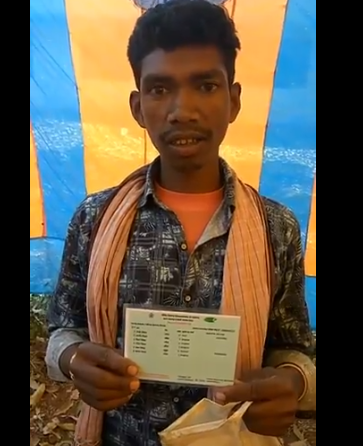
According to news reports, 18,66,803 (approx. 19 lakh) beneficiaries whose Aadhaar numbers were not seeded to their PDS ration cards have been declared bogus. This follows the Odisha government’s Food Supply and Consumer Welfare Department making linking of Aadhaar numbers with ration cards mandatory, with 15 September 2019 as the deadline. Ground reports also indicate that the the foodgrains entitlements for these 19 lakh beneficiaries have not been delivered to ration shops.
https://twitter.com/OrissaRtf/status/1102868905314279424?s=20
https://twitter.com/OrissaRtf/status/1102869971858685952?s=20
On October 11, members of the Odisha Khadya Adhikar Abhijan handed over a letter apprising the Odisha State Food Commission that most of these so-called bogus beneficiaries possess an Aadhaar number which they have already submitted to the concerned dealers and officials. They are clueless as to why their Aadhaar numbers have not been seeded to their PDS ration cards. Further, a substantial number of persons comprising children, the elderly and the disabled are yet to get an Aadhaar number for reasons beyond their control such as the biometric device at the enrolment centre being unable to read their fingerprints, Aadhaar enrolment centres being far away from their villages, etc. For these families and individuals the supply of foodgrains against their ration cards has been stopped without any notice or prior intimation.
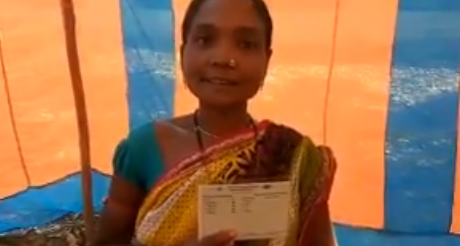
https://twitter.com/OrissaRtf/status/1102873518679576577?s=20
The Abhijaan, along with the Right to Food campaign, Rethink Aadhaar and others, urges the Odisha government to take the following steps immediately:
Publish names of beneficiaries declared bogus:The details of the individuals whose ration cards have been declared bogus should be published by the department on their website and should also be pasted on the walls of the Gram Panchayat buildings, in rural areas, and ration dealers’ shops, in the urban areas. The department should aim to conduct a door-to-door verification of all PDS beneficiaries, giving them a chance to identify themselves through other documents/ methods than Aadhaar-based authentication.
Release beneficiaries’ foodgrain entitlements: Foodgrains are a fundamental right for all beneficiaries covered under the NFSA and cannot be denied for technological reasons such as non-linking of Aadhaar. All beneficiaries whose ration entitlement has been denied for the past two months should be released urgently.
Provide alternatives to Aadhaar authentication: PDS being one of the most successful schemes in the state and a major enabler of food security for large numbers of people, the state government should explore other options of identity authentication in place of Aadhar based biometric authentication.
Respect the SC judgment: The Supreme Court in its Aadhaar judgment has clearly stated that no beneficiaries should be deprived of their rightful entitlement for want of Aadhaar. Such deprivation from entitlements is therefore a contempt of the apex court’s order.In sum, the state should immediately refrain from denying ration to otherwise eligible beneficiaries on a mere technical plea that their Aadhaar numbers are not linked with PDS.
The full letter to the Odisha State Food Commission, along with supporting documents, can be accessed here.
For further information, please email contact@rethinkaadhaar.in or tweet to or @OrissaRtf.
### 1 Oct 2019 — An appeal To support rethink aadhaar & article 21 Trust > Last year, we created the Article 21 Trust as an engine that could power further struggles to counter the impact of Aadhaar and other civil technologies on human rights – in particular the right to life, liberty, and livelihood (as the name of the Trust might suggest). Article 21 will support Rethin Original: https://rethinkaadhaar.in/blog/2019/10/1/an-appeal-for-support-on-article-21-trustLast year, we created the Article 21 Trust as an engine that could power further struggles to counter the impact of Aadhaar and other civil technologies on human rights – in particular the right to life, liberty, and livelihood (as the name of the Trust might suggest). We find ourselves facing complex questions which will someday seek resolution in the highest courts in our country, just as the Aadhaar project did. Among these are questions of citizenship in the age of digital identities thrown up by the National Register of Citizens recently finalized in Assam; questions of the power of the state in relation to citizens, even as India prepares to build its “Health Stack” comprising citizens’ medical data tied to a singular identifying number; and questions of “datafication” of citizens as we engage with the prospects of a data economy. Article 21 Trust aims to develop a vision of technology- and data-driven governance that puts citizens and their welfare at its core.
Article 21 will also support Rethink Aadhaar through fundraising as well as working on necessary research. Early next year we envision organising a national tribunal on Aadhaar-related issues as we continue to campaign for doing away with (and finding alternatives for) the use of the Aadhaar number or Aadhaar-based authentication/verification, especially for welfare schemes and even on a voluntary basis. Given the pace at which the government is pushing for expanding the Aadhaar project, there is an urgent need to ensure that there are reminders of the Aadhaar project’s limited scope - with enrolment strictly voluntary - as directed by the Supreme Court.
Rethink Aadhaar could not have grown without your support – many have contributed to this campaign, supported interns financially, and through volunteer efforts. We request your continued support for both Rethink Aadhaar and Article 21 Trust. Should you wish to make a (further) monetary contribution, Article 21 Trust bank details are included below.
Name on account: Article 21 Trust
Bank A/C No.: 50200037948512
Bank name: HDFC Bank
Branch name: Hauz Khas
IFSC Code: HDFC0000467
Note on Article 21 Trust: The Trust was created in July, 2018; the current Trustees include Maansi Verma, Praavita, Prasanna S, Raghu Godavarthi, and Rohith Jyotish
Engage with us on Twitter:
### 1 Oct 2019 — Rethink Aadhaar Newsletter: October 2019, Vol. I > The Finance Ministry has yet again extended the deadline by which people can link their Aadhaar numbers to PAN, until December 31, 2019. Rethink Aadhaar maintains that such linking is disproportionate and unconstitutional. A challenge to such linking is being heard in the Karnataka High Court wherei Original: https://rethinkaadhaar.in/blog/2019/10/1/rethink-aadhaar-newsletter-october-2019-vol-iDeadline for linking Aadhaar to PAN EXTENDED yet again
The Finance Ministry has yet again extended the deadline by which people can link their Aadhaar numbers to PAN, until December 31, 2019. Rethink Aadhaar maintains that such linking is disproportionate and unconstitutional. A challenge to such linking is being heard in the Karnataka High Court wherein the Central Board of Direct Taxes (CBDT) has asked for more time to respond. The HC has directed the CBDT not to take any action against the petitioners for not linking Aadhaar to PAN until the hearing is complete.
ECI proposes amendments to the RP Act to allow Aadhaar-Voter ID linking
The Election Commission wrote to the Law Commission on August 13 proposing amendments to the Representation of the People Act, 1950, which would allow linking the Aadhaar number to Voter IDs. This follows the July 16 Delhi HC direction to the ECI to consider a plea for an Aadhaar-based voting system, in response to a PIL filed by BJP member Ashwini Kumar Upadhyay. Concerned citizens wrote to the ECI in response to that direction pointing out multiple reasons to dismiss linking Aadhaar numbers with Voter IDs, including the dangers of voter profiling highlighted by the Cambridge Analytica episode, and the fact that self-reported errors in Aadhaar data were found to be one-and-one-half times higher than errors in the electoral database. Rethink Aadhaar demands that the Law Commission dismiss the proposed amendments and ensure the sanctity of the electoral process in India, which the Election Commission has most grievously failed to do.
Madras HC dismisses Aadhaar-social media linking; SC tosses issue to Centre
On September 13, the Supreme Court directed the Centre to submit to the Court its plans for regulating social media companies, including progress that had been made on the intermediary liability rules, in what is being called the WhatsApp traceability case, before the next hearing on September 24. The Court was hearing Facebook’s petition to transfer four cases pending in three different High Courts. Earlier, on August 21, the Madras HC reiterated its view that Aadhaar cannot be used to authenticate social media accounts, as it violated the SC judgment on Aadhaar.
The SC’s Constitution Bench, in K.S. Puttaswamy v. Union of India (the 2018 Aadhaar judgment) ruled out the use of Aadhaar numbers by private parties. This apart, linking Aadhaar numbers with social media accounts could result in the commercialisation of peoples’ personal data, highlighted as a potential threat in Justice DY Chandrachud’s dissent:
“...But the real issue is whether the linking of Aadhaar cards is the least intrusive method of obviating the problems associated with subscriber verification. The state cannot be oblivious to the need to protect privacy and of the dangers inherent in the utilization of the Aadhaar platform by telecom service providers. In the absence of adequate safeguards, the biometric data of mobile subscribers can be seriously compromised and exploited for commercial gain.”
In any case, mandatory linking of Aadhaar numbers with social media accounts would also violate the proportionality principle laid down by the 9-judge Constitution Bench in K.S. Puttaswamy v. Union of India (the 2017 Privacy judgment).
Biometrics of people excluded from NRC and unable to prove citizenship to be flagged
Reports that the Home Ministry will be flagging the biometrics of those residents of Assam excluded from the final National Register of Citizens list published on August 31 and unable to prove their citizenship even after approaching the Foreigners’ Tribunal have raised fresh questions on the use of the Aadhaar number to determine citizenship. Possessing the Aadhaar number does not constitute proof of citizenship as per the Aadhaar Act, 2016 (Section 9).
There is the additional concern that such collection of biometric data can enable surveillance - something also observed against the backdrop of deporting Rohingya refugees. The lack of a data protection law in India exposes those excluded from the NRC to further dangers of data "trafficking", which as a violation of privacy rights must be seen as equivalent to human trafficking. This last aspect has also been pointed out in some conversations - that creating a stateless class is only a way of providing cheap labour in the so-called fourth industrial age.
Adivasis from Pathalgadi villages publicly reject Aadhaar
Adivasi residents of Pathalgadi villages in Jharkhand have publically rejected Aadhaar as they are apprehensive that Aadhaar will ease exploitation of Adivasis and their resources by outsiders, as the unique identification system equates Adivasis with the ‘aam aadmi’ (common man). A fact-finding team of the Jharkhand Janadhikar Mahasabha learned that “Pathalgadi, an ancient way of disseminating important information among the community, was also used to express dislike towards certain government actions”. The team found that the state responded to Pathalgadi with severe repression and violence.
The immediate trigger for Pathalgadi was the state government’s repeated attempts to amend the Chhotanagpur Tenancy Act to ease acquisition of Adivasi land. There is also anger against the constant attack on Adivasis’ right to self-governance. Gram Sabha is not consulted before implementing projects in Adivasi-dominated areas.
40-year old Jharkhand woman dies in childbirth, child sold for Rs. 10,000
40-year old Jhibal Tirkey, of Champanagar village in Jharkhand’s Gumla district, died on August 26, two days after birthing her eighth child, a girl who was subsequently sold for Rs. 10,000 to an unidentified family. Investigation into the case revealed that the family had no ration card, no Antyodaya Anna Yojana (AAY) card and no LPG connection. Although the woman’s mother-in-law, Maudo, was eligible to receive pensions under the National Social Assistance Program, she never received any money due to a discrepancy between her voter ID, per which her age is 67, and her Aadhaar card, per which she is 51.
Marking the first anniversary of the Aadhaar judgment
The Aadhaar hearings by the Supreme Court’s Constitution Bench and the subsequent judgment are a significant milestone in the struggle against Aadhaar. Rethink Aadhaar is therefore marking the first anniversary of the judgment this week as a reminder of how the fight against the Aadhaar onslaught is still ongoing. We trialled an online conversation open to the public on the takeaways from the Aadhaar judgment and on overcoming the lack of response from the UIDAI and the government on Aadhaar issues. We will be organising more such talks - do look out for our updates on Twitter and Facebook.
Aadhaar in the News
Series: One year after the Aadhaar judgment….
How Aadhaar Has Taken Over Our Lives
Spying on your body: Health Blueprint and Aadhaar
As Aadhaar's Idea Spreads From Kenya To Venezuela, We Still Need To Ask – Why ID?
What benefit does Aadhaar give to Indian citizens? And how will the NRC affect them?
Children continue to be perversely targeted
We need to keep talking about Aadhaar
Targeted money transfers using Aadhaar: A way to steal elections
‘It is a big hoax’: Col. Mathew Thomas
Concerns over linking Aadhaar to voter ID and social media accounts
Other recent news articles on Aadhaar
HC relief to JP Morgan in EPFO complaint (Company refused to share employees’ Aadhaar, bank details)
Voters hesitant to provide Aadhaar details to surveyors
Why Maj. Gen. Vombatkere has challenged Aadhaar Amendment Act in the Supreme Court
Two Men Arrested for Duping over 1,000 People on the Pretext of Linking Aadhaar Cards
Engage with us on Twitter:
### 25 Jul 2019 — Citizens write to Election Commission demanding opposition to Aadhaar-Voter ID linking > On July 16, the Delhi High Court directed the Election Commission of India (ECI), to consider a plea for an Aadhaar-based voting system, in response to a PIL filed by BJP member Ashwini Kumar Upadhyay. The petition “proposes an e-voting system using fingerprint and face biometric” and, for that purp Original: https://rethinkaadhaar.in/blog/2019/7/25/citizens-write-to-election-commission-demanding-opposition-to-aadhaar-voter-id-linking-iOn July 16, the Delhi High Court directed the Election Commission of India (ECI), to consider a plea for an Aadhaar-based voting system, in response to a PIL filed by BJP member Ashwini Kumar Upadhyay. The petition “proposes an e-voting system using fingerprint and face biometric” and, for that purpose, linking of Aadhaar number with voter ID. Such a system, the petition claims, will lead to an increase in voting percentage while also preventing bogus or fraudulent voting. Crucially, the petition does not mention a single study or pilot programme whose results might support either of these two claims. The Election Commission is yet to respond to the High Court’s direction.
The main concerns with this proposal are the following:
While it is assumed that Aadhaar will help reduce bogus voter IDs, there is research to show that there are more errors in the Aadhaar database than in the voter ID database. So, it is unreasonable to expect that linking Aadhaar with voter IDs will help in reducing the number of fraudulent voter IDs.
The ECI’s 2015 National Electoral Roll Purification and Authentication Programme (NERPAP) which involved linking Aadhaar with voter IDs resulted in deletion of nearly 55 lakh voters in Andhra Pradesh and Telangana.
Aadhaar is by design issued to all those who are residents of India including, for example, foreigners who have been legally staying here for an extended period. Aadhaar, therefore, is not a proof of citizenship whereas voting rights are restricted solely to citizens.
This issue assumes even more significance in the light of a letter recently written by the Chief Minister of Maharashtra to the ECI recommending the linkage of Aadhaar with voter IDs. We have seen with Cambridge Analytica the dangers of voter profiling. In Andhra Pradesh earlier this year, the Telugu Desam Party was accused of misusing Aadhaar and demographic data - including names, photographs, caste information, and family details - of 3.7 crore voters. Investigative media reports indicated that another 2 crore voters were deleted from the electoral rolls in Punjab through the misuse of stolen Aadhaar data.
Over 200 civil society organisations and concerned citizens endorsed the letter
Over 200 civil society organisations and concerned citizens have signed their name to a letter which demands that the Election Commission proactively seek dismissal of this petition.
Some of the notable names, among those who have endorsed the letter, include:
Political leaders such as Brinda Karat, Yashwant Sinha and Manoj Jha
Over twenty five former civil servants
Retired defence personnel Col Mathew Thomas and Wg Cdr Kartar Sainani
Those working on electoral issues and reform such as Kamal Kant Jaswal (Former Secretary, Department of Information Technology, GoI), Vipul Mudgal (Common Cause), Jagdeep Chhokar (Association for Democratic Reform) and Srinivas Kodali
Petitioners in the SC Aadhaar case: Kalyani Menon-Sen, Shantha Sinha, M. G. Devasahayam and Bezwada Wilson
Activists and social workers Syeda Hameed, Aruna Roy, Harsh Mander, Deep Joshi, and Nikhil Dey among numerous others
Academicians, for example, Uma Chakravarti, Jayati Ghosh, Virginius Xaxa, Jean Dreze, Sukhadeo Thorat, Satish Deshpande, Aditya Nigam, Achin Vanaik and Rajendran Narayanan
Jurists like G Haragopal (Visiting Professor, NLSIU, Bengaluru)
Journalists like Rajni Bakshi, Sucheta Dalal and P. Sainath
Artists including Nandita Das, Shyam Benegal, T. M. Krishna and Anand Patwardhan
The organisations Action India, JEEVIKA, IT for Change and the Internet Freedom Foundation
Engage with us on Twitter:
### 19 Jul 2019 — Rethink Aadhaar Newsletter: July 2019, Vol. I > While the government is trying hard to crush every voice against Aadhaar, one person from Mumbai not only fought, but also won against the government's mandatory linking policy. Hear Mr Ramesh Kurhade of Mumbai Port Trust as he shares the story of his unwavering fight against Aadhaar. A number of c Original: https://rethinkaadhaar.in/blog/2019/7/19/rethink-aadhaar-newsletter-july-2019-vol-iCelebrating Mr. Ramesh Kurhade’s fight against mandatory Aadhaar linking
When: Friday, 19 July 2019 Time: 5pm to 7pm
Register Online: https://www.moneylife.in/event/250.html
While the government is trying hard to crush every voice against Aadhaar, one person from Mumbai not only fought, but also won against the government's mandatory linking policy. Hear Mr Ramesh Kurhade of Mumbai Port Trust as he shares the story of his unwavering fight against Aadhaar.
A number of concerned citizens and NGOs have come together to felicitate Mr Kurhade in the hope that his experience will give courage to others. The felicitation and his talk will be followed by brief interventions from additional speakers: Dr. Anupam Saraph, Vickram Crishna, Raghu (aka godavar), Vidyut Gore, Elisha Ebenezer, and more.
Where: Moneylife Foundation Knowledge Centre, 304, 3rd Floor, Hind Service Industries Premises, Off. Veer Savarkar Marg, Near Shivaji Park Seaface, Dadar (W), Mumbai - 400028
Map Link: https://goo.gl/maps/nchPXrXqKBMCay1N9
RSVP: Shilpa at 022-49205000 or email foundation@moneylife.in or Call/SMS/ WhatsApp on +91-7045156415 (Please give your Name, Email ID & Contact number)
Read: Mumbai Mirror has published a profile of Mr. Kurhade.
What to do about Aadhaar linking with PAN, quoting Aadhaar in Income Tax returns?
The short answer: linking Aadhaar with PAN has become a legal requirement.
The cost of refusing to enrol in the Aadhaar program appears to be an invalid PAN card. Resistance to Aadhaar will not end with enrolment. We hope that it will strengthen the struggle for many of us who had earlier felt safe not being enrolled and will make the struggle even more imperative.
If you are looking for options to stay out of the system and are worried about the security and privacy risks of the Aadhaar project, we urge you to consult a lawyer. You could also seek legal advice on the potential penalties or other consequences of, for instance, a delayed tax return filing. It would be best to take an informed decision specific to your situation. In case you'd like us to connect you with a lawyer, please write to legal@rethinkaadhaar.in.
Aadhaar Amendments Bill passed by both Houses of Parliament
The Aadhaar Amendments Bill, 2019, was passed by the Lok Sabha on July 4, after a day-long debate which involved fiery critique of the Bill from MPs NK Premachandran (RPI), Mahua Moitra (TMC), Supriya Sule (NCP), Ritesh Pandey (BSP), Asaduddin Owaisi (AIMIM), among others. Subsequently, the Bill was passed by Rajya Sabha on July 8. The Bill is identical to the version passed by the Lok Sabha in January, and later promulgated as an Ordinance, although during its final passage the government also promised to include schemes paid out of the Consolidated Fund of states. Read our statement on the Bill here. You can also read the full discussion of the Bill in the Lok Sabha at MediaNama.
Rethink Aadhaar statement on Economic Survey
The government’s vision to collate comprehensive, exhaustive data about every citizen and making it available for commercial use by private entities as stated in the budget document the Economic Survey 2018-19 is quite alarming. Read our full statement.
Delhi HC asks ECI to consider plea on Aadhaar-Voter ID linking
A Delhi High Court bench headed by Chief Justice DN Patel directed the Election Commission of India (ECI) to consider a plea by BJP leader Ashwini Upadhyay seeking linking of Aadhaar number with Voter IDs. The petitioner contends this will facilitate an “e-voting system using fingerprint and face biometric” which will “lead to an increase in voting percentage” and prevent “prevent bogus or fabricated voting”. Rethink Aadhaar strongly opposes any such proposal for linking Aadhaar with Voter IDs.
Aadhaar in the news
Jaipur teens tampering with Aadhar details to watch ‘Kabir Singh’: https://www.thehindu.com/entertainment/movies/teens-tampering-with-aadhar-details-to-watch-kabir-singh/article28271056.ece
Pay Interest For Delaying Salary Of Employee Who Did Not Link Aadhaar: Bombay HC To Port Trust: https://www.livelaw.in/news-updates/pay-interest-for-delaying-salary-of-mbt-employee-who-did-not-link-aadhar-145922
The Aadhaar Amendments Bill has reinstated many of the provisions of Section 57 of the original Aadhaar Act which was struck down by the Supreme Court in September 2018 as unconstitutional: https://indianexpress.com/article/opinion/columns/aadhaar-amendment-bill-new-rules-uidai-5829226/
#MyBodyMyRights: Will Aadhar prevent you from getting an abortion? http://www.hidden-pockets.com/mybodymyrights-will-aadhar-prevent-you-from-getting-an-abortion/
The imposition of Aadhaar to avail benefits and subsidies “is nothing but the state’s arrogance towards the poor”, says INC MP from Koraput, Saptagiri Ulaka: https://caravanmagazine.in/politics/congresss-lone-mp-from-odisha-on-food-security-aadhaar-and-the-condition-of-his-party
Aadhaar Card Not A Valid Document For Travel To Nepal: NCDRC: https://www.livelaw.in/news-updates/aadhar-card-not-a-valid-document-for-travel-to-nepal-ncdrc-read-order-146469
Aadhaar verification no more in use for driving license: https://www.livemint.com/news/india/aadhaar-verification-no-more-in-use-for-driving-license-1563251433918.html
Economic Survey has based Aadhaar impact on MGNREGS on false assumptions, say researchers: https://www.thehindu.com/news/national/economic-survey-has-based-aadhaar-impact-on-mgnregs-on-false-assumptions-say-researchers/article28313214.ece
Madras HC seeks EPFO response on plea against mandatory Aadhaar-UAN linking: https://www.business-standard.com/article/pti-stories/plea-in-hc-against-linking-aadhaar-to-uan-to-avail-pf-pension-119070900224_1.html
TISS study: Aadhaar fraud rampant in Kalyana Lakshmi: https://timesofindia.indiatimes.com/city/hyderabad/tiss-study-aadhaar-fraud-rampant-in-kalyana-lakshmi/articleshow/70135322.cms
For whom is the Aadhaar Amendments Bill: only to please Telecom companies: https://www.nationalheraldindia.com/governance/for-whom-is-the-aadhaar-amendments-bill-reliance-jio-airtelvodafone-and-tata
Engage with us on Twitter:
### 6 Jul 2019 — Budget's Economic Survey Pushes For Interlinking and Selling Citizens' Data for Private Purposes > We are alarmed and concerned at the government’s vision to collate comprehensive, exhaustive data about every citizen and making it available for commercial use by private entities as stated in the budget document the Economic Survey 2018-19 published on July 4. Chapter 4 of the Economic Survey (a b Original: https://rethinkaadhaar.in/blog/2019/7/6/budgets-economic-survey-pushes-for-interlinking-and-selling-citizens-data-for-private-purposesWe are alarmed and concerned at the government’s vision to collate comprehensive, exhaustive data about every citizen and making it available for commercial use by private entities as stated in the budget document the Economic Survey 2018-19 published on July 4. Chapter 4 of the Economic Survey (a budget document laid before parliament) Data “Of the People, By the People, For the People argues for expanding collection and interlinking of comprehensive data on citizens, violating Supreme Court judgments on privacy and Aadhaar. It makes a case for integrating citizens’ data for commercial purposes even when no legal framework provides for this. It assumes privacy concerns will be taken care of by a forthcoming data protection law which has in fact been pending on the drawing board for years.
Already, in the government’s coercive and callous interlinking of Aadhaar in existing databases, we have witnessed alarming data leaks that have had substantial financial implications and legal consequences for ordinary citizens. It makes blanket assertions that technology measures would protect privacy in the future, claiming “technology has largely kept pace to mitigate” (data leaks) when the government is yet to provide any redressal or compensation to those who have suffered from data leaks.
It states the example of how Telangana has integrated multiple points of information and data on thousands of its residents and their relatives in its ‘Samagra’ without stating how this was done in the absence of privacy and data protection laws. The document argues for using Aadhaar numbers to create a health registry to sell sensitive medical data to commercial entities for a profit. It argues “people can always opt out of divulging data to the government where possible”, but so far the government has put all its energies in coercing citizens to give their data, cutting them off from essential services if they do not provide data.
It erroneously claims that increased data collection and integrating databases will reduce inclusion errors and rectify exclusion errors. This is a wrong claim to make. In the past few years, both UPA and NDA governments have pushed for Aadhaar enrolment by claiming this will help improve welfare services. This has led to denial of wage payments, food grains, vital social security pensions to thousands of individuals, especially the elderly and those who work with their hands, who face faulty data entry, network errors, servers and network errors, and biometric authentication failures because of changes while working with their hands over time. Since 2017, the Right to Food Campaign has recorded more than 40 deaths when the most vulnerable got cut from any social security in the fault-ridden transition to Aadhaar. One such death was recorded in Jharkhand’s Latehar last month when an Adivasi farmer 65 year old Ramcharan Munda died after he was denied food rations for three months. The government has failed to act responsibly and provide any relief and voluntary alternatives for those facing such problems because of its manic focus on data linking. Yet, in this new document it again pushes for more of the same.
It is worrying that the budget document of the vision for the Indian economy once again states two different standards of privacy rights for India’s poor and rich. It declares: “care must also be taken to not impose the elite’s preference of privacy on the poor, who care for a better quality of living the most”, thus imposing its own assumptions that the poor can do with fewer privacy protections than the rich. It falsely pits welfare rights against privacy rights. Justice Chandrachud had warned against this in the Aadhaar judgement, noting: "The refrain that the poor need no civil and political rights and are concerned only with economic well being has been utilised through history to wreak the most egregious violations of human rights." In fact the vulnerable need stronger privacy rights at a time of heightened profiling of citizens based on their religion and caste for political purposes, as seen with the NRC in Assam, and lynchings all over the country. .
Further advocating for unchecked collecting and collating of data on citizens will only lead to further undermining of our rights, and to worse surveillance and data breaches.
For any responses, suggestions, please write to contact@rethinkaadhaar.in
The Aadhaar Amendments Bill, 2019, was introduced in the Lok Sabha on Monday, June 24, and is listed for debate today (June 27). This Bill is identical to the Bill passed by the Lok Sabha earlier this year as well the subsequently promulgated Ordinance.
While the government claims the Amendments ensure compliance with the Supreme Court judgment, the Bill in effect seeks to bypass the judgment in, for instance, allowing commercial use of Aadhaar (supposedly on a voluntary basis) by amending other laws. The Bill also includes amendments to the Telegraph Act and the Prevention of Money Laundering Act allowing use of Aadhaar authentication for availing mobile and banking services - it is likely that other laws will be similarly amended in due time.
Rethink Aadhaar has been reaching out to several Members of Parliament (MPs) requesting them to demand that the Bill be sent to a Parliamentary Standing Committee, so as to ensure a thorough public consultation. Yet, while the government insists "Indians have accepted Aadhaar" - and enjoys numerical superiority in the Lok Sabha - we need to collectively raise our voices and denounce Aadhaar in the strongest terms, and ensure that our representatives echo us.
You can help:
By directly calling your MP - or any MP of your choice, using the contact details listed here.
By signing a petition addressed to the same MP.
By tagging your MP in a Twitter post. (Some sample tweets can be found here.)
We urge you to take action before 1pm today - Thursday, June 27.
### 6 Mar 2019 — Letter to CBDT protesting PAN-Aadhaar Linking > While we continue to wait for a favorable review of the judgement upholding PAN-Aadhaar linking, many citizens are opposing this rule in the spirit of civil disobedience against enrolling in a project which poses a lifelong threat for one’s personal security. There is much evidence that raises Original: https://rethinkaadhaar.in/blog/2019/3/6/letter-to-cbdt-protesting-pan-aadhaar-linkingFriends,
While we continue to wait for a favorable review of the judgement upholding PAN-Aadhaar linking, many citizens are opposing this rule in the spirit of civil disobedience against enrolling in a project which poses a lifelong threat for one’s personal security. There is much evidence that raises serious concerns about potential loss of identity, fraud (including identity fraud), and privacy. This is apart from the deeply problematic nature of both the manner in which enrollments have happened and continue to happen.(including most recently a complaint by State Bank of India which has alleged misuse and wrongful generation of Aadhaar numbers. A report on January 29, 2019 explained the manner in which the fraud was being committed, raising concerns about fake numbers being generated by the project. More recently, on 26 February, 2019, the Times of India reported that the UIDAI had to launch a probe into a privacy breach and misuse of data of 3.7 crore voters in Andhra Pradesh.)
As we wait, collectively, we have prepared a letter draft addressed to the Central Board of Direct Taxes (CBDT)
, the division of the ministry which deals with collection of taxes, seeking confirmation on the safety of personal information and data protection of our information and for extending time for linking PAN with Aadhaar while review petitions are pending.
The letter(attached here) requests the CBDT to rescind the orders mandating linking PAN with Aadhaar or, in the alternative, extend the time for linking PAN with Aadhaar until sufficient safeguards are put in place to protect the rights and interests of tax payers.
We urge those among you concerned about the violation of your rights in this coercive enrolling in Aadhaar and linking of existing IDs to it, to use and share this draft letter widely, to use this send a letter to the CBDT by Speedpost and email. Do share scans of Speedpost receipts and email with us you do this so we can collate and share the numbers resisting this more widely and build further collective efforts.
The letter should be sent to:
The Chairman
Central Board of Direct Taxes (CBDT)
Ministry of Finance, Dept. of Revenue,
North Block, ITA II Division
New Delhi - 110001
The email address is: chairmancbdt@nic.in
TEXT OF DRAFT LETTER
To
The Chairman Central Board of Direct Taxes (CBDT) Ministry of Finance, Dept. of Revenue, North Block, ITA II Division New Delhi - 110001
chairmancbdt@nic.in
Date:
Sir,
SUB: Seeking confirmation on the safety of personal information and data protection in the context of the Order dt. 30.06.2018 u/Sec 119 of the Income Tax Act extending time for linking PAN with Aadhaar
We are writing to you to request a reconsideration of your order dated 30.06.2018, passed under Section 119 of the Income Tax Act, 1961 (hereinafter referred to as the “Income Tax Act”) through which the Central Board of Direct Taxes (hereinafter referred to as the “CBDT”) has extended time for linking PAN with Aadhaar till 31.03.2019.
It is requested that your office rescind the orders mandating linking PAN with Aadhaar or, in the alternative, extend the time for linking PAN with Aadhaar until sufficient safeguards are put in place to protect the rights and interests of tax payers, including and especially the fundamental right to privacy which the Supreme Court has recognised as an intrinsic part of the fundamental rights contained in Part III of the Constitution, and including the right to dignity.
In September 2018, the Supreme Court upheld section 139AA of the Income Tax Act which requires the linking of the Aadhaar number to income tax returns and PAN card. The majority judgment accepted the statement of counsel for the respondents that Aadhaar is an impeccable identity, that no duplicates exist, that it reflects the identity of each person accurately. On matters of security of data, the court only considered the UIDAI and accepted the powerpoint presentation made by the CEO of the UIDAI that it is secure. The majority judgment also acknowledged that there was no data protection law yet in place, and that that must be remedied.
Significantly, therefore, the court’s partial imprimatur to the Aadhaar programme, and to Section 139AA of the Income Tax Act, through its judgment dated 26.09.2018 (Puttaswamy II), also recognised the inviolability of the right to privacy. The judgment does not validate the methods employed in linking Aadhaar with PAN but merely holds such linking to be constitutionally valid subject to such linking being in conformity, among other things, with the various principles of privacy that the nine-judge bench of the court recognised unanimously in August 2017, in JusticeK.S.Puttaswamy(Retd) v. Union of India (Puttaswamy I).
Since the date of the judgment, many events have transpired that raise questions about the Aadhaar project, and the validity of Aadhaar as a secure and robust identity. Some illustrative examples are set out below.
The State Bank of India has alleged misuse and wrongful generation of Aadhaar numbers. A report on January 29, 2019 explained the manner in which the fraud was being committed, raising concerns about fake numbers being generated by the project. State Bank of India, it may be recalled, has been directed by the UIDAI (as have other banks, see https://economictimes.indiatimes.com/industry/banking/finance/banking/banks-without-stipulated-number-of-Aadhaar-centres-will-face-rs-20000-fine-from-october/articleshow/60376996.cms) to set up enrolment centres in at least 10% of their branches, and to do a certain number of enrolments everyday on pain of penalty (https://www.thehindu.com/business/Industry/Aadhaar-authentication-13-banks-fined-face-penalties/article24835382.ece , August 31, 2018).
See https://economictimes.indiatimes.com/industry/banking/finance/banking/sbi-alleges-Aadhaar-data-misuse-uidai-rubbishes-charge/articleshow/67734688.cms
A single judge of the Calcutta High Court, in the matter of Debashis Nandy v. Union of India in judgment dated January 3, 2019, was confronted with a case where the father’s name had been falsely entered when demographic information was collected at the time of enrolment. His finding in the case is that the Supreme Court judgment does not deal with the authenticity of demographic data, and in fact, demographic information is unverified, and that “there is definitely something amiss with the Aadhaar enrolment process if important demographic information such as the name of the applicant’s father, as the case in hand, can be falsified and even go undetected.” The judgment records that “the Learned Additional Solicitor General submitted that no verification is sought as regards such information and the application is processed on the basis of the bare information provided by the applicants in their application.” The ease with which false identities can be created is the central aspect of this judgment. See
https://drive.google.com/viewerng/viewer?url=https://www.livelaw.in/pdf_upload/pdf_upload-357113.pdf
This problem with the Aadhaar system has also been acknowledged by a Division Bench of the Lucknow Bench of the Allahabad High Court in the matter of Smt Parvati Kumari v. State of UP in judgment dated January 9, 2019. In this case, the court held: “We clearly deduce from the above that the other information namely name, date of birth, gender and address as entered in the Aadhaar Card, is furnished by the Aadhaar applicant at the time of authentication/enrolment. Although, the regulations provide for the applicant to rely on a set of documents for giving information in regard to name, address and proof of date of birth, however, because the said information is merely given by the applicant, and is not authenticated by UIDAI at the time of authentication, the Aadhaar Card cannot be conclusive proof in regard to those entries.” The only connection that can be established, according to the High Court, is the biometric information collected and the Aadhaar number. See
https://www.livelaw.in/top-stories/aadhar-entries-not-conclusive-proofs-allahabad-hc-142428
In the meantime, biometric fraud has surfaced on several occasions. A recent incident is reported at
https://www.indiatimes.com/trending/wtf/hackers-use-Aadhaar-biometrics-to-rob-a-man-s-account-whose-job-is-to-issue-Aadhaar-cards-361274.html
and
https://www.huffingtonpost.in/entry/aadhar-biometrics-theft-case-police-arrests-victims-close-friend_in_5c5f2788e4b0eec79b23f356
The vulnerability of the UID data base, and of the various databases in which the number has been seeded, has been revealed. On January 25, 2019, it was reported that fake voter IDs had been created by Telengana Congress to make a point about the shortcomings in the voter registration system. “All one needs is to create a duplicate Aadhaar card of a person and use a house address which has an electricity bill. The photo and details can be sourced from Whatsapp or from social media accounts, it’s that simple. No one will verify if the Voter ID is genuine or fake,” explained the Congress worker who created the bogus card. See
https://www.thenewsminute.com/article/anyone-can-fake-it-telangana-congress-workers-forge-voter-ids-election-officers-95659
d, More recently, on 26 February, 2019, the Times of India reported that the UIDAI has launched a massive probe into a complaint filed regarding alleged privacy breach and misuse of data of 3.7 crore voters in Andhra Pr adesh. The problem has been exacerbated by the seeding of the Aadhaar number in various databases, including in this case the Smart Pulse Survey and the State Resident Data Hub, which contain demographic data in the UID database and in the electoral rolls. “The app has voter ID numbers, names, colour photos, booth-level information, family details, caste information and government schemes and amounts a voter gets as beneficiary. The app comes with all the information inbuilt and is extensively used by TDP activists”, the report says. It says that investigation is on to find out how the company, IT Grids (India) obtained family details and beneficiary data. See
https://timesofindia.indiatimes.com/india/tdp-app-breached-data-of-3-7cr-voters-probe-begins/articleshow/68160839.cms
e. The vulnerability of the data in the Aadhaar system was acknowledged by the UIDAI in a press release in February 2018, when the “CEO, UIDAI advised people to be watchful for the protection of their privacy and recommended not to share their Aadhaar number or personal details to unauthorized agencies for getting it laminated, or printed on plastic card.” See
http://pib.nic.in/PressReleaseIframePage.aspx?PRID=1519253
This caution extends, as is now evident, more generally, and in situations beyond the control of the individual.
f. Most recently, a data breach is under investigation in Hyderabad, which reveals the vulnerability of systems that incorporate the Aadhaar number in their data base.
<http://www.newindianexpress.com/states/telangana/2019/mar/03/data-breach-by-tdp-app--cops-search-offices-of-it-grids-detain-four-1945964.html> and related news.
It is a matter of record that the SRDH (State Resident Data Hubs) have been set up by collaboration between the UIDAI and state governments.
See https://archive.org/stream/UIDAISRDHStateAdoptionStrategy/UIDAI%20-%20SRDH%20-%20Institutional%20Framework_djvu.txt for the 2012 UIDAI document on the creation and updation of SRDH, which has been the basis of which various SRDHs have been created. See for instance
https://apit.ap.gov.in/?page_id=588
and
http://degs.org.in/UIDAI.aspx (Delhi)
and
https://www.karnataka.gov.in/Aadhaar/Pages/Karnataka-Resident-Data-Hub-(KRDH).aspx
and
https://osrdh.odisha.gov.in/srdhportal/LdapConfig.action
and
https://makkal.tn.gov.in/makkal/login,
For a summary of the risks of the SRDH system, see
<https://medium.com/karana/the-360-degree-database-17a0f91e6a33>
g. A recent RTI reply from the UIDAI has revealed an astonishing fact: that the UIDAI does not have a Chief Information Security Officer. See
https://www.moneylife.in/article/Aadhaar-truth-uidai-never-appointed-a-chief-information-security-officer-reveals-rti/56267.html
h. Breaches of various databases holding Aadhaar numbers have been reported since the judgment, other than the Telengana breach cited above, and including
on 19 February, 2019, at https://techcrunch.com/2019/02/18/Aadhaar-indane-leak/ (Indane gas company leaks - it is estimated that over 6.7 million customers could be affected)
end January 2019, at https://techcrunch.com/2019/01/31/Aadhaar-data-leak/ (Jharkhand government web site)
at the World Economic Forum, the Global Risk Report 2019 named Aadhaar as having suffered multiple breaches, compromising over 1.1 billion people. See the report dated 19 February 2019 at
https://www.moneylife.in/article/Aadhaar-data-breach-largest-in-the-world-says-wefs-global-risk-report-and-avast/56384.html
Another report by Avast Software made a similar assessment. Both had Rachna Khaira’s investigative report for the Tribune for reference, but seem to have found reason to endorse it. The assessment also seems to point to `lax cybersecurity protocols’ as the possible reason for the breaches. That the UIDAI routinely denies leaks from its database, even when it has had to blacklist operatives, launch investigations, penalise connected persons, is part of the p
i. Since the judgment on September 26, 2018, information gathered from Fact Finding Reports and in the media shockingly reveals at least 12 further deaths where the poor have not been able to access their basic entitlements including ration and pension. This is despite the assurance given to the court by the Attorney General that “no deserving person would be denied the benefit of a scheme on the failure of authentication”. (at p.554 of the majority judgment). See for instance
https://www.firstpost.com/india/failure-of-a-biometric-machine-leaves-this-up-village-stranded-for-ration-5975641.html
In this case, it was a problem of connectivity, which is why a whole village found itself stranded.
j. There are further reports of the police demanding from housing societies “complete information of their residents” including details of their voter ID, PAN card, Aadhaar, phone number, vehicle number, email address, blood group, driving licence number, 2 passport size photographs and more. (By police notice from the office of the Police Inspector, KP Agarahara Police Station, Bangalore City, dated 28 January, 2019, No. KPAPS/CC/2019.)
The Regional Office in Bangalore of the EPFO continues to demand the Aadhaar number, even as recently as 7 February 2019, despite the Supreme Court judgment which renders this illegal.
This wide range of evidence has raised serious concerns about potential loss of identity, fraud including identity fraud, and privacy. This is apart from the deeply problematic nature of both the manner in which enrolments have happened and continue to happen (see the SBI complaint, supra).
In such a situation, there is ample ground to oppose the linking of the income tax returns and the PAN card to the Aadhaar number. In any event, such a move should be held off till the questions raised are answered and the vulnerabilities of the system and of the individual are satisfactorily dealt with.
We would also draw your attention to the judgment of the Supreme Court which accepted the logic of linking Aadhaar and PAN, but not while doing away with the right to privacy. The court accepted the government’s averment that it would serve a legitimate state aim, and so there can be inroads made into the right to privacy, if the doctrine of proportionality is met. There was already a law, but that law only mandated the linking of PAN and Aadhaar, and Aadhaar and income tax returns. It did not provide any manner of data protection. The government left it to the government to pass a Data Protection Law that would pass the test of protecting people’s rights and interests. That has not yet happened.
In its absence, we draw your attention to the report of the Group of Experts on Privacy constituted by the Planning Commission, under the chairmanship of Justice AP Shah, and whose report was presented to the government in October 2012. The report enunciated nine clear principles (“privacy principles).
These are
a requirement that the any data collector provide a simple notice of the information collected to all individuals, in clear and concise language, prior to the collection of such information;
that a data controller ought to give individuals a choice with regard to providing their personal information, and take individual consent only after providing notice of its information practices;
that only such information as is necessary for an identified purpose be collected;
that data collected ought to be adequate and relevant to the purposes for which they are processed;
that individuals ought to be allowed access to personal information about them held by the collecting authority;
that it be made mandatory that information collected is only disclosed to third parties after notice and informed consent is obtained;
that the collection and processing of the information is done in a manner that protects against loss, unauthorized access, destruction, use, storage, etc;
that a data processor ought to take all necessary steps to implement practices, procedures, policies and systems in a manner proportional to the scale, scope, and sensitivity to the data that is collected and processed; and nine, that clear mechanisms be put in place to implement privacy policies, including tools, training, and education; and external and internal audits.
For a more detailed reading of the report, see http://planningcommission.nic.in/reports/genrep/rep_privacy.pdf
You will agree with the conclusion of the report that it is of the utmost importance to acknowledge that data protection is not just about protecting data, but about protecting the person whose data it is.
These privacy principles have since been memorialised through the judgment of the Supreme Court in Puttaswamy I (the Privacy judgment), and the holding that the linking of Aadhaar with PAN is constitutionally valid is subject to the measures taken for the said purpose being compliant with these essential principles.
Parliament has not enacted such a law. When it is enacted, it will have to be tested to ensure it meets the standards set by the privacy judgment, which was rendered unanimously by a bench of nine judges.
Till then, and given
the state of demographic information in the UIDAI database
the wide range of places where the number has been linked/seeded
the regularity of data breaches
the absence of a Chief Information Security Officer in the UIDAI
the repeated cases of biometric failure and of biometric fraud
the probability of inorganic seeding, which takes consent away from the individual, and which must be struck down if any further seeding is to be allowed (see p.2 at https://pdsportal.nic.in/Files/Aadhar%20seeding%20guidelines.pdf)
the failure to delete the Aadhaar number from various databases where it has been wrongly seeded such as in banks and with mobile service providersdespite the judgment of the Supreme Court
the PAN number is required to be handed over to a multiplicity of agencies (15 at a quick count)
We request that you immediately suspend the linking of the Aadhaar number with the PAN card, and remove the requirement of providing the Aadhaar number while filing income tax returns till the problems stated above are addressed.
In addition, since as a data controller you are responsible for data protection, we are requesting you to kindly let us know
how the data will be stored
how the data will be/is being processed,
what security measures have been taken to prevent the breach of the data base, protect personal information and ensure that there is no unauthorised transfer
the purposes for which the Aadhaar number will be used, and what measures have been taken to ensure that it is not used for any other purpose
how you will detect that it has been used for a purpose other than that for which it is collected
how the breach of our data will be communicated to us
what action will be taken in the event of a breach
whose is the liability when there is a leak, transfer or inorganic seeding of the Aadhaar number
what is the extent, and forms of liability in the event that there is a data breach
which companies are involved in collecting, storing, processing and dealing with the data in any way, and what measures are in place to protect our data, and our privacy? This is especially important since there is no data protection law.
We also request you to respond to the various other queries raised in this missive.
Kindly make it convenient to send a response within 10 days, since the time for filing income tax returns is drawing close, and I wish to file my returns on time.
Yours sincerely,
### 2 Mar 2019 — Government’s Aadhaar Ordinance for commercial use is another Fraud upon the Constitution > Late in the evening of February 28, 2019, in the midst of a critical situation at the Indian border, the Central Government issued the Aadhaar and Other Laws (Amendment) Ordinance, 2019 , which seeks to revive the commercial use of the biometrics-linked 12-digit Aadhaar number which the Supreme Original: https://rethinkaadhaar.in/blog/2019/3/2/governments-aadhaar-ordinance-for-commercial-use-is-another-fraud-upon-the-constitution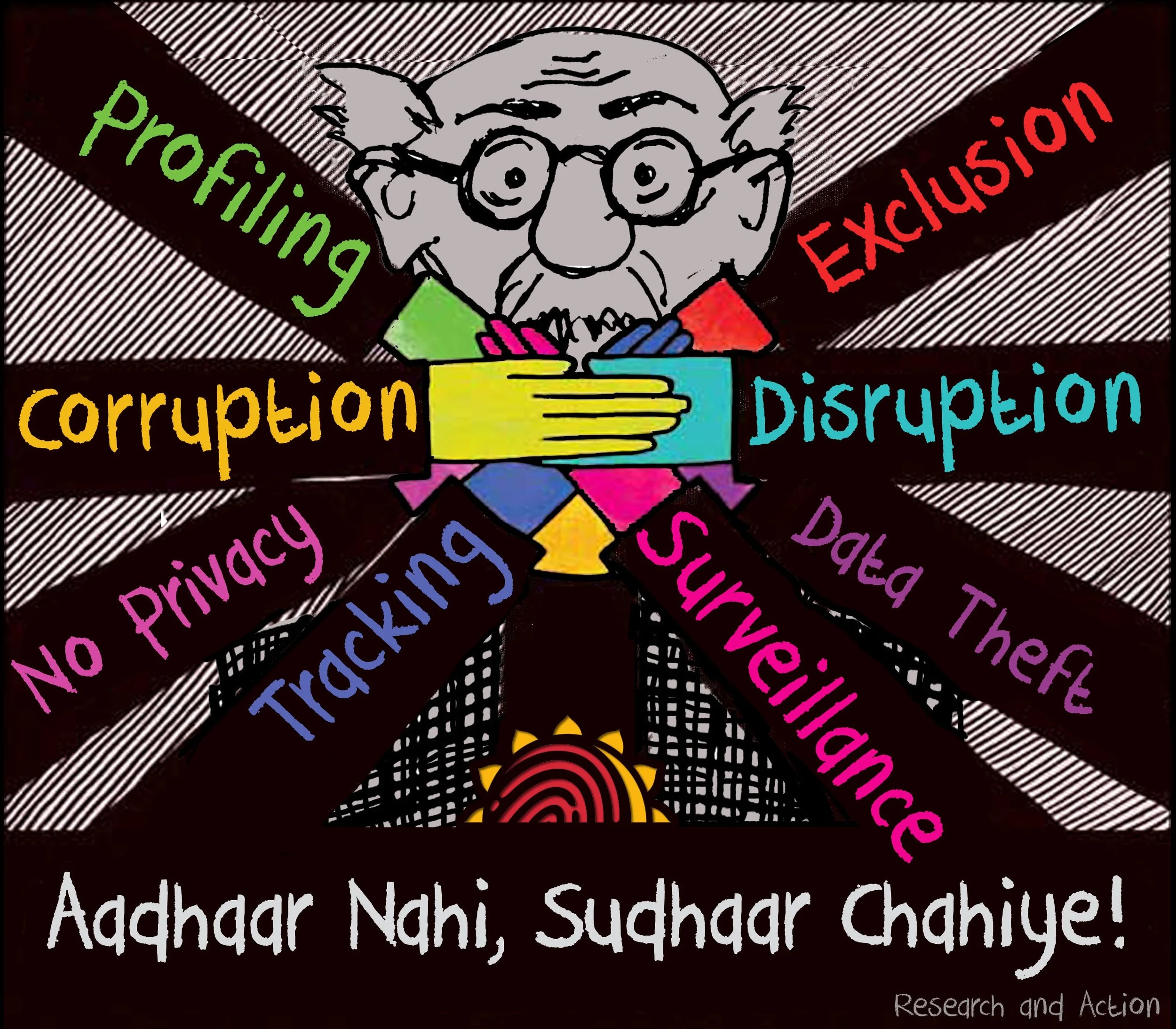
Late in the evening of February 28, 2019, in the midst of a critical situation at the Indian border, the Central Government issued the Aadhaar and Other Laws (Amendment) Ordinance, 2019, which seeks to revive the commercial use of the biometrics-linked 12-digit Aadhaar number which the Supreme Court had specifically struck down as being unconstitutional in September 2018. By promulgating this ordinance, the government is attempting to push through the Amendments to the Aadhaar Act, which it had failed to pass through Parliament and in particular the Rajya Sabha where it lacks a majority. The passage of this ordinance shows the Central government’s contempt of democratic and legislative institutions and signals the further weakening of our most basic democratic structures.
The Lok Sabha had passed the Aadhaar and Other Laws (Amendment) Bill, 2018, on January 4, 2019. Failing it’s passage through the Rajya Sabha, the Bill lapsed. The ordinance has the same text as this Bill.
When introducing the Bill in the Lok Sabha, Minister for Law and IT, Mr. Ravi Shankar Prasad, misleadingly claimed the amendments were “in compliance with the SC”. Since the SC's judgment on Aadhaar, the government has disingenuously attempted to manipulate the Court’s judgment in order to expand Aadhaar’s commercial applications to allow use by private entities, with Finance Minister Arun Jaitley signaling this within a day of the SC judgment.
On January 31, 2019, just prior to the start of Parliament's Budget Session, 294 citizens and organisations wrote to both the Prime Minister as well as the Vice President (who is also the chairperson of the Rajya Sabha); these included petitioners in the Aadhaar case, eminent jurists, political leaders, former civil servants - including a former chairman of TRAI and a former Secretary of the Department of Information Technology, citizens who have served in the armed forces, academics, artists, management professionals, and activists cautioning against this. They urged the MPs to refer the Bill to a Select Committee for sufficient scrutiny of the proposed amendments.
By promulgating the ordinance, which features the same language as the Aadhaar Amendments Bill, the government is abusing its privilege as the Executive, using Constitutional provisions (Article 123) which should only be used as an exception, when urgent action is required such as in armed conflict or natural calamities.
The ordinance is the latest in a series of unconstitutional, illegal, and coercive steps successive governments have adopted in expanding the Aadhaar project, violating citizens’ welfare and privacy rights. The Aadhaar Act was passed as a Money Bill bypassing the Rajya Sabha as the government claimed it dealt only with welfare provisions, subsidies, and public services paid for by the Consolidated Fund of India.
While undermining citizens’ legal entitlements and unleashing havoc on food, pensions, scholarships schemes through use of Aadhaar-based automated systems, the government is yet again encouraging Aadhaar’s commercial applications, which allow private profiteering through data collected for public purposes.
We are deeply concerned about the government’s eagerness to safeguard the commercial interests riding on Aadhaar, even at the cost of undermining citizens’ rights and social protections. We demand:
that the President of India NOT promulgate this Ordinance
that the Ordinance be withdrawn at once by the present government
that any government formed after the general elections halt such blatant attempts to allow commercialisation of citizens’ data.
that any future legislative action on Aadhaar be focused on and ending the coercive use of Aadhaar-based biometric authentication for disbursement of social benefits which has affected the most impoverished and marginalized citizens of India.
Further reading
Reetika Khera writes in Bloomberg Quint "the truth is that Aadhaar is not really about welfare. Instead, it has everything to do with facilitating businesses that thrive on mining our personal data.”
Gautam Bhatia talks about the Constitutional concerns with the Amendments in the Hindustan Times.
We described earlier the serious concerns with this Bill.
Read the letter from eminent citizens to the Vice President and Prime Minister.
### 1 Mar 2019 — Hundreds of Adivasi farmers protest denial of foodgrain by use of Aadhaar in Public Distribution System > Hundreds of Adivasis of several villages of Jharkhand’s Khuntpani block (West Singhbhum district) protested at the block administration’s office on February 28 against the denial of ration, use of Aadhaar and other irregularities in the Public Distribution System. Ration has not been distributed i Original: https://rethinkaadhaar.in/blog/2019/3/1/hundreds-of-adivasi-farmers-protest-denial-of-foodgrain-by-use-of-aadhaar-in-public-distribution-system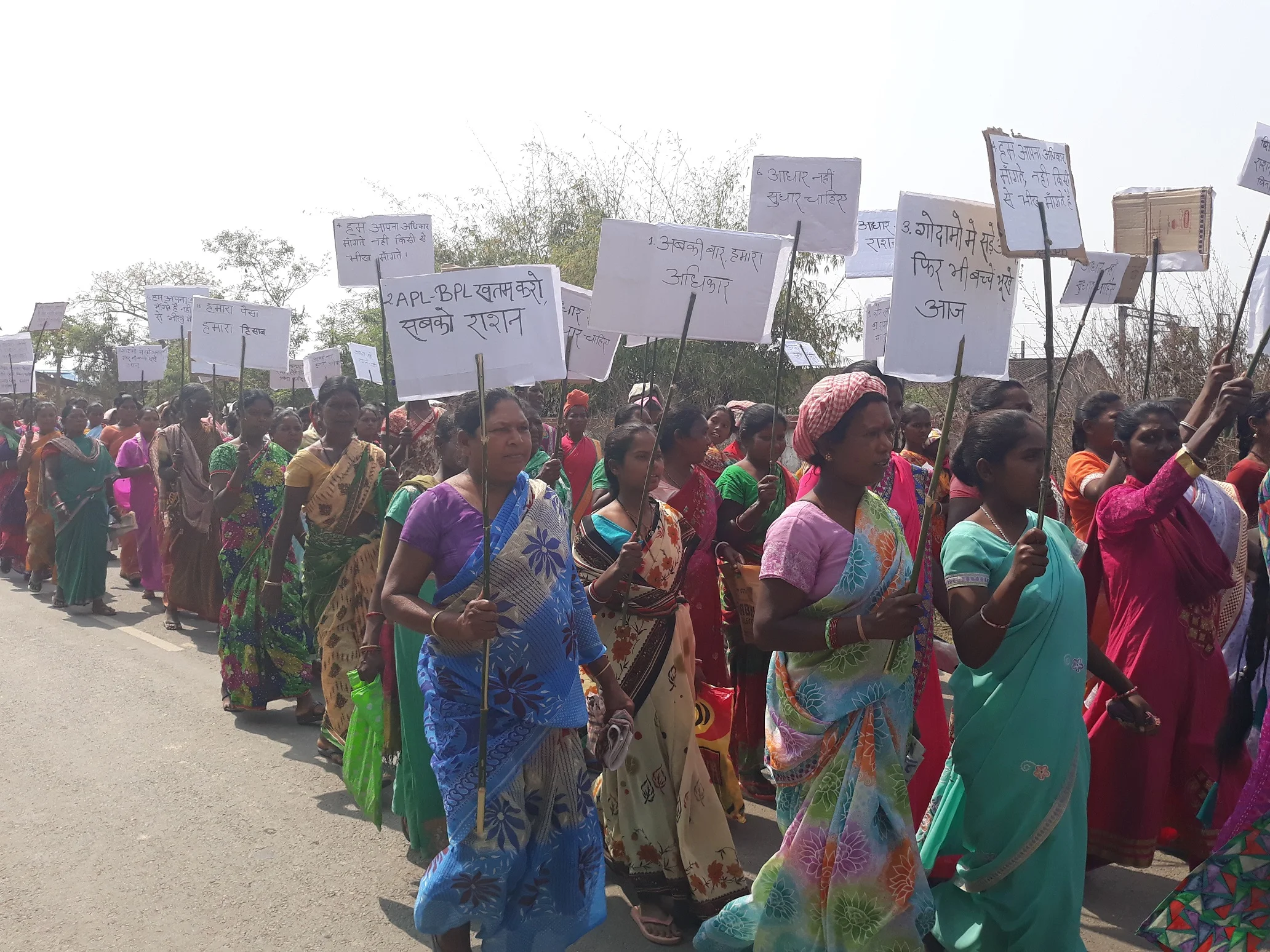
Hundreds of Adivasis of several villages of Jharkhand’s Khuntpani block (West Singhbhum district) protested at the block administration’s office on February 28 against the denial of ration, use of Aadhaar and other irregularities in the Public Distribution System.
Ration has not been distributed in some villages since several months. Cardholders of Ulirajabasa did not get ration in September-December 2018 and February 2019, one month in 2017 and three months in 2016. People of Ankolkuti have not received their grain entitlements for August-September and November-December 2018.
Cardholders have to face hassles (often leading to denial of ration) due to mandatory use of Aadhaar and Aadhaar-based biometric authentication in the PDS. Even though the ration shop is in their village, cardholders of Ulirajahasa village have to travel 3 kms away to another village just for Aadhaar-based biometric authentication required for getting their grain entitlement. Their village does not have adequate internet connectivity. Meena Bodra said that not only do the people have to spend money for the travel, they also have to lose their daily wages; sometimes for 2-3 days. And after all this hassle, biometric failure continues to deny cardholders of their grain entitlements. Kande Purty of this village was denied his ration for the month of January 2019 as his fingerprints did not work in the PoS machine. People unequivocally said that the earlier system of ration distribution (through registers) was better than the current biometric based system.
While some vulnerable families are yet to get ration cards, ration cards of many marginalised families have been cancelled recently. Asai Bodra of Paseya village, who is physically disabled, said that she could not collect her ration for the month of February 2018 as her ration card was cancelled without even informing her. Banubinj’s Naguri Hembram said that she and some other families stopped getting ration since July 2017 as their ration cards were cancelled.
People had complained to the block administration several times but the issues remain unresolved. The people submitted the attached memorandum addressed to the Chief Minister with the following demands to the Block Development Officer. She gave verbal assurance that action would be taken after inquiring into the issues.
Grain entitlements pending for earlier months be immediately given to the cardholders and the government should ensure timely delivery of ration every month.
Aadhaar-based biometric authentication system (PoS machine) be removed from the Public Distribution System and Aadhaar be made non-mandatory. Earlier system of ration distribution (through registers) be implemented.
License of all concerned ration dealers be cancelled and women self-help groups be given responsibility for distribution.
Families whose ration cards have been cancelled should be immediately re-enrolled in the Public Distribution System.
Administrative action be taken on all officials responsible for the above mentioned issues.
For further details, please contact Amar Purty( (8340151835), Mekyu Banra (6200675632), Jai Singh (8201410143) or Siraj (9939819763).
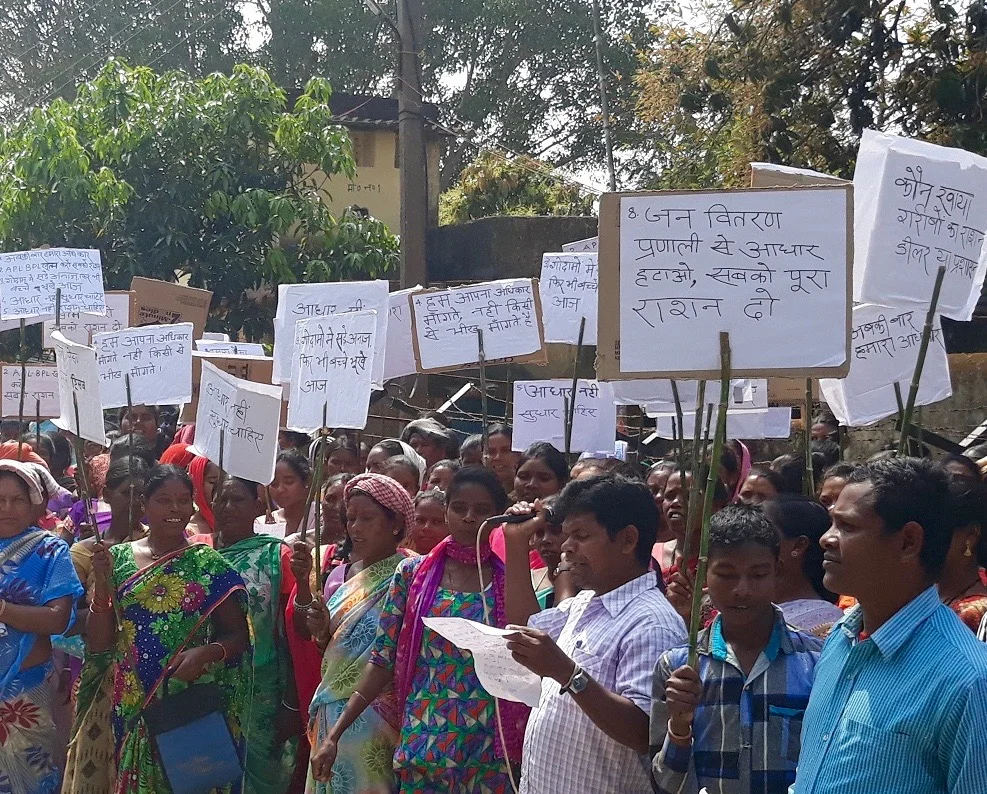
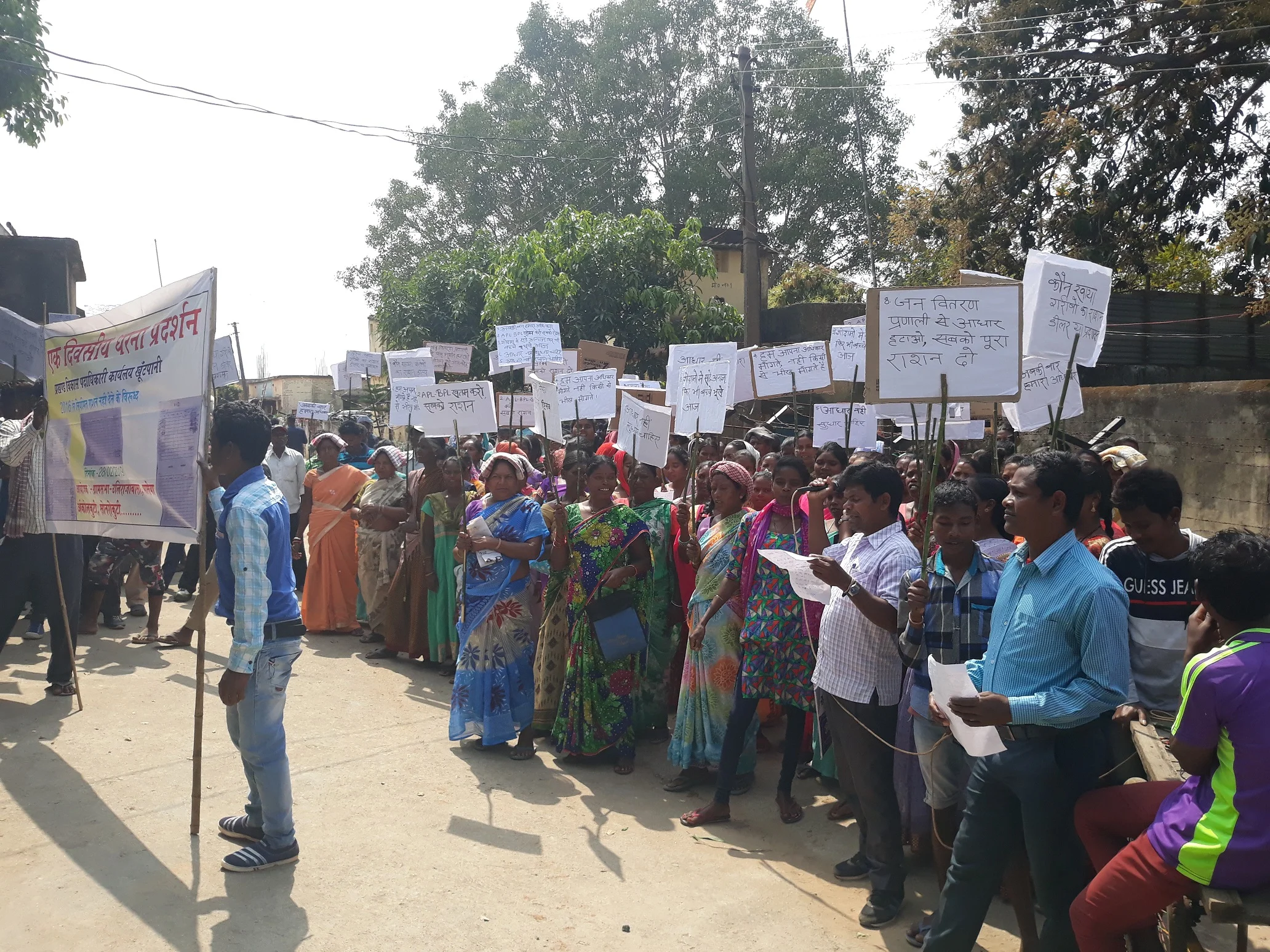
28 फ़रवरी 2019
राशन न मिलने एवं जन वितरण प्रणाली में आधार की अनिवार्यता के विरुद्ध
झारखंड के आदिवासियों का विरोध
झारखंड के खुंटपानी प्रखंड (पश्चिमी सिंहभूम ज़िला) के कई गावों के सैंकड़ों आदिवासियों ने जन वितरण प्रणाली में आधार के इस्तेमाल, कई महीनों तक राशन न मिलने व अन्य अनियमितताओं के विरुद्ध प्रखंड कार्यालय में धरना-प्रदर्शन किया.
अनेक गावों में कई महीनों से राशन का वितरण नहीं किया गया है. उलिराजाबासा गाँव में सितम्बर - दिसम्बर 2018 एवं फरवरी 2019 में राशन वितरण नहीं किया गया है. 2017 में भी एक महीने और 2016 में तीन महीनों का राशन नहीं दिया गया था. अंकोलकुटी गाँव में अगस्त-सितम्बर व नवम्बर-दिसम्बर 2018 का राशन वितरण नहीं किया गया है.
जन वितरण प्रणाली में आधार की अनिवार्यता एवं आधार-आधारित बायोमेट्रिक प्रमाणीकरण व्यवस्था के कारण कार्डधारियों को समस्याओं का सामना करना पड़ता है. हालाँकि राशन दूकान गाँव में हैं, लेकिन गाँव में नेटवर्क न होने के कारण उलिराजाबासा के लोगों को बायोमेट्रिक प्रमाणीकरण के लिए 3 किमी दूर पन्द्रसाली जाना पड़ता है. मीना बोदरा बोली कि इससे न केवल आने-जाने का भाड़ा खर्च होता है बल्कि दिन-भर का समय भी बर्बाद होता है. कभी-कभी तो 2-3 दिन भी जाना पड़ता है. एवं, कई लोग पॉस मशीन में उँगलियों के निशान काम नहीं करने के कारण अपने राशन से वंचित हो जाते हैं. इसी कारण से इस गाँव के कांदे पूर्ती को जनवरी 2019 में राशन नहीं मिला था. सभी लोगों ने एक स्वर में कहा कि राशन वितरण की पुरानी व्यवस्था (रजिस्टर के माध्यम से) बेहतर थी.
एक तरफ अभी भी कई ज़रूरतमंद परिवारों को राशन कार्ड नहीं मिला है, और दूसरी ओर अनेक परिवारों का कार्ड रद्द कर दिया गया है. पासेया गाँव की असाई बोदरा, जो शारीरिक रूप से विकलांग हैं, बोली कि उन्हें फरवरी में राशन नहीं मिला क्योंकि उनकी जानकारी के बिना उनका कार्ड रद्द कर दिया गया है. बनाबिंज के नागुरी हेम्ब्रोम ने कहा कि उनको एवं अन्य कई परिवारों को जुलाई 2017 से राशन नहीं मिल रहा है क्योंकि कार्ड रद्द कर दिया गया है.
इस विषय में कई बार शिकायतों के बाद भी समस्याओं का समाधान नहीं हुआ है. सभी ग्रामीणों ने मुख्यमंत्री के नाम से संलग्न मांग पत्र निम्न मांगों के साथ प्रखंड विकास पदाधिकारी को दिया. उन्होंने जांच के बाद कार्यवाई करने का मौखिक आश्वासन दिया.
अभी तक का बकाया राशन तुरंत वितरण किया जाए एवं आगे से प्रत्येक महीने ससमय राशन वितरण सुनिश्चित किया जाए.
जन वितरण प्रणाली से आधार-आधारित बायोमेट्रिक प्रमाणीकरण व्यवस्था (पॉस मशीन) हटाया जाए एवं आधार की अनिवार्यता समाप्त की जाए. राशन वितरण की पुरानी व्यवस्था (रजिस्टर के माध्यम से) बेहतर थी एवं उसे पुनः लागू किया जाए.
गाँव के राशन डीलर का लाइसेंस रद्द किया जाए और सक्षम महिला समिति को राशन वितरण की ज़िम्मेवारी दी जाए.
जिन परिवारों का राशनकार्ड रद्द किया गया है, उन्हें तुरंत जन वितरण प्रणाली में वापिस जोड़ा जाए.
उपरोक्त समस्याओं के लिए ज़िम्मेवार पदाधिकारियों पर उचित कार्यवाई की जाए.
अधिक जानकारी के लिए अमर पूर्ती (8340151835), मेक्यु बनरा (6200675632), जय सिंह (8201410143) अथवा सिराज (9939819763) से संपर्क करें.
### 28 Feb 2019 — Counter Aadhaar As Polls Near: A Call to Arms > Some of you might already be clued in on what our politicians are planning for their election manifestos. In terms of Aadhaar, while there may not be any immediately positive indications, efforts are underway to push parties to take a stated stance to at least ensure that Aadhaar is purely a volunta Original: https://rethinkaadhaar.in/blog/2019/2/28/newsletter-february-2019-a-call-to-armsPre-election push against Aadhaar: A Call to Arms
Some of you might already be clued in on what our politicians are planning for their election manifestos. In terms of Aadhaar, while there may not be any immediately positive indications, efforts are underway to push parties to take a stated stance to at least ensure that Aadhaar is purely a voluntary id similar to other Officially Valid Document(OVDs). However, we will need to push the demand through to all political parties we can possibly contact. A petition of demands has been drafted; please let us know latest by noon on Thursday, February 28, if you and/or your organization wish to be a signatory to this petition.
We will also need to conduct at least one on-ground countrywide agitation prior to the elections, which will be accompanied by circulating a status update on Aadhaar exclusions, leaks, and other critical failures of the project. The timeline for such a public agitation is the week of March 17-24 (i.e. either side of Holi; latest by end of March). Please send your name, city, and contact number to Raghu/godavar at 97177-49998 or godavar@gmail.com if you wish to participate in this push. Please also share your suggestions on how we can expand our impact. Do forward this message to those who you think will find it important, asking them to contact Raghu/godavar.
Supreme Court reiterates Aadhaar-PAN linking mandatory; deadline March 31 :(
In an order passed on Feb. 4, the Supreme Court reiterated that linking of Aadhaar and PAN is mandatory. Responding to the Union government's petition impugning the order in Shreya Sen, the Court said that filing of income tax returns for the assessment year 2019-2020 should comply with the September 2018 Aadhaar judgment which upheld Aadhaar-PAN linking.
As things currently stand, legally, one has to mandatorily obtain an Aadhaar number and link it with PAN by 31st March 2019. While we continue to hope for a favorable review of this order, we suggest that readers follow their discretion and/or seek legal advice should they not possess an Aadhaar number and/or not wish to link with their PAN. We also note that many citizens are opposing this order in the spirit of civil disobedience against enrolling a project which poses a lifelong threat for one’s personal security. Instead, they have chosen to face whatever fines or penalties might be imposed for failing to link Aadhaar with PAN or failing to quote it in their income tax return (which will not be due until July 31 at any rate).
Note: Our lawyers have advised that not linking Aadhaar to PAN could result in a fine of INR 10,000, besides a 2-year jail term. This, we feel, is still a lower cost than that arising from enrolling in the Aadhaar project which threatens our fundamental right to life and livelihood.
Workers in Varanasi district protest denial of rations due to e-POS issues
On Feb. 5, workers from 50 gram panchayats in the Cholapur and Chiraigaon blocks of Varanasi staged a dharna [Hindi Link] at the Tehsil headquarters protesting their exclusion from receiving PDS rations since November 2018 due to e-POS limitations. In their petition to the UP Chief Minister, members of MNREGA Mazdoor Union and Mahila Chetna Samiti Sangathan highlighted several issues with the ePOS machines, including delays in distribution due to weak or failing networks in far-flung villages resulting in long queues; deletion of ration cards and/or denial of rations if rations not procured for 3 months (common for workers migrating to cities with families); children forced to miss school waiting at ration shops for biometric authentication should their mothers’ biometric fail to get authenticated, etc. The Tehsil authorities have promised redressal of these grievances within 15 days, failing which the workers plan to stage a district-wide agitation. [Read the English version of the Press Note.]
As starvation deaths rise, Jharkhand govt says Aadhaar mandatory for PDS
Also on Feb. 5, the Jharkhand government made it mandatory to link Aadhaar with ration cards in order for a household to receive its ration. According to the state’s food department, the Aadhaar of 68.8 lakh out of 2.62 crore registered in the PDS are yet to be linked with family ration cards. In Jharkhand, lakhs of cardholders are regularly denied their grain entitlements due to biometric failures.A survey in eight districts of the State in June 2017 found that the proportion of households not collecting grains in the previous month was five times higher in villages that use ABBA (21%) as compared to those that do not (4%). Close to half of the respondents in ABBA villages reported Aadhaar-related reasons for not collecting their grains. The government clearly hasn't learned from past tragedies: at least nine of the 19 persons who allegedly died of starvation in the state in the last two years were denied their entitlements because of Aadhaar-related issues. Among the dead is 11-year old Santoshi Kumari.
More Aadhaar Leaks - from Jharkhand, Delhi, and Indane LPG Service
Meanwhile, three major Aadhaar data leaks have been reported. TechCrunch reported that a Jharkhand government website was left exposed and without a password as far back as 2014, allowing anyone access to names, job titles, and partial phone numbers on 166,000 workers. The data leak isn’t a direct breach of the UIDAI's CIDR, but represents another lapse in responsibility from the authority.
The French security researcher Robert Baptiste (aka Elliott Alderson) reported another massive Aadhaar data leak from the Indane server. Indane, IndianOil’s LPG distribution arm, accounts for over 90 million consumers, of whom 5.8 million were affected in this leak of consumer data relating to 11,000 dealers and including names and addresses besides Aadhaar numbers.
Another leak, reported in The Hacker News, has exposed nearly 500 thousand individuals’ data records from a database possibly created for the Delhi government by Goa-based Transerve. The details exposed include Aadhaar numbers, voter card numbers, health conditions, education, etc.
Citizens express concern regarding Aadhaar Amendments Bill and DNA Bill
Over 260 organisations and concerned citizens have written (letter attached) to the Vice President of India, who is also the Chairperson of the Rajya Sabha, and the Prime Minister demanding that the Aadhaar Amendments Bill and the DNA Bill be scrutinized by the appropriate Parliamentary committees.
The Aadhaar Amendments Bill allows the use of the biometrics-linked 12-digit ID for commercial purposes, including banks and mobile services. This is in blatant violation of the Supreme Court judgment which prevented the use of Aadhaar by the private sector. There are also reports that Aadhaar may be linked to voter IDs. The DNA Bill allows for the creation of a widespread DNA database of Indian citizens, without specifying the purpose for which it may be used, how long it will be kept.
With regular disruptions throughout the Budget Session, the Rajya Sabha adjourned indefinitely on Feb. 13, without discussing either of these bills. With the 16th Lok Sabha now completing its term and likely to be dissolved soon, the two Bills will lapse. There is however the possibility that the government may still introduce the Amendments through an ordinance with no regard to citizens’ rights.
Updates from Parliament
While the Parliament’s Budget session concluded with no further action on the Aadhaar Amendments Bill, we are continuing to track questions related to the Aadhaar project raised in either the Lok Sabha or Rajya Sabha. The questions and responses from Parliament are summarized on this page.
Briefly, during the Budget session, Ministers informed Parliament that 86% of the approx. 23 crore ration cards in the country have been seeded with Aadhaar, with 2.51 crore cards cancelled since 2014; that the nutrition programme of Anganwadi Services is being implemented as a DBT Scheme, requiring proof of possession of Aadhaar; that Aadhaar-enabled Payment Systems (AePS) continue to be operative to facilitate payment of monetary subsidies through micro ATMs; and that 123.03 crore Aadhaar numbers have thus far been issued by the UIDAI.
Earlier, during the Winter Session, Parliament was told that no study had been conducted to evaluate the impact of Aadhaar linkage with either MNREGA wage deposits or with the PDS for disbursal of rations. This further underscores the hollowness of all the claims of welfare savings by the government when, in fact, this has not been studied by the government at all. Despite there being no study to back their claims, the government also continued its denial of Aadhaar-related exclusion from welfare benefits and entitlements as well as starvation deaths. Several peoples’ campaigns have repeatedly highlighted the havoc that Aadhaar has been causing in welfare disbursements. Links to some of the latest reports are at the end of this newsletter.
Aadhaar linking with Voter ID - no clear answers yet
With the Election Commission of India looking to mandate linking Aadhaar with Voter ID yet again, questions are being raised about Aadhaar-based revision of electoral rolls. Such a revision is seen as the reason 22 lakh voters were deleted from the Telangana electoral rolls. Following RTI requests from data researcher Srinivas Kodali, the Chief Electoral Officer (CEO) for Telangana admitted that the deletions were not preceded by door-to-door verification as mandated by law. The Supreme Court’s Aadhaar judgment, however, did not explicitly settle the question of linking Aadhaar to voter cards. As a result, the matter is still pending, per the ECI.
Aadhaar in news
Jharkhand Survey Pokes Holes in Modi's Claims on Digital Service Delivery
Failure of a biometric machine leaves this UP village stranded for ration
Man in Jind, fingerprint used in Delhi, Bihar to withdraw money from his account
Aadhaar Entries Not Conclusive Proof In Criminal Cases
...in the case of the UID, [our data is] being held by companies, says Usha Ramanathan
Usha Ramanathan also writes on the urgency to give corporates access to the UID system
NPCI’s call for bids to set up mobile payments facilities potentially facilitates an illegal private monopoly disproportionately benefiting the likes of Anil Ambani and Nandan Nilekani
There is no provision to cancel or surrender Aadhaar, even after death
Never mind the SC, Aadhaar is now in the people’s court
In Jharkhand, 43% go hungry due to Aadhaar linking-related web of procedural obstacles
Aadhaar Operator's Biometrics Stolen & Misused, UIDAI Documents Prove
Aadhaar scam: Jharkhand spends ₹222 cr on PoS machines, when it could have been bought for ₹12.5 c
### 13 Feb 2019 — Hundreds of labourers in Varanasi protest against biometric authentication for food rations > The memorandum related to the problems has been given to the SDM of the Tehsil by Rita, Ayesha, Rekha, on behalf of the Mahila Chetna Samiti Sangathan and by Gautam, Sheela, and Rukhsana from the MNREGA Mazdoor Union. The administration has assured resolution of the problem within 15 days. If the pr Original: https://rethinkaadhaar.in/blog/2019/2/13/hundreds-of-labourers-in-varanasi-protest-against-biometric-authentication-for-food-rationsपाॅस मशीन के विरोध मे मजदूर पहुँचे तहसील पर
दिनांक 5/2/19 को पाॅस मशीन से राशन वितरण के विरोध मे मनरेगामजदूर यूनियन व महिला चेतना समिति संगठन के मजदूरो ने तहसील पर हुंकार भरी , जिसमे महिला चेतना समिति व मनरेगा संगठन के तत्वावधान मे 2 ब्लाक चोलापुर व चिरईगाॅव के 50 पंचायत सैकड़ों मजदूरों ने पिछले तीन महीने से राशन न मिलने या राशन वितरण मे कई तरह की समस्या आने पर तहसील का घेराव किया , जिसमें उनकी निम्नलिखित मांगे रही अभी तक पंचायतों मे ग्रामवासियों को कोटेदार से राशन मिलता रहा है ,कहीं कहीं राशन वितरण मे दिक्कते आती थी तो जिले स्तर पर इसका निस्तारण हो जाता था, नवम्बर 2018 से राशन वितरण पाॅस मशीन द्वारा किया जा रहा है । इस पाॅस मशीन से कई तरह की समस्या आ रही है । जैसे --
हम छोटे मजदूर , किसान है हम खेतो मे काम करते है जिससे हमारे हाथो के निशान बनते बिगडते है जिससे अंगूठे के निशान का मिलान नही होने पर राशन नही मिल रहा है, दूरदराज के गाँवो मे सरवर डाउन होने से नेटवर्क नही मिल रहा , नेटवर्क कमजोर होने के कारण वितरण व्यवस्था बाधित है राशन के लिए लम्बी लाईन लगानी पडती है , हम मजदूर साथी कई बार पुरा परिवार काम या मजदूरी करने के लिए शहरों की ओर पलायन करते है , अगर तीन माह तक राशन नही लिया तो कार्ड डिलिट हो जायेगा व राशन नही मिलेगा , महिला के अंगूठा न मिलने पर बच्चों को भी अंगूठे का मिलान हेतु घंटों लाईन मे लगने हेतु स्कूल की शिक्षा से वंचित करना पड़ रहा है , कई लोगों के तो आधार मे ही निशान नही मिलते वह राशन कैसे लेंगे , पंचायत की अन्य मजरों से दूरी दो से पाॅच किलोमीटर है।महिला मुखिया होने के कारण महिलाएं ही राशन लेने जायेंगी कई बार आना जाना घंटो लाइन मे लगने से उन्हें ही अधिक परेशानी हो रही है।आदि समस्याओं से सम्बन्धित ज्ञापन तहसील पर एस डी एम को महिला चेतना समिति से चमेला , रीता, आयशा, रेखा , व मनरेगा से गौतम , शीला ,रूख्शाना के अगुवाई मे दिया गया जिसपर अधिकारियों ने 15 दिन के अन्दर समस्या समाधान का आश्वासन दिया है यदि समस्या का हल नही होगा तो संगठनो द्वारा जिलास्तर फर विरोध प्रदर्शन किया जायेगा।जिसमें पुनम, नीति , कविता , सुबेदार , सोना , रामदुलार सहित सैकड़ों मजदूर साथियों की उपस्थिति रही।
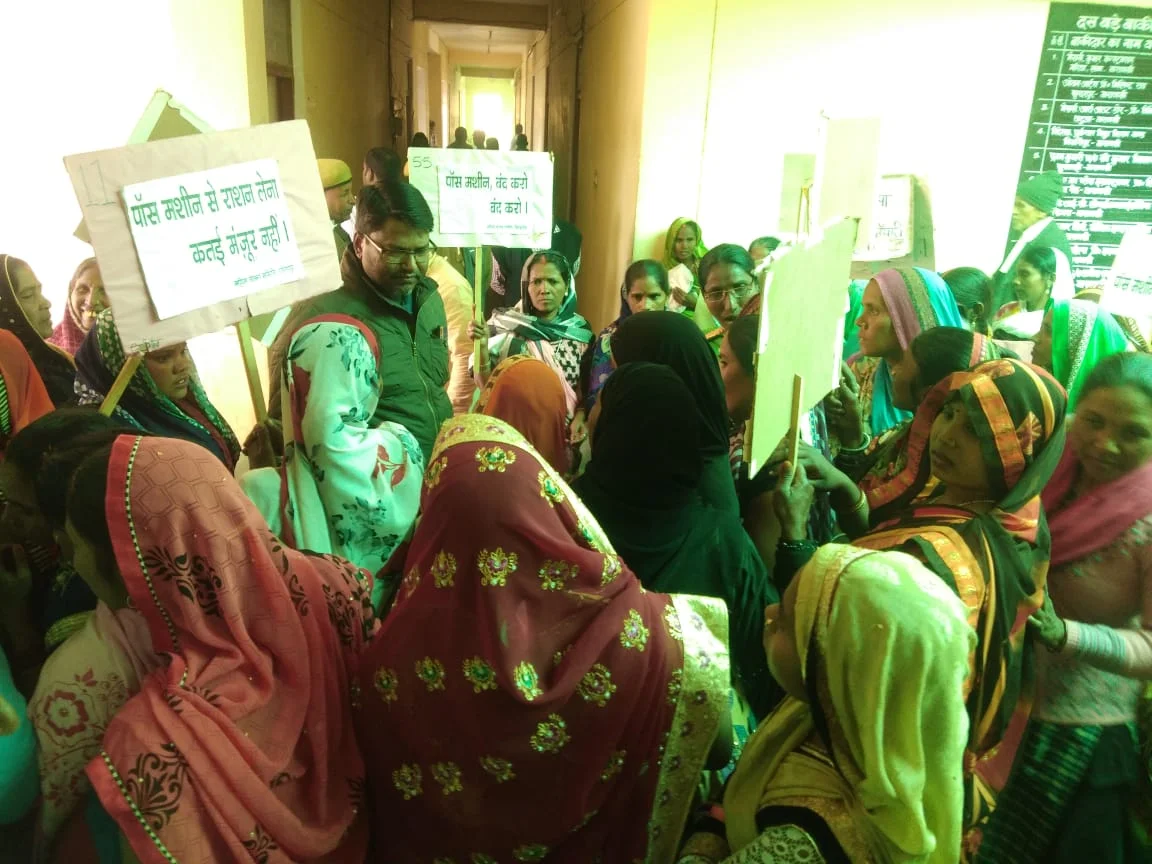
Workers protest against e-POS machine at Block Headquarters
Protest against the distribution of food rations using e-POS machines, on February 5, 2019, the workers of MNREGA Mazdoor Union and Mahila Chetna Samiti Sangathan from 50 Gram Panchayats from 2 Blocks - Cholapur and Chiraigaon - in Varanasi district expressed their grievances to the block administration. Until recently, villagers used to receive rations from the ration dealer, and when issues arose they were addressed by the district administration. However, since November 2018, rations have been distributed mandatorily through e-POS machines due to which many have either been denied rations or faced massive difficulties.
The workers expressed the following problems arising from use of the e-POS machine:
We are daily labourers, farmers who work in fields and because of our work, our fingerprints are not clear. We cannot receive rations when our fingerprints don't match (with the biometrics recorded in Aadhaar database);
Not connectivity is unavailable due to the far-flung nature of remote villages. If the network is weak, the distribution system is slow, and disbursing rations takes several hours
We work as casual labourers, sometimes the entire family migrates to cities to work. The machine requires a member to be physically present to do biometric authentication. Now the government has states that if the ration is not procured for three months, the ration card will be deleted and further food rations cannot not be received.
If the women cannot authenticate her fingerprints, children have to be deprived of school education in order to stand in queues and authenticate their fingerprints (since the villagehead is a woman, only women go to receive rations).
When no biometrics can be obtained, how will people get ration, given that the distance from other panchayats is two to five kilometers?
The memorandum related to the problems has been given to the SDM of the Tehsil by Rita, Ayesha, Rekha, on behalf of the Mahila Chetna Samiti Sangathan and by Gautam, Sheela, and Rukhsana from the MNREGA Mazdoor Union. The administration has assured resolution of the problem within 15 days. If the problem is not resolved then the workers will protest at the district level.
Hundreds of labourers including Poonam, Kavita, Niti, Subedar, Sona, Ramdular, etc. took part in the protest.
.jpg)
.jpg)
.jpg) ### 12 Feb 2019 — Citizens write to Vice President, Prime Minister regarding Aadhaar Amendments Bill and DNA Bill
> Over 260 organisations and concerned citizens across the spectrum of Indian society have written (read the letter ) to the Vice President of India, who is also the Chairperson of the Rajya Sabha, and the Prime Minister demanding that the Aadhaar Amendments Bill and DNA Bill be subjected to great
Original: https://rethinkaadhaar.in/blog/2019/2/12/citizens-write-to-vice-president-prime-minister-regarding-aadhaar-amendments-bill-and-dna-bill
### 12 Feb 2019 — Citizens write to Vice President, Prime Minister regarding Aadhaar Amendments Bill and DNA Bill
> Over 260 organisations and concerned citizens across the spectrum of Indian society have written (read the letter ) to the Vice President of India, who is also the Chairperson of the Rajya Sabha, and the Prime Minister demanding that the Aadhaar Amendments Bill and DNA Bill be subjected to great
Original: https://rethinkaadhaar.in/blog/2019/2/12/citizens-write-to-vice-president-prime-minister-regarding-aadhaar-amendments-bill-and-dna-bill
The Aadhaar and Other Laws (Amendment) Bill, 2018 (Aadhaar Amendments Bill) was passed by the Lok Sabha with very little debate and scrutiny. The DNA Technology (Use and Application) Regulation Bill, 2018 (DNA Bill) was similarly passed in the Lok Sabha with no amendments despite concerns raised and despite requests to refer the Bill to a Standing Committee. There are now suggestions that the government is likely to break from tradition and go beyond passing a Vote on Account in the upcoming Budget Session by listing the aforementioned bills for discussion and passing in the Rajya Sabha in the final session of this Parliament.
The Aadhaar Amendments Bill allows the use of the biometrics-linked 12-digit ID for commercial purposes, including banks and mobile services. This is in blatant violation of the Supreme Court judgment which prevented the use of Aadhaar by the private sector. There are also reports that Aadhaar may be linked to voter IDs. The DNA Bill allows for the creation of a widespread DNA database of Indian citizens, without specifying the purpose for which it may be used, how long it will be kept.
Over 260 organisations and concerned citizens across the spectrum of Indian society have written (read the letter) to the Vice President of India, who is also the Chairperson of the Rajya Sabha, and the Prime Minister demanding that both these bills be subjected to greater scrutiny by the Rajya Sabha by sending them to appropriate Parliamentary committees. Among the signatories are:
Petitioners in the Aadhaar case that was before the Supreme Court, such as Aruna Roy, Nikhil Dey, Shanta Sinha, Devasahayam M G, Dr. S. G. Vombatkere and others
Eminent jurists including Justice V. S. Dave (Retired High Court Judge and former Chairman of Rajasthan Law Commission), Indira Jaising (former Additional Solicitor General of India), Prof. G. Mohan Gopal (Former VC, National Law School University, Bangalore and Former Director, National Judicial Academy, Bhopal) and Professor G Haragopal (Visiting Professor, NLSIU, Bengaluru)
Around 40 former civil servants including Rahul Khullar, Former Chairman, Telecom Regulatory Authority of India (TRAI)
Politicians - Yogendra Yadav (Swaraj Abhiyan) and Raghavendra Rao (Secretary, Bhosari Vidhan Sabha, Aam Aadmi Party, PCMC, Pune)
Indian armed forces and veterans: Admiral Vishnu Bhagwat (former Chief of the Naval Staff of India)
Jayati Ghosh, Satish Deshpande, Aditya Nigam and several other academics
Journalists and writers (P. Sainath, Nityanand Jayaraman, Rohini Hensman and many others)
Various kinds of artists - filmmakers (Anand Patwardhan) and musicians (Charul Bharwada and Vinay Mahajan)
Trilochan Sastry and Jagdeep Chhokar (who are IIM professors and Founding members of the Association for Democratic Reforms), Anand Teltumbde (who has been a management professional) and Prof. Varun Arya (Formerly President, IIT Delhi Alumni Association & Secretary, IIM Ahmedabad Alumni Association)
Numerous activists and prominent members of civil society like Farah Naqvi, Deep Joshi, Ashish Kothari and Swami Agnivesh
Organisations / collectives: Alliance for Sustainable and Holistic Agriculture (ASHA), the National Center For Labour, INSAF, Citizens Forum for Mangalore Development, the Forum Against Oppression of Women, Mumbai and more
It is very important and urgent to get the message out to leaders of all political parties and MPs of the Rajya Sabha that these bills MUST be sent to the appropriate Parliamentary committees for expert testimony and citizen inputs. Bypassing such process pose a threat to citizens democratic rights.
Please tweet “Send the Aadhaar Amendment Bill and DNA Bill in the Rajya Sabha to the Select Committee” @MVenkaiahNaidu, @narendramodi, @RahulGandhi, @AIADMKOfficial, @MamataOfficial, @yadavakhilesh, @Naveen_Odisha, @NitishKumar, @ncbn, @trspartyonline and other leaders of political parties.
The government’s doublespeak and constitutional fraud on Aadhaar, the 12-digit “unique” biometrics-linked identification number, continues. First, after passing the Aadhaar (Targeted Delivery of Financial and Other Subsidies, Benefits, and Services) Act as a Money Bill on the false grounds that Aadhaar enables welfare, it encouraged rampant commercial use of citizens' data. Now, when the Supreme Court has reined in Aadhaar by striking down Section 57 of the 2016 Act which permitted the use of Aadhaar by private entities, the government is amending laws to again allow private, commercial use of citizens' Aadhaar-related data.
The Union Government has listed for introduction in the Lok Sabha tomorrow (January 2, 2019) the Aadhaar and Other Laws (Amendment) Bill, 2018, in the Lok Sabha. There are serious concerns with this Bill as it violates Supreme Court orders as well as citizens' fundamental rights:
The Bill is in contravention of SC judgment - The Supreme Court in its judgment dated 26.09.2018 in Justice K.S. Puttaswamy vs Union of India (the Aadhaar judgment) in WP Civil No. 494 of 2012 explicitly prohibited use of Aadhaar by private parties by declaring Section 57 of the Aadhaar Act, 2016, as unconstitutional.This section provided grounds for Aadhaar-based authentication by private entities as well. The present Bill proposes amendments to the Aadhaar Act, Telegraph Act and the Prevention of Money Laundering Act which will circumvent the SC judgment, and allow the continued use of Aadhaar-based e-KYC authentication by private entities for mobile and banking services, respectively.
Bill may allow private entities to continue to hold Aadhaar data in disregard of SC judgment - After the SC judgment, private entities are no longer allowed to maintain any Aadhaar-related data records whatsoever. While the petitioners have been trying to push for compliance on this, the government’s latest move may encourage the continued collection of citizens’ data through use of Aadhaar-based authentication violating the protections laid down by the Supreme Court.
Privacy and security concerns in Aadhaar remain unaddressed - When private entities were allowed use of Aadhaar-based e-KYC, there were several reports of fraudulent transactions and scamming of citizens’ personal data as well as their money. There is no indication that either the finance ministry or the UIDAI has attempted to address these security lapses in the Aadhaar ecosystem. Allowing and encouraging use of Aadhaar-based authentication by private entities will result in further scams and theft.
Bill lacks any stakeholder consultation - The Government has not undertaken a public consultation on the proposed amendments to the various laws. Any Bill on the issue of Aadhaar should not be merely rubber-stamped by Parliament; any proposed amendment must be fairly and thoroughly studied by the appropriate Parliamentary Standing Committee as well.
Government can try to bypass Rajya Sabha - The Rajya Sabha in March 2016 had voted to curtail private sector Aadhaar usage when it debated the original Aadhaar Act, but the government over-rode Upper House’s farsighted warnings through the Money Bill route. In the SC judgement, Justice Chandrachud termed this a “fraud on the Constitution.” We are concerned that the government may once again take the Money Bill route to bulldoze these amendments through Parliament despite the fact that the proposed amendments do not confirm to constitutional requirements of a Money Bill.
Help us help you
With these concerns, Rethink Aadhaar, and other citizens and agencies concerned with the rampant expansion and function creep of Aadhaar, has placed the following demands before Members of Parliament on Tuesday.
Oppose the introduction of The Aadhaar and Other Laws (Amendment) Bill, 2018, in Lok Sabha by Members of Parliament across political parties.
Undertake a thorough and transparent public consultation on the Bill and the amendments and introduce any Aadhaar-related legislation in Parliament only after such a consultation
If the Bill is still introduced, then it immediately be sent to the appropriate Parliamentary Standing Committee for legislative scrutiny and review.
Stop constitutional fraud undermining the Rajya Sabha of allowing this overbroad Amendment Bill to be certified as a Money Bill.
Introduction of a strong, people-centric Personal Data Protection Bill, after adequate public consultation instead as the top priority of the Union Government. Thus far, a Privacy and Data Protection Bill has not even been presented in Parliament, whereas the Supreme Court had accepted assurances from the government that the concerns raised in the Aadhaar matters vis-a-vis data security and informational privacy would be adequately addressed by a soon-to-be-passed data protection law.
We hope that our elected representatives will bear due vigilance and not allow our fundamental rights to be encroached by such ill thought-out legislation.
We urge members of the press to join us in ensuring that the government takes a democratic route for all Aadhaar-related legislation, i.e. undertaking a thorough public consultation and review by a Parliamentary Standing Committee.
For more information, please contact:
Raghu 97177-49998
Maansi 98187-13833
Engage with us on Twitter:
### 1 Jan 2019 — More Aadhaar-related starvation deaths reported in Jharkhand > The Right to Food Campaign in Jharkhand reported the death of three more people from starvation after their ration cards were canceled due to not linking with Aadhaar. The full RFC update is included here. Original: https://rethinkaadhaar.in/blog/2019/1/1/more-aadhaar-related-starvation-deaths-reported-in-jharkhandThe Right to Food Campaign in Jharkhand reported the death of three more people from starvation after their ration cards were canceled due to not linking with Aadhaar. The full RFC update is below:
At least three more persons died of starvation in Jharkhand in the last 2 months. This takes the total number of hunger deaths in the state to 18, since September 2017. Among the most recent victims is 45-year old Kaleshwar Soren, who died of hunger and destitution on 11 November in Mahuatanr village of Jama block of Dumka district. A fact finding team of the Right to Food Campaign, Jharkhand found that the ration card of Kaleshwar’s family was cancelled as it was not linked with Aadhaar.
Kaleshwar lived in extreme deprivation, in a dilapidated kutcha house with no possessions except a wooden cot. Lack of adequate food and nutrition was routine for the family. Kaleshwar could barely manage to survive on the food given by neighbours. He had grown weak over the last couple of years and had stopped working. He had to mortgage the family’s agricultural land and sell off his pair of oxen to survive. Owing to persistent lack of food at home and unavailability of any means of earning, all his five children never went to school and had to seek work since early age. Two older sons, who work as daily wagers in Rajasthan, were not allowed by the contractor to go back home even once in the last two years. They could not even visit after their father’s death.
The family’s Priority ration card was canceled in 2016 as the family had not linked it with Aadhaar of any of the family members. They stopped receiving grains under the Public Distribution System (PDS). According to the ration dealer, after the cancellation of the ration card, when Kaleshwar was asked to submit his Aadhaar to get back on the ration list, he could not submit it as he had misplaced the card bearing the 12-digit unique ID. None of his children has an Aadhaar number. The Mukhiya of the Gram Panchayat claimed to have given some grain to Kaleshwar from the Khadyan Kosh (grain bank) of Rs. 10000 established to support vulnerable families. Even though fact-finding team could not verify the claim, it shows how ineffective the government’s “solution” is.
Along with Kaleshwar, ration cards of 27 families of the same village were also canceled in 2016. Twenty-six households were reinstated on the ration list a year after their card was canceled and after they submitted their Aadhaar and bank account details. Jian Kisku of the same village, whose ration card was also canceled in 2016, is yet to get back on the ration list as neither he nor his wife has Aadhaar.
Kaleshwar’s death comes close on the heels of the deaths of Moti Yadav of Margomunda block (Deoghar) on 1 November and Seeta Devi of Basia block (Gumla) on 25 October. Moti Yadav, visually impaired, died of destitution. He did not get disability pension despite applying for it. 75 year-old Seeta Devi, who lived alone, starved to death as she did not have any food or cash at home before her death. Even though she had a ration card, due to illness, she could not go to the ration shop in October to authenticate her identity (earlier, a ration card holder could request relatives, or neighbours or others to pick their rations on their behalf after showing the ration card but now they must go in person). She was also denied old age pension as her bank account was not linked with Aadhaar.
The 18 starvation deaths, since September 2017, include 8 adivasis, 4 dalits and 5 of backward communities, the most vulnerable communities. Contrary to government’s claims, the immediate causes of these deaths include denial of foodgrains due to absence of a ration card, cancellation of ration cards not linked with Aadhaar, or Aadhaar-based biometric authentication failures. Denial of social security pensions and absence of work under the National Rural Employment Guarantee Act further contribute to the destitution of the starvation victims and their families. At least seven victims were eligible to social security pension, but were either not issued a pension or did not receive their pension due to administrative lapses or Aadhaar-related issues. Not to mention the children of these families, with poor education, negligible access to health services and employment, are staring at a bleak future.
Help us help you
The deaths also highlight the inadequate coverage of the Antyodaya Anna Yojana (AAY). Most of these families, despite living in acute poverty, did not have a AAY ration card. To address the issue of hunger in the state, the Right to Food Campaign has been repeatedly demanding (1) universalization of PDS in rural areas to reduce exclusion errors; (2) inclusion of pulses and edible oil in PDS; (3) doing away with the mandatory requirement of Aadhaar in welfare programmes; (4) universalization of social security pensions; and (5) strict action against government officials whose lapses have caused these deaths. But the state government continues to deny starvation as the cause of these deaths and has done nothing to reduce the alarming state of food insecurity in Jharkhand. It is worth noting that at least five persons have died of hunger since the government’s announcement of setting up Khadyan Kosh at the Gram Panchayat level to support vulnerable households. Such token initiatives fail to ensure universal access to food security as a matter of right and expose the government’s lack of commitment for right to food of the people.
For more details, please contact Asharfi Nand Prasad (9334463332), Siraj (9939819763) or Vivek (8873341415) or write to rtfcjharkhand@gmail.com
All the fact-finding reports and consolidated list of deaths can be downloaded from https://drive.google.com/open?id=1A7LpJQywTp3qNUx5qX35JbmCdZCZvB4u
Engage with us on Twitter:
### 26 Sep 2018 — Press statement: Supreme Court Constitution Bench verdict - A Renewed Struggle > More than six years after the first legal challenge to the Unique Identification project were filed in court, today the Supreme Court ruled on the constitutional validity of the Aadhaar project. While four judges wrote upholding the validity of the Aadhaar project, one judge ruled that the Aadhaar p Original: https://rethinkaadhaar.in/blog/2018/9/26/press-statement-on-supreme-court-5-judge-bench-ruling-on-aadhaar-challengesMore than six years after the first legal challenge to the Unique Identification project were filed in court, today the Supreme Court ruled on the constitutional validity of the Aadhaar project. While four judges wrote upholding the validity of the Aadhaar project, one judge ruled that the Aadhaar project is unconstitutional and the database must be deleted.
The Aadhaar Act as drafted by the UIDAI and its consultants, years after the project was already in operation, was recognized as having multiple loopholes. It is significant that even the four who upheld the judgment the judgment read down several sections of the Aadhaar Act, 2016 and limited the unrestrained expansion of the Aadhaar project.
As per Justice Sikri’s judgment, Aadhaar cannot be made mandatory for CBSE, NEET, JEE, UGC., school admissions, and secondary education as they are outside the purview of Section 7 and are not backed by any law.
Significantly, the concerns raised by citizens and several members of parliament on the use of Aadhaar by private entities were roundly addressed by the Supreme Court while striking down section 57 of the Aadhaar Act and declaring it as unconstitutional.
The lack of clarity on scope of curtailment of Section 57 means the legality of UID use by NPCI, a private non profit company as well as MicroATM, business correspondent usage of Aadhaar auth for #AePS is now in a grey zone.
The court stated Aadhaar cannot be made mandatory for bank accounts and mobile linking as it is unconstitutional.
In one victory protecting the rights of children, it stated: “On attaining the age of majority, such children who are enrolled under Aadhaar with the consent of their parents, shall be given the option to exit from the Aadhaar project if they so choose in case they do not intend to avail the benefits of the scheme.”
The judgment further restricts the sharing of Aadhaar data with state agencies in the name of “national security” a term which is nowhere defined in the Constitution. The judgment gives residents a right to hearing on data sharing and allows for filing complaints against UIDAI if their data is breached, a remedy not available till now. In all these aspects, the court has found Aadhaar Act flawed.
However, we are shocked and disappointed that the Court failed to read down section 7 of the Aadhaar Act which allows for welfare to be made contingent on the production of Aadhaar. Justice Sikri’s judgment recoginises that welfare schemes have attained the status of fundamental rights. But the judgment led by Justice Sikri bizarrely chooses to see the Aadhaar Act as a “beneficial legislation” ignoring the hardship, exclusion and destruction of the lives of the poor due to the additional hurdle created by the Aadhaar technology. Right to Food has documented that 25 citizens have died in the last three years due to Aadhaar issues and glitches in crucial social support programmes. Rethink Aadhaar is disturbed by the assertion that the rights of those excluded from welfare due to Aadhaar are in a small minority, are an “unproven plea of some”, that must be balanced against the majority of those who have supposedly benefited from Aadhaar.
We expect the Union Government to immediately order the removal of Aadhaar data from the databases where it is no longer legal to hold them including telecom operators and banking databases.
Justice Chandrachud’s judgment is the judgment we would have hoped for as the majority. J. Chandrachud in his judgment concurs with parts of Justice Sikri’s judgment while dissenting with large parts of it. Justice Chandrachud recognized that the passage of the Aadhaar Act a Money Bill is completely invalid his judgment states that “it constitutes a fraud on the Constitution.” It states that “This debasement of a democratic institution [Rajya Sabha] cannot be allowed to pass. Institutions are crucial to democracy… The passage of the Aadhaar Act is an illegality.” His judgment states that the Aadhaar database should be deleted.
We salute the struggle of all those who have fought for so many years against the Aadhaar project and we know that this is beginning of the battle and our challenges. We have made history and we will do it again.
For any questions, email contact@rethinkaadhaar
### 22 Sep 2018 — Vol. 2: Delinking Aadhaar, Data Protection, and more! > Latest from courts, parliament and the grassroots. Official rethink on the use of Aadhaar has started. Original: https://rethinkaadhaar.in/blog/2018/9/22/august-2018-vol-2-delinking-aadhaar-data-protection-and-more0. a couple of cases where there has been an official rethink on the use of Aadhaar:
Discontinue Aadhaar-based payments through UPI and IMPS, NPCI tells banks
Aadhaar card no longer needed for old age, widow pensions: Delhi govt
I. Wishing you had never linked Aadhaar to your bank account, and wishing you could delink?
Many people linked their Aadhaar numbers to their bank account under coercion and fear of losing access to their financial assets. However, for those now wondering how safe such linking, here is some hope - it is indeed possible to delink your Aadhaar and bank account! Download and complete this one-page form, and submit it to the manager at your bank branch. You could ensure you get SMS confirmation that Aadhaar has indeed been delinked!
II. CAN AADHAAR EXIST IN A DATA PROTECTION REGIME?
Aadhaar insufficiently cut to size by Srikrishna Committee recommendations; Rethink Aadhaar to participate in public consultation
The Ministry of Electronics and Information Technology (MeitY), headed by Ravi Shankar Prasad, constituted a Committee of Experts to deliberate on a data protection framework for India on 31st July 2017, chaired by ex-Justice B N Srikrishna of the Supreme Court. Rethink Aadhaar had made submissions to this Committee. Almost a year after it was constituted, the Committee submitted its report and a draft data protection bill on 27th July 2018. The report is 213 pages in all (including annexures and an appendix) and the bill is 67 pages long (including prescribed amendments to other existing Acts in order to ensure no conflict with the proposed bill). The bill has been published solely in English and no other language. The Committee has invited comments with the last date of submission being 10th September.
The report is unsatisfactory respect to Aadhaar, unsurprising given the Committee was stacked with people who have publicly espoused views in support of Aadhaar. The recommendations envisage the UIDAI in a regulatory role (like TRAI, SEBI, etc), which is unacceptable because the UIDAI is also the implementing agency. The Committee effectively suggests that the UIDAI regulate itself. The track record of the UIDAI so far inspires little confidence that they will do a good job in self-regulation. The Committee also recommends that individuals should be able to approach the Data Protection Authority (DPA) with grievances against the UIDAI. It must be remembered that, as per the current Aadhaar Act in force (the constitutionality of which has being challenged in the Supreme Court, with the judgment pending), anybody with a grievance against the Aadhaar Act, 2016, has to go to the UIDAI itself for redressal!
The report takes into account Virtual IDs (VIDs) and offline verification even though the report itself says, "there is no statutory backing for such announcements as on date and it is unclear as to how they are to be effectively implemented." Further, after accounting for VIDs, it still allows for certain entities to access the Aadhaar number itself for functioning. This defeats the purpose of creating VIDs if certain entities can still combine databases using their access to the Aadhaar number. If VIDs are being advocated, they must be made applicable in all cases without exception. Short of destroying the Aadhaar, the next best thing to ensure inability to combine databases for profiling might be to use VIDs everywhere without exception. But it must be noted here that even if Virtual IDs are used everywhere all-the-time thereby making it quite difficult for most people to combine databases, the UIDAI itself will still have the metadata of authentication logs and anyone with that data will still technically have the capability to profile Aadhaar users.
The proposed offline verification technology using QR codes could be applied to any and all other IDs to ensure their genuineness thereby removing the need for one more ID such as Aadhaar. If no Aadhaar number or biometrics is being used in this mechanism, then what is the need for Aadhaar itself?
The draft of the Data Protection bill sets a high bar in certain cases, such as:
Section 12 (2) says that consent (to sharing data) must be capable of being withdrawn. This would imply that those who have Aadhaar and wish to now opt-out should be able to do so.
Section 12 (3) says that provision of any service shall not be made conditional to processing of data not necessary for that purpose. This could be read to mean that Aadhaar should not be mandatory.
This high bar is then seemingly watered down in the case of Aadhaar as following:
Section 13 (2) will allow the state to authorise by law processing of personal data for provision of services and benefits or issuance of certifications, licenses or permits by the state to the citizen. Although this seems reasonable enough the next point makes the exemption for government services even more broad in the case of Aadhaar.
Section 19 seeks to allow processing of sensitive personal data (which is what Aadhaar numbers would be classified as under this bill) if it is “strictly necessary” for the provision of services and benefits authorised by law. This seems to be allowing the state an exception in the case of Aadhaar to make it mandatory by law and thereby impractical to opt-out.
Curiously, although Section 12 (3) can be thought to imply that Aadhaar cannot be made mandatory for any service, the bill also states that the person withdrawing consent (and thereby opting out of Aadhaar) would be responsible for implications of withdrawal of consent. One wonders if this means that the individual withdrawing consent would then be held responsible if the government then denies any service on this account.
Other provisions state that personal data breaches (which the report acknowledges have been rampant in Aadhaar) will have to be reported to the Data Protection Authority (DPA) which will then determine if the individual(s) whose data has been compromised and the public at large are to be informed of the breach or not. One would imagine that all breaches should be reported to at least the individual(s) affected by default.
The report says, "The right to object to processing; right to object to direct marketing, right to object to decisions based on solely automated processing, and the right to restrict processing need not be provided in the law". Since one of possible commercial uses of Aadhaar (because, supposedly ‘data is the new oil’) is for such targeted marketing and making decisions that affect individuals by analysing ‘big data’, it is sad that the Committee recommended against providing safeguards against this in the law.
It might appear that Committee has tried its best to save Aadhaar. Media reports also reinforce this apprehension. Two notes of dissent were published in the report. Ms. Rama Vedashree says, “In addition to the above-mentioned points, the report under chapter 7 and the associated appendix, suggests sweeping amendments to the Aadhaar Act; these need a thorough review. I suggest a separate public consultation exercise by the government to examine these amendments.” Prof. Rishikesha T Krishnan of IIM Indore noted that “[t]he observations and recommendations regarding the Aadhaar Act are outside the scope of the committee’s work.” Ironic, considering Aadhaar is one of the primary factors that led to the constitution of the Committee in the first place.
Nandan Nilekani (former Chairperson of the UIDAI) later suggested that the Supreme Court bench to decide on the constitutionality of Aadhaar should look at this Committee’s report. The Chief Justice of the Supreme Court, however, said, “I do not think that is required.”
Going forward we hope that the government will give due regard to the pre-legislative process adopted in 2014 and have meaningful consultations with respect to the proposed data protection bill and the amendments to the Aadhaar Act 2016. Currently, the government has sought feedback on the recommendations of the Srikrishna Committee. Although the pre-legislative process clearly states that the “summary of feedback/comments received from the public/other stakeholders should also be placed on the website of the Department/Ministry concerned” MeitY has refused to share this information more than once. Justice Srikrishna justified this secrecy by comparing the process of drafting a law to taking a bath!
III. “They have Bill Gates, we have Snowden!”
Whistleblower Edward Snowden fired his latest salvo at the UIDAI and Aadhaar emphasizing the potential for a civil death due to the pervasiveness of Aadhaar. Speaking on video at a journalism event, Snowden said that the UIDAI had created a mass surveillance system with Aadhaar. Watch the full video interview on Moneylife.
Given the support Aadhaar has received from the likes of Bill Gates, Snowden's comments are a shot in the arm for everyone agitating against Aadhaar. We continue to hope that such international criticism of Aadhaar will force some accountability.
IV. Face authentication: UIDAI’s latest “gimmick”?
While the very fate of Aadhaar is pending in the Supreme Court, while India is yet to establish a data protection regime, the latest measure mandating face recognition in addition to the existing fingerprint or iris (biometric) authentication is, as Yogesh Sapkale points out in Moneylife, only the latest in the series of gimmicks. These steps follow the circular on face recognition published by the UIDAI on 15th January. The circular states that all Aadhaar User Agencies and Registered Device providers must comply or face action under section 42 and 43 of the aadhaar Act, 2016. As things stand, the UIDAI seems intent on rolling out face authentication on Sep. 15, but is yet to publish any notification on the same.
A scathing editorial by the Times of India notes “In what is implicit acceptance of exclusion errors, Unique Identification Authority of India (UIDAI) has begun face recognition for Aadhaar authentication. UIDAI circulars since January harp on the need to make Aadhaar authentication “more inclusive” by performing facial recognition in addition to fingerprint/iris scans. In April, UIDAI told Supreme Court that authentication failure rates were 6% for fingerprint scan and 8.54% for iris scans. In July 2018, there were 71 crore fingerprint and 1.6 crore iris authentications indicating a whopping 4 crore fingerprint authentication failures last month.
These failures could have happened to people accessing rations or purchasing new SIM cards. Aadhaar was initially pitched as an efficient way of delivering welfare. But now, like Leviathan, it is extending its empire everywhere. Limiting Aadhaar to welfare and fixing the glitches must precede overreach. The trust quotient with Aadhaar is falling. Earlier, we were told fingerprints are almost foolproof but then iris scanners were introduced. Goalposts keep changing all the time. Or is it Aadhaar that is floundering?”
V. Rajasthan Govt. adds more fuel to the Aadhaar-for-surveillance fire
Caravan Magazine reported that, “A 30-year-old who tried to apply for the post of a librarian with the Rajasthan government this July was shocked when the state’s information technology department asked for access to his Twitter, Facebook or Gmail accounts as a pre-condition for the application. If he did not wish to share his social media information, the government’s web portal for job applications—Rajasthan Single Sign On, or RSSO—said, he would have to provide both his Aadhaar number and the biometric data registered with the Unique Identification Authority of India.”
The screenshot below illustrates the unfettered access the RSSO app demands of users.
VI. Ministry of Corporate Affairs clarifies: Aadhaar NOT mandatory for directors of companies
The notification dated 5th July 2018 is available here. The clarification issued by the Ministry of Corporate Affairs is recorded in the letter issued by the Institute of Company Secretaries
It appears that providing Aadhaar might still be mandatory for those directors who are already enrolled. Business Standard reports Angry directors mull legal action as Aadhaar is made mandatory.
VII. UIDAI’s use of advertisements
UIDAI’s use of advertisements was analysed in The Wire. Anandita Thakur and Karan Saini write “It is unsurprising, therefore, that the advertisements the UIDAI has commissioned over the last few years come from a moralistic high-ground, where nothing is wrong in Aadhaar-land and everything works as it’s supposed to. As we show below, these advertisements masquerade under the guise of serving a public good while conveniently sidestepping legitimate concerns regarding failures of the project.” The authors point out “The question arises, do these advertisements fulfill the purpose of serving a public good, or are they merely attempts at public-service-propaganda being paid for by taxpayer money? (Rs 30 crore was spent for an ‘image makeover’ of Aadhaar in the fiscal year 2014)”
VIII. Digital Security Tools and Tactics
Giving the increasing concerns around data security, we found Security in a Box useful. Let us know if you have come across any other tools and information we can learn from!
### 22 Sep 2018 — Of 42 hunger deaths in 2017, 2018, 25 deaths related to Aadhaar issues: RTF > News reports of “starvation deaths” have been coming in a steady trickle over the past few years. One particularly tragic episode was that of eleven-year old Santoshi Kumari in Jharkhand. She died one year ago, on 28 September, begging her mother for rice as she slipped into unconsciousness. It was Original: https://rethinkaadhaar.in/blog/2018/9/22/of-42-hunger-deaths-in-2017-2018-25-deaths-related-to-aadhaar-issues-rtf
Hunger Deaths in 2015-18
News reports of “starvation deaths” have been coming in a steady trickle over the past few years. One particularly tragic episode was that of eleven-year old Santoshi Kumari in Jharkhand. She died one year ago, on 28 September, begging her mother for rice as she slipped into unconsciousness. It was later learnt that her family had lost their ration card because it had not been linked with Aadhaar (in mid-2017, the Jharkhand government mass-cancelled Aadhaar-less rations cards).
On the occasion of Santoshi’s death anniversary, we compiled the attached list of reported hunger deaths from 2015 onwards. By hunger death we mean that the victim died after prolonged hunger because there was no food or money in the house, and that, quite likely, he or she would have survived otherwise. This is a partial list, based on Google searches in the English and Hindi media.[1]
As many as 56 hunger deaths (at least) were reported in the last four years, of which 42 happened in 2017 and 2018. This is a telling reminder of the precarious living conditions of the Indian poor. Many of them depend critically on social security pensions and the public distribution system (PDS) for their survival. Denial of PDS rations or pensions accounts for most of the hunger deaths. Most of the victims are from disadvantaged groups, e.g. Dalits, Adivasis and Muslims.
Out of 42 hunger deaths in 2017 and 2018, a large majority (25) were related to Aadhaar. At least 18 of these deaths were directly due to Aadhaar (see the rows in yellow highlight and bold). Common reasons include losing one’s ration card or pension for lack of Aadhaar linking, and failure of Aadhaar-based biometric authentication (ABBA), which is compulsory – for practical purposes – in several states. Another 7 deaths were possibly related to Aadhaar (rows with only a yellow highlight). These are mainly cases where a person was denied PDS rations or a ration card for unspecified reasons, which are likely to be related to Aadhaar in some cases at least.
Reports of hunger deaths are particularly frequent in two states: Jharkhand and Uttar Pradesh (16 cases each). In Jharkhand, ABBA is effectively compulsory in most ration shops. Uttar Pradesh has implemented the National Food Security Act in a belated and haphazard manner.
In a healthy democracy, hunger deaths would make headlines and become a matter of debate and action. Some of the cases reported here did receive some attention, but even those did not lead to the sort of sustained pressure that would force the government to do what it takes to prevent hunger deaths. Most of them barely made it to the “news ticker” of fast-paced breaking news. And despite growing evidence of the counter-productive role of ABBA in the PDS, the central government persists in its determination to make it compulsory across the country.
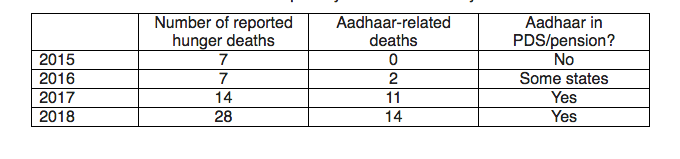
[1] For Jharkhand, detailed reports based on independent investigation are available (see last column of detailed table). The circumstances of starvation deaths, and the role played by Aadhaar, are reasonably clear from these reports.
2015-18 में भूख से मौतें
पिछले कुछ वर्षों में भूख से मौतों की खबरें लगातार आती रही हैं. इनमें से झारखंड की 11-वर्षीय संतोषी कुमारी की मृत्यु खास कर के दुखद थी. संतोषी 28 सितम्बर 2017 को अपनी माँ को भात-भात कहते-कहते चल बसी. बाद में पता चला कि आधार से लिंक न होने के कारण उसके परिवार का राशन कार्ड रद्द कर दिया गया था (मई-जुलाई 2017 में झारखंड सरकार ने व्यापक पैमाने पर बिना आधार से जुड़े राशन कार्डों को रद्द किया था).
संतोषी की पुण्यतिथि पर हम लोगों ने 2015 से लेकर अभी तक भूख से हुई मौतों (जिनकी जानकारी उपलब्ध है) की सूचि समेकित की है. हमारे हिसाब से अगर कोई व्यक्ति, घर में खाना या पैसा न होने के कारण, लम्बे समय से भूखा रहता है एवं उसकी मृत्यु होती है और उसे अगर समय से खाना या पैसा मिलता, तो शायद उसकी मृत्यु नहीं होती, तो उसे भूख से मौत मान सकते है. अंग्रेजी व हिंदी खबरों के गूगल सर्च पर आधारित यह एक आंशिक सूचि है.[1]
पिछले चार वर्षों में कम-से-कम 56 भुखमरी से मौतें हुई हैं. इनमें से 42 मौतें 2017 व 2018 में हुई हैं. यह भारत के गरीबों के जीवन में अनिश्चितता की स्थिति को दर्शाता है. अनेक गरीबों के लिए सामाजिक सुरक्षा पेंशन और जन वितरण प्रणाली जीवन रेखा समान है. अधिकांश मौतें पेंशन या जन वितरण प्रणाली से राशन न मिलने के कारण हुई हैं. भुखमरी के शिकार हुए अधिकांश व्यक्ति वंचित समुदायों – आदिवासी, दलित व मुसलमान – के हैं.
2017 और 2018 में जो 42 मौतें हुई, उनमें से 25 आधार सम्बंधित समस्याओं के कारण हुई थी. इनमें से कम-से-कम 18 मौतों के लिए सीधे तौर पर आधार ज़िम्मेदार था (सूचि में पीले व बोल्ड हाइलाइट्स देखें). मुख्य कारण हैं – आधार से न जुड़े होने के कारण राशन कार्ड रद्द हो जाना या पेंशन सूचि से नाम कट जाना व आधार-आधारित बायोमेट्रिक सत्यापन व्यवस्था की विफलता. अनेक राज्यों में जन वितरण प्रणाली में आधार-आधारित बायोमेट्रिक सत्यापन व्यवस्था अनिवार्य समान है. इनके अलावा 7 मौतें संभवतः आधार के कारण ही हुई हैं (सूचि में केवल पीले हाइलाइट्स को देखें). इनमें से अधिकांश व्यक्ति अपने राशन या राशन कार्ड से वंचित थे, जिसके लिए आधार ज़िम्मेवार हो सकता है.
भूख से मौतों की सूचनाएं झारखंड और उत्तर प्रदेश से लगातार आती रही हैं. अभी तक इन दोनों राज्यों से 16-16 व्यक्तियों की मृत्यु की सूचनाएं मिली हैं. झारखंड में आधार-आधारित बायोमेट्रिक सत्यापन व्यवस्था लगभग हर राशन दुकान में अनिवार्य है. उत्तर प्रदेश ने राष्ट्रीय खाद्य सुरक्षा कानून को देर से व अव्यवस्थित तरीके से लागू किया है.
एक स्वस्थ और जीवंत लोकतंत्र में भूख से मौतें बड़ी खबर होनी चाहिए व इस पर गंभीर चर्चा और सक्रीय प्रतिक्रिया होना चाहिए. चंद मौतें कुछ हद तक चर्चित तो हुई हैं. लेकिन उस चर्चा से ऐसा निरंतर दबाव नहीं बन सका जिससे भूख से मौतों को रोकने के लिए सरकार को कार्यवाई करने के लिए विवश किया जा सके. इनमें से अधीकंश मामलें ‘ब्रेकिंग न्यूज़’ के दौर में मुख्य समाचार का हिस्सा भी नहीं बन पाई. जन वितरण प्रणाली में आधार-आधारित बायोमेट्रिक सत्यापन व्यवस्था से व्यापक पैमाने पर हो रही समस्याओं के बावज़ूद केंद्र सरकार इसे पूरे देश में अनिवार्य करने पर लगी हुई है

[1] झारखंड में हुई मौतों पर स्वतन्त्र तथ्यान्वेषण पर आधारित रिपोर्ट्स उपलब्ध हैं (संलग्न सूचि का आखरी कॉलम देखें). भुखमरी से हुई मौतों के कारण व आधार की भूमिका इन रिपोर्ट्स से स्पष्ट पता चलते हैं.
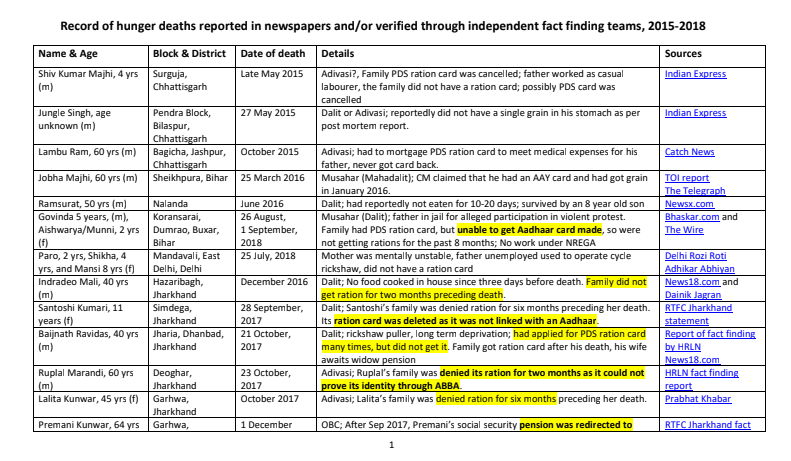
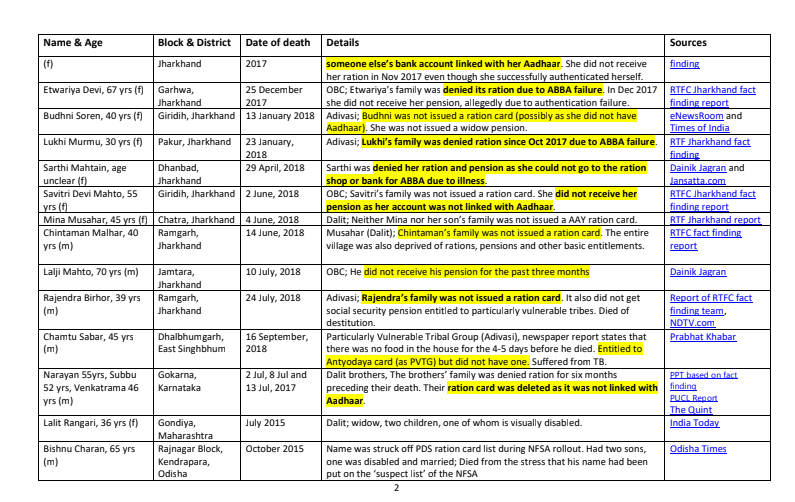
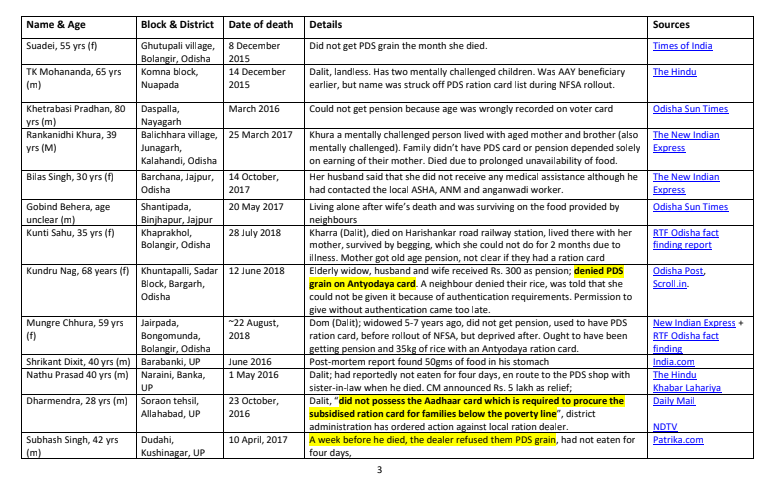
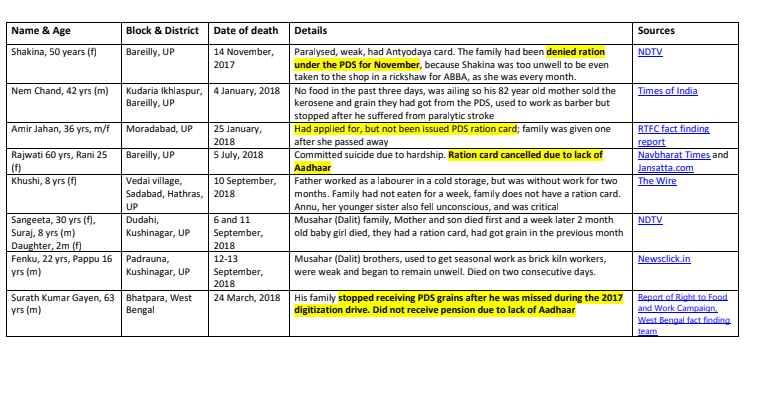
Resources
https://drive.google.com/file/d/0B0A8K4XEQ4YBR2JFeG5mTTVlaU8xVmNYLWh0bWREVHFvcnNz/view
https://drive.google.com/file/d/0B0A8K4XEQ4YBVGU4cDdianBHbXNWTU5NTWo5UjVnTERYa2RR/view
https://drive.google.com/file/d/0B0A8K4XEQ4YBRDU3Z1R1dW5tWS1FMkFqTkpyMEt2Q01wbl9F/view
Press coverage
https://www.deccanherald.com/national/least-56-died-due-hunger-2015-693791.html
https://thewire.in/rights/of-42-hunger-related-deaths-since-2017-25-linked-to-aadhaar-issues
We are almost at the end of August, and the wait for the Supreme Court Constitution Bench's judgment in the final Aadhaar hearings continues. All we know for now is that the judgment will be out, and soon...
Most recently the Delhi High Court issued notice to the UIDAI and the Union government on a petition filed by academic Shamnad Basheer, seeking allowing people to opt out and request deletion of existing Aadhaar data, and asking for payment of exemplary damages for all Aadhaar data breaches.
The Income Tax department finally allowed online filing of tax returns without quoting the Aadhaar number, as stipulated by the Supreme Court last year in Binoy Viswam for those without Aadhaar. Multiple petitions were filed all over the country, with courts granting relief for petitioners alone, until finally on 24th July 2018, a two judge bench of the Delhi High Court in Shreya Sen v. Union of India directed the Central Board of Direct Taxes (CBDT) to rework their software so that people can file their tax returns online without having to furnish their UID number or any proof of having enrolled.They said it: "This court is of the opinion that at least till 31.3.2019, the CBDT shall issue an appropriate direction, and also create a platform by amending the digital form of (sic or) substituting them properly to enable ‘opt-out’ from the mandatory requirement of having to furnish Aadhaar registration or Aadhaar linkage, for the duration, the exemption subsists, that is, till 31.3.2019."
While the CBDT seemed in no hurry to follow the order of the court, one of us tried to file returns online, and to our pleasant surprise, Aadhaar was not required!
We strongly recommend that those still waiting to file their tax returns make their accountants and/or tax consultants aware of the latest court order and aim to file their returns without quoting Aadhaar.
I. Updates from Parliament
From misinterpreting the Supreme Court's judgments and misleading citizens to link Aadhaar with mobile phones to the open challenge issued by the TRAI Chairman Ram Sewak Sharma, many issues around Aadhaar were raised and discussed in Parliament in the recently concluded Monsoon Session. Some highlights:
One MP pointed out that farmers, already reeling under several losses, were finding it difficult to claim timely payment under the Pradhan Mantri Fasal Bima Yojana because of mandatory linking of Aadhaar to claim compensation. He stated that amidst the Supreme Court challenge and several Central Govt notifications, there was no clarity among citizens on whether Aadhaar is mandatory or not.
Another MP demanded an explanation from the Central Govt for misinterpreting the Supreme Court's judgments and making Aadhaar linking with mobile phones mandatory and wondered about the Govt's stand on the Fundamental Right to Privacy.
The issue of the mysterious inclusion of the UIDAI helpline number in millions of Android phones was also raised and it was claimed that 'big brother' is watching.
In response to a Question raised on the TRAI Chairman Ram Sewak Sharma revealing his Aadhaar number on Twitter, the Government did not clarify whether any action would be taken against him, but simply stated that he is a public figure and his personal details are already out in public domain.
In response to several Questions on making Aadhaar mandatory for obtaining rations through PDS and the same leading to hunger deaths, the Government first claimed that no starvation or hunger death has been reported in the country in last four years. Then it clarified that instructions have been given to States/UTs not to delete any person / household from list of eligible beneficiaries or deny subsidized foodgrains or cash transfers for not possessing Aadhaar or for failure of biometric authentication. It also stated that beneficiaries under NFSA, who did not have an Aadhaar needed to make an application for one by 30th September, 2018.
In response to another Question on complaints received by UIDAI against registrars and enrollment agencies, a list of such Registrars and Enrollment Agencies whose services were suspended and terminated was provided which included the Govt-promoted CSC e-Governance. It also stated that everyday, on average, UIDAI contact centres for grievance redressal receive 2 lakh calls most of which are for seeking information.
With respect to the Tribune report of getting access to 1 Billion Aadhaar details for as little as Rs.500, the Govt stated that it was a case of 'misreporting and completely false'.
There was a news report of online leakage of Aadhaar and bank details of 1.34 lakh employees of Andhra Pradesh State Housing Corporation. In response to a Question on this, the Govt evaded answering the actual question and simply stated that there has been no leakage of Aadhaar data from UIDAI database.
In response to another Question, the Govt stated that in 2015-16, National Population Register data was shared with State Governments to update it and to seed it with Aadhaar numbers. But it also stated that the Aadhaar seeded Population Register data has not been shared with State Governments.
In an RTI filed earlier this year, UIDAI had refused to disclose information on Aadhaar promotion and branding. When a Question on the same was raised in Parliament, it was denied that UIDAI hires any agencies to undertake image makeover of Aadhaar.
II. Protests against ICDS-Aadhaar linking in Gujarat
A group of concerned citizens from Gujarat had begun investigating the Aadhaar scheme in 2017. On 17th April 2018, the Gujarat State ICDS Department released a circular mandating production of Aadhaar for disbursement of salary. The department wanted Anganwadi workers to open new accounts that were Aadhaar linked into which they could transfer salaries through DBT, and demanded that Anganwadi workers submit photocopies of Aadhaar cards to the ICDS department. Four Anganwadi workers reached out to the group of concerned citizens asking for help in resisting the order making Aadhaar mandatory because they believed Aadhaar was a breach of their privacy.
Integrated Child Development Service (ICDS) is a government programme in India which provides food, preschool education and primary education to children under 6 years of age and their mothers. The ICDS department governs and manages various sub-schemes including Anganwadi services. The salaries of Anganwadi workers had been stopped for the past 3 months due to non-linking of Aadhaar. After forcefully imposing this scheme, some of workers were given the choice of either submitting their Aadhaar or quitting the job. Such coercion was not limited to salaries alone - they were also mentally tortured to submit their Aadhaar card and collect Aadhaar cards of their students by any means necessary.
Activists from the area report that they had met the Department’s Director at the Gandhinagar office several times and were initially given assurances that salaries would not be stopped. In their latest meeting, however, officials stated that salaries would not be disbursed until and unless Aadhaar cards were linked. The Anganwadi workers have tried to submit other government IDs such as Voter ID, Ration card, etc. but have been refused their salaries until submission of their Aadhaar cards.
A petition challenging this mandatory linking has been filed by one of the Anganwadi workers in the Gujarat High Court.
The team of concerned citizens has been reaching out to those affected when Aadhaar is made mandatory. Adil Patel in Gujarat can be reached on 09638177097.
III. Aadhaar Fraud in PDS
On 26.08.2018, the Times Of India reported:
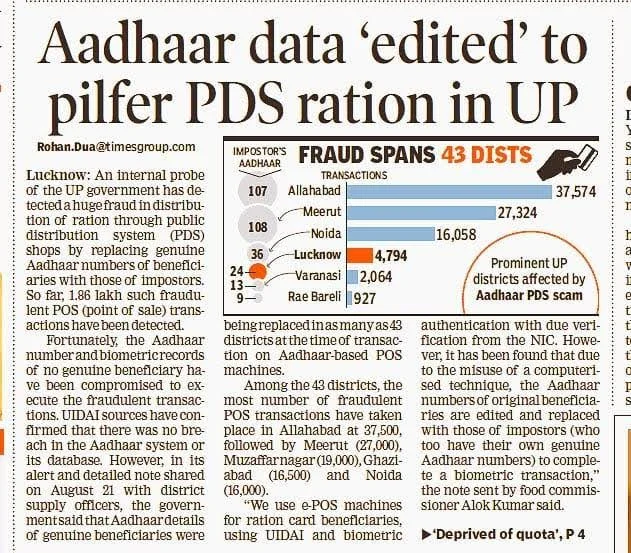
Vol. II of this update on how to delink your bank account and aadhaar number, data protection, and more will follow soon.
### 27 Jul 2018 — Statement of solidarity - RTI and RTP activists > A day long workshop on the issues of the Right to Information (RTI), the Right to Privacy (RTP), the proposed data protection legislation and their intersections was held on 17th July 2018. The consultation was attended by members of various peoples' campaigns and movements, researchers, legal scholars and citizens Original: https://rethinkaadhaar.in/blog/solidarity-statementA day long workshop on the issues of the Right to Information (RTI), the Right to Privacy (RTP), the proposed data protection legislation and their intersections was held on 17th July 2018. The consultation was attended by members of various peoples' campaigns and movements, researchers, legal scholars and citizens interested in, and affected by, issues pertaining to transparency and privacy.
This workshop was organised in the light of the government’s doublespeak on the rights to information and privacy. Privacy is cited by the government to deny information crucial to hold those in power to account while, at the same time, privacy is denied to citizens when it comes to collecting excessive information for projects such as Aadhaar.
As a statement of solidarity within the civil society among those promoting the rights to information and privacy, the following resolutions were passed:
The citizens' Rights to Information and Privacy are both fundamental rights under the Constitution of India and the State must protect, promote and fulfill both these rights to further democratic values and protect constitutional freedoms.
There is a need for legislation on Privacy and Data Protection in order to adequately protect the privacy of citizens and protections in such a law should be oriented on the rights of natural persons and extend against both State and non-State actors.
This legal framework for giving effect to citizens' right to privacy should emerge from a pre-legislative consultative process so that the relevant legislation incorporates concerns of the wide set of stakeholders that such a law will inevitably affect.
Neither the recognition of the Right to Privacy nor the legislation of a privacy and data protection law requires any amendment to the RTI Act. The legal framework for privacy and data protection should complement the RTI Act and in no way undermine existing statutory framework that enables citizens to use transparency for holding power structures to account.
These resolutions are endorsed by the National Campaign for the Peoples’ Right to Information (NCPRI), SaveOurPrivacy, IT for Change and Rethink Aadhaar. Those interested in endorsing this statement may do so here.
### 24 Jul 2018 — June-July Update > Summer is seeping into the monsoon. Much has happened in the last months. For the poor, Aadhaar and hunger deaths remain connected. The Right to Food Campaign reported on continuing hunger deaths in Jharkhand. Many of those who died faced issues with rations related to Aadhaar. For the middle classe Original: https://rethinkaadhaar.in/blog/2018/7/24/june-july-updatesUpdate Amended to add
Live Law reported that assesses can now file their income tax returns online without the Aadhaar enrolment number as the Delhi High Court, while providing the relief to two petitioners, asked the Central Board of Direct Taxes to create a platform for people to file returns without Adhaar till the deadline of March 31, 2019 for PAN-Aadhar linkage. A bench of Justice S Ravindra Bhat and Justice A K Chawla allowed petitioners Shreya Sen and one other to file their income tax return online without the Aadhaar. Read the order of the Delhi High court dated 24.07.2018.
Similarly, on 24.07.2018, the Madras High Court also allowed 9 petitioners to file their taxes manually without submitting Aadhaar numbers. Bar and Bench reported.
Is Aadhaar mandatory? What is it mandatory for?
1. The government has repeatedly asserted that Aadhaar is not mandatory. The Aadhaar enrollment form itself states that Aadhaar is "free and voluntary".
2. While there are various rules/notifications making Aadhaar linking in practice mandatory within fixed deadlines, all these deadlines have been extended, with some notifications nullified.
a) For instance, the deadline for linking PAN and Aadhaar has been extended to 31st March 2019 - the relevant CBDT Order was published on LiveLaw. On the other hand, the Income Tax Dept. continues to insist on inclusion of Aadhaar in IT returns - despite the Supreme Court direction in Binoy Visvam making production of or enrollment for Aadhaar for this purpose strictly voluntary. There are, thankfully, “easy” workarounds - see our section below for more details.
b) The 13th March order of the Supreme Court of India states that mobile and financial services need not be linked with Aadhaar until the final judgment in the Aadhaar matters is announced by the SC’s Constitution Bench. While Aadhaar continues to be mandatory for opening new bank accounts, per the RBI’s Master Directions (updated in July 2018), the account holder has 6 months within which to link their Aadhaar. [Note: We understand that banks are demanding immediate production of Aadhaar or enrolment number. We urge that customers request written proof of such requirement failing which they should escalate the matter to the bank managers and further to the banking ombudsman.]
3. The Aadhaar scheme is currently under challenge in the Supreme Court of India and its legitimacy itself is in question. The Supreme Court is likely to curb the project: in the absence of any judgment in the case, the matter remains pending and sub judice during which time Aadhaar cannot be mandatory for availing any service or subsidy or benefit, per the SC’s earlier orders.
Are you unable to file your Income Tax return without an Aadhaar?
For most salaried employees, the process of filing Income Tax returns is fairly “automated” - once the employer supplies the Form 16, you confirm the details align with the TRACES portal record. Subsequently, you use the NetBanking-based tax service feature of your salary account (or other account already used for previous Income Tax returns) to allow you to file “e-verified” returns, usually ITR-1 (aka Sahaj). Since July 2017, the Income Tax Department has required taxpayers to provide their Aadhaar number although the form fiendishly does not indicate that the Aadhaar is mandatory. This is not doubt frustrating, especially if you do not possess an Aadhaar nor have any intention of enrolling for it.
We have heard that the simplest hack is based on the recognition that the form does not actually “verify” the authenticity of the Aadhaar - i.e. there is no “Yes/No” authentication being performed, even during the processing of the returns. All that the form does, reportedly, is execute the Verhoeff algorithm to determine if the checksum - the 12th digit of the “Aadhaar” - is valid, thus validating the entire 12-digit number. Therefore, apparently, as long as you enter a twelve digit number that is likely to be an Aadhaar, you are good to go!
Last year, several individuals filed their returns using 12 zeroes as their Aadhaar - fact brought up by Senior Advocate Arvind Datar during the Aadhaar hearings. We have been told that the Income Tax Department has wised up and no longer recognizes 12 zeroes as a valid Aadhaar number. There are other numbers (11 1s and a 5, for instance) that are purportedly doing the rounds which are said to serve the purpose just as well. Although many people are using such Verhoeff compliant numbers, we advise verifying through the UIDAI portal whether the Aadhaar actually exists lest you get another person into trouble!
There are reportedly other workarounds as well - using a “valid” (but not authentic) enrollment id (rather than Aadhaar), and choosing to verify your returns by post, rather than by electronic means are two. Our recommended methods, however, are other alternatives including (i) waiting for the SC judgment and paying a late filing fee than provide any Aadhaar information whatsoever and (ii) filing a writ petition in the local High Court demanding that the IT Dept allow you to file your returns without an Aadhaar. The latter method has been adopted by various groups across India, among whom are some of the petitioners in the recently concluded Aadhaar hearings.
Hunger Deaths Continue
The Right to Food Campaign on 21.06.2018 held a press conference in Ranchi calling out the governance failure in Jharkhand that has lead to a spate of starvation deaths over the past year. Presenting details of 12 starvation deaths, the Campaign noted that 7 of these cases were directly related to Aadhaar-enabled exclusion.
Reports indicate that three persons have died during the month of June.
The reports highlight the fact that contrary to all the claims of enhancing efficiency in welfare, Aadhaar has no role to play in facilitating inclusion, For instance, Chintaman Malhar, 40, died of starvation as he had no food to eat in his makeshift shelter. His son Videsh claimed that his father was hungry for the last few days and collapsed while repairing the hut in the scorching heat on Thursday. He alleged that in spite of having Aadhar cards, they have not been issued ration card so far. For years, two successive governments at the center have portrayed Aadhaar as important to improve inclusion into government schemes. But simply having an Aadhaar does not lead to any greater inclusion as several schemes continue to have own quotas and cut-offs. While the requirement to have an Aadhaar for food schemes, and to give biometric authentication each time adds more hoops to cross to get grains and pensions on time.
On 13th July a protest was organised at the Jharkhand State Bhawan, New Delhi by the Right to Food Campaign. The Campaign submitted a memorandum to the resident commissioner which highlighted the ongoing issues related to the Public Distribution System in Jharkhand and the various attacks on the Right to Life. The memorandum also demanded the delinking of Aadhaar from all public services.
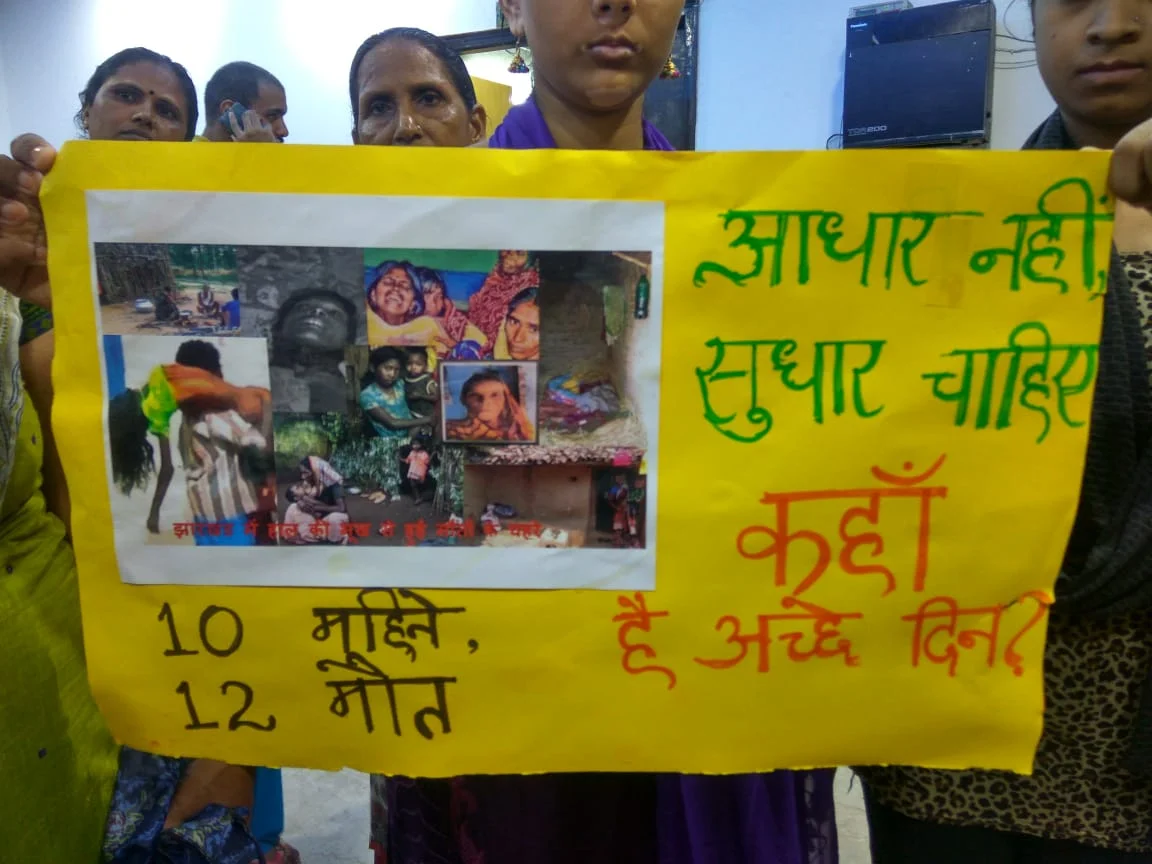
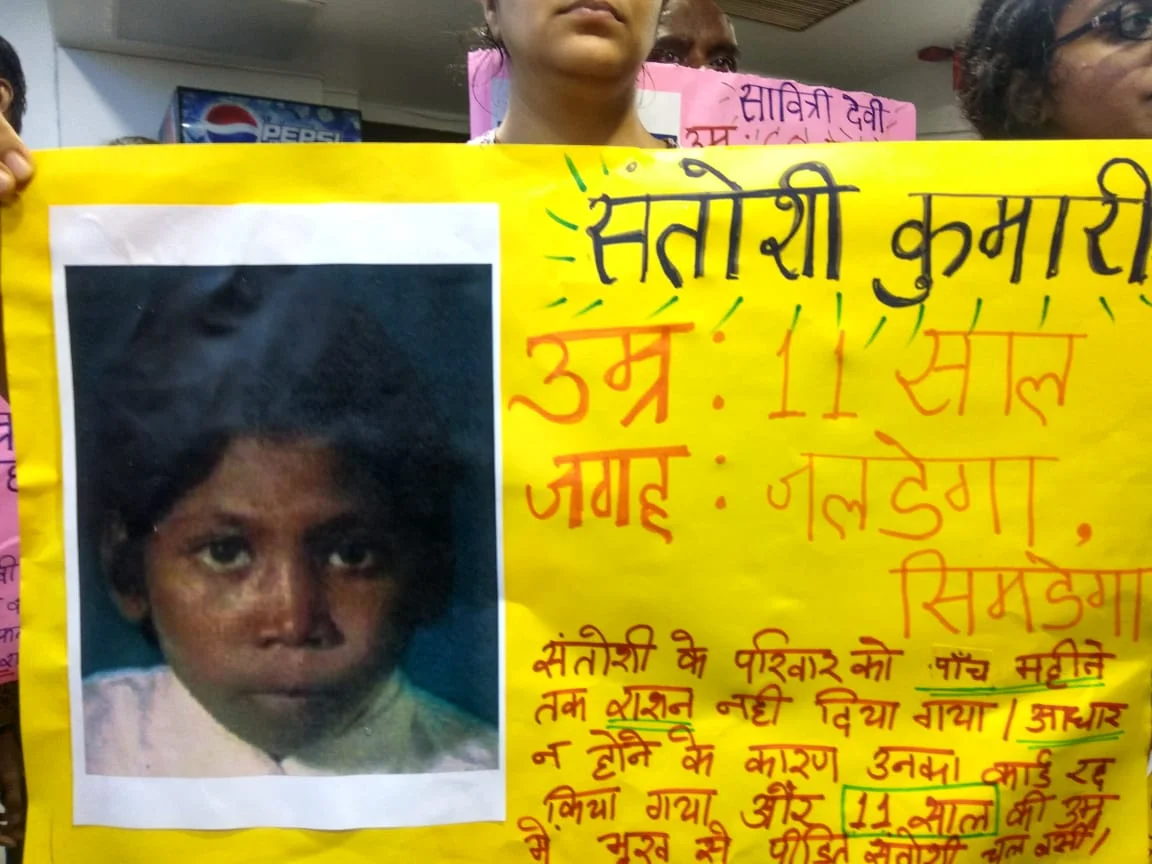
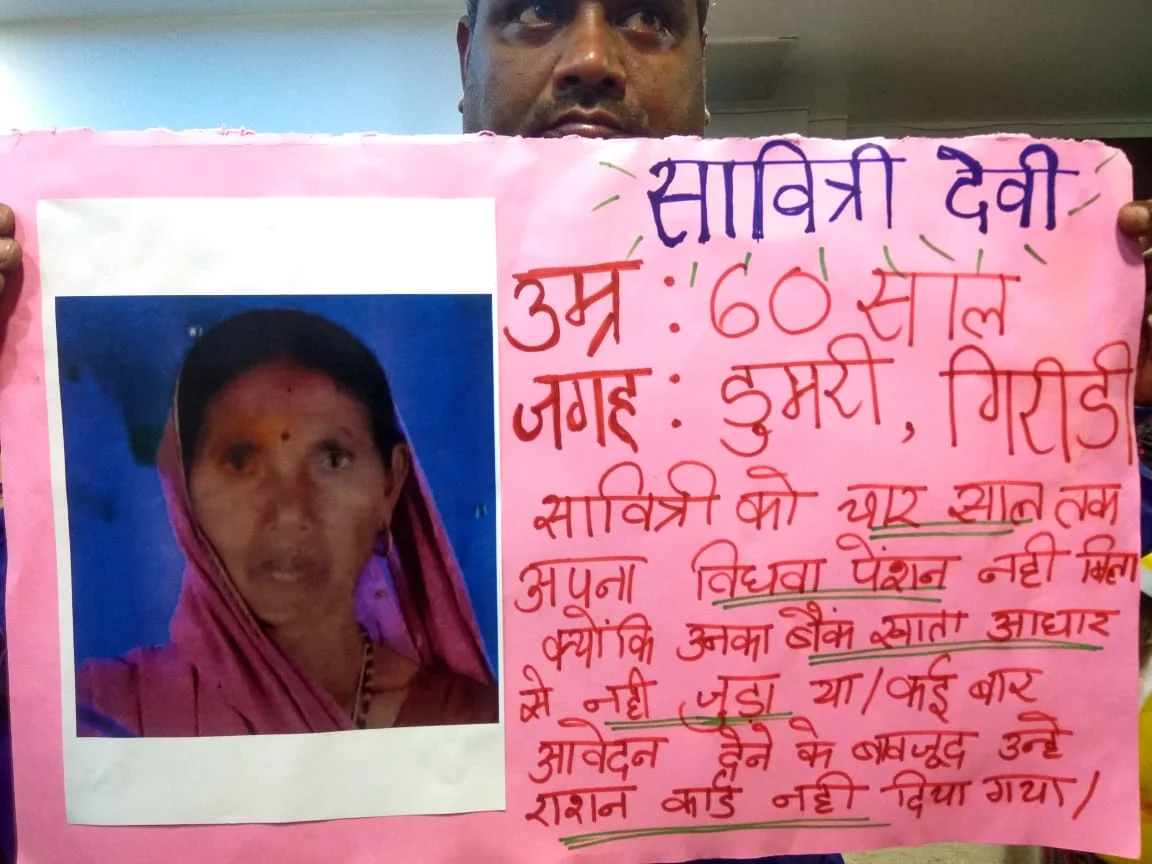
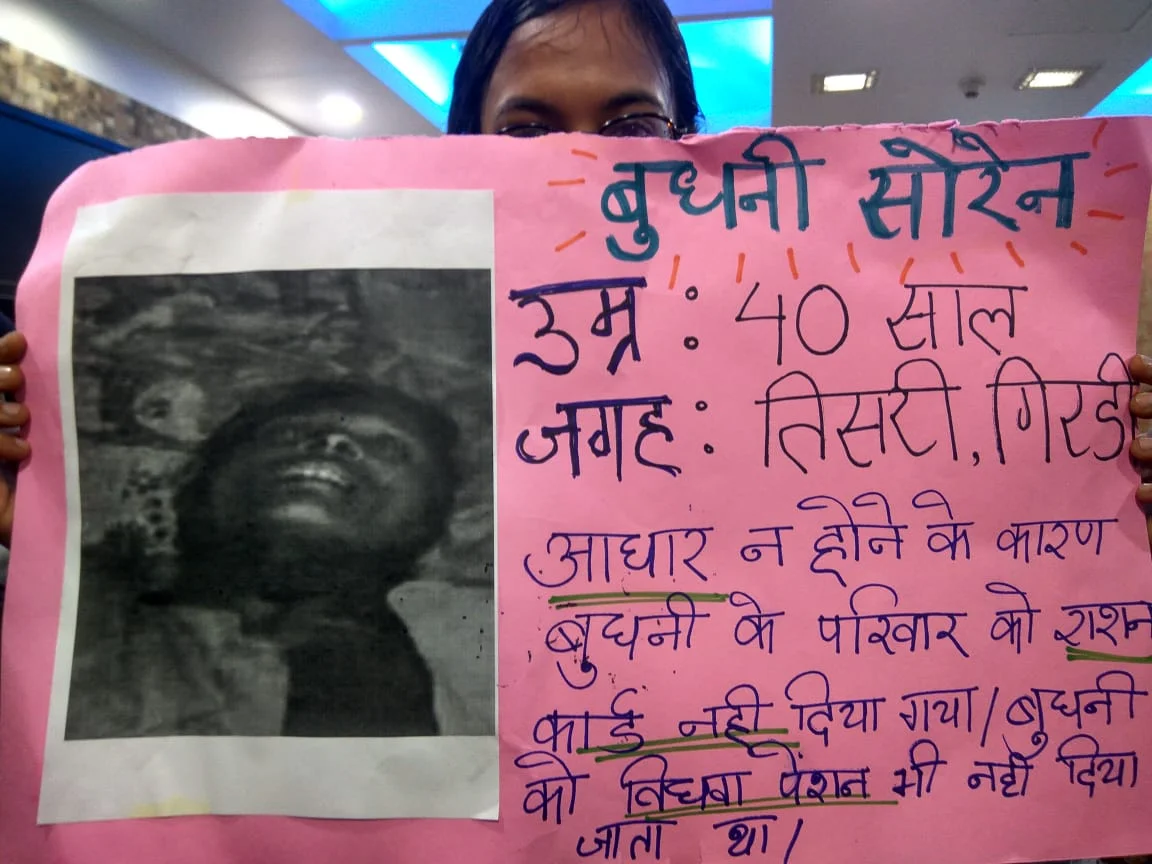
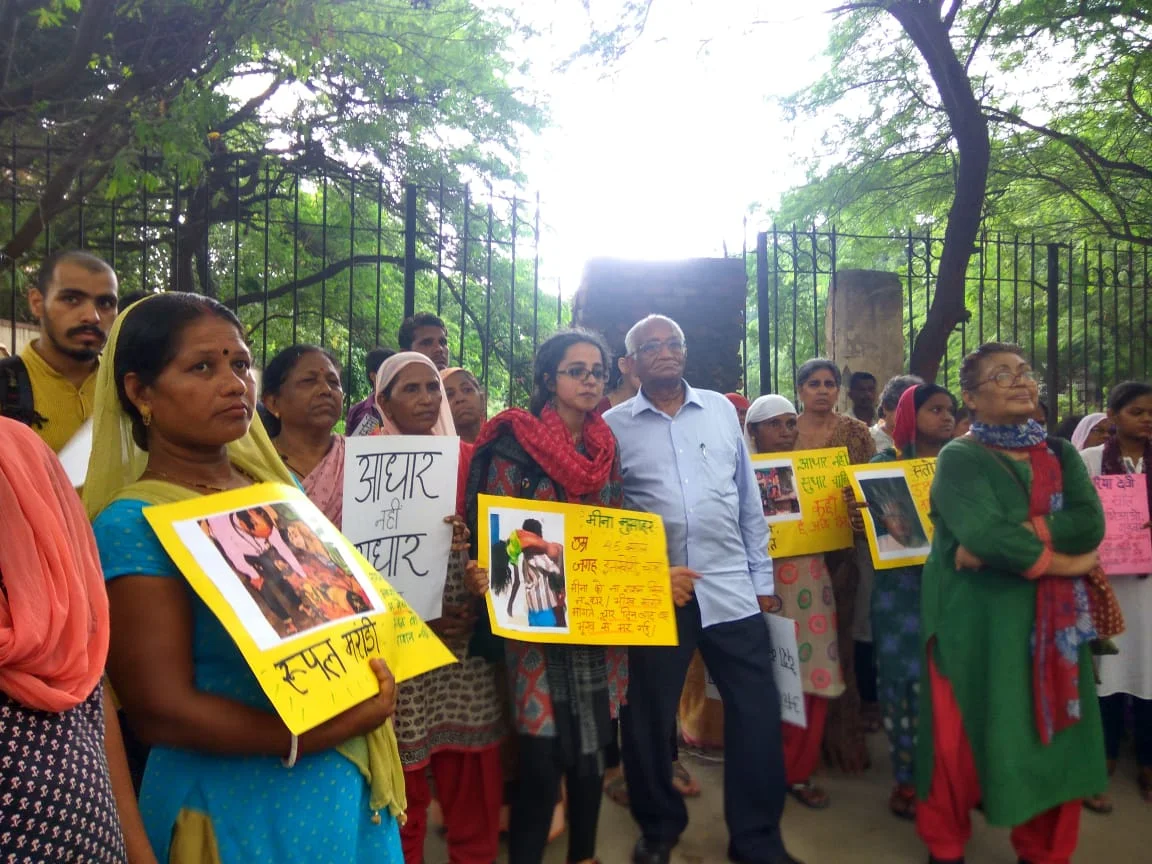
Photos via. The Right to Food Campaign, India
National Health Stack
The government’s push to include Aadhaar in every single system continues with the release of a consultation paper on the ‘National Health Stack’. The dangers of pushing an insecure, leaky, vulnerable, centralised identity system onto the already under-served and broken public healthcare system, have not been examined by the authors of the consultation paper. The proposed National Health Stack might have serious and far-reaching consequences for the security and privacy of sensitive health information and data.
“Significantly, the National Health Stack is designed and developed on the same lines as the Aadhaar-based India Stack — a controversial FinTech system for delivery of services, such as digital payments.” - Praneta Jha of Newsclick writes National Health Stack: An Architecture Of Doom For Public, Data For Private Profit - The proposed Stack, a digital infrastructure to subsume all medical and healthcare activities in India, seeks to turn the entire health sector into a market (run by private players obviously) — while ensuring those at the edge actually fall off.
Court updates
Affected individuals have been continuously approaching the courts praying for relief against Aadhaar induced problems.
On 9th May 2018, the Rajasthan High Court has ruled that Aadhaar is not mandatory. In its order, the HC directed Rajasthan Public Service Commission (RPSC) to not insist on Aadhaar for submission of online application of the petitioners of the Rajasthan Administrative Service and Allied Service 2018-19. The petitioners said the Aadhaar card scheme is purely voluntary and it cannot be made mandatory and prayed that the commission be directed to withdraw its press notification making registration through mobile number registered with Aadhaar mandatory.
On 15th May 2018, the Karnataka High Court also ruled that Aadhaar is not mandatory. In its order, the HC directed the State government and the Department of Pre-University Education not to insist on a copy of Aadhaar for admission of a 15-year-old student to a 1st year pre-university course. The petitioner had last year approached the High Court against guidelines issued by the authorities concerned making Aadhaar mandatory for submitting an application to appear for the SSLC exams
On 8th June 2018, the Delhi High Court directed AIIMS, country’s premier health institution, to compensate an aspiring medical student, who was not allowed to sit in this year’s MBBS entrance examination just because the QR Code in his Aadhar Card could not be scanned at the examination center. Petitioner had uploaded the details of his Aadhaar Card as his I.D.Proof, which was verified by AIIMS and admit card with Aadhaar number was issued. However on the day of the exam the student was not allowed to take the exam for the mere reason that his aadhaar card was not being scanned on their mobile phone.
On 31st May 2018, Delhi’s Tis Hazari Court clarified that Aadhaar is not mandatory for litigants. Delhi-based Mohan Bhadana had filed an application under RTI with the Public Information Officer of Tis Hazari Court seeking copy of the notification or directions making Aadhaar mandatory before District Courts in Delhi or the Delhi High Court.
Issues with ABBA
Aadhaar-linked DBT has been creating havoc everywhere. There are reports that payments have been delayed upto a year or even more in some cases for payments related to NREGA, pension, rations etc. In Pune, the aadhaar-linked disbursement of salary from banks has been full of glitches, and many anganwadi workers have not been paid honorarium for several months. Activists have alleged that an anganwadi worker committed suicide because she was deprived of honorarium for six months as her biometrics did not match.
In Karnataka, Prajwal Bhat has reported on the issues faced by people in rural Karnataka - With their ration linked to Aadhaar, residents say they’ve had to forego their monthly staples – the fingerprints don’t match, or there isn’t enough connectivity to process their biometrics. Of the 1.2 crore ration cards linked with the biometrics database in Karnataka, nearly 99 lakh cards recorded transactions in February 2018. Of these, fingerprint authentication did not work for over 18.6 lakh cards, almost one in five families in the state. We would like to remind readers of our own analysis which found a large percentage of authentication failure.
The Digital Identity Research Initiative (DIRI), hosted at the Indian School of Business (ISB) and funded by Omidyar Network (ON) recently released a data brief on ABBA in the PDS in Delhi. Based on an analysis of transaction logs received from PoS devices (data which is not available in the public domain), they find that during the Month of March 2018, the authentication failure rate was 1.3%. They note that was predominantly due to insufficient capacity of Aadhaar servers and not due to failure in biometric authentication per-se. In a manner characteristic of research funded by ON (see State of Aadhaar by IDinsight), the framing of the findings attempt to divert from the real issue that irrespective of which specific ‘‘fragile technologies’ of Aadhaar broke down, it is resulting in significant exclusion. Further, the pro-Aadhaar lobby (see here, here and here) are attempting to project these findings (fraught with framing effects) as innovative and illuminating. This is surprising given that Aadhaar critics have highlighted the role that disruptions relating to remote Aadhaar servers can lead to exclusions - see articles and studies highlighting this very aspect here, here and here.
NREGA
The Union Government has continued to attempt to push the narrative tha Aadhaar has had a mostly positive impact on welfare. The latest claims were related to the NREGA, a lifeline for rural India. On 13th July 2018, Jean Dreze writes in ‘Hollowing Out a Promise’, “Today, “e-KYC” (biometric authentication of Aadhaar-linked accounts) is compulsory for NREGA workers, if not in theory then certainly in practice. That, too, is a fountain of technical glitches. A senior official at the Ministry of Rural Development (MoRD) recently told me that the MoRD had identified more than 200 different possible reasons for a payment to be rejected. Some of the error codes, like “inactive Aadhaar”, are beyond the comprehension of the MoRD itself and even of UIDAI — both pleaded ignorance in response to an RTI on this matter. According to the NREGA’s management and information system (MIS), nearly Rs 500 crore of wage payments were rejected in 2017-18 alone.”
NPCI/Aadhaar Payments
The Financial Express reported on 20.07.2018 that The National Payments Corporation of India (NPCI) has told banks to discontinue Aadhaar-based payments through the Unified Payments Interface (UPI) and Immediate Payment System (IMPS) channels.
Educational Institutions
On 11th July, Huffington Post reported that “A form circulated among faculty in IIT Delhi has asked teachers to urgently share their Aadhaar numbers, and also the linked phone numbers. This isn't the first time that teachers at IIT have been asked to do so, but in the past many of the faculty did not enter their Aadhaar numbers. This time however, the circular states that if a teacher does not want to share their Aadhaar number, they need to explain why this won't share this information.” Incredibly the report stated that, “The circular is marked urgent, and the text reads: "The above data is required by MHRD urgently, which includes the mobile numbers of all faculty." IIT Delhi's heads of departments have been directed to collect this information before the end of July, and to note the reasons for dissent from teachers who don't want to share this information”
Is your educational institution demanding Aadhaar? See this:
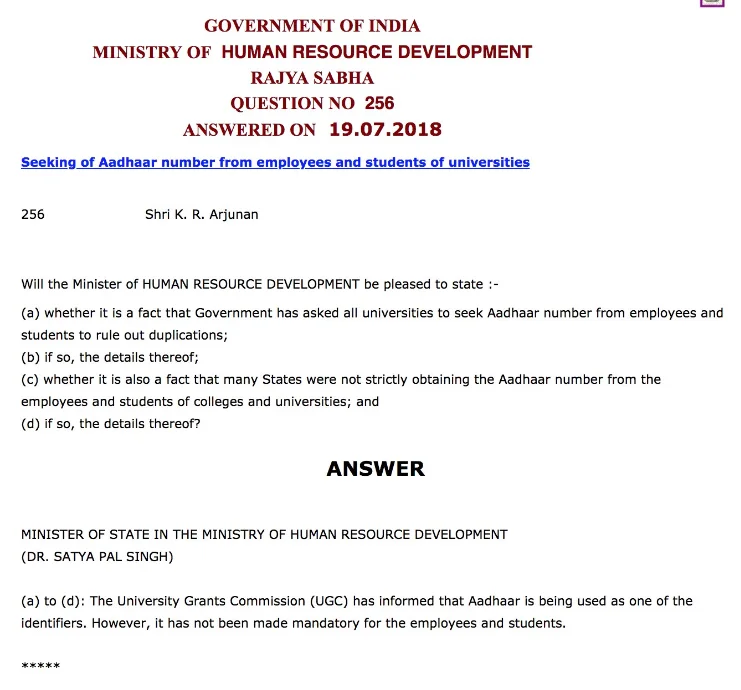
Political updates
In some welcome moves, some state governments are beginning to realize that making Aadhaar needlessly mandatory for everything is counter productive. Odisha has refused to implement Centre’s flagship health scheme Ayushman Bharat, on the grounds that it would deprive poor families who do not have Aadhaar. By 12th July, the National Health Mission clarified that “The use of Aadhaar Card is desirable but not a must to avail benefits under the Ayushman Bharat”
In Jharkhand, the Congress President wrote to the Union Food Minister to withdraw the ‘DBT for food subsidy’ pilot in Nagri block of Jharkhand and compensate all households that are denied their grain entitlement due to this pilot. The Congress State President also requested the Minister to remove the mandatory integration of Public Distribution System with Aadhaar and the requirement of Aadhaar-based biometric authentication for accessing rations. While the state units of national parties are cognizant of the reality of errors of Aadhaar, it is time the national offices of these parties also take a firm stand against making citizen’s rights contingent on the probability of an Aadhaar authentication.
Oversight mechanism
There has been a severe lack of any oversight mechanism of UIDAI, and it is no wonder that UIDAI has become a law unto itself - giving directions to other national agencies like the RBI, TRAI and state governments in matters where it may not have jurisdiction or competence.
The Aadhaar Act, 2016 calls for various reports to be submitted annually before the Central Govt and Parliament. We wonder where these annual reports are and what our parliamentarians have to say about them. In April this year, new rules were notified by MEITY wherein UIDAI needs to submit various detailed reports quarterly and annually. We certainly hope that these new sets of rules are not ignored by UIDAI and that these reports are proactively made available to the people in the interests of transparency and accountability.
Miscellany

The Tamil film Irumbu Thurai decided to tackle the issues of Aadhar and “Digital India” and unsurprisingly met with stiff resistance from a BJP-associated outfit which protested against the dialogues and scenes related to Aadhaar and Digital India. A PIL filed against release of the film was dismissed by the Bombay High Court a day before the release.
Once more UIDAI has been found to be deficient in the “services” it provides, and its accountability - in a shocking incident, the Deccan Chronicle reported that nearly 5000 Aadhar card were been found in a scrap dealer's shop in Jaipur. With the illegal mandatory use of Aadhaar in all walks of life, it can be debilitating for citizens’ Aadhaar cards to go missing. Imagine the plight of the people who were waiting to receive their Aadhaar card - what recourse do they have? Often, in rural India, especially, when the residents do not receive their Aadhaar “cards” on time, they try to enroll again, but are rejected each time, as their biometrics are already in the database. This leaves them without any redressal and cut-off from essential services.
### 17 May 2018 — Pension Parishad Press release- 17/05/2018 > Pension Parishad is releasing this statement in the behest of Mr. Jitendra Singh's statement that aadhaar is not mandatory for senior government employees for pensions. by not extending the same courtesy, or option to the beneficiaries of the pension schemes of the NSAP smacks of discrimination, cal Original: https://rethinkaadhaar.in/blog/2018/5/17/pension-parishad-press-releaseHow much more discriminatory can it get?
Minister of State for Personnel, Jitendra Singh recently clarified that Aaadhar will not be mandatory for retired central government employees to avail of their pension. This is a laudable and sound decision. Only , by not extending the same courtesy, or option to the beneficiaries of the pension schemes of the NSAP smacks of discrimination, callousness, and cruelty with some of the most vulnerable citizens of India. They have already been reeling under the exclusion caused by the mandatory Aadhaar payment system, and have the additional disadvantage of being excluded due to social and economic circumstances. This discriminatory treatment is only greater validation of the widely held belief that this government has no concern for the poor. Even the attitude that this ridiculously small pension amount is a welfare measure, and not an entitlement can only come from a refusal to acknowledge the immense contribution of the working people to the building and development of this country. While the unwillingness to provide a decent amount as pension is bad enough, the decision to not extend to them the benefit being given to retired government employees, is beyond justification.
Both groups comprise the elderly, so what sets them apart and why are there two sets of rules that apply to them? While both sets of people have served the country in different capacities, it is only government ‘employees’ who are entitled to pensions. All the other masses of informal workers who have served the country in actually building roads and fancy airports, all the farmers and farm labourers who grow food crops, the cleaners who provide services are not entitled to pensions. What they get is referred to as ‘social assistance’, and is labelled as welfare. Their precarious existence throughout their working life dogs them in old age as well. Even the meagre social assistance of Rs.200 per month, sometimes matched or topped up by the state governments, is certainly not enough to live on. The pensions of the government employees on the other hand, amount to an average of half the salary drawn when they demit office and allow for periodic increases to keep pace with the cost of living.
Help us help you
The precarious existence throughout the working life of the informal workers, dogs them in old age as well.If anything it is they who must be exempt from cumbersome procedures. Like the mandatory Aadhar. Biometric verification is often a nightmare for calloused fingers! The claim that Adhaar was brought in to prevent fraud and to weed out ineligible beneficiaries seems a little absurd when compared with the frauds that have beset the banking sector. The pensions under the NSAP account for about Rs.9000 crores per annum, considerably less than the fraud at a single bank! Under the circumstances, it may be worthwhile for the government to consider doing away with the Adhaar requirement for all social assistance schemes. For many of the informal workers, it could mean the difference between life and deprivation, and in some cases the right to life.
In Solidarity,
Aruna Roy, Baba Adhav
National Conveners: Nikhil Dey, Shankar Singh, Pooornima Chikarmane, Kamayani Swami
For Further details, please contact – Nancy (9769580173)

Engage with us on Twitter:
### 14 May 2018 — Rethink Aadhaar campaign update on the UID hearing in the Supreme Court > In 2016, some of us came together to formulate a response to the Aadhaar onslaught and attempted to organise resources to challenge Aadhaar. We also worked to raise awareness and developed resources to help others understand - and critique - the project. We thought we would be focused on both “welfa Original: https://rethinkaadhaar.in/blog/2018/5/14/rethink-aadhaar-campaign-update-on-the-uid-hearing-in-the-supreme-courtThe Supreme Court’s Constitution Bench concluded its final hearings of the matters challenging the constitutional validity of the Aadhaar project on Thursday, May 10, and reserved its judgment. Reservation of judgment is routine and means that the bench will take some time to give its final judgment. We expect the judgment sometime around July - August, after the Supreme Court’s summer recess. In the more than four-month long final hearings of the Aadhaar matters by the Supreme Court’s Constitution Bench, the petitioner’s lawyers covered the many criticisms of the Aadhaar project. Documents and submissions submitted in Court can be found here and present a repository of valuable, historic documents.
This past year, conversation around the Unique Identification (UID) or Aadhaar has grown significantly largely because the government coercively pushed Aadhaar into every aspect of residents’ lives. Partly in response, people began engaging with concerted social and mass media campaigns, live tweeting of court proceedings, and academic research and writing about the project.
In 2016, some of us came together to formulate a response to the Aadhaar onslaught and attempted to organise resources to challenge Aadhaar. We also worked to raise awareness and developed resources to help others understand - and critique - the project. We thought we would be focused on both “welfare and privacy” - two worlds that did not seem particularly connected until the UID project attacked our rights in both spheres. Some of us loosely began calling for “Rethink Aadhaar” (or “no2UID”). Since then we have supported public hearings, conducted signature campaigns, and had conversations on Aadhaar in public places including outside the UIDAI regional office in New Delhi, and at India Gate. During this time of campaigning, most significantly, the Supreme Court affirmed our fundamental right to privacy. In this time we also became a proxy grievance redressal centre for UIDAI with people calling us from across the country to help them with filing taxes, getting mobile phone connections, scholarships, etc without Aadhaar!
For many of us, the destruction of welfare accompanied by bogus claims of savings deserved criticism and called for a rethinking of the UID project. In Court and outside, the response of the State has been that welfare is a burden not a responsibility on the State, and the barter of our fundamental right to privacy is an inevitable part of the social contract. We have fought against this (mis)conception of welfare, and our own understanding of the idea of privacy and its intrinsic link to liberty and freedom has expanded and deepened.
The Aadhaar project has needed welfare schemes to spread itself, and welfare suffers because of it. Having made Aadhaar mandatory to access any government service or entitlement, the State has managed to get Aadhaar numbers seeded into every database creating a gold mine of data that can potentially enable 360º surveillance. We have been told, “Data is the new oil”. In the age of Cambridge Analytica and breaches in the famed Social Security Number (SSN) database in the US, it is clear that no database, whether maintained privately or by government, is truly secure. That a data protection regime is being created in India in a secretive, opaque manner with the active participation of Aadhaar officials only compounds matter further.
Help us help you
Attempting to build a campaign - working on regular updates, collating information from an ever-larger number of sources, and reaching out to more people and wider audiences - with few resources and limited support has been difficult. We have had many ideas to which we have been simply unable to give time and physical energy. There have been mistakes and shortcomings along the way.
Much of our campaigning has been galvanised by the ongoing court cases. In many ways the final hearing and waiting for the judgment in the Aadhaar matters is also an important juncture in this nascent campaign. We might wake up one morning and find that the judgment has come and in the dead of night the UID database was deleted with this government saying that it had itself asked for deletion of the database and it was all a Congress project anyway. Or, we might have to live with it, with the Supreme Court allowing the government to force citizens to trade their privacy and dignity for basic, Constitutionally-assured necessities such as food, education and livelihood.
Whatever the verdict of the Supreme Court, this will not be the end of our legal battles and our struggles and campaigns outside court.
For us we have learned, that we must never forget that the State loves power over its citizens, that there are many excuses given for the need and desire for power: care, good governance, genuine concern, efficiency, etc. Power can be exerted in many forms in the digital age - mass surveillance, phone tapping, database creation; the all-powerful Aadhaar project. In its attempts to justify its power, the State can and does forget its limitations and the inviolable rights of individuals and collectives. Rights are not given to us by the benevolence of a ruler, but they are fought for and are won by all of us working tirelessly together. We had won the fundamental right to privacy. Someday we will Destroy Aadhaar.
If we do have to live with the UID project in some form, we want to think about the institutions and strategies through which we can continue to critique Aadhaar. We would also hope more people can join us and contribute time, or effort towards helping this campaign grow.
One suggestion we are considering is to register ourselves as a formal trust through which we can fundraise and seek contributions. These funds could support campaigners to be involved full-time, or for interns and other supporters to join us on an as-needed basis.
The last line of Justice Kaul’s opinion in the Right to Privacy judgment reads: “the old order changeth, yielding place to new.” Whatever, the outcome of the Aadhaar judgment - we live in a new order.
We will keep fighting.
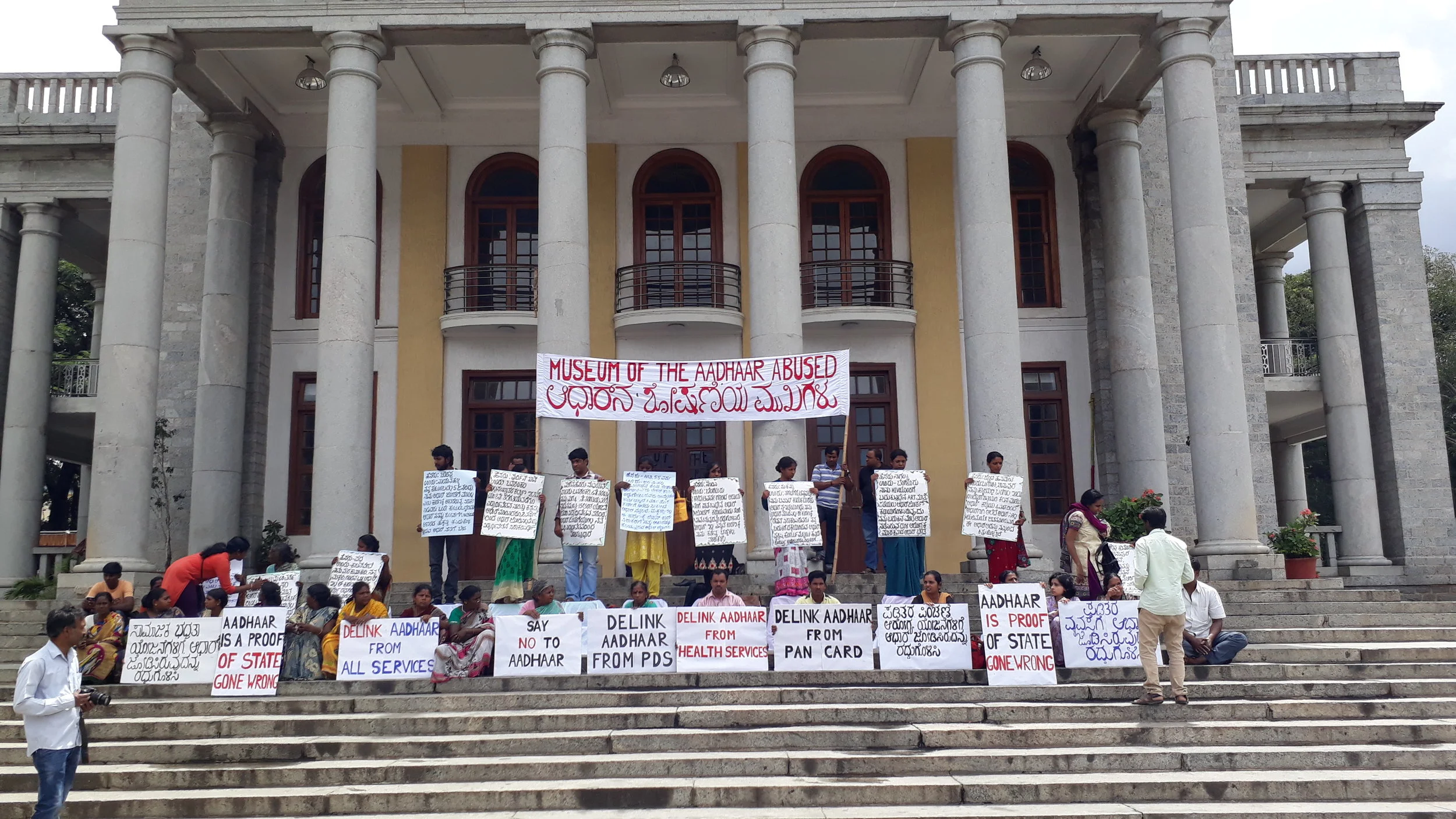
Engage with us on Twitter:
### 13 May 2018 — Aadhaar-related Privacy Concerns > Under the Aadhaar Act, “identity information” consists of Aadhaar number, biometric information and demographic information. “Biometric information”, as of now, consists of fingerprints, iris scan and photograph, but its scope can be expanded at UIDAI’s discretion. “Demographic information” refers t Original: https://rethinkaadhaar.in/blog/2018/5/13/aadhaar-related-privacy-concernsAadhaar-related privacy concerns tend to get confused and mixed up. The main concerns are as outlined in this post.
Reminder: Under the Aadhaar Act, “identity information” consists of Aadhaar number, biometric information and demographic information. “Biometric information”, as of now, consists of fingerprints, iris scan and photograph, but its scope can be expanded at UIDAI’s discretion. “Demographic information” refers to demographic details (name, date of birth, address etc.) collected at the time of Aadhaar enrolment. The term “personal information”, not used in the Aadhaar Act (except in Section 30) can be understood in more general terms as any information of a private nature.
Confidentiality of “core biometrics”
The core biometrics (as of now, fingerprints and iris scan) are supposed to be safely stored in the Central Identities Data Repository (CIDR) and not shared with anyone. Some IT experts, however, believe that it is only a matter of time until the CIDR is hacked. That would be a serious breach: if your biometrics are stolen, you would be vulnerable to identity fraud for life. Further, fingerprints are easy to clone or steal outside the CIDR (as Nandan Nilekani himself said put it to a Financial Times reporter, “I can steal your fingerprint off your glass”). That, too presents a threat of identity fraud, given the numerous uses of biometrics in the proposed Aadhaar ecosystem.
Confidentiality of Aadhaar numbers
Aadhaar numbers are not supposed to be “displayed or posted publicly” (Aadhaar Act, Section 29(4)). However, this has happened many times, and keeps happening. When Aadhaar numbers are displayed along with other sensitive information such as bank account numbers, it makes the victims vulnerable to various types of fraud.
Wide sharing of demographic information
In the draft of the Aadhaar Act (the “NIDAI Bill 2010”), demographic information collected at the time of Aadhaar enrolment was supposed to be confidential – authentication only consisted of a “yes/no” response to a query whether a person’s biometrics matched the Aadhaar number being submitted. The Aadhaar Act, however, now allows demographic information to be shared with the requesting entity (Section 8). Further, there is very little protection against this information being shared or misused by the requesting entity, except for a weak “consent” clause whereby this entity is supposed to use that information only for the purpose to which the person has consented at the time of authentication. This is just a cosmetic safeguard. In effect, demographic information is up for grabs. The wide dissemination of demographic information will facilitate large-scale mining of personal information by private businesses. It is well known that private businesses already thrive on this type of information for numerous purposes, from targeted advertisement and credit rating to manipulating elections (the recent Cambridge-Analytica and Facebook affairs are just the tip of that mountain). Aadhaar is likely to take the mining of personal information – not just demographic information – to new levels. As someone put it in an insightful tweet, “data is the new oil and Aadhaar is the drill”.
Help us help you
State surveillance
By the same token, Aadhaar creates a powerful infrastructure of state surveillance. Aadhaar-enabled access to personal information will be even wider for the state than for private entities, because the state has access to numerous Aadhaar-linked databases including the Aadhaar numbers (not accessible, in principle, to private entities). For instance, the state can easily use Aadhaar to link our bank account details with travel details and phone records. Some state governments are already on the job under the State Resident Data Hub (SRDH) project, which “integrates all the departmental databases and links them with Aadhaar number”, according to the SRDH websites. Intelligence agencies, quite likely, are not far behind. To this, the UIDAI responds that the UIDAI is “blind” by design and confines its work to authentication without collecting or collating personal data. This is neither here nor there: the danger of surveillance comes from the government, not the UIDAI specifically.
All this would be easier to swallow if the UIDAI had shown some sense of responsibility and accountability. Instead, it constantly denies the issues, hounds the whistle-blowers, and tries to confuse matters through relentless propaganda. The Aadhaar Act makes the UIDAI a law unto itself. An entire chapter of the NIDAI Bill, aimed at ensuring independent oversight of UIDAI by a high-powered “Identity Review Committee”, was dropped – how and why one wonders - in the final version of the Act. And of course, under Section 47, no court is allowed to take cognizance of any offence under the Act except on a complaint made by UIDAI. The unaccountable nature of the UIDAI, an authority of immense powers, reinforces and magnifies all the privacy concerns.
This is an guest post by Jean Dreze, which formed the basis of an article published in the Indian Express: Know your Aadhaar / 8th May 2018
Featured image sourced from the Indian Express article / credit: CR Sasikumar
Engage with us on Twitter:
### 13 May 2018 — RTI reveals no evidence to back claims of 80,000 bogus teachers detected through Aadhaar > In January 2018, while releasing the AISHE 2017-18, HRD Minister Shri Prakash Javdekar said that 80,000 bogus teachers had been detected through use of Aadhaar. However, in response to an RTI application, the HRD ministry was unable to furnish any evidence to back the claim. In response to anothe Original: https://rethinkaadhaar.in/blog/2018/5/13/rti-reveals-no-evidence-to-back-claims-of-80000-bogus-teachers-detected-through-aadhaarIn January 2018, while releasing the AISHE 2017-18, HRD Minister Shri Prakash Javdekar said that 80,000 bogus teachers had been detected through use of Aadhaar. Watch the video below, starting at 9:55 mins into the video.
Various publications zealously reported the same
Jan 2018, Livemint, Economic Times and possibly others carried news items about "ghost teachers" discovered due to aadhaar. Sample these:
- Aadhaar helps HRD ministry dig up 80,000 ghost lecturers via ET Bureau
- Introduction of aadhaar card helps HRD Ministry identify 80,000 ‘ghost’ teachers via Express Web Desk
- 80,000 ‘ghost’ teachers identified by HRD ministry, were teaching ‘by proxy’ via PTI
It was even spun into "positive news" and published by organizations like YourStory and The Better India.
Not to be outdone, UIDAI tweeted the YourStory article from their official handle.
This is how Aadhaar helped to catch over 80000 teachers who work in multiple colleges. #AadhaarInNews https://t.co/ysisf2fxYm
— Aadhaar (@UIDAI) January 9, 2018
Stalwarts like TVS Mohandas Pai used the opportunity to bash "leftist malcontents":
Frauds exposed by Aadhar, great work @rsprasad @NandanNilekani @PMOIndia Leftist malcontents do not want this to happen https://t.co/NHbV6giOgV
— Mohandas Pai (@TVMohandasPai) January 13, 2018
Help us help you
RTI suggests that claim had no factual basis
However, in response to an RTI application, the HRD ministry was unable to furnish any evidence to back the claim. It could not provide the names of bogus teachers or details of institutions where they were employed. The RTI application and reply are attached.
In response to another RTI application, the HRD ministry stated that it had no information on whether any inquiry had been set up to probe into the matter & whether any disciplinary action was taken against those involved in this fraud. The relevant RTI application and reply are attached.
Of course, this is not the first time: similar stories about detection of "bogus" ration cards, NREGA job cards, inflated savings due to Aadhaar and so on have been time and time again disproved with data by activists and concerned citizens.
Anjali Bhardwaj of Right To Food explains how the government claims are bogus:
Yet another false claim of savings due to Aadhaar? @PrakashJavdekar said 80,000 bogus teachers detected through Aadhaar. Reply to RTI shows MHRD unable to furnish any evidence to back the claim. Unable to provide names of bogus teachers & institutions where they were employed 1/2 pic.twitter.com/FhGC8cubk7
— Anjali Bhardwaj (@AnjaliB_) May 11, 2018
Engage with us on Twitter:
### 30 Mar 2018 — Truth of authentication failures on ground > On 22nd March, UIDAI CEO Ajay Bhushan Pandey made a presentation before the Supreme five-judge bench to convince them that all was well with Aadhaar. On slide 42, an extremely important piece of evidence showing the utter failure of Aadhaar Based Biometric Authentication ABBA for welfare was allowed Original: https://rethinkaadhaar.in/blog/2018/3/30/truth-of-authentication-failures-on-groundThe Interim Order issued by the Supreme Court on 13th March come as a grave disappointment, given the large scale exclusion and cases of starvation deaths reported due to ABBA (Aadhaar Based Biometric Authentication), from the poorest districts of the country. The deadline was not relaxed for notifications under Section 7 of the Aadhaar Act, 2016 that practically make it a requirement to link Aadhaar for people to continue to have access to 139 crucial welfare schemes, several of which are citizens’ legal rights.
On 22nd March, UIDAI CEO Ajay Bhushan Pandey made a presentation before the Supreme five-judge bench to convince them that all was well with Aadhaar. On slide 42, an extremely important piece of evidence showing the utter failure of ABBA for welfare was allowed to stand without being brought to notice of the learned judges: the percentage of authentication failures. To wit, a small mathematical jugglery allowed the UIDAI to claim that auth failures measured on interactions with the government (mostly welfare) were as low as 13% from 2016 onwards. In a recent interview, UIDAI CEO was dismissive of the failure rates and called it human error.
However further examination of this innocuous detail reveals the following, much of which researchers, activists and civil society have been pointing out for years:
UIDAI’s sleight of hand in calculating the auth failure percentage
UIDAI considers successful authentication to be one that occurs once even after multiple attempts! Thus multiple failures are clubbed together and hidden when a successful authentication event occurs, which then allows UIDAI to claim “only” 13% auth failures. This statistic is of course ethically quite wrong since it completely ignores the hardship and distress faced by people each time ABBA does not work and citizens are required to make multiple trips.
A study of Kerala dairy farmers pension authentication data showed that by UIDAI’s method of calculation, only 9% of pensioners were denied pension. However a deeper look at the data immediately showed that 45% of pensioners’ authentication had failed failed once or more number of times.
The actual auth failure percentage is revealed
What should concern all of us are the actual biometric authentication failure rates which are as high as 66%! This is borne out by analysis of 4 separate datasets:
- Case 1 - Kerala dairy farmers pension – 66%
- Case 2 – KA PDS study – 62%
- Case 3 - MNREGA and SSP programs from AP – 41%
- Case 4 – Maharashtra PDS data – 60%
Help us help you
The real impact of authentication failures - Mass distress
A study of the PDS system in Karnataka across 9.6lakh families found that introduction of biometric verification and monthly coupons has made an already cumbersome process unmanageable. People are forced to go multiple times to perform authentication; further they are forced to make visits to higher officials and have to bring a family member along, all of which adds to distress and entails a minimum opportunity cost[1] of Rs 557 / per family / per month. 80% of the beneficiaries face serious issues with the current Public Distribution System.
Govt data shows that 850 – 900 Million people are forced to use ABBA as part of the 139 welfare schemes across India. Extrapolating from the Karnataka PDS study, ABBA is causing distress to nearly 700 million Indians.
The real impact of authentication failures - the truly excluded
Coming back to UIDAI’s data on biometric authentication failure, 13%, is a measure of the people who are truly excluded from the system. These are beneficiaries who can never get benefits, irrespective of how many times they try, what UIDAI euphemistically calls “trials”.
Now imagine the double whammy for the truly excluded: they can’t draw benefits due to ABBA issue, and if the situation persists for a period of months, they are removed from the system being labeled a “ghost”. The government in turn falsely then shows these people cut off from welfare they are legally entitled to as “Savings”. Hence over a period of time, UIDAI claims success by virtue of weeding out ghosts and the authentication success % increases.
[1] An opportunity cost refers to a benefit that a person could have received, but gave up to take another course of action. For example – The opportunity cost of following the process of collecting ration results in each family losing two days of work (~Rs 400). Money which could have been used to buy 8 kg of good quality rice in the open market!
Engage with us on Twitter:
### 14 Mar 2018 — SC extending Aadhaar linking deadline indefinitely for only banking, mobile leaves most vulnerable with no protection for privacy or basic rights to welfare > The Interim Order issued by the Supreme Court today has come as a grave disappointment, given the large scale exclusion and cases of starvation deaths reported due to Aadhaar, the biometrics-linked resident ID, from the poorest districts of the country. Original: https://rethinkaadhaar.in/blog/2018/3/14/leavng-the-most-vulnerable-outStatement by Rethink Aadhaar on the Supreme Court's Interim Order
The Interim Order issued by the Supreme Court today has come as a grave disappointment, given the large scale exclusion and cases of starvation deaths reported due to Aadhaar, the biometrics-linked resident ID, from the poorest districts of the country.
The Court on Tuesday extended the deadline for linking Aadhaar only for banking and mobile services, for which the Aadhaar linking deadline so far was coming up on March 31, 2018.
It is expected that with respect to PAN linking, the previous orders from June 2017 will apply.
Worryingly, in line with a request by the Attorney General in court today, the deadline was not relaxed for notifications under Section 7 of the Aadhaar Act, 2016 that practically make it a requirement to link Aadhaar for people to continue to have access to 139 crucial welfare schemes, several of which are citizens’ legal rights.
These include a essential services such as mid-day meals for children, food subsidies under the National Food Security Act, the Right to Education for children upto 14 years, disability, widows’ and old age pensions, scholarships for Dalit and Adivasi students, teachers’ and health workers’ stipends, maternity benefits under Janani Suraksha Yojana, and a wide range of welfare schemes.
Though today’s orders say that previous orders remain in force that provide exemptions for food security benefits when biometric authentication fails, the evidence is that these orders from October and December have been completely ignored by government departments, with UIDAI, the agency managing the database, continuing to push for making Aadhaar mandatory in every aspect of life, and forcing seeding, linking Aadhaar numbers across databases, violating citizens’ right to privacy and security. These circulars on which today’s court order refers to have remained ineffective and failed to alleviate our distress on the ground when Aadhaar authentication regularly fails.
Today’s order says the deadline for mobile and bank linking have been extended till the final judgement of the court. As such no time can be prescribed, but one indicative date may be October 2, when the current Chief Justice of India’s tenure ends.
The petitioners’ advocates will now push for these Section 7 notifications to be covered under the indefinite extension as well, and not limit relief only for bank and mobile customers.
Despite Aadhaar being presented as a voluntary scheme since 2009, two successive prime ministers have forced citizens to submit their biometrics to access essential services. They have done this by making the most basic services for vulnerable citizens available only to those who pass the biometric authentication test, armtwisting citizens to enroll in the database operated without any legal framework while the data was collected.
Today’s order has failed to provide the most vulnerable citizens of the country protection or relief from disruption of the legal right and access to even basic social services.
Help us help you
Hindi version
आधार मामले में सर्वोच्च न्यायालय की संविधानिक पीठ के अंतरिम आदेश पर Rethink Aadhaar का वक्तव्य
सर्वोच्च न्यायालय द्वारा केवल बैंकिंग व मोबाइल सेवाओं को आधार से जोड़ने की समय सीमा को बढ़ाने के निर्णय से अधिकांश नागरिक अपने निजता व सामाजिक सुरक्षा के अधिकारों से वंचित रहेंगे
पूरे देश में, खास कर गरीब क्षेत्रों में, व्यापक पैमाने पर लोग आधार के कारण अपने सामाजिक सुरक्षा के अधिकारों से वंचित हो रहे हैं. इस वंचना के कारण कई लोगों की भुखमरी से मौत भी हुई है. ऐसी परिस्थिति में सर्वोच्च न्यायालय द्वारा जारी किया गया अंतरिम आदेश लोगों के लिए अत्यंत निराशाजनक है.
अभी तक बैंकिंग व मोबाइल सेवाओं को आधार से जोड़ने की समय सीमा 31 मार्च 2018 थी. न्यायालय ने मंगलवार को इस सीमा को बढ़ा दिया. लेकिन यह आशंका है कि इस निर्णय के बाद भी पैन कार्ड को आधार से जोड़ने की पुरानी समय सीमा ही लागू रहेगी.
यह चिंताजनक है कि अटॉर्नी जनरल के अनुरोध पर न्यायालय ने आधार कानून के खंड 7 अंतर्गत अधिसूचनाओं की समय सीमा को नहीं बढाया. इसका सीधा मतलब है कि लोगों को 139 महत्त्वपूर्ण जन कल्याणकारी योजनाओं की सुविधाएं (जिसमें से कई नागरिकों के मौलिक अधिकार हैं) को प्राप्त करने के लिए अपने आधार को लिंक करवाना पड़ेगा.
इनमें बच्चों के लिए मध्यान भोजन, राष्ट्रीय खाद्य सुरक्षा कानून अंतर्गत खाद्य सब्सिडी, 14 साल तक के बच्चों के लिए शिक्षा का अधिकार, सामाजिक सुरक्षा पेंशन, दलित व आदिवासी छात्रों के लिए छात्रवृत्ति,शिक्षकों व स्वास्थय कर्मियों का मानदेय, जननी सुरक्षा योजना अंतर्गत मत्रित्व भत्ता जैसी ज़रूरी जन कल्याणकारी योजनाएं शामिल हैं.
13 मार्च 2018 के आदेश में यह कहा गया है कि पिछले सभी आदेश लागू रहेंगे जिनके अनुसार बायोमेट्रिक सत्यापन न होने के कारण लोगों को उनके खाद्य सुरक्षा के अधिकार से वंचित नहीं किया जा सकता. लेकिन ज़मीनी हकीकत यही है कि अक्टूबर-दिसम्बर 2017 में निर्गत ऐसे अनेकों निर्देशों को सरकारी विभागों व UIDAI ने दर-किनारे कर के जीने के अधिकार के हर पहलू में आधार को अनिवार्य बना दिया है. इससे नागरिकों की निजता व सुरक्षा के अधिकार का व्यापक हनन हो रहा है. न्यायालय के 13 मार्च के निर्णय में इन सरकारी निर्देशों का हवाला दिया गया है, लेकिन ये आज तक निष्प्रभावी रहे हैं और आधार के कारण लोगों के अधिकारों के हनन को रोकने में असमर्थ रहे हैं.
13 मार्च के आदेश में मोबाइल व बैंकिंग सेवाओं को आधार से जोड़ने की समय सीमा को आधार मामले की अंतिम सुनवाई के निर्णय तक बढ़ा दिया गया है. हालाँकि कोई अंतिम तिथि नहीं बताई गयी है, लेकिन अनुमानित तिथि 2 अक्टूबर 2018 हो सकती है जब वर्तमान मुख्य न्यायाधीश सेवा-निवृत्त होंगे.
याचिकाकर्ता के वकीलों द्वारा अब यह कोशिश की जाएगी कि समय सीमा को आगे बढ़ाने के अंतरिम आदेश अंतर्गत आधार कानून के खंड 7 सम्बंधित विभिन्न अधिसूचनाओं को भी जोड़ा जाए और इसे केवल बैंकिंग व मोबाइल सेवाओं तक ही सिमित न रखा जाए.
हालाँकि 2009 से आधार को एक स्वैच्छिक योजना के रूप में पेश किया जाता रहा है, लेकिन देश के दोनों प्रधान मंत्रियों (वर्तमान व पूर्व) ने नागरिकों को आवश्यक सुविधाओं को प्राप्त करने के लिए उनकी बायोमेट्रिक जानकारी देने के लिए मजबूर किया है.
इसके लिए उन्होंने कई आवश्यक सेवाएं प्राप्त करने के लिए बायोमेट्रिक सत्यापन को अनिवार्य कर दिया. इससे सरकार ने बिना किसी क़ानूनी ढांचे के नागरिकों को आधार डेटाबेस से जुड़ने के लिए विवश कर दिया.
हाश्ये पर रहने वाले नागरिक जिनके मौलिक अधिकारों का लगातार हनन हो रहा है एवं जो जन कल्याकारी सुविधाओं से वंचित हो रहे हैं, उन्हें SC आदेश से किसी प्रकार की राहत नहीं मिली.
आधार मामले में सर्वोच्च न्यायालय की संविधानिक पीठ के अंतरिम आदेश पर Rethink Aadhaar का वक्तव्य
सर्वोच्च न्यायालय द्वारा केवल बैंकिंग व मोबाइल सेवाओं को आधार से जोड़ने की समय सीमा को बढ़ाने के निर्णय से अधिकांश नागरिक अपने निजता व सामाजिक सुरक्षा के अधिकारों से वंचित रहेंगे
पूरे देश में, खास कर गरीब क्षेत्रों में, व्यापक पैमाने पर लोग आधार के कारण अपने सामाजिक सुरक्षा के अधिकारों से वंचित हो रहे हैं. इस वंचना के कारण कई लोगों की भुखमरी से मौत भी हुई है. ऐसी परिस्थिति में सर्वोच्च न्यायालय द्वारा जारी किया गया अंतरिम आदेश लोगों के लिए अत्यंत निराशाजनक है.
अभी तक बैंकिंग व मोबाइल सेवाओं को आधार से जोड़ने की समय सीमा 31 मार्च 2018 थी. न्यायालय ने मंगलवार को इस सीमा को बढ़ा दिया. लेकिन यह आशंका है कि इस निर्णय के बाद भी पैन कार्ड को आधार से जोड़ने की पुरानी समय सीमा ही लागू रहेगी.
यह चिंताजनक है कि अटॉर्नी जनरल के अनुरोध पर न्यायालय ने आधार कानून के खंड 7 अंतर्गत अधिसूचनाओं की समय सीमा को नहीं बढाया. इसका सीधा मतलब है कि लोगों को 139 महत्त्वपूर्ण जन कल्याणकारी योजनाओं की सुविधाएं (जिसमें से कई नागरिकों के मौलिक अधिकार हैं) को प्राप्त करने के लिए अपने आधार को लिंक करवाना पड़ेगा.
इनमें बच्चों के लिए मध्यान भोजन, राष्ट्रीय खाद्य सुरक्षा कानून अंतर्गत खाद्य सब्सिडी, 14 साल तक के बच्चों के लिए शिक्षा का अधिकार, सामाजिक सुरक्षा पेंशन, दलित व आदिवासी छात्रों के लिए छात्रवृत्ति,शिक्षकों व स्वास्थय कर्मियों का मानदेय, जननी सुरक्षा योजना अंतर्गत मत्रित्व भत्ता जैसी ज़रूरी जन कल्याणकारी योजनाएं शामिल हैं.
13 मार्च 2018 के आदेश में यह कहा गया है कि पिछले सभी आदेश लागू रहेंगे जिनके अनुसार बायोमेट्रिक सत्यापन न होने के कारण लोगों को उनके खाद्य सुरक्षा के अधिकार से वंचित नहीं किया जा सकता. लेकिन ज़मीनी हकीकत यही है कि अक्टूबर-दिसम्बर 2017 में निर्गत ऐसे अनेकों निर्देशों को सरकारी विभागों व UIDAI ने दर-किनारे कर के जीने के अधिकार के हर पहलू में आधार को अनिवार्य बना दिया है. इससे नागरिकों की निजता व सुरक्षा के अधिकार का व्यापक हनन हो रहा है. न्यायालय के 13 मार्च के निर्णय में इन सरकारी निर्देशों का हवाला दिया गया है, लेकिन ये आज तक निष्प्रभावी रहे हैं और आधार के कारण लोगों के अधिकारों के हनन को रोकने में असमर्थ रहे हैं.
13 मार्च के आदेश में मोबाइल व बैंकिंग सेवाओं को आधार से जोड़ने की समय सीमा को आधार मामले की अंतिम सुनवाई के निर्णय तक बढ़ा दिया गया है. हालाँकि कोई अंतिम तिथि नहीं बताई गयी है, लेकिन अनुमानित तिथि 2 अक्टूबर 2018 हो सकती है जब वर्तमान मुख्य न्यायाधीश सेवा-निवृत्त होंगे.
याचिकाकर्ता के वकीलों द्वारा अब यह कोशिश की जाएगी कि समय सीमा को आगे बढ़ाने के अंतरिम आदेश अंतर्गत आधार कानून के खंड 7 सम्बंधित विभिन्न अधिसूचनाओं को भी जोड़ा जाए और इसे केवल बैंकिंग व मोबाइल सेवाओं तक ही सिमित न रखा जाए.
हालाँकि 2009 से आधार को एक स्वैच्छिक योजना के रूप में पेश किया जाता रहा है, लेकिन देश के दोनों प्रधान मंत्रियों (वर्तमान व पूर्व) ने नागरिकों को आवश्यक सुविधाओं को प्राप्त करने के लिए उनकी बायोमेट्रिक जानकारी देने के लिए मजबूर किया है.
इसके लिए उन्होंने कई आवश्यक सेवाएं प्राप्त करने के लिए बायोमेट्रिक सत्यापन को अनिवार्य कर दिया. इससे सरकार ने बिना किसी क़ानूनी ढांचे के नागरिकों को आधार डेटाबेस से जुड़ने के लिए विवश कर दिया.
हाश्ये पर रहने वाले नागरिक जिनके मौलिक अधिकारों का लगातार हनन हो रहा है एवं जो जन कल्याकारी सुविधाओं से वंचित हो रहे हैं, उन्हें SC आदेश से किसी प्रकार की राहत नहीं मिली.
Engage with us on Twitter:
### 13 Mar 2018 — Supreme Court Order on Aadhaar: A Blow to Welfare > The Right to Food Campaign is deeply disappointed by the 13 March 2018 Supreme Court order which extends the deadline for Aadhaar linking of facilities such as bank accounts and SIM cards, but permits the continued imposition of Aadhaar on social services and entitlements such as the public distribu Original: https://rethinkaadhaar.in/blog/2018/3/13/supreme-court-order-on-aadhaar-a-blow-to-welfareStatement by Right To Rood Campaign on the Supreme Court's Interim Order
The Right to Food Campaign is deeply disappointed by the 13 March 2018 Supreme Court order which extends the deadline for Aadhaar linking of facilities such as bank accounts and SIM cards, but permits the continued imposition of Aadhaar on social services and entitlements such as the public distribution system (PDS), the National Rural Employment Guarantee Act (NREGA) and social security pensions. This order perpetuates a long-standing double standard, whereby the hardships experienced by privileged classes due to Aadhaar being made mandatory are being addressed while much greater hardships endured by poor people are ignored.
From September 2017 to January 2018, at least ten persons across three states died of starvation due to reasons directly connected with Aadhaar. These persons were denied their legal entitlements to ration/pension either because their ration card was not linked with Aadhaar or because of failures in Aadhaar-based biometric authentication.
In a recent public hearing in Delhi, more than 400 people from different districts and marginalised communities of the national capital testified about their inability to access their legal entitlements of rations and pensions due to mandatory linking of Aadhaar. Last year, in a similar public hearing in Bengaluru, people from across Karnataka shared the various problems they were facing in accessing social security entitlements, rations as well as health services.
In 2017, according to data put out by state food departments, in Rajasthan 33 lakh families were unable to access their Public Distribution System (PDS) ration entitlement each month due to the linkage of the PDS with Aadhaar. Similarly, in Jharkhand, 25 lakh families were deprived of their grain entitlements on a monthly basis. Even in areas (e.g., Ranchi District) where the integration had been in place for over a year, the rate of non-transacting households was high.
The damage caused by Aadhaar is not limited to the PDS. Recipients of social security payments, such as NREGA workers, social security pensioners and scholarship holders, are also suffering due to this application. Many such payments get credited in others’ accounts due to errors in Aadhaar seeding. People’s pensions have been stopped because their Aadhaar numbers are not seeded, or cannot be seeded; in some cases, old people whose biometrics do not match are also denied their entitlements (rations, pensions, etc). In one village in Badauli block, Sarguja District, Chhattisgarh 124 old people were not able to access their old age pensions as the village did not have network connectivity. Such denials of entitlements are in fact in violation of the right to life and must be penalised.
Despite some token safeguards being introduced recently in some of welfare schemes in response to Aadhaar-related starvation deaths and other tragedies, in practice Aadhaar linkage and (in some cases) even Aadhaar-based biometric authentication are still compulsory for a wide range of welfare schemes and basic entitlements. The exclusion problems created by this compulsion have been abundantly documented in a long series of media reports, statistical analyses, public hearings, testimonies, videos, tweets, and other records.
Aadhaar is unable to reduce “quantity fraud” – the most important form of leakage from welfare programmes. Also, many other reforms that predate the integration of welfare programmes with Aadhaar have succeeded to reduce corruption from these programmes. Nevertheless, the government persists in its obsessive imposition of Aadhaar on every possible scheme. Instead of acknowledging the very limited role of Aadhaar in improving welfare but the widespread damage caused by this integration, it fabricates and propagates its own evidence of alleged Aadhaar-enabled savings to defuse the opposition.
The Right to Food Campaign feels that by putting all the focus on Aadhaar, the government is distracting attention from the real reforms required in these programmes –increase in the quantum of support through greater allocation of resources, streamlining of delivery mechanisms and activating systems for transparency, accountability and grievance redress. For example, there is an urgent need to universalise the PDS, introduce pulses and oil in it, introduce eggs and other nutritious items in the midday meals and anganwadi programmes, increase in the rates of NREGA wages, social security pensions and maternity entitlements and timely payment of these transfers, and so on. We demand that all the notifications linking Aadhaar with welfare programmes (PDS, NREGA, social security pensions, midday meals, , anganwadi services, maternity entitlements etc) be immediately withdrawn.
For further information, please contact the Dipa Sinha (9650434777) or Kavita Srivastava (9351562965) – co-convenors of the Steering Committee of the Right to Food Campaign or write at rtfcindia@gmail.com.
Help us help you
Hindi version
सर्वोच्च न्यायालय का 13 मार्च 2018 का आदेश: सामाजिक और आर्थिक अधिकारों पर चोट
आधार मामले में सर्वोच्च न्यायालय के 13 मार्च 2018 के आदेश से रोज़ी-रोटी अधिकार अभियान अत्यंत निराश है. इस आदेश ने बैंकिंग और मोबाइल सुविधाओं को आधार से जोड़ने की समय सीमा को बढ़ाया है, लेकिन सामाजिक सुरक्षा सुविधाओं और जन कल्याणकारी योजनाओं जैसे जन वितरण प्रणाली, राष्ट्रीय ग्रामीण रोज़गार गारंटी कानून (नरेगा) और सामाजिक सुरक्षा पेंशन में आधार की अनिवार्यता को जारी रखा है. इस आदेश से मध्यम व उच्च वर्ग को आधार की अनिवार्यता के कारण हो रही समस्याओं का निराकरण किया गया है. लेकिन वंचित और गरीब लोगों को, इनसे कहीं ज़्यादा हो रही कठिनाइयों को नज़रंदाज़ किया गया है.
सितम्बर 2017 से जनवरी 2018 तक तीन राज्यों में कम से दस लोगों की आधार के कारण भूख से मौत हुई है. इन लोगों को राशन कार्ड आधार से न जुड़े होने के कारण या आधार-आधारित बायोमेट्रिक सत्यापन में त्रुटियों के कारण उनके राशन-पेंशन के कानूनी अधिकार से वंचित किया गया था.
हाल में दिल्ली में आयोजित एक जन सुनवाई में विभिन्न ज़िलों और हाश्ये पर रहने वाले समुदायों से आए 400 से भी अधिक लोगों ने गवाही दी कि कैसे आधार के कारण वे राशन और पेंशन के अधिकारों से वंचित हो रहे हैं. पिछले साल, बेंगलुरु में भी ऐसी ही एक जन सुनवाई में, कर्नाटक के विभिन क्षेत्रों से आए लोगों ने आधार के कारण सामाजिक सुरक्षा सुविधाएं, राशन व स्वास्थ्य सुविधाएं में हो रही समस्याओं के बारे में बतलाया था.
2017 में विभिन राज्यों के खाद्य विभागों द्वारा दिए गए आंकड़ों के अनुसार राजस्थान की जन वितरण प्रणाली में आधार की अनिवार्यता के कारण 33 लाख परिवार अपने राशन से वंचित हो गए थें. उसी प्रकार झारखंड में 25 लाख परिवार अपने राशन से प्रत्येक महीने वंचित हो रहे थे. ऐसे क्षेत्रों में जहाँ जन वितरण प्रणाली को आधार से जोड़े हुए एक साल से भी ज्यादा हो गया (जैसे रांची ज़िला), वहाँ भी ऐसे अनेक परिवार है जो आधार-आधारित बायोमेट्रिक सत्यापन व्यवस्था के माध्यम से अपना राशन लेने में असमर्थ हैं.
आधार से हो रहा नुकसान केवल जन वितरण प्रणाली तक ही सिमित नही है. जिन लोगों को सामाजिक सुरक्षा भुगतान मिलते हैं – जैसे नरेगा मज़दूर, सामाजिक सुरक्षा पेंशनधारी और छात्रवृत्ति प्राप्तकर्ता भी आधार की अनिवार्यता से परेशान हैं. आधार से नहीं जुड़े होने के कारण कई लोगों की पेंशन बंद कर दी गई है. अनेक बुज़ुर्ग, जिनका बायोमेट्रिक मैच नहीं करता, अपने विभिन अधिकारों (जैसे राशन, पेंशन आदि) से वंचित हो रहे हैं. छत्तीसगढ़ के सरगुजा ज़िले के बदौली प्रखंड के एक गाँव में 124 बुज़ुर्ग अपनी पेंशन नहीं ले पा रहे थें क्योंकि उनके गाँव में इन्टरनेट कनेक्टिविटी नहीं थी. इन अधिकारों से वंचित होना जीने के अधिकार का उलंघन है और इसके लिए दोषी दण्डित होने चाहिए.
आधार से जुडी समस्याओं के कारण भुखमरी से हाल में हुई मौतों और अन्य हादसों के बाद जन कल्याणकारी योजनाओं में आधार की अनिवार्यता में कुछ नाम-मात्र राहत तो दी गयी है, लेकिन हकीकत में अभी भी अनेक जन कल्याणकारी योजनाओं व आवश्यक सुविधाओं को आधार से जोड़ने की अनिवार्यता बरक़रार है. कई योजनाओं में तो आधार-आधारित बायोमेट्रिक सत्यापन भी अनिवार्य है. इन अनिवार्यताओं के कारण लोगों के अधिकारों के व्यापक पैमाने पर हो रहे उलन्घनों का वृहद् स्तर पर विभिन्न प्रकार से दस्तावेजीकरण किया गया है – जैसे मीडिया रिपोर्ट, सांख्यिकीय विश्लेषण, जन सुनवाई, लोगों की गवाही, विडिओ, त्वीट्स आदि के माध्यम से.
कल्याणकारी योजनाओं में चोरी का सबसे बड़ा स्त्रोत है लोगों को उनकी पात्रता से कम देना. परन्तु, आधार इस प्रकार की चोरी को कम करने में असमर्थ है. इन योजनाओं में आधार की अनिवार्यता के पहले ही कई परिवर्तन हुए हैं जिनसे चोरी कम हुई है. पर फिर भी सरकार हर योजना (जिसमें भी संभव हो) में आधार को अनिवार्य करने में लगी हुई है. सरकार इन सबूतों को स्वीकार कर समस्याओं का निराकरण करने के बजाए आधार से हो रही बचत के झूठे आंकड़ों का प्रचार कर रही है.
रोज़ी-रोटी अधिकार अभियान का यह मानना है कि सरकार आधार पर ज़ोर देकर इन कार्यक्रमों की मूल समस्याओं से ध्यान हटाने की कोशिश कर रही है. इन कार्यक्रमों में दी जाने वाली सेवाओं की मात्रा बढ़ाने की आवश्यकता है, सेवाओं की वितरण प्रणाली सुधारने की आवश्यकता है और पारदर्शिता, जवाबदेही व शिकायत निवारण की प्रक्रियाओं को सक्रीय करने की आवश्यकता है. उदहारण के लिए, जन वितरण प्रणाली का सर्वव्यापीकरण हो, उसमें दाल और खाद्य तेल जोड़ा जाए, मध्यान भोजन और आंगनवाड़ी में अंडे और अन्य पौष्टिक सामग्री दी जाए, नरेगा मज़दूरी, सामाजिक सुरक्षा पेंशन और मातृत्व लाभ की राशि बढ़ाई जाए और इनका समय पर भुगतान हो आदि. हम मांग करते हैं कि जन कल्याणकारी योजनाओं (नरेगा, जन वितरण प्रणाली, मध्यान भोजन आंगनवाड़ी सेवाएं, सामाजिक सुरक्षा पेंशन, मातृत्व लाभ आदि) को आधार से जोड़ने से सम्बंधित सभी अधिसूचनाओं को तुरंत वापस लिया जाए.
अधिक जानकारी के लिए दीपा सिन्हा (9650434777) या कविता श्रीवास्तव (9351562965) से संपर्क करें या rtfcindia@gmail.com पर लिखें.
Engage with us on Twitter:
### 8 Mar 2018 — Tyranny of Aadhaar newsletter Mar 2018 edition, volume 1 > Dear friends and subscribers, The March 31, 2018, deadline for linking Aadhaar to various essential services is nearing, which we are sure is a cause for anxiety. We hope this comprehensive newsletter will help you navigate the Aadhaar mess - as always, please feel free to write in with your questio Original: https://rethinkaadhaar.in/blog/2018/3/8/tyranny-of-aadhaar-newsletter-march-2018-edition-volume-1The Tyranny of Aadhaar newsletter brings you the real state of Aadhaar roll-out and how it affects crores of Indians across states. So far, the only real beneficiary of Aadhaar is: the State & Corporates, not the citizens. We share relevant data, and findings from the ground on experience of citizens in the Aadhaar project to sift through the false claims made about the biometrics project.
Dear friends and subscribers, The March 31, 2018, deadline for linking Aadhaar to various essential services is nearing, which we are sure is a cause for anxiety. We hope this comprehensive newsletter will help you navigate the Aadhaar mess - as always, please feel free to write in with your questions and concerns. (Download the newsletter as a pdf here.)
Are you about to give in and enroll for an Aadhaar, thinking that the deadline is still March 31?
Or, if you have an Aadhaar, are you panicking about linking it to EVERYTHING?
Advisory after the Hearings in SC on March 8 2018
The SC Constitution Bench has ordered Aadhaar cannot be mandatory for NEET, or any other exam, and will discuss extending the deadline beyond March 31 next week.
Hold on – do not link your Aadhaar anywhere yet!
Right from the judgment in the Aadhaar-PAN linking case last year, it has appeared that not having an Aadhaar is the favorable situation, with the SC asking those already having Aadhaar to comply with new rules. However, there is ample reason to avoid linking your Aadhaar, not least because the deadline will be extended – again!
Wait, even if I have an Aadhaar, I should not link?
We believe that the Aadhaar scheme is about surveillance - the government wants Aadhaar to profile citizens through data. We must avoid linking Aadhaar everywhere to ensure our data is not available to anyone who gets to know our Aadhaar.
Petitioners have requested suspension of all Aadhaar enrolment and linking until the conclusion of the case. The ensuing Court order may halt all future Aadhaar linking, preventing data accumulation!
Court updates
In the two days of further hearings this week, the constitution bench of the Supreme Court ordered that Aadhaar cannot be made mandatory for the National Eligibility cum Entrance Test, or any other exam, and directed the CBSE to post a circular on its website to that effect. The Bench will also discuss extending the Aadhaar linking deadline beyond March 31 at the conclusion of Senior Advocate P. Chidambaram's submissions challenging the Aadhaar Act's passage through Parliament as a Money Bill.
Earlier, Senior Advocate Arvind Datar argued that the PMLA Rule 9 requiring Aadhaar linking for bank accounts violated the right to property besides being discriminatory, and contrary to the RBI's own master directions on using 6 officially valid documents (OVDs) for the KYC procedure. He also challenged the Aadhaar-PAN linking on the grounds of arbitrariness which the recent judgments on Triple Talaq (Justice Nariman's opinion) and the Right to Privacy upheld as a valid ground for striking down legislation. Justice Sikri, who had earlier - in Binoy Viswam vs Union of India - declined to test the Aadhaar-PAN linking on arbitrariness, agreed that the judgment in that case would have to be revisited.
The court will resume hearings on March 13.
Parliament updates
Per its #Budget2018 proposals, the Union government’s spending on Aadhaar is likely to be eight times the spending on cybersecurity - in 2017-18 it spent 6 times on Aadhaar as on cybersecurity.
Last year, MEITy informed Parliament’s Departmental Standing Committee on IT that it had received only INR 900 crore against its proposed allocation of Rs.1938 crore for UIDAI. When asked whether this allocation was sufficient, the Ministry responded that the saturation of Aadhaar numbers had made enrolment less viable commercially for UIDAI’s ecosystem partners, necessitating UIDAI’s support for ICT infrastructure and for seeding Aadhaar in different databases. The Ministry therefore asked for another INR 300 crore which the Standing Committee recommended without requesting details about either the expenses or the projections.
Interestingly, the Committee also enquired about creating a revenue model for UIDAI which currently does not charge for its e-KYC and authentication services. The Ministry responded that it is studying different pricing models. The Committee recommended coming up with a self-sustaining financing model which would reduce UIDAI’s reliance on public funds. The Ministry’s response to the Committee’s question about UIDAI’s impact on getting legal status for the privacy and security of citizen data was an explanation of how the Aadhaar Act provided a sufficient mechanism and that all possible steps are being taken to ensure privacy and security of citizen data. Again, the Committee accepted this response despite the many concerns raised about cybersecurity. Even though it enquired about the role of Aadhaar in digital payments and e-KYC, the Committee’s only recommendation was that these must be promoted, with hardly any concerns on the safety of transactions despite the RBI providing data on financial e-frauds (16468 cases in 2015-16, 8689 cases in 2016-17, till December 2017).
#SPEAKFORME
CONCERNED CITIZENS LAUNCHED #SPEAKFORME, A TOOL TO TELL MPS TO SPEAK ON AADHAAR AND QUESTION IT. MORE THAN 34,000 EMAILS HAVE BEEN SENT TO MPS AND SERVICE PROVIDERS.
EMAILS FROM #SPEAKFORME TO MPS: 30,629 | BANKS: 1,484 | MOBILE SERVICE PROVIDERS: 1,642 | GOVERNMENT SERVICES: 648 | OTHERS: 27
Privacy and security
HACKERS DEMONSTRATE UID’S WEAKNESSES (YET AGAIN)
A hacker managed to access Telangana's NREGA database and, through this, to the APIs used to connect with the UIDAI’s Aadhaar database. “Using API keys of Aadhaar, anyone can make a fake Aadhaar app and upload the same on Google Play Store."
IDRB PAPER HIGHLIGHTS MAJOR WORRIES ABOUT AADHAAR DATABASE SECURITY
Dr S. Ananth of the RBI-established Institute for Development & Research in Banking Technology has said in his paper that a “major challenge for UIDAI is to protect the data under its control since the biometrics is now an important national asset. Thanks to Aadhaar, for the first time in the history of India, there is now a readily available single target for cyber criminals as well as India’s external enemies. In a few years, attacking UIDAI data can potentially cripple Indian businesses and administration in ways that were inconceivable a few years ago. The loss to the economy and citizens in case of such an attack is bound to be incalculable.The problem is now compounded with the linkage of bank account, driving license, phone number and a host of other services to Aadhaar. It means that the Aadhaar number will be available in databases of each and every service provider. Hence, any breach of the database of one provider has the potential to compromise the details of the Aadhaar numbers."
Sri Krishna Committee finally releases its meeting minutes
The meeting minutes released by the Sri Krishna committee show that it has already considered a draft Data Protection Bill. This draft Bill could not have taken into account feedback from the consultations held in January 2018 since the meeting held in October 2017 has discussed this draft. Therefore, it is imperative that this draft Bill be made available for further comments from the public. In the spirit of transparency, democracy and public participation, Rethink Aadhaar urges the committee to make the draft Bill public.
It also emerges from these minutes that the Vidhi Centre for Legal Policy played a key role in the drafting process. The same organisation also - rather shoddily - drafted the 2016 Aadhaar Act. Being among those concerned about Aadhaar we find this ominous - the Data Protection Act should not be reduced to an enabler for Aadhaar.
The minutes of the meeting were obtained through an RTI filed by Anjali Bhardwaj. The entire document can be accessed here.
Reminder: Rethink Aadhaar wrote to the Committee earlier asking for broader representation on the committee since most Committee members have publicly supported Aadhaar. Further, the conduct of this Committee has been far from transparent. The Rethink Aadhaar response to the White Paper on Data Protection framework for India may be found here.
Engage with us on Twitter:
### 3 Mar 2018 — Tyranny of Aadhaar newsletter Feb 2018 edition, volume 1 > Dear friends and subscribers, The March 31, 2018, deadline for linking Aadhaar to various essential services is nearing, which we are sure is a cause for anxiety. We hope this comprehensive newsletter will help you navigate the Aadhaar mess - as always, please feel free to write in with your questio Original: https://rethinkaadhaar.in/blog/2018/3/3/tyranny-of-aadhaar-newsletter-feb-18-volume-1The Tyranny of Aadhaar newsletter brings you the real state of Aadhaar roll-out and how it affects crores of Indians across states. So far, the only real beneficiary of Aadhaar is: the State & Corporates, not the citizens. We share relevant data, and findings from the ground on experience of citizens in the Aadhaar project to sift through the false claims made about the biometrics project.
Dear friends and subscribers, The March 31, 2018, deadline for linking Aadhaar to various essential services is nearing, which we are sure is a cause for anxiety. We hope this comprehensive newsletter will help you navigate the Aadhaar mess - as always, please feel free to write in with your questions and concerns. (Download the newsletter as a pdf here.)
Our sincere recommendation: Do not link your UID/ Aadhaar anywhere yet!
Worried about the looming deadline?
DON’T BE! Over 50% of bank accounts are not Aadhaar-linked, despite intensifying coercion
The Economic Times misreported that a petition asking for extension of Aadhaar linking deadlines beyond March 31 has been rejected by the Supreme Court. This is completely untrue: the hearings are still going on, and no order / judgment has yet been passed. On the contrary, the Supreme Court has indicated that it would take up the issue of extension at a later date. Advocate Gautam Bhatia has tweeted about this here.
Denying citizens information
In addition to denying food, medical aid, and other entitlements for lack of Aadhaar linking, the government has also been denying information about the Aadhaar scheme. RTI requests are being refused, or answered with fudged data, reinforcing citizens’ concerns that the project is a complete sham.
A simple query about the amount spent by the UIDAI on advertising and publicity was refused on the grounds that this information was a trade secret or intellectual property. Another crucial RTI question on the amount paid - from taxpayers’ money - to Vidhi Centre for Legal Policy for representing the Telecom Regulatory Authority of India in the Aadhaar cases was denied on the grounds that such information is not available!
Looking forward to 2020 – the new Indian Police State
The SRDHs are not protected by any law in most of these states. UIDAI's documents suggest SRDH to be used for 360° profiling of residents under a project named Servam. In Telangana, the police have announced that even traffic offences will be recorded and used against issual of passports and visas for travel abroad.
State Resident Data Hubs shut?
Advocate Rakesh Trivedi, representing the Govt. of Gujarat, stated in the Supreme Court that State Resident Data Hubs, which are UIDAI-sponsored Aadhaar databases parallel to the Central Identities Data Repository, do not exist anymore and the data has been deleted. Since no databases have ever been shut down since the promulgation of the Aadhaar scheme, this statement is crucial, as it opens up the possibility that the SC can order that the Aadhaar scheme itself should be shut down.
Impact on social welfare
Delhi Government Says Aadhaar not mandatory to avail rations
Soon after the public hearing, the Delhi Government announced that Aadhaar would no longer be mandatorily required to obtain rations. Unfortunately, no notification to this effect has been issued so far. On the contrary, it appears that iris scanning machines are being installed in ration shops across Delhi.Delhi Public Hearing by the Delhi Right to Food Campaign & Satark Nagrik Sangathan
On February 5, the Delhi Rozi Roti Adhikar Abhiyan (DRRAA) and the Satark Nagrik Sangathan, along with other groups, organised a public hearing on the exclusions caused as a result of Aadhaar being made mandatory to access rations under the National Food Security Act. More than 400 people from marginalised communities participated and testified about their inability to access their legal entitlements since the introduction of Aadhaar due to failure of biometric authentication and Aadhaar glitches. According to RTI activist Anjali Bharadwaj, Delhi government’s own data of Jan. 2018 shows that biometric authentication via Point Of Sale(POS) biometric machines failed for over 36,000 ration cards affecting ~1 lakh people. Further, while there are 19.5 lakh ration cards issued in Delhi, the government’s data on POS transactions only accounts for 15.5 lakh cards. This implies that, despite being linked to Aadhaar (and thereby genuine by the government’s own admission) 4 lakh ration cards haven't procured rations for Jan 2018.
A full report of the public hearing can be accessed here (Dropbox) and here (Google Drive).
Denial of rations due to Aadhaar continues in Karnataka
Food ration card holders in Karnataka are being denied their rations for not linking their Aadhaar to ration cards. “The idea here is 'Give Aadhaar or you don’t get ration',” says Shashiraj, an activist from Chintamani, who estimates that there are hundreds who have been denied rations because of various reasons that eventually boils down to lack of an Aadhaar link. For some, it is the lack of an Aadhaar, for some others the biometric fails. But in the end the result is the same - exclusion from food.” Read more here - When Red Tape Creates Hunger
Rural reporting network PARI investigates Aadhaar mess in Andhra Pradesh
The coercive linking of Aadhaar with such entitlements as rations and MGNREGA job cards has resulted in widespread errors, and potentially even large scale fraud. Rural workers end up suffering due to this though the public is told, they are the ones supposed to benefit from these new systems. Read this report to know about their lives. Fake ration cards or faulty Aadhaar data?
More proof that Aadhaar is not unique
It is called a Unique ID, but what happens when two people have the same Aadhaar number?
Two people, same Aadhaar number; MGNREGA wage goes to wrong person
Also: "A Chandigarh couple was left bemused on receiving two Aadhaar cards via post yesterday, registered in the name of their two-year-old son Pranav Saini. “We do not know which one of these Aadhaar cards is authentic and can be used as identity proof of our son,” said the toddler’s father Parveen Kumar Saini" UIDAI goof-up: Twin Aadhaar for toddler
Cash transfers replacing PDS
The Aadhaar scheme will be used to promote cash transfers and not for distributing rations through the PDS. While many see this as a welcome move towards greater efficiency, others see it as taking away welfare for dubious savings while corporate frauds keep going unpunished. What do the people who actually use cash transfers have to say?
Watch: Food or cash? 97% of people surveyed in this Jharkhand block had the same answer
Thousands of residents of Nagri Block in Ranchi District marched over 10 km to the Jharkhand CM R Das’s house to protest against the Aadhaar-linked “DBT for food subsidy” experiment which has caused havoc in past four months. While the march, under the banner of Ration Bachao Manch, comprised opposition parties and people’s organisations including the Right to Food Campaign, the main actors, were be the DBT victims themselves, whose protests and agitations the over the last 4 months are being ignored by the administration.
आधार नहीं तो इलाज नहीं (No Aadhaar, No medical treatment)
दिल्ली में कई ऐसे एचआईवी पॉजिटिव मरीज हैं जिन्हें आधार नहीं होने की वजह से मुफ्त दवाइयां नहीं मिलतीं. साथ ही इन्हें कोई सरकारी पेंशन नहीं मिलती.
https://www.ndtv.com/video/news/news/no-aadhar-no-medication-478413
WE NEED YOUR HELP
A data journalist is building a public database chronicling Aadhaar failures in order to analyse:
- Instances of Aadhaar failures
- Mapping the locations of the Aadhaar fails
- Sorting Aadhaar failures and finding patterns
If you have been affected in any way by Aadhaar issues, or know someone who has, please get in touch with us. Email: contact@rethinkaadhaar.in, Twitter: @no2uid
COURT UPDATES
When the hearing concluded on Day 13, senior counsel pressed the Court for extending the March 31 deadline. Justice Sikri said he was getting nearly 10 messages everyday too! CJI Misra responded that an appropriate interim order would be passed at the time of reserving for judgment.
On March 6, the Supreme Court’s Constitution Bench will continue hearing petitioners’ submissions in the ongoing Aadhaar cases. In the 13 days of hearings, Senior Advocates Shyam Divan, Kapil Sibal, and Gopal Subramaniam have made submissions. Here are the key highlights from the submissions since January 17:
- If the Aadhaar scheme and Act continue unchecked, they can “hollow out the Constitution” (Sen. Adv. Shyam Divan, Day 1)
- Can the State delegate a “core sovereign function” of collecting biometric data of citizens to private agencies? (Sen. Adv. Shyam Divan, Day 2)
- “The Justice K. S. Puttaswamy judgment lays down that any encroachment on the right to privacy must be backed by a valid law. Section 59 attempting to accomplish that in respect of the pre-Act breaches is in the nature of legal fiction.” (Justice DY Chandrachud, Day 4)
- Specific details about the Central Identities Data Repository (CIDR) are not in the public domain because of national security concerns. The source code of the CIDR is proprietary and not owned by the UIDAI. (Day 4)
- “Can the State say you must identify yourself in this one manner, or I won’t recognise you any more?” (Sen. Adv. Shyam Divan, Day 5)
- “Today I am addressing five constitutionalist judges. But if Aadhaar is upheld, then after twenty-five years the Supreme Court would be packed with Aadhaar judges” (Sen. Adv. Shyam Divan, Day 6, discussing Aadhaar enabling profiling by the government)
- That Aadhaar itself causes exclusions can be argued to be a violation of Article 14 – the fundamental right to equality, and against discrimination. (Day 7)
- “What might be appropriate for fighting crime and terrorism is inappropriate for the daily interactions between citizen and State” (Sen. Adv. Kapil Sibal, Day 8)
- You cannot barter or surrender one fundamental right to gain another (Day 10)
- Aadhaar makes a person an un-person (Day 10)
- Aadhaar’s ability to negate personhood causes not only civil death but also Constitutional death. (Day 11)
- Even a benevolent state cannot guarantee the benevolence of an algorithm which it does not and cannot control, thus [the Aadhaar project] is architecturally unconstitutional. (Day 11)
- Exclusion in constitutional parlance is discrimination. Any Act that leads to discrimination even with the best of intentions will have to go! (Sen. Adv. Gopal Subramaniam, Day 11)
- This [Aadhaar] Act has an element of objectification and de-personalization of the individual. If a person can exist independent of Aadhaar, and if the Act does not accommodate that possibility, then it must go! (Sen. Adv. Gopal Subramaniam, Day 12)
- The bench must consider granting compensation to citizens who have suffered on the ground of exclusion, particularly instances of starvation deaths. (Sen. Adv. Gopal Subramaniam, Day 13)
Engage with us on Twitter:
### 17 Jan 2018 — Citizens' chargesheet against Government of Jharkhand and Unique Identification Authority of India (UIDAI) > Charges against Government of Jharkhand and Unique Identification Authority of India (UIDAI) The last few months have seen the cruel starvation deaths of at least four residents of Jharkhand - Santoshi Kumari, Ruplal Marandi, Premani Kunwar and Etwariya Devi. This is a direct result of the actions Original: https://rethinkaadhaar.in/blog/2018/1/17/charges-against-government-of-jharkhand-and-uidaiRight to Food Campaign, Jharkhand
15th January 2018
Charges against Government of Jharkhand and Unique Identification Authority of India (UIDAI)
The last few months have seen the cruel starvation deaths of at least four residents of Jharkhand - Santoshi Kumari, Ruplal Marandi, Premani Kunwar and Etwariya Devi. This is a direct result of the actions and inactions of the Government of Jharkhand and UIDAI.
- Clear evidence has been put forward that these deaths were due to the stopping of their legally entitled rations and old-age pensions because of Aadhaar related issues.
- Further, Government of Jharkhand repeatedly ignored evidence that the mandatory linking of Aadhaar to welfare entitlements causes exclusion of the most vulnerable citizens and denies citizens their legal rights to food and old age pensions.
- Moreover, the UIDAI has refused to take any action against those responsible for scores of violations of people’s legal entitlements to social welfare due to Aadhaar.
- Finally, this exclusion has been deceitfully projected to the public, Parliament and Supreme Court of India by dressing these cases of Aadhaar-driven exclusion as deletions of “fake persons” and “savings” of public funds.
In light of the above, the Government of Jharkhand (GoJ) and UIDAI should surely be charged for criminal negligence leading to death, and for the criminal offence of dishonesty and an intention to deceive. Moreover, they have freely violated several legislations of the country without any consequences (Annexe 1). The attached timeline clearly lays out the pattern of negligence and dishonesty, and a lack of honouring the rights based legislations of NFSA and MGNREGA.
A Partial List of Aadhaar-related Violations of Basic Entitlements in 2017
7 September 2017: Announcement by Minister of Women & Child Development and Social Security, GoJ that 3 lakh fake pension accounts have been deleted with “savings” of Rs. 180 crores.
28 September 2017: 11-year-old Santoshi Kumari from Jaldega Block, Simdega, dies of starvation after her family was deprived of legally entitled food grains for 5 months.
23 October 2017: Ruplal Marandi from Deoghar district dies of starvation after being denied food grains for 2 months as the PoS machine did not recognize his fingerprints.
26 October 2017: More “fake” families with deleted ration cards found to be alive and legally entitled to ration, via field verification in Bishnubandh GP (Latehar).
4 November 2017: Letter to CEO, UIDAI from activists associated with Right to Food Campaign, Jharkhand asking him to take action against Chief Secretary, GoJ.
19 November 2017: Evidence of MGNREGA wages in Khunti district being diverted into Airtel accounts created without the workers’ knowledge, using Aadhaarplatform.
1 December 2017: Premani Kunwar (Garhwa district) dies of starvation after being simultaneously deprived of pension and food rations due to Aadhaar-related problems.
1 December 2017: Study of MGNREGA wage payments finds ‘rejected payments’, most likely due to Aadhaar-related issues, amounting to 83L in the sample payments. Field verifications reveals close to 6L payments in just one block (Manika, Latehar).
12 December 2017: Notice sent by the Khunti district administration to cardholders that names of such members will be stuck off the rationcard of the family who do not submit their UID numbers in the next 10 days.
25 December 2017: Etwariya Devi of Majhiaon block, Garhwa district dies of starvation after being denied rations for 3 months and pension for 2 months.
4 January 2017: Ministry of Rural Development notifies Aadhaar mandatory for MGNREGA under Aadhaar Act, i.e. all persons listed in a job card to be linked toAadhaar.
8 February 2017: Food Ministry notifies mandatory linkage of PDS with Aadhaar, i.e. individual beneficiaries of a household in a ration card to be linked to Aadhaar.
27 March 2017: Chief Secretary GoJ, via video-conference, orders Food Supply Officers to delete ration cards not linked with Aadhaar after 5th April.
9 April 2017: Ministry of Rural Development states that 9.3 million fake job cards were deleted due to Aadhaar. In Jharkhand, 1.08 L job cards and 3.3L persons deleted.
5 May 2017: RTI reply states that out of all deleted job cards, only 12.6% were classified as ‘fake’ or ‘duplicate’ with nearly 60% deleted due to “other” reasons, which is most likely to be those who did not submit Aadhaar numbers. The same pattern is likely for Jharkhand.
22 July 2017: Ration card of Santoshi Kumari’s family (No. 202004278512) deleted for lack of Aadhaar linkage.
August 2017: Letter to BDO, Boram, East Singhbum with evidence that ICICI Bank opened approx. 6,000 bank accounts of MGNREGA workers without their knowledge in 2016. With the physical bank being 30 km away, withdrawals could only be made through the micro ATM Aadhaar Enabled Platform with Banking Correspondents.
17 August 2017: Letter to CEO, UIDAI from activists associated with Right to Food Campaign, challenging savings claim and presenting findings from survey on dire situation caused by Aadhaar-based biometric authentication (ABBA) in Jharkhand.
7 September 2017: Announcement by Food Minister, GoJ that 11.64 lakh fake ration cards have been deleted to achieve 100% seeding with “savings” of Rs. 225 cores.
A note on violations in MGNREGA, PDS and social security pensions due to Aadhaar is attached. The evidence and annexures related to the chargesheet can be downloaded from this link. For further information, please contact Dheeraj (9199667984) or Siraj (9939819763).
### 17 Jan 2018 — January 12: Month of Action Against Aadhaar Begins > The 12th of January marks the beginning of a month of protests against the UID project by various organisations. Protests were held in Delhi, Mumbai and Bangalore. Jharkhand and Bihar have events planned that will take place in the coming weeks. Original: https://rethinkaadhaar.in/blog/2018/1/17/january-12-month-of-action-against-aadhaar-begins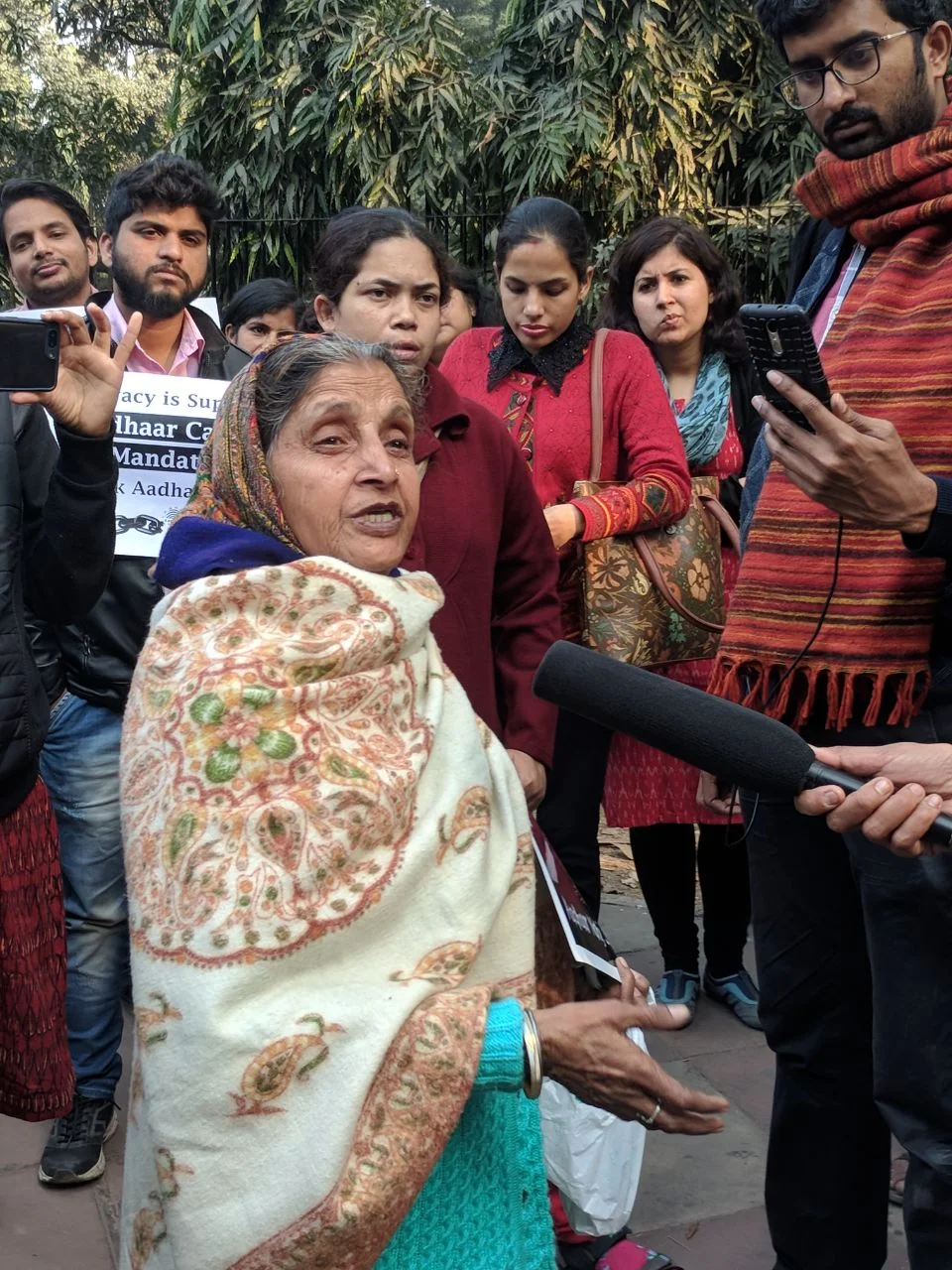
The 12th of January marks the beginning of a month of protests against the UID project by various organisations. Protests were held in Delhi, Mumbai and Bangalore. Jharkhand and Bihar have events planned that will take place in the coming weeks.
In Delhi, at Parliament Street, Kanshu Devi from Savitri Nagar spoke about how she is unable to get rations because her fingerprints are not recognised by the Aadhaar based machines installed at ration shops. Due to biometric failure, she has also not received her pension in months. Santosh from Lal Gumbad stated that the machines also failed to recognise her fingerprints. Geeta from the same area has 3 children who have not been added to her ration card because, despite the fact that they have birth certificates, they do not have Aadhaar. Ruksana and Geeta from Jagdamba Camp are facing the same issue. Their families therefore get much less ration than they are entitled to, putting an additional burden on them.
The government and proponents of the UID have averred constantly, despite all evidence to the contrary, that the citizens of India have whole heartedly embraced the Aadhaar. Citing enrolment rates to back this claim, they deliberately ignore the fact that Aadhaar has been made mandatory for all manner of common public services that range from birth to death of a resident, forcing people to enrol. These same proponents of the project are unable to fix the real issues with Aadhaar that continue to affect people’s lives.
Students from AISA spoke about how students entitled to scholarships were being forced to enrol in Aadhaar in order to get their scholarships. Sucheta De explained how the UID has clearly become a surveillance project. Kavita Krishnan of the AIDWA explained the threat that the UID posed for people’s privacy.
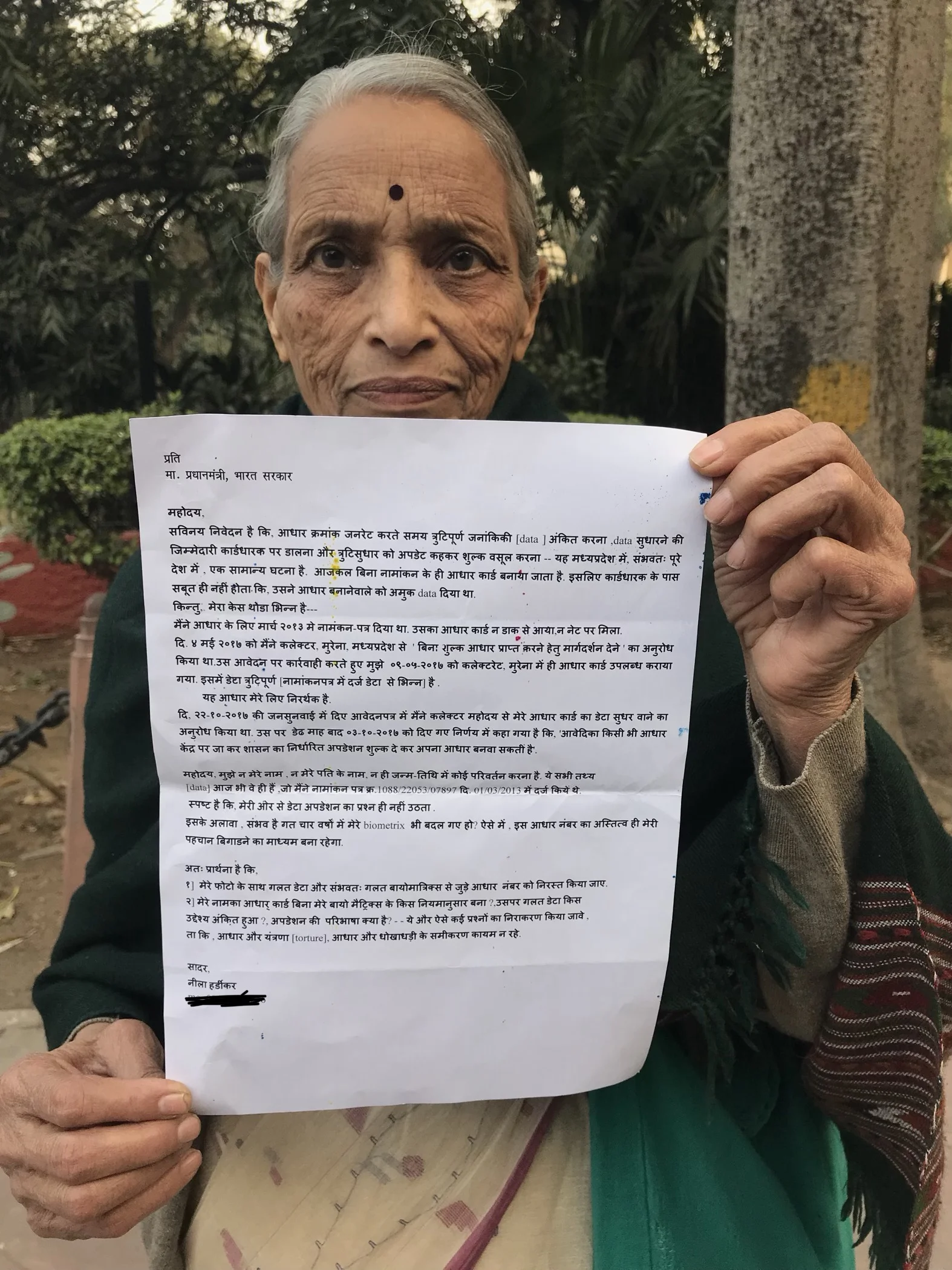
One last story is that of Neela Hardikar, from Morena who is in Delhi for the Book Fair and decided to attend the protest. She is a teacher who retired from Sarangpur, MP. She is 76 years old. When she went to enrol in the UID project in 2012, her iris didn’t get recorded so they refused her in 2012. In 2013 when the rules changed she again tried to enrol using her fingerprints l, the machine recorded 4 prints. She was given an Enrolment ID but didn’t get the card in the mail or from the Center. In 2017 she finally got the UID from the ADM office, Morena by getting it downloaded online. The ADM said she would have to update her biometrics. There were further problems with a mismatch in birthdates, the Aadhaar updation official they could only fix problems at a time. She is so fed up that she says she is too old to fix it now and will live without Aadhaar.
We are also tired. Tired of the constant stream of stories, facts and information being ignored by the authorities and others. The system is not transparent, nor is it accountable. It has no form of relevant and accessible grievance redress to respond to people’s problems. The few times that UIDAI has sprung into action are when FIRs have been filed against whistleblowers or in matters concerning celebrities.
The last few months have seen reports of starvation deaths due to Aadhaar related issues. We have seen how easy (and cheap) it is to access the Aadhaar database via the explosive tribune report. Elderly pensioners continue to face massive difficulties in using biometric authentication.
We stand together and say NO2UID, no to surveillance, no to starvation deaths, no to tech failures, no to human rights violations, and no to the coercive UID system.
The protest was attended by Rethink Aadhaar, AISA, Satark Nagrik Sangathan, Right to Food Campaign.
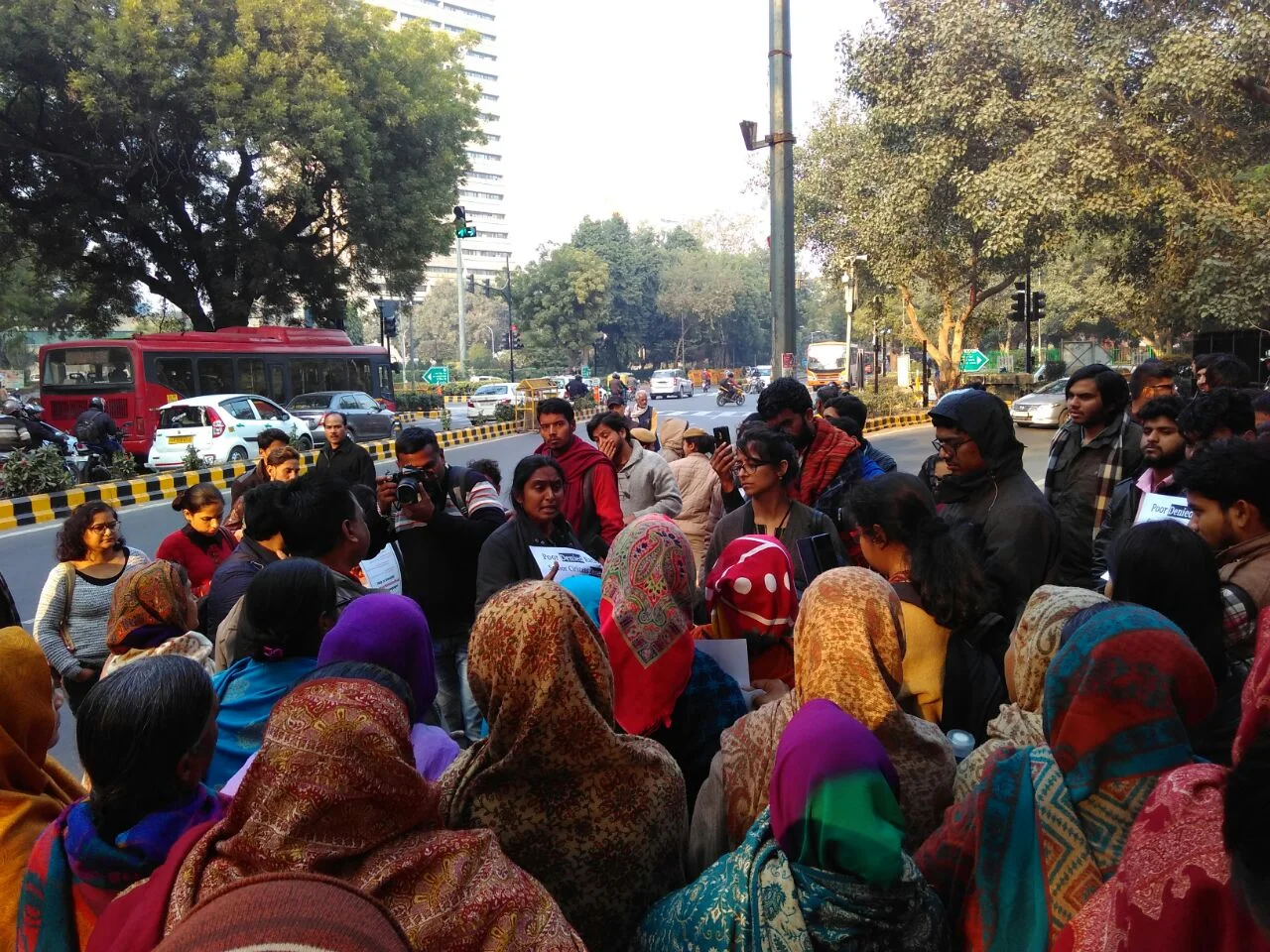
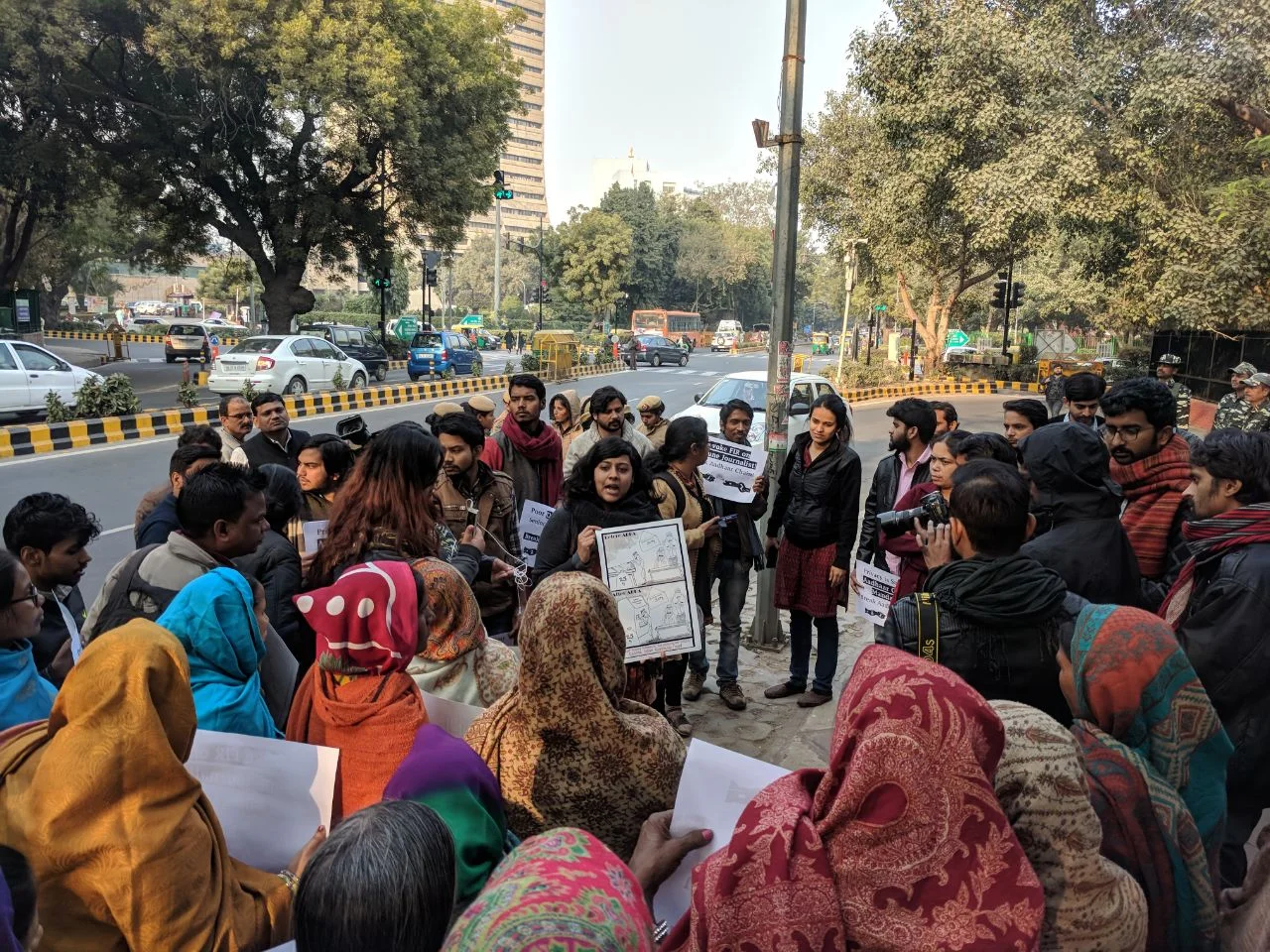
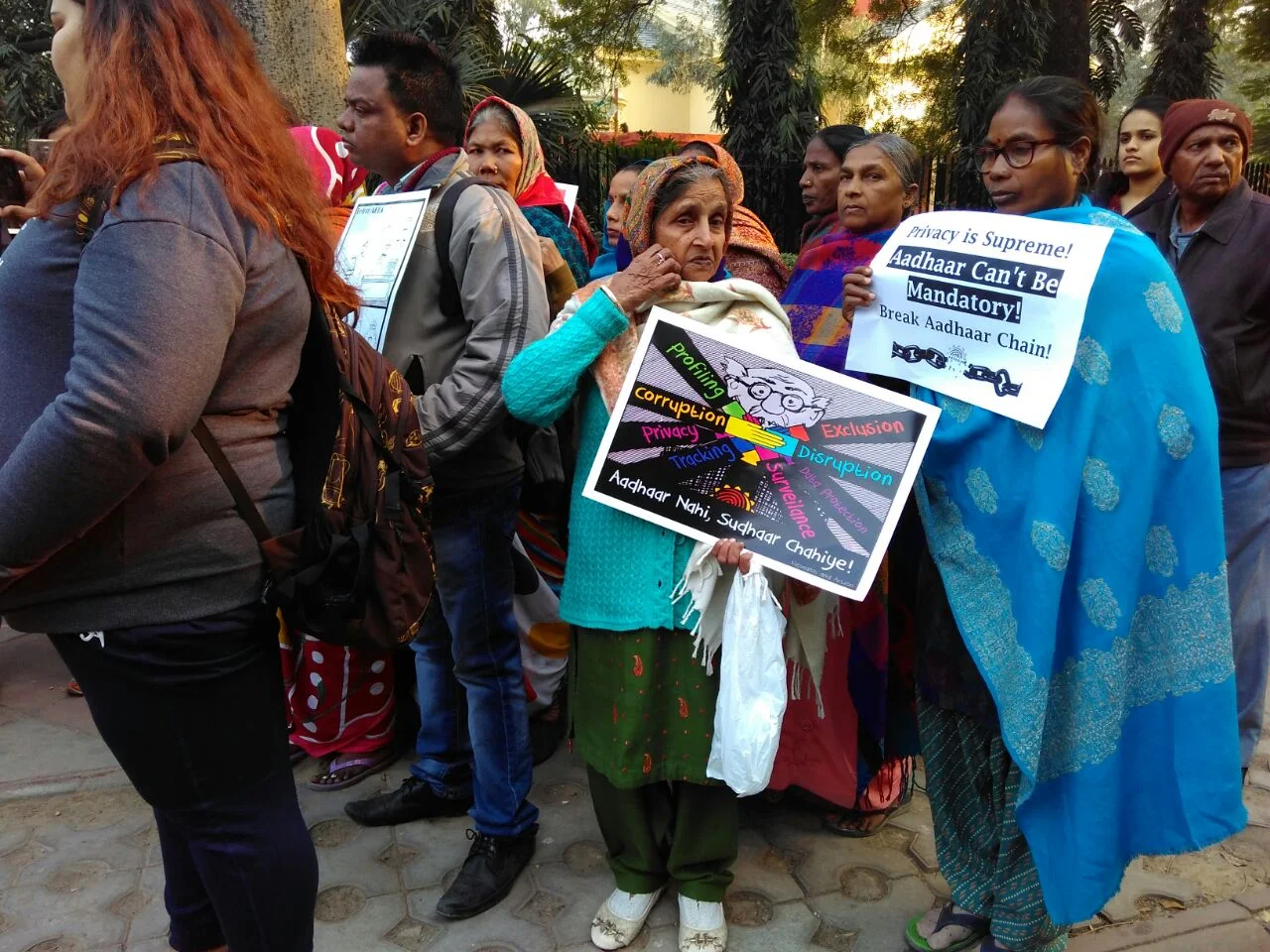
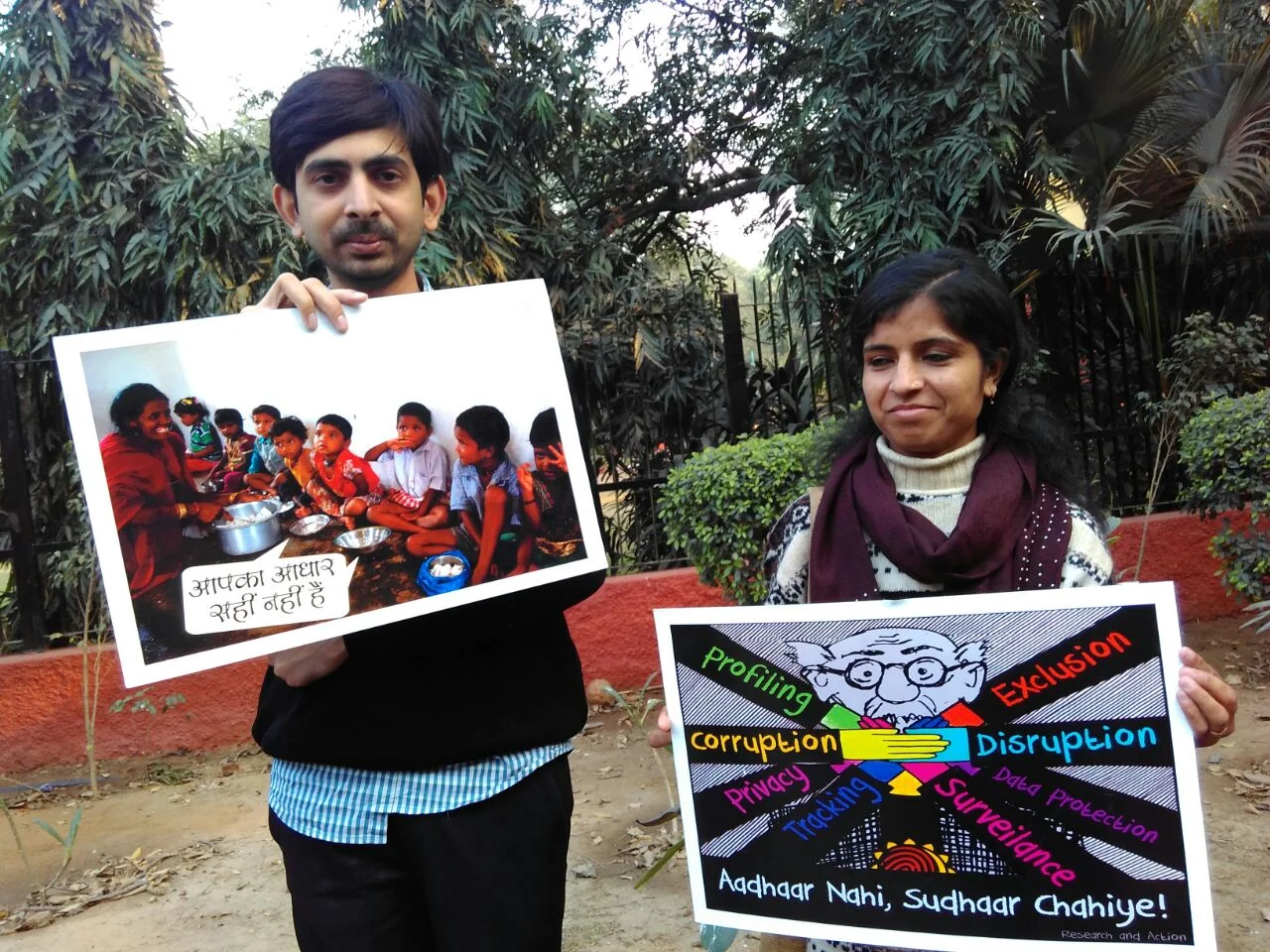
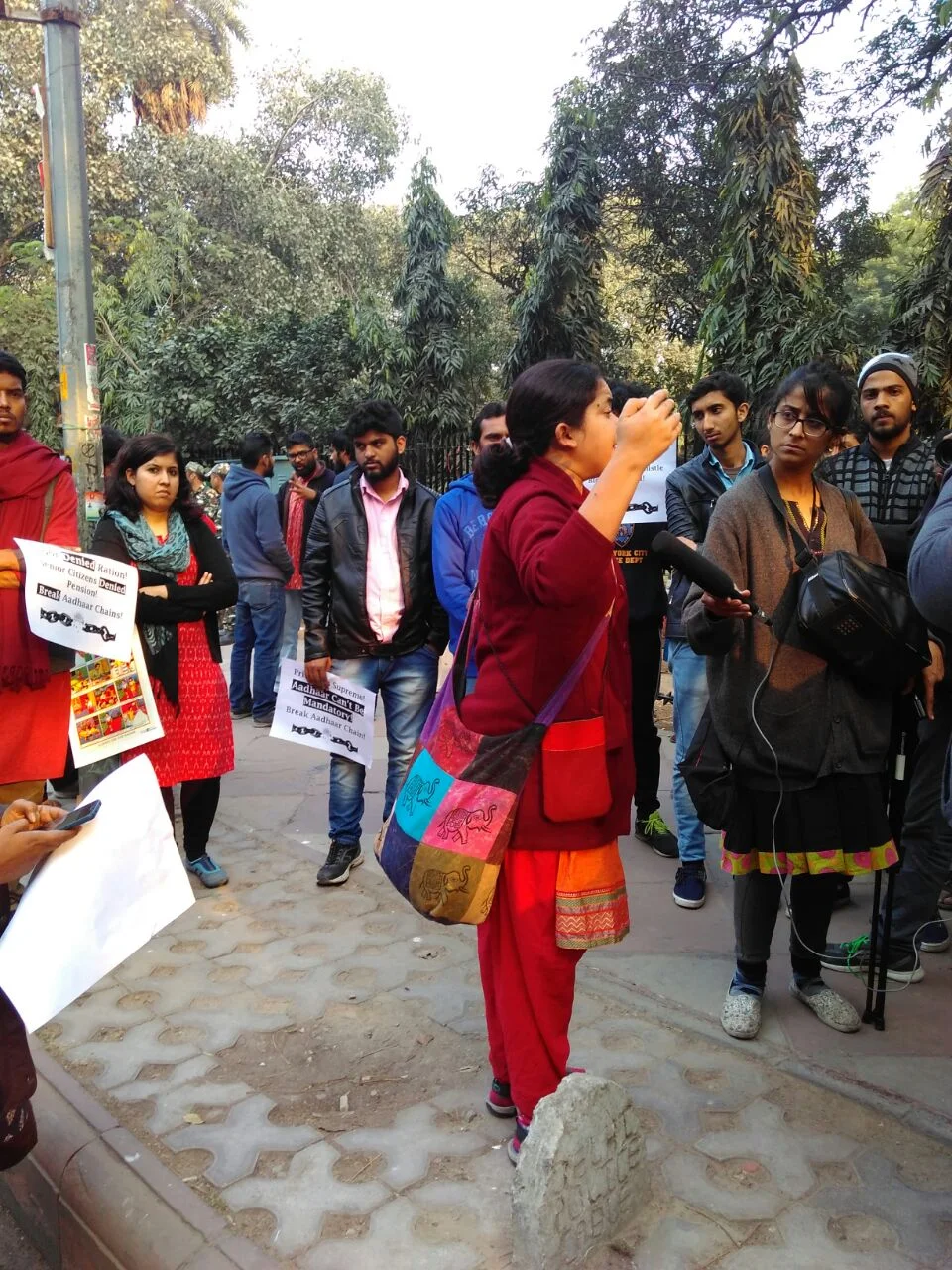
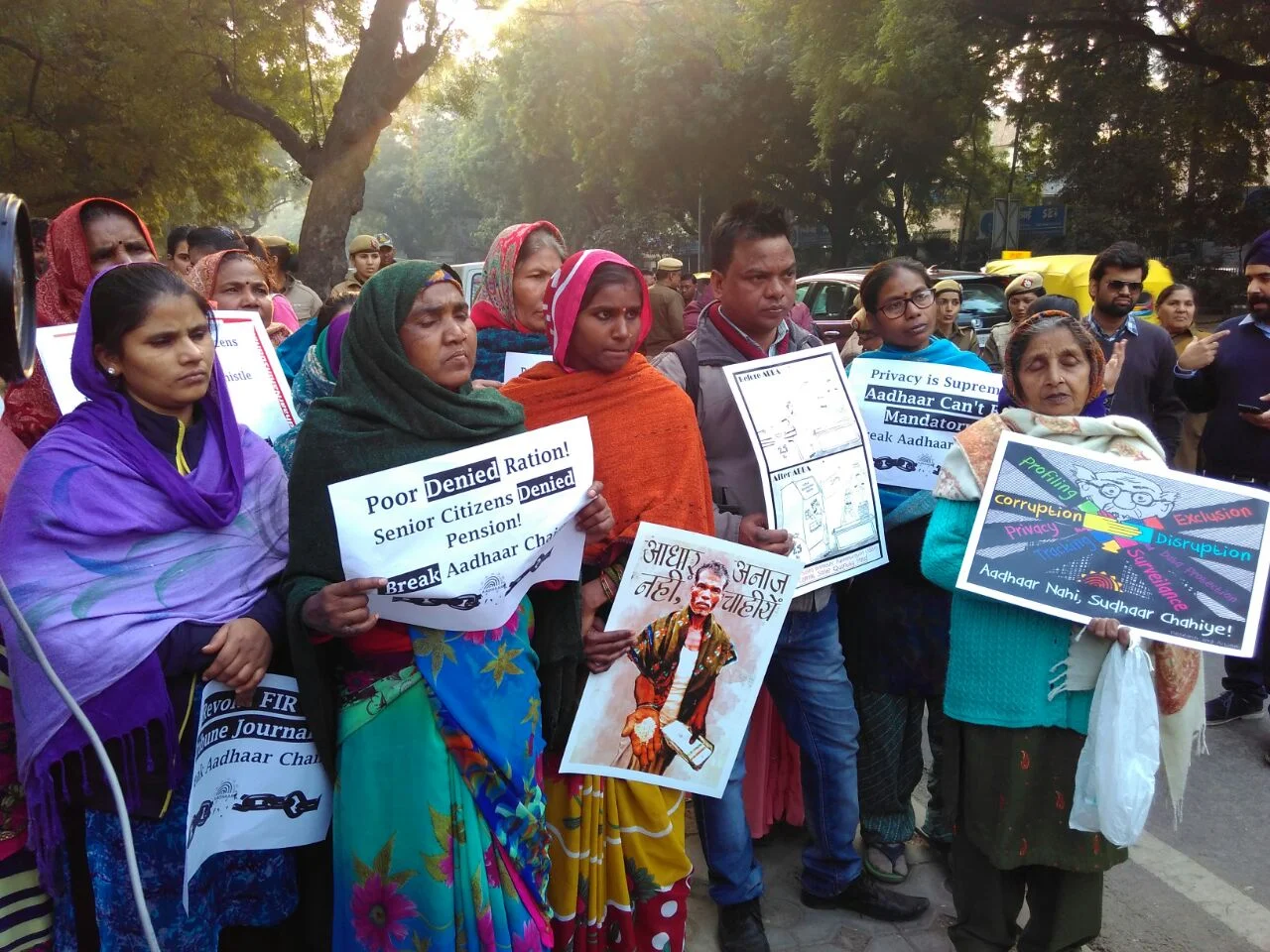
 ### 17 Jan 2018 — Protests for the "Break Aadhaar Chains" campaign gather steam across India
> Protests against Aadhaar occurred across India on 12th Jan 2018 as part of the Break Aadhaar Chains campaign.
Original: https://rethinkaadhaar.in/blog/2018/1/17/mumbai-public-meeting-breakaadhaachains
### 17 Jan 2018 — Protests for the "Break Aadhaar Chains" campaign gather steam across India
> Protests against Aadhaar occurred across India on 12th Jan 2018 as part of the Break Aadhaar Chains campaign.
Original: https://rethinkaadhaar.in/blog/2018/1/17/mumbai-public-meeting-breakaadhaachains
Mumbai
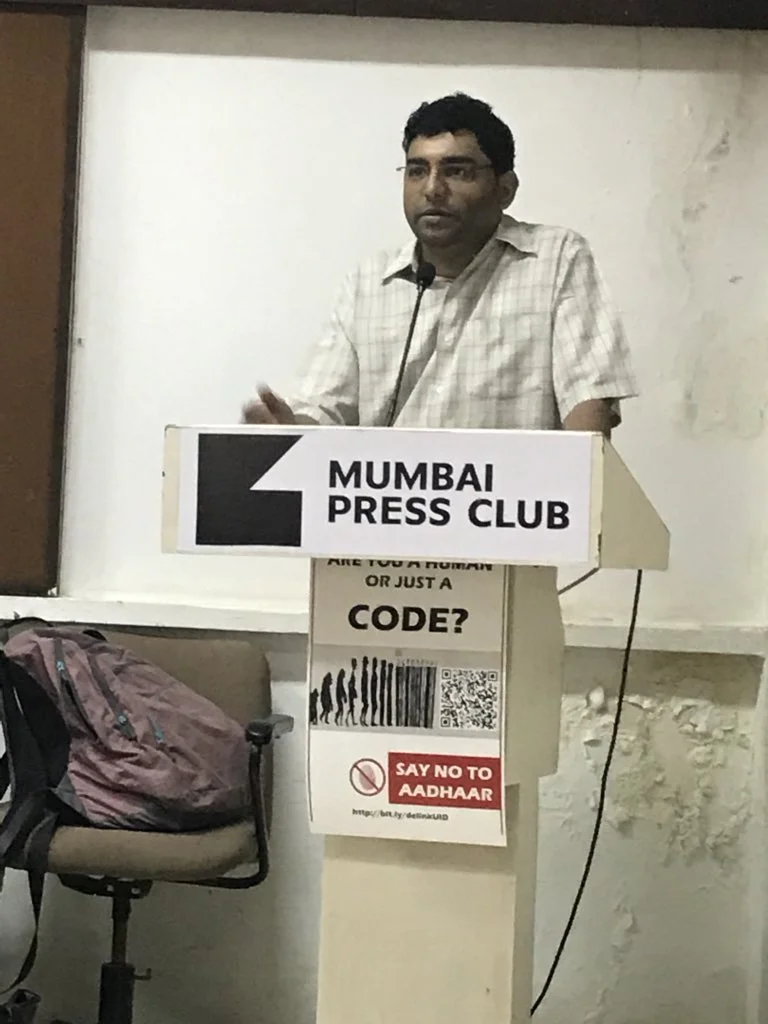
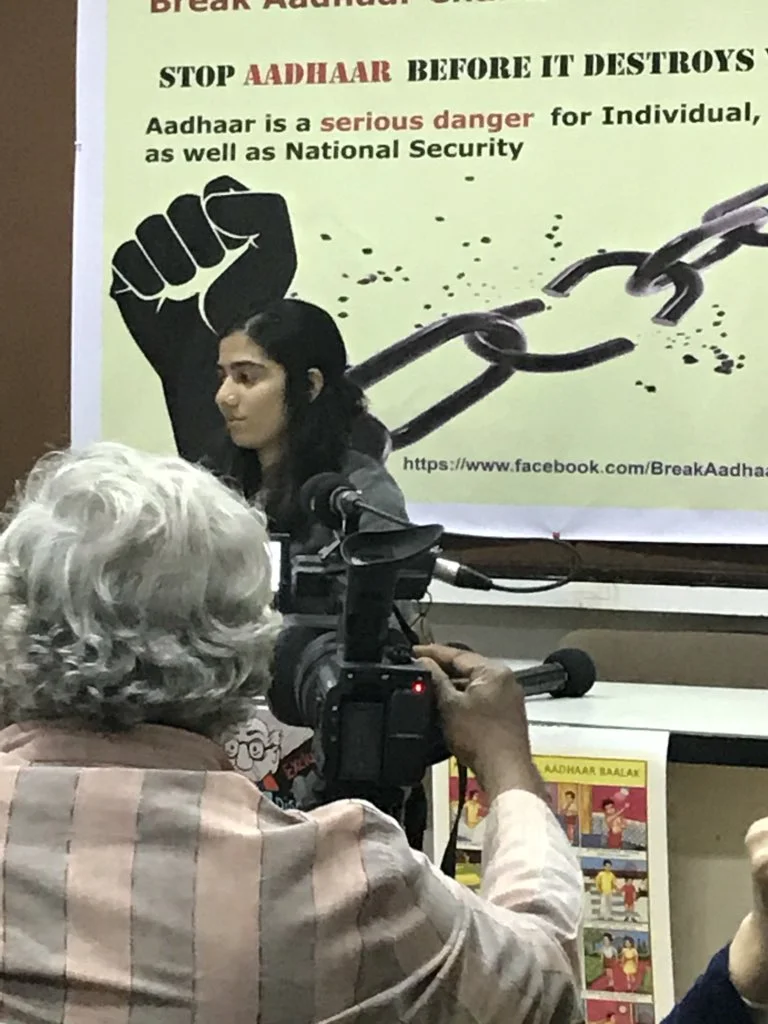
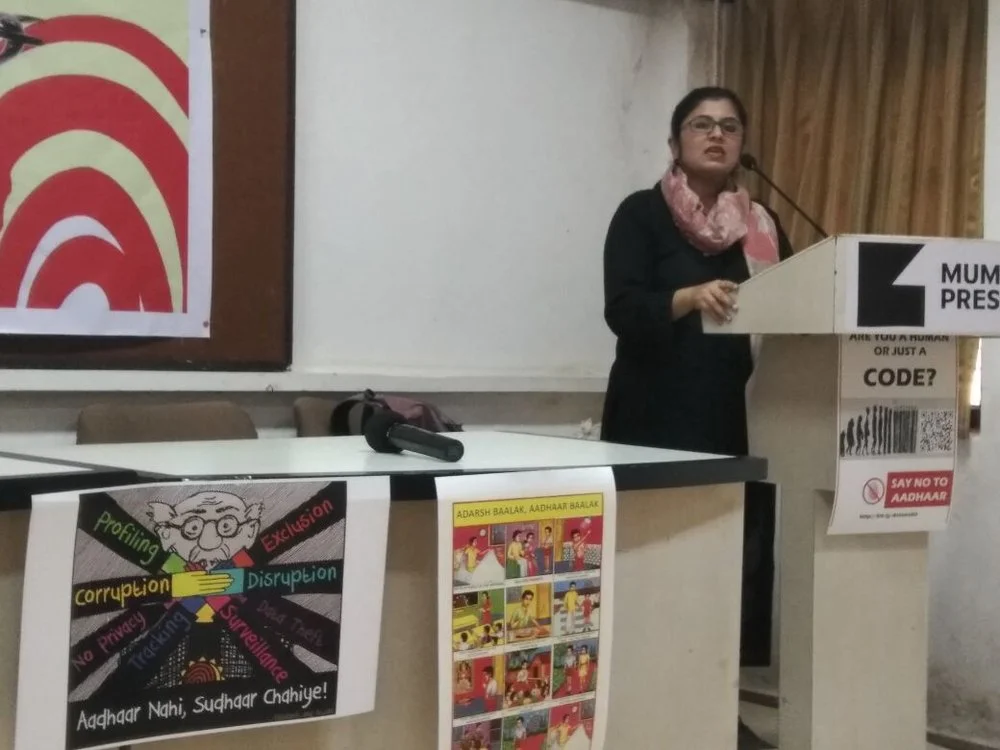
Kolkata
Puducherry
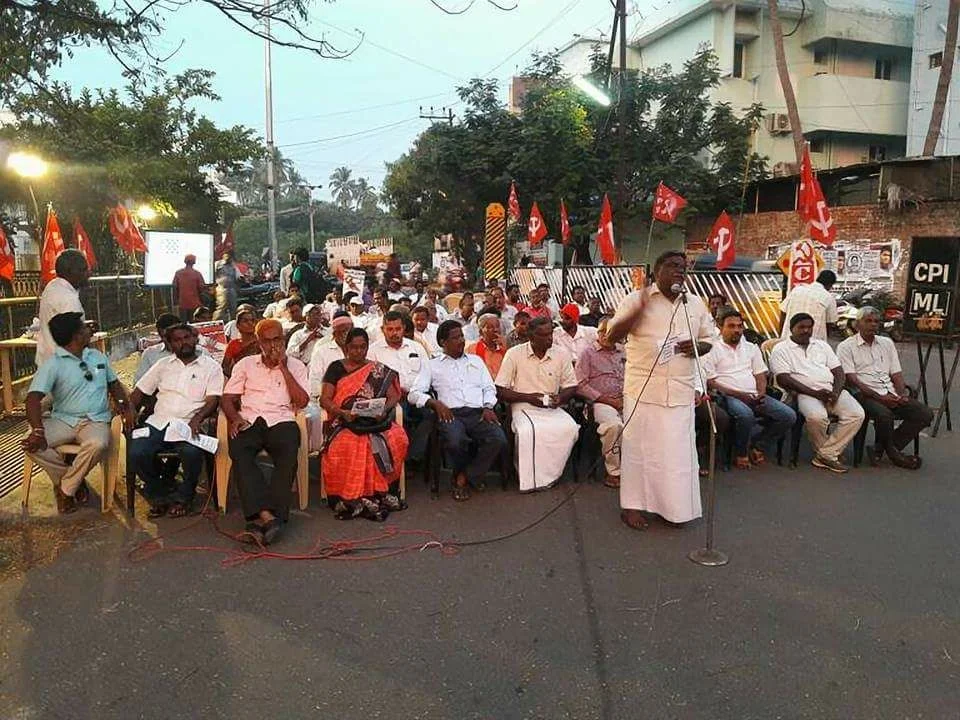
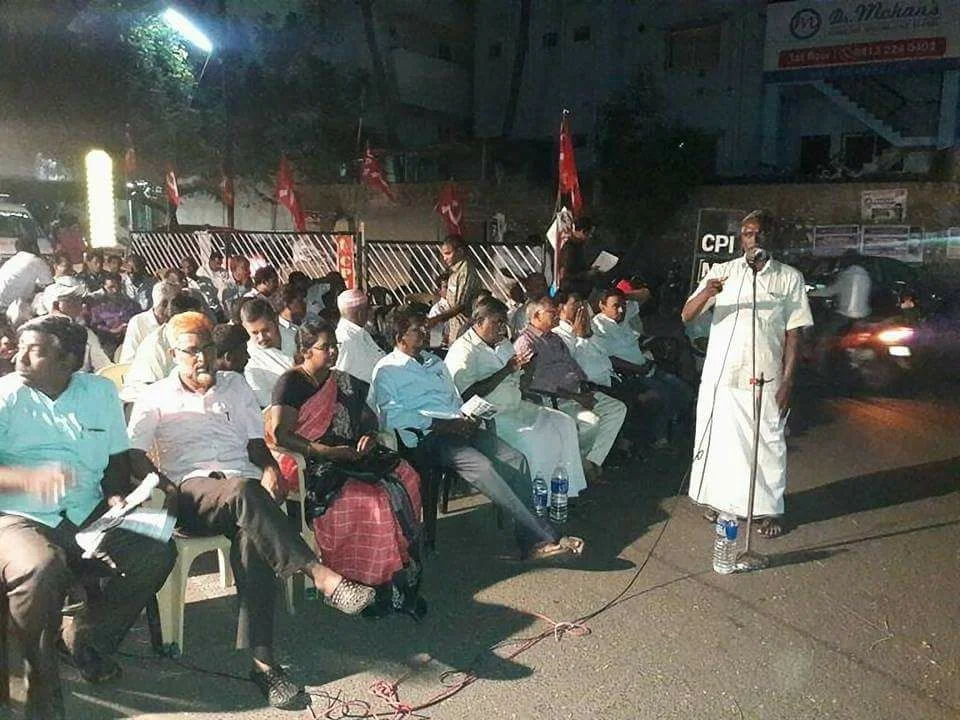
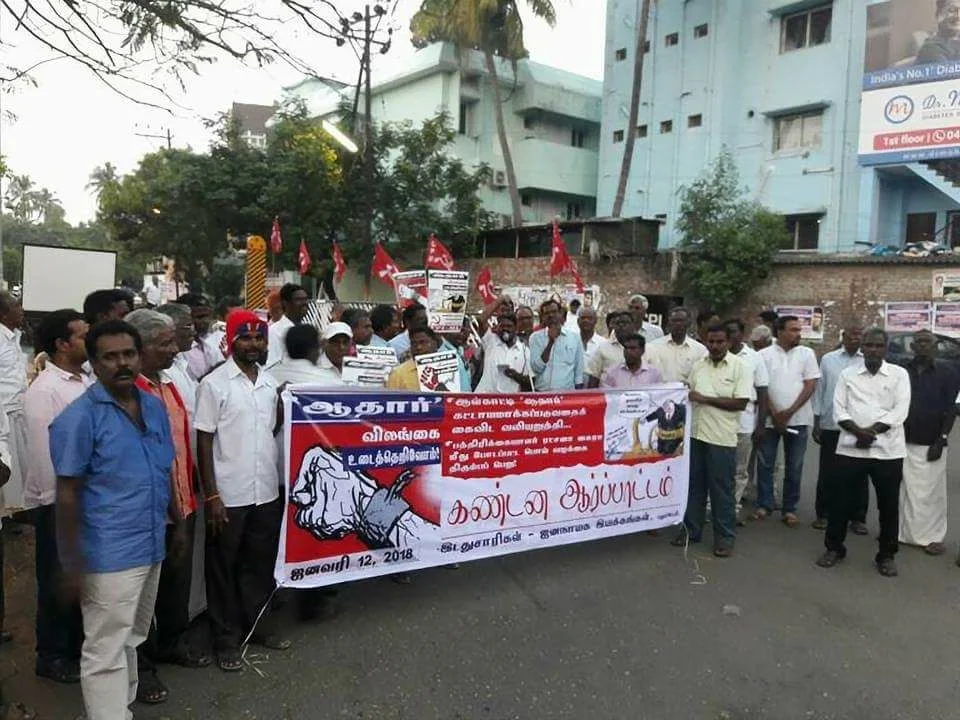
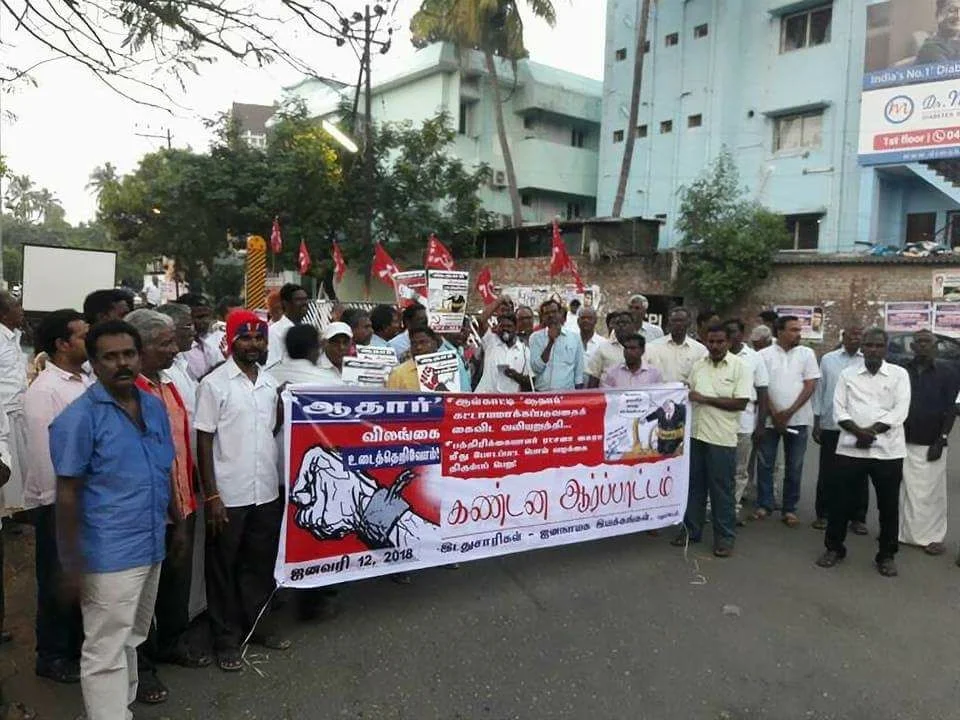 ### 17 Jan 2018 — Protest in Jaipur as part of the Break Aadhaar Chains campaign: आधार नहीं सुधार चाहिए!
> आधार नहीं सुधार चाहिए संविधान में दी गई स्वतंत्रता के मूल अधिकार का उल्लंघन हैआधार- प्रेमकृष्ण शर्मा जयपुर 16 जनवरी, जयपुर शहर के गाँधी सर्कल पर आधार के खिलाफ प्रदर्शन में आधार नहीं अधिकार दो, आधार नहीं अनाज चाहिए, आधार धोखा है, आधार की अनिवार्यता बंद करो जैसे नारे लगे. सरकार द्वारा आधार को व्यक्
Original: https://rethinkaadhaar.in/blog/2018/1/17/rajasthan-breakaadhaarchains-protest-in-jaipur
### 17 Jan 2018 — Protest in Jaipur as part of the Break Aadhaar Chains campaign: आधार नहीं सुधार चाहिए!
> आधार नहीं सुधार चाहिए संविधान में दी गई स्वतंत्रता के मूल अधिकार का उल्लंघन हैआधार- प्रेमकृष्ण शर्मा जयपुर 16 जनवरी, जयपुर शहर के गाँधी सर्कल पर आधार के खिलाफ प्रदर्शन में आधार नहीं अधिकार दो, आधार नहीं अनाज चाहिए, आधार धोखा है, आधार की अनिवार्यता बंद करो जैसे नारे लगे. सरकार द्वारा आधार को व्यक्
Original: https://rethinkaadhaar.in/blog/2018/1/17/rajasthan-breakaadhaarchains-protest-in-jaipur
आधार नहीं सुधार चाहिए
संविधान में दी गई स्वतंत्रता के मूल अधिकार का उल्लंघन हैआधार- प्रेमकृष्ण शर्मा
जयपुर 16 जनवरी,
जयपुर शहर के गाँधी सर्कल पर आधार के खिलाफ प्रदर्शन में आधार नहीं अधिकार दो, आधार नहीं अनाज चाहिए, आधार धोखा है, आधार की अनिवार्यता बंद करो जैसे नारे लगे. सरकार द्वारा आधार को व्यक्ति के जीवन में हर जगह पर अनिवार्य बना दिए जाने की बजह से गरीबों और वंचितों का जीवन बहुत ही दूभर हो गया है. विभिन्न संगठनों के साथियों ने गाँधी सर्कल पर जोरदार प्रदर्शन किया और हमारे साथ पारदर्शिता के नाम पर जो धोखा किया जा रहा है उसे उजागर किया। । गाँधी सर्कल पर प्रदर्शन में आये लोगों को संबोधित करते हुए मजदूर संगठनों के साथी हरिकेश बुगालिया ने कहा कि गुजरात की धरती से एक गाँधी जी उठे जिन्होंने विदेशियों से देश को आज़ाद कराया और उसी धरती से उठे हमारे देश के प्रधानमंत्री नरेन्द्र मोदी ने विदेशी और कॉर्पोरेटस को देश को बेच दिया हैचाहे वह भारत में विदेशी निवेश की बात हो या आधार कार्ड को अनिवार्य करके लोगों की निजी सूचनाओं को कॉर्पोरेट को देकर. प्रदर्शन में सामिल सभी लोगों ने आधार कार्ड को देश और हमारे देश के नागरिकों के लिए खतरा बताया क्योंकि आज यदि किस व्यक्ति का आधार कार्ड डिलीट हो जाये या उसका कार्ड काम नहीं करे तो वह मध्यान्ह भोजन से लेकर किसी भी छात्रवृत्ति एवं किसी भी सरकारी पद के लिए आवेदन तक नहीं कर सकते हैं.
प्रदर्शन से पहले आधार (आधारकार्ड की अनिवार्यता) की राजनीति और उसके पीछे सरकार की मंशा को विनोबा ज्ञान मंदिर में एक बैठक आयोजित की गई जिसमें विभिन्न सामाजिक और छात्र संगठनों के प्रतिनिधियों और देश के विभिन्न विश्विद्यालयों के छात्रों ने हिस्सा लिया. बैठक में शुरुआत में सूचना एवं रोज़गार अधिकार अभियान से जुड़े मुकेश निर्वासित ने आधार की राजनीती और उससे गरीबों और वंचितों को होने वाली परेशानियों के साथ-2 आधार के बारे में युवाओं के बीच जो झूंठ फैलाया जा रहा है कि आधार बजह से देश में काला धन बाहर आ जायेगा और इस देश के अमीरों और पूंजीपतियों के साथ साथ भ्रष्टाचारियों को पकड़ा जा सकेगा पर तथ्यात्मक बातें रखी गईं. उच्च और उच्चतम न्यायालय के बरिष्ठ वकील और मानवाधिकार संगठन पीयूंसीएल से जुड़े प्रेमकृष्ण शर्मा ने कहा कि ये संविधान में दी गई स्वतंत्रता के मूल अधिकार का उल्लंघन है इसका हमें हर हालत में विरोध करना चाहिए. उन्होंने अपना स्वयं का उदहारण देते हुए बताया कि आज से 6 वर्ष पहले मेरा आधार कार्ड तो बन गया लेकिन अब मुझे मेरा पासपोर्ट का नवीनीकरण कराना तो आधार मेरे अंगूठे और अँगुलियों के निशान रीड ही नहीं कर रहा है इसलिए मुझे इसके लिए सर्वोच्च न्यायालय में जाना पड़ा है.
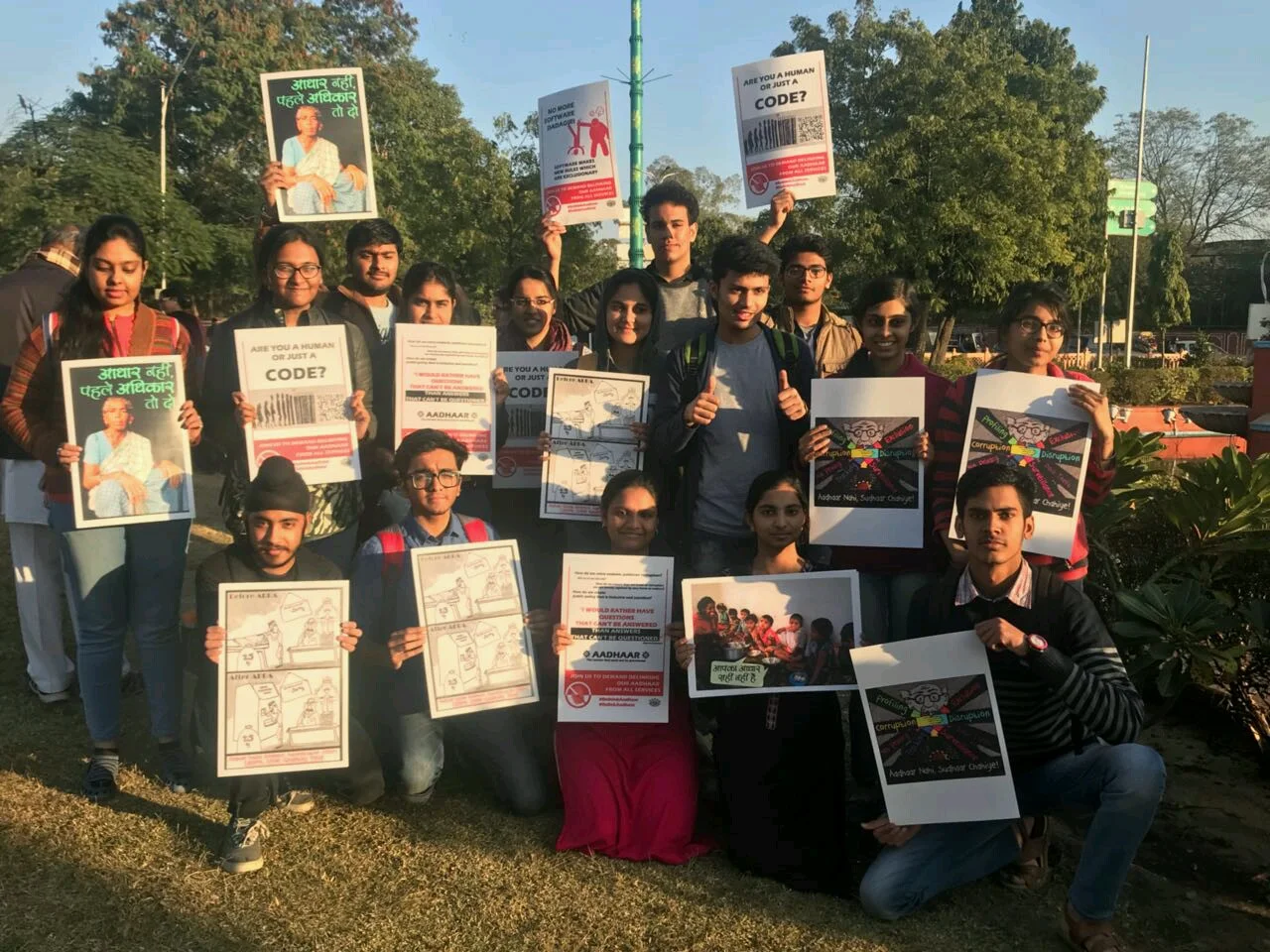
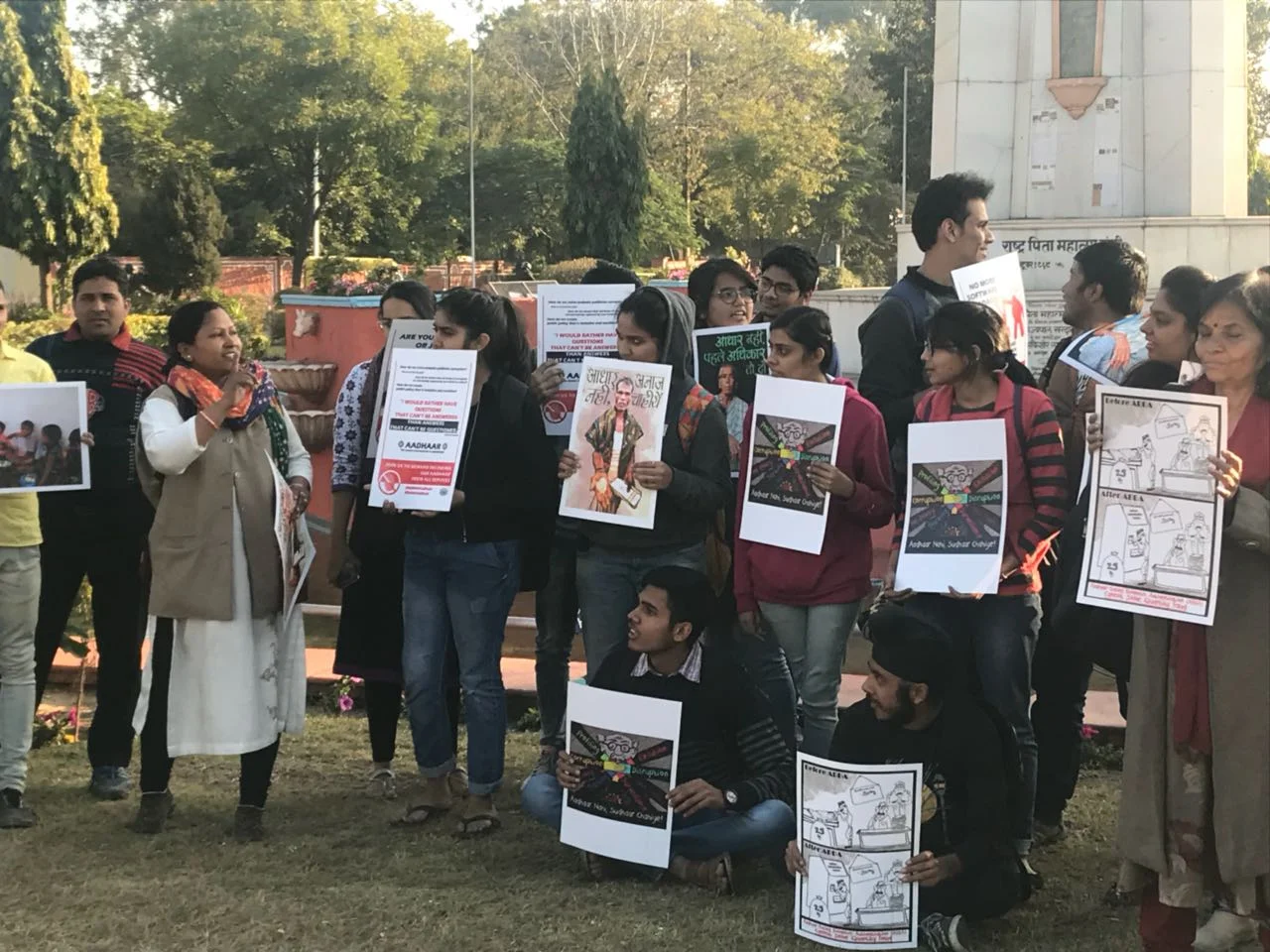
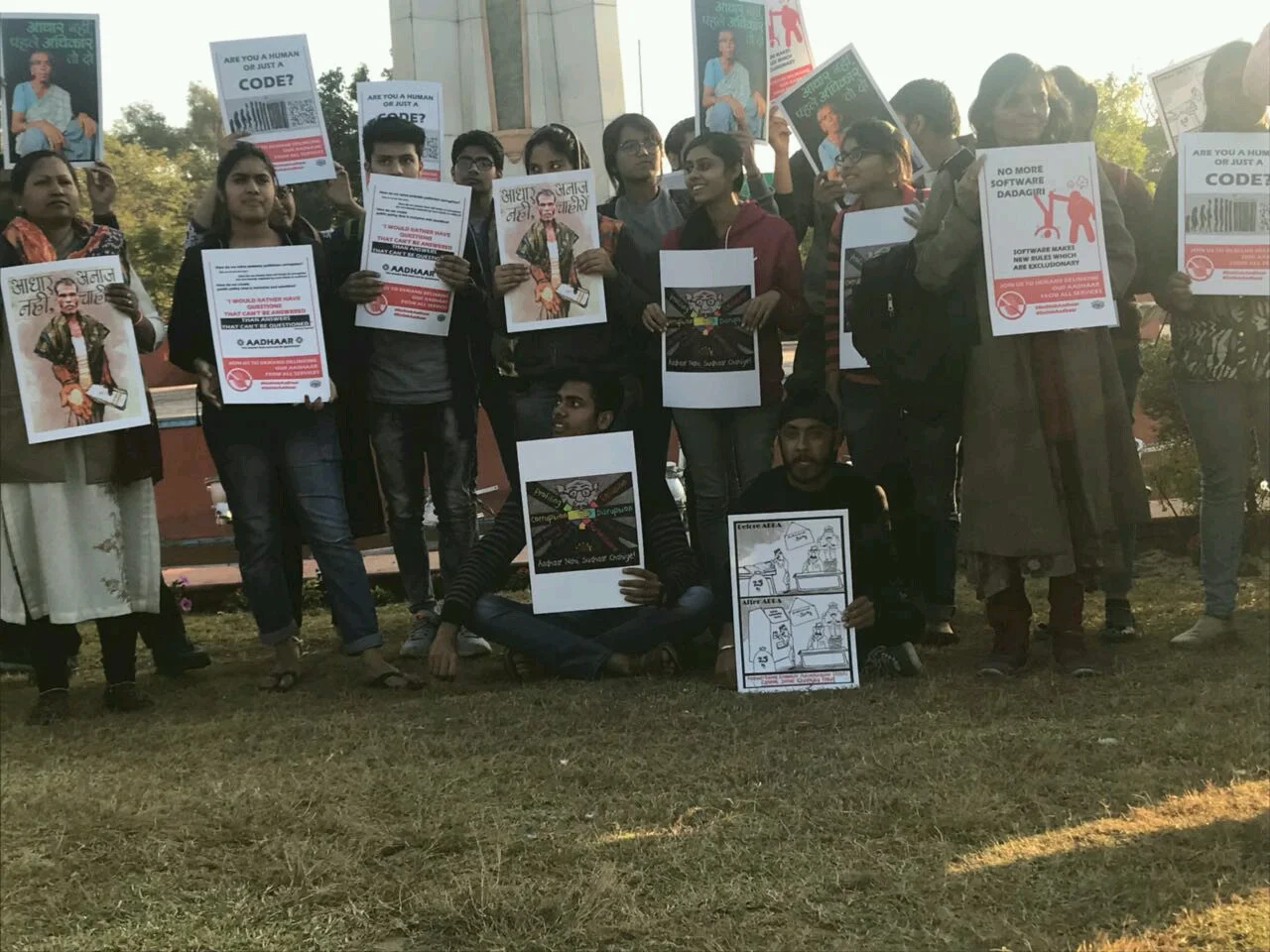
सेवानिवृत्त डॉक्टर मालती गुप्ता ने कहा कि अब तो हमारे देश में महिलाओं को बच्चे पैदा करने के लिए पहले आधार बनवाना होगा नहीं तो सरकारी चिकित्सालय में उनका प्रसव नहीं कराया जायेगा तथा इसी प्रकार बेघरों के साथ काम करने वाले समूह ने कहा कि किसी भी बेघर को रेन बसेरे में रात बिताने के लिए लोगों से आधार कार्ड माँगा जा रहा है नूर जिन लोगों के पास आधार कार्ड नहीं है उनको रेन बसेरे में रुकने नहीं दिया जा रहा है. विभिन्न विश्विद्यालयों के कानून पढने वाले विद्यार्थी जयपुर शहर की विभिन्न बस्तियों व रेलवे स्टेशन और बस स्टैंड पर जाकर लोगों से आधार कार्ड की परेशानियों के बारे में जाना और उन सभी ने अपनी प्रस्तुति में बताया कि आधार कार्ड की बजह से सब लोगों को परेशानियाँ ही हो रही हैं. कई लोगों ने अपने व्यक्तिगत अनुभव बताये कि किस प्रकार आजकल उनके पास बैंक का अधिकारी बनकर फ़ोन आ रहा है और आधार और बैंक की सूचना मांगी गई.
आधार कार्ड के डाटा को लेकर बात हुई जिसमें लोगों ने कहा कि जबसे इसके बारे में मीडिया में विस्तृत रिपोर्ट आई है कि इसका डाटा तो केवल 500 रुपये में मिल रहा है जिससे आप किसी का भी डाटा चुरा सकते हो. लोगों का यह तक कहना था कि कुछ प्राइवेट कंपनियों को फायदा पहुँचाने के लिए यह योजना चालू की गई है क्योंकि अभी तक आधार की बजह से ना तो भ्रष्टाचार में कोई कमी आई है इसके लिए राजस्थान में राशन वितरण में जो PoS(पॉइंट ऑफ़ सेल) मशीने लगाई गईं हैं उसके बाद भी राशन वितरण में भ्रष्टाचार में कोई कमी नहीं आई है बल्कि एक गरीब और वंचित व्यक्ति को अब राशन डीलर यह कह देता है कि आपका तो अंगूठा काम नहीं कर रहा है और उसका पूरा राशन मशीन से निकल लेता है इसी प्रकार आधा राशन देकर कहता है बस इतना ही राशन आपका मशीन में आ रहा है. इसलिये राजस्थान के राशन वितरण और सामाजिक सुरक्षा पेंशनर्स को जो BC (बैंकिंग कोरेस्पोंडेंट) अंगूठा लगवाकर एक तरह से लोगों को लूट ही रहे हैं.
आधार के खिलाफ ये संघर्ष जारी रहेगा और हमारा आन्दोलन जयपुर शहर के विभिन्न हिस्सों में जारी रहेगा.
इस विज्ञप्ति के साथ प्रधानमंत्री के नाम दिये गए ज्ञापन की प्रति संलग्न है.
कविता श्रीवास्तव, मुकेश निर्वासित, नवीन नारायण
पीयूसीएल, सूचना एवं रोज़गार अधिकार अभियान, जन शक्ति मोर्चा एवं मजदूर किसान शक्ति संगठन की ओर से
संपर्क करें: मुकेश निर्वासित-9468862200 ,कविता श्रीवास्तव-9351562965 ,नवीन नारायण-9413340889
### 17 Jan 2018 — SC asks whether Aadhaar biometric data collected between 2009-2016 should be destroyed > Constitution Bench hearings on Aadhaar begin: SC asks whether biometric data collected between 2009-2016 should be destroyed After about seven years since the first challenges to the Aadhaar project, on Wednesday, a Constitution bench began hearing the arguments to decide the legal validity of the Original: https://rethinkaadhaar.in/blog/2018/1/17/sc-asks-whether-aadhaar-biometric-data-collected-between-2009-2016-should-be-destroyedConstitution Bench hearings on Aadhaar begin:
SC asks whether biometric data collected between 2009-2016 should be destroyed
After about seven years since the first challenges to the Aadhaar project, on Wednesday, a Constitution bench began hearing the arguments to decide the legal validity of the project.
Why the long wait
In 2015, while defending the Aadhaar project, the Attorney General had argued that citizens have no fundamental right to privacy in India. In November 2017, after a two-year-long wait, the 9-judge Constitution Bench delivered a historic judgement affirming the fundamental right to privacy enshrined in India’s Constitution. Two months on, a five-judge Constitution Bench, comprising the CJI Dipak Misra and Justice DY Chandrachud, Justice AK Sikri, Justice AM Khanwilkar, and Justice Ashok Bhushan, began hearings today to decide on the constitutional validity of the Aadhaar scheme.
What happened in the hearing
At the start of the hearing, the Attorney General asked that fixed time be allotted to each of the lawyers arguing on both sides. Senior advocate Shyam Divan said the entire project needs to be examined, and its notifications examined. The Chief Justice of India also agreed that time for arguments cannot be limited in this fashion in this matter.
Divan began proceedings for the petitioners by recounting the history of the project. His opening statement can be found here.
Briefly, the salient points in the opening statements include:
No democratic society has adopted a programme that is similar in its command and sweep.
The government seeks to tether every resident of India to an electronic leash.
At its core, Aadhaar alters the relationship between the citizen and the State and diminishes the status of the citizen.
The State is empowered with a ‘switch’ by which it can cause the civil death of an individual.
When Mr. Divan described the illegality of biometric data collection prior to the promulgation of the Aadhaar Act in 2016, Justice Sikri interjected to ask whether Mr. Divan was saying the data collected from 2009-2016 would have to be destroyed. Chief Justice Mishra too questioned whether data collected in infringement of a fundamental right should be destroyed. Mr. Divan stated that it would.
It is also crucial to remember that in 2015, when petitioners had pointed to long delays in the case hearings even as government was rushing and coercing enrolment, Justice Chelameswar had explicitly stated that the court could not allow the government to present a fait accompli.
Another important interjection was made on the question of the passage of the Aadhaar Act as a Money Bill, bypassing one house of parliament where the government lacked a majority.
On the CJI quoting his earlier judgment on not discussing the Money Bill issue, Senior Advocates P. Chidambaram and Arvind Datar pointed out the contradiction to two previous Constitution Bench judgments. The current bench will thus also have to decide on the validity of the Aadhaar Act’s passage as a Money Bill.
Further, Mr. Divan pointed out that the 2016 Act was identical to the 2010 National Identity NIDAI Bill which had been rejected by a Parliamentary Standing Committee on Finance in 2011. Mr. Divan submitted that the 2016 Bill had not been examined by any such committee, making its being passed as a Money Bill questionable
Help us help you
Aadhaar false claims obvious
Even as the Supreme Court began hearing arguments today, the spate of news stories bringing to light technological issues with Aadhaar continue, with the latest being Go News’s follow up on the Kanpur Fake Aadhaar racket, revealing that the UIDAI is clueless about how many fake Aadhaar enrolments were generated and how to tell apart fake authentications from genuine ones. Given that the hackers were able to bypass biometric authentication - both fingerprint and iris scans were compromised - this is another telling commentary on the vulnerability of the Aadhaar ecosystem, begging the question if UIDAI is indeed competent enough to maintain such a vast program whose mishandling puts the life of every single Indian at risk for all time.
Meanwhile, another petition has been admitted wherein 50 private companies have pleaded that Aadhaar should not be struck down as it would cause losses to their businesses. Considering that Aadhaar claims to make delivery of welfare benefits more efficacious (the title of the 2016 Aadhaar Act itself reflects this), and was passed as a Money Bill on same basis bypassing the Rajya Sabha, it is a shocking attempt now to frame the project as a for-profit enterprise.
The hearings are likely to continue for another 4 to 6 weeks. Shyam Divan will continue arguments for petitioners tomorrow.
The outcome of this hearing will impact similar coercive biometric UID programs across the world.
For more details, write to contact@rethinkaadhaar.in
Recent relevant articles
Let people perish if need be, Aadhaar must prevail: http://www.thehindu.com/opinion/lead/following-the-grain-trail/article22451645.ece
Aadhaar: Enabling a form of supersurveillance: http://www.thehindu.com/opinion/lead/aadhaar-enabling-a-form-of-supersurveillance/article22444686.ece
Engage with us on Twitter:
### 5 Jan 2018 — Rethink Aadhaar writes to Home Affairs Committee on security issues of Aadhaar > Rethink Aaadhar wrote to the Chairperson and Members of the committee on the 15th November, 2017 and 14th December, 2017. We raised several concerns including those related to privacy, security and data breaches. Original: https://rethinkaadhaar.in/blog/2018/1/5/rethink-aadhaar-writes-to-home-affairs-committee-on-security-issues-of-aadhaarThis week’s stellar investigation by the Tribune, Chandigarh has definitively exposed the fragility of the security of the UID project. Activists, scholars, experts and academics have been warning of the insecurity of the Aadhaar database since its inception.
Following the Supreme Court's landmark judgment upholding privacy as a Fundamental Right, the Parliamentary Standing Committee on Home Affairs decided to review the Aadhaar project based on the historic recognition of the tenets of privacy and security. As per news reports, officials of Home Affairs Ministry and UIDAI addressed concerns raised the Committee.
Rethink Aaadhar wrote to the Chairperson and Members of the committee on the 15th November, 2017 and 14th December, 2017. We raised several concerns including those related to privacy, security and data breaches.
Our letters are attached along with a simple presentation of issues sent to the Committee.
Help us help you
We sincerely hope that the Committee refers to the concerns raised in our letters and addresses them appropriately by giving suitable recommendations.
As citizens of India, we call upon the Government of India to recognise the failings in the Aadhaar project, as highlighted in our letters, making it a threat to national security and abrogating citizens’ rights.
----------
To,
Chairperson and Members
Parliamentary Standing Committee on Home Affairs
Sub: Grave security concerns related to Aadhaar
With regard to the committee's work on Aadhaar, and in continuation of our earlier Memorandum highlighting privacy and security concerns of Aadhaar, we would like to highlight few real world security issues encountered with Aadhaar and the associated ecosystem. We would like to point to these issues to highlight the gravity of the misuse of Aadhaar and potential harms in the future to come.
Aadhaar in principle as a Digital Identity cannot establish the identity of an individual without being verified through a digital transaction, either an authentication by Unique Identification Authority of India (UIDAI) or by the user through his online verification password and / or biometric authentication. This concept of a Digital Identity is not entirely understood by an average citizen or any individual collecting this information as part of the Government requirements. This is leading to citizens being confused and harmed due to the security lapses made at various levels in the ecosystem. Some of these security issues can be fixed with due diligence and further improvements in security, but the current design of the Aadhaar architecture and infrastructure is inadequate to protect citizens from harm due to negligence.
We hope the points being highlighted are used constructively to improve it and make an average individual not prone to any harm in the cyberspace.
Reported Misuse Cases of Aadhaar:
The lack of electronic infrastructure to establish this identity is severe and makes people accept a paper copy of Aadhaar of any individual as a proof of identity. Photoshopped Aadhaar cards are being used to fake identity, brokers are trading copies of Aadhaar for as low as Rs 5 causing potential identity and financial risk to law abiding citizens.
In a reported incident in Bhubaneswar, a foreign national Zeboo Asalina of Uzbekistan was found with an alternate identity Aadhaar of Duniya Khan as a resident of Lajpat Nagar in South Delhi.
Aadhaar is not a proof of age as clarified by the UIDAI, but Aadhaar is being used to claim minor children as majors in flesh trade as consenting adults with wrong date of births or with photoshopped physical copies of Aadhaar.
There have been several reports of rogue enrollment centres enrolling multiple individuals with no verification at all, Adding to it sophisticated security modifications were performed to bypass security protocols of UIDAI by making new biometric clients and cloning biometrics using polymer resins in Kanpur as reported by the UP Police Special Investigation Task Force.
Information Security of Aadhaar Demographic Information:
There have been several reports of publication of Aadhaar demographic information containing Aadhaar Number, name, age, date of birth, caste, bank account numbers by various government and non-government entities.
The information of Aadhaar numbers along with bank account numbers and several demographic information can be used to easily commit financial fraud by rogue elements. The information published by various departments on the internet will always be a threat, as there are hundreds of search engines indexing and storing public information available on the internet.
A report by Centre for Internet and Society estimated just 4 government websites published demographic information of 13 crores Aadhaar numbers of individuals along with 10 crore bank account numbers.
Minister of State for Electronics and Information Technology in his written reply to Member of Parliament SHRI M.B. RAJESH clarified that 210 government websites of Central Government, State Government departments including educational institutes were displaying the list of beneficiaries along with their name, address, other details and Aadhaar numbers for information of general public.
The Application programming interface of Aadhaar allows third party companies to perform E-KYC, who in turn are required to store the KYC details for audits. Private companies cannot be trusted with the security of Aadhaar Demographic Information. There have been several security breaches reported within private sector including the recent breach of telecom service provider “Jio”, whose subscribers demographic details were found on internet forums. Whether the security breach within Jio servers, has also caused any potential leak of Aadhaar numbers has not been yet asserted.
There is no clarity on who is allowed to collect Aadhaar from an individual. With no active publicity of where Aadhaar is not mandatory, Citizens are under risk by sharing it with everyone. Increasingly several private internet companies like Amazon India, Ola Cabs, Paytm are demanding the Digital Identity for E-KYC with no official government order in place. This misunderstanding of what Aadhaar is will make it hard for Demographic Information to be secure at any given point of time.
Security of Biometrics and usage within Aadhaar Ecosystem:
Biometrics unlike passwords cannot be modified in the event of breach, it is near impossible to change fingerprints and iris of an individual. However they are easily accessible directly from an individual to collect it under various circumstances like social engineering or stealing by just using a polymer resin.
Biometric scanners can also be easily fooled with cheap adhesives, Around 200 students of Institute of Chemical Technology in Matunga used polyresins to spoof attendance.
Biometric readers currently used in practice do not encrypt the fingerprint images at source, the encryption of images occurs on mobile or computer device application and then is uploaded to CIDR for verification. There is always a possibility for malware or secondary computer programmes running in the background to capture biometric details at source collection.
The UIDAI has issued new specifications for devices to collect biometric data in January 2017 only, the new specifications make it mandatory to use recognized biometric devices. Yet, these biometrics devices do not encrypt the biometric data within device again and are prone to attacks.
Security of Central Identities Data Repository:
The Central Identities Data Repository (CIDR) houses all of the biometrics and demographic information has been classified National Critical Information Infrastructure. For security reasons within the architecture of Aadhaar, CIDR is not connected to the internet directly. Around 254 Authentication Service Agencies are licensed to access CIDR directly through a secure network, which in turn allow other licensed entities to indirectly access CIDR.
An Engineer Abhinav Srivastava has been arrested for indirectly accessing CIDR without permission. He exploited an Application Programming Interface (API), security key used by a government Android Application “e-Hospital“ developed by National Informatics Center, which has direct access to CIDR.
The licensed entities which are allowed to have access to CIDR are not always secure from cyber-attacks. This poses a risk for CIDR being prone to attacks from sophisticated malware.
There is no mandatory audit or a security framework which various private and government entities have to strictly follow to get access to Aadhaar APIs, they are required to follow Aadhaar Data Regulations under the Aadhaar Act after they get license to access Aadhaar API’s.
One of the private companies Syntizen Technologies Pvt Ltd. on whom the UIDAI has filed a criminal complaint for maintaining aadhaarupdate.com is contracted to maintain the official Aadhaar Service Agency for Govt. of Telangana and is part of the sandbox firms of IndiaStack, A set of official government APIs maintained by the industry body iSPIRIT whose volunteers built the CIDR.
State Resident Data Hubs:
State Resident Data Hubs (SRDH) are databases with demographic information linked with all services residents in states of India access from government. These databases are part of the Aadhaar ecosystem and not mentioned while describing the Aadhaar Architecture. UIDAI has actively helped various state governments build these databases by providing them with demographic data by terming it Know Your Resident (KYR) data.
State governments collect Aadhaar numbers of citizens and actively link it with every government database containing personal information of the resident, which often includes race, religion, caste, tribe, ethnicity, language, records of entitlement, income or medical history. SRDH contains every information about the resident giving the state government a 360 degree information of residents. Governments in various states of India have been found to conduct field surveys to collect door to door information including geotagging the location of the resident.
Unlike CIDR, the SRDH databases are connected to the internet and pose a major threat if these databases are ever breached. The user names for Andhra Pradesh SRDH have been published online, making it further easy for cyber criminals to only guess the passwords.
SRDH is how various state governments link mandatory Aadhaar requirement for various schemes. When a citizen has not proactively linked his Aadhaar for any particular service from the Government, the SRDH allows force seeding of Aadhaar from their KYR data provided by UIDAI. KYR data also includes Aadhaar enrollment number, whose Aadhaar number is automatically provided by UIDAI once the Aadhaar is generated.
SRDH of Andhra Pradesh called e-Pragati/People-Hub has integrated 76 government projects with Aadhaar as identifier. SRDH projects are designed to conduct mass surveillance of residents and are out-right against the fundamental Right to Privacy guaranteed under the constitution.
Potential Risks associated with Misuse of Aadhaar Data:
Aadhaar is a direct threat for existence of an individual in our democracy, his digital identity once stolen can be misused to commit fraud or worse kill him and take over his place. Aadhaar provides the state so much power over an individual, if his digital identity is terminated he ceases to exist. It can be used as a kill-switch to stop an individual from accessing every tiny basic service.
Demographic data like medical records associated with Aadhaar can be misused by foreign, domestic state actors and non-state actors like corporates houses to surveil individuals of interest, personal information of individual can be misused to target him emotionally, socially or physically.
The CIDR doesn’t store the race and religion data of any individual. But the SRDH and other associated databases of the government have been found to link Aadhaar number with caste, religion and income information. This information can be misused by biased individuals to discriminate residents over their religious or caste background.
With so much data of individuals being stored in the SRDH databases, a political party in government can misuse this information to profile citizens electorally and cause populist decision making in our democracy. Aadhaar data being used for elections cannot be ruled out as a possibility.
Corporate surveillance of competitors is not unheard of in India, Aadhaar data actively allows employees/citizens being surveilled constantly and increases the risk for an individual to ever legally proceed against corporates.
We would also like to highlight that there is no official policy by the Unique Identification Authority of India to accept security reports from third party security researchers doing important work on identifying security loopholes of Aadhaar.
We have put together a presentation as a supplement to this document which also summarizes our main concerns.
We would have greatly appreciated an opportunity to present our views in person either to you or to the Standing Committee formally. Please do let us know if that can be arranged.
We would also like to request you to use the information outlined in this Memorandum and the earlier one to raise Aadhaar related concerns in the upcoming Winter Session of Parliament and demand answers from the government. Please do not hesitate to reach out in case of any further assistance or help.
Thank you
Letters and Presentation
Memorandum to Parliamentary Committee on Home Affairs
Urgent Memorandum for Standing Committee on Home Affairs
Engage with us on Twitter:
### 8 Dec 2017 — The ground realities of Aadhaar-ration card linking in Jharkhand > In a hurry to show Aadhaar savings, the Jharkhand government is canceling even genuine ration cards without any prior notice, ground verification, or explanation to ration card holders -- this emerged from both a door to door survey of 135 canceled ration cards in Manika, Jharkhand, and a public hea Original: https://rethinkaadhaar.in/blog/2017/12/8/the-ground-realities-of-aadhaar-ration-card-linking-in-jharkhandRation card linking in Jharkhand is leading to hunger deaths: there is no process to verify if genuine or false beneficiary is being canceled.
In a hurry to show Aadhaar savings, the Jharkhand government is canceling even genuine ration cards without any prior notice, ground verification, or explanation to ration card holders -- this emerged from both a door to door survey of 135 canceled ration cards in Manika, Jharkhand, and a public hearing at Manika block office, where at least four hunger deaths have been recorded in the past three months.
Hundreds of ration card holders whose names have been cut off from ration lists turned up at the public hearing organised by the Right to Food Campaign Jharkhand, and NREGA Watch, at Manika block office in Latehar, Jharkhand to register their protest at cancelation of their ration cards.
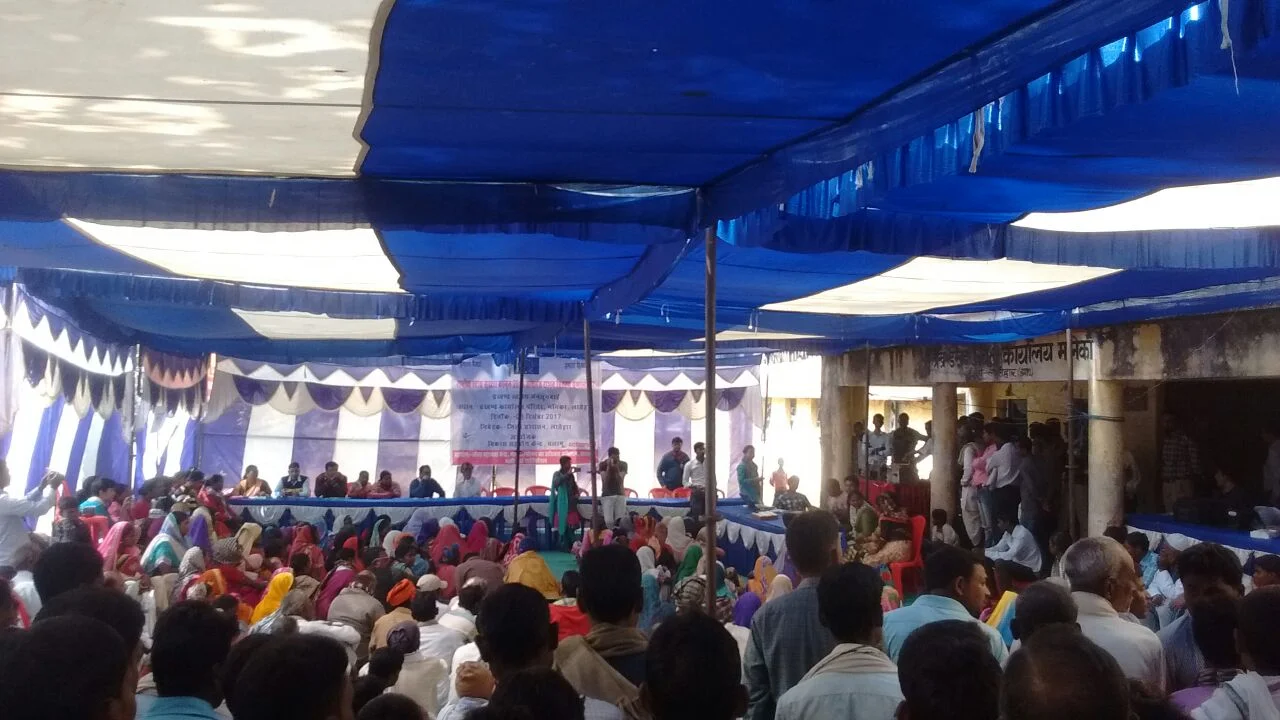
Kuleshwar Mistri who works as a mason in Ranki Kala village in Manika block said: “I enroled in Aadhaar. My family got 25 kilo rations till this February. But since March, the dealer says, “Your name is not in the net”, and I can no longer get any rice from the ration shop. Where is my share of grains then?”
Though the government is claiming that Aadhaar linking will stop theft of grains in the public distribution system, several residents from villages in Manika, Barwadih, and Kumandih block testified that the ration dealers were able to siphon off grains even after biometric authentication, as there was nothing in the new system to prevent grain theft. In most cases, dealers were doing this when ration card holders had not been able to collect grains for two months because of network errors and other glitches in linking, they said.
“The dealer cut a slip which showed a receiving of 40 kilos, but he gave me only 20 kilo and pocketed the rest. He did not give ration for August at all,” said Nagina Bibi of Bishunbandh in Manika block.
Under the National Food Security Act 2013, ration card holders are legally entitled to get 5 kilo per person foodgrains at subsidised rates at fair price shops. Antodaya card holders, which include “the poorest of the poor”, including Particularly Vulnerable Tribal families, low income women headed households that are vulnerable, families with disabled members, are entitled to get 35 kilo foodgrains per month. But at the hearing, both priority households and Antodaya households reported being cut off from grain access completely after the Jharkhand government stopped allowing grains to those whose cards had not been porperly seeded.
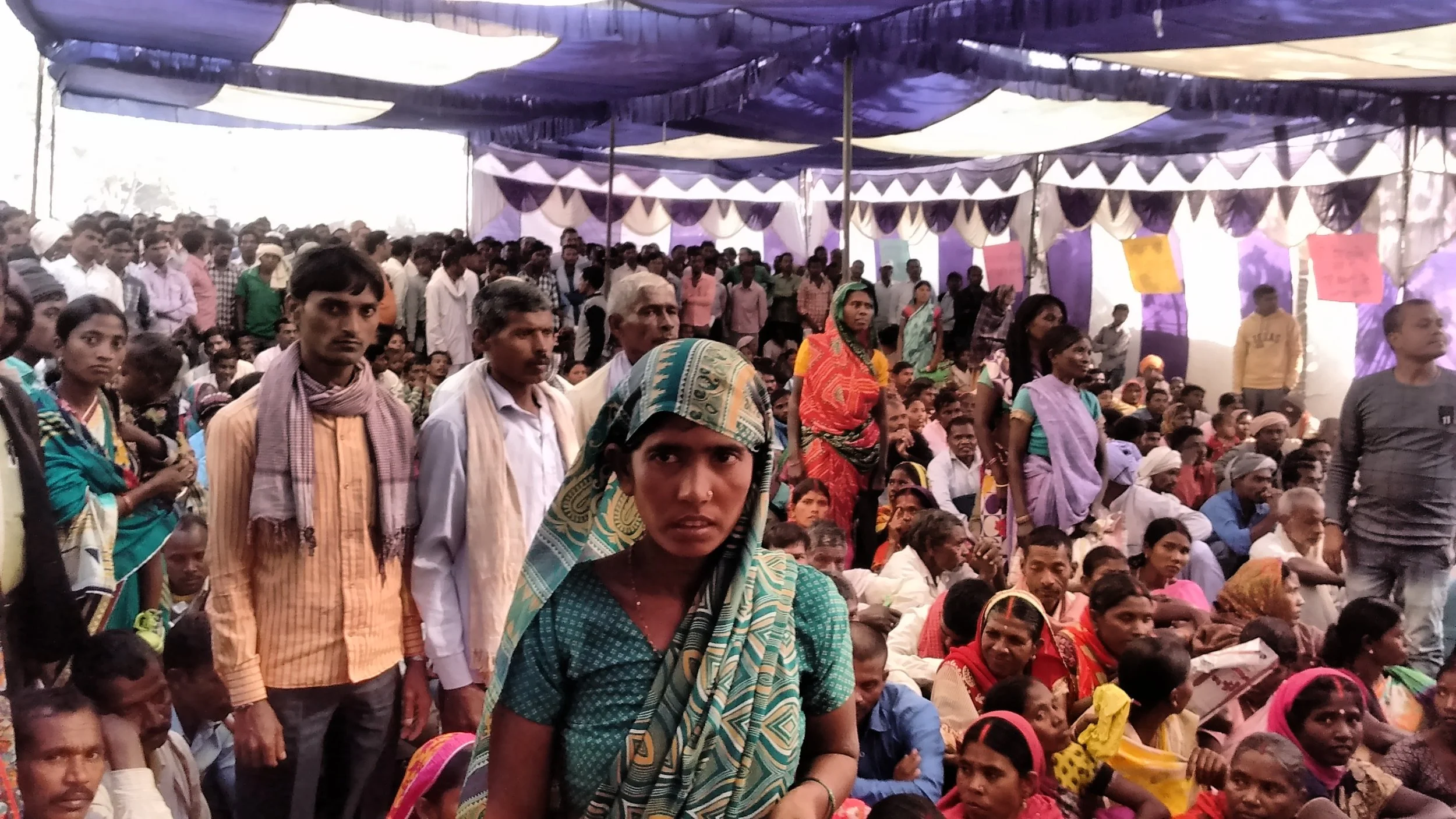
“Several Parhaiya families that are Particularly Vulnerable Tribal families, are present here from Ranki Kala, Dundu, and Sendhra, who have been cut off from rations since months when they were not able to link their ration cards to their Aadhaar number,” said a Parhaiya mukhia from Sevdhara village of Rankikala panchayat. “Even those who are getting, are now getting 25 kilo not 35 kilos rice anymore.”
Help us help you
Further, a survey by Right to Food Campaign Jharkhand in November-December of 135 households with canceled ration cards showed that 2 our of 135 cards were canceled as “fake”, 3 of 135 cards were canceled as “duplicate”, and in a majority cases the administration had not stated any reason for cancelation of ration cards. In 26 of 135 cards, the administration gave “not linking Aadhaar” as reason for even cancelation of genuine ration cards, said James Herenj, Convenor Jharkhand MNREGA Watch.
Since October, several hunger deaths have been recorded in Jharkhand. In October, Santoshi Kumari a 11 year old child died in Simdega district months after her family’s ration card was canceled. In late October, Ruplal Marandi died in Deoghar district after being denied grains his family members’ biometric authentication failed. In December, Premni Kunwar Khairwar adivasi died in Garhwa district after she was denied ration in delays in the linking process, and after her pension was canceled during Aadhaar linking.
Jharkhand government claims it has canceled 11.6 lakh ration cards after Aadhaar linking, but the public hearing showed there is no process on the ground to verify if it is a genuine or false beneficiary whose ration card is being canceled, and even genuine ration cards are being canceled if there is delay or data entry errors in Aadhaar linking.
Engage with us on Twitter:
### 7 Dec 2017 — Wait till next week before you decide on linking Aadhaar > It has been 849 days since the Indian Supreme Court decided to set up a Constitution Bench to examine if Aadhaar project violates Indian Constitution. Every day that the court delays in deciding on this matter, there are more instances of people suffering because Aadhaar has been made ‘mandatorily v Original: https://rethinkaadhaar.in/blog/2017/12/7/wait-till-next-week-before-you-decide-on-linking-aadhaarIt has been 849 days since the Indian Supreme Court decided to set up a Constitution Bench to examine if Aadhaar project violates Indian Constitution. Every day that the court delays in deciding on this matter, there are more instances of people suffering because Aadhaar has been made ‘mandatorily voluntary’. Since the matter didn’t get listed in the Supreme Court on its own, there was a mentioning by the lawyers today morning in the court of the Chief Justice of India.
A "mentioning" is when a lawyer appears in Court and asks for something related to a case, often asking for a date for it to be heard.
— Gautam Bhatia (@gautambhatia88) October 25, 2017
At this mentioning, the Attorney General of India, Mr. K. K. Venugopal, said in the court that the Government of India will publish a notification tomorrow extending the 31st December 2017 deadline to link Section 7 notifications (PDS, NREGA, disability assistance, MDM and over 100 others) to 31st March, 2018 EXCEPT in the case of mobile-Aadhaar linkage. The Attorney General added that in the case of mobile-Aadhaar linking the deadline will continue to be 6th February 2018 since it will require a judicial order to extend to 31st March 2018 because the Supreme Court had, in the Lokniti Foundation case, ordered Aadhaar verification of all mobiles by 6th February 2018. (Note: There is also an opinion that the mandatory Aadhaar verification of mobile numbers is a misreading of the court's opinion in the Lokniti Foundation case.)
It is understood that this notification would extend the deadline only for those without Aadhaar and that those with Aadhaar will have still have to link to bank accounts and other services by 31st December 2017, similar to the PAN judgement earlier this year where in those with Aadhaar had to mention their Aadhaar number when filing their Income Tax returns but those without Aadhaar needn’t do so. In the present case, this will be confirmed only if and when such a notification is published by the Government of India as indicated by the Attorney General.
Help us help you
Mr. Shyam Divan, advocating for the petitioners in the Aadhaar case, insisted that the deadline should be extended for both those with and without Aadhaar and that the government should assure citizens that no coercive action will be taken against Aadhaar holders. To this the Attorney General replied that if this is the case then nobody will produce the Aadhaar number and was prepared to argue on this point. The Chief Justice of India gave his assurance that a Constitution Bench will decide on the matter of providing interim relief next week till such time that this matter is decided by the Supreme Court.
IMPLICATIONS OF TODAY’S DEVELOPMENTS FOR CITIZENS CONCERNED ABOUT AADHAAR
For those without Aadhaar: Be on the lookout for the notification mentioned by the Attorney General at the court. If this notification comes out, it is likely that you can wait at least till 31st March 2018 before linking.
For those with Aadhaar: Again, be on the lookout for the notification mentioned by the Attorney General at the court. If this notification doesn’t exempt those with Aadhaar from the 31st December 2017 linking deadline, then wait till the Constitution Bench hearing next week to see if interim relief is offered by the Supreme Court.
As a disclaimer we at Rethink Aadhaar urge you to personally assess risk and make an independent decision. Our updates are not legal advice and are aimed to creating public awareness.
Engage with us on Twitter:
### 27 Nov 2017 — Aadhaar project violates vital principles on data collection & storage > Rethink Aadhaar cautiously welcomes the Sri Krishna Committee White Paper which has been shared for public comments and inputs. This marks an important first step in a more transparent and accountable pre-legislative process. Original: https://rethinkaadhaar.in/blog/2017/11/27/aadhaar-project-violates-vital-principles-on-data-collectionRethink Aadhaar cautiously welcomes the Sri Krishna Committee White Paper which has been shared for public comments and inputs. This marks an important first step in a more transparent and accountable pre-legislative process.
Rethink Aadhaar wrote to the Srikrishna committee on the 5 November 2017 expressing its concern with the constitution of the committee. 22 concerned citizens from across the country signed this letter including, ex-Chief Justice of Delhi High Court, AP Shah, former Chief Information Commissioner Wajahat Habibullah, Privacy Petitioners, Maj Gen (retd) SG Vombatkere, Prof Anupam Saraph and Aruna Roy, Senior Advocates Prashant Bhushan and Indira Jaising, former Governor Gopalkrishna Gandhi, Prof Tarlochan Sastry and Prof Jagdeep Chokkhar of the Association for Democratic Reforms among several Information activists.
The Srikrishna committee was constituted on 31 July 2017 to identify issues related to data protection and to formulate a Data Protection Bill.
Our earlier letter highlighted the fact that the Committee the present composition of the committee is problematic insofar as all its members, except Justice Srikrishna, have pronounced professional and personal views in support of the Aadhaar program and its extension into areas that it was not designed for.
We are disappointed that the composition of the committee remains unchanged.
Experts who have expressed independent and critical views on Aadhaar have not been co-opted by the committee. This could still be possible in the future and we hope the Committee will keep this in mind.
A mandatory and coercive Aadhaar project has led to millions of Indian citizens being enrolled into the world’s largest biometric identification project.
Issues of surveillance, welfare, national security, and Private companies and their access to this data is becoming crucial. Massive data collection proliferates unregulated.
Help us help you
On a first and rapid reading of the report we find that the White Paper expresses deep caution when dealing with data - its collection use and storage. We do not think that the Aadhaar project will survive this increased scrutiny and caution. It is in fact clear that the Aadhaar project, since its inception, has already violated many principles expressed in the white paper.
The deliberations of the Srikrishna Committee are vital for our collective future and the shape of the Data Protection law. The white paper is a first step in what we hope is increased transparency in these deliberations. As we read this document and begin writing our suggestions and responses we hope that many people will join in with these deliberations. It is important that we all engage with this process as it shapes our digital futures.
Link to the Government of India white paper on a data protection legislative framework in India, inviting comments by December 31, 2017:
http://meity.gov.in/writereaddata/files/white_paper_on_data_protection_in_india_171127_final_v2.pdf
Engage with us on Twitter:
### 10 Nov 2017 — Citizens reject Aadhaar: Initiate Opt Out > After our last update of November 9, we have received several messages an emails in support of more citizen action against Aadhaar's coercion and exclusion. Now, we present three ways in which you can take action, and make a difference 1. On November 11, tomorrow at 11 am, Join #NoAadhaar#NoMobil Original: https://rethinkaadhaar.in/blog/2017/11/10/citizens-reject-aadhaar-initiate-opt-outAfter our last update of November 9, we have received several messages an emails in support of more citizen action against Aadhaar's coercion and exclusion.
Now, we present three ways in which you can take action, and make a difference
1. On November 11, tomorrow at 11 am, Join #NoAadhaar#NoMobile #SwitchOff mobiles for 30 minutes #AadhaarFree #NoMobile30
Switch off your mobile phone for 30 minutes at 11am on 11/11
And let's repeat EVERY DAY for the next 30 days.
Don't forget to send an SMS or mail to your service provider to tell them why you're doing this.
Draft template to send to your mobile service providers, and their email IDs are provided here:
https://rethinkaadhaar.in/blog/2017/11/9/join-noaadhaarnomobile-november
2. Add your voice to the "Opt-out from Aadhaar" Campaign. https://rethinkaadhaar.in/take-action/
3. Petition Chief Justice of India, by signing here https://secure.avaaz.org/en/petition/Chife_Justice_of_India_Stop_Mandatory_Aadhaar_for_services/
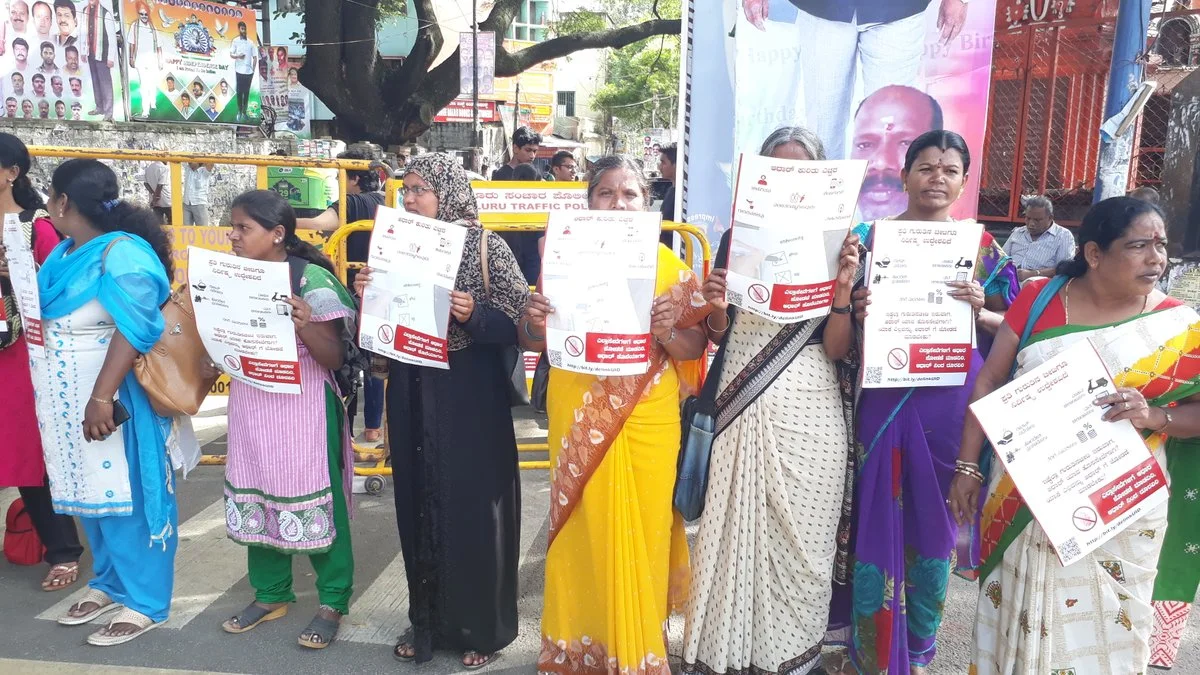 ### 9 Nov 2017 — Citizens reject Aadhaar: Initiate Opt Out campaigns
> The Government recently claimed in the Supreme Court that 118 crore Indians would be hurt if the Court passed an order against Aadhaar. What this claims ignores is that people have been coerced to enroll for and “seed” or link Aadhaar to various schemes. The consequences of such coercion are terribl
Original: https://rethinkaadhaar.in/blog/2017/11/9/citizens-reject-aadhaar-initiate-opt-out-campaigns
### 9 Nov 2017 — Citizens reject Aadhaar: Initiate Opt Out campaigns
> The Government recently claimed in the Supreme Court that 118 crore Indians would be hurt if the Court passed an order against Aadhaar. What this claims ignores is that people have been coerced to enroll for and “seed” or link Aadhaar to various schemes. The consequences of such coercion are terribl
Original: https://rethinkaadhaar.in/blog/2017/11/9/citizens-reject-aadhaar-initiate-opt-out-campaigns
The Government recently claimed in the Supreme Court that 118 crore Indians would be hurt if the Court passed an order against Aadhaar. What this claims ignores is that people have been coerced to enroll for and “seed” or link Aadhaar to various schemes. The consequences of such coercion are terrible - the death of 11-year old Santoshi Kumari from starvation in Jharkhand, for instance, after the local ration dealer cancelled her family’s ration card for not “seeding” (or linking) it with their Aadhaar number. Every single day, we receive e-mails and SMS messages from banks and mobile service companies demanding we link Aadhaar or have our account frozen/suspended!
Government's false stand in court on Aadhaar have spurred new Opt Out, Delink Aadhaar campaigns, calling the bluff on the government’s claim.
- The claim ignores the repeated coercion thanks to which these 118 crore Indians have an Aadhaar. Many such citizens are now demanding to opt out of the Aadhaar ecosystem or delink their Aadhaar from various services
- Within five days of its launch, over 1,200 people in Meghalaya alone have signed a petition asking to opt out of Aadhaar altogether
- Rethink Aadhaar’s “Delink Aadhaar” campaign, similar to the campaign in Meghalaya, has received more than 2,300 responses from people wanting to either delink their Aadhaar or opt-out of Aadhaar altogether
- Calls for opting-out on Twitter alone have been seen more than two lakh times, and have gathered more than 8000 engagements in the past month
- Two online petitions, one demanding that mandatory linking of Aadhaar be stopped, and the one asking people to Say No to Aadhaar, have together received over 1,100 signatures
- Last but not least, the government’s claim ignores the dangers of a single ID with dubious security measures, now being widely exposed
The claims with respect to support for Aadhaar is similar to the government repeatedly making highly overstated claims about savings from welfare programs linked to Aadhaar, repeatedly exposed by independent researchers. Some examples of the problems faced since Aadhaar linking began:
- Fefi Devi says she enrolled in Aadhaar but the machine does not recognise her fingerprints. After Aadhaar was made mandatory, she can no longer get her pension in the village, and has to now travel 10 kilometers spending Rs 150 for getting her Rs 500 pension
- Babu Singh, a construction worker in Jawaja block in Ajmer, and his wife Punni Devi, who has polio, have been "locked out" of food grains because of errors in Aadhaar numbers
Here are a few people who have added their voice to Rethink Aadhaar’s campaign calling upon the Government to repeal Aadhaar Act, 2016:
- Kannan Ramakrishnan: “I have 3 decades of experience in Banking and using Banking Technology. I have worked in countries like USA, Canada, UK, ASEAN and Australia. These countries have the legal framework (Data protection act, Privacy Act, Computer Misuse Act) have citizens have a well defined procedure for a legal recourse in the event of a violation. The EU has recently improved its legal structure. In my personal professional opinion, I consider the Aadhar implementation Ultra Vires the very act under which it was brought into operations. The current status of linking under 'mandatory orders' render the scheme VOID AB INITIO. The aadhar act was poorly conceived. There was very very limited debate in Parliament and no debate in civil society. Its implementation is PATHETIC. I have raised a RTI on relevant points (sent details to Ms. Menon) but did not answers to specific questions. Media has extensively reported SEVERAL TYPES OF HIGH SEVERITY RISK Incidents. Yet, the GOI blindly muscles ahead with no application of mind. Data has been LOST. In a country where politicians could NOT CARE LESS for human lives, the shameful response to data vulnerabilities, comes as no surprise. I am AGAINST AADHAR for extremely SOUND REASONS. I live in a DEMOCRATIC country. I have my rights. I will FIGHT for it. JAI HIND. Kannan”
- Seerat Ahmad: “I believe that aadhar card will add to the burden of average citizens making their life more complicated and less secure too! More paperwork for everyone where's the need?”
- Thomas John: “Aadhar is a clear attack on Privacy. Tracking of all activities of a person is very easy. This results in easy prediction of a person's move which is a grave risk. Manipulations, campaigns even advertisements based on Aadhar data could come up. No government or organisation can ensure absolute safety of data. Duplication could be another concern. Overall Aadhar is high risk with no reward to the public. Need to abolish this. Prevent the forcing of linking of Aadhar data which contains biometric data to banks, PAN etc. It is against a citizen's constitutional rights. Say no to Aadhar.”
- Vishal Meel: “Just like "half knowledge" is worst than "no knowledge at all"...Biometric ID without proper security is worst than having no ID at all. Hence, I am against the way of such mindless and forceful implementation of Aadhar.”
- Vidyut Gore: “Aadhaar is a scam from the word go. Poorly conceived, opportunistically implemented and puts both individuals and country at risk. It has dubious connections with intelligence agencies of other countries, unaccountable registration or security. It has never been independently audited and it denies citizens the right to seek legal recourse against violations to themselves. It doesn't get more colonial than this. Aadhaar has already done irreversible damage and the damage will only continue and grow the longer Aadhaar is allowed to exist. Aadhaar should be shut down and its perpetrators should be investigated and punished.”
- Suresh Joshi: "My fingerprint dont match even after two biometric updates with UIDAI, Im not able to issue a SIM. In future, Driving license, Bank, Railway.Air travel, PF, Pension everything will be banned for me due to poor technology. Why dont this government ask to use other means of documents for people whose authentication fails....No Iris scanners either.....Its a tool for exclusion for me, an honest tax-payer. Im harrassed for the basic facilities with no fault of mine.....Would like to be involved in the PILs filed. against this demon....Govenment is insensitive and so is UIDAI....."
- Himanshu Malhotra: “If Aadhar has so many benefits than citizens should voluntarily opt for it and it should not be mandated. The very idea of threatening by the govt to opt for aadhar shows that there is more than what meets the eye”
- Imtiyaz Palsaniya: “Constitution of India has given rights to the citizens of India against their performed duties which can't be denied by anyone and by any means. Aadhaar has been forced into every segment in such a way that rights of the citizens are not directly accessible without having Aadhaar and upon identity authentication failure, very rights of the citizens can be denied without even a justification.”
- K.A. Verghese: "Aadhar strikes at the right to privacy of the individual, and has the very real danger of being misused for selective vindictive targeting of individuals or sections of society. Remember the novel 1984 by George Orwell?! It was introduced in bad faith, without even a law to validate it ! When agitated citizens went to court, the government half heartedly rustled together an ill drafted law, and cynically pushed it through Parliament as a Money Bill, without proper debate and consultation, thus making it a statute forced upon the people of India without their consent. Therefore, the regressive law should go. The government must repeal it forthwith."
- Rajesh K: "1. Taking my biometrics - I dont want to part it, I have seen misuse and abuse 2. I dont know if data/Biometric is valid and whether it was modified is not notified 3. I cant sue authorities for misusing the data 4. Against absolute power"
- Sasi kumar: “Personally I don't have any problem with Aadhaar but the concept of Micro-management by the Governments is too dangerous for democracy. The possible mis-utilization is way too more than the benefits it gives to the society/economy”
Switch off your mobiles
at 11 am on 11/11
#NoMobile #NoAaadhar
Earlier this year, the government ordered us to link our mobile connections to our Aadhaar numbers or have our mobile connections cut off.
NO hesitation in jumping the gun even as the legal challenge to Aadhaar comes up for hearing in the Supreme Court!
NO qualms against violating our Constitutional right to privacy!
NO concern that telecom operators will use our data for commercial purposes!
NO protection from use of personal data for targeting and profiling!
The government can behave like this because it thinks that we citizens will not push back.
Let's show them they're wrong.
LET'S TELL THEM WE ARE NOT FOR SALE.
Join #NoAadhaar#NoMobile
Switch off your mobile phone for 30 minutes at 11am on 11/11
And let's repeat EVERY DAY for the next 30 days.
And don't forget to send an SMS or mail to your service provider to tell them why you're doing this.
#NoMobile30 #SwitchOff
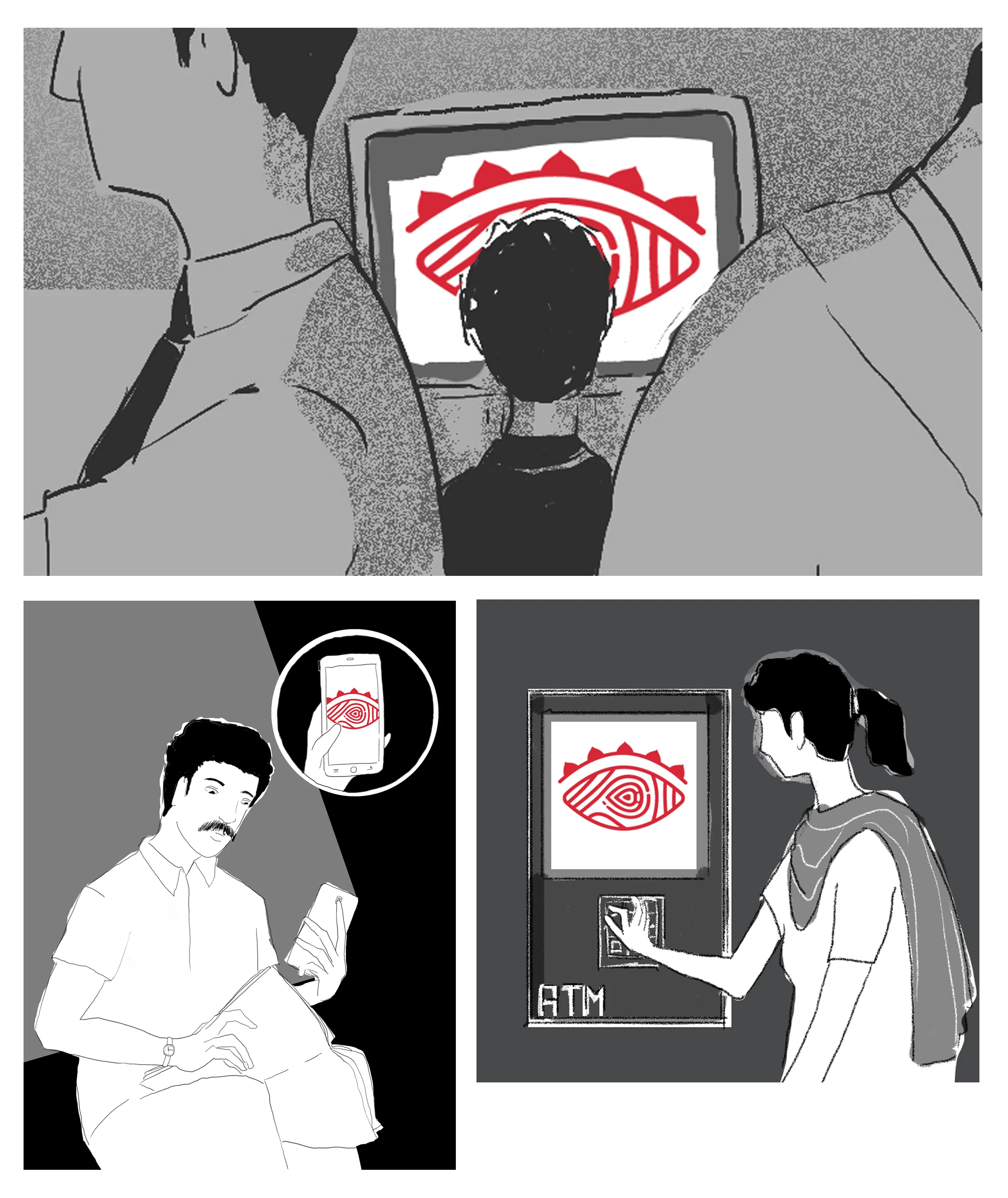
Below is a template draft that you could email your mobile service provider and to TRAI:
To,
Service Provider,
In response to your drive to update Aadhaar I would like to draw your attention to the following:
1. More than a dozen PILs including several challenging the Aadhaar and its linking to various databases are pending before the Supreme Court. In the meantime the order dated Oct 15th 2015 of a five member bench headed by the then Chief Justice of India reiterated all its previous orders in the matter of WP(C) 494/2013 continue to hold force. In particular we draw your attention that the court has stated that:
(a) “We will also make it clear that the Aadhaar card Scheme is purely voluntary and it cannot be made mandatory till the matter is finally decided by this Court one way or the other”.
(b) “We impress upon the Union of India that it shall strictly follow all the earlier orders passed by this Court commencing from 23.09.2013”.
(c) In its first order of September 23, 2013 court had highlighted that “In the meanwhile, no person should suffer for not getting the Aadhaar card inspite of the fact that some authority had issued a circular making it mandatory”. No-one can cause any person to suffer inspite of any authority having mandated Aadhaar. Any coercion to link would amount to causing suffering and a contempt of the Supreme Court of India.
2. Furthermore, the use of Aadhaar for linking to other databases, retention, storage or publishing is not only not permitted but prohibited and also a punishable offence under sections 8, 29 and 37 the The Aadhaar (Targeted Delivery of Financial and Other Subsidies, Benefits and Services) Act 2016. Anyone asking to retain, link, store or publish the Aadhaar, will be in violation of the Aadhaar Act.
3. I have already provided many alternate means of identification on the basis of which you have been providing the service so far.
4. Since Aadhaar was introduced in September 2010, citizens have been cut off from essential services, and there are growing concerns around big data collection and identity theft. The multiple problems surrounding Aadhaar -- its data errors, "deactivation" of genuine people, personal data exposed -- have convinced me that Aadhaar linking serves no purpose except to create a surveillance over me.
I trust you will bring these facts to the attention of anyone in your organisation who insist on mandating Aadhaar. I am also sure you will raise complaints and serve notices, to appropriate authorities, to protect my rights, and ensure my rights do not suffer in any way because of coercion, and contempt of the orders of the Supreme Court, or violation of the The Aadhaar (Targeted Delivery of Financial and Other Subsidies, Benefits and Services) Act 2016.
Thanks and No2UID.
Mobile Service Provider emails IDs.
Airtel: 121@in.airtel.com ,
Vodafone: vodafonecare.del@vodafone.com ,
Jio care@jio.com ,
IDEA: customercare@idea.adityabirla.com
BSNL: cmdcomplaints@bsnl.co.in ,
Cellular Operators Association of India contact@coai.in
Please mark a copy of email to
1) HONOURABLE MINISTER (LAW & JUSTICE, ELECTRONICS & INFORMATION TECHNOLOGY) mljoffice@gov.in
2) Telecom Regulatory Authority of India cp@trai.gov.in ,
3) and Secretary Telecom secy-dot@nic.in
If you prefer to SMS mobile service providers to stop illegally requiring Aadhaar:
For Airtel : Please contact: Shakyasingha Das m: 9831049835 e: shakyasingha.das@airtel.com
Vodafone : Please contact: Gowtham Gowda m: 9923006663 e: Gowtham.Gowda1@Vodafone.com
BSNL : Please contact: Siddharth Gabiyal p: 01123708125 m: 9868142999 e: garbiyal@bsnl.co.in
Idea Cellular illegally requiring Aadhaar? Please contact: Rahul Vatts m: 9891005951 e: rahul.vatts@idea.adityabirla.com
Reliance Jio illegally requiring Aadhaar? Please contact: Arvind Tiwari m: 9987702300 e: Arvind.Tiwari@ril.com
@Sushubh Aircel contact: N.L. Garg m: 9810121026 e: nl.garg@aircel.co.in
### 3 Nov 2017 — SC Orders Banks, Telcos to inform customers of last date for linking Aadhaar > Today, the Supreme Court tagged the four new petitions brought before it with the other pending Aadhaar cases. All the petitions will be heard by a Constitution Bench, possibly by end of November. The Court assured the petitioners that if the matter is not heard at the end of November, it w Original: https://rethinkaadhaar.in/blog/2017/11/3/sc-orders-banks-telcos-to-inform-customers-of-last-date-for-linking-aadhaar
Today, the Supreme Court tagged the four new petitions brought before it with the other pending Aadhaar cases. All the petitions will be heard by a Constitution Bench, possibly by end of November. The Court assured the petitioners that if the matter is not heard at the end of November, it would consider issuing interim orders to stay the linking of Aadhaar with bank accounts and mobile services. For now, it issued directions that messages from telcos and bank accounts must specify the deadline for linking Aadhaar, which remain unchanged as December 31 for bank accounts and Feb 6 for mobile services.
Some media reports suggest that the deadlines have been extended. This is not the case. The confusion arises from an affidavit submitted by the government to the Supreme Court where the government stated that the deadline for linking bank accounts may be extended but has issued no instruction or notification to that effect.
Senior advocates representing the petitioners brought to the Court’s attention that telcos and banks were sending threatening messages on a daily basis. The Attorney-General claimed that these were only oral assertions by the petitioners, to which Justice Sikri replied "We all know what's happening, we are getting these messages too." We hope that the honourable judges will pull up the government for similarly misrepresenting the ground realities of Aadhaar-linked welfare programmes. In Jharkhand alone, the failure of the Aadhaar-PDS ecosystem has resulted in two starvation deaths, as reported recently.
For any queries, worries or for more information, email us at contact@rethinkaadhaar.in
Advisory after today's Hearings
Are you also wondering:
What transpired in court today? Are we now forced to link Aadhaar to everything? What happens next?
Linking to Aadhaar still has a deadline of 31.12.2017 for banks and 06.02.2018 for mobiles.
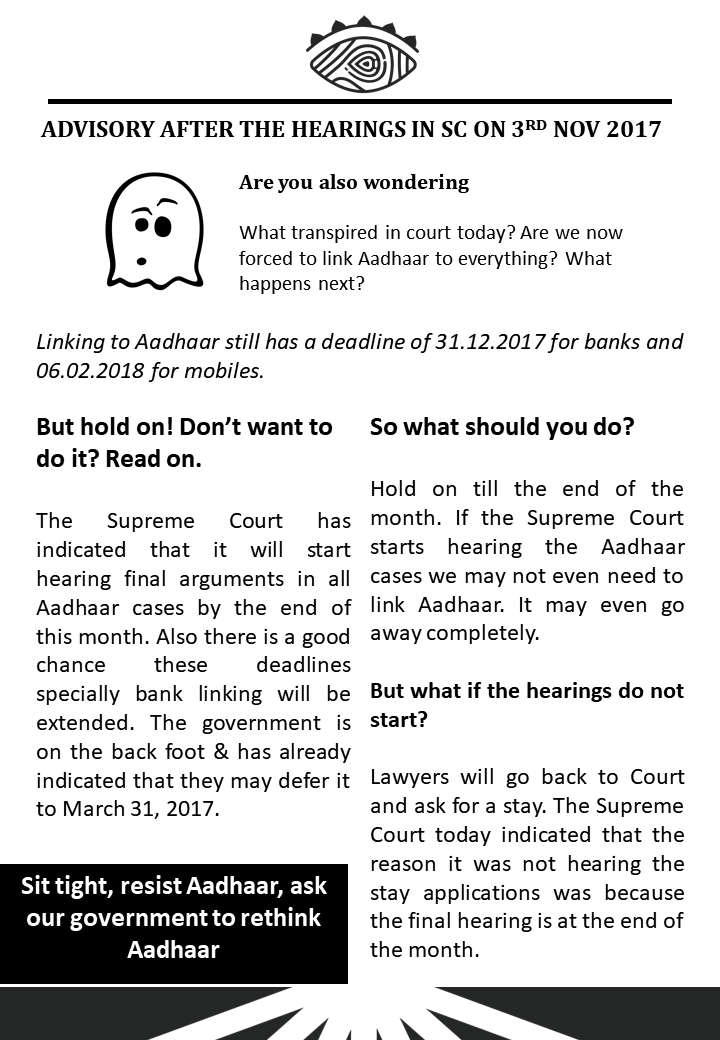
But hold on! Don’t want to do it? Read on.
The Supreme Court has indicated that it will start hearing final arguments in all Aadhaar cases by the end of this month. Also there is a good chance these deadlines specially bank linking will be extended. The government is on the back foot & has already indicated that they may defer it to March 31, 2017.
So what should you do?
Hold on till the end of the month. If the Supreme Court starts hearing the Aadhaar cases we may not even need to link Aadhaar. It may even go away completely.
But what if the hearings do not start?
Lawyers will go back to Court and ask for a stay. The Supreme Court today indicated that the reason it was not hearing the stay applications was because the final hearing is at the end of the month.
Engage with us on Twitter:
### 30 Oct 2017 — Rethink Aadhaar demands an immediate end to the linkage and use of Aadhaar and biometric authentication > There have been reports coming in of starvation deaths because people are not being able to access their ration entitlements due to failure to link with and authenticate using Aadhaar. Some of these reports can be found in the update from the Right to Food Campaign at the end of this mail. The Stat Original: https://rethinkaadhaar.in/blog/2017/10/30/rethink-aadhaar-demands-an-immediate-end-to-the-linkage-and-use-of-aadhaar-and-biometric-authenticationThere have been reports coming in of starvation deaths because people are not being able to access their ration entitlements due to failure to link with and authenticate using Aadhaar. Some of these reports can be found in the update from the Right to Food Campaign at the end of this mail. The State of Aadhaar Report 2016-17 shows that failure rates, after multiple attempts, vary between 7% and 17%. Their subsequently updated figures from here is reproduced below. Other reports show failure rates as high as 66% This is unacceptably high and, translated in to absolute numbers, the number beneficiaries being excluded is in the order of crores across the nation. Please also see this documentary to hear voices from the ground about how Aadhaar is playing with peoples lives without any accountability.
Following these developments, the Department of Food & Public Distribution issued an order (attached with this mail) stating, "all field functionaries in the State may be instructed to ensure that no instance of denial of food grains or deletion of names of family from the Ration Card database only on the ground of non possession of Aadhaar takes place and strict action is taken by State / UT Governments for denial of benefits".
Additionally, there have been reports of denial of healthcare services for lack of Aadhaar against which a statement was issued that also highlighted concerns of privacy of medical history and its linkage to Aadhaar. It can be found here.
Further, a "gang that was involved in counterfeiting Aadhaar cards, hailed for their bulletproof biometric features at the centre of the government's push for reforms in welfare, taxation and communications", put paid to the claim that it is "robust enough to eliminate ... fake identities". Earlier this year, we also learned how "impersonation by illegally storing Aadhaar biometric data" is possible raising serious questions about the security behind the "state-of-the-art digital and online Id" and "one of the key pillars of the ‘Digital India’".
Given the state of Aadhaar, Rethink Aadhaar demands an immediate end to the linkage and use of Aadhaar and biometric authentication to access government services and entitlements.
The latest update from the Right to Food Campaign (which has been edited to include only Aadhaar related updates) is following. We would like to thank Aysha of the Right to Food Campaign (copied on this mail) for this compilation.
Help us help you
Update from Right to Food Campaign
Dear friends,
Much has happened in the field of right to food and work in this month. Here are some updates:
Do send updates on struggles and other developments on the right to food in your area on righttofoodindia@gmail.com or WhatsApp - 9716048979
Zindabad
Secretariat, Right to Food Campaign
Starvation death in District Simdega of Jharkhand
Eleven-year-old Santoshi Kumari died asking for rice on September 28, eight months after her family stopped getting food rations from the local ration shop because their ration card was not linked to their Aadhaar.
The child’s death in Jharkhand’s Simdega district has elicited official responses that verge on denial. Jharkhand’s food and civil supplies minister claimed to have nothing to do with an order passed by his own government that led to 11 lakh ration cards being cancelled because the cardholders had not furnished their Aadhaar numbers. The CEO of UIDAI, Ajay Bhushan Pandey said that the Aadhaar Act made it clear that no one will be denied food rations if they did not possess an Aadhaar number.
But this is exactly what is happening. Countless reports by activists and journalists, including Scroll.in’s Identity Project series, have documented the disruption in PDS on account of Aadhaar. Across states, people are struggling to authenticate themselves by scanning their fingerprints each time they go to the ration shop. In many cases, their fingerprints are too worn out to register on the fingerprint scanning machines. Often, the internet connection fails. The result is that they are unable to access the foodgrains they are legally entitled to under the National Food Security Act 2013.
In Jharkhand, the government’s website showed at least 10% of families were unable to buy their food rations, as Jean Drèze, an economist who is part of the Right to Food campaign, pointed out. “That may not seem like a very large number, but in absolute terms, it translates into something like 2.5 million people in Jharkhand being deprived of their food rations,” he said.
The Jharkhand Right Food Campaign has written a letter to Mr. Vinay Chaubey, Secretary, Food and Civic Supply Department, Government of Jharkhand regarding the starvation death. A team from the campaign conducted a fact finding of the death. Click here to see the fact report.
Links to media reports of the incident are given below:
- Scroll - Denied food because she did not have Aadhaar-linked ration card, Jharkhand girl dies of starvation
- Hindustan Times - Jharkhand girl’s ‘starvation death’: Mother attacked for ‘defaming village’
- Indian Express - After starvation death case: Jharkhand minister scraps top state official’s order on Aadhaar-PDS link
- Scroll: Chronicle of a starvation death foretold: Why it is time to abandon Aadhaar in the ration shop
- Newswing - दे नी आयो भात...दे नी आयो भात...बुदबुदाते हुए भूख से मर गई 11साल की संतोषी
- India.com - Aadhaar Card Not Mandatory For Benefits of Welfare Schemes, Says UIDAI Chief Ajay Bhushan Pandey, No Aadhaar Needed For Ration Under PDS: UIDAI
- Times of India - Jharkhand 'starvation' death: Security to girl's mother after she alleges abuse by villagers
- Scroll - No Aadhaar, no food rations: 11 stories that show the Jharkhand child death was no aberration, Aadhaar is depriving the most vulnerable people of their grain entitlements.
2 more deaths in Jharkhand
A 40-year-old rickshaw driver died on October 23, 2017 in Dhanbad district of Jharkhand. The family has alleged that the rickshaw puller was struggling to make a ration card for the last three years.
An another 62-year-old man died of hunger on Monday in Jharkhand’s Deoghar district after the biometric reader at the PDS shop couldn’t read his thumb impression and he was refused ration, his family alleged, a charge denied by the government.
Three hunger deaths in Karnataka
Starvation deaths have occured in Karnataka as well. In July 2017, three brothers of a dalit family died of starvation in Gokarna district of Karnataka because their local PDS shop refused to give them grain for not linking their ration card to Aadhaar. A report on the matter published in the New Indian Express can be read here. A fact finding report by a member of the People’s Union for Civil Liberties (PUCL) can be read here.
Featured image used from new article published on scroll.in. Photo credit: Taramani Sahu
Engage with us on Twitter:
### 24 Sep 2017 — “Hume Aadhaar nahi, sudhar chahiye!”: MNREGA workers at a nation-wide protest > The Aadhaar Act, 2016 as it says is supposed to be for the “targeted delivery of financial and other subsidies, benefits and services.” But the ground reality tells us a different story. Thousands of MNEREGA workers gathered at Jantar Mantar for five days from 11th September to 15th September 2017 Original: https://rethinkaadhaar.in/blog/2017/9/24/hume-aadhaar-nahi-sudhar-chahiye-mnerega-workers-at-a-nation-wide-protestThe Aadhaar Act, 2016 as it says is supposed to be for the “targeted delivery of financial and other subsidies, benefits and services.” But the ground reality tells us a different story.
Thousands of MNEREGA workers gathered at Jantar Mantar for five days from 11th September to 15th September 2017 to express their frustration over lack of wages, no ration, and poor maternity benefits.
They revealed that Anganwaadi workers had not been receiving wages for the past 6 months. They have no food to eat. How are they supposed to work in such poor conditions?
One woman expressed that the villagers haven’t been receiving ration for the past 2 and a half years. They are not even getting kerosene to cook their food. After the introduction of Aadhaar, their living conditions have gotten miserable. She said, “Aadhaar ke wajah se hume bahut dikaat ho rahi hai. Ration nahi milta, hum majdoori karne waale hai” (We have been facing a lot of problems because of Aadhaar. We who do manual labour can no longer get ration under the PDS system, to sustain our families).
Another woman said that they all have had to pay Rs. 100 each to make the Aadhaar number card which is supposed to be free of cost. They have had to pay more money to add their children’s names to the cards to avail benefits.
Tukaram Malawe from the Dalit Adivasi Jagrati Sangathan in Badwani, Madhya Pradesh said that women workers have not been able to avail maternity benefits under the Janani Suraksha Yojna after Aadhaar has been made mandatory to avail these services.
One pregnant woman worker reached the hospital at midnight in excruciating labour pain and she was asked to produce her Aadhaar card first. There was no means of commute in the night and with a lot of difficulty her husband went home to get the card.
Many women workers have been denied service in hospitals since their names are not found in the system after the introduction of Aadhaar. Infants will suffer every year because of these lack of benefits.
Tukaram ji also explained that one of the workers had entered a wrong Aadhaar number in the MNEREGA scheme and since months his wages were being sent in the account of another person. The elderly had suddenly stopped receiving their pension, since their rugged fingerprints don’t match with those stored in the system.
The poor villagers are being exploited. Tukaram ji expressed their frustration, “Aadhaar is needed in schools for children, in hospitals, in court, to pay electricity; it it even required to use a mobile phone it seems.” In fear they have been paying Rs. 500 to get a tatkal Aadhaar made.
Most workers complained that even after linking Aadhaar to their bank accounts, their thumb impressions don’t match with those in the system and they are not able to get their wages or ration because of this.
Another major problem with the system is the fear of being “deactivated”.
Norat Mal from Tilonia, Rajasthan explained that many workers were not receiving wages while the other were. On investigating, they found out that their Aadhaar cards were deactivated, without any prior notice or reason. They had to spend a lot of money to travel far to get their Aadhaar re-activated.
How can the Government take away essential services from the poorest in the country without giving any explanation? Are we moving towards the end of democracy?
The Government has been repeatedly emphasizing on the “social benefits” of Aadhaar and its role in eradicating hunger. These testimonies are showing us the exact opposite of what the Government is claiming. And these very testimonies will show the judges of the Supreme Court, what the implications of making Aadhaar mandatory can be.
By Chandni Chawla,
Researcher, Intern with Rethink Aadhaar Campaign
### 13 Sep 2017 — "No Janani suraksha Facilities for pregnant women without Aadhaar", say MNREGA Workers from MP > On the third day of the NREGA Sangharsh Morcha hundreds of MNREGA rural workers gathered at Jantar Mantar in New Delhi spoke of the varied problems they are facing due to Aadhaar, a biometrics linked ID, being made mandatory to continue getting essential services. Tukaram from the Jagrat Adivasi Da Original: https://rethinkaadhaar.in/blog/2017/9/13/no-ambulance-for-pregnant-women-without-aadhaar-say-mnrega-workers-from-mpOn the third day of the NREGA Sangharsh Morcha hundreds of MNREGA rural workers gathered at Jantar Mantar in New Delhi spoke of the varied problems they are facing due to Aadhaar, a biometrics linked ID, being made mandatory to continue getting essential services.
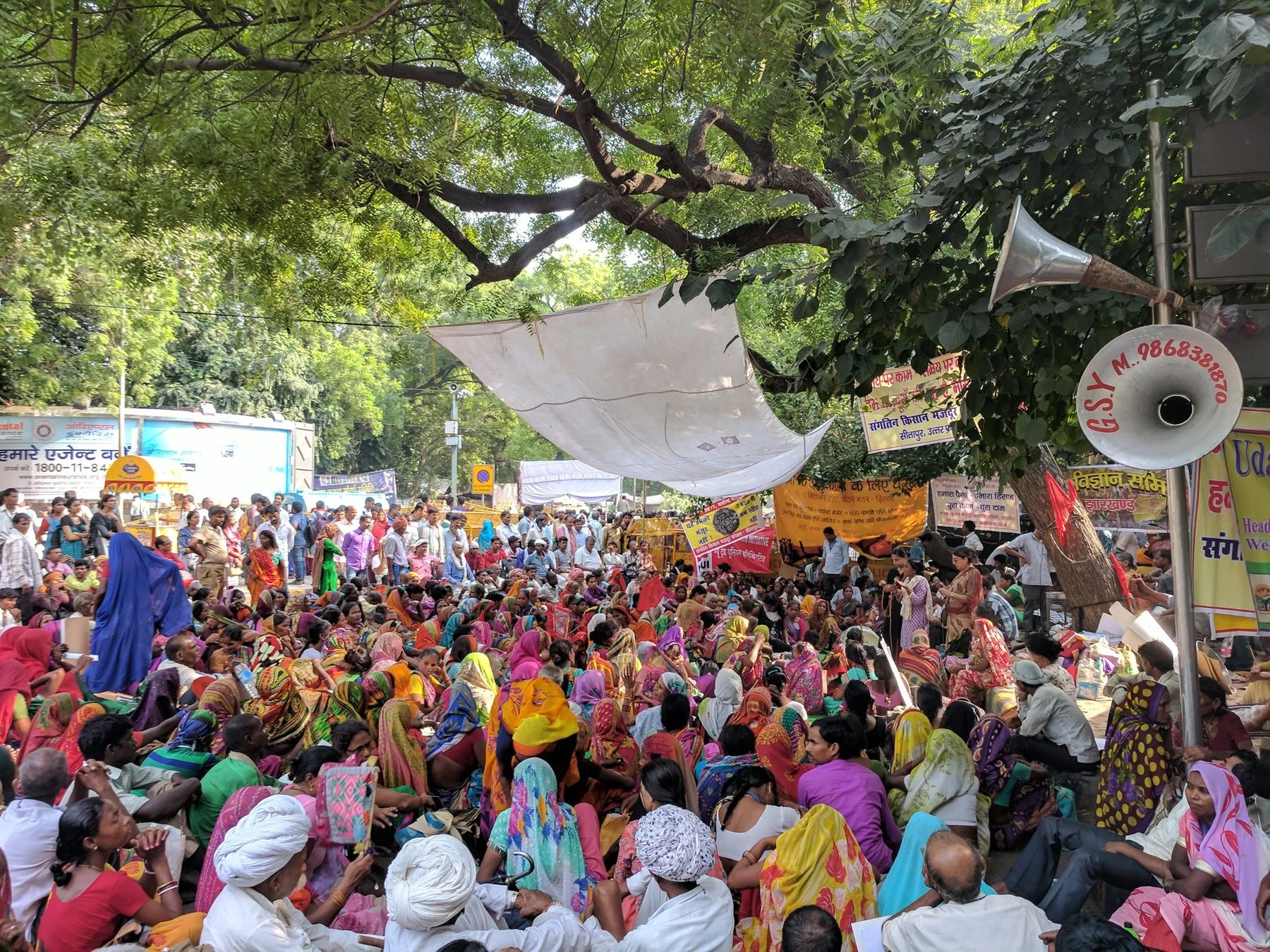
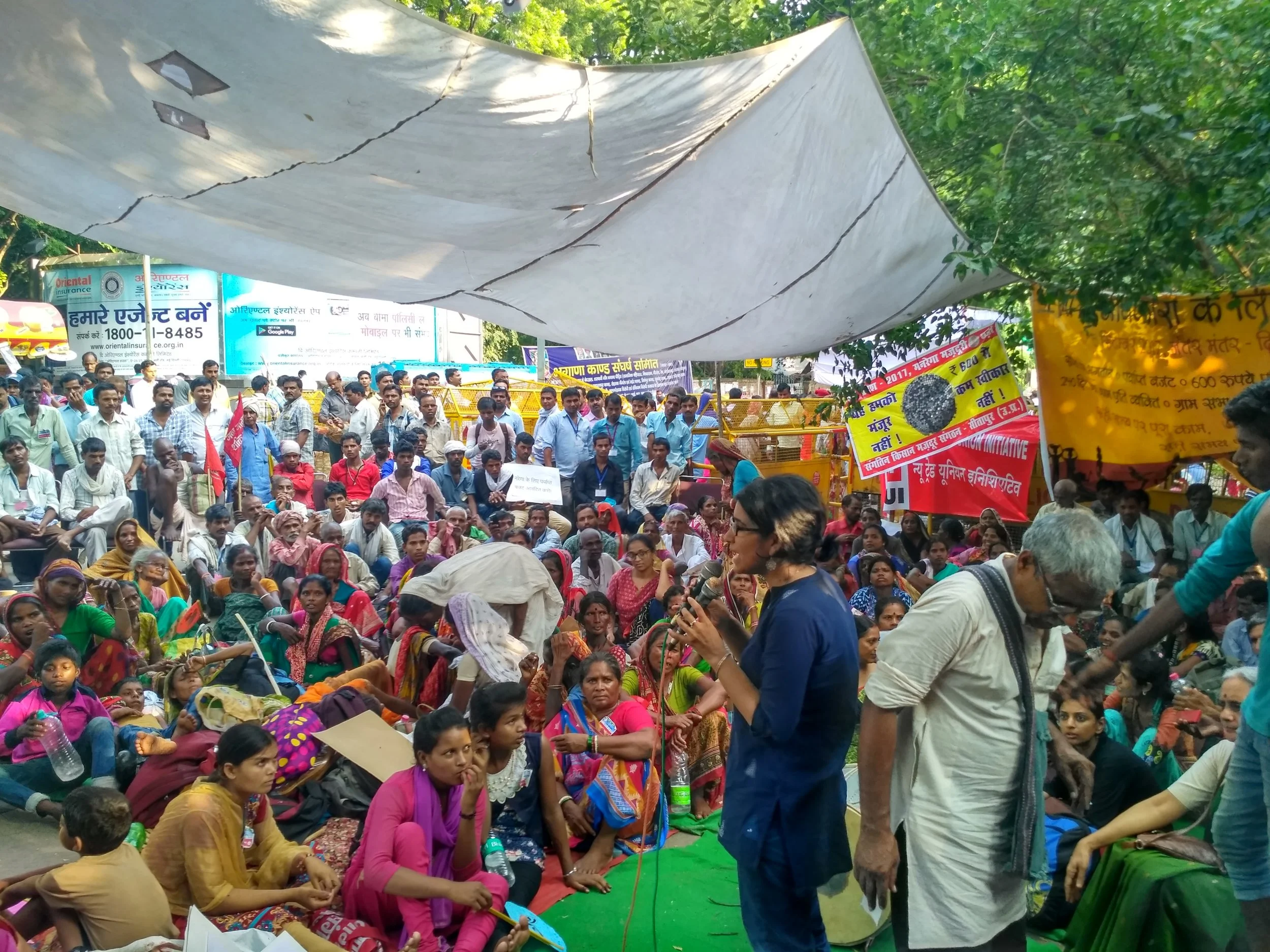
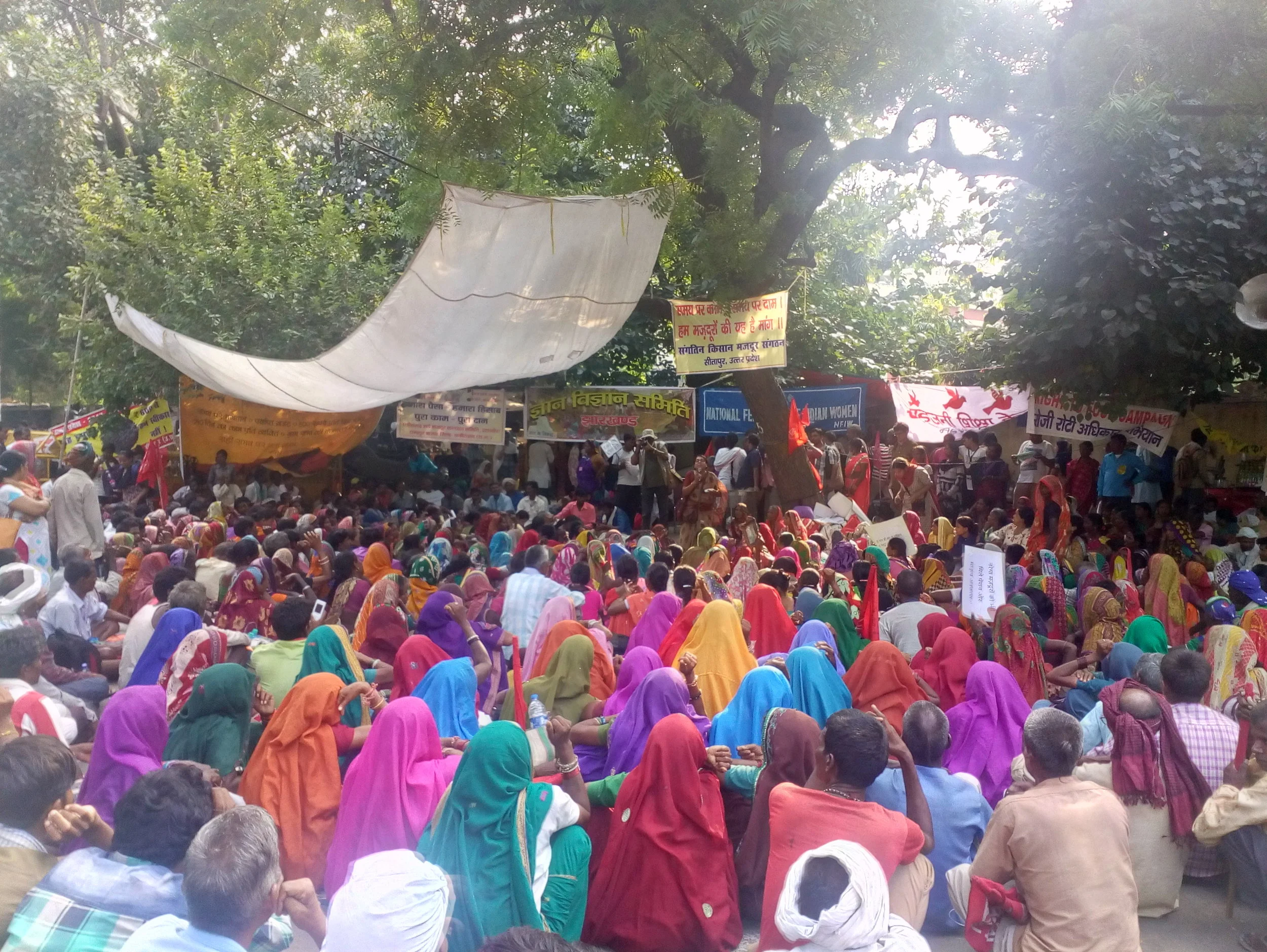
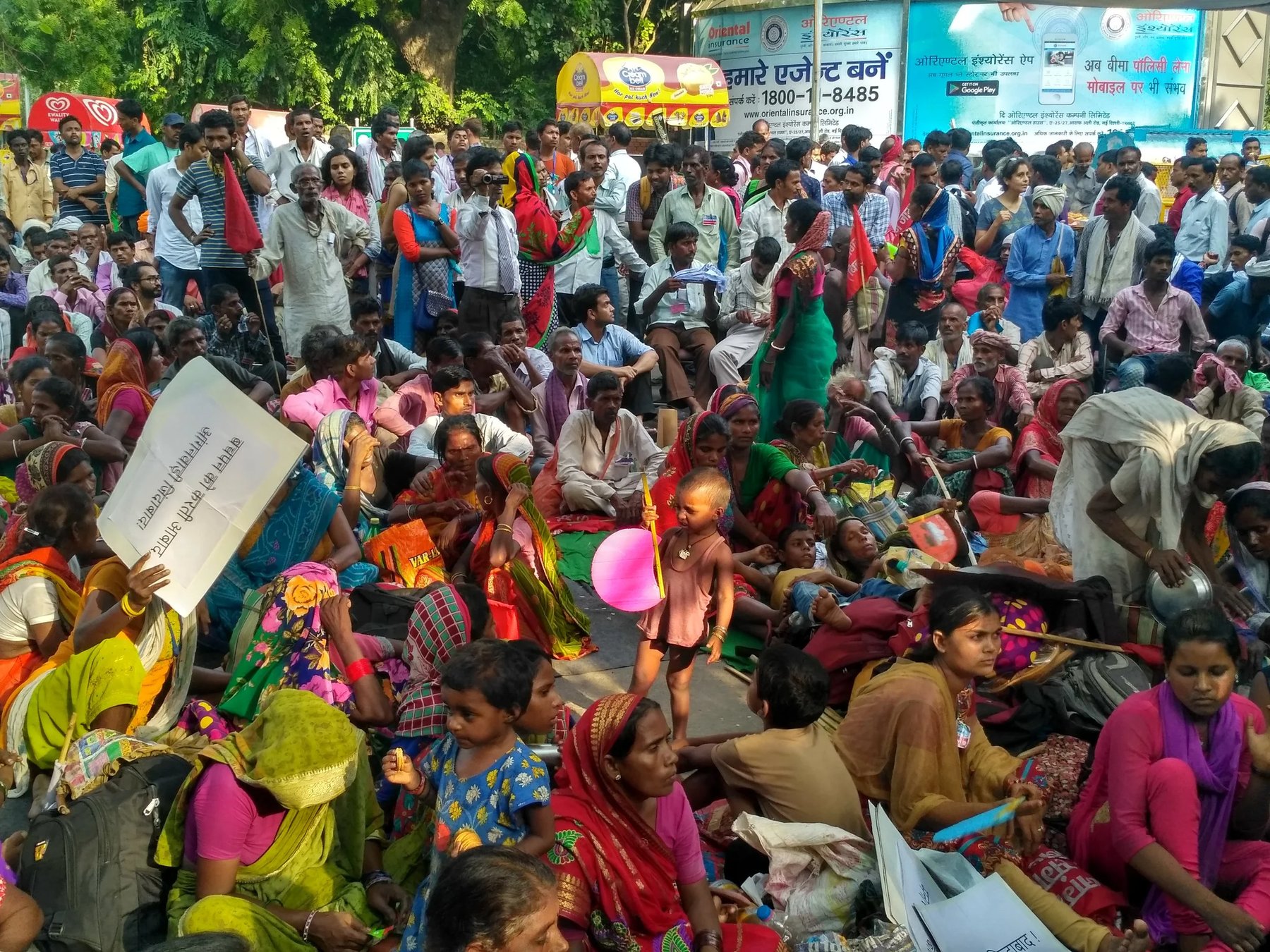
Tukaram from the Jagrat Adivasi Dalit Sangathan, Madhya Pradesh said that in their village, pregnant women faced enormous problems at the time of delivery. He spoke of an instance when a woman worker was told that at the time of delivery that she will not get Janani Suraksha Yojana benefits, a cash transfer aimed at reducing maternal mortality, till she produced her Aadhaar proof. She was told this when the woman worker was at the hospital for her delivery. "A woman worker's delivery was delayed because she forgot to carry her Aadhaar card to the hospital."
Tukaram went on to state that the linking of Aadhaar to hospitals, schools, food rations is creating enormous inconvenience and harassment. "We have to go multiple times and make payments repeatedly - first, we spend hundreds of rupees to make the card as operators ask for money, and then workers have to go and link it," He said "Aadhaar is mandatory for everything. On death also, Aadhaar is needed. To go to court also, Aadhaar is needed in our district," he said.
Pushpa, a resident of Delhi said, "In Delhi, Aadhar is killing people. There is no space where Aadhaar is not creating a hassle, be it ration shops, our pensions, or hospitals. They want Aadhaar and won't help or assist people without it."
From Uttar Pradesh, workers stated that they received MNREGA wages for a few months which then stopped. When they checked, they found out the MNREGA MIS stated that their Aadhaar had become "inactive". Under Aadhaar Act, the regulations state the government can "deactivate", or suspend any resident's Aadhaar for "any reason deemed appropriate" without giving any prior notice. The problems that are resulting from this are now surfacing in huge numbers in rural areas.
"We asked what inactive meant but no one was able to tell us," said one worker. "Nobody was told why they were made inactive."
Vikas Ojha from Uttar Pradesh explained that the Aadhaar database demographic details are full of errors, and Aadhaar centres take an excessive bribes for updating of information.
Norat Mal from Tilonia, Ajmer stated that several MNREGA workers have stopped receiving wages because the MIS shows that Aadhaar is "inactive". They did not get any prior notice before deactivation; forty workers in his village were unable to get wages after deactivation.
Norat from Rajasthan explains how NREGA workers don't get wages because Aadhaar randomly becomes inactive pic.twitter.com/uI4zE1CsCx
— Rethink Aadhaar (@no2uid) September 13, 2017
Daaku Devi from Jawaja, Ajmer stated that elderly's fingerprints are not recognised by Aadhaar enabled machines and that several residents are now unable to get pension because of this.
Indira from Rajsamand, Rajasthan stated that fingerprints change and POS machines used to disburse rations are not able to recognise the elderly.
Hundreds of workers gathered said "Aadhaar nahin, sudhaar chahiye!" "We don't want Aadhaar, we want genuine reform."
@AnjaliB_ explains that Aadhaar cannot stop corruption. We need grievance redress, transparency, accountability and participation #no2UID pic.twitter.com/Z8c98GOalp
— Rethink Aadhaar (@no2uid) September 14, 2017
Further readings:
https://thewire.in/102103/aadhaar-mgnrega-errors-corruption/
On UIDAI's arbitrary powers of deactivation,
http://www.caravanmagazine.in/vantage/aadhaar-regulations-uidai-power
Engage with us on Twitter:
### 11 Sep 2017 — Concerned Citizens Call For Independent Audit of Aadhaar Database > In a shocking security breach of Aadhaar, India’s biometric ID project for residents, the police have arrested 10 men in Uttar Pradesh in North India for successfully creating fake biometrics identities in the Aadhaar database, by cloning fingerprints. On September 11, the Uttar Pradesh Special Tas Original: https://rethinkaadhaar.in/blog/2017/9/11/concerned-citizens-call-for-independent-audit-of-aadhaar-databaseIn a shocking security breach of Aadhaar, India’s biometric ID project for residents, the police have arrested 10 men in Uttar Pradesh in North India for successfully creating fake biometrics identities in the Aadhaar database, by cloning fingerprints.
On September 11, the Uttar Pradesh Special Task Force caught a 10-member gang who have been impersonating the credentials of certified Aadhaar operators both by faking the operators’ fingerprints using photopolymer resin, and by illegally cracking open enrollment software of the Unique Identification Authority of India (UIDAI).
As per news reports, the criminal gang lifted the fingerprints of the operators sub-contracted by the UIDAI, printing the fingerprints on a butter paper. Additionally, they illegally used a software vulnerability to bypass the iris authentication check established by the government. Such a breach would allow any one to send enrollment packets into the Central Identities Data Repository, where all biometrics and demographics data of Indian residents are stored.
News reports indicate the revenue model of this latest theft was abased on selling kits of software, and fingerprints at Rs 5,000 each, which allowed people to run fake enrollment agencies.
The police team claimed in raids, they found “38 cloned fingerprints on paper, 46 cloned fingerprints made of a chemical, 12 mobile phones, two Aadhaar finger scanners, two retina scanners, eight rubber stamps, 18 Aadhaar cards”, according to an Indian Express report. The investigation is still on, and Uttar Pradesh Special Task Force have said the network operating the latest Aadhaar scam may extend to several states.
We demand that the UIDAI:
- Immediately halt coerced enrollment, linking of services and existing IDs to Aadhaar; withdraw of all notifications issues under section 7 of Aadhaar Act mandating Aadhaar for essential services
- Independent audit of Aadhaar database, by a public agency with public representation
- That UIDAI immediately notify and compensate unsuspecting residents whose personal biometrics data may have been compromised at these fake enrollment centers
- UIDAI make public the records of when did the details of the Uttar Pradesh STF police investigation and raids first come to light, for how long and in how many states have such security breaches been found so far
- UIDAI must explain to Standing Committee on Home Affairs how many instances of breach / attempt to breach of Aadhaar database has been notified to UIDAI and what has been the action taken by UIDAI in all such cases?
What this latest breach means
The latest incident is a shocking breach of public trust. The government claims Aadhaar is more foolproof than any existing Proof of Identity and Proof of Address documents because it is accompanied by biometrics.
As per the UIDAI, only authorized agents can do enrollment, and all enrollment must be validated by the operator's finger print and iris along, with their Aadhaar number. This breach shows a poor process of approving who could be doing the enrollments as unaudited and unverified enrollments entered the CIDR central database. This attack shows the government’s claims to be false and makes approved enrollments in the CIDR made via these compromised operator accounts worthless.
In this latest security breach, the criminal gang had successfully cracked open the enrollment software. Official statements and news reports on silent on how this was done. The result was that they were able to send enrollments into CIDR by impersonating the credentials of certified operators.
The latest incident shows the UIDAI is unable to guarantee the veracity of data in the Aadhaar repository. It has failed to guarantee the security of residents’ identity information, including core biometrics which cannot be replaced. Experts have also warned that if a fingerprint can be faked on a high resolution scanner used during enrollment, it can definitely be faked on the low resolution scanners used during authentication.
Aadhaar-based biometric scams, identity theft are now a real risk for the poor, especially those with less access to digital literacy.
Help us help you
Lack of legal remedies to citizens
Despite security vulnerabilities, the government of India is continuing pushing residents, including minors and elderly who are especially vulnerable, to enroll into the Aadhaar database. There is a continuous push to enroll along with a threat of cutting off citizens from essential services of food, coking gas, pensions, scholarships, disability aid, and now the threat of cutting off access to bank services and mobile connections, unless they submit their biometrics and link every existing ID to the Aadhaar database.
There is also a worrying absence of legal remedies to residents if their personal data being made insecure by the UIDAI.
Section 47(1) of the Aadhaar Act says: “No court shall take cognizance of any offense punishable under this Act, save on a complaint made by the Authority or any officer or person authorized by it.”
Thus, UIDAI is responsible for both maintaining the security and confidentiality of identity information and authentication records, as well as for approaching a court in case of a security breach – which is a conflict of interest. There is no provision in the law for residents to get mandatory notifications from UIDAI, if their data is breached.
Worryingly, this is not the first time such a breach has been detected. Four years back, in 2012, Infrastructure Leasing & Financial Services Limited (IL&FS) staff had enrolled 30,000 people fraudulently in Hyderabad.
There is fraud not only at the enrollment stage, but also at the authentication stages leading to identity fraud.
Earlier this year, students at a technology institute in Mumbai demonstrated how easy fingerprints cloning is when they used it to falsify attendance.
Despite warnings from security experts over the years and petitioners approaching the Supreme court that biometrics is an insecure, non-consensual, and broken technology, and that biometrics can be easily replicated and cloned using even fevicol and wax, and that such breaches have occurred in other countries, the both the Congress and the BJP government have pushed the residents of India to submit their biometrics into an insecure database.
This coercion must stop, and both the UIDAI and other central agencies mandating Aadhaar must be held to the highest standards of accountability for risking citizens’ personal data into an insecure and compromised database.
News reports on breach:
Gang involved in making fake Aadhaar cards busted in UP, 10 arrested
UP Gang Found Complex Way To Make Fake Aadhaar Cards, Say Police
Engage with us on Twitter:
### 1 Sep 2017 — Delhi HC appointed Commissioner records exclusion from food rations due to Aadhaar > Delhi High Court appointed Commissioner records exclusion from food rations due to Aadhaar; HC asks Delhi Government to operationalise transparency, grievance redress, accountability provisions of National Food Security Act. In a landmark hearing today, a bench of the Delhi High Court com Original: https://rethinkaadhaar.in/blog/2017/9/1/delhi-hc-appointed-commissioner-records-exclusion-from-food-rations-due-to-aadhaarDelhi High Court directs Delhi government to operationalize transparency, grievance redress and accountability provisions of National Food Security Act, says no deserving person should be left out of the ambit of food security.
In a landmark hearing today, a bench of the Delhi High Court comprising Chief Justice Geeta Mittal & Justice C. Hari Shankar said that were appalled to note that the Delhi government had failed to promulgate rules under the National Food Security Act (NFSA) including those related to transparency, grievance redress and accountability provisions despite passage of more than 3 years since the enactment of the law. The Court directed the government to frame Rules and operationalise all provisions of the law in a time-bound manner to ensure proper functioning of ration shops in Delhi. Rules under the law are required to be framed by the State government, but till date the Delhi government had not promulgated any rules.
These directions came in an ongoing case filed by the Delhi Rozi Roti Adhikar Abhiyan against Aadhaar being made mandatory for receiving ration under the National Food Security Act. The High Court said that no deserving and eligible person should be left out of the ambit of food security. Several affidavits were filed by people testifying how either they themselves or members of their family were excluded from the National Food Security Act as they did not possess Aadhaar at the time when ration cards were made. The Delhi Rozi Roti Adhikar Abhiyan informed the court that it had identified many more cases of exclusions of the most marginalised sections of society- homeless, transgenders, residents of slums etc.- due to Aadhaar being a mandatory condition for accessing rations. Download report here.
In the last hearing the Court had appointed Mr. Zoheb Hossain (advocate) to act as a commissioner of the court and meet with people who are being excluded from food security due to Aadhaar and also visit the shops where Aadhaar enabled Point of Sale (POS) devices were installed. The report of the Commissioner recorded the problems faced by people due to Aadhaar being mandatory and also the problems in areas where Aadhaar based biometric authentication through Point of Sale (POS) device was made mandatory for receiving food entitlements from ration shops. It is the first time that a report by an independent person appointed by the court has confirmed that making Aadhaar mandatory for receiving ration has led to exclusions. In fact even the response filed by the Delhi government admitted that there were problems in the delivery of ration using Point of Sale devices- like network coverage, lack of electricity, biometric failures etc.,- due to which the government had to allow manual distribution of rations.
The commissioner’s report also highlights that Aadhaar in itself cannot resolve all the issues plaguing the public distribution system. When the commissioner visited the ration shops to examine the problems due to POS devices, the shops were found to be closed during working hours. The Commissioner had to call up the Food Department officials in order to get the ration shops to open. The High Court noted that poor functioning of ration shops is a key problem which hinders peoples’ ability to access rations.
Help us help you
The Delhi Rozi Roti Adhikar Abhiyan also put before the court its report on ‘Peoples’ Assessment of the Implementation of Transparency, Grievance Redress and Accountability Measures of the National Food Security Act in Delhi’ which on the basis of physical inspection of 250 shops (10% of all ration shops in Delhi) found that: more than 60% shops were shut during working hours; most shops did not display requisite information of rights of ration cardholders; in many cases shops were selling poor quality of grains, overcharging etc. The report highlights that complaints about non-delivery of ration are wide-spread across low income and marginalised communities in Delhi.
The National Food Security law provides for mandatory periodic social audits and setting up of State Food Commission. Till date, no social audit has been undertaken and there is no functional State Food Commission in Delhi. Further the law also requires appointment of District Grievance Redressal Officers, internal grievance redressal mechanism and transparency of ration related records. These provisions have not been properly implemented in Delhi.
The Court said that it was inclined to appoint local commissioners to monitor functioning of ration shops in Delhi. There are 2500 ration shops in Delhi and about 72 lakh people who have been identified as beneficiaries so far.
The case is now listed for hearing on September 19. The Delhi Rozi Roti Abhikar Abhiyan was represented by Mr. Sanjay Parikh, Apar Gupta and Prasanna.
For further details, please contact- Anjali Bhardwaj- 9910009819 or Amrita 9810273984 (On behalf of Delhi Rozi Roti Adhikar Abhiyan)
Engage with us on Twitter:
### 24 Aug 2017 — Explainer: What is the Right to Privacy judgement Background? > When is the judgement expected? The Right to Privacy judgement is expected today, after a wait of over two years , or 744 days. See timeline of orders . How did we get here? In 2015, Attorney General Mukul Rohatgi while defending the Aadhaar project that seeks to assign every resident a biometr Original: https://rethinkaadhaar.in/blog/2017/8/24/explainer-what-is-the-right-to-privacy-judgement-all-aboutWhen is the judgement expected?
The Right to Privacy judgement is expected today, after a wait of over two years, or 744 days. See timeline of orders.
How did we get here?
In 2015, Attorney General Mukul Rohatgi while defending the Aadhaar project that seeks to assign every resident a biometric ID, argued that Indians have no right to privacy under the Indian Constitution. This shocked observers and legal experts. The government’s claim would set back the privacy debate by over 50 years.
Over decades, the Supreme Court has in its judgements read the right to privacy into the Constitution. The highest court in doing so had recognised that without a right to privacy, the right to liberty and freedom of expression cannot survive. The government’s claim threatened our basic rights.
So this case is not about Aadhaar but it still is?
Yes, today’s judgement is specifically on if there is a right to privacy under the Indian Constitution. A bench of nine judges including the Chief Justice of India, Justice Khehar, Justices Jasti Chelameswar, SA Bobde, RK Agarwal, Rohinton Nariman, AM Sapre, DY Chandrachud, SK Kaul and S Abdul Nazeer will give their verdict on right to privacy. After this is decided, a smaller bench will take a final call on the Aadhaar project.
In the interim period of two years of a wait for the Right to Privacy judgement, the Government of India has blatantly violated the prior orders of the Court restraining the use and expansion of Aadhaar. It has linked and made Aadhaar mandatory for filing taxes, operating bank accounts, for children’s schemes to get school lunches, scholarships, taking exams, stipends for the disabled, causing immense hardship to ordinary citizens.
As it has since its start, the Aadhaar project has run ahead of the law. The government has tried to force people to enrol citizens to enroll in the project and cited the enrolment numbers as justification for continuing the project, with no respect for citizens’ legal rights, and their consent.
What is the big deal about privacy?
Privacy is the basis of the freedom to dissent. With unfettered surveillance, every time you disagree with the state, they can take advantage of the huge imbalance of information between them and you. They can put you under pressure to concede or use information that you did not even know they possessed to embattle you in court. And their story need not be true. The availability of mass data does not automatically reveal the truth. The truth has to be extracted from it. The details of your phone calls, movements, purchases, demographics and social interactions can be used to construct any number of different truths.
Aadhaar links multiple databases, and the Aadhaar database stores your “meta-data” authentication records, which can reveal the fine details of whom you interact with, where you travel, which organisation you donate to, which hospital you visit, building a 360 degree profile of you.
If Aadhaar is “deactivated”, it can threaten to cut off a citizen from essential services. The mere existence of such an infrastructure will stifle dissent. How comfortable are you with that?
Don't be an Aadhaar Adarsh Balak, fight for your privacy!
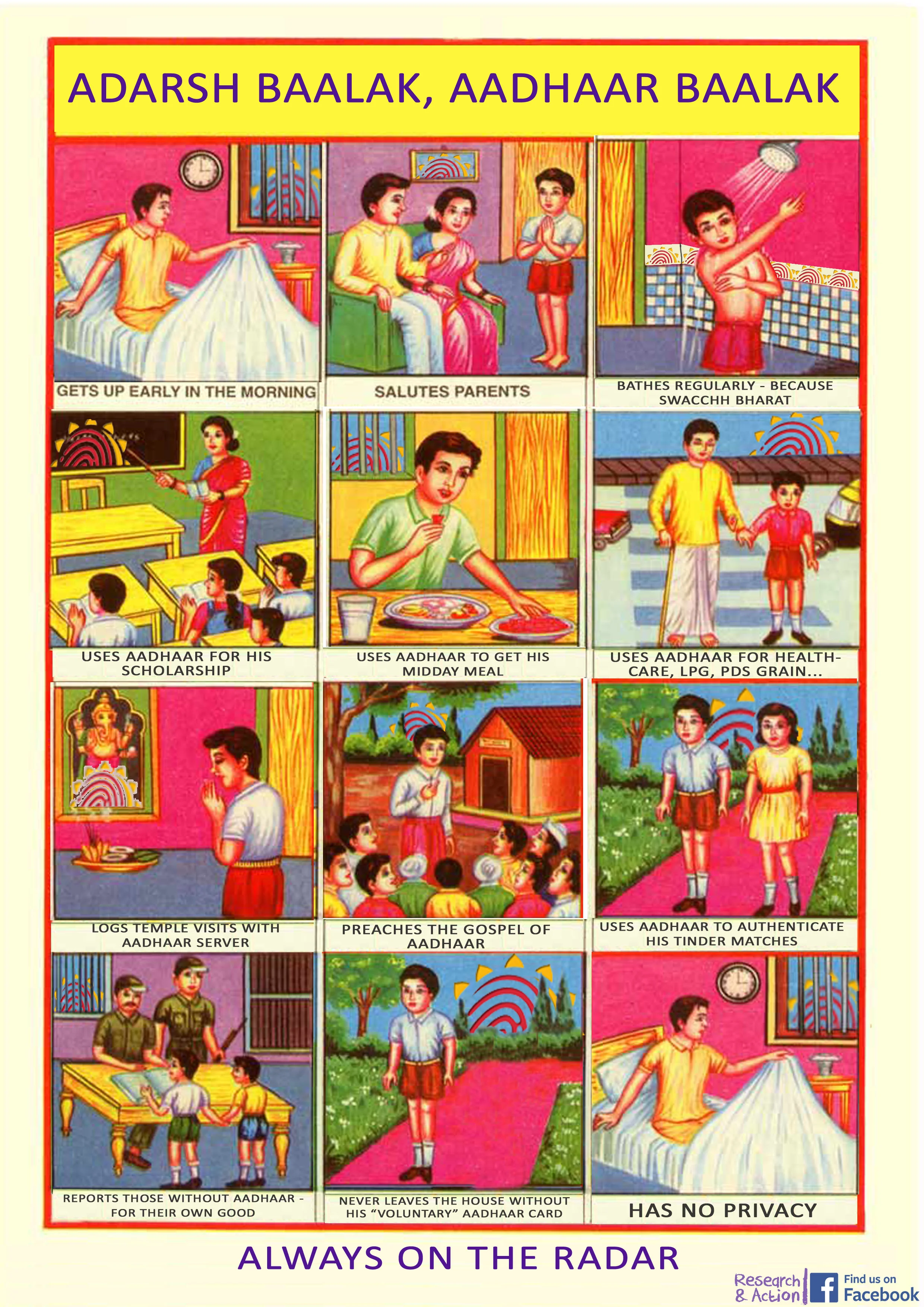 ### 24 Aug 2017 — Supreme Court affirms the Right to Privacy as a fundamental right
> We welcome the judgment of the Supreme Court affirming the Right to Privacy as a fundamental right. This is a historic day. This judgment comes to us after a reference in the Aadhaar cases starting in in 2012 where the Union Government in August 2015 argued that the fundamental right to privacy doe
Original: https://rethinkaadhaar.in/blog/2017/8/24/supreme-court-affirms-the-right-to-privacy-as-a-fundamental-right
### 24 Aug 2017 — Supreme Court affirms the Right to Privacy as a fundamental right
> We welcome the judgment of the Supreme Court affirming the Right to Privacy as a fundamental right. This is a historic day. This judgment comes to us after a reference in the Aadhaar cases starting in in 2012 where the Union Government in August 2015 argued that the fundamental right to privacy doe
Original: https://rethinkaadhaar.in/blog/2017/8/24/supreme-court-affirms-the-right-to-privacy-as-a-fundamental-right
We welcome the judgment of the Supreme Court affirming the Right to Privacy as a fundamental right. This is a historic day.
This judgment comes to us after a reference in the Aadhaar cases starting in in 2012 where the Union Government in August 2015 argued that the fundamental right to privacy does not exist under the Constitution. Since then the government and UIDAI, the agency managing the Aadhaar database, have consistently argued in Court that Indians have no fundamental privacy and that privacy is a concern only of the elite. These pernicious arguments have finally been laid to rest.
The unanimous judgment unequivocally recognises the fundamental right to privacy. Today, the majority judgment states what should never have been in doubt that the people of this country have the fundamental right to privacy, whether rich or poor. There can be no waiver of fundamental rights under any circumstances.
The judgment recognises the efforts of the government to formulate a data protection law. Any law, including a data protection law, that might be formulated will have to make sure that it protects the people's right to privacy. Any policy can be tested on whether it breaches the right to privacy.
The Union Government had attempted to subvert the Aadhaar matters by referring it to a 9 judge bench of the Supreme Court. Now that the Supreme Court has taken a decision in favour of the petitioners, this means that the field is clear for the Aadhaar now to finally resume hearing by a smaller bench.
We welcome an early hearing of the Aadhaar petitions.
The State has been put on notice that it must protect our right to privacy.
Help us help you
Chronology of the case
September 2013: SC tells UPA government that Aadhaar cannot be made mandatory for any services.
July-August 2015: NDA Government tells SC that it plans to make Aadhaar mandatory for a range of services. Attorney General M Rohatgi argues citizens have no fundamental right to privacy, shocking everyone. SC says a constitution bench will decide on this.
August 2015: SC limits use of Aadhaar to the Public Distribution System, only on voluntary basis
October 2015: SC allows Aadhaar to be used in four more schemes, purely on voluntary basis
March 2016: NDA Government passes Aadhaar Act as a money bill bypassing Rajya Sabha where it lacks majority. Pushes Aadhaar in over 50 schemes, making it mandatory.
June 2017: SC forms constitution bench to decide right to privacy, after a wait of nearly two years
Read our earlier post on this historic judgement.
Supreme Court image credit Legaleagle86 [CC BY-SA 3.0], via Wikimedia Commons
सर्वोच्च न्यायालय स्पष्ट रूप से निजता को एक मौलिक अधिकार मानता है
आधार के मामले में केंद्र सरकार ने अगस्त 2015 में कहाँ था कि भारत के संविधान के अनुसार निजता एक मौलिक अधिकार नहीं है. तबसे सरकार व Unique Identification Authority of India (UIDAI) जो एगेंसी आधार के डेटाबेस के प्रबंधन के लिए ज़िम्मेदार है, दोनों ने न्यायालय में यह बार बार कहा है कि भारतीयों का निजता का कोई मौलिक अधिकार नहीं है और निजता केवल अभिजात वर्ग की चिंता है. इन हानिकारक तर्कों का आज समापन हो गया है.
संविधानिक पीठ का आज का एकमत फैसला स्पष्ट रूप से निजता को एक मौलिक अधिकार मानता है. इस बहुमत फैसले ने जो कहाँ है वह संदेह का मुद्दा होना ही नहीं चाहिए था: कि निजता इस देश के लोगों का एक मौलिक अधिकार है, चाहे वे अमीर हो या गरीब. किसी भी स्थिति में मौलिक अधिकारों का हनन नहीं हो सकता.
यह फैसला सरकार की डेटा की रक्षा करने के लिए कानून बनाने के प्रयासों को मानता है. भविष्य में बने किसी भी कानून को, डेटा की रक्षा करने के लिए बनाए गए कानून को भी, यह सुनिश्चित करना होगा कि वह लोगों के निजता के अधिकार को बचाए रखे. किसी भी नीती को इस बात पर परखा जा सकता है कि वह निजता के अधिकार का हनन करती है या नहीं.
सरकार ने निजता के अधिकार का मामला सर्वोच्च न्यायालय की एक नौ जजों की पीठ के हवाले कर दिया था. चूंकि सर्वोच्च न्यायालय ने याचिकाकर्ताओं के पक्ष में फैसला सुनाया है, अब आधार के मामले की सुनवाई एक छोटी पीठ के द्वारा पुनः शुरू हो सकती है.
हम आधार की याचिकाओं की जल्द सुनवाई का स्वागत करते हैं.
सरकार को यह सूचित कर दिया है कि वह हमारे निजता के अधिकार की रक्षा करे.
मामले का कालक्रम
सितम्बर 2013: सर्वोच्च न्यायालय UPA सरकार को कहती है कि आधार कोई भी सेवा के लिए अनिवार्य नहीं बनाया जा सकता.
जुलाई 2015: NDA सरकार सर्वोच्च न्यायालय को कहती है कि उसका आधार को कई सेवाओं के लिए अनिवार्य बनाने का इरादा है. अटर्नी जेनरल मुकुल रोहतगी यह बोलकर कि नागरिकों को निजता का कोई मौलिक अधिकार नहीं है सबको चौका देते हैं. सर्वोच्च न्यायालय कहता है कि इस बात का निर्णय संविधानिक पीठ करेगी.
अगस्त 2015: सर्वोच्च न्यायालय आधार का प्रयोग जन वितरण प्रणाली तक सीमित करता है, वह भी स्वैच्छिक रूप से.
अक्टूबर 2015: सर्वोच्च न्यायालय चार अन्य योजनाओं में आधार के प्रयोग की अनुमति देता है, पर केवल स्वैच्छिक रूप से.
मार्च 2016: सरकार आधार कानून को एक मनी बिल के रूप में पारित करती है, जिससे राज्य सभा से मंजूरी नहीं लेनी पड़े, जहां उसका बहुमत नहीं है. आधार को 50 से अधिक योजनाओं के लिए अनिवार्य बनाती है.
जून 2017: लगभग दो वर्षों के इंतज़ार के बाद सर्वोच्च न्यायालय निजता के अधिकार पर निर्णय लेने के लिए संविधानिक पीठ का गठन करती है.
आज के फैसले की पृठभूमि के लिए: https://rethinkaadhaar.in/blog/2017/8/24/explainer-what-is-the-right-to-privacy-judgement-all-about
अधिक जानकारी के लिए संपर्क करें contact@rethinkaadhaar.in को लिखें.
Engage with us on Twitter:
### 23 Aug 2017 — Get ready for the right to privacy judgement by the Supreme Court > Tomorrow the Supreme Court of India will decide whether or not Indian citizens have a fundamental right to privacy. This historic decision will have far reaching consequences. A bench of nine judges including the Chief Justice of India, Justice Khehar, Justices Jasti Chelameswar, SA Bobde, RK Agarwa Original: https://rethinkaadhaar.in/blog/2017/8/23/get-ready-for-the-right-to-privacy-judgement-by-the-supreme-courtTomorrow the Supreme Court of India will decide whether or not Indian citizens have a fundamental right to privacy. This historic decision will have far reaching consequences. A bench of nine judges including the Chief Justice of India, Justice Khehar, Justices Jasti Chelameswar, SA Bobde, RK Agarwal, Rohinton Nariman, AM Sapre, DY Chandrachud, SK Kaul and S Abdul Nazeer have heard the case.
The 9-judge bench deciding this was constituted in August 2015 following a reference made in the Aadhaar/UID case (Puttuswamy & Anr WP Civil No. 494 of 2012) almost 2 years ago. Petitioners, activists, academics and lawyers skeptical of the Aadhaar project have been waiting since then for the resolution of the question of whether or not a fundamental right to privacy will be recognized by the Supreme Court. In the interim period, the Government of India blatantly violated the prior orders of the Court restraining the use and expansion of Aadhaar. As the project has grown, so has awareness of its multiple shortcomings and of the threat it poses to the security and welfare of the country.
It is important to remember that the Union of India has repeatedly in its arguments pressed and submitted that no fundamental right to privacy exists. It has in the course of these, and earlier hearings, almost ludicrously, denied the existence of people’s rights over their own bodies.
We have faith and hope that the highest Court of this land will in its wisdom recognize the fundamental right to privacy tomorrow. But whatever the decision of the Court, this means that the Aadhaar matters will finally resume normal hearing.
Evidence is mounting of exclusion, devastation of welfare programs, inadequacy of legal protections, the threat of mass surveillance and the weakening of national security. The decision tomorrow means that we must be prepared to increase awareness and bring the Court’s attention to the massive violation of people’s rights that is the Aadhaar project.
Engage with us on Twitter:
### 17 Aug 2017 — Activists, Scholars Respond to Various Issues Raised by Dr Ajay Bhushan Pandey, CEO UIDAI > On 8th Aug, 2017, a press conference was organized in Delhi by Satark Nagrik Sangathan, Mazdoor Kisan Shakti Sangathan, Right to Food Campaign and Delhi Rozi Roti Adhikar Abhiyan to expose the claims of the Government about the benefits of Aadhaar. In response to the press conference, the Original: https://rethinkaadhaar.in/blog/2017/8/17/responce-to-various-issues-raised-by-ceo-uidaiOn 8th Aug, 2017, a press conference was organized in Delhi by Satark Nagrik Sangathan, Mazdoor Kisan Shakti Sangathan, Right to Food Campaign and Delhi Rozi Roti Adhikar Abhiyan to expose the claims of the Government about the benefits of Aadhaar. During the recently concluded hearings on privacy in the Supreme Court, the government made tall claims about Aadhaar ensuring food security for millions of people. The Prime Minister in February 2017, in Parliament, stated that the use of Aadhaar and technology had helped weed out 3.95 crore bogus ration cards. However, experience on the ground and information accessed under the RTI Act shows that such claims are not backed by evidence.
In response to the press conference, the media reported Dr. Ajay Bhushan Pandey, CEO UIDAI, as saying that the findings “arise from a skewed approach” and “misinterpretations”. Further, it was reported that according to him, “to claim that Aadhaar is responsible for denial is a misconstrued fact presented with malafide intent”.
Anjali Bhardwaj, Nikhil Dey, Dipa Sinha & Amrita Johri have written to Dr. Ajay Bhushan Pandey, replying to the various issues raised by him. The contents of the letter are below and can be downloaded here.
Help us help you
Dr. Ajay Bhushan Pandey
CEO
UIDAI
Date: 17-8-2017
Dear Dr. Pandey,
We are a group of activists who have been working for many years with socially and economically marginalized communities in rural and urban India. We write to you with reference to the comments made by you, as reported in the media, in response to a press conference organized in Delhi by Satark Nagrik Sangathan, Mazdoor Kisan Shakti Sangathan, Right to Food Campaign and Delhi Rozi Roti Adhikar Abhiyan on the 8th of August 2017.
At the press conference, the following documentation and evidence was presented:
- Information obtained under the RTI Act which showed that there was no official data to corroborate the Prime Minister’s statement made in the Lok Sabha on February 7, 2017 that nearly 4 crore bogus ration cards had been detected through use of technology and Aadhaar.
- Statistics indicating that as of July 2017, only 67% of NFSA ration card holders in Rajasthan (identified by Government and seeded with Aadhaar) were able to procure their rations from the PDS outlets. The figures discussed (33% exclusion) were from the Food Department website of Government of Rajasthan.
- Interim findings from a field study conducted by IIT Delhi in collaboration with Ranchi University indicating continued quantity fraud, higher transaction costs and hardship as well as outright exclusion of the most vulnerable since the introduction of Aadhaar-Based Biometric Authentication (ABBA) in the PDS in Jharkhand.
- Testimonies of people from Delhi, including homeless people, some of whom have also filed affidavits in the Delhi High Court, explaining the different ways in which they have been unable to access ration entitlements since Aadhaar was been made mandatory for obtaining a ration card in Delhi.
On the 10th of August 2017, the media (Times of India and syndicated feed from PTI) quoted you as saying that our findings “arise from a skewed approach” and “misinterpretations”. Further, the report states that according to you, “to claim that Aadhaar is responsible for denial is a misconstrued fact presented with malafide intent”.
We were surprised and distressed to read these comments for many reasons: Some of us belong to organisations and networks who have been working for peoples’ empowerment for decades. We have carefully watched Aadhaar and its impact on the ground as it has been rolled out. Had Aadhaar in fact been a means of inclusion, empowerment, anti-corruption and efficiency in delivering entitlements to the poor and marginalized, we would have had no hesitation in presenting what we saw, and congratulating the government for its success. However, what we have seen is that as a result of the multiple government directions making Aadhaar mandatory for accessing rights and entitlements, countless numbers of people have been put through great distress to access their entitlements. We see it as our duty to put this information in the public domain, and hope that Government officials, such as yourself, would take cognizance and try and immediately find a remedy.
Unfortunately, you have been reported as questioning our presentation, and as having stated, that we have “malafide intent”. We would like to know what you base your comments upon, including having determined the malafide nature of our intent.
The suffering caused to people due to mandatory Aadhaar linking and biometric authentication can be witnessed across the country. However, we confined ourselves to Delhi, Rajasthan, and Jharkhand, because this was information backed by official statistics and/or detailed enquiry and testimonies. We would like to point out that in an ongoing matter before the Delhi High Court, scores of affidavits have been filed by people documenting how either they themselves or members of their family have been excluded from the National Food Security Act as they did not possess Aadhaar at the time when ration cards were being made.
The data available on the website of the Department of Food, Rajasthan shows that since September 2016, when Aadhaar based biometric authentication was made mandatory in the state, 25% to 33% per cent of ration card holders are not getting their rations. That amounts to more than 25 lakh families, or more than a crore of the most vulnerable people (http://food.raj.nic.in/). Similarly, according to publicly available data on the state food department website of Jharkhand (http://aahar.jharkhand.gov.in/), a substantial proportion of households in the state are not getting their monthly grain entitlements since Aadhaar based biometric authentication was introduced in the PDS - even 10% exclusion would mean 25 lakh people. It is distressing to note that despite such large scale exclusions of the poor and marginalised, the government has not been able to explain the reasons why these people have been unable to access their ration entitlements and has not taken adequate steps to remedy the problems.
Despite, official government data and evidence from the ground to the contrary, we are surprised to note that the report quotes you as saying, “Aadhaar is a technology of people's empowerment and not a tool of exclusion or denial as claimed by some activists”. All the points put forth at the press conference were backed by evidence which is publicly available, and have been shared by us through multiple platforms and fora. As you know, the Supreme Court has repeatedly stated that Aadhaar cannot be made mandatory for availing services. The Rajasthan High Court also passed an order that no beneficiary could be denied rations due to Aadhaar. We regret that the Government continues to audaciously violate the orders of the Courts. In addition, it is disturbing that instead of resolving to take corrective action on account of exclusion cased due to Aadhaar linking and biometric authentication, the Government and the UIDAI are focusing their energies on denial and escaping from dealing with redressing the core issues.
The report quotes you as saying that Aadhaar “has never claimed to be a panacea for all ills and dishonesty or acts of unscrupulous elements”. In fact, we have, for the last several years, been pointing out that Aadhaar cannot help address problems of quantity fraud, quality fraud and overcharging, which form the bulk of the corruption in the PDS. Such corruption can only be addressed if there are proper mechanisms of transparency, accountability and grievance redress which in real terms empower people to report problems in accessing their entitlements and getting redress in a time-bound manner. Grievance redress mechanisms, if any exist, remain completely ineffective, an issue on which the Supreme Court also recently expressed its disappointment and summoned chief secretaries of various states.
Further, as per the media report you said, “if a person is denied because he does not have Aadhaar or he is unable to biometrically authenticate, it is undisputedly a violation of instructions issued by the government and such violators have to be punished”. Even people like us do not know where to go, and have little knowledge of any such punishment that might have been ordered and carried out. We would like to request you to make public a copy of all such instructions issued by the government, especially in the context of Delhi, Jharkhand and Rajasthan, including the punishment that violators are liable to face. Also, kindly put the list of violators who have been punished in the last 3 years in the public domain. The information being requested for is mandated to be put out in the public domain by UIDAI as a public authority as per Section 4 of the Right to Information Act. With this letter we are enclosing a copy of the RTI application we have filed in this regard.
We would urge the UIDAI and Government of India to organize a platform for public discussion where evidence on the impact of biometric authentication and use of Aadhaar in the delivery of public services can be presented in the public domain. We would appreciate if you would also invite us to the public discussion so that we could present our findings. In any case, we would like to organize a public dialogue, which we would like to request you to attend. If you agree, we will fix a mutually convenient time and place.
Thank you
Best wishes and regards,
Anjali Bhardwaj, Nikhil Dey, Dipa Sinha & Amrita Johri
Engage with us on Twitter:
### 16 Aug 2017 — We are looking for an intern > We are looking for an intern who will work on Rethink Aadhaar’s communications and outreach efforts, as well as monitoring developments and news on the Aadhaar project, which is now the world’s largest biometrics database. The person will be mentored and guided by several Rethink Aadhaar campaign m Original: https://rethinkaadhaar.in/blog/2017/8/16/call-for-internsWe are looking for an intern who will work on Rethink Aadhaar’s communications and outreach efforts, as well as monitoring developments and news on the Aadhaar project, which is now the world’s largest biometrics database.
The person will be mentored and guided by several Rethink Aadhaar campaign members, who work in areas of law, social policy, economics research, and advocacy.
Deadline
The target start date for the internship is September 2017 – so apply soon!
Interns can expect to undertake the following responsibilities:
- Track developments related to Aadhaar project in parliament and state legislature discussions, public records, government notifications
- Follow ongoing Right to Privacy, and Aadhaar legal challenge hearings in the Supreme Court
- Visit Aadhaar enrolment centers, other facilities, fair price shops, to research and document facts on Aadhaar enrolment and authentication through articles, blogposts, short videos
- Assist in the drafting of press releases in English/Hindi, and performing other related duties as required including the Rethink Aadhaar campaign’s social media presence
Some of the benefits of interning at Rethink Aadhaar include:
- Develop research and organization skills
- Deeper understanding of the communications and policy environment on Aadhaar project
- Grow a network and get familiar with the policy and advocacy space in New Delhi.
- Work in a motivated group of individuals in a campaign who share data, and findings from the ground on experience of citizens in the Aadhaar project
Qualifications
Ideally, candidates are recent graduates or students of Law, Communications, Journalism, International Relations, Public Policy, Economics, Political Science, Sociology, or related fields. This is a great opportunity for someone who’s looking for experience to understand how legal and parliamentary research is done, as well as the work of grassroots campaigns in the social policy space.
- While a legal background is not required, a working knowledge of legal debate over and background of Aadhaar project is highly favourable
- A genuine interest in human rights, social policy, field research
- Good written communication skills
- Motivated to work and learn
Location
The internship will be in New Delhi. We will try to provide office space as and when required, but we are counting on your interest and motivation to get work done at home
Time Commitment and Terms
- This position will start in September 2017. The duration of the position will be two months, and can be extended
- It is open to candidates finishing studies, who need a flexible schedule
- The internship will not be remunerated, but we will provide support for any travel related to research or documentation on Aadhaar scheme’s implementation
- We will try provide need-based stipends
Application Requirements
To apply, send a copy of your CV and a brief cover letter explaining your interest and qualifications for the position, and one reference to contact@rethinkaadhaar.in. Please use “Internship Application– [Your Name]” as the subject line.
Women, Adivasi, Dalit individuals are encouraged to apply.
### 11 Aug 2017 — The Tyranny of Aadhaar newsletter, Aug 2017 > Here is the Aug edition of the Tyranny of Aadhaar newsletter, bringing you the real state of Aadhaar roll-out and how it affects crores of Indians across states. So far, the only real beneficiary of Aadhaar is: the State & Corporates, not the citizens. We share relevant data, and findings fr Original: https://rethinkaadhaar.in/blog/2017/8/11/the-tyranny-of-aadhaar-newsletter-aug-2017Here is the Aug edition of the Tyranny of Aadhaar newsletter, bringing you the real state of Aadhaar roll-out and how it affects crores of Indians across states. So far, the only real beneficiary of Aadhaar is: the State & Corporates, not the citizens. We share relevant data, and findings from the ground on experience of citizens in the Aadhaar project to sift through the false claims made about the biometrics project. Join us in demanding freedom from this new form of digital slavery 70 years after we won Independence.
LEGAL STATUS OF AADHAAR UP IN THE AIR
In 2015, the NDA government in the ongoing Aadhaar case claimed that there is no fundamental right to privacy in India. After a nine judge is expected to decide on the Right to Privacy case by end of August, a smaller bench will decide on the Aadhaar case, even as Government continues to hurry to make people enroll in it.
As we wait for the Supreme Court judgement on the Right to Privacy, National Law University Delhi academic Chinmayi Arun writes on why the right to privacy is vital, and why a few wrong questions trying to equate the right to privacy with a mere post-Aadhaar data protection framework should not be allowed to derail the legal case.
Faizan Mustafa, vice chancellor NALSAR University Hyderabad wrote in The Indian Express stressing that a fundamental right to privacy must be reiterated by court. He stressed how global experience shows that the denial of privacy neither promotes national security nor curbs terrorism, and merely takes away citizen’s freedom to be left alone and curtailing his/her choice in personal decisions.
It is heartening to see signs of a subtle shift in the editorial stand of various leading national dailies:
- Indian Express calls upon the Supreme Court to Build a Fortress,
- Business Standard calls upon the Govt to take a clear stand on the right to privacy and
- Hindu Business Line say that Data protection is not a substitute for a right to privacy but the two are interlinked
Help us help you
NEW EVIDENCE FROM RTI
To press reports that Aadhaar had helped remove 1 crore “fake” MNREGA cards, when economist Dr Jean Dreze filed an RTI application, the Rural Development Ministry responded that so-called “fake” and “duplicate” job cards account for less than 13% of all 94 lakh deletions in 2016-7. Over 85% deletions were on account of a change in address, mistakes on job cards, people who wanted to surrender their job card etc. With more than 12 crore job cards in the country, duplicate and fake job cards thus account for barely 1 per cent of all job cards according to government's own data.
IIT-Delhi researchers did a survey on use of Aadhaar biometric authentication in the public distribution system. At the same time, a number of ground reports documented the effects based on interviews with beneficiaries.
- How Aadhaar And Digitisation Compounded Problems Of Corruption, Leakages And Exclusion
- Aadhaar Link to Welfare Schemes is Excluding the Most Needy
- Poorest are being kicked out of PDS due to Aadhaar
After filing Right to Information requests, researchers, social activists were surprised to find the government has no evidence on its claims on “savings” from the Aadhaar linking.
In response to Prime Minister Narendra Modi’s statement in parliament that Aadhaar and technology helped detect nearly 4 crore bogus ration cards in just over two years, transparency activist Anjali Bhardwaj filed a RTI request with PMO which transferred to the Ministry of Food. The ministry and state food departments have responded that they do not have proof to match the claims made by the prime minister. Surprisingly, while the video of prime minister’s parliament speech shows him clearly saying “4 crore, meaning 3.95 crore”, the edited parliament debate transcripts now reflects this number as “4 crore, meaning 2.33 crore”!
EXCLUSION FROM ESSENTIAL SERVICES
In recent weeks, there has been a vital debate on various aspects -- reality of claims on savings, inclusion, security -- of Aadhaar project, and the implications on our rights as citizens.
Jean Dreze's piece on Dissent and Aadhaar in Indian Express led to a response from UIDAI’s CEO Ajay Bhushan Pandey.
In response to his particular claim that Aadhaar “empowers” citizens, Reetika Khera wrote demolishing Pandey's claims on savings with data.
Nikhil Dey and Aruna Roy wrote about the devastation caused by Aadhaar in welfare programmes in Rajasthan where 34 lakh families or nearly 1 crore people are unable to get their entitlement to foodgrains in the biometric authentication system.
UIDAI CEO Pandey repeated his statements and dismisses the “collateral damage” done by Aadhaar in various contexts.
Dreze responds that the fixation with Aadhaar seems to blind the UIDAI to the severe damage Aadhaar often causes on the ground, and points to its surveillance potential that if the government decides to use Aadhaar as a tool of surveillance, the UIDAI (or the Aadhaar Act for that matter) is unlikely to stop it from doing so.
In another analysis in Mint, Sumit Mishra, who teaches at Institute of Financial Management and Research critiqued the “mindless expansion” of Aadhaar linkage, in the absence of an independent cost and benefit analysis.
SECURITY CONCERNS GROWING
Karnataka police have arrested a software development engineer working at cab aggregator Ola, and against Quarth Technologies, for illegally accessing Aadhaar numbers and personal details of 40,000 Aadhaar holders. The UIDAI have accused them of stealing Aadhaar data over a period of seven months from January 1 to July 26 this year.
Under Aadhaar Act, display of Aadhaar numbers if prohibited, even as Government is continuously pushing its linking everywhere and has done little to keep Aadhaar number confidential in design.
A Punjab Government website recently displayed 20,000 residents’ Aadhaar numbers. Links were removed later but PDF files remained online a day after being pointed out, reported HT.
After brushing questions over Aadhaar as elitist, and people raising valid questions as “vested interests”, Nandan Nilekani, founder chairperson of the UIDAI, admitted in the Economic Times that Aadhaar security was going to be a “big concern”, and already several attempts of identity fraud by re-setting of one-time passwords provided by residents against their Aadhaar numbers had been detected.
Cover illustration by C R Sasikumar (Indian Express)
Engage with us on Twitter:
### 9 Aug 2017 — Press Conference on 8th Aug, 2017 to expose GoI's false claims about benefits of Aadhaar > A press conference was held on 8th August 2017 to question the claims of the government about savings due to Aadhaar and about the benefits of Aadhaar in welfare programs and schemes. On February 7, 2017, the Prime Minister in the Lok Sabha stated that use of Aadhaar and technology led to the disco Original: https://rethinkaadhaar.in/blog/2017/8/9/press-conference-on-8th-aug-2017-to-expose-gois-false-claims-about-benefits-of-aadhaarPress release, 8th Aug, 2017
A press conference was held on 8th August 2017 to question the claims of the government about savings due to Aadhaar and about the benefits of Aadhaar in welfare programs and schemes.
On February 7, 2017, the Prime Minister in the Lok Sabha stated that use of Aadhaar and technology led to the discovery of nearly 4 crore (3 crore 95 lakhs) bogus ration cards. Since no details of these 3.95 crore ration cards was available online, an RTI application was filed by Anjali Bhardwaj to the Prime Minister’s Office (PMO) seeking state-wise break-up of the 3.95 crore bogus rations cards and the names and addresses of all those whose cards were cancelled. The PMO transferred the RTI application to Department of Food & Public Distribution (DFPD). DFPD replied stating that information about the state-wise number of bogus ration cards was available on their website. On the website of the DFPD, a file titled “Deletion of bogus ration cards by States/UTs” is available. This file provides the state-wise “Statement showing the number of bogus/ineligible rations cards deleted by the State/UT Governments with effect from July 2006 onwards” and was “Updated on 16.02.2016”. Anjali Bhardwaj said that the file on the website of the Ministry is not related to the statement of the PM as it neither pertains to the time period mentioned by the PM nor does it state that the cards were found to be bogus due to technology or Aadhaar. Further, the figures provided in the file do not match with the figures stated by the PM.
With respect to the question dealing with the names and addresses of those whose cards were cancelled, the RTI application was transferred to all the State/UT governments by the Department of Food & Public Distribution (DFPD). Till date 25 states/UTs have sent letters/replies to the RTI application which was transferred to them. 13 states have replied stating that there are no bogus ration cards. For details of the responses received from states, please see the folder attached.
Therefore, despite the passage of more than 5 months since seeking information under the RTI Act the government has not been able to provide information/ evidence on the basis of which the PM made the statement in the Lok Sabha. While the video of the proceedings and the uncorrected record of Lok Sabha of 7th February 2017 mentions the number of bogus ration cards as nearly 4 crore, meaning 3 crore 95 lakhs, the corrected version of the debate states 4 crore, meaning 2 crore 33 lakhs. It is not clear why the content of the PM’s speech has been changed as the video clearly shows the figure as being- 4 crore, meaning 3 crore 95 lakhs bogus ration cards.
Similarly, recently the media quoted government officials as stating that 1 crore fake job cards had been found during the process of cleaning up by seeding with Aadhaar etc. Jean Dreze filed an RTI application which showed that so-called “fake” and “duplicate” job cards account for less than 13% of all deletions in 2016-7 which were 94 lakh. Other deletions were on account of a change in address, mistakes on job cards, people who wanted to surrender their job card etc. Bearing in mind that there are more than 12 crore job cards in the country, according to official data, duplicate and fake job cards account for barely 1 per cent of all job cards according to this tally.
The speakers demanded that the government must provide the evidence and basis of all such statements as eventually such figures inform policy decisions and public discourse. Nikhil Dey pointed out that in Rajasthan when the government cancelled the pension of more than 10 lakh beneficiaries claiming that these had been weeded out through various reforms including Aadhaar, on ground verification showed the hollowness the claims. In Bhim block, the government had shown that 2900 beneficiaries had been weeded out as they had died, however, a door to door verification showed that more than 1300 of these people classified as dead were in fact alive and were being denied their pensions. He said that this showed the callousness of the administration and exposed why it was urgent that the data be made public so that people can verify it.
The speakers also stated that if the claims of such large scale corruption being weeded out through Aadhaar were indeed true, then the government must also show how many FIRs have been filed till date and what action has been taken against government officials with whose collusion all these bogus cards were made.
The speakers strongly contested the claims of the government that Aadhaar was ensuring food security for millions of people.
Nikhil Dey cited the official data of the Rajasthan government which shows that since September 2016, when Aadhaar biometric authentication was made mandatory in the state, over 25 per cent of ration card holders have been unable to draw their rations. That amounts to 25 lakh families, or more than a crore of the most vulnerable people. The removal of the manual override mechanism, which could be used when biometric authentication failed, has resulted in an additional 5 lakh families being excluded in April and May 2017.
Help us help you
In Ranchi, Jharkhand where the Aadhaar linked biometric authentication system for ration has been operational since 2016, Reetika Khera said that many families were unable to receive their ration for the month of June 2017, as per the data on the official government website. Reetika explained that 25 lakh people are deprived of their grain entitlements on a monthly basis.
A survey undertaken by IIT Delhi in collaboration with Ranchi University, covering about 900 randomly-selected households in 32 villages spread across eight districts in Jharkhand, showed that transaction costs have increased as a result of Aadhaar-Based Biometric Authentication (ABBA). Households report longer queues, increase in the number of trips required, pulling children out of school, etc in order to work the new system. Also, Reetika explained “Katauti” continues more or less as before: Households also report that the ‘cuts’ extracted (in kind) by PDS dealers have remained more or less the same before and after the introduction of ABBA.
Dipa Sinha said that the government was without any evidence making Aadhaar mandatory for all schemes. Recently, the government also issued a notification making Aadhar mandatory for mid-day meal (MDM). She said the main problem in MDM is quality of meal, there is no concrete evidence of attendance inflation. If the government starts doing daily authentication it will be a huge disaster given the problems with biometric authentication especially of children.
Amrita Johri said that the government was suppressing data about failure of the Aadhaar enabled biometric authentication. In Delhi, in 42 shops the Aadhaar linked Point of Sale (POS) devices were piloted. Visits to these shops showed that were several problems regarding connectivity and difficulty in authenticating biometrics especially of the elderly and those engaged in manual labour. In one ration shop, the POS device had to be hung on a tree due to network problems! Yet the report on the pilot, obtained under the RTI Act, makes no mention of these problems, in fact it does not even state whether any site visits were undertaken while compiling the report. The Delhi government is now reportedly pushing through with universalizing the POS devices in all ration shops in Delhi.
Several people from different districts of Delhi testified about the exclusions they are facing as a result of Aadhaar being made mandatory for receiving ration cards. The Delhi Rozi Roti Adhikar Abhiyan has filed a case in the Delhi High Court challenging the government’s notification making Aadhaar mandatory and the court has appointed a local commissioner to look into cases of exclusions.
While the central and state governments have been aggressively pushing Aadhaar as a tool for addressing corruption in ration, despite little evidence to support this, they have failed to operationalise the mandatory transparency, accountability and grievance redress provisions of the law. The National Food Security Law requires every state government to constitute a State Food Commission and appoint District Grievance Redress Officers to receive and redress complaints of people. Further, periodic social audits of the functioning of ration shops and PDS is required to be undertaken along with setting up vigilance committees. Most states have failed to implement these measures and in a recent case, the Supreme Court summoned Chief secretaries of several states and has directed that all these measures must be operationalised by the end of the year.
Anjali Bhardwaj said that in Delhi, an audit of 10% of the ration shops undertaken by Delhi Rozi Roti Adhikar Abhiyan & Satark Nagrik Sangathan found flagrant violations in the functioning of these shops- more than 60% of the ration shops were found to be closed during working hours while several were found to be illegally selling atta. Desite Delhi being one of the first states to roll out the NFSA in 2013, till date, the government has not constituted the State Food Commission and has also failed to operationalise the social audit provisions.
The speakers said that the failure of the governments to implement the accountability provisions of the NFSA showed the lack of political will and commitment towards addressing corruption in the PDS.
The material from today's press conference is available in this folder: https://drive.google.com/open?id=0B3oQ77E3KGKBbzF1Z0tLTW9MWWc
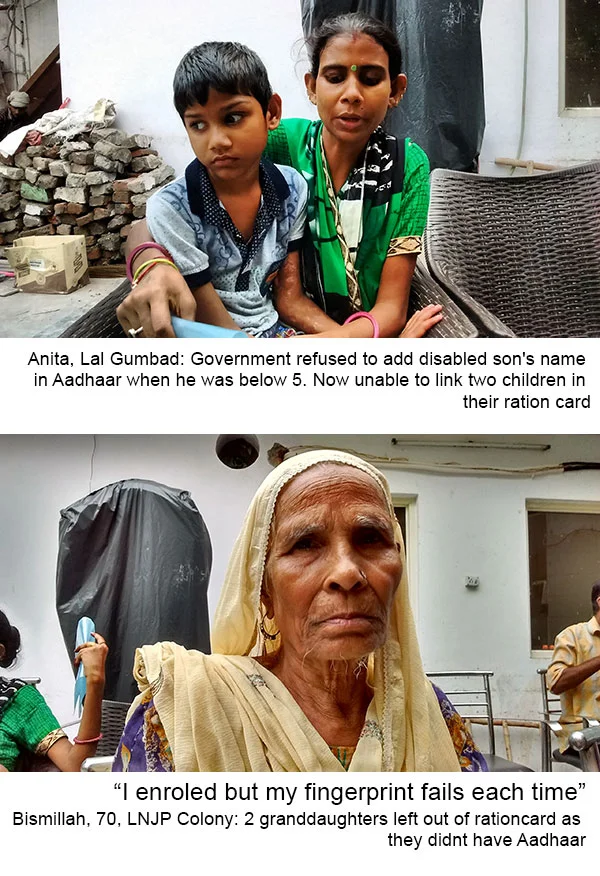
Engage with us on Twitter:
### 2 Aug 2017 — Government’s claim that only wrong-doers need privacy shocks the court > The 9-Judge Constitution Bench concluded hearings to settle the question of whether there exists a fundamental right to privacy in India. The bench has reserved its judgment over whether privacy is a fundamental right in India. The government’s counsels insisted that the Supreme Court should not re Original: https://rethinkaadhaar.in/blog/2017/8/2/governments-claim-that-only-wrong-doers-need-privacy-shocks-the-courtA Summary of the Final Day of the Nine-Judge Constitution Bench Hearing
The 9-Judge Constitution Bench concluded hearings to settle the question of whether there exists a fundamental right to privacy in India. The bench has reserved its judgment over whether privacy is a fundamental right in India. The judgment is expected in the next four weeks.
The government’s counsels again insisted that the Supreme Court should not recognise privacy as a fundamental right. They repeated arguments that privacy is an elite concept, that privacy interests are being only canvassed by a minority of wealthy citizens, and even that only wrong-doers were asking for privacy rights. Counsel for State of Gujarat Rakesh Dwivedi began arguing that privacy is an abstract concept. He referred to how, for medical treatment, it could be waived. At one point, Justice D.Y. Chandrachud asked if recognising a fundamental right to privacy would diminish India's stature as a “knowledge economy” and an economic powerhouse. (The same has also sometimes been asserted by the Aadhaar project’s proponents who have argued “Data is the new oil”, raising questions if citizens’ biometric data provided to government without any real choice should be harvested for commercial use.)
Advocate Gopal Shankaranarayanan, appearing for think-tank Centre for Civil Society argued that if privacy was deemed a fundamental right, it could not be waived and this would be impractical. Lastly, Arghya Sengupta, of think-tank Vidhi Center for Legal Policy, represented the State of Haryana, and the Telecom Regulatory Authority of India, claiming that no new jurisprudence was required as existing right to liberty sufficiently covered privacy on a case to case basis.
A number of senior lawyers with an illustrious record then gave a strong rejoinder to the Government of India, arguing that privacy is a fundamental right. They emphasised that in the 70th year of our Independence, it was extremely regressive of the Government of India to claim that citizens have no fundamental right to privacy. The senior advocates argued for the fundamental right to privacy, irrespective of whether a citizen is rich or poor. They cited examples from Canada, South Africa, and other countries where privacy is recognised as a fundamental right.
Help us help you
Beginning the rejoinder, senior advocate Gopal Subramanium stressed the inalienability of rights, and reminded the court how during the Emergency, citizens have once earlier been deprived of both, the right to liberty, and privacy. Senior advocate Kapil Sibal representing State of Karnataka added that privacy was the at the heart of diversity, and liberty.
Next, Mr Shyam Divan reiterated to the Bench that the right to privacy case is not just about information sharing, but about bodily integrity and about surveillance. Privacy is at the core of personal freedom and must be constitutionally protected because statute law is insufficient to protect the interests at stake, he argued.
Senior advocate Meenakshi Arora submitted that fundamental rights have no fixed content. They are empty vessels into which each generation pours its wisdom. She argued that the State cannot say, “I will give you welfare if you give away privacy”, as that would affect the rights of the most vulnerable.
Mr. Arvind Datar revisited that the Court has filled in the structure of rights with life. He emphasised that privacy is as important as life. He posited that the Court must consider the consequences if it holds that privacy is not a fundamental right. Constitutional protections previously established will be harmed, he argued.State of Kerala counsel P.V. Sundaresan dismissed the state's claims of privacy being fluid as irrelevant, and said the fundamental right to privacy could not be denied on such grounds.
The judgement is expected by August 28, as the current Chief Justice of India J.S. Khehar’s term ends then. Subsequent to the judgment by this 9-judge Constitution Bench, the fate of the pending Aadhaar cases which challenge government notifications to make Aadhaar mandatory in a number of essential services, will be decided.
Further reading:
Opinion: Aadhaar, rights and the state
Live tweets from the Supreme Court today:
<To be updated shortly>
Engage with us on Twitter:
### 1 Aug 2017 — Govt claims that right to privacy will make the poor suffer > The 9-Judge Constitution Bench continued hearing the arguments of the Government of India to settle the question of whether there exists a fundamental right to privacy in India. In August 2015, the Government of India denied that a fundamental right to privacy exists in India in the ongoing Aadhaar Original: https://rethinkaadhaar.in/blog/2017/8/1/govt-claims-that-right-to-privacy-will-make-the-poor-sufferA Summary of Day 5 of the Nine-Judge Constitution Bench Hearing
The 9-Judge Constitution Bench continued hearing the arguments of the Government of India to settle the question of whether there exists a fundamental right to privacy in India. In August 2015, the Government of India denied that a fundamental right to privacy exists in India in the ongoing Aadhaar case. After the 9-judge bench finishes hearings on the limited question of whether Indians have a fundamental right to privacy, a 5-judge bench is then expected to rule on whether the Aadhaar scheme violates such a fundamental right and will thereby decide the fate of the Aadhaar project.
On Tuesday, counsel for Maharashtra CA Sundaram continued to argue for the state that the framers of the Constitution did not include right to privacy as a fundamental right. He claimed that since the framers excluded it, the court could not now read this into the Constitution. Justice Chandrachud objected it was not fair to say that there was a categorical exclusion of privacy by the framers of the Constitution.
The Additional Solicitor General Tushar Mehta then continued on the same lines. He also repeatedly also stressed that the court should not lay down any fundamental right to privacy as only Parliament can make law on the subject. He also provided a list of countries that do not provide a fundamental right to privacy which included China, Israel and the Kingdom of Saudi Arabia. He even included countries that do not even have a Bill of Rights or any written constitution.
The ASG also submitted before court that a government committee has been constituted for framing a right to privacy. The letter is signed off by the Cyber Law and Aadhaar officer at MEITY. The Rethink Aadhaar campaign notes the composition of the committee with concern and holds a reasonable apprehension that this may be an exercise to accommodate concerns around Aadhaar.
The ASG on Tuesday again cited the PUCL versus Union of India Right to Food case and argued that Aadhaar is intended to reform the public distribution system. But the Right to Food Campaign has strongly opposed use of Aadhaar in nutrition schemes such as ration and mid day meals, and has even challenged government making Aadhaar mandatory for food rations in Delhi High Court and Karnataka High Court.
Mehta again and again termed that privacy was a "perceived" right, and one which concerns only the elite.The ASG claimed if privacy is a fundamental right, then it will have a huge impact on “good governance through Aadhaar”, and the poorest of the poor would suffer if a “perceived” right to privacy is recognised by the Hon’ble Supreme Court!
Help us help you
Arguing after the ASG, Counsel for Gujarat Rakesh Dwivedi conceded that right to choose and decisional autonomy is a part of Article 21. But only that there's no confidentiality in identity information, so you cannot say no to parting with phone number etc. To this, Justice Nariman asked, can it not be said that every time one gives a mobile number, for example, is there is no reasonable expectation that it is used only for that purpose and no other purpose? This claim lead again to the question then if Aadhaar can be made mandatory at all.
Government data shows lakhs of low income households, pensioners are not able to access their food rations because of errors in Aadhaar seeding, network failures, and biometric failures, the Right to Food Campaign had said in a statement on July 24 in response to the central government’s arguments in the same Right to Privacy case.
The government is expected to complete its submissions on Wednesday.
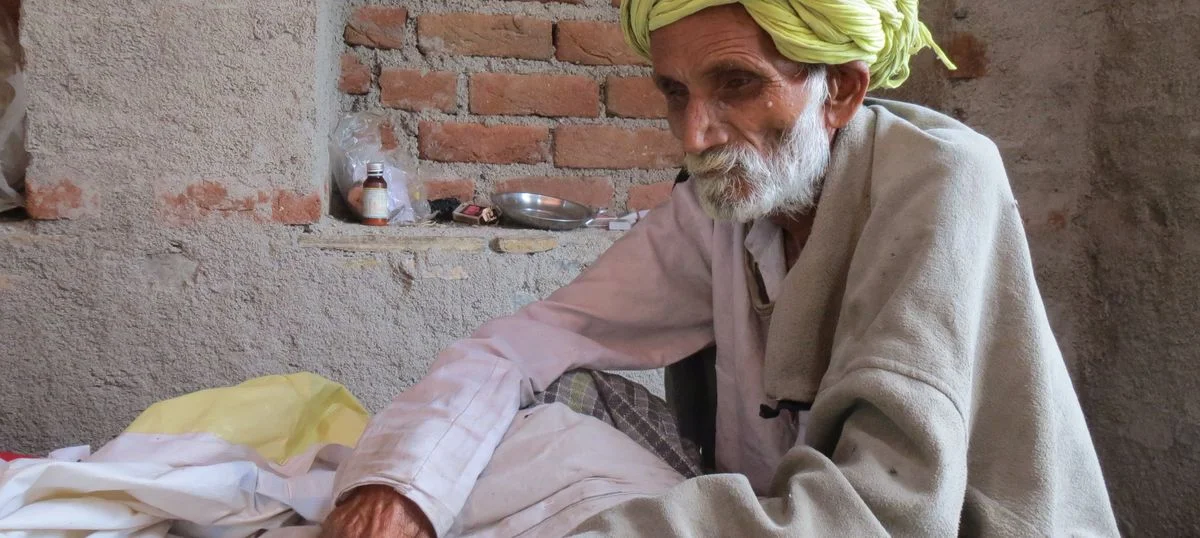
Cover image: Hazaari Singh, 70, a resident of Kushalpura, Rajsamand, Rajasthan who stopped getting pension last October because of Aadhaar data entry errors. (Scroll.in)
Further reading:
Aadhaar disrupting food security: Right to Food Campaign
Shocked by Centre’s stand that Aadhaar is necessary for welfare programmes: Right to Food Campaign
Live tweets from the Supreme Court today:
Engage with us on Twitter:
### 27 Jul 2017 — Government of India ties itself in knots in #RightToPrivacy Case > The 9-Judge Constitution Bench continued hearing the arguments of the Government of India to settle the question of whether there exists a fundamental right to privacy in India. In August 2015, the Government of India denied that a fundamental right to privacy exists in India in the ongoing Aadhaar Original: https://rethinkaadhaar.in/blog/2017/7/27/government-of-india-ties-itself-in-knots-in-righttoprivacy-caseA Summary of Day 4 of the Nine-Judge Constitution Bench Hearing
The 9-Judge Constitution Bench continued hearing the arguments of the Government of India to settle the question of whether there exists a fundamental right to privacy in India. In August 2015, the Government of India denied that a fundamental right to privacy exists in India in the ongoing Aadhaar case. After the 9-judge bench finishes hearings on the limited question of whether Indians have a fundamental right to privacy, a 5-judge bench is then expected to rule on whether the Aadhaar scheme violates such a fundamental right and will thereby decide the fate of the Aadhaar project.
On Thursday, arguing for the Union, the Attorney-General K.K, Venugopal began with reading out US Supreme Court decisions arguing that “informational privacy” can never be a fundamental right. In the discussion, Justice DY Chandrachud countered this position saying America lagged behind Europe in protecting informational privacy. In response, the Attorney-General reiterated that the right to privacy could not be determined without taking into account cultural and environmental norms, which he held the US courts had done, and that India should not imitate foreign jurisprudence.
Justice Chandrachud expressed the need to determine what kind of data gets protection under privacy laws, which in turn brought up the question of balancing compelling state interest and legitimate state interest. To the AG’s subsequent argument for the consideration of legitimate state interest (with which Justice Chandrachud and Nariman did not agree), Justice Chandrachud underlined the need for robust data security mechanisms.
Subsequently, the Additional Solicitor-General Tushar Mehta read out provisions from the Aadhaar Act. 2016, dealing with information sharing. Justice Nariman asked if the discussion on privacy interests in the Aadhaar Act suggested a legal recognition of privacy. Choosing not to answer that directly, the ASG sought to assure the court that the Act protected both privacy and data.
Attorney-General K.K. Venugopal, however, jumped in with the claim that protecting privacy through a legislative Act meant that there was no fundamental right to privacy. He reiterated that if there was a fundamental right to privacy it could not be claimed in relation to Aadhaar.
In conclusion, he revisited the two cases at the heart of the Constitution Bench hearing - M.P. Sharma and Kharak Singh- and emphasized that the majority views in these should be upheld.
Help us help you
Senior Advocate C.A. Sundaram then argued for the State of Maharashtra, claiming that privacy could not be unambiguously defined and could only be protected insofar as the impact on other fundamental rights. Justices Bobde, Khehar, and Chandrachud retorted that even life and dignity could not unambiguously denied. Continuing after lunch, Mr. Sundaram claimed that the framers of the Constitution had only included exact rights as fundamental rights. He argued for testing privacy against other Fundamental Rights and said it was not a fundamental right per se.
Sparring with the Justices, Mr. Sundaram sought to show how Kharak Singh as well as various subsequent judgments in India and the US primarily dealt with other fundamental rights rather than privacy, and that zones of privacy were created by specific guarantees. Justice Nariman countered that seeing privacy solely in the context of liberty was difficult, but agreed to the later point that if privacy was recognized as a fundamental right, its extent would have to be defined.
On the same day, Right to Food Campaign issued a strongly worded statement stating that the Campaign was “shocked and dismayed” that Government of India had claimed in court a day earlier that even if Aadhaar infringed on privacy, it was doing to so to protect right to food and right to life.
The Right to Food Campaign stated that government data shows lakhs of low income households, pensioners are not able to access their food rations because of errors in Aadhaar seeding, network failures, and biometric failures. The Campaign opposes the use of Aadhaar in ration, mid day meals, and other nutrition schemes. Aadhaar does not protect or enhance the right to food and the right to life in fact it deepens the difficulty faced by the poor in accessing these fundamental rights.
Live tweets from the Supreme Court today:
Engage with us on Twitter:
### 26 Jul 2017 — Right to Privacy not Absolute in a Developing Economy like India: Government > The 9-Judge constitutional bench resumed hearings to settle the question on whether there exists a fundamental right to privacy in India. This bench in the words of Justice Nariman “..will decide the issue once and for all for conceptual clarity for the nation.” In an important development, several Original: https://rethinkaadhaar.in/blog/2017/7/26/right-to-privacy-not-absolute-in-a-developing-economy-like-india-governmentThe 9-Judge constitution bench resumed hearings to settle the question on whether there exists a fundamental right to privacy in India. This bench in the words of Justice Nariman “..will decide the issue once and for all for conceptual clarity for the nation.” In an important development, several states decided to join the issue on the side of the petitioners and argued that there does exist a fundamental right to privacy in India.
Background
First, a recap. Last week, a large number of lawyers with an illustrious record argued for privacy as a fundamental right. This included Soli Sorabjee, Anand Grover, Arvind Datar, Meenakshi Arora, S Poovayya. Senior advocate Shyam Divan who argued in the PAN-Aadhaar case that Aadhaar was like an “electronic leash” on the people also appeared for the petitioners.
The government’s contention – riding on the back of the Kharak Singh judgement - which had raised the question on privacy as a fundamental right in the first place did not seem to convince the bench. There have been 40 judgements since then reiterating the right to privacy.
In fact, the government has itself, in its earlier submissions in the Aadhaar matter, not contested privacy as a fundamental right. In fact, Finance Minister Mr. Jaitley has said so on the floor of the House. Further, in the Whatsapp case, the government has this week argued for the right to privacy!
Help us help you
In court
On Wednesday, Senior advocate Kapil Sibal began the day’s proceedings representing the States of Karnataka, West Bengal, Punjab, and the Union Territory of Pondicherry. He took the position that privacy was indeed a fundamental right, but argued that it was not absolute, and the court would have to strike a balance between rights and restrictions. His elaboration that the contours of privacy would have to considered afresh was cut short by CJI Khehar reiterating that the concern at present was only whether privacy was a fundamental right. Responding to Justice Chelameshwar’s question on the location of a potential fundamental right to privacy, Mr. Sibal suggested Article 21 but also maintained that it is an inalienable natural right that inheres in all human beings.
The counsel for the state of Himachal Pradesh, J.S. Atri, then made a brief submission supporting privacy as a fundamental right and being part of personal liberty flowing from the Preamble to the Indian Constitution.
Attorney-General K.K. Venugopal then began his arguments for the Union. His primary prayer was that privacy is not a fundamental right, that it is too vague to qualify as a fundamental right. He argued that there can be no independent right called right to privacy, and that privacy is only a sociological notion, not a legal concept. If privacy were declared a fundamental right, then it can be a qualified right. He asked judges to state that only some aspects of privacy are fundamental, not all, and it is a limited fundamental right that can be taken away in legitimate state interest.
Most shockingly, the Attorney General then said that in developing countries something as amorphous as privacy couldn't be a fundamental right, that other fundamental rights such as food, clothing, shelter etc. override the right to privacy.
The government will continue its submissions tomorrow, Thursday.
While Supreme Court was hearing the Right to Privacy matter, as a fallout of the government's argument denying this right, a few kilometers from the court premises, several people struggled to get their benefits, which have been disrupted by Aadhaar errors:
Live tweets from the Supreme Court today:
Engage with us on Twitter:
### 20 Jul 2017 — Right to Privacy Hearing: No democracy without the Right to Privacy > The bench of nine SC judges continued hearing arguments for a second day, to settle the question of whether Indian citizens have a fundamental right to privacy, in the ongoing Aadhaar case. Several petitioners had questioned whether the government can mandatorily link the 12-digit, biometrics linked Original: https://rethinkaadhaar.in/blog/2017/7/20/right-to-privacy-hearing-day-2*Privacy crucial in digital age*
A democracy cannot exist without the Right to Privacy
A Summary of Day 2 of the Nine Judge Constitution Bench Hearing
The bench of nine SC judges continued hearing arguments for a second day, to settle the question of whether Indian citizens have a fundamental right to privacy, in the ongoing Aadhaar case. Several petitioners had questioned whether the government can mandatorily link the 12-digit, biometrics linked UID number to government services, and make it compulsory to enroll in the biometrics database.
Senior advocate Arvind Datar reiterating that any right to privacy cannot be solely located under any one article of the Indian Constitution. Given the judges’ questions on defining the contours of the right to privacy, Datar laid emphasis on deciding the test of right to privacy on a case-by-case basis.
Senior advocate Anand Grover then reiterated that the right to privacy must be given a flexible meaning. He referred to the Protection of Human Rights Act, 1993, specifically Section 2(f) to suggest that international human rights law had been read into Indian law. Locating dignity within Article 21, he said privacy must be cultivated from dignity. He highlighted the hyphenation of “privacy-dignity claims”, quoting from the 1975 order in Govind vs State of MP: “there can be no doubt that privacy-dignity claims deserve to be examined with care.”
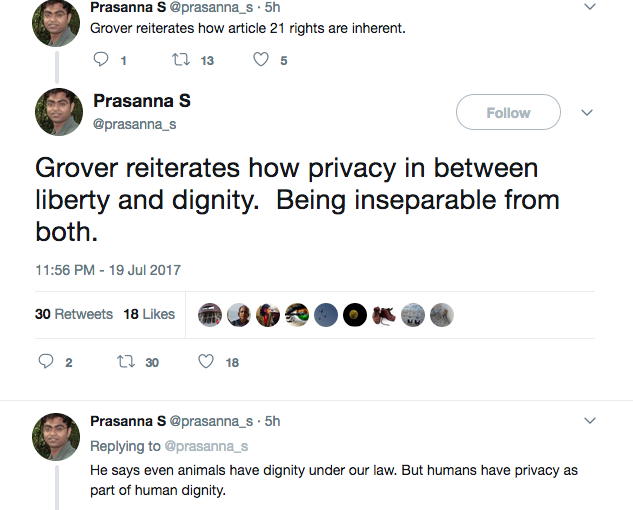
Grover also addressed questions from the judges on the privacy violations by non-state actors, which he said the State was duty-bound to protect, by enacting a law as needed.
Senior advocate Sajan Poovayya responded to the questions raised on Wednesday on privacy in the context of data protection, positing that data protection was a subsidiary argument to privacy. He reiterated that privacy can reside in several articles, citing the example that lack of privacy can have a chilling effect, triggering freedom of speech protections under Article 19(2). The question of protecting privacy could not depend on first determining the location of the right to privacy.
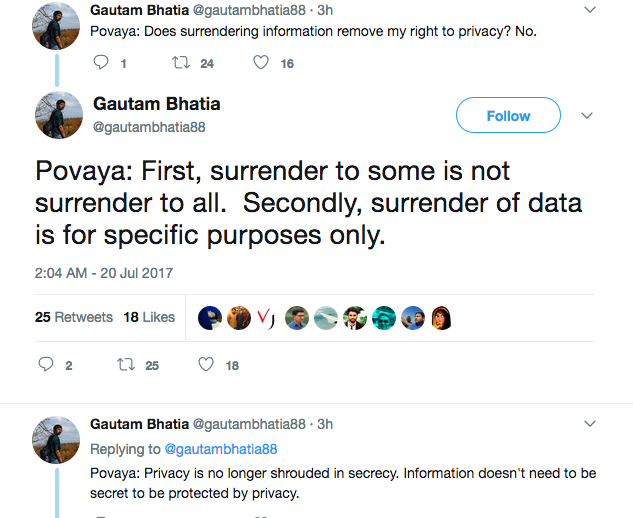
To a further question on whether the violation of right to privacy occurred during collection or data or its misuse, he reiterated that the limited purpose of collecting that data must be recognized by law, adding that, without informed consent, even collection would be a violation.
Senior advocate Meenakshi Arora concluded arguing that even the majority judgment in Kharak Singh had been interpreted by later decisions of the Supreme Court as having incorporated a right to privacy, such as in R. Rajagopal v. State of Tamil Nadu as well asPUCL v. Union of India. Ms. Arora added that the right to privacy can be drawn from Articles 17, 24, and 25 of the Constitution - not just Articles 14, 19, and 21.
In closing, Ms. Arora took the court through an evolution of the right to privacy and compared a world without privacy to an existence under one unending general warrant. She examined the German Constitution which evolved through the country’s experiences to further secure the privacy rights of German citizens. She concluded her arguments for the privacy of personal information and personal choice by stating memorably: “History teaches us that without privacy, the consequences are unimaginable.”
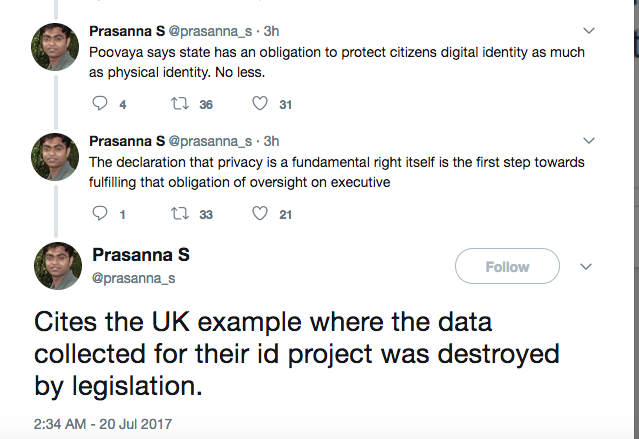
With the petitioners’ arguments concluded, the Union of India is expected to respond on Tuesday, July 21.
### 18 Jul 2017 — Is Government correct to deny privacy as a fundamental right? SC to decide > Today, a five-judge bench of the Supreme Court presided over by Chief Justice of India J.S. Khehar heard a bunch of petitions today challenging Aadhaar, a biometrics-linked residents ID, on different grounds, including those related to right to privacy. They decided to constitute a nine-judge bench Original: https://rethinkaadhaar.in/blog/2017/7/18/privacy-is-a-fundamental-rightToday, a five-judge bench of the Supreme Court presided over by Chief Justice of India J.S. Khehar heard a bunch of petitions today challenging Aadhaar, a biometrics-linked residents ID, on different grounds, including those related to right to privacy.
They decided to constitute a nine-judge bench to decide on the issue of whether we enjoy a right to privacy as a fundamental right under the Constitution of India.
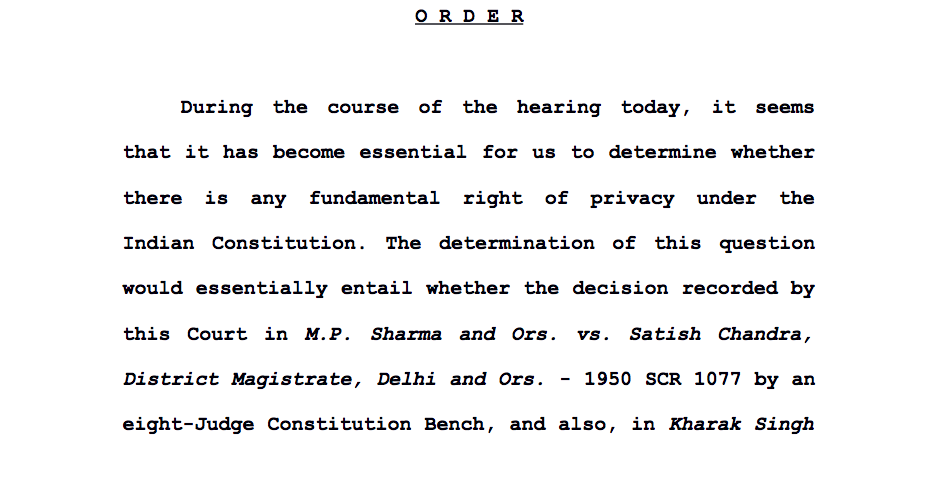
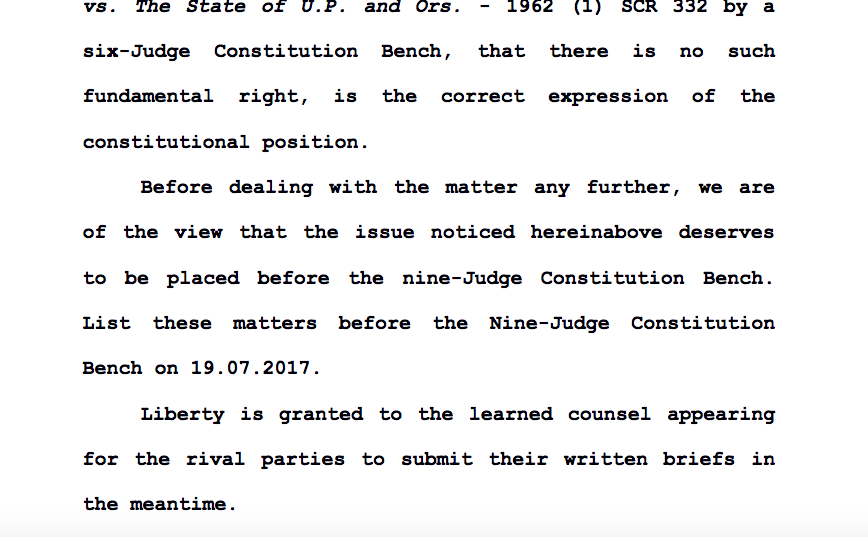
In court today
Today’s five-judge bench heard counsels from both the sides and decided to constitute a nine-judge bench to look into the matter of right to privacy and the validity of judgements in Kharak Singh judgment and M.P. Sharma judgement (a six-judge bench decision issued in 1962 and an eight-judge bench decision issued in 1954, respectively).
Attorney General KK Venugopal argued that Indians have no fundamental right to privacy under the Constitution, and that rulings of the Supreme Court on the subject after the MP Sharma and Kharak Singh judgments were per incuriam and not legally binding.
The court has allotted two and a half hours tomorrow each for the petitions and the Union Govt to presenting their arguments before the nine-judge bench. The request made by the Centre for more time to be allotted was rejected by the court.
Background
Today’s hearing arose from earlier arguments made by Attorney General Mukul Rohatgi in the 22nd July 2015 hearing of the Justice K.S. Puttuswamy v. Union of India writ petition; in which the Attorney General had, on behalf of the Union Government, submitted that the right to privacy was not a fundamental right in our Constitution.
Earlier, after looking at various precedents in which right to privacy was referred or asserted, in an order dated 11th August, 2015, a three-judge bench headed by Justice Chelameswar had noted “We are of the opinion that the cases on hand raise far-reaching questions of importance involving interpretation of the Constitution… that there appears to be certain amount of apparent unresolved contradiction in law declared by this (Supreme) court.” Therefore, the bench was of the opinion that the questions involving Right to Privacy should be examined and authoritatively decided by a bench of the appropriate strength, and asked the Registry of the Supreme Court to place the matter before Hon’ble Chief Justice of India for appropriate orders. These questions are:
(i) whether there is any “right to privacy” guaranteed under our Constitution and,
(ii) if such a right exists, what is the source and what are the contours of such a right as there is no express provision in the Constitution on the right to privacy;
What's at stake beyond Aadhaar?
— Apar (@aparatbar) July 17, 2017
1.Surveillance & profiling (credit scores)
2.Bodily autonomy (abortion)
3.Regimentation (beef/alcohol bans)
Two years on, on 7th July, 2017, a bench comprising of Justices Chelameswar, Khanwilkar and Sinha had suggested that both the petitioners and the Union Govt request the Chief Justice to constitute a larger bench so that all the issues coming out of Aadhaar should be decided by a larger bench and once and for all. A few days ago, on 12th July, 2017, Chief Justice of India J.S. Khehar decided upon the date for the hearing by a constitutional bench of 5 judges.
This now will in turn, look into the past judgments and will decide whether there is a requirement of a larger bench upon the question of privacy.
The bench headed by C.J.I. Justice J.S. Khehar will hearing the matter tomorrow, Wednesday, 19th July, 2017.
A copy of the order passed by the court today can be found here.
Further reading:
'Privacy is a Fundamental Right' (Chinmayi Arun, The Hindu)
### 7 Jul 2017 — Justice Chelameswar: "Set up constitution bench at the earliest to hear Aadhaar matter " > The Supreme Court on Friday, July 7 heard applications for interim relief to stay notifications which make Unique Identification Number or Aadhaar, a biometrics-linked identity number for residents, mandatory for availing any benefits and entitlements. The applications are by the same petitioners Original: https://rethinkaadhaar.in/blog/2017/7/7/aadhaar-urgent
The Supreme Court on Friday, July 7 heard applications for interim relief to stay notifications which make Unique Identification Number or Aadhaar, a biometrics-linked identity number for residents, mandatory for availing any benefits and entitlements. The applications are by the same petitioners whose challenge against the constitutionality of the Aadhaar Act is pending before a Constitution Bench of the Supreme Court.
The notifications make Aadhaar mandatory for a number of schemes, including for children to get hot cooked meals, several scholarships for disabled students and students in SC. ST, OBC categories, schemes for relief for women rescued from trafficking, bonded labourers, and relief for Bhopal gas leak victims. The notifications make possession of an Aadhaar number, or proof of enrolment in Aadhaar database, mandatory.
Petitioners have prayed that imposing enrolment in Aadhaar as a pre-condition for availing social benefits violates the fundamental rights of citizens. It is causing denial of benefits to persons who are otherwise legally entitled to the benefits, at enrolment stages, as well as when they face biometric rejection, data errors, network errors, and other problems.
The hearing began with the senior counsel for the petitioners Shyam Divan taking the Bench through the earlier orders of the Supreme Court including those of 11th August 2015 and the 15th Oct 2015 which clearly stated that Aadhaar shall be purely voluntary. Divan emphasised that the case deals with a vital constitutional question as allowing Aadhaar project to go ahead unchecked in the manner, seeking linking aadhaar to almost every transaction and aspect in life, is effectively reducing the citizen into a 12-digit number and transforming the country into a concentration camp for the citizens.
The Court was of the view that given that the entire matter was before a Constitution Bench (it is now 696 days since a constitution bench was asked to me formed to finally decide on Aadhaar matter), and that the litigation on Aadhaar has been lingering on for years, the correct course would be for both the parties i.e. the petitioners and the government to jointly mention before and impress upon the Chief Justice to constitute a Constitutional Bench to finally dispose of the entire batch of petitions. Attorney-General K.K. Venugopal who was present in Court agreed to join Divan for a mentioning before the CJI early next week for that purpose.
The Bench also indicated that in the eventuality of CJI not being able to form a Constitution bench, petitioners may come back to the court and argue for interim relief.
These applications were earlier heard on 9th May and then on 27th June by a vacation bench consisting of Justice Khanwilkar and Justice Navin Sinha. July 7 hearing was before a special three judge bench headed by Justice Chelameswar sitting with Justice Khanwilkar and Justice Sinha. Justice Chelameswar also headed the bench that passed the order dated 11th August 2015 that referred the batch of petitions challenging Aadhaar project to a constitution bench as it felt it required a definitive pronouncement on, among other issues, the issue of the existence and scope of a fundamental right to privacy under the Constitution of India.
The Friday’s hearing marks the first time that the government has agreed to mention before the CJI to constitute a larger bench to finally hear the constitutional challenge to the project and the Aadhaar Act. In October 2015, government had mentioned before the then CJI Dattu to get the Constitution Bench only to hear and decide their applications for modifying the 11th August order.
------------
How Aadhaar causes exclusion: WATCH How residents face exclusion at the UIDAI regional office in Delhi
Further readings:
Read the rejoinder by petitioners against the counter affidavit filed by the State on Aadhaar. It's not just the savings numbers that have been cooked up, but the actual enrollment figures as well.
https://drive.google.com/file/d/0B1zazrrJPMWfaTNLQUJBVU9sT2tMZ0NPRVlCY19BNkJiRG9V/view
Govt. stats on Aadhaar coverage "puffery", includes dead, petitioners tell SC
#Aadhaar: AG KK Venugopal objects to Shyam Divan's concentration camp argument
Who Is Opposing the Aadhaar Project?
### 27 Jun 2017 — Update from the hearing on Govt notifications making Aadhaar mandatory > The Aadhaar matter ( Shantha Sinha & Anr vs. Union of India & Ors) was listed before a vacation bench of Justice Khanwilkar and Justice Navin Sinha today. Applications to stay notifications issued under Section 7 of the Aadhaar Act were before the Court. There are over a h Original: https://rethinkaadhaar.in/blog/2017/6/27/update-from-the-hearing-on-govt-notifications-making-aadhaar-mandatoryThe Aadhaar matter (Shantha Sinha & Anr vs. Union of India & Ors) was listed before a vacation bench of Justice Khanwilkar and Justice Navin Sinha today. Applications to stay notifications issued under Section 7 of the Aadhaar Act were before the Court. There are over a hundred such notifications, among them are notifications making Aadhaar mandatory for accessing benefits under mid-day meal scheme, benefits due to rescued bonded labourers, benefits due to victims of Bhopal gas leak, benefits due to girls rescued from human trafficking, benefits under PDS/NFSA etc.
Senior Advocate, Shyam Divan appeared for petitioners. The Union’s representation was led by ASG Tushar Mehta.
As the hearing began, the Union raised a preliminary point about a strong rejoinder by the Petitioners that requires a sur-rejoinder and sought time till next week to file the same. It was mentioned that the grave urgency that had arisen to keep the hearing today no longer exists as there has been an extension granted until Sep 30 for people to get Aadhaar for various notifications.
Sr Counsel for the Petitioner agreed for the adjournment in principle but wanted an ad-interim order clarifying that no person shall be deprived of any benefits till the next date of hearing until then. The Bench was of the view that the Petitioner's concerns are already covered by Para 90 and 94 of the judgment in Aadhaar-PAN case dated 09.06.2017 and that no further clarification was required.
Mr. Divan read out the previous orders of the Court as well as the judgment dated 09.06.2017 and mentioned that the interpretation of Section 7 has been left open by the Court. The Union responded saying the earlier orders were passed when the project was still a scheme and did not have a statutory basis, but the position has now changed and the project is now governed by the provisions of the Act.
There was an exchange between the Bench and Mr. Divan around what is the need for a further order till the next date of hearing as the operative part of the judgment in PAN case covered that no person shall be deprived and Mr. Divan pointed out that the extension to September 30 operated only qua people who had not enrolled for Aadhaar and not for those who had enrolled but could not link, or do not want to link or that the authentication does not work etc. and that all the petitioners want is an extension of deadline for all classes of people.
The Bench also queried Mr. Divan as to whether there are any deprived people before the Court, to which Mr. Divan responded saying that the deadline is still not over and we will have lot of people coming up in the next weeks as the deadline of June 30 gets over for various schemes.
The Bench however, refused any further clarificatory order and opined that the judgment in the PAN case was sufficient for the moment. Nor did Union of India want to make any further statement on not depriving people of any benefits till the next date of hearing and stuck to its stand that the notification including the one extending to 30th September would be followed in letter and spirit.
The next hearing will be on the 7th of July.
### 23 Jun 2017 — Petitioners' rejoinder to Government making Aadhaar mandatory in mid day meals, welfare schemes > Read the rejoinder by petitioners Shanta Sinha (political scientist, anti-child labour activist and padma sri winner) and Kalyani Menon-Sen (noted feminist activist) against the counter affidavit filed by the State on Aadhaar. It's not just the savings numbers that have been cooked up, but several o Original: https://rethinkaadhaar.in/blog/2017/6/23/petitioners-rejoinder-to-government-making-aadhaar-mandatory-in-mid-day-meals-welfare-schemes
Read the rejoinder by petitioners Shanta Sinha (political scientist, anti-child labour activist and padma sri winner) and Kalyani Menon-Sen (noted feminist activist) against the counter affidavit filed by the State on Aadhaar. It's not just the savings numbers that have been cooked up, but several other claims as well.
Uploaded here.
On Legal Issues Websites:
https://barandbench.com/aadhaar-115-crore-supreme-court/
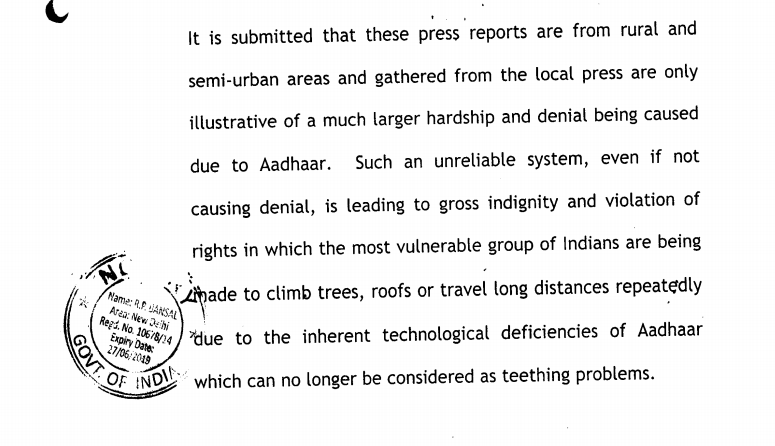
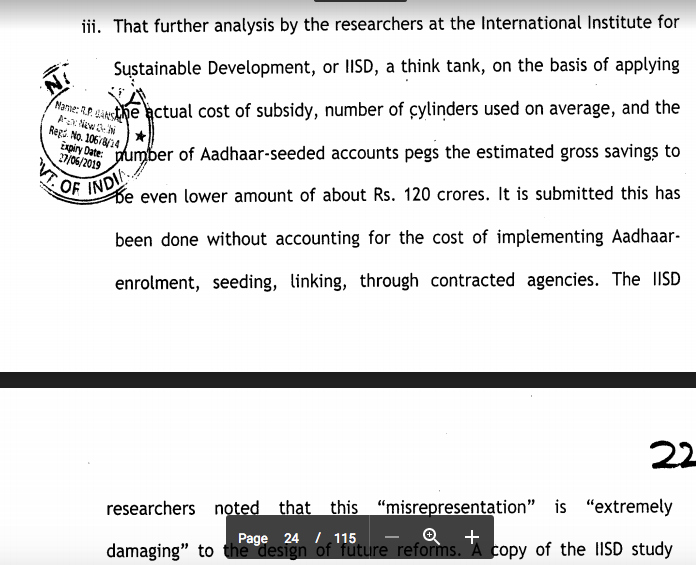
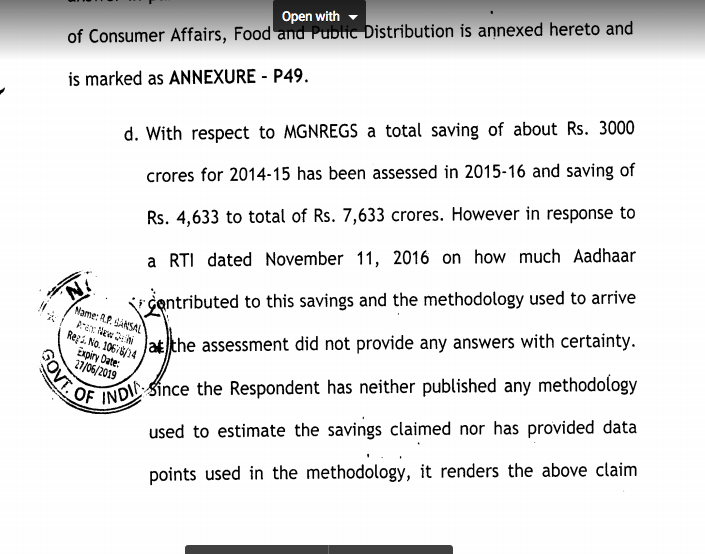 ### 25 May 2017 — Delhi High Court concerned about citizens not being able to access food rations due to Aadhaar glitches
> The Delhi Rozi Roti Adhikar Abhiyan has filed a case in the Delhi High Court against Aadhaar being made mandatory for receiving ration under the National Food Security Act. The matter was heard today, on May 25, by a bench of the Acting Chief Justice Geeta Mittal and Justice C. Hari Shankar.
Original: https://rethinkaadhaar.in/blog/2017/5/25/delhi-high-court-expresses-concern-about-people-not-being-able-to-access-their-rations-due-to-aadhaar-glitches
### 25 May 2017 — Delhi High Court concerned about citizens not being able to access food rations due to Aadhaar glitches
> The Delhi Rozi Roti Adhikar Abhiyan has filed a case in the Delhi High Court against Aadhaar being made mandatory for receiving ration under the National Food Security Act. The matter was heard today, on May 25, by a bench of the Acting Chief Justice Geeta Mittal and Justice C. Hari Shankar.
Original: https://rethinkaadhaar.in/blog/2017/5/25/delhi-high-court-expresses-concern-about-people-not-being-able-to-access-their-rations-due-to-aadhaar-glitches
Court asks lawyer representing UIDAI to visit ration shops to understand problems faced by ration card holders
The Delhi Rozi Roti Adhikar Abhiyan has filed a case in the Delhi High Court against Aadhaar being made mandatory for receiving ration under the National Food Security Act. The matter was heard today, on May 25, by a bench of the Acting Chief Justice Geeta Mittal and Justice C. Hari Shankar.
The Government of India advocate wanted the petition to be dismissed as similar petitions are pending before the Supreme Court but the judges declined the request saying the powers under Article 226, which deals with powers of the High Courts, are broader.
It was highlighted by Delhi Rozi Roti Adhikar Abhiyan (DRRAA) that Aadhaar is leading to exclusion in two ways
- It has been made mandatory for applying for a ration card- this has led to large scale exclusions as those families which did not have Aadhaar number, have not got ration cards. Also, in many families, at the time when ration cards were being made in Delhi those members who did not have Aadhaar were not added to the ration cards. As under the National Food Security Act (NFSA), 5 kg of foodgrains per person is given, or for all the people listed on the ration card, many families are unable to access their full entitlements of ration.
- In 2015, the Delhi government initiated a pilot in 42 ration shops of delivering rations through Aadhaar enabled POS (Point of Sale) device.
Despite evidence of these Point of Sale devices not functioning -- because of recurring problems of network coverage, biometric failures and rejection of even genuine beneficiaries, the government is still insisting on making biometric authentication mandatory for all shops, causing exclusion of and hardship to genuine card holder in this system.
After hearing the problems faced by people, the Court has appointed Mr. Zoheb Hossain (advocate representing the UIDAI) to act as a commissioner of the court and meet with ration card holders who are being excluded from food security due to Aadhaar, and also visit the shops where POS devices were installed.
He was requested to report back to the court on the problems being faced by people who are being denied their ration entitlements due to Aadhaar.
A Report done by the Delhi Rozi Roti Adhikar Abhiyan (DRRAA) on the implementation of transparency, grievance redress and accountability provisions of the National Food Security Act in Delhi can be accessed at https://drive.google.com/file/d/0B3oQ77E3KGKBcmtZSDNKTHo3dkU/view?usp=sharing
Videos showing problems with POS devices in Delhi can be accessed at- https://www.youtube.com/watch?v=fVSVqbW6dP0&list=PLdHEUXbHHVe30wNaeZqdb04XyJ5j3_ehc
For more details, contact:
Anjali Bhardwaj, Amrita Johri, Koninika Ray & Dipa Sinha 9810273984 (for the Delhi Rozi Roti Adhikar Abhiyan)
The Supreme Court on Tuesday heard an important constitutional challenge against 18 notifications which have made Aadhaar mandatory for availing any benefits and entitlements.
These include notifications making Aadhaar mandatory for hot cooked meals, several scholarships for disabled students and students in SC. ST, OBC categories, schemes for women rescued from trafficking, bonded labourers, and relief for Bhopal gas leak victims.
The notifications which make possession of an Aadhaar number, or proof of enrolment in Aadhaar database, mandatory which would have resulted in denial of benefits to persons who are otherwise legally entitled to the benefits.
The petitioners, Shanta Sinha, former chairperson of the National Commission for Protection for Child Rights, and an activist campaigning against child labour and human rights activist Kalyani Menon Sen prayed that imposing enroling in Aadhaar as a pre-condition for availing social benefits violates the fundamental rights of citizens. Senior advocate Shyam Divan appeared for the petitioners.
Considering the grave and important issues which had been raised in the petition, Justice AK Sikri and AK Bhushan tagged this petition with the earlier petition challenging the Aadhaar Act, 2016, already pending in court.
The SC also in its orders recorded the submission that there is urgency in the case since the several notifications become effective by June 30.
The bench also indicated that as the matter was already pending for constitution of a bench to determine the validity of the aadhaar scheme and Aadhaar Act , the petitioner may mention this matter again to the Honorable Chief Justice.
As per the notifications of the Ministry of Chemicals and Fertilizers, Bhopal gas victims will not be able to seek relief — including compensation for death, permanent disability, cancer, renal failure, permanent or temporary disability — unless they submit an Aadhaar or an enrollment proof. In another notification by the Ministry of Labour and Employment without an Aadhaar number or Aadhaar enrollment slip, workers rescued from bonded labour, will not get any cash or non-cash assistance unless they show an Aadhaar number by June 30, 2017.
The petitioners have pointed out that since June 30 is the deadline for enrolment, it is important that the case is heard at the earliest.
The petitioners have stated that making Aadhaar mandatory in mid-day meal scheme, scholarship schemes availed by children below the age of 18, and disabled persons implies that the, “State is securing bio-metric and demographic data even before the age of consent in so far as children are concerned…..it is irrational and per se unconstitutional for the government to insist on Aadhaar as mandatory pre-condition for availing hot cooked meals under the mid-day meal scheme.”
Also, “making Aadhaar mandatory for the Ujjwala Scheme which provides for rehabilitation of victims of trafficking or commercial sexual exploitation and for Bhopal Gas Tragedy victims to claim compensation goes against the very objects of the said schemes.” The petitioners had made a slew of prayers, including a plea to strike down the Act as unconstitutional.
The orders of the SC are expected to be available on the Supreme Court website by late evening today.
For further information, write to contact@rethinkaadhaar.in
Further readings:
https://rethinkaadhaar.in/blog/2017/4/2/aadhaar-nahi-aahaar-do-satyagrah-from-april-9
https://rethinkaadhaar.in/blog/compulsoryformiddaymeal
How people are caught in the middle of unique number web (Sarika Malhotra, March 28, 2017)
Are Ghosts really getting mid-day meals? (Jean Dreze, March 28, 2017)
Need internet to buy PDS rations? Go climb a tree (Geetha Sunil Pillai, TOI, March 2017)
Aadhaar number: Udaipur BTech student gets Aadhaar jitters (Rosamma Thomas, March 2017)
Photograph by Anil Sharma/HT
### 8 May 2017 — Petitioners' arguments: Why Aadhaar-PAN linking is unconstitutional > Last month, through an amendment to the Income Tax Act , Parliament made it compulsory for all taxpayers to quote their Aadhaar numbers while filing their return of income (or while applying for a new PAN number ). Under the new Section 139AA of the IT Act, the consequence of not complying with Original: https://rethinkaadhaar.in/blog/2017/5/8/petitioners-arguments-why-aadhaar-pan-linking-is-unconstitutionalLast month, through an amendment to the Income Tax Act, Parliament made it compulsory for all taxpayers to quote their Aadhaar numbers while filing their return of income (or while applying for a new PAN number). Under the new Section 139AA of the IT Act, the consequence of not complying with this was an invalidation of the individual’s PAN number. This, in turn, would have a number of serious consequences, affecting an individual’s ability to pay her taxes, as well as being blocked from undertaking a number of transactions (such as buying a motor vehicle, or opening a bank account), all of which require a PAN number. In short, Section 139AA effectively required tax-paying individuals to get an Aadhaar Card, on the pain of visiting severe disabilities upon them in case of non-compliance.
On this blog, we have covered some of the constitutional problems with the Aadhaar scheme (which involves the taking of an individual’s biometric details, iris scan, and demographic information, ostensibly for the purpose of better authentication), the government’s conduct in having the Aadhaar Act passed as a money bill, and the Supreme Court’s continuous evasion of the issue by refusing to hear the pending constitutional challenges. Readers will recall the following facts: on 11th August 2015, when Aadhaar was still an executive scheme, three judges of the Supreme Court had referred the constitutional challenge to a larger bench, on the basis that the constitutional status of the fundamental right to privacy was in some doubt; in the meantime, the Court stipulated that Aadhaar could not be made mandatory for welfare schemes. The Constitution Bench assembled once more in October 2015 to modify that order in some respects. After that, the case has not been heard. In the meantime, Parliament passed the Aadhaar Act, which authorised the State to make Aadhaar mandatory for availing of certain benefits or subsidies. Since the passage of the Aadhaar Act, Aadhaar has been made mandatory for a wide range of goods and services, including midday meals. It is in this context that Section 139AA of the IT Act came into being: a statutory amendment that sought to (effectively) make Aadhaar compulsory for taxpayers.
Section 139AA was challenged before the Supreme Court. The Petitioners, led by senior counsel Arvind P. Datar and Shyam Divan, argued their case before a two-judge bench, over three days, followed by two days of arguments by the Union of India. Mr Datar is due to reply tomorrow, after which the hearing will conclude.
In this post, I will attempt to summarise and contextualise the key points of challenge.
Privacy Not Argued
If a case comes to the Supreme Court where the issues involved are substantially similar to another case that is already pending, the Court “tags” the latter case with the former, and hears the two together. This created a threshold problem for the Petitioners. The constitutional problems with Aadhaar remained the same, whether it was a challenge to the Aadhaar Act itself, or to the Income Tax Act making Aadhaar mandatory to file returns: basically, an alleged violation of the right to privacy. However, that question had been referred to a larger bench on 11th August 2015, and had not yet been heard. Consequently, it was a “pending case”, and according to convention, the Court hearing the challenge to the Income Tax Act would be obliged to “tag” it with the pending proceedings before the larger bench. So Petitioners had a choice: insist on their right to argue privacy, and have the case “tagged” with the pending challenge; or give up the argument on privacy, and attempt to convince the Court that Section 139AA was unconstitutional on other grounds.
Perhaps in view of the fact that the Supreme Court has effectively buried the Aadhaar challenge (three successive Chief Justices have refused to list it for hearing, despite multiple “oral mentionings” asking them to do so), Petitioners chose to go ahead with the challenge to S. 139AA without arguing privacy. This was made clear at the beginning of the hearing by Justice Sikri, who pointed out that there was no stay on Aadhaar in the case pending before the larger bench; at this, both Mr Datar and Mr Divan agreed that they would only argue the 139AA challenge on other grounds.
While Justice Sikri, sitting as part of a two-judge bench, was entirely correct in what he said (indeed, there was nothing else he could have said), the Supreme Court’s institutional disingenuousness here needs to be called out very clearly: as I have detailed in my post on judicial evasion, the constitutional challenge to Aadhaar Act has been pending for one year and eight months, with the Court – or rather, the Chief Justice – simply refusing to constitute the bench to hear it. In the meantime, the government has gone full steam ahead to create a fait accompli situation where the challenge becomes academic. Section 139AA is part of that broader program. By not allowing Petitioners to argue privacy on the ground that it was part of a pending challenge in which no stay had been granted because it had simply never been heard, the Court was – effectively – using its own refusal to hear the case as a reason to make the Petitioners fight this battle with one arm tied behind their backs!
The Arguments of Mr Arvind P. Datar
No Indirect Overruling of Judicial Orders
Mr. Arvind Datar’s first argument was that Section 139AA of the Income Tax Act amounted to an indirect legislative overruling of prior judicial orders stipulating that Aadhaar could only be voluntary. While Mr Datar conceded that Parliament was entitled to overrule a judicial decision or order by legislating to take away its very basis, he drew a distinction between direct overruling (by taking away the basis of a court order), and indirect overruling (the latter, he argued, was impermissible). Relying upon the judgments of the Supreme Court in Madan Mohan Pathak vs Union of India, Indian Aluminium Co vs State of Kerala, and Janapada Sabha Chindwara vs Central Provinces Syndicate Ltd, he argued that, in the present case, had Parliament simply passed a law mandating that every individual must have an Aadhaar Number, that would have been a legitimate response to the Court’s orders; however, while the Aadhaar Act continued to insist that getting Aadhaar was voluntary, Parliament had chosen to make it mandatory in a backdoor fashion, by inserting penal consequences for not having Aadhaar in the Income Tax Act. And in case of any doubt, “we should adopt an interpretation which upholds… rights.”
Article 14
Mr Datar argued that Section 139AA violated Article 14 of the Constitution because it drew an arbitrary distinction between assessees who were individuals (and therefore compelled to get an Aadhaar Card), and non-individual assessees (such as an HUF, or a company). If the objective of introducing Section 139AA was to use Aadhaar to check black money and fraud (which the Union claimed that it was), then the distinction between individual and non-individual taxpayers bore no rational nexus to the objective, and fell foul of Article 14. T
The bench asked the natural question: given that non-individuals could not, by definition, obtain Aadhaar cards, wasn’t an Article 14 challenge misconceived to start with? In other words, the Aadhaar Card requirement was a way to check black money and fraud specifically by individual assessees. To this, Mr Datar responded by arguing that there were twelve categories of assessees under the Income Tax Act. Section 139AA picked out one class (individuals), and imposed a burden upon them. This act of disadvantaging one class could only be justified under Article 14 if it had a rational nexus with a legitimate goal; but given that black money and fraudulent transactions were not only crimes committed by individuals, there was no rational nexus between the objective and the act of singling out individuals and making them suffer.
Mr Datar also argued that there was no evidence to show that compulsory Aadhaar would actually fulfil the goal of eliminating black money and preventing fraud (or “shell companies”). In fact, the UIDAI’s own statistics showed that there were likely many duplicate Aadhaar Cards; on the other hand, only 0.4% of all PAN Cards had been shown to be duplicate. Consequently, the State had no evidence to show that a shift from PAN to PAN + Aadhaar would actually serve the goal of eliminating black money and fraud.
Article 19(1)(g)
Mr Datar argued that an individual without a PAN Card was prohibited from engaging in many transactions that were absolutely basic to life in contemporary society. These included buying or selling a motor vehicle and opening a bank account. A cancelled PAN effectively amounted to a “civil death”. It was, therefore, a violation of the freedom “to practise any profession, or to carry on any occupation, trade or business”, guaranteed by Article 19(1)(g) of the Constitution.
Once it was established that Article 19(1)(g) had been infringed, the burden shifted to the State to show that, under Article 19(6) of the Constitution, the restriction was reasonable, and in the public interest. In Modern Dental College vs State of M.P., a Constitution Bench of the Supreme Court had held that the correct test to apply under Article 19(6) was the test of proportionality. In a judgment authored by Justice Sikri himself, the Court held that “proportionality” involved a showing that the means chosen to achieve the “public interest” goal were themselves narrowly tailored; that is, Article 19(6) could not save a statute if it could be shown that some other method, which infringed rights to a lesser degree, could achieve the same goal. Mr Datar argued that – once again – in view of the fact that only 0.4% of all PAN Cards were found to be duplicate, and in view of Aadhaar’s own, widely publicised failings (using the UIDAI’s own data), it could not be argued that compulsory Aadhaar was a “proportionate” restriction upon the right under Article 19(1)(g).
Colourable Exercise of Power
Mr Datar concluded by arguing that Section 139AA amounted to a colourable exercise of legislative power. Solemn undertakings had been given by the Union of India to the Supreme Court that Aadhaar would remain voluntary. Aadhaar remained voluntary under the parent statute (the Aadhaar Act), but there was now a back-door attempt to make it mandatory through the Income Tax Act. In fact, the Statement of Objects and Reasons of the Aadhaar Act themselves made no mention of black money or fraud; Mr Datar argued that if Aadhaar was to be used for that purpose, then surely there would have been some indication of that in the parent statute. All these factors combined pointed to a clear colourable exercise of power. Mr Datar submitted that Section 139AA should accordingly be struck down as unconstitutional.
The Arguments of Mr Shyam Divan
Collision Between the Aadhaar Act and the Income Tax Act
Mr Shyam Divan argued that there was a “collision” between the Aadhaar Act and the Income Tax Act. The former made it clear that Aadhaar was to be a voluntary scheme. While the Government could make it mandatory for the purposes of availing of subsidies, it could not compel people to get an Aadhaar Number, simpliciter. The Income Tax Amendment, however, effectively compelled people to part with their biometric information and iris scans, on the pain of penal consequences. In other words, Section 139AA made mandatory what the Aadhaar Act guaranteed would be voluntary.
In response to the Bench’s observation, that surely it was open to Parliament to create two different statutory regimes – one in which Aadhaar was voluntary, and the other in which it was made mandatory for the purposes of paying Income Tax – Mr Divan argued that the Aadhaar Act and Section 139AA could not be viewed in isolation in such a manner. The Aadhaar Act was the parent statute: and everything in the Aadhaar Act suggested that, from the moment of enrolment, it was a purely voluntary exercise. Now, you could not engraft a scheme whose very basis was voluntariness and free consent, into the Income Tax Act, and make it mandatory. It was in that sense that the procedures under the Aadhaar Act and the Income Tax Act were “in collision”. Mr Divan therefore invited the Bench to read down Section 139AA of the IT Act by interpreting the word “shall” as “may”; or, in other words, convert the mandatory requirement under 139AA into voluntariness, in order to bring the Aadhaar Act and Section 139AA into harmony.
Article 14
Mr Divan’s case under Article 14 was different in important respects from Mr Datar’s. While Mr Datar had drawn a distinction between individual and non-individual assessees, Mr Divan drew a distinction between individual assessees who consented to getting an Aadhaar Card, and other individual assessees who didn’t. He argued that Section 139AA drew a distinction within this homogenous class of persons, and disadvantaged the latter. Now, in view of his previous submission – that the parent Aadhaar Act made it clear that Aadhaar was voluntary – drawing a distinction between those who had chosen to get an Aadhaar Card, and those who would now be required to get an Aadhaar Card to pay their taxes, and placing a burden upon the latter – constituted ex facie discrimination. In other words, the statute’s very purpose was discriminatory, on its face (which, according to the judgment of the Supreme Court striking down S. 6 of the DSPE Act, was impermissible). Hence, there was no need to go into questions of classification and nexus: the amendment was presumptively unconstitutional under Article 14.
Bodily Integrity
Mr Divan argued that biometric information and iris scans belonged to the individual. They were, effectively, part of the individual’s body. He cited a range of thinkers, from Hobbes and Locke on the one hand, to Salmond and Rawls on the other, to argue for the individual’s absolute ownership of her body, and her right to bodily integrity under Article 21 of the Constitution. What, he asked, did Article 21 protect, if it did not protect the body?
Justice Bhushan pointed out that at the time of issuing a passport, similar information was taken from the individual. Mr Divan argued, however, that while it was permissible to take such information for limited and narrow purposes (for instance, for the purposes of identifying an individual in case of an emergency while she was abroad), and where there was a compelling State interest, those conditions were not satisfied in the present case. Mr Divan also invoked the 1920 Identification of Prisoners Act to argue that even in pre-Constitutional, colonial statutes, information that had to do with the body was collected only in very specific circumstances, and only for a very narrow set of purposes, where it was absolutely necessary to do so. Even a refusal would only lead to an adverse inference. That manner of necessity had not been demonstrated in the present case – especially in light of the fact that Aadhaar was suffering from numerous problems of duplication and public leakages (instances of which were cited to the Court).
In sum, Mr Divan argued that fingerprints and iris scans belonged to the individual, as integral parts of her body. They could not be “nationalised” or “expropriated” by the State without express consent, unless there was a compelling State interest, and the infringement was narrowly tailored. The argument of compelling State interest and narrow tailoring may justify, for instance, the taking of DNA or blood samples in certain limited circumstances (this was in response to a question from Justice Bhushan), but certainly did not permit the kind of 24/7 tracking system established by Aadhaar. What Aadhaar was doing, Mr Divan argued, was fundamentally changing the nature of the relationship between the individual and the State; it was shifting the balance of power between individual and State to the extent that it ended up betraying the promise of the Constitution to establish “limited government”. The Constitution, he argued, was not a “charter of servitude“; it envisaged free individuals, whose bodies could not be invaded without their express consent. He relied upon the judgments of the Supreme Court in Sunil Batra vs Delhi Administration, NALSA vs Union of India and Aruna Shanbaug vs Union of India, to highlight the importance of bodily integrity under Article 21 and the constitutional scheme.
Personal Autonomy and Informational Self-Determination
Mr Divan argued that in the digital age, the right to informational self-determination had become a crucial facet of the right to personal autonomy, and was protected under Articles 14, 19, and 21 of the Constitution. The principle of informational self-determination – which had its origins in German constitutional doctrine, with the Population Census Case, and had now been accepted in both Canadian and South African Constitutional law – stipulated that an individual had the right to limit what she put out to the world about herself. Its basis was not privacy, but the principles of dignity and personal autonomy, both of which were long recognised under Indian constitutional doctrine. Informational self-determination was essential for the free development of the individual. Moreover, it was not simply an individual right: likewise, the free development of the individual was essential to constitute a free and democratic society, and a free and democratic communicative order.
In the case of Aadhaar, Mr Divan argued, the principle of informational self-determination was specifically compromised because data was required to be handed over to private parties. These private parties’ only accountability was in the form of a “Memorandum of Understanding” with the government; there were minimal data protection safeguards imposed upon them, and indeed, 34,000 such independent operators had been blacklisted by the government. In fact, the MoU’s allowed the registrars of these entities to retain biometric data with them, something that could have potentially devastating consequences. In sum, compelling the handing over of personal data to private parties with such minimal safeguards over their functioning amounted to “a complete destruction of personal autonomy [and] a debasement of… [the] right to informational self-determination.”
Compelled Speech
Mr Divan then argued that compelled extraction of demographic information in Aadhaar – and even more, compelled extraction of biometric data and iris scans – effectively amounted to compelled speech, which was an infringement of Article 19(1)(a) of the Constitution. In the case of Bijoe Emmanuel vs State of Kerala, the Article 19(1)(a) rights of Jehovahs Witnesses to not be compelled to sing the national anthem had been recognised by the Supreme Court. The Jehovahs’ Witnesses, argued Mr Divan, were willing to stand up and respect the national anthem, but not to sing it; similarly, non-Aadhaar tax payers were willing to respect the law of the land and pay their taxes – only not by parting with their biometric and demographic information.
Proportionality
Mr Divan reiterated Mr Datar’s argument that, in view of the Government’s own data that only 0.4% of PAN Cards were duplicates, this move was simply disproportionate.
Legislative Competence
Mr Divan argued that there was no legislative entry in the Seventh Schedule that allowed for a right of “eminent domain” over the individual body. Consequently, the State was barred from “nationalising” the individual’s fingerprints and biometric data, except in the narrowest of circumstances. At best, the State could act as a “trustee”, or a “fiduciary”, of a person’s property in themselves. It could not compel beneficiaries to permanently part with it, especially in view of the fact that giving up one’s fingerprints and iris scans was a permanent act. Under the Constitution, the State could not simply take that data and store it in a centralised database.
Conclusion
Mr Divan ended by arguing that Section 139AA had serious impacts on the freedom of trade and commerce, the freedom of speech and expression, and the freedom of association (one could hardly form associations without a bank account). He argued that what the Union of India was doing was effectively a bait-and-swith, in the mould of Humpty Dumpty in Alice Through the Looking Glass, who had stated that a word meant exactly what he said it meant: the Union was doing something similar with the “mandatory voluntary” nature of Aadhaar.
In view of all of that, he requested the Court to strike down or read down the Section. However, he had an alternative prayer as well: in case the Court felt that the privacy and non-privacy issues in the case were inseparable, then they could refer and “tag” the case with the pending hearing; however, in view of the fact that the situation would become irreversible after July 1 (the day the amendment would come into effect), at the very least, he requested the Court to stay the provision, or prohibit coercive action by the State to implement it, until the final decision. All the previous orders of the Court had recognised the gravity of the situation, and protected status quo.
—
(Disclosure: The author assisted Mr Datar in the constitutional challenge before the Court.)
This post first appeared on lawyer Gautam Bhatia's blog.
### 5 May 2017 — "Anyone could have been issued a duplicate "Aadhaar card" in my child's name, is worrying..." > In the past few months, there have been several reports citing security flaws in Aadhaar. There are also reports on Aadhaar numbers being displayed publicly, along with mobile phone numbers, financial details, which could expose citizens to fraud, including by use of such details to generate fake &q Original: https://rethinkaadhaar.in/blog/2017/5/5/anyone-could-have-been-issued-a-duplicate-aadhaar-card-in-my-childs-name-is-worryingIn the past few months, there have been several reports citing security flaws in Aadhaar. There are also reports on Aadhaar numbers being displayed publicly, along with mobile phone numbers, financial details, which could expose citizens to fraud, including by use of such details to generate fake "Aadhaar cards", which is just a colour printout of one's Aadhaar information.
K Sudha, a senior activist with Human Rights Forum, Visakhapatnam, Andhra Pradesh shared the following incident to share her experience with poor security of Aadhaar, and how easily the "Aadhaar card", could be misused.
My daughter lost her "Aadhaar card" recently. She did not save her Aadhaar card number nor did she have a photocopy of it. The mobile number that she mentioned in the Aadhaar card is also no longer accessible.
We approached Karvy consultants who said that it will not be possible for them to trace and generate a duplicate Aadhaar card without the number. But they suggested that Meeseva Kendras (an e-governance portal in Andhra Pradesh, and Telangana) might be able to trace it. So I approached a Meeseva Kendra in Visakhapatnam.
I told the above details to the Meeseva operator. He asked me to state my daughter's name and the pin code mentioned in the Aadhaar card. He took my mobile number. A One Time Password was generated and sent to my number. He could trace it and issue a duplicate. He charged Rs 100/- for this service. For this, he did not give a receipt.
What we are concerned about it that if I can get the duplicate Aadhaar card on her behalf by simply stating her Aadhaar number and pin code, anybody can do it. The operator did not even seek my ID proof or any documents which would establish my relationship with my daughter. He didn't even bother to cross check my credentials while issuing the duplicate Aadhaar card. The fact that anybody could get my daughter's duplicate Aadhaar card is quite disquieting.
K Sudha,
Human Rights Forum (HRF).
Visakhapatnam
Senior Advocate Datar: "Aadhaar is like building a bridge and then looking for a river. It is hunting for problems to make itself relevant."
Senior Advocate Arvind Datar’s fiery rebuttal began today in the Aadhaar-PAN(Permanent Account Number) linkage case. Datar, who is representing CPI's senior leader Binoy Viswam. argued that the earlier orders of the Supreme Court that Aadhaarcannont be made mandatory continue to hold weight. The Union and all states were before the Court when these orders were passed. The Attorney General (AG) had even given an undertaking to the Court stating that Aadhaar would be voluntary.
Justice Sikri said the Act would shave to be tested for its basis. Datar agreed that this was a new kind of case placed before the Court for the first time. Justice Bhushan said, "The scheme has now become an Act". Datar explained that when the Supreme Court had given its orders Parliament could only overrule judicial orders in a manner known to law - that is, by taking away their basis. A Supreme Court directive or judgment is sacrosanct, unless set aside by a process known to law. Datar said that there was a clear collision between the Aadhaar Act and the Income Tax Act, and "if both Acts are allowed to stand the results would be absurd."
Datar explained that the government had failed to show how the stated objective of curtailing black money is possible by linking Aadhaar and PAN. On the Attorney General’s (AG) argument that Aadhaar was needed to fight black money and terrorism, Datar said "Anybody with any common sense would ask, how will Aadhaar check black money? Aadhaar was sold as a panacea for all ills - black money, terrorism, leakage etc. like herbal medicine", but, he noted, "Aadhaar is like having built a bridge and looking for a river. It is hunting for problems to make itself relevant."
On the AGs argument on Foreign Account Tax Compliant Act (FATCA), Datar said that nothing in FATCA created a requirement for Aadhaar. He was interrupted by government's counsel Arghya Sengupta who stated "the problem is that if we give the United States duplicate PANs, it becomes an embarrassment." Mr. Datar responded that this had nothing to do with the stated objective of of 139AA.
Senior advocate Arvind Datar cited the figure of only 0.04% of PAN cards being duplicates. He asked whether the government had done any study before introducing 139AA. He said "for 0.4% duplicates, 99.6% must seed their Aadhaar with PAN. Is that reasonable restriction under Article 19(6)?" He argued that without a PAN card, people's economic lives would come to a standstill, and that interests (the ability to do business versus duplicate PAN cards ) had to be balanced.
He said that the government was slowly attempting to make Aadhaar mandatory when claimed it was voluntary. This was a case of extreme and far reaching consequences. Mr. Datar said "The AG says, 99% have got it. What's your problem? That argument is the death knell of individual rights and democracy." Quoting William O. Douglas, Senior Advocate Datar said "As nightfall does not come at once, neither does oppression. In both instances, there is a twilight when everything remains seemingly unchanged. And it is in such twilight that we all must be most aware of change in the air – however slight – lest we become unwitting victims of the darkness.” "Darkness does not come all at once. It is in the twilight that we must be most vigilant, or we are lost." He asked "are fundamental rights the playthings of the majority?"
Finally, Datar submitted that the Court must strike down 139AA or read it down and in case the Court decides to refer the case it should stay 139AA. Mr. Salman Khurshid also appeared for the petitioners and made brief submissions about human dignity and state control over the body.
The judgment has been reserved and no date has been given yet for the orders of the Court.
For more information, email contact@rethinkaadhaar.in
Statements on previous hearings at: https://rethinkaadhaar.in/blog/
### 3 May 2017 — Shyam Divan, advocate for petitioners: "Aadhaar is purely Voluntary" > At the latest hearing on Aadhaar in the Supreme Court today, Arghya Sengupta of Vidhi Centre for Legal Policy who was arguing on behalf of the Government started with two broad arguments for the Union of India and UIDAI: (1) That proportionality could not be read into Article 14, and (2) The idea of Original: https://rethinkaadhaar.in/blog/2017/5/3/shyam-divan-advocate-for-petitioners-aadhaar-is-purely-voluntaryAt the latest hearing on Aadhaar in the Supreme Court today, Arghya Sengupta of Vidhi Centre for Legal Policy who was arguing on behalf of the Government started with two broad arguments for the Union of India and UIDAI: (1) That proportionality could not be read into Article 14, and (2) The idea of informational self-determination was equivalent to privacy and privacy was referred to a larger bench.
He countered the proportionality arguments by citing judgments from the UK.
He said that a statute could not be struck down for disproportionate penalty because penalty could be decided by the wisdom of Parliament.
Sengupta said that the object of this amendment is to fight corruption but no legislative order can completely solve the problem 100%. Sengupta said the object of the amendment is not to discriminate between those who have Aadhaar and those who don't but rather to weed out fake PAN cards.
He then argued that informational self-determination is not absolute even in Germany, where there is informational self determination (mentioned by Dpetitioners ;lawyers Divan in earlier hearings) and it could not be read into Indian law and that it could only be understood to be a party of privacy.
Justice Sikri then observed that the right to be left alone is a question of a person’s own life. The question lay in whether in a tax regime you could exercise your right and say that you would pay taxes in the manner you chose to. Sengupta responded by quoting Oliver Wendell Holmes, "Taxes are the price we pay for civilised society", he said. Sengupta admitted that there were technical difficulties and errors in the UID system, but maintained that biometrics is the best technology in existence at present.
Zoheb Hussain appearing for the UIDAI said there is a distinction between protected and unprotected speech and that distinction will always be maintained. Every action is not speech. Enrolment for Aadhaar does not amount to exercising the right to free speech. He argued that the object of the amendment was to fight black money, increase tax collection and therefore reduce inequality. The object could not be said to be discriminatory because it was in furtherance of equality.
Petitioners' lawyers response
Senior Advocate Shyam Divan appearing for the petitioners Dalit activist Bezwada Wilson and retired Major General SG Vombatkare responded to these arguments. He began by establishing again the credentials of the petitioners. He said "It is being alleged that I am a hermit who wants to live in the Himalayas." In fact the petitioners are a decorated Major General in the Army and the other, a Magsaysay Award winner for his work with the Safai Karamchari Andolan. "The petitioners live robust lives and are contributors to society."
He said that the concern raised about Aadhaar was not an elite concern, rather that it was a concern of civil liberties, affecting all citizens. "The citizens of what we regard to be a free country are being mandated to be fingerprinted."
Mr. Divan went on to explain that there is contradiction when "Aadhaar is voluntary but PAN is mandatory." The Income Tax Act makes PAN mandatory and the lack of PAN leads to penal consequences. Aadhaar is completely voluntary. The Aadhaar enrolment form says that Aadhaar is free and voluntary, Section 3 of the Aadhaar Act says that a resident is entitled to get an Aadhaar number, several advertisements in which the UIDAI itself said that Aadhaar was voluntary, Divan pointed out.
Subsequent provisions specify that residents must be informed how their data will be used, he said. Every requesting agency under the Act must ask for the consent of the individual Aadhaar number holder, as per the Aadhar Act, then consent and information required under the Act can only exist if Aadhaar is voluntary. Divan said , "It is untenable to claim that Aadhaar can be made mandatory when the statute says that it is voluntary."
Mr. Divan cited a definition of fraud laid down in a judgment and asked whether UIDAI was committing a fraud on the public at large. He said that an institution of the government could not commit fraud on the public and so the only conclusion could be that Aadhaar is voluntary.
He explained that the object of 139AA was discriminatory because it discriminated between those who chose to give up their biometrics and those who didn't, in order to pay their taxes. Some people chose Aadhaar but PAN is not replaced by Aadhaar.
Mr. Divan cited a news report from the same day where a newborn child was given a UID number before he was given a name because, without UID, he was not able to get a birth certificate. Mr. Divan asked "Can you have a system where a child is tagged and numbered before he has a name? Can you have a system of surveillance? It will destroy all political choice."
The UID project violates Article 19(1)(a) because it requires individuals to give my most sensitive information – not to the Government of India – but to unknown third party enrolling agencies, Divan added.
On the Union’s argument that fingerprints are collected under the Registration Act, he explained that to buy property, fingerprints were given on paper in a process totally distinct from giving fingerprints to a central database where they could be repeatedly authenticated. He said that there might be some instances where invasion of the body might occur (e.g., hospital procedures or wearing helmets, seat belts), but all these actions are protective in nature and to protect the body.
Finally, he showed the Court a reply to an RTI where the UIDAI admitted that only 0.03% of people who had enrolled in Aadhaar had no other form of identity before. He also pointed out that in another RTI query the UIDAI admitted that 1 lakh Aadhaar numbers had been cancelled due to duplication.
Mr. Datar began his rebuttal by stating that the basic argument being made by the Union and UIDAI was "What is your problem?" Mr. Datar said "But one must remember civil rights movement started with a woman made to sit at the back of the bus. No one told her not to make it a big deal." He argued strongly that condoning the violation of the interim orders of the Supreme Court in the earlier batch of petitions would have grave consequences for the rule of law.
Mr. Datar will complete his submissions tomorrow, May 4.
For more information, email contact@rethinkaadhaar.in , or call Praavita: 98688 69900
### 2 May 2017 — Attorney General on Aadhaar and What he Overlooked > Attorney General on Aadhaar: “You want to be forgotten. But the State doesn't want to forget you.” At today's hearing on Aadhaar in the Supreme Court, the Attorney General Mukul Rohatgi responded to the arguments made by the petitioners. He claimed there were only two ways to challenge an enactmen Original: https://rethinkaadhaar.in/blog/2017/5/2/attorney-general-on-aadhaar-and-what-he-overlookedAttorney General on Aadhaar: “You want to be forgotten. But the State doesn't want to forget you.”
At today's hearing on Aadhaar in the Supreme Court, the Attorney General Mukul Rohatgi responded to the arguments made by the petitioners. He claimed there were only two ways to challenge an enactment of Parliament - first whether parliament has the power to make such a law and second whether the law infringes the Constitution. He said the petitioners had no right to argue privacy.
He claimed that the object of introducing Aadhaar was to stop black money and terrorism. The AG argued that giving fingerprints to the Aadhaar database was acceptable as we in any case give our fingerprints for buying property, visas, give our photos for rations and make driving licenses. He said the petitioners cannot claim they don't have passports or phones.
Justice Sikri interrupted to clarify that these were voluntary services.
The AG said: "What is privacy. You don't have a house, you don't live the way you project. You cannot say you want live in a vacuum. I have transgressed to show that the concept of bodily integrity is bogus." He explained that abortion was regulated and prohibited under certain circumstances laid down by law.
AG argued that PAN was a doubtful document made on the basis of localised documents which could be duplicated. (In fact, PAN is a valid document of identity proof to obtain an Aadhaar card.) The PAN card, he said, was suspect because of fraud, tax evasion and black money used for drugs and terror. He said Aadhaar could not be faked and it was the most secure ID.
The AG argued that PAN-Aadhaar linking was being made mandatory to fulfil international obligations under FACTA which obliged the government to share information on foreign citizens in India with their own governments. "If we do not have a robust system how can we give details. We have obligations to the world."
He also said that aadhaar was necessary and that it had been introduced for the purpose of delivering benefits including the food rations in Public Distribution System and MNREGA, and that the government could nevertheless use Aadhaar for anything it wished to. Further, he claimed that the government had saved Rs. 50,000 crore. (This savings figure has been disputed by the Comptroller and Auditor General’s office as well as several researchers and economists, who claim that the bulk of the savings came from a reduction in international prices.)
In response to the Jharkhand leaks the AG said the central government and the UIDAI were not responsible rather the state
government was. Leaks from the central government (e.g., Swachch Bharat Mission) were not mentioned. In another first the Government admitted that Aadhaar is mandatory as provided for by section 7 of the Aadhaar Act, though it has claimed several times in court and parliament over past six years that enrolment is and will be voluntary.
The AG said that the right not to have bodily intrusion is not absolute. In the case of criminal matters, criminals have to surrender their fingerprints. The AG said "I am not saying everyone is accused but we need identification." In response Justice Sikri said "you cannot raise the spectre of crime to say that we will treat everyone as an accused. The liberty of individuals is to be maintained. We live in a society and we have to live with dignity." You cannot stretch this theory to that extreme. Isn't there a balance between dignity and state interests?” Justice Sikri told the AG. These were among several interjections from Justice Sikri.
When AG argued, the right to your body is restricted by the State, this is Rousseau's Social Contract, citing that there are breath checks for drunk driving, Justice Sikri pointed out, that these examples were not apt, because in those instances, the restrictions are reasonable.
The hearing will continue tomorrow, May 3.
For more information, email contact@rethinkaadhaar.in , or call Praavita: 98688 69900
### 28 Apr 2017 — Press Release: Aadhaar's "Compelled free consent" is a contradiction in terms > Two writ petitions challenging the latest amendment to the Income Tax Act are being heard at the Supreme Court by a bench comprising of Justice A.K. Sikri and Justice Ashok Bhushan. The amendment in question introduces Section 139AA that makes submission of one's Aadhaar/UID -- a 12-digit biometrics Original: https://rethinkaadhaar.in/blog/2017/4/28/press-release-aadhaars-compelled-free-consent-is-a-contradiction-in-termsTwo writ petitions challenging the latest amendment to the Income Tax Act are being heard at the Supreme Court by a bench comprising of Justice A.K. Sikri and Justice Ashok Bhushan.
The amendment in question introduces Section 139AA that makes submission of one's Aadhaar/UID -- a 12-digit biometrics-based identity number for residents -- mandatory when filing of income tax returns and obtaining and retaining the Permanent Account Number (PAN), both of which will be implemented from July 01, 2017 onwards.
Thus, the amendment makes it a penal offence to not enrol for Aadhaar/Unique Identity Number if one is an income tax payer in India.
The first petition was filed by CPI Leader Binoy Viswam, who is represented by Senior Advocate Aravind Datar, and the second one was filed by retired Major General Sudhir Vombatkere and Dalit activist Bezwada Wilson, who are represented by Senior Advocate Shyam Divan. Attorney General Mukul Rohatgi, Harish Salve, and others are representing for Union of India and UIDAI.
"Self Determination"
Today, on April 28, arguments began with the idea of ‘informational self determination". Informational self-determination was developed by the German Federal Constitutional Court which articulated it as: “the authority of the individual to decide himself, on the basis of the idea of self-determination, when and within what limits information about his private life should be communicated to others.”
The case for privacy protection in the Aadhaar Act is often made by citing the fact that core biometric information (s. 2 (j) fingerprints and biometrics or such other biological attribute of an individual as may be specified by regulation) cannot be shared by anyone. However, once you submit your fingerprints and iris scan to the UIDAI, under the Aadhaar Act, you yourself can never access your own information (proviso to s.28 and s.29). Thus, there is no question of self-determination here because when one gives up your biometrics to the UIDAI, one truly gives them up.
Senior advocate Shyam Divan distinguished informational self determination from the Right to Privacy and explained that informational self-determination had its basis in the liberty and freedom of an individual. He said “the individual decides about their data. Not the government and not the data banks".
He argued that the State lacked the legislative competence to nationalise a person’s own fingerprints. He said “if the State can have control over your body to this extent, taking your data and centralising it, that reduces us to vassals.”
He informed the court that children are being compelled to enrol into the Aadhaar system before they reach the age of free consent. Parents across the country have been coerced into attempting to enrol their children into Aadhaar because their food and schooling was made contingent on the production of Aadhaar numbers or enrolling into the database.
The relationship between the citizen and the UIDAI is that of a trusteeship / fiduciary relationship and that no law can compel a beneficiary to entrust his data with a body that beneficiary does not actually trust. Divan told the court that biometric data collection was carried out by private enrollment agents whose relationship with the UIDAI is governed by a Memorandrum of Understanding. The Handbook prepared by UIDAI for Registrars specifies that registrars may retain biometric information with them, and also allows them to have their own security protocols etc which is an abdication of responsibility of sorts. Further, the UIDAI themselves warn the registrars – who may be banks, private companies like HDFC etc, that they are to hold the data in a fiduciary capacity. Retention of biometrics poses certain dangers. E.g., one an change my password but not my fingerprints.
"State cannot compel me to speak by making me part with my most sensitive information to private parties"
Divan argued that the Aadhaar programme violates article 19 (1) (a) of the Constitution which guarantees the citizens of India the right to freedom of speech and expression and is a cornerstone of the democratic character of the state. He siad “surely they cannot compel me to speak by making me part with my most sensitive information to private parties.”
Making Aadhaar mandatory for PAN the government violates the principle of proportionality. According to data from a parliament question, a miniscule fraction (0.4%) of PANs are duplicate. The mandatory link of Aadhaar to PAN places an enormous disproportionate burden on people. Even those who have aadhaar are facing enormous problems linking their PAN cards for a variety of reasons including mismatch in names. To solve this problem, people will be required to either get new PAN cards or attempt the arduous process of correcting their Aadhaar details.
Given that the decision of the Court would have far reaching impact and that the deadline for Aadhaar PAN linking of July 1st was fast approaching, he asked the bench to prevent this coercive action of the State.
Counsels for the third petitioner led by Mr. Anando Mukherjee, argued that there was a clash between the Aadhaar Act and the Income Tax Act. They explained that the Aadhaar Act allowed collection and storage of demographic information that specifically excluded “income” in its definition and that by linking PAN and Aadhaar, the Union was trying to do indirectly what they could not do directly under the Aadhaar Act.
As the problems with the Aadhaar project are brought further into the light of day, there is an urgent need to rethink Aadhaar and to rethink the basis, intent, constitutionality and workability of this ever-expanding project.
### 27 Apr 2017 — Press Release: The Constitution is not a Charter of Servitude, argues advocate Shyam Divan > "How can you engraft a provision into the Income Tax Act making Aadhaar mandatory when the Aadhaar Act itself makes Aadhaar purely voluntary," argued Mr Shyam Divan, lawyer for petitioners Two writ petitions challenging the latest amendment to the Income Tax Act are being heard at the Original: https://rethinkaadhaar.in/blog/2017/4/27/press-release-the-constitution-is-not-a-charter-of-servitude-argues-advocate-shyam-divan"How can you engraft a provision into the Income Tax Act making Aadhaar mandatory when the Aadhaar Act itself makes Aadhaar purely voluntary," argued Mr Shyam Divan, lawyer for petitioners
Two writ petitions challenging the latest amendment to the Income Tax Act are being heard at the Supreme Court by a bench comprising of Justice A.K. Sikri and Justice Ashok Bhushan.
The amendment in question introduces Section 139AA that makes submission of one's Aadhaar/UID --- a 12-digit biometrics-based identity number for residents --- mandatory when filing of income tax returns and obtaining and retaining the Permanent Account Number (PAN), both of which will be implemented from July 01, 2017 onwards.
Thus, the amendment makes it a penal offence to not enrol for Aadhaar/Unique Identity Number if one is an income tax payer in India.
The first petition was filed by CPI Leader Binoy Viswam, who is represented by Senior Advocate Aravind Datar, and the second one was filed by retired Major General Sudhir Vombatkere and Dalit activist Bezwada Wilson, who are represented by Senior Advocate Shyam Divan. Attorney General Mukul Rohatgi, and others are representing for Union of India and UIDAI.
Today, on April 27, senior Advocate Shyam Divan argued the matter highlighting major problems with the Aadhaar project and spoke of seminal issues vital to the nature of relationship between the citizen and the state.
He covered bodily integrity, discrimination, personal autonomy and choice in the context of Aadhaar being made mandatory for PAN cards.
He explained that the petitioners in this case are conscientious objectors to the Aadhaar project. They are law abiding citizens who wish to pay tax, but do not wish to get Aadhaar. There are many like them.
Further, the amendment to the Income Tax Act discriminates between those who have Aadhaar and those who do not want to get Aadhaar. Both classes of people want to pay taxes but those who do not wish to get Aadhaar will face penal consequences. The government's move violates Article 14 of the Constitution, which guarantees the right to equality.
Aadhaar acts as an "electronic leash" and creates the potential for constant and continuous surveillance, he argued.
The Aadhaar project itself has been riddled with scandals. Divan read out a list of government websites that are leaking Aadhaar numbers and financial details of individuals.
We have seen massive data leaks across 12 government websites including the Jharkhand Directorate of Social Security which displayed the Aadhaar numbers and bank account numbers of over a million pensioners. 34,000 private enrolment agencies were blacklisted by the UIDAI itself.
In such a situation people are compelled to enrol through various manipulative coercive exercises of this government when it links vital services to this biometrics-linked number when the Aadhaar Act makes Aadhar purely voluntary. The Aadhaar Enrolment Form itself states that Aadhaar is consensual and voluntary.
Divan pointed out that citizens in Rajasthan had been denied food rations because of Aadhaar biometric failures. He questioned if we lived in a State where citizens are denied will be denied ration because of Aadhaar failures. Shockingly, children and even new-born babies are being forced to enroll in Aadhaar. (The government is forcing parents, and it has made essential to have Aadhaar even in children's schemes such as school education and mid-day meal lunches before the age of free consent). Consent must be free and informed.
Mr. Divan explained what was at stake in this matter. He said that since the matter was referred three Chief Justices had not been able to constitute a bench to hear the question of whether privacy is a fundamental right. In the interim there could not be a fait accompli situation.
Issues of civil liberties
The Aadhaar project alters the relationship between the State and the individual. It is an issue of civil liberty, Mr Divan argued.
The Attorney interrupted these arguments and asserted that the right to privacy could not be argued. Justice Sikri said that Mr. Divan was only explaining the context of the matter.
The Aadhaar Act itself does not allow Aadhaar to be made mandatory. Section 3 creates a right that entitles citizens to get Aadhaar but there is no duty to obtain an Aadhaar number. "How can you engraft a provision into the Income Tax Act making it mandatory when the Aadhaar Act itself makes Aadhaar purely voluntary," said Mr Divan.
Mr. Divan returned to the question of bodily integrity. He said "my fingerprints and iris are mine and my own. As far as I am concerned, the State cannot take away my body. This imperils my life."
He cited judgments and jurisprudence literature that "others cannot act in a way that subjects my body to their interests". He explained bodily integrity in the context of the intrinsic wrongfulness of slavery which takes away the body and liberty. The use of a person's body can only be for their own objects.
When asked whether this argument would apply to passports, Mr. Divan responded that biometric collection could only apply to a narrow limited situation, such as passports, or identification of prisoners. Biometrics could not be collected wholesale and stored in a central depository. He said that the Aadhaar programme went against the concept of limited government.
He said that regular routine activities including buying a car, selling property, opening a savings account, would become contingent on the provision of biometric linked information. He said, "how can someone ask for fingerprints for carrying out routine activities."
The bench asked whether this argument would apply to the mandatory provision of PAN as well. Mr. Divan explained that PAN cards are not intrusive of our bodies whereas Aadhaar is.
Mr. Divan said "this is the kind of case where we have to read the Preamble to the Constitution". In reading the Preamble he emphasised that the people of India give the Constitution to ourselves. "The Constitution of India is not a Charter of Servitude"
The Aadhaar project is unworkable, unreasonable, void, colourable and discriminatory.
Mr. Divan's arguments will conclude tomorrow after 2pm. The Attorney General will reply to these arguments next Tuesday.
For more information, email contact@rethinkaadhaar.in
For signing up for Rethink Aadhaar mailing list, please click:
https://lists.riseup.net/www/info/rethink-aadhaar
Twitter: @No2UID
Facebook: https://www.facebook.com/no2uid/
### 26 Apr 2017 — सर्वोच्च न्यायालय द्वारा आधार पर अब तक दिए गए आदेशों के अंश > 23 सितम्बर 2013 [ जब तक संवैधानिक पीठ इस बारे में कोइ अंतिम सुनवाई न करे तब तक ] “ किसी भी व्यक्ति को आधार कार्ड नहीं होने के कारण परेशानी न हो भले ही किसी प्राधिकरण द्वारा इसे अनिवार्य करने का कोइ आदेश जारी किया गया हो ” 24 मार्च 2014 “.......किसी भी व्यक्ति को आधार नंबर नहीं होने के कारण किसी भी Original: https://rethinkaadhaar.in/blog/2017/4/26/
23 सितम्बर 2013
[ जब तक संवैधानिक पीठ इस बारे में कोइ अंतिम सुनवाई न करे तब तक ] “ किसी भी व्यक्ति को आधार कार्ड नहीं होने के कारण परेशानी न हो भले ही किसी प्राधिकरण द्वारा इसे अनिवार्य करने का कोइ आदेश जारी किया गया हो ”
24 मार्च 2014
“.......किसी भी व्यक्ति को आधार नंबर नहीं होने के कारण किसी भी सेवा से वंचित नहीं किया जाएगा. सभी प्राधिकरण को यह निर्देश दिया जाता है कि वे फॉर्म्स, सर्कुलर्स और अन्य ऐसी चीज़ों में ऐसा बदलाव लायें कि आधार नंबर अनिवार्य न हो ताकि कोर्ट द्वारा पारित अंतरिम आदेश का पालन किया जा सके.”
16 मार्च 2015
“....हम उम्मीद करते हैं कि केंद्र और राज्य सरकार तथा उसके सभी अधिकारी कोर्ट द्वारा 23 सितम्बर 2013 को पारित आदेश का पालन करेंगे ”
11 अगस्त 2015
“भारत सरकार इलेक्ट्रौनिक और प्रिंट मीडिया ,जिसमे रेडियों और टेलीविजन शामिल हैं, द्वारा इस बात का व्यापक प्रचार प्रसार करेगी कि एक नागरिक के लिए आधार कार्ड प्राप्त करना अनिवार्य नहीं है ”
किसी भी सेवा के लाभ के लिए आधार कार्ड प्रस्तूत करना शर्त नहीं होगी
[ पी.डी.एस और एल.पी.जी में छुट] “ जवाबदाता द्वारा पी.डी.एस योजना खासकर खाद्यान्न इत्यादि और इंधन तेल जैसे केरोसीन के वितरण को छोड़कर किसी अन्य योजना के लिए आधार कार्ड का इस्तेमाल नहीं किया जाएगा
आधार कार्ड निर्गत करते वक़्त भारतीय विशिष्ट पहचान प्राधिकरण [UIDAI] द्वारा किसी व्यक्ति के बारे में प्राप्त सूचना का इस्तेमाल किसी अन्य उद्देश्य के लिए नहीं होगा, ऐसे आपराधिक मामलों को छोड़कर जिसके तहकीकात के लिए कोर्ट द्वारा कोइ आदेश दिया गया हो.
15 अक्तूबर 2015
[ नरेगा, राष्ट्रीय सामाजिक सहायता कार्यक्रम,जन धन योजना, ई.पी.एफ.ओ- में भी आधार इस्तेमाल की छुट]
हम भारत सरकार को यह आदेश देते हैं कि वह इस कोर्ट द्वारा 23/9/2013 से पारित आदेशों का कड़ाई से पालन करे
हम यह भी स्पष्ट करना चाहेंगे कि आधार कार्ड योजना पूरी तरह से वैकल्पिक है और इसे तब तक अनिवार्य नहीं बनाया जा सकता जब तक कि कोर्ट द्वारा इस बारे में कोइ अंतिम निर्णय नहीं दिया जाए
14 सितम्बर 2016
[ 15 अक्टूबर 2015 के आदेश को दोहराते हुए कोर्ट ने भारत सरकार द्वारा राज्यों को जारी किये गए उस आदेश को निरस्त कर दिया जिसमें विभिन्न छात्रवृतियों के लिए आधार को अनिवार्य किया गया है ]
अंतिम आदेश खासकर महत्वपूर्ण है क्योंकि यह आधार अधिनयम लागू होने के बावजूद पुराने आदेश को दोहराता है.
--- By Dheeraj Kumar, Right to Food, Jharkhand.
### 26 Apr 2017 — Press Release: Linking of Aadhaar to PAN stands on weak legal grounds > Two writ petitions challenging the latest amendment to the Income Tax Act were heard on Wednesday at the Supreme Court by a bench comprising of Justice A.K. Sikri and Justice Ashok Bhushan. The amendment in question introduces Section 139AA that makes submission of one's Aadhaar/UID number, an ident Original: https://rethinkaadhaar.in/blog/2017/4/26/press-release-linking-of-aadhaar-to-pan-stands-on-weak-legal-ground
Two writ petitions challenging the latest amendment to the Income Tax Act were heard on Wednesday at the Supreme Court by a bench comprising of Justice A.K. Sikri and Justice Ashok Bhushan. The amendment in question introduces Section 139AA that makes submission of one's Aadhaar/UID number, an identity number linked to biometrics, mandatory when filing of income tax returns and obtaining and retaining the Permanent Account Number (PAN), both of which will be implemented from July 01, 2017 onwards.
Thus, the amendment makes it a penal offence to not enrol for Aadhaar/Unique Identity Number if one is an income tax payer in India.
The first petition was filed by CPI Leader Binoy Viswam, who is represented by Senior Advocate Aravind Datar, and the second one was filed by Sudhir Vombatkere and Bezwada Wilson, who are represented by Senior Advocate Shyam Divan. Attorney General Mukul Rohatgi, Harish Salve, and others are representing for Union of India and UIDAI.
On Wednesday, the bench began by stating that the Constitutional challenge to Aadhaar was yet to be heard. The counsels for the petitioners immediately said that arguments would be made without covering the Right to Privacy. The bench said that they had been thinking of tagging the matter.
For over a year the Supreme Court has refused to constitute a bench to hear the Aadhaar matter and the government has continued on in flagrant violation of the orders of the Court. The Aadhaar project has been riddled with controversies in the last few months.
Massive data leaks and fraud have been recorded and brought into the public domain. In these conditions citizens have little recourse. Arguments nevertheless commenced.
Senior Advocate Arvind Datar began by discussing how the mandatory linking of PAN to Aadhaar violated article 14 and article 19(1)(g). He further argued that even the Aadhaar Act did not allow for Aadhaar being made mandatory. In this context how could the govt amend another law to make it mandatory?
He pointed out that the proviso to s.139AA said that all PAN cards would be deemed to be invalid as if the person had never applied for PAN. The govt. clarified that it would not be retrospectively applicable. Mr. Datar stated that the amendment violates article 14 and is arbitrary in nature. He cited judgments in support of the proposition that laws can be struck down on the grounds of arbitrariness.
Senior Advocate Shyam Divan began by explaining the context of the petitions. He said that even though privacy was not in question the bench should be aware of what was at stake. He said "what is it that we are fighting for? My fingerprints and iris are mine and under my control. Not even the great Republic of India can force me to part from my body. There is no bargain the the Constitution of India that allows the government to say give me your fingerprints."
Mr. Divan explained that even if privacy was not in question - surveillance, profiling and seeding (putting Aadhaar in multiple databases) was.
He explained the enrolment process which is carried out by private agents who collect and store biometric data. 34,000 enrolment agencies have been blacklisted.
He also showed the court the Aadhaar enrolment form prior to 2016 under which lakhs had enrolled where people had to give their consent to the UIDAI which could arbitrarily share their data with third parties.
The matter will be heard again tomorrow.
For more information, email contact@rethinkaadhaar.in , or call Praavita: 98688 69900
### 25 Apr 2017 — Poorest Adivasi in Chhattisgarh cannot get pensions after Aadhaar glitches > Due to failure of recognition by machine, 7 pensioners didn’t get their pension after introduction of biometric machine in Kardana village of Chhattisgarh. One of those pensioners has died since then. Original: https://rethinkaadhaar.in/blog/2017/4/25/some-of-the-poorest-in-chhattisgarh-cannot-get-pensions-after-aadhaar-glitchesDue to failure of recognition by machine, 7 pensioners didn’t get their pension after introduction of biometric machine in Kardana village of Chhattisgarh.
Kardana village is situated in Sarguja district of Chhattisgarh -- one of India's poorest districts. The villages is under Batauli block, around 60 km from district headquarter Ambikapur and 12 km from Batauli. The village is surrounded by hills and inhabited by Adivasis including Particularly Vulnerable Tribal Groups (PVTGs), of which there are 223 households and a population of 946. There are 195 pensioners living in the village, who get small pension amounts every month under categories of old age pension, widow pensions, disabilities pension.
There are no bank branches in village neither does it have mobile connectivity. For any nearest connectivity they have to go 9 km to Chiranga village across the hill.
To avail the pension scheme beneficiaries were told to open their account in Union Bank of India which has only one branch in district that too in Ambikapur 60 km from Kardana village.
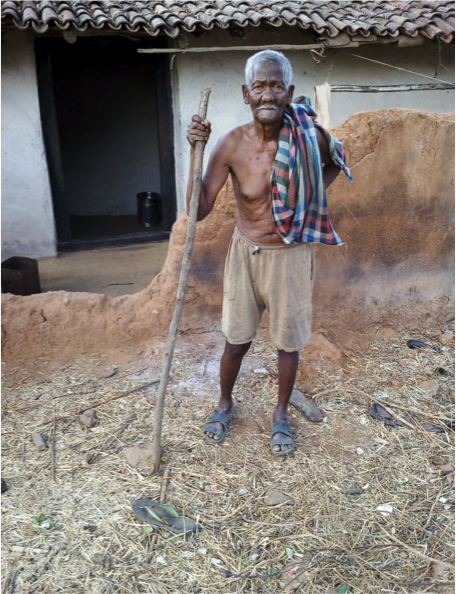
For the disbursal of their amount a ‘Bank Mitra’ is appointed by the bank who lives in Chiranga village. His duty is to take fingerprints of beneficiaries and provide them receipt and on approval he collects the aggregated amount from Ambikapur Union bank branch and distribute to beneficiaries on showing their receipt.
After the change in mode of payment from cash through panchayat to transfer in beneficiaries account in post office to introduction of modern banking system, Pension schemes has gone through lot of technological changes.
In recent development banks have been using biometric machine at places where there are no bank branches, in doing so, for the authentication beneficiaries finger print is taken on biometric machine, this biometric machine uses mobile network to connect with Aadhaar database and verify the fingerprint taken. Beneficiary gets his pension if and only if their biometric indicator matches. But the catch here is what if the finger print doesn’t match? Or what if there is no mobile network in remote areas?
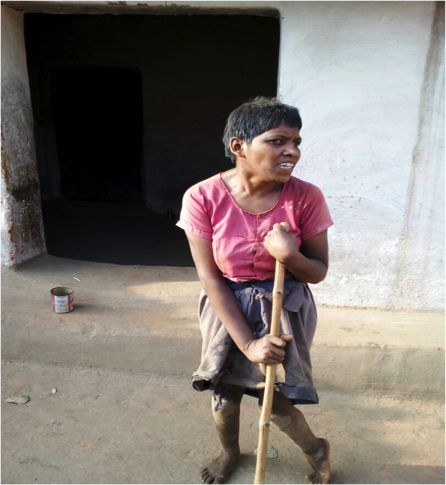
Connectivity
These two loopholes had been the story of many villages in Chhattisgarh. Since biometric machine requires mobile network to operate, bank mitra can’t come to Kardana as there is no network. Pensioners, many of them can’t walk and have bent back, have to walk down the hill 9 km to Chiranga village to verify their thumbprint. And even if they manage to reach, many times it happens that biometric machine refuses to recognize the person making their 9 km toil in vain. In such situation machine bears the burden of all guilt. In Kardana village only, there are seven such persons who are not getting their pension ever since biometric machine has come into use. Since this machine necessarily needs mobile network it can’t be used in areas where there are no networks like in Kardana.
Prior to using these biometric machines, payment through panchayat was scrapped because of rent seeking behavior and post office didn’t have enough staff to handle the sheer number of accounts. Even after deploying Bank correspondent who is locally know as ‘Bank mitra’ or ‘BC’ is supposed to visit pensioners and distribute their money after collecting their thumb impression, complaint of rent seeking has only increased, observed reason being asymmetric information relation between bank and beneficiaries. Beneficiary doesn’t get any idea of amount he or she is stipulated. And as it is often happening, pension amount is kept pending for 2 to 3 months, villagers are unable to keep track of their record on the basis of flimsy receipt on which ink start vanishing within a month on villagers damp and rough hand. Since there is no Union bank branch nearby they can’t get their passbook printed. In this state of confusion it is alleged by the villagers that bank mitra doesn’t give their stipulated money.
Main branch of the bank is 60 km away and there is no direct bus service from the village. Auto goes till Batauli and from there they can board the bus, but it gets very difficult to travel at this age and transport fare cost them half of their monthly pension. And many times bank employees refuse to print passbook on the pretext of ‘machine is not working’.
Aadhaar glitches adding to existing problems
Use of Aadhaar in welfare programs has been a contentious issue lately. Government’s desperate attempt to link Aadhaar with some basic provisions has lead many people in dire need to gasp for little discount.
Even if they are linked, as it happens many times, that machine refuses to recognize an authentic person. Such situation questions the locus of authority and basic premise of democracy, “to the people, by the people” and if it has shifted to inanimate machine.
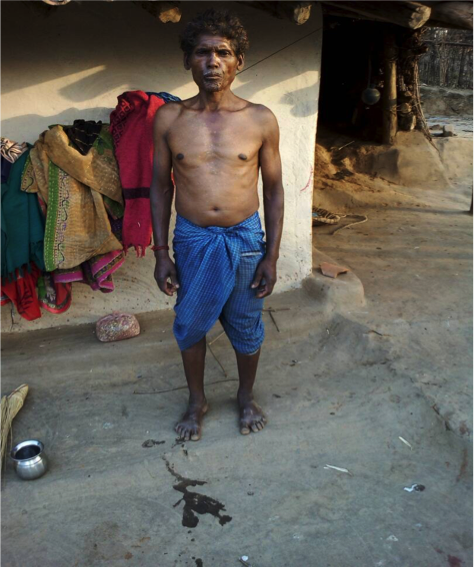
In a recent government office visit, it came out that pension of those person who have not submitted their Aadhaar with bank, their pension amount is not being released. In doing so, government has not only defied the Supreme Court’s ruling of not imposing Aadhar card but snubbed the fundamental right to life inherent in Article 21 of constitution of India.
There are seven persons in Kardana village who can no longer get their pensions because their thumb impression do not match with their biometrics or demographic details in the Aadhaar database.
Sadly, one of the beneficiaries, Devnath, a Kanwar Adivasi diedwhile waiting for his stopped pension.
Reason for mismatch may be many from rough hands of villagers due to their working condition to link failure of machine.
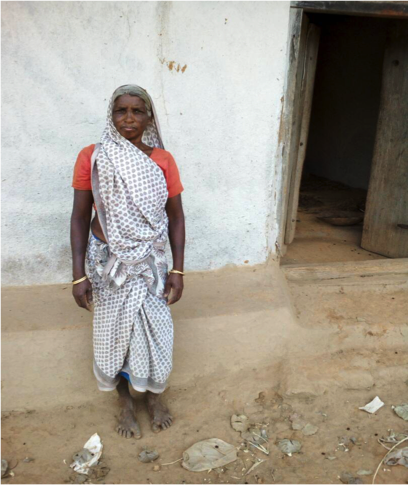
The important thing here, that, a needy person is not getting their due benefit gets sublimated in the clamor of whole Aadhar debate.
Those people are:
Name Caste/category Amount (in Rupees)
Bhinsari Pahari Korwa(PVTG) 4,550
Kondaha Nagesia(ST) 4,550
Budhram Majhwar(ST) 2,150
Sukhmania Kanwar(ST) 4,550
Sarojini Kanwar(ST) 4,550
Suni Bai Nagesia(ST) 4,900
Devnath(Deceased) Kanwar(ST) 1,750
This is important here to note the government’s attitude towards social assistance program when demands of increasing the amount and widening the canopy of such program are increasing from various corners.
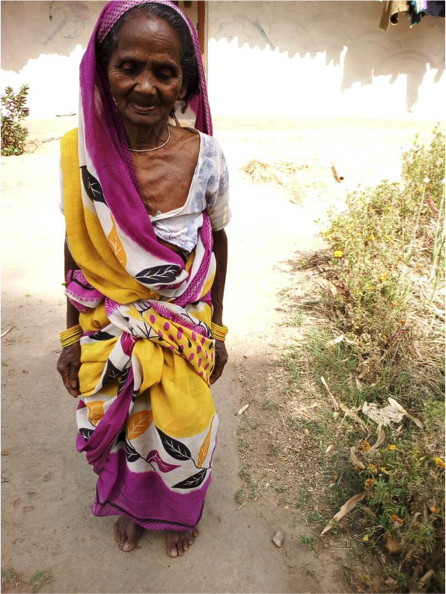
The government’s role as a welfare state has been ambiguous when it comes to providing social security net to the needy which is apparent from gradual budget slashes in real terms Jharkhand shows why Old Age Pension Scheme needs legal framework. For the time being situation now is just the tip of the iceberg, with demographic transition India’s largest youth working population will convert into dependent population, without any concrete planning and action situation will only going to be worsen.
--- By Vipul Paikra, Chaupal Sanstha.
### 25 Apr 2017 — Why the Government is wrong to claim it is legal to force citizens to link Aadhaar to PAN > The Supreme Court is set to hear an important challenge on Wednesday, April 26 on linking of Aadhaar, a 12-digit biometrics based identity number to the Permanent Account Number(PAN), used for filing income tax. On Friday, April 21, two writ petitions challenging the latest amendment to the Income Original: https://rethinkaadhaar.in/blog/2017/4/25/why-the-government-is-wrong-to-claim-it-is-legal-to-force-citizens-to-link-aadhaar-to-panThe Supreme Court is set to hear an important challenge on Wednesday, April 26 on linking of Aadhaar, a 12-digit biometrics based identity number to the Permanent Account Number(PAN), used for filing income tax.
On Friday, April 21, two writ petitions challenging the latest amendment to the Income Tax Act were heard at the Supreme Court by a bench comprising of Justice A.K. Sikri and Justice Ashok Bhushan. The amendment in question introduces Section 139AA that makes submission of one's Aadhaar/UID number mandatory when filing of income tax returns and obtaining and retaining the Permanent Account Number (PAN), both of which will be implemented from July 01, 2017 onwards.
Thus, the amendment makes it a penal offence to not enrol for Aadhaar/Unique Identity Number if one is an income tax payer in India.
The first petition was filed by CPI Leader Binoy Viswam, who is represented by Senior Advocate Aravind Datar, and the second one was filed by Sudhir Vombatkere and Bezwada Wilson, who are represented by Senior Advocate Shyam Divan. Attorney General Mukul Rohatgi, Harish Salve, and others are representing for Union of India and UIDAI. Mr. A.B.P. Pandey, Chief Eexcutive Officer of UIDAI, was also present in the Supreme Court when the matter was heard last Friday. .
During the arguments, Justice Sikri asked the Attorney General as to how the Union Government can force someone to enrol for Aadhaar/UID numbers when there are interim orders of the court in the case. (These SC orders say Aadhaar can only be used on a voluntary basis, that no one can be denied a service they are otherwise entitled to just because they do not have an Aadhaar number, and the matter is pending after it was referred to a Constitution bench.)
In response, the Attorney General advanced three arguments in support of the Income Act Tax amendment:
1. That the interim orders issued by the Supreme Court were made prior to the coming of the Aadhaar Act 2016 and because the basis of those orders were absence of legislation, those orders no longer hold the field.
2. That the Supreme Court has endorsed mandatory use of Aadhaar/UID for SIM card verification in the February 06, 2017 order given in the Lokniti Foundation Vs Union of India and Anr case.
3. That the Supreme Court's oral comments on March 27, 2017 has indicated that Aadhaar/UID may not be made mandatory for accessing welfare services but can be made mandatory for other purposes.
However, none of these arguments are valid.
1. The Aadhaar Act 2016 was published on March 26, 2016 [1]. The most recent order prohibiting making of Aadhaar/UID mandatory for access to any government programmes and services was issued by the Supreme Court on September 14, 2016 [2]. In this order, Justice V. Gopala Gowda and Justice Adarsh Kumar Goel directed that making submission of Aadhaar/UID number for applying for a government scheme is "contrary to the interim order passed by the Constitution Bench and therefore, to that extent they are not tenable in law" [Ibid.]. Thus, even after the Aadhaar Act was passed, the Supreme Court had reiterated its earlier orders on Aadhaar and these still stand.
2. The order given by Supreme Court on February 06, 2017 in the Lokniti Foundation Vs Union of India and Anr case quotes the Attorney General himself informing the Supreme Court that the government "has launched Aadhaar based E-KYC for issuing mobile connections on 16th August, 2016" and that "[currently] Aadhaar card or biometric authentication is not mandatory for obtaining a new telephone connection" [3]. Nowhere in the order does the Supreme Court endorses the acceptability or desiability of making Aadhaar/UID mandatory for obtaining and using SIM cards in India.
3.The Supreme Court's oral comments on March 27, 2017 were a short discussion during a 'mentioning'. That day, there was a brief exchange between thebench and advocate Shyam Divan, as the bench was trying to understand the court’s earlier orders. This verbal exchange included some remarks by the Chief Justice of India on whether the October 15, 2015 order perhaps only applied to social welfare and benefit schemes and did not apply to other activities like I-T filings. Many media organisations including the Press Trust of India (PTI), wrongly reported these remarks as definitive observations amounting to judicial orders, which is incorrect.
The court nowhere said that the UID can be asked for other services. Anyone who knows court proceedings knows that the court could not have made any such order. One, because it was a `mentioning' that was underway, and that was only to fix a date, and such an order cannot be passed without hearing the parties to the case, and two, the October 15, 2015 order was by a 5-judge bench, and 3 judges cannot revise/rewrite/override that order.
Further, before tomorrow's hearing it is important to remember that the Supreme Court has previously noted in its orders that:
1. "The Union of India shall give wide publicity in the electronic and print media including radio and television networks that it is not mandatory for a citizen to obtain an Aadhaar card" [4].
2. "The production of an Aadhaar card will not be condition for obtaining any benefits otherwise due to a citizen;" [Ibid.].
3. "The Unique Identification Number or the Aadhaar card will not be used by the respondents for any purpose other than the PDS Scheme and in particular for the purpose of distribution of foodgrains, etc. and cooking fuel, such as kerosene. The Aadhaar card may also be used for the purpose of the LPG Distribution Scheme;" [Ibid.].
/There is no evidence of any of these directives being implemented or adhered to by the Union of India./
The Rethink Aadhaar team awaits the judgement of the honourable judges on this case.
The next hearing is to take place on Wednesday, April 26, 2017, morning. Please send your reporters/correspondents to attend and report on this important hearing.
References
[1] Source: https://uidai.gov.in/images/targeted_delivery_of_financial_and_other_subsidies_benefits_and_services_13072016.pdf.
[2] Source: https://github.com/rethinkaadhaar/docs/blob/master/Court%20Orders/SC_2016.09.14_Order.pdf.
[3] Source: https://github.com/rethinkaadhaar/docs/blob/master/Court%20Orders/SC_Lokniti_2017.02.06.pdf.
[4] Source: https://github.com/rethinkaadhaar/docs/blob/master/Court%20Orders/SC_2015.08.11_Proceedings%2BOrder.pdf.
For further information, write to contact@rethinkaadhaar.in.
Further reading:
https://rethinkaadhaar.in/blog/2017/3/31/legal-did-sc-allow-aadhaar-in-income-tax-pan-no
### 11 Apr 2017 — Extracts from Supreme Court Orders on Aadhaar > September 23, 2013 [Until final hearing of the Constitution Bench] “…no person should suffer fornotgetting the Adhaar card inspite of the fact that some authority hadissued a circular making it mandatory”. November 26, 2013 [States/UTs impleaded.] March 24, 2014 “… no person shall be deprived of Original: https://rethinkaadhaar.in/blog/2017/4/11/extracts-from-supreme-court-orders-on-aadhaarSeptember 23, 2013
[Until final hearing of the Constitution Bench] “…no person should suffer fornotgetting the Adhaar card inspite of the fact that some authority hadissued a circular making it mandatory”.
November 26, 2013
[States/UTs impleaded.]
March 24, 2014
“… no person shall be deprived of any service for want of Aadhaar number in case he/she is otherwise eligible/entitled. All the authorities are directed to modify their forms/ circulars/ likes so as not to compulsorily require the Aadhaar number in order to meet the requirement of the interim order passed by this Court forthwith.”
March 16, 2015
“… we expect that both the Union of India and States and all their functionaries should adhere to the Order passed by this Court on 23rd September, 2013.”
August 11, 2015
“1. The Union of India shall give wide publicity in the electronic and print media including radio and television networks that it is not mandatory for a citizen to obtain an Aadhaar card;
2. The production of an Aadhaar card will not be condition for any benefits otherwise due to a citizen;
3. [PDS and LPG exemptions] “will not be used by the respondent for any purpose other than the PDS Scheme and in particular for the purpose of distribution of foodgrains, etc. and cooking fuel, such as kerosene. The Aadhaar card may also be used for the purpose of the LPG Distribution Scheme”
4. The information about an individual obtained by the Unique Identification Authority of India while issuing an Aadhaar card shall not be used for any purpose, save as above, except as may be directed by a Court for the purpose of criminal investigation.”
October 15, 2015
[Further exemptions for NREGA, NSAP, JDY, EPFO – see attached snapshot.]
“We impress upon the Union of India that it shall strictly follow all the earlier orders passed by this Court commencing from 23.09.2013.
We will also make it clear that the Aadhaar card scheme is purely voluntary and it cannot be made mandatory till the matter is finally decided by this Court one way or the other.”
September 14, 2016
[Reaffirming the 15/10/15 order, the Court struck down directions from the Union of India to the states making Aadhaar mandatory for various scholarships.]
The last order is particularly significant as it reaffirms earlier orders even after the Aadhaar Act.
 ### 10 Apr 2017 — In Rajya Sabha: "What sterilisation was to the Emergency, Aadhaar seeding is becoming to your Government"
> During a heated short duration discussion on the Aadhaar project in the Rajya Sabha on Monday, MPs attacked the notifications making Aadhaar mandatory for essential services. Opposition MPs raised the issue of the violation of the Supreme Court’s orders and exclusions due to Aadhaar in many welfare
Original: https://rethinkaadhaar.in/blog/2017/4/10/in-the-rajya-sabha-today-what-sterilisation-was-to-the-emergency-aadhaar-seeding-is-becoming-to-your-government
### 10 Apr 2017 — In Rajya Sabha: "What sterilisation was to the Emergency, Aadhaar seeding is becoming to your Government"
> During a heated short duration discussion on the Aadhaar project in the Rajya Sabha on Monday, MPs attacked the notifications making Aadhaar mandatory for essential services. Opposition MPs raised the issue of the violation of the Supreme Court’s orders and exclusions due to Aadhaar in many welfare
Original: https://rethinkaadhaar.in/blog/2017/4/10/in-the-rajya-sabha-today-what-sterilisation-was-to-the-emergency-aadhaar-seeding-is-becoming-to-your-government
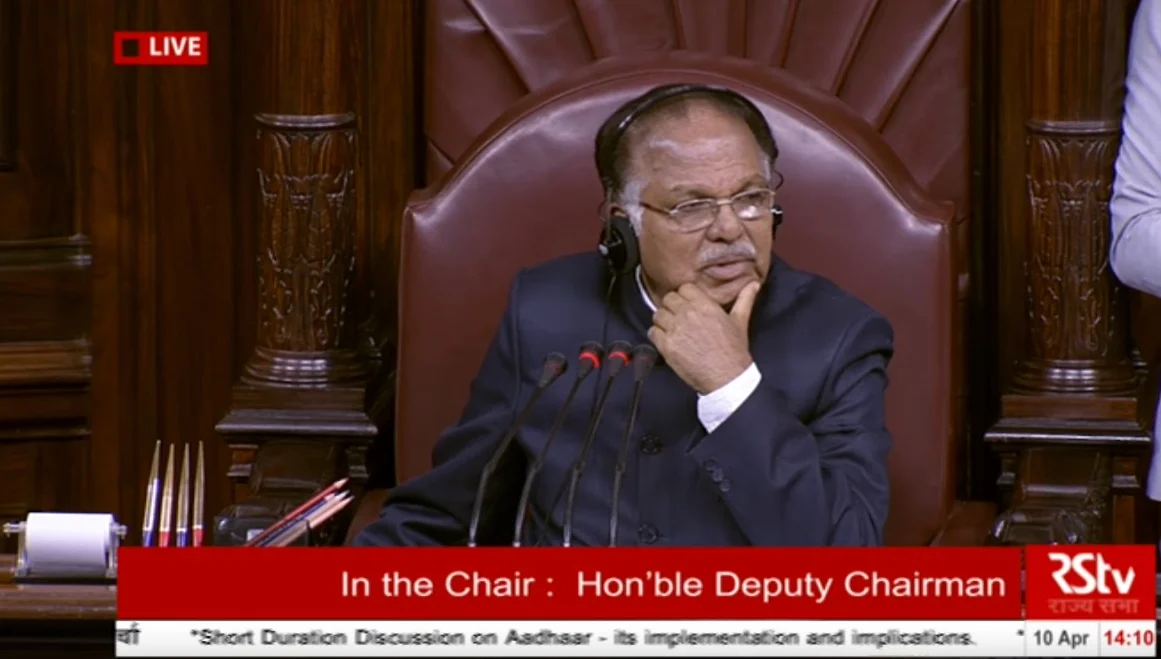
During a heated short duration discussion on the Aadhaar project in the Rajya Sabha on Monday, several MPs attacked the notifications making Aadhaar mandatory for essential services. Opposition MPs raised the issue of the violation of the Supreme Court’s orders and exclusions due to Aadhaar in many welfare programmes. The Supreme Court had allowed only voluntary use of Aadhaar and that too for only six government schemes.
MP Rajeev Chandrashekhar began by raising concerns regarding verification of the database. He pointed out that before the Aadhaar Act was passed in 2016, 100 crore people had already been enrolled, but no verification of the UID database had been carried out. He also pointed out that the Standing Committee on Finance on Aadhaar had concluded that the database was going to be ineffective even for the purposes of directing subsidies. He reminded the house that the Leader of the House conceded that privacy is a fundamental right even without the Supreme Court saying so.
Jairam Ramesh said that Aadhaar had become a tool of exclusion (in the PDS, NREGA and social security pensions) and was in violation of the orders of the Supreme Court of India. In Rajasthan, 10 lakh pensioners had been removed from the list of beneficiaries. In Bhim (Rajsamand district) almost 1500 out of 3000 elderly whose names were cut after being declared “dead” or “duplicates”, were found to be alive and were restored their pensions. In the PDS the exclusion rate in Rajasthan was 25 per cent, according to government figures, i.e. 25 lakh people had not got rations since Aadhaar-Based Biometric Authentication was made mandatory. Similarly, A Navneethakrishnan, D Raja were concerned about denial of benefits due to various failures of aadhaar.
Derek O'Brien pointed out that there was no regulation and no information on the third parties that have access to the UID database. "Have you considered how other databases - NATGRID, Health are being linked to Aadhaar” and raised concerns on data use and data security." KTS Tulsi (noted lawyer) said that he has never seen as poor statutory framing in his life as in the Aadhaar Act.
In reply, Minister Ravi Shankar Prasad stated that the orders of the Supreme Court were interim orders and the Aadhaar Act overrode the orders. He, however, failed to mention that in September 2016, after the Aadhaar Act was passed in Parliament, the Court had said that their earlier orders stand. In fact the matters challenging the constitutionality of the Aadhaar project as well as the 2016 Aadhaar Act are still pending before the Supreme Court.
He said that the CAG report on LPG savings which debunked government claims was "judgmental" and instead cited World Bank and UNDP reports in support of the project. Again, the World Bank’s figures have been challenged. The World Development Report 2016 (p. 195) states "This [LPG] is just one of many subsidy programs in India that are being converted to direct transfers using digital ID, potentially saving over US$11 billion per year in government expenditures through reduced leakage and efficiency gains." In fact, the source of this US$ 11 billion estimates states that "The value of these transfers [NREGA, pensions etc.] is estimated to be Rs. 70,000 crores ($11.3 billion) per annum."
He insisted that the database was secure and safe, but was unable to answer questions on access to the database by third parties, on national security, and on the gross and inhuman exclusion caused in social sector. Though Ravi Shankhar Prasad assured the House that no person could be denied welfare entitlements for lack of Aadhaar, no notification making it mandatory has been withdrawn so far. No concrete steps or plans to keep Aadhaar truly voluntary were given by Mr. Prasad. Empty words and rhetoric continue as pensioners, ration card holders, and mgnrega workers are pushed further into poverty and exclusion.
For further information, email: contact@rethinkaadhaar.in
For signing up for Rethink Aadhaar mailing list, please click here
Follow us on Twitter @No2UID
Right to Food, Jharkhand is going on hunger strike from April 9 against Jharkhand government's unconstitutional order to make Aadhar mandatory in Public Distribution System foodgrains.
For more details, contact: rtfcjharkhand@gmail.com
"राशन कार्ड के लिए आधार अनिवार्य करने के खिलाफ 9 अप्रैल से "आधार नहीं आहार दो सत्याग्रह"
राशन कार्ड के लिए आधार अनिवार्य कर झारखंड सरकार ने संविधान व सुप्रीम कोर्ट के आदेश का उल्लंघन किया है.भोजन का अधिकार अभियान, झारखंड से जुड़े सामाजिक कार्यकर्ता राज्य सरकार के इस फैसले के खिलाफ 9 अप्रैल से राजभवन, रांची के सामने अनशन पर बैठकर "आधार नहीं आहार दो सत्याग्रह" की शुरुआत करेंगे.
ज्ञातव्य हो कि 27 मार्च को सुप्रीम कोर्ट ने यह आदेश जारी किया था कि सरकार अपने कल्याणकारी योजनाओं का लाभ देने के लिए आधार को अनिवार्य नहीं बना सकती. अर्थात सरकार वृद्धा पेंशन, राशन या अन्य किसी तरह की कल्याणकारी योजनाओं का लाभ देने के मामले यह नहीं कह सकती कि ये लाभ इसलिए नहीं मिलेंगे, क्योंकि लाभुक के पास आधार कार्ड नहीं है.
लेकिन सुप्रीम कोर्ट के आदेश का उललंघन कर 27 मार्च को ही झारखंड सरकार ने यह आदेश जारी किया कि 5 अप्रैल के बाद बिना आधार वाले कार्ड धारियों को राशन नहीं मिलेगा. अभियान मानता है कि राज्य सरकार का यह आदेश सुप्रीम कोर्ट व संविधान का उलंघन है और लोगों के भोजन के हक़ पर हमला है.
अभियान मांग करता है कि राज्य सरकार अपना निर्णय वापस ले अन्यथा अभियान के सदस्य सरकार के इस निर्णय के खिलाफ 9 अप्रैल से राजभवन के सामने अनशन पर बैठेंगे.
भोजन का अधिकार अभियान, झारखण्ड | rtfcjharkhand@gmail.com

Hunger strike is against the following press statement of Jharkhand Government:
INFORMATION AND PUBLIC RELATIONS DEPARTMENT
Press Release27/03/2017
Ration cards devoid of Aadhar number will cease to exist from 5th April, PDS outlets will work as mini bank: CS
Reviewing the PDS Department, Chief Secretary Mrs. Raj Bala Verma said that the govt. is committed for paddy procurement. She said that paddy has been produced in ample quantity and farmers should bemotivated for paddy procurement. A door to door campaign should be run with the help of panchayat sevak and krishak mitra so that farmers can reach to the purchase center.
She said that the list of all the registered farmers should be made available topanchayat sevaks and krishak mitras so that they can contact the concerned farmers and inspire them for paddy procurement. The krishak mitras will be given promotion amount for procuring 50 quintals of paddy. 1.2 lakh metric ton paddy has been procured and 65 thousand farmers have been sent SMS out of 90 thousand registered farmers. She said that mill owners should be contacted and grains should be lifted from the packed godowns of the concerned districts.
She directed to work in the direction of providing the tribal 35 kilos rice at their homes. 35 kg packets should be made by sakhi mandals for all PDSs at block level so that they can be distributed through Panchayat sevaks. She directed to make the LDM and BSO responsible for it. Panchayat sevaks will be given Rs. 20 per bag promotion amount from the dept.
She said that all the ration cards which have not been linked with Aadhar number will become null and void on 5th April. Aadhar based ration card will be considered for food grains by the PDS outlets. Nearly 3 lakh ration cards have been declared invalid. Kerosene will be distributed through DBT from 7th March.
The CS said that PDS outlets will work as mini banks. Electricity bills, rail tickets, cash deposits and cash withdrawals can be done at PDS outlets. For this, the PDS owners are being trained. She said that they should be trained through DEGS.
PDS Sec Mr. Vinay Kr. Choubeyand other officers were present in the meeting.
Some newspapers have reported erroneously that the Supreme Court on March 27 directed that the government can ask for the UID for Income Tax and PAN card; this is misinformation.
For one, what transpired happened during a `mentioning', that is, where the lawyer mentioned the matter only to the court to ask that the matter actually be listed and heard on April 3. Earlier the case was listed for March 27, but then it got shifted in the list to April 3. The lawyer took the matter to court to ask the court that there should be no further delay, and that it should be heard on the April 3.
The court turned down the request for such an assurance.
While doing that, the court looked at para 5 of the order of the 5-judge bench in its order dated 15th October 2015, where it said that even when it is used in Public Distribution System(PDS), NREGA, pensions, LPG, Jan Dhan Yojana(JDY) and provident fund, it cannot be made mandatory.
That is it.
The court nowhere said that the UID can be asked for other services.
Anyone who knows court proceedings knows that the court could not have made any such order,
One, because it was a `mentioning' that was underway, and that was only to fix a date, and such an order cannot be passed without hearing the parties to the case, and
Two, the October 15, 2015 order was by a 5-judge bench, and 3 judges cannot revise/rewrite/override that order.
For public information, the October 15, 2015 order OF Supreme Court said:
- The UID can be used in six services: PDS, LPG, NREGA, JDY, EPFO, pensions such as disability, widow, old age pensions which are seen as services provided by the state.
- Even in these services, its use "is purely voluntary, and cannot be made mandatory till the matter is finally decided by this court one way or the other".
- The UID number cannot be used in any other service. It is not a matter of whether it is voluntary or mandatory. It cannot be used at all.
- All earlier orders from the first order of the court on September 23, 2013, when it directed that no one can be denied any service only because they do not have a UID card or number, shall be `strictly followed'. That includes the order dated August 11, 2015, which, among other things says that enrolment is not mandatory (which makes their notifications saying that those who do not have a UID number should be shepherded to the enrolment station is in contempt of court).
On October 15, 2015, the 5 judge bench heard a series of applications for expansion of the use of the number, including the TRAI that came to court saying that they could deal with terrorism if they were able to use the UID number for giving and checking Sim cards. The 5 judge bench refused this use. This refusal by the 5 judge bench was suppressed by the Attorney General when he told the court in a matter taken to court by Lokniti, an NGO, that they intended to make sim cards secure by having it checked against the UID. The court reproduced this submission and disposed of the matter. This has been read by some part of the press as an order by the court that sim cards should be checked against the UID, which is inaccurate. This did, however, mean that the court did not object to such use. That was a 3 judge bench, and could not have overridden a 5 judge bench. This happened because the Attorney-General did not inform the court, and since it was not a UID matter that was being heard, there was no one challenging the UID project who could have pointed this out to the court. This is what is called an order -per incuriam' (i.e. being in disregard of the facts or the law, in this case because they were kept in the dark about what had happened before the 5 judge bench.)
So, the government attempt to make UID mandatory for income tax and PAN card is in contempt of court. Not just making it mandatory, but even using the UID in these fields is in contempt.
The reason the court so restrained the court is because it had seen the various dimensions of the project that made up the challenge before it, including
- surveillance
- profiling
- tagging
- tracking
- insecurity of the data base
- national security issues, posed both by the creation of such data bases, and because of the companies involved which includes L-1 Identity Solutions, Morpho and Accenture, which have close connections to the intelligence establishments of foreign governments.
- lawlessness
- the use by private actors, and
- importantly, the denial of the right to privacy of the people that the government had asserted before them. Like the court said: without the right to privacy, "the fundamental rights guaranteed under the Constitution of India, and more particularly the right to liberty under Article 21 would be denuded of vigour and vitality."
That is why they said that their order would be till the court has heard and decided these matters - not till passage of a law or any other such circumstance.
By Dr Usha Ramanathan
Further reading:
A shaky Aadhaar (Indian Express, March 30, 2017.)
Statement on court proceedings on March 27 by petitioners.
### 31 Mar 2017 — Parliament update: Issues raised by MPs on Aadhaar > The following are links to, and text of discussion by members of parliament in Lok Sabha and Rajya Sabha this week: Bhupendra Yadav's private member resolution to hold Lok Sabha and Assembly elections simultaneously to be taken up tomorrow in RS. He suggests linking of Aadhaar number with Electio Original: https://rethinkaadhaar.in/blog/2017/3/31/parliament-update-issues-raised-by-mps-on-aadhaar-in-parliamentThe following are links to, and text of discussion by members of parliament in Lok Sabha and Rajya Sabha this week:
Bhupendra Yadav's private member resolution to hold Lok Sabha and Assembly elections simultaneously to be taken up tomorrow in RS. He suggests linking of Aadhaar number with Election Card.
(list of business for- http://164.100.47.5/newlobsessions/sessionno/242/310317.pdf)
2. Full text of March 29 Rajya Sabha proceedings where Aadhaar was discussed - ( http://164.100.47.5/newdebate/242/29032017/Fullday.pdf)
KTS Tulsi -
Sir, through you, I wish to raise three concerns with regard to the Finance Bill. The first is with regard to making Aadhaar mandatory for various schemes, the second is, removing the cap on corporate funding, and the third is, rubbishing several tribunals in a jiffy.
Sir, with regard to the Aadhaar, I want to bring to the attention of this august House that Section 29 of the Aadhaar Act, 2016, as notified, categorically provides that the core biometric information collected by the Unique Identification Authority of India under the Act shall not be shared with anyone for any reason whatsoever. Now, that is a legislative provision. Now, when the Act was notified under the Rules, what is being provided is that any individual agency or entity, which collects the Aadhaar Number and the document containing it, shall obtain consent.
When the Act says, “It cannot be shared for any reason whatsoever”, how can you prescribe a procedure of voluntary consent? Consent could also be by force. When the use of this Card is forbidden for any other purpose whatsoever, it cannot be allowed to be introduced. The rules are in conflict with Section 29 and Section 8(3) is also in conflict with Section 29. This is going to create a huge problem.
The provisions therefor permitting sharing of biometric information by merely informing, which is taken to be consent, is fraught with danger. It was meant only for the purpose of delivering public services.
The question is: How safe is our data? It has already been scrapped in the UK as well as in France. The then Home Secretary, now the Prime Minister, Theresa May, in 2010, announced the end of the ID Card project of 2010 and said, “We need to balance national security and civil liberties.” Australia in 2007 cancelled the Social Services Access Card because of the dangers which were inherent with the hacking or the leakage of that information.
France in 2012 sought to justify this but the Identification Protection Act was declared to be unconstitutional by the highest Court in France. Today, there are petitions pending in the Supreme Court which have been referred to a 9-Judge Bench. We are permitting doing of things through subterfuge of a rule what was prohibited by the Act.
The Supreme Court on 15th October, 2015 allowed Aadhaar Card to be used only for the six Government schemes of Public Distribution, that is, LPG, rural employment, employees’ provident fund, pension scheme and so on. Now, there are several Government agencies which have begun to insist on Aadhaar Card for even opening a bank account and for various other purposes.
This can jeopardize the privacy and security of the citizens and no attention is being paid for safeguarding the data from hackers. We must be able to guard against hackers, particularly in the context of China and Pakistan getting into our systems all the time, and many a time succeeded. How we intend to safeguard the personal information? Not only that, we are completely blissfully unaware of the dangers of that information.
Anybody’s fingerprints can be planted anywhere because fingerprints will be available. My fingerprints can be planted; my iris impression can be planted. If that information becomes available to anyone, it will become extremely dangerous and it is precisely for this reason that a number of democratic countries have abandoned this project. Unless we can safeguard the data, only then can it be permitted to be used for the purpose for which the Act was enacted and only for the use of services.
The second point that I want to submit, Sir, is regarding removing a cap on donations and also making them anonymous. It only achieves one purpose. It manages to multiply political corruption. If that is the aim of the Finance Bill, then they must be clear about it.
The third is with regard to winding up of the Tribunals by a notification of the mere rules. There are several statutes, which will have to be amended, but in the process, what is being provided is that by virtue of the rules, the Government will decide the qualifications and the method of appointment of members.
There is no regard paid to the law which has been declared by the Supreme Court that even with regard to the appointment of the members of various Tribunals, the Courts must be consulted to ensure that they are independent and they are not the persons with questionable integrity.
In this regard, I submit that you cannot permit the delegation of essential legislative function. What will be the qualifications for the members is an essential legislative function and if it is delegated to the Government, it will amount to abdication of the legislative responsibility and I strongly oppose this. There are 27 Tribunals, and seven are sought to be shut down immediately. They can be paid three months' salaries and told to go home. That is what is left of all the Tribunals. I strongly oppose these three provisions in the Finance Bill.
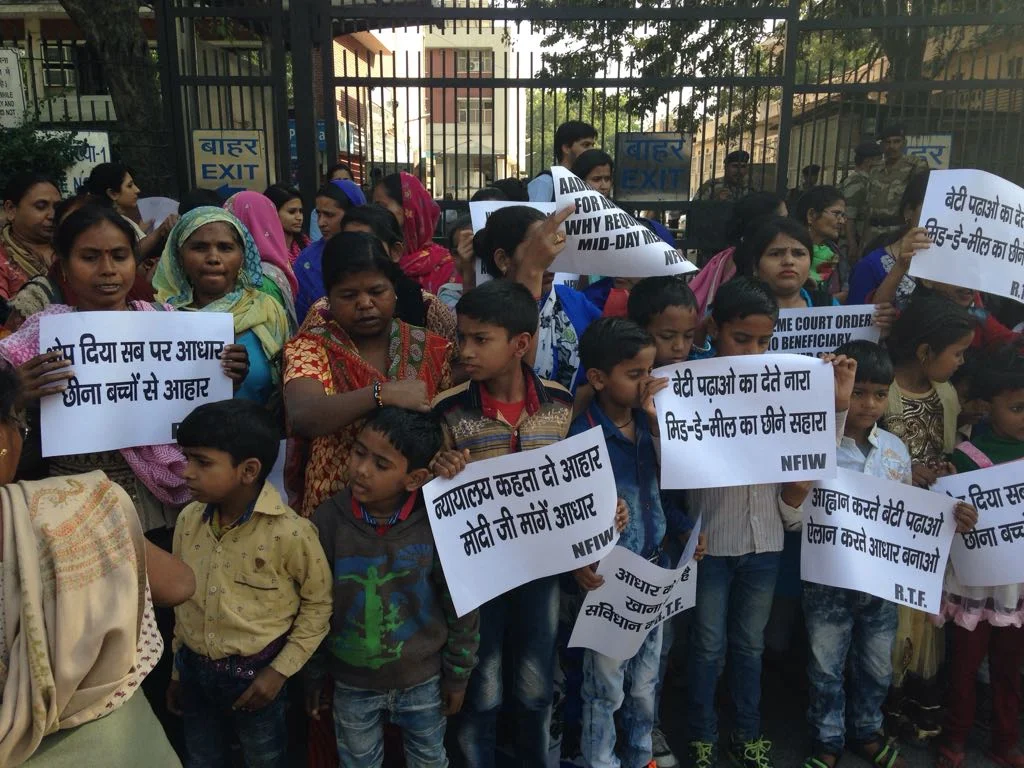
Jairam Ramesh -
I wish the amendments had been brought through normal circumstances, through procedures and a debate would have taken place. Sir, worse, this is an afterthought, this is after the Finance Bill had been introduced. This is not as if it was there in the original Finance Bill. This is an afterthought from the 1st of February to the 24th or 25th of March. (Time-bell) Sir, finally I come to Clause 56. We are going to have a debate on Aadhaar after this. I don’t want to speak much on Aadhaar.
But I have to congratulate the Finance Minister because he has forced me to do something which I had said I would never do, which is actually to get an Aadhaar number. I have to get Aadhaar number because now Aadhaar is compulsory for filing your Income Tax Returns. There are over three crore Income Tax assesses and there are over seventeen crore PAN Cards.
Now, how many of these are duplicates? How many of these are fake that you are making Aadhaar compulsory even for filing Tax Returns? I can do no better, Sir, than to bring to Finance Minister’s attention not what I am saying, not what civil society activists are saying, not what liberals are saying but what a magazine, which is fully in consonance with the Ruling Party’s philosophy, the Swarajya magazine, which is published out of Chennai, started by Great Mr.C. Rajagopalachari says.
What is the article that has appeared in the latest issue of Swarajya? “Aadhaar overreach making it a must for PAN will leave millions vulnerable.” भूपेन्दर् जी, आप इसे पिढ़ए। यह कोई यॉन रेस नहीं कह रहा है, कोई िलबरल नहीं कह रहा है। यह आप ही का वƪा, 'Îवराज्य' मैगज़ीन, जो हर हÄतेआपके समथर्न मȂिलखा करती है, वह कह रही हैिक This is overreach of Aadhaar.
चुनीभाई जी, आपनेसही कहा that we started Aadhaar but we started Aadhaar for ensuring better delivery of social services, for eliminating fake identities, for eliminating duplicate identities. Sir, I will have more scope to discuss this later on, but the fact is that this morning, as Mr. Digvijaya Singh pointed out, the headlines are ‘how Mahendra Singh Dhoni’s wife is very upset with the office of the Minister for Information Technology because Mr. Dhoni’s Aadhaar details are all available today on the internet.’
That is something we want to avoid, this is something that we want to ensure. But, I feel that by introducing Aadhaar in a whole set of activities unrelated to the purpose of Aadhaar for which Aadhaar was originally conceived by the Finance Minister then and the Prime Minister then has been completely lost.
So, Sir, in summary, may I say that this is not a Finance Bill? This is something more than a Finance Bill. This is actually an agenda for reducing Parliament to complete irrelevance, both the Houses. This is an exercise for this. When Mr. Chidambaram was the Finance Minister, he introduced a tax called Fringe Benefits Tax and it used to be called FBT. Sir, this Finance Bill is also an FBT. It is Finance Bill terrorism. Thank you. Sir.
Arun Jaitley -
Sir, Mr. Sibal made a comment with regard to Aadhaar. As far as legislation is concerned, that itself makes it clear in Section 7. As far as benefits are concerned, for the benefits, you can produce an Aadhaar card and if you don't have one, you can produce any other proof of identity
And, simultaneously apply for Aadhaar.
Fortunately, the scheme is successful, almost 98 per cent of the adults have gone in for it and I am sure, this will continue to improve. He was right on one count—let me tell him— that some of us, at some stage, had doubts. Immediately, when this Government was formed, the hon. Prime Minister organized a presentation and I was also present. I put across those doubts—some of which had been raised even by your colleagues when you were in Government—and they were answered adequately and we were candid enough to say that we accept that it was a great initiative and we expand this initiative.
We accepted that. I have no hesitation in this. But as far as tax evasion is concerned, the present Bill says, either give your Aadhaar number or give proof of the fact that you applied for it, that is all, in your tax assessment so that the possibility of a person committing tax frauds, filing through different pan cards, all that can be eliminated.
Why should we not allow this technology which was created in larger public interest to be utilized for this particular purpose? Sir, these are broadly some of the main points as far as the taxation proposals are concerned. I may only say this that while encouraging more and more people to join the tax net, the lowest slab we have reduced to 5 per cent and the idea is that more people should feel attracted enough to join.
P Chidambram -
Sir, the Finance Minister may kindly yield. He is moving on to another subject. We are grateful that you have acknowledged that Aadhaar was the initiative of the previous Government and you have expanded it. The question is, one, the purpose of Aadhaar. Aadhaar was an instrument to extend services and benefits, especially, subsidies.
Aadhaar was never intended to be tagged to income tax returns and bank accounts. But if your Government has taken a decision to tag it to income tax accounts and bank accounts, so be it. I accept it, for the time being, that maybe there are some benefits by asking it to be tagged to income tax accounts and bank accounts.
The larger question, that is being raised, and I think you should answer is, how will you protect the privacy of transactions in bank accounts? How will you protect the privacy of facts, material in the income tax returns? The Pentagon has been hacked, and five hundred million accounts have been hacked by somebody sitting in some country of Europe. What is the guarantee that you have the technology to prevent hacking of bank accounts, hacking of income tax accounts through the Aadhaar number?
The complaint of Mr. Mahendra Singh Dhoni's wife is that her Aadhaar number is being made public. Now, if Aadhaar numbers are available to a large number of authorities, what is the guarantee that using the Aadhaar number route, these accounts will not be hacked and the privacy that is required to be maintained by these accounts will not be breached? That is the question
Man, everyone's not a Dhoni. What happens to the rest of us whose Aadhaar data is made public because of such callous behaviour? https://t.co/7DLEn3TldV
— Kritika (@Kritika12) March 29, 2017
ARUN JAITLEY:
I think the Pentagon got hacked even without the Aadhaar being there. ...(Interruptions)... So, the hacking doesn't take place because of Aadhaar. ...(Interruptions)... SHRI ANAND SHARMA: Sir, what is this? ...(Interruptions)... SHRI DIGVIJAYA SINGH: Sir, we didn't expect it from him. ...(Interruptions)... Sir, kindly look at this. ...(Interruptions)... SHRI P.
CHIDAMBARAM: Sir, I appeal to the Finance Minister not to trivialize the question. ...(Interruptions)... I asked him a serious question and I request him to seriously answer it. Let him not caricature my question. If you don't want to answer my question, then, say, "I don't want to answer.”
SHRI P. CHIDAMBARAM (CONTD.): Don’t caricature it, don’t trivialize it.
SHRI ARUN JAITLEY: It is a serious answer. If the firewalls can be broken and hacking can take place, then, hacking will take place anywhere. That is not a ground that hacking takes place only because Aadhaar is there. ...(Interruptions)...
SHRI DIGVIJAYA SINGH: You are making it easier. ...(Interruptions)... This is making it easier. ...(Interruptions)... MR. DEPUTY CHAIRMAN: Okay. ...(Interruptions)... Please. ...(Interruptions)... No, no. He is not yielding. ...(Interruptions)... He is not yielding. Sit down. ...(Interruptions)... Mr. Bhattacharya, please sit down. ...(Interruptions)...
SHRI ARUN JAITLEY: Mr. Chidambaram, let us assume ...(Interruptions)...
MR. DEPUTY CHAIRMAN: He is not yielding. ...(Interruptions)...
SHRI P. CHIDAMBARAM: I am not attributing motives to the Government. I am asking as to how they will prevent it. SHRI ARUN JAITLEY: Therefore, let us assume, there is no Aadhaar, but some information which is contained in some network gets hacked or gets leaked. That is because of the technology you use there and technology, itself, can be broken into.
Therefore, the fact that technologies can be broken into, there is never an argument which is given saying, don’t have technology. Therefore, the answer is that your firewalls, that you have built around such a structure, must be strong enough.
The Aadhaar legislation has some provisions with regard to this. Now, don’t compare it with what happened yesterday to Mr. Dhoni because this was the case where some individual misconducted himself for the craze of a selfie or a photograph. And he has been blacklisted for ten years. It was an immature behavior of the person who went there. The fact is that, therefore, have a better technology. The idea, therefore, not to use technology or to go in for only obsolete method of collection of documents, is not the answer. ...(Interruptions)...
Sitaram Yechury -
Sir, I really want to know from the hon. Finance Minister that there has been a report of a particular college giving out the names and list of the students who won scholarship with their Aadhaar numbers. The Government may be unaware. I am not saying that the Government is involved in it. What I am saying is: What is the protection? What is the protection? If anybody is making public the Aadhaar number of somebody else, is there any law to prevent it? What is the protection?
SHRI ARUN JAITLEY: It comes in the Aadhaar legislation itself. ...(Interruptions)... For making it public, he can be prosecuted. These are provisions in the Aadhaar legislation itself.
SITARAM YECHURY: That is already there. In spite of that, Sir, I am asking. And I think that is what the sentiment from there also is. What is the protection? ...(Interruptions)... What is the protection? ...(Interruptions)...
MR. DEPUTY CHAIRMAN: He is not yielding. ...(Interruptions)...
SHRI JAIRAM RAMESH: About linking of Aadhaar with the PAN number, what I want to ask the Leader of the House is: Can you take us into confidence as to what is your broad estimate of the fake or duplicate PAN numbers in the 17 crore universe that you are dealing with? Because this must have been at the back of your mind to introduce Aadhaar. In fact, Aadhaar was optional in 2012. You have made it compulsory. You have made it compulsory now, so I want to know how serious is the fake or duplicate PAN card problem, which has forced you into this? This is the straight factual question I am asking you. ...(Interruptions)...
MR. DEPUTY CHAIRMAN: That is okay. That is enough.
SHRI ARUN JAITLEY: Let me clarify. Technology always is a learning experience. If you recollect, when the UPA Government brought the Aadhaar legislation, the legislation, itself, only dealt with the manner in which the cards are going to be issued. The law was never finally passed, but that was the draft law. What do you do with that Aadhaar card? The legislation did not mention that.
SHRI ARUN JAITLEY (CONTD.): As we learn from the benefit of that technology and the strength of that technology, can it be used to make sure that benefits are not misused? Can we make it for direct benefit transfer? Can we use it for detecting any form of tax misrepresentation, or, frauds? Now these are all areas where we are now expanding into.
I share the concern of the hon. Members and that is why there is a provision in the Act that privacy norms must be maintained, and it can’t be made public. So, if anybody in the list of successful candidates makes Aadhaar number public, then, he is guilty of the violation of that particular Act.
But the fact that somebody in Ranchi, or, somewhere else has violated it, let us not discredit the technology, as a whole, itself. Sir, my final point is: we have reduced the first slab in order to make sure that there is an incentive for more people to join.
We tried to encourage the MSME sector. We have also tried to encourage the housing sector in certain areas of investment. We are also trying to discourage cash transactions to the extent that is possible. These are various provisions which we have brought in. I would urge this hon. House , therefore, to support these provisions as far as the Finance Bill is concerned. Thank you very much, Sir. That is all I have to say.
CLAUSE 56 -- INSERTION OF NEW SECTION 139AA; QUOTING OF AADHAAR NUMBER DR. T. SUBBARAMI REDDY (ANDHRA PRADESH):
Sir, I just want to say a few words before moving my Amendments. I have submitted notice for these two Amendments which are similar in nature. I am proposing the date of making Aadhaar Card compulsory from 1 st December, 2017, instead of 1st July, 2017. The idea is that the income tax assesses should be given sufficient time for linking their Aadhaar Cards while filing their returns. Sir, even the Supreme Court has said that it should not be made mandatory. However, the Government is making it. You are, now, making it compulsory from Financial Year 2016-17. So, I am moving my amendments. Sir, I move:
(2) That the Rajya Sabha recommends to the Lok Sabha that the following amendment be made in the Finance Bill, 2017, as passed by Lok Sabha, namely;- "That at page 27, line 43, for the figures and words "1st day of July, 2017" the figures and words "1st day of December, 2017" be substituted." (3) That the Rajya Sabha recommends to the Lok Sabha that the following amendment be made in the Finance Bill, 2017, as passed by Lok Sabha, namely;- "That at page 28, line 6, for the figures and words "1st day of July, 2017 the figures and words "1st day of December, 2017" be substituted."
### 19 Mar 2017 — Protest Against making Aadhaar compulsory in Mid Day Meal > Today the National Federation of Indian Women and the Right to Food Campaign held a protest outside the Ministry of Human Resource Development, Shastri Bhawan to protest against the move of the Central Government to make Aadhaar mandatory for Mid Day Meal Scheme. People from more than ten states including UP, West Original: https://rethinkaadhaar.in/blog/compulsoryformiddaymealToday the National Federation of Indian Women and the Right to Food Campaign held a protest outside the Ministry of Human Resource Development, Shastri Bhawan to protest against the move of the Central Government to make Aadhaar mandatory for Mid Day Meal Scheme. People from more than ten states including UP, West Bengal, Odisha, Rajasthan, Chhatisgarh, Jharkhand, Bihar and Delhi participated in the protest. A memorandum was handed over to the Minister regarding the issue. The notification is in complete violation of the orders of the Supreme Court which have time and again stressed that Aadhaar cannot be made mandatory for receiving entitlements or benefits. This move of the Central government will put millions of children across India at risk of starvation as the MDM is often the only complete meal that children have access to and is essential for their survival and welfare.
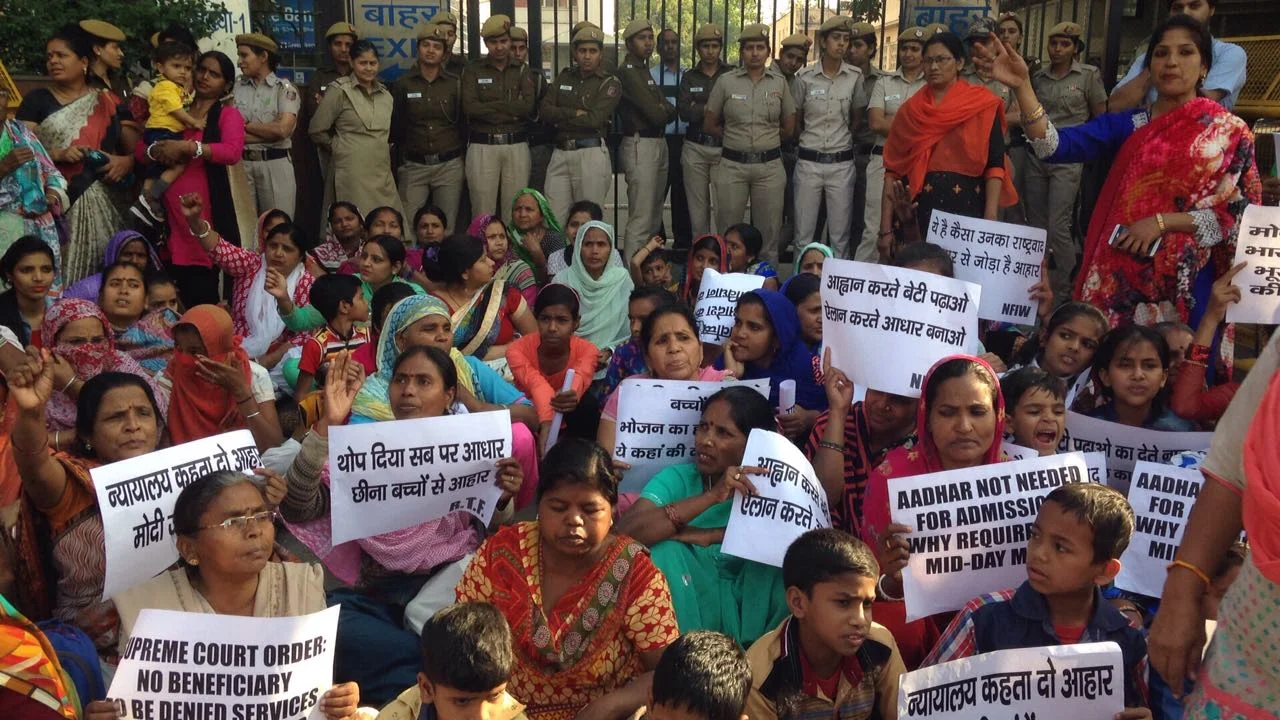
We strongly opposes the central government's move to make Aadhaar compulsory for children under the midday meal scheme in government schools. This is nothing but an attempt to coerce people to enrol their children under Aadhaar.
School meals are an important entitlement of Indian children, legally enforceable under Supreme Court orders as well as under the National Food Security Act. Numerous studies show that India's midday meal scheme has made an important contribution to higher school attendance, better child nutrition and more effective learning. Midday meals also help to break the barriers of class and caste by imparting to children of diverse backgrounds a habit of sharing meals.
No conditionalities can be imposed on this critical entitlement of Indian children. Making Aadhaaar compulsory for the midday meal would serve no purpose, and is bound to disrupt instead of helping this important programme. Further, this move is a violation of Supreme Court orders.
In a series of orders, the Supreme Court has made it clear that Aadhaar cannot be made compulsory for any services to which people are otherwise entitled. It has also made it clear that the Aadhaar Act does not supersede these orders, until such time as the Court settles the issue of compatibility of Aadhaar with the right to privacy.
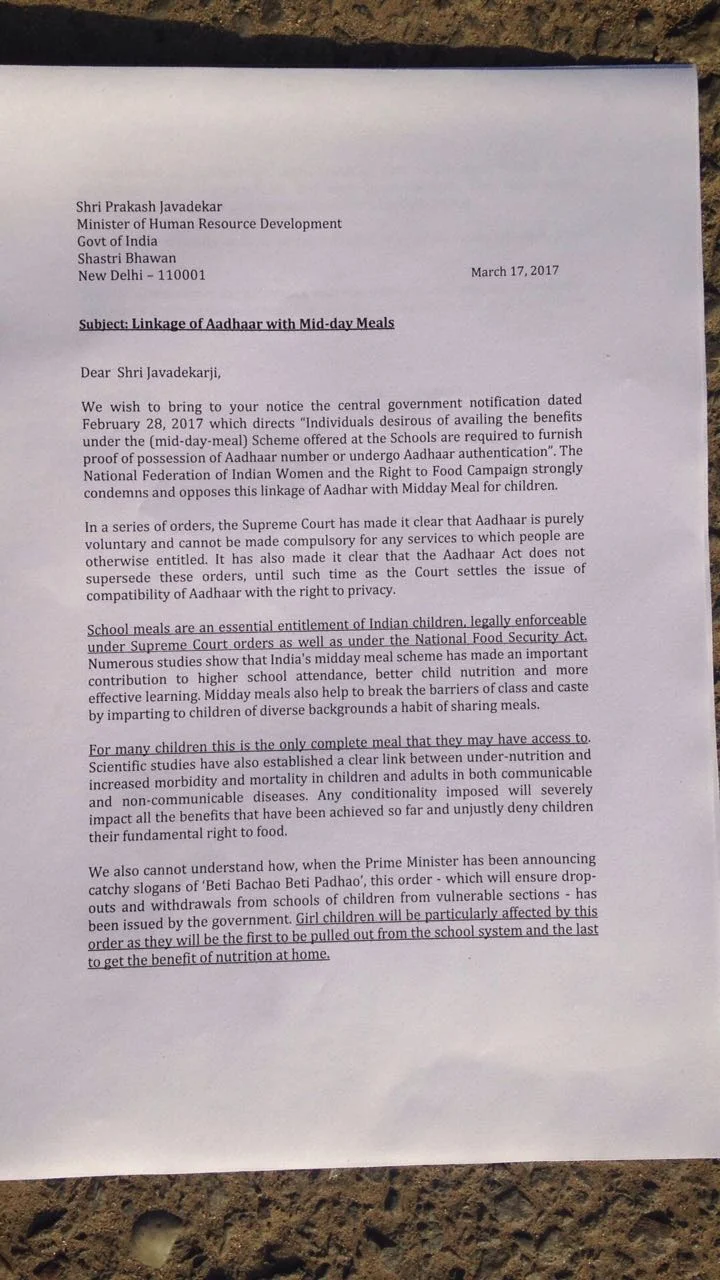

During the last few years, Aadhaar has been made compulsory for a growing list of welfare schemes, under the garb of making them more effective. In fact, this imposition has led to serious disruptions, such as elderly people without Aadhaar being bumped off pension lists, NREGA workers being denied their wages due to Aadhaar seeding errors and PDS cardholders being deprived of their food rations because of technical glitches with Aadhaar-based biometric authentication. The government has paid no attention to the mounting evidence of these disruptive effects. Reason: the real purpose of this drive is to put pressure on people to enrol with Aadhaar. The need of the hour is to stop this rampage, not to extend it further, least of all to programmes like midday meals that are critical for the wellbeing of Indian children.
The NFIW and the right to food campaign demands immediate withdrawal of the illegal notification seeking to make Aadhaar compulsory for midday meals. It also calls on state governments to desist from implementing this illegal notification.
### 1 Mar 2017 — How the push for Aadhaar and Cashless enhances surveillance > The National Democratic Alliance has stated that the decision to withdraw Rs 500 and Rs 1,000 currency notes is aimed to make India a “cashless economy”. Aadhaar, is being presented as a crucial tool in the hands of the government and financial institutions to enforce a transition to digi Original: https://rethinkaadhaar.in/blog/2017/3/1/citizens-aadhaar-data-and-digital-trails-to-be-used-to-go-cashless-but-for-whose-benefit-at-what-costs-to-citizensThe National Democratic Alliance has stated that the decision to withdraw Rs 500 and Rs 1,000 currency notes is aimed to make India a “cashless economy”.
Aadhaar, is being presented as a crucial tool in the hands of the government and financial institutions to enforce a transition to digital payments and new opportunities built on “digital footprints” of individuals.
The coercion and illegal manner in which the biometrics-linked digital identity number which in the last few years has been been made mandatory for accessing essential services is now being repeated in forcing a switch to electronic payments, rather than this being a matter of choice of users.
National biometric identifications projects have been discussed and debated in other countries such as the United Kingdom (the UK started and then dismantled its biometrics database in mid-2000s). But an important difference is what is being built upon and surrounds UID/Aadhaar, is initiatives like India Stack being built by software “think-tank” and lobbyist group ISpirit, that several former UIDAI employees have now joined as “volunteers”: IndiaStack is building layers of applications on top of Aadhaar for use by financial services sector companies. Aadhaar is being designed such that citizens' data will be collected coercively by the government but made available for use both by the state, and private companies through systems that are built upon Aadhaar.
Where are citizens’ rights and freedoms within such a system?
Where are the safeguards and what are the protections? What have we learnt from the massive bank data breach experienced earlier this year when over Rs 1 crore of individuals savings were wiped out? Did Aadhaar-based system play a role in it?
With the attempt to route all payments through UPI which comes under the NPCI, lack of clarity about legal safeguards, data protection etc, it is time to think through these issues.

1. Legal scholar Dr Usha Ramanthan points out the links between Aadhaar and new fintech (Financial technology) firms.
Fintech firms are fighting to acquire specific data of individuals; to use it to market their products among other things. Citizens are being made to enroll in Aadhaar by linking essential government services to Aadhaar. The creators of Aadhaar have built Aadhaar to be an open platform on which fintech firms can build apps, at grave risks to citizens' privacy and right to life. Why is personal data of citizens being compromised and monetised on a mass scale, she asks.
2. Dr Anupam Saraph points out the violations and risks in which Aadhaar systems have been pushed on to the RBI in last five years:
RBI had maintained that the use of the Aadhaar number was in conflict with the Prevention of Money Laundering Act (PMLA), the Basel Standards for maintaining customer information and its own extant guidelines. Not happy with the restrictions, the UIDAI pressed to push the RBI to lift the restrictions placed on accounts opened with Aadhaar numbers under the Prevention of Money Laundering Act.
Professor Saraph also examines if the common point in the 3.2 million customers compromised in the alleged debit card hack of the 17-19 banks was the link to NPCI’s RuPay and UPI initiatives.
Just weeks before the breach, the NPCI had denied a major breach of customer data of banks on its Aadhaar based platforms, he points out.
http://www.sundayguardianlive.com/opinion/7100-pm-modi-must-protect-india-s-banking-system-hack-attack
http://www.moneylife.in/article/how-aadhaar-linkage-can-destroy-banks/38736.html
http://www.moneylife.in/article/banking-on-aadhaar-what-concerns-the-rbi/43569.html
Kiran Jonnalagadda on lack of safeguards in use of Aadhaar in banking:
"Would you share a photocopy of your credit card and pray it’s not misused?...
The “Aadhaar card” is at best a receipt acknowledging a user’s enrolment. It is easily faked—far more easily than a plastic-backed PAN card or driving license—and should not be trusted as an identity card without corresponding digital verification (based on biometrics or demographic data), and yet the Aadhaar card is widely accepted as id proof thanks to the government’s own push"
https://medium.com/@jackerhack/a-rant-on-aadhaar-6213e002f064#.jrjpqmejs
3. Nandan Nilekani switching from advocating Aadhaar for welfare systems to pushing for Aadhaar systems use by business sector for profit in this foreword to a Credit Suisse Report.
Remember, the last time Nilekani came to town, it was all about slaying corruption in welfare programs with Aadhaar. Having been exposed, with Aadhaar leading to exclusion in social schemes and high rate of biometric failures, he reinvents himself and Aadhaar, jumps on #cashless carriage. Now its become about being "data rich." FinTech is unregulated, poorly regulated field, these companies want to make a windfall, disguising it as nationalism.
http://indianexpress.com/article/opinion/columns/the-coming-revolution-in-indian-banking-2924534/
4. Global discussion on how cashless systems enhance surveillance:
A future without money would mean a surveillance state where every transaction is tracked by banks and the state.
https://www.theguardian.com/sustainable-business/2015/sep/30/1984-does-a-cashless-economy-make-for-a-surveillance-state
Poor people and small businesses rely on cash. A contactless system will likely entrench poverty and pave the way for terrifying levels of surveillance
https://www.theguardian.com/money/commentisfree/2016/mar/21/fear-cashless-world-contactless
Banks, governments, credit card companies and fintech evangelists all want us to believe a cashless future is inevitable and good. But this isn't a frictionless utopia and it's time to fight back
http://thelongandshort.org/society/war-on-cash
भाजपा सरकार का यह कहना है कि 500 व 1,000 रुपये के नोट वापस लेने का उद्देश्य है भारत को "युद्ध स्तर" पर एक "बिना नकद की अर्थव्यवस्था" बनाना.
डिजिटल भुगतान के लिए आधार को सरकार व वित्तीय संस्थानों के हाथ में एक महत्वपूर्ण औज़ार के रूप में प्रदर्शित किया जा रहा है.
पहले आधार, जो एक बायोमेट्रिक आधारित डिजिटल पहचान संख्या है, को ज़रूरी सामाजिक सुविधाएं प्राप्त करने के लिए गैर कानूनी रूप से लोगों पर थोपा गया. उसी प्रकार अब आधार का प्रयोग करते हुए लोगों को डिजिटल भुगतान करने के लिए मजबूर किया जा रहा है, न कि उन्हें अपनी सुविधा के अनुसार भुगतान का तरीका अपनाने की आज़ादी दी जा रही है.
आधार-आधारित प्रणालियों में कंपनियों व सरकारों द्वारा लोगों की जानकारी माँगी जा रही है.
पर ऐसी प्रणालियों में लोगों के अधिकार व पसंद कहाँ है?
सुरक्षा व बचाव के क्या उपायहैं? हमने इस वर्ष बैंक के डेटा के भारी उलंघन से क्या सीखा, जिससे 1 करोड़ रुपये से अधिक लोगों की निजी बचत उड़ गई? क्या इसमें आधार-आधारित प्रणाली की कोई भूमिका थी?
http://www.bbc.com/hindi/india-38110385
नोटबंदी को लेकर सरकार जो दावे कर रही है, उसे परखने की जरूरत है। एक फीसदी गलत लोगों की कीमत निन्यानबे फीसदी क्यों चुकाएं?
http://www.amarujala.com/columns/opinion/99-per-cent-vs-one-per-cent
नोटबंदी के फ़ैसले के बाद से भारत के अधिकांश शहरी और ग्रामीण इलाकों में पैसे की कमी के कारण अफरा-तफरी का माहौल है. मुकेश दारा सिंह खेत में काम करने वाले मजदूर हैं. लाखों भारतीयों की तरह मुकेश दारा सिंह के पास भी किसी तरह का कोई बैंक खाता नहीं है. अब जबकि बाज़ार में मौजूद करीब 90 फ़ीसदी नोट बेकार हो चुके हैं, उनके पास पैसे का कोई दूसरा उपाय नहीं है. कई गांवों में तो अभी तक बैंक पहुंचे तक नहीं हैं. भारत में लोगों को अभी भी क्रेडिट कार्ड और डेबिट कार्ड के इस्तेमाल की आदत नहीं हो पाई है.
http://www.bbc.com/hindi/india-38039162
http://www.youthkiawaaz.com/2016/11/demonetization-effect-on-common-man/
Blogs by journalist Ravish Kumar on demonetisation
- सवाल पूछना काला धन का समर्थन नहीं है सर
- क्या व्यापारी-बिज़नेस क्लास चोर है? काला धन के सरदार हैं ?
- दादी नानी को चोर बना, ये फ़ैसला ले गया उनकी आज़ादी भी
- हम साथ हैं लेकिन…..यहां से सुनिये चांदनी चौक के व्यापारियों को…
### 28 Feb 2017 — Aadhaar: An Assault on Welfare, Privacy and Democracy > The Aadhaar project, to provide a unique number to all residents in India, was packaged as a welfare-enabling programme. It was sold as an initiative for greater inclusiveness in welfare, a tool against corruption, greater efficiency and so on. Six years down the line, there is mounting evidence of Original: https://rethinkaadhaar.in/blog/2017/2/28/aadhaar-an-assault-on-welfare-privacy-and-democracy-need-for-an-urgent-debate
The Aadhaar project, to provide a unique number to all residents in India, was packaged as a welfare-enabling programme. It was sold as an initiative for greater inclusiveness in welfare, a tool against corruption, greater efficiency and so on. Six years down the line, there is mounting evidence of the destruction of welfare programmes due to Aadhaar-linkage. Moreover, the Aadhaar project has a sinister side to it – it is a surveillance-enabling programme, which threatens privacy and democratic practice. People have been lulled into believing that privacy is the price we have to pay for better implementation of welfare programmes. In fact, the Aadhaar project is endangering both – welfare, as well as privacy.
The UIDAI claims that over a billion people have been enrolled into the system, several legal challenges to the project have been filed (but not heard for over a year), a law has been passed, and the interim orders of the Supreme Court that attempted to rein in the project still stand. These orders have been regularly flouted with impunity. The Aadhaar project with all its fundamental weaknesses and dangerous effects, is steadily becoming a part of daily life for millions.
Below are excerpts from articles which discuss each of these aspects: the propaganda on welfare, exclusion and disruption of welfare programmes due to Aadhaar, the legal concerns, surveillance-enabling aspects of the programme, as well as some indications of the commercial interests that might be behind it. These different links represent some of the writings that have been published in the media. The last part of this email contains a short explanation of the current status of the project and the Supreme Court orders in the context of the passage of the law.
Sign up for updates on https://lists.riseup.net/www/info/rethink-aadhaar
Overview
“Aadhaar was built on a techno-utopian foundation to plug leakages. It abridges the rights of citizens, and imposes severe hardships on the poor.” (Threats to Citizen’s Rights, Usha Ramanathan)
“The Aadhaar Bill, passed as a money bill, has uncertain benefits, and opens the door to mass surveillance. This danger needs to be seen in the light of recent attacks on the right to dissent.” (The Aadhaar Coup, Jean Drèze)
“In view of the afore-mentioned concerns and apprehensions about the UID scheme, particularly concerning the contradictions and ambiguities within the Government on its implementation as well as its implications, the [Standing] Committee categorically convey their unacceptability of the National Identification Authority of India Bill, 2010 in its present form…The committee would, thus, urge the Government to reconsider and review the UID scheme as also the proposals contained in the Bill in all its ramifications and bring forth a fresh legislation before Parliament.” (And the UID juggernaut keeps rolling on, Reetika Khera)
Propaganda on welfare and savings
“UID cannot prevent exclusion errors. Other technologies, simpler, safer and cheaper than UID, can help reduce corruption and improve portability.” (UID: Does Evidence Matter?, Reetika Khera)
“Aadhaar was supposed to be a "game-changer" and improve the implementation of welfare programmes. Indeed, it is living up to its game-changing promise - except, it is doing this by wrecking welfare programmes.” (Yes, Aadhaar is a game changer in wrecking welfare, Reetika Khera)
“While the government painted a highly exaggerated picture of savings from the direct benefit transfers for LPG, the media played along with this portrayal.” (Big Media’s Take on Aadhaar-LPG Savings Saga Highlights Why We Can’t Trust It, Reetika Khera)
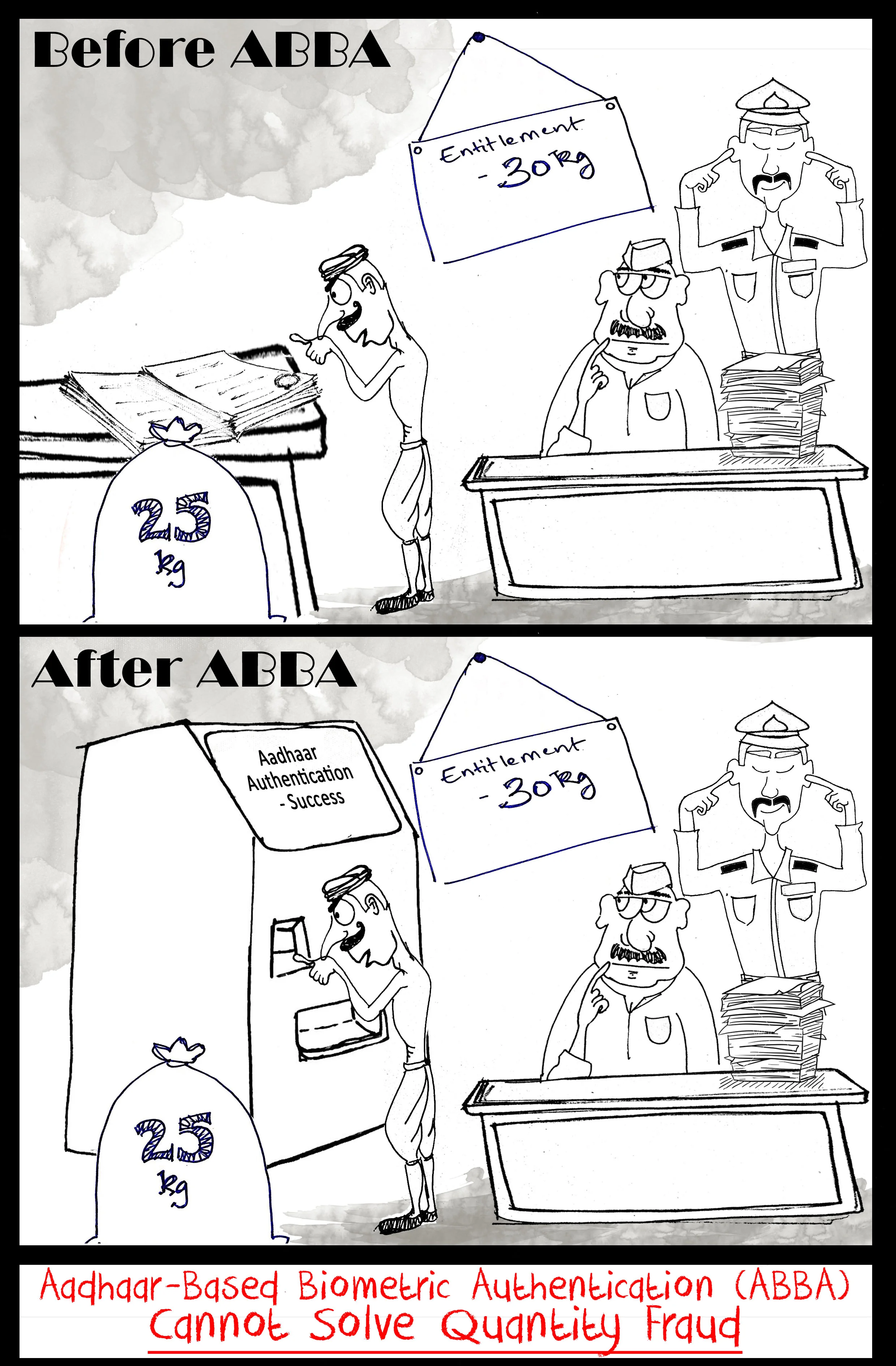
Exclusion and disruption of welfare programmes due to Aadhaar
“The UIDAI project had two important goals – provision of ID documents to everyone, and better inclusion into government programmes. While both goals are desirable, the experience so far tells a different story. On the first (providing ID documents to the ID-less), the project has achieved next to nothing so far (only 0.22 million out of nearly 830 million Aadhaar numbers were issued to the ID-less). On the second, the UID project cannot do much. The UIDAI’s understanding of the source of exclusion was inaccurate.” (UID: From Inclusion to Exclusion, Reetika Khera)
“The imposition of Aadhaar-based biometric authentication in the Public Distribution System threatens to disrupt recent progress with PDS reforms. It also deprives millions of people of essential food entitlements.” (Dark Clouds Over the PDS, Jean Drèze)
“Some of the most vulnerable people, Rajasthan’s elderly poor, have been denied meagre pensions due to errors in linking their details with Aadhaar numbers.” (Rajasthan’s Living Dead, Anumeha Yadav)
“Pilot cash transfer projects taken up in Jharkhand for MGNREGA wages have achieved little success due to a variety of logistical, human and technological problems. A year after the launch of these projects, the problems remain unsolved.” (To Pass Biometric identification, apply vasline or boroplus on fingers overnight, Anumeha Yadav)
Legal concerns
The Aadhaar Bill has been passed with no public consultation about the privacy safeguards necessary for such a database and no provision for public or independent oversight. The rights to liberty and freedom of expression cannot survive if the right to privacy is compromised. (Privacy is a Fundamental Right, Chinmayi Arun)
“Critics say the Aadhaar Bill does not address concerns over privacy, even as government is rushing the Bill without adequate parliamentary scrutiny.” (Seven Reasons Why Parliament Should Debate the Aadhaar Bill, Anumeha Yadav)
“In 2012, the Justice A.P. Shah Committee suggested nine distinct principles canonising the right to privacy. An analysis of the Aadhaar bill shows that it does not even recognise some of these nine principles.” (The Basis of Privacy, Apar Gupta)
“The concept of Aadhaar appears to be good. In Utopia. But after going through this Act, I am a little worried about how this system can be misused by our dear politicians and bureaucrats. I just don’t trust the people who will handle this system. They are known to be incompetent in matters related to technology” (Aadhaar Act, Why You Should Panic, Meghnad S)
Surveillance
“What technology has broken cannot be fixed by the law. Aadhaar is a broken technology; it is surveillance technology disguised as developmental intervention that identifies people without their consent and authenticates transactions on their behalf.” (Aadhaar is actually surveillance tech, Sunil Abraham)
“The lack of a public debate on the effectiveness or safeguards created for the Central Monitoring System, NATGRID, and Aadhaar puts data at the sole discretion of the government.” (Towards a database nation, Chinmayi Arun)
“The cult of technology is intolerant to blasphemy. For example, Shekhar Gupta recently tweeted saying that part of the opposition to Aadhaar was because “left-libs detest science/tech”. Technology as ideology is based on some fundamental articles of faith: one, new technology is better than old technology; two, expensive technology is better than cheap technology; three, complex technology is better than simple technology; and four, all technology is empowering or at the very least neutral. Unfortunately, there is no basis in science for any of these articles of faith.” (Surveillance Project, Sunil Abraham)
Commercial interests
“Information being collected for the unique identification project will be sold back to the government through specially created, privatised, for profit utilities.” (Your data, going on sale soon, Usha Ramanathan)
“an investor note…said that the implementation of DBT for food subsidies can result in Rs 45,500 crore annual rise in disposable incomes of targeted households, which in turn can drive a 14 per cent increase in rural FMCG demand. Hindustan Unilever, Colgate and Dabur are likely to be the biggest beneficiaries, the brokerage said. While the methodology adopted by Ambit could be questioned, there cannot be any doubt over the business opportunity Aadhaar and DBT linkage offers for another segment - the mobile phone operators and the software companies.” (Aadhaar’s Identity Crisis, Joe Mathew)
“from the welfare perspective, other than being an employment guarantee scheme for the recession-hit IT/BPO sector, there is no apparent need for the multi-million dollar biometric Aadhaar database…Like those opposing Aadhaar as a matter of principle today, Mahatma Gandhi too refused to get fingerprinted — not because he had something to hide, but because fingerprinting legal citizens is..a violation of civil liberty that sets the stage for a police state.” (Why Nandan Nilekani’s Sales Pitch is Hard to Buy, Siddharthya Swapan Roy)
The Status of the Project
After the Aadhaar Act of 2016 was passed many have wondered whether the challenge to the project in the Supreme Court have now become redundant. A short explanation is given below –
- The petitions before the Supreme Court are not infructuous. They were filed to challenge the entire UID project. The fact that there was no law at the time of the initiation of the project was only one of several challenges presented in various petitions, and therefore the petitions before the court remain valid. The batch of petitions referred to as Justice K.S. Puttaswamy (Retd.) & Others Versus Union of India & Others has been referred to a Constitution Bench which has not yet been constituted.
- In the meanwhile the orders of the Supreme Court in K.S. Puttuswamy continue to hold.
- The two orders dated 11 August and 15 October 2015 are particularly important. The 11 August order restricted the use of the aadhaar number to PDS and LPG, and made even that could only be voluntary use, and they had asked that it be advertised that enrolment was also not mandatory.
- The Supreme Court’s reasons for restricting use of the UID was because, if the number was used in multiple data bases, they saw that the challenges that had been raised in the court about surveillance, profiling, tracking and violations of privacy would have to be resolved before anything so drastic as the project could be permitted; and it was possible after all that the court may hold the project, or aspects of it, unconstitutional.
- The 15 October order allowed the government to use it in a few other fields, again voluntarily - and that was the promise on which the use was permitted.
- The 15 October order expressly says that the government may not change the conditions - either of voluntariness or of expanding the fields - without further orders from the court. The passage of the law makes no difference to this.
- The 2016 Act nowhere authorises the `seeding' of the aadhaar number in any database. This is very important. This is a significant omission in the law, especially as they have been trying to do it these past years, and so certainly knew that that was one of the things happening in the field, and something that the government was itself doing. The 2016 Act clearly speaks only of `authentication', viz., asking the UIDAI database to verify that we are who we say we are. So asking anyone to put the number in any other database (the LPG database, for example, is unsupported by the law).
- The UID number and the UIDAI database can at best be used for `authentication'.
So to make Aadhaar mandatory is
- in contempt of the Supreme Court orders, which, you may clarify to the authorities, as in force, and will be so long as the case is pending before the court
- not supported by the 2016 Act, which does not authorise seeding
आधार: कल्याण, निजी जीवन व लोकतंत्र पर हमला, अविलम्ब बहस की ज़रूरत
आशीष गुप्ता, प्राविता कश्यप व रीतिका खेरा द्वारा संकलित
आधार परियोजना को, जो भारत के सभी निवासियों को एक विशिष्ट संख्या देती है, कल्याण की योजनाओं को सहयोग करने का एक कार्यक्रम बताया गया था. यह बोला गया था कि आधार के प्रयोग से ज़्यादा लोगों को कल्याण की योजनाओं से जोड़ा जा सकेगा, भ्रष्टाचार कम होगा, दक्षता बढ़ेगी आदि. छः वर्ष बाद, कल्याण की योजनाओं को आधार से जोड़ने के कारण उनके विनाश के सबूतों का भरमार है. यही नहीं, आधार परियोजना का एक भयावह पहलू भी है – आधार के उपयोग से लोगों पर नज़र रखी जा सकती है, जो लोकतंत्र को खतरे में डालता है. जनता को इस बहकावे में डाला जा रहा है कि कल्याण की योजानाओं को बेहतर रूप से लागू करने के लिए थोड़ा-बहुत तो लोगों के जीवन में तांकझांक करना पड़ेगा. पर सच तो यह है कि आधार परियोजना से तो लोगों के जीवन में तांकझांक भी हो रही है और कल्याण की योजनाओं को भारी नुक्सान.
जहां एक ओर भारतीय विशिष्ट पहचान प्राधिकरण के अनुसार देश के 100 करोड़ से अधिक लोगों को आधार नंबर मिल गया है, वहीं दूसरी ओर कई लोग इस परियोजना को कानूनी रूप से चुनौती दे रहे हैं (जिनकी लम्बे समय से सुनवाई नहीं हुई है). हालांकि आधार पर एक कानून पारित हो गया है, इस परियोजना पर लगाम लगाने वाले सर्वोच्च न्यायालय के आदेशों (जो अभी भी लागू हैं) का खुले आम उलंघन हो रहा है. बुनियादी कमज़ोरियों व खतरनाक प्रभावों वाली आधार परियोजना करोड़ों लोगों के जीवन की हकीकत बनती जा रही है.
आधार परियोजना के चिंताजनक पहलुओं पर जानकारी बढ़ाने के लिए कुछ लेखों के अंश नीचे दिए गए हैं जो निम्न मुद्दों पर चर्चा करते हैं: कल्याण से सम्बंधित गलत प्रचार-प्रसार, आधार के कारण कल्याण की योजनाओं पर हो रहे हमले व लोगों का इन योजनाओं से बहिष्कार, कानूनी मुद्दे, आधार के प्रयोग से लोगों के जीवन में तांकझांक करना व आधार के प्रयोग के पीछे वाणिज्यिक हितों के संकेत. इस ईमेल के आख़िरी भाग में आधार पर पारित हुए कानून के परिप्रेक्ष्य में आधार परियोजना और उससे सम्बंधित सर्वोच्च न्यायालय के आदेशों की वर्तमान स्थिति को संक्षिप्त में समझाया गया है. अन्य सामग्रियों के साथ साथ आप किस्से और बयानों का भी योगदान करें.
अन्य जानकारी व अभियान से जुड़ने के लिए rethink.uid@gmail.com पर लिखें.
परिचय
“आधार भ्रष्टाचार रोकने के लिए एक टेक्नौलजी-आधारित काल्पनिक बुनियाद पर बना है. यह नागरिकों के अधिकारों को संकुचित करता है और गरीब लोगों पर कई मुसीबतें थोपता है.” (Threats to Citizen’s Rights, ऊषा रामनाथन)
“आधार विधेयक में, जो एक मनी बिल के रूप में पारित हुआ था, बड़े पैमाने पर लोगों पर नज़र रखने की संभावना है. इस खतरे को हाल में असहमति के अधिकार पर हो रहे हमले के परिप्रेक्ष्य में देखने की ज़रूरत है.” (The Aadhaar Coup, ज्यां द्रेज़)
“आधार परियोजना पर पूर्वकथित चिंताएं और आशंकाओं को देखते हुए, विशेष रूप से सरकार में इसके कार्यान्वयन व निहितार्थ पर विरोधाभासों और अस्पष्टता से सम्बंधित, [स्थाई] समिति भारत के राष्ट्रीय पहचान प्राधिकरण विधेयक, 2010 के वर्तमान प्रारूप के प्रति स्पष्ट रूप से अपनी अस्वीकार्यता व्यक्त करता है... इसलिए समिति सरकार से आग्रह करती है कि वह आधार परियोजना और इस विधेयक के प्रस्तावों की समीक्षा करे और उनपर पुनः विचार करे और एक नए विधेयक को संसद में पेश करे.” (And the UID juggernaut keeps rolling on, रीतिका खेरा)
कल्याण व बचत पर गलत प्रचार-प्रसार
“आधार लोगों का गलती से कल्याण की योजनाओं से छूट जाने की समस्या का समाधान नहीं कर सकता. अन्य तकनीकियां जो आधार की तुलना अधिक सरल, सुरक्षित व सस्ती हैं, भ्रष्टाचार कम करने व पलायन की गई जगह में भी योजनाओं की प्राप्ति में सुधार ला सकती हैं.” (UID: Does Evidence Matter?, रीतिका खेरा)
“आधार से एक भारी बदलाव आना था और कल्याण की योजनाओं के क्रियान्वयन में सुधार होना था. आधार से भारी बदलाव तो आया, परन्तु कल्याण की योजनाओं को नष्ट करने की दिशा में.” (Yes, Aadhaar is a game changer in wrecking welfare, रीतिका खेरा)
“सरकार ने एलपीजी के लिए हुए प्रत्यक्ष लाभ हस्तांतरण से हुई बचत को बहुत बढ़ा-चढ़ाकर दिखाया और मीडिया ने भी इन दावों का समर्थन किया.” (Big Media’s Take on Aadhaar-LPG Savings Saga Highlights Why We Can’t Trust It, रीतिका खेरा)
आधार के कारण कल्याण के कार्यक्रमों को नुक्सान और लोगों का इन कार्यक्रमों से बहिष्कार
“भारतीय विशिष्ट पहचान प्राधिकरण की परियोजना के दो महत्वपूर्ण उद्देश्य थे – सबको पहचान के लिए दस्तावेज़ देना और यह सुनिश्चित करना कि सरकारी कार्यक्रमों में कम से कम लोग छूटे. हालांकि ये दोनों उद्देश्य वांछित हैं, अनुभव कुछ अलग ही कहानी बताता है. अगर बिना पहचान के सबूत वाले लोगों को पहचान के लिए दस्तावेज़ देने के उद्देश्य को देखा जाए, तो इस परियोजना ने लगभग कुछ भी नहीं हासिल किया है (जिन 83 करोड़ लोगों के पास आधार नंबर है, उनमें से केवल 2.2 लाख ही ऐसे लोग है जिनके पास कोई अन्य पहचान प्रमाण नहीं है). दूसरे उद्देश्य के लिए आधार परियोजना बहुत कुछ नहीं कर सकती. भारतीय विशिष्ट पहचान प्राधिकरण की सरकारी कार्यक्रमों से लोगों के छूट जाने के कारणों की समझ सही नहीं थी.” (UID: From Inclusion to Exclusion, रीतिका खेरा)
“जन वितरण प्रणाली में आधार-आधारित बायोमेट्रिक प्रमाणीकरण से राशन व्यवस्था में हाल ही में हुए सुधारों के बाधित होने का खतरा है. इससे करोड़ों लोग अपने अतिआवश्यक खाद्य सामग्रियों के अधिकार से भी वंचित हो जाते हैं.” (Dark Clouds Over the PDS, ज्यां द्रेज़)
“राजस्थान के गरीब बुज़ुर्गों को, जो सबसे वंचित लोगों में से हैं, आधार नंबर की उनकी जानकारी के साथ गलत जुड़ाव के कारण अपनी तुच्छ राशि की पेंशन नहीं मिल पाई.” (Rajasthan’s Living Dead, अनुमेहा यादव)
“झारखंड में मनरेगा की मज़दूरी में नकद हस्तांतरण के प्रयोग कई समस्याओं के कारण बहुत सफ़ल नहीं हुए. इन प्रयोगों के शुरू होने के एक साल बाद भी इनकी समस्याओं का समाधान नहीं हुआ.” (To Pass Biometric identification, apply vasline or boroplus on fingers overnight, अनुमेहा यादव)
कानून से सम्बंधित चिंताएं
आधार विधेयक लोगों की इकत्रित जानकारी से उनके जीवन में तांकझांक करने से बचाव व न ही लोगों या कोई स्वतंत्र इकाई द्वारा निरीक्षण पर जनता के साथ बिना कोई परामर्श किए पारित हुआ है. अगर जीवन में तांकझांक से बचाव के अधिकार के साथ समझौता होता है तो स्वाधीनता व अभिव्यक्ति की स्वतंत्रता के अधिकार नहीं बचेंगे.” (Privacy is a Fundamental Right, चिन्मयी अरुण)
“आलोचकों का कहना है कि हालांकि आधार विधेयक लोगों के जीवन में तांकझाँक की चिंता पर ध्यान नहीं देता, फिर भी सरकार इस विधेयक को संसद द्वारा समीक्षा के बिना ही पारित करने की जल्दी में है.” (Seven Reasons Why Parliament Should Debate the Aadhaar Bill, अनुमेहा यादव)
“2012 में जस्टिस ए पी शाह समिति ने जीवन में तांकझाँक से बचाव के अधिकार के नौ ज़रूरी सिद्धांत सुझाए थे. आधार विधेयक में तो इन नौ सिद्धन्तों में से कुछ को माना भी नहीं गया है.” (The Basis of Privacy, अपार गुप्ता)
“आधार का विचार अच्छा लगता है. कल्पना में. परन्तु, इस कानून को पढ़ने के बाद मुझे इस बात की थोड़ी चिंता हो रही है कि इस प्रणाली का हमारे प्रिय राजनैतिक नेताओं व सरकारी अधिकारियों द्वारा दुरुपयोग हो सकता है. मुझे इस प्रणाली को संभालने वाले लोगों पर भरोसा नहीं है. पूर्व में भी ये लोग टेक्नौलजी के मामले में अक्षम हुए हैं.” (Aadhaar Act, Why You Should Panic, मेघनाद एस)
लोगों के जीवन में तांकझांक
“टेक्नौलजी ने जो तोड़ा है उसे कानून द्वारा नहीं जोड़ा जा सकता. आधार एक टूटी हुई टेक्नौलजी है; यह लोगों पर नज़र रखने के लिए एक टेक्नौलजी है जो लोगों की बिना उनकी सहमति के पहचान करती है और उनकी ओर से लेनदेन प्रमाणित करती है, पर इसे विकास के लिए एक हस्तक्षेप बताया जा रहा है.” (Aadhaar is actually surveillance tech, सुनील अब्राहम)
“केन्द्रीय निगरानी प्रणाली, नैटग्रिड, और आधार की प्रभावशीलता या उनके लिए बनाए गए सुरक्षा उपायों पर सार्वजनिक बहस के आभाव में इकत्रित की गई सब जानकारी केवल सरकार के विवेक के भरोसे है.” (Towards a database nation, चिन्मयी अरुण)
वाणिज्यिक हित
“विशिष्ट पहचान परियोजना के लिए इकत्रित की जा रही जानकारी मुनाफ़े के लिए खास बनाई गई निजी इकाइयों द्वारा वापस सरकार को बेची जाएगी.” (Your data, going on sale soon, ऊषा रामनाथन)
“एक निवेशक की टिप्पणी के अनुसार खाद्य सब्सिडी में प्रत्यक्ष लाभ हस्तांतरण से लक्षित परिवारों की खर्च के लिए उपलब्ध सालाना आय 45,500 करोड़ रुपए बढ़ सकती है, जिससे रोज़मर्रा की वस्तुओं की मांग में 14 प्रतिशत बढ़ौतरी हो सकती है. इससे हिन्दुस्तान यूनीलीवर, कोलगेट, डाबर को सबसे अधिक फ़ायदा होगा. हालांकि ऐम्बिट द्वारा अपनाए तरीके पर सवाल उठाया जा सकता है, आधार और प्रत्यक्ष लाभ हस्तांतरण के जुड़ाव से मोबाईल फ़ोन ऑपरेटरों व सॉफ्टवेयर कंपनियों को मिले व्यवसाय के अवसरों पर कोई संदेह नहीं है.” (Aadhaar’s Identity Crisis, जो मैथ्यू)
“कल्याण के दृष्टिकोण से, आधार के करोड़ों डौलर के बायोमेट्रिक डेटाबेस का मंदी-ग्रस्त आईटी/बीपीओ क्षेत्र के लिए एक रोज़गार गारंटी योजना होने के अलावा और कोई उपयोग नहीं है... उन लोगों की तरह जो आधार का सिद्धान्तिक कारणों से विरोध कर रहे हैं, महात्मा गांधी ने भी अपनी उँगलियों के निशान देने से मना किया था – इसलिए नहीं क्योंकि उनके पास कुछ छुपाने के लिए था, पर क्योंकि कानूनी नागरिकों की उँगलियों के निशान लेना...नागरिक स्वतंत्रताओं का उलंघन है और पुलिस राज की स्थापना करने की दिशा में कदम है.” (Why Nandan Nilekani’s Sales Pitch is Hard to Buy, सिद्धार्थ्य स्वपन रॉय)
आधार पर हिंदी में कुछ लेख
- नकद हस्तांतरण से क्या हो पाएगी खाद्य सुरक्षा
- क्या ‘आधार’ लोगों का अधिकार छीन रहा है?
- आधार से किसका उद्धार
आधार परियोजना की स्थिति
2016 के आधार कानून पारित होने के बाद कई लोग सोच रहे हैं कि क्या सर्वोच्च न्यायालय में इस परियोजना को दी जा रही चुनौती व्यर्थ हो गई है. एक संक्षिप्त व्याखा नीचे दी गई है:
- सर्वोच्च न्यायालय में दर्ज याचिकाएं निष्फल नहीं हैं. ये पूरी आधार परियोजना को चुनौती देने के लिए डाली गईं थी. यह बात कि इस परियोजना के शुरू होने के समय कोई कानून नहीं था विभिन्न याचिकाओं में प्रस्तुत चुनौतियों में से केवल एक था और इसलिए न्यायालय के समक्ष याचिकाएं वैध हैं. जो याचिकाओं का जत्था जस्टिस के एस पुट्टस्वामी (सेवानिवृत्त) व अन्य बनाम भारत संघ व अन्य के नाम से जाना जाता है, संविधान न्यायपीठ को भेजा गया है जिसका अभी तक गठन नहीं हुआ है.
- इस दौरान सर्वोच्च न्यायालय के के एस पुट्टस्वामी में दिए गए आदेश लागू हैं.
- 11 अगस्त व 15 अक्टूबर 2015 के आदेश विशेष रूप से महत्वपूर्ण हैं. 11 अगस्त का आदेश आधार नंबर का प्रयोग जन वितरण प्रणाली व एलपीजी तक सीमित करता है, और कहता है कि इन सेवाओं में भी आधार का प्रयोग स्वैच्छिक रूप से ही होना है और इस बात का व्यापक प्रचार होना है कि आधार नामांकन अनिवार्य नहीं है.
- सर्वोच्च न्यायालय ने आधार के प्रयोग पर लगाम लगाई क्योंकि अगर यह नंबर कई डेटाबेस में प्रयोग होता है तो इस परियोजना को अनुमति देने से पहले लोगों पर नज़र रखने के मुद्दे का समाधान होना होगा. साथ में यह भी संभव था कि न्यायालय इस परियोजना या इसके कुछ पहलुओं को गैर-संविधानिक माने.
- 15 अक्टूबर के आदेश में न्यायालय ने सरकार को कुछ अन्य क्षेत्रों में आधार प्रयोग करने की अनुमति दी, परन्तु इस ही वादे पर कि इसका प्रयोग स्वैच्छिक रूप से होगा.
- 15 अक्टूबर का आदेश यह स्पष्ट करता है कि बिना न्यायालय के आगे के आदेशों के सरकार शर्ते नहीं बदल सकती – न तो स्वेच्छाधीनता की और न ही आधार के उपयोग के क्षेत्रों को बढ़ानी की. कानून के पारित होने से इसमें कोई बदलाव नहीं होता.
- 2016 का कानून आधार नंबर को किसी डेटाबेस में “सीड” करने की अनुमति नहीं देता. यह बहुत महत्वपूर्ण है. यह कानून में एक महत्वपूर्ण चूक है, खासकर क्योंकि ये पिछले कुछ सालों से यह करने की कोशिश कर रहे हैं, और इसलिए यह ज़रूर जान रहे थे कि ज़मीन पर यह हो रहा था, और वह भी सरकार द्वारा. 2016 का कानून स्पष्ट रूप से केवल ‘प्रमाणीकरण’ की बात करता है, मतलब भारतीय विशिष्ट पहचान प्राधिकरण के डेटाबेस से यह सत्यापित करना कि कोई व्यक्ति वास्तव में जो व्यक्ति होने का दावा करता है, वही है. तो किसी का आधार नंबर किसी अन्य डेटाबेस में डालना (जैसे एलपीजी के), कानून द्वारा असमर्थित है.
- आधार नंबर व भारतीय विशिष्ट पहचान प्राधिकरण के डेटाबेस का अधिकतम‘‘प्रमाणीकरण’ के लिए ही प्रयोग हो सकता है.
तो आधार को अनिवार्य बनाना –
- सर्वोच्च न्यायालय के आदेशों का उलंघन करना है. आप प्राधिकारियों को यह स्पष्ट कर सकते हैं कि ये आदेश लागू हैं और जब तक यह मुकदमा न्यायालय में है, तब तक लागू हैं
- 2016 के कानून द्वारा असमर्थित है, जो सीडिंग की स्वीकृति नहीं देता
Compiled by Aashish Gupta, Praavita, and Reetika Khera
## Exclusion stories ### 5 Nov 2025 — In Andhra Pradesh, software flaws aid land grab from tribal and Dalit farmers > Land record columns changed or deleted, NRIs claiming tribal lands, Dalit farmers losing welfare schemes — Andhra Pradesh’s digitalisation dream – linked with the Aadhaar database – deepens marginalisations. Read the report here . Original: https://rethinkaadhaar.in/testimonials/2025/11/5/in-andhra-pradesh-software-flaws-aid-land-grab-from-tribal-and-dalit-farmersLand record columns changed or deleted, NRIs claiming tribal lands, Dalit farmers losing welfare schemes — Andhra Pradesh’s digitalisation dream – linked with the Aadhaar database – deepens marginalisations. Read the report here.
### 30 Oct 2025 — Yet another Aadhaar related hunger death > Right to Food Campaign Odisha has highlighted that Risa Mankadia, an elderly man from a Particularly Vulnerable Tribal Group (PVTG) community, has died of #hunger after he failed to complete the Aadhaar linking and updating #ekyc for his Antodaya ration card. Being single person on his card, h Original: https://rethinkaadhaar.in/testimonials/2025/10/30/yet-another-man-killed-by-denial-of-food-and-social-security-in-aadhaar-related-hunger-deathRight to Food Campaign Odisha has highlighted that Risa Mankadia, an elderly man from a Particularly Vulnerable Tribal Group (PVTG) community, has died of #hunger after he failed to complete the Aadhaar linking and updating #ekyc for his Antodaya ration card.
Being single person on his card, he tried to complete it multiple times, RTF reports, but failed. He was being denied his entitled ration since June and Mankadia died on October 22.
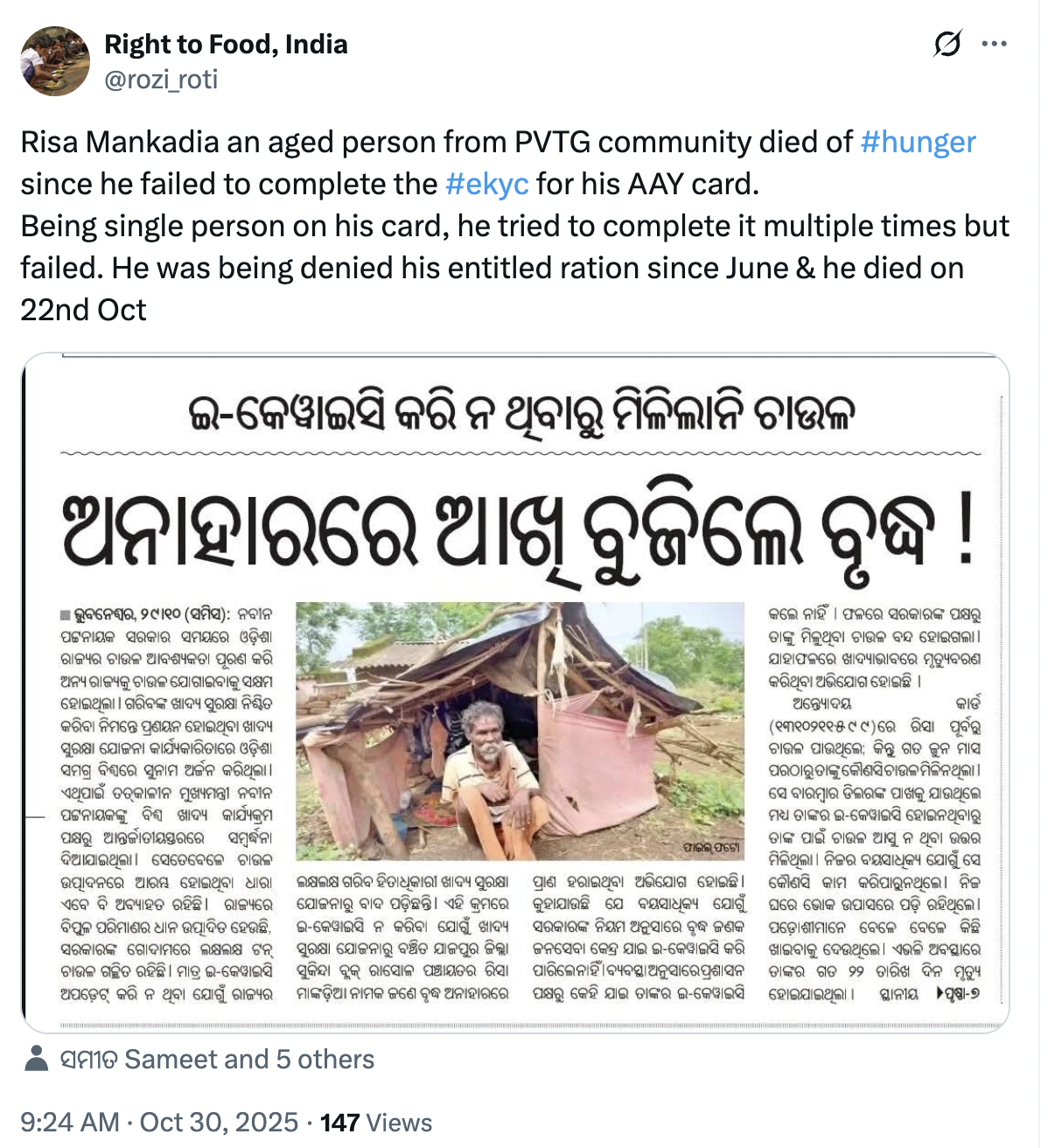
https://x.com/rozi_roti/status/1983744249624719760
There is a recent history of a large number of Aadhaar related denials causing a large number of starvation deaths, particularly in interior villages in this and Jharkhand region, as documented here in 2020 by Siraj Dutta, an activist living in Jharkhand, where 27 people died in the five years after Aadhaar was made mandatory. It worsened chronic hunger and under-nutrition when the poorest communities could not access digital technologies that had been made compulsory to access their welfare rights.
Rethink Aadhaar demands investigation into Mankadia’s death and accountability from central and Odisha officials and companies running Aadhaar systems for the denial of vital social security in Mankadia’s final months.
### 28 Oct 2025 — From the Trenches of Aadhaar Distress | कैसे आधार ने भारत को आँसुओं, कतारों और Kagaz में डुबो दिया > For this report, journalist Aparna Kalra interviewed Delhi residents who have had to make multiple rounds of Aadhaar correction centers to be able to access basic services such as school admission for their children Original: https://rethinkaadhaar.in/testimonials/2025/10/28/from-the-trenches-of-aadhaar-distress-kagazFor this report, journalist Aparna Kalra interviewed Delhi residents who have had to make multiple rounds of Aadhaar correction centers to be able to access basic services such as school admission for their children
इसी तपती दोपहर में बाहर निकलती हैं गुड्डी कुमारी। ग़ुस्से में कांपती हैं, फिर जैसे ग़ुस्से का भार आँसू बनकर बह निकलता है। उनकी बच्ची रजनंदिनी कुमारी का आधार रद्द कर दिया गया है—एक ऐसी सज़ा, जिसका कोई अपराध नहीं। उनके हाथ में कुछ कागज़ हैं—सादे से, पर शायद ज़िंदगी के सबसे भारी कागज़। एक कर्मचारी ने काले अक्षरों में लिख दिया है: “Aadhar Cancelled” और नीचे लिखा है – “Supreme Court Metro Station, Gate No. 2, Aadhar Seva Kendra.” Aadhaar एक पहचान बना, लेकिन जो इस देश के सबसे हाशिये पर हैं, उनके लिए यह पहचान अब गुमनामी बनती जा रही है। ये पहचान अब शिक्षा छीन रही है, राशन छीन रही है, और साथ ही साथ वह आत्मसम्मान भी, जो हर नागरिक का जन्मसिद्ध अधिकार है। देखिए ये वीडियो और जानिए गुड्डी जैसी शबनम की कहानी जो रहती हैं दिल्ली की कुसुमपुर पहाड़ी में, उनका कहना है कि पाँच साल से उनका आधार कार्ड अमान्य हैं। देखिए वीडियो।
### 28 Oct 2025 — No Blinking, No Mobile SIM: Indian activists and acid attack survivors take their fight to court and win > Pragya Prasun and Amar Jain went before the Supreme Court and highlighted the exclusionary nature of the current digital KYC norms. “My concern was, slowly, it should not spread everywhere where if I have to get a ticket, boarding pass, or cash from an ATM, I’ll have to blink an eye to use that faci Original: https://rethinkaadhaar.in/testimonials/2025/10/28/no-blinking-no-mobile-sim-indian-activists-and-acid-attack-survivors-take-their-fight-to-coughtMy face changes with each surgery. How many times will I update my Aadhaar?”: Indian acid attack survivors take their fight against exclusionary digital ID update and verification norms to Supreme Court and win. Report by Scroll.in
Bhubaneswar, 5th April, 2023
On 3rd March 2023, 11-year-old Arjun Hembram, known to his family as Juna Hembram, from the Keonjhar district of Odisha, passed away in the early hours of the morning, because of severe malnourishment. The child, who was born with a disability, had not had any rice to eat for two days, and passed away after developing a fever. The child was buried the next day, without a post-mortem.
The tragic incident of a child’s death due to malnourishment, was reported by the local media. A fact-finding team, of journalists, social workers and social scientists, visited Ghatisahi under Ragada revenue village of Ranagundi Grampanchayat, Keonjhar district of Odisha, to look into the matter. The team’s report (which can be accessed here) found that the child’s family had not received rations for 21 months, most likely due to another Aadhaar-enabled exclusion, because “Aadhaar seeding” or linking the ration card to Aadhaar had not happened. Arjun’s mother was not able to understand why her ration card had been cancelled, but it was most likely due to her name being spelt differently on her Aadhaar card and ration card.
Expressing their deep concern at Arjun Hembram’s tragic death, the experts noted that this was not the first time that such an incident has taken place in Jajpur district. As the local news has reported, hundreds of children from this community have been excluded from the PDS as they do not have Aadhaar.
“No words of condemnation would be enough to censure this act by the very state whose primary responsibility is to protect the lives of its citizens,” said Sameet Panda, from Odisha Khadya Adhikar Abhiyan, Bhubaneswar.
Rethink Aadhaar stands in support of the key demands made by the Civil Society Forum on Human Rights (CSFHR), Odisha Khadya Adhikar Abhijan and Jan Swasta Abhiyan, outlined below:
Exclusion of children without Aadhaar from PDS is an issue of concern in this community. Steps must be taken to ensure all left out children and adults are added to the PDS immediately and the onus of submitting Aadhaar should not be left to the community. Administration must take steps to ensure not a single person is excluded from the system for want of Aadhaar.
As per the Hon’ble Supreme Court of India’s interim orders on the PUCL Vs. Union of India and others (Civil Writ Petition 196 of 2001) and also the New Education Policy, 2023, Aadhaar seeding is not necessary/mandatory for availing Government supported social security and food and nutritional security schemes and programmes. No child/family should be excluded from their entitlements due to Aadhaar seeding related issues.
The district administration needs to initiate weighing of all children in the AWCs across the regions in a mission mode to identify children suffering from malnutrition and take immediate steps for community management of malnutrition amongst children. The weighing and malnutrition measurement of children should be done every month judiciously and all AWCs should be provided with necessary equipment and training with regular monitoring.
The team understood that Mid Day Meal in the school is the first and primary meal for the children in the community. The administration must take steps to introduce nutritious breakfast programmes in the schools which can be supported under DMF. Also the families especially the children go through extreme food crises during summer holidays, steps must be taken to ensure MDM is continued even during summer breaks for the children.
Even under a universal entitlement approach, aged and disabled people, dalits, and tribal groups would need specific unconditional support of food, health services and benefits. Community kitchens could provide a cohesive solution for families with precarious food and nutrition conditions.
Out-of-school children are left out of the school meal programme, despite being the most vulnerable; they should be allowed to access all feeding programmes unconditionally.
Three children with disability from the deceased’s family, though eligible for social security pension, have not been added under the scheme till the time of visit. All AWCs have details regarding children with disability, steps must be taken by the district administration to arrange necessary documents and include children and adults with disability under the pension scheme. All eligible but left out families must be included under the pension scheme as soon as possible which would strengthen financial and food security of the families.
Numbers of old age pension beneficiaries are said to be facing problems after the transition in the pension scheme from cash in hand to bank transfer. This can lead to extreme hardship and hunger among the aged persons. State must take steps to ensure no pension beneficiaries are excluded or cease to receive pension due to the transition and they are given cash in hand as soon as possible.
The MGNREGA which has consistently proved to be a lifeline when it comes to rural work and income security, the team was told that work under the scheme has been put on hold due to the problem faced with the NMMS app. The steps must be taken to sort out the issue immediately and all households must be provided with job cards and necessary numbers of work is allocated to the village. District Mineral Fund (DMF) and MGNREGS funds can be utilized for developing private agricultural lands and community lands, especially for soil and water conservation, development of village infrastructure and community assets. The initiation of MGNREGA should also be with a functional crèche in the community which would free the mother to work under public work programs.
The team also understood that none of the households have cultivable agricultural land, necessary steps must be taken to include the households under FRA and land is being allocated looking at the feasibility under the Act.
Panchayati Raj Institutions (PRI) members need to play a more proactive role to address issues of chronic hunger and malnourishment, right to quality education, health services and benefits, food and nutritional security, social security benefits and wage employment, especially during the lean periods of the year. There is a greater need for better co-ordination with the Block and District administration.
The companies which have benefited from the land and natural resources have hardly taken any measures to give back to the communities other than hardship and pollution. They are no less accountable than the administration to ensure no family lives with hunger in their vicinity. The companies like Tata Steel and others must allocate necessary resources and develop a clear integrated and overall development strategy and implemented on a Mission mode in the tribal pockets of Jajpur district. Focus should be on food and nutritional security, gender equality and women’s empowerment, promotion of Climate-resilient regenerative agriculture systems and practices to ensure food and income security of the communities.
The Fact Finding Report can be accessed here.
### 20 Sep 2021 — Aadhaar's Bermuda Triangle: Mission impossible to retrieve misplaced Aadhaar > Where do lost Aadhar numbers go? For many people who lose their Aadhaar numbers, retrieving them is close to impossible. For example many daily-wage labourers in APMC mandi, have lost their Aadhaar card, don't remember their Aadhaar number, don't have a registered mobile number and have no idea whe Original: https://rethinkaadhaar.in/testimonials/2021/9/20/missing-aadhaar-missing-identityWhere do lost Aadhar numbers go? For many people who lose their Aadhaar numbers, retrieving them is close to impossible.
For example many daily-wage labourers in APMC mandi, have lost their Aadhaar card, don't remember their Aadhaar number, don't have a registered mobile number and have no idea where or how to retrieve it.
Jheenak Prasad is a migrant labourer from Azamgarh (UP). He lost his Aadhaar six months ago, doesn't have a registered mobile number, can't remember his date of birth, and is running around to retrieve the lost card as he needs it for COVID vaccination - without which he cannot find work.
### 17 Jan 2018 — आग लगा दो मशीनों को! Original: https://rethinkaadhaar.in/testimonials/2018/1/17/- ### 17 Jan 2018 — 'After the machine has come, of course, it (receiving pension) has become more difficult' Original: https://rethinkaadhaar.in/testimonials/2018/1/17/after-the-machine-has-come-of-course-it-receiving-pension-has-become-more-difficult ### 17 Jan 2018 — 'I do not get rations. They say machine does not recognise your fingerprints' Original: https://rethinkaadhaar.in/testimonials/2018/1/17/i-do-not-get-rations-they-say-machine-does-not-recognise-your-fingerprints ### 17 Jan 2018 — 'In MP, pregnant woman forced to show Aadhaar card even while she was in labour pain' Original: https://rethinkaadhaar.in/testimonials/2018/1/17/9roe4axuruprxujk1sh3nptx29sch6 ### 17 Jan 2018 — Kali Salvi says, "our fingerprints are taken 4 times, only kerosene is handed. Where is our ration?" Original: https://rethinkaadhaar.in/testimonials/2018/1/17/kali-salvi-says-our-fingerprints-are-taken-4-times-only-kerosene-is-handed-where-is-our-ration ### 17 Jan 2018 — No Aadhaar, No Education Original: https://rethinkaadhaar.in/testimonials/2018/1/17/no-aadhaar-no-education ### 17 Jan 2018 — Problem in school admissions due to Aadhaar Original: https://rethinkaadhaar.in/testimonials/2018/1/17/problem-in-school-admissions-due-to-aadhaar ### 17 Jan 2018 — Ration dealer Pratap Singh of Hamela ki Ver climbs on a hill daily to be able to distribute rations Original: https://rethinkaadhaar.in/testimonials/2018/1/17/ration-dealer-pratap-singh-of-hamela-ki-ver-climbs-on-a-hill-daily-to-be-able-to-distribute-rations ### 17 Jan 2018 — 'Tell the government to take away the biometric machines' Original: https://rethinkaadhaar.in/testimonials/2018/1/17/tell-the-government-to-take-away-the-biometric-machines ### 10 Jun 2017 — 'I cannot get pensions in village after Aadhaar introduced' > Fefi Devi says she enrolled in Aadhaar but the machine does not recognise her fingerprints. After Aadhaar was made mandatory, she can no longer get her pension in the village, and has to now travel 10 kilometers spending Rs 150 for getting her Rs 500 pension. Original: https://rethinkaadhaar.in/testimonials/2017/6/10/i-cannot-get-pensions-in-village-after-aadhaar-introduced Fefi Devi says she enrolled in Aadhaar but the machine does not recognise her fingerprints. After Aadhaar was made mandatory, she can no longer get her pension in the village, and has to now travel 10 kilometers spending Rs 150 for getting her Rs 500 pension.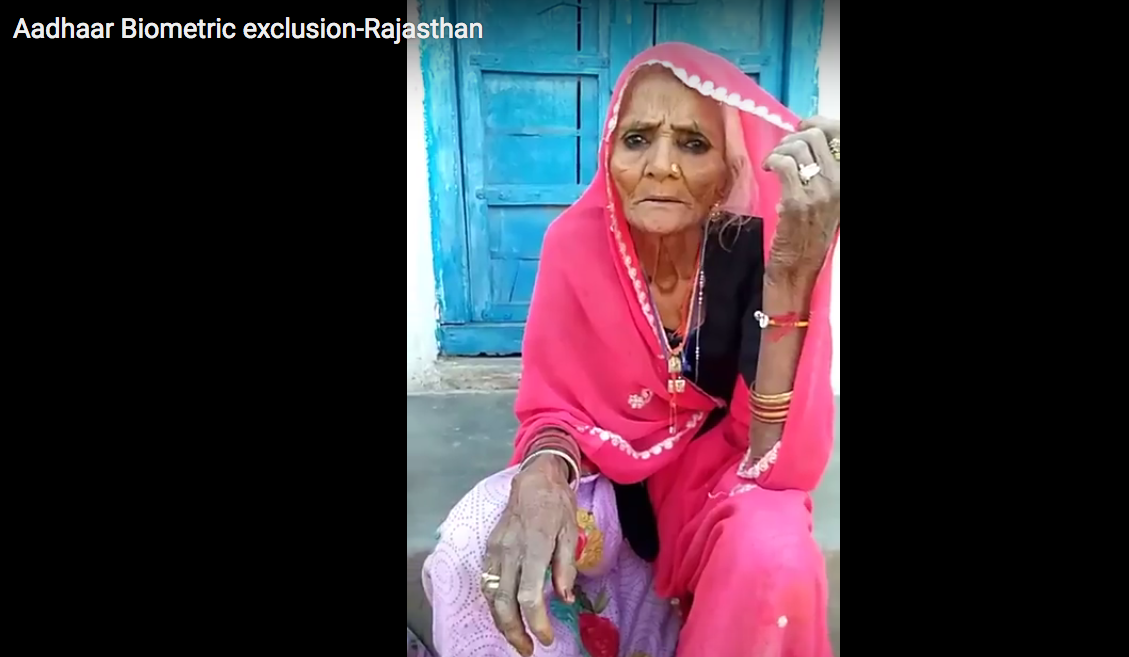 ### 28 May 2017 — What is the harm in negligent display of Aadhaar numbers?
> Aadhaar authentication is done not just through through use of biometrics (fingerprints and iris verification), but also either by matching the Aadhaar number with demographic attributes, or through a one-time password sent to a mobile number/email stored in the Central Identities Data Repository. When Aadhaar numbers
Original: https://rethinkaadhaar.in/data-leaks/2017/5/29/what-is-the-harm-in-negligent-display-of-aadhaar-numbers
### 28 May 2017 — What is the harm in negligent display of Aadhaar numbers?
> Aadhaar authentication is done not just through through use of biometrics (fingerprints and iris verification), but also either by matching the Aadhaar number with demographic attributes, or through a one-time password sent to a mobile number/email stored in the Central Identities Data Repository. When Aadhaar numbers
Original: https://rethinkaadhaar.in/data-leaks/2017/5/29/what-is-the-harm-in-negligent-display-of-aadhaar-numbers
Aadhaar authentication is done not just through through use of biometrics (fingerprints and iris verification), but also either by matching the Aadhaar number with demographic attributes, or through a one-time password sent to a mobile number/email stored in the Central Identities Data Repository.
When Aadhaar numbers are published, along with demographic data and mobile numbers associated with the Aadhaar number, there is a possibility of fraudulent authentications on behalf of an individual.
Currently, Aadhaar numbers are thus being used both as an identifier (which get widely and publicly used), as well as for authenticator (which are best when confidential, such as passwords), and for authorizing transactions can increase the risk of identity fraud.
An impression has been created that Aadhaar and bank account numbers have been displayed on government websites due to temporary technical glitches. More likely, they have been visible for weeks if not months, in some cases at least.
The victims have no recourse under the Aadhaar Act since the UIDAI has reserved for itself the right to lodge complaints under the Act. Nor does the UIDAI have a legal duty to monitor these breaches of privacy.
What happens in such instances of data being negligently being displayed is we lose control over data/information that affects our lives. We do not know who will have access to it, and what they may use it for. Already ready availability of mobile numbers leads to small annoyances such as bulk SMSes (to reduce weight or buy property, etc).
A project that was supposed to help curb identity fraud is actually opening up many avenues for identity fraud.
"Digital identities of more than a million citizens have been compromised by a programming error on a website maintained by the Jharkhand Directorate of Social Security.
The glitch revealed the names, addresses, Aadhaar numbers and bank account details of the beneficiaries of Jharkhand’s old age pension scheme.
Jharkhand has over 1.6 million pensioners, 1.4 million of whom have seeded their bank accounts with their Aadhaar numbers to avail of direct bank transfers for their monthly pensions.
Their personal details are now freely available to anyone who logs onto the website, a major privacy breach at a time when the Supreme Court, cyber-security experts and opposition politicians have questioned a government policy to make Aadhaar mandatory to get benefits of a variety of government schemes and services..."
### 24 Apr 2017 — Chandigarh PDS Website > Source: Original: https://rethinkaadhaar.in/data-leaks/2017/4/30/chandigarh-pds-websiteSource: https://twitter.com/roadscholarz/status/856436644089548801
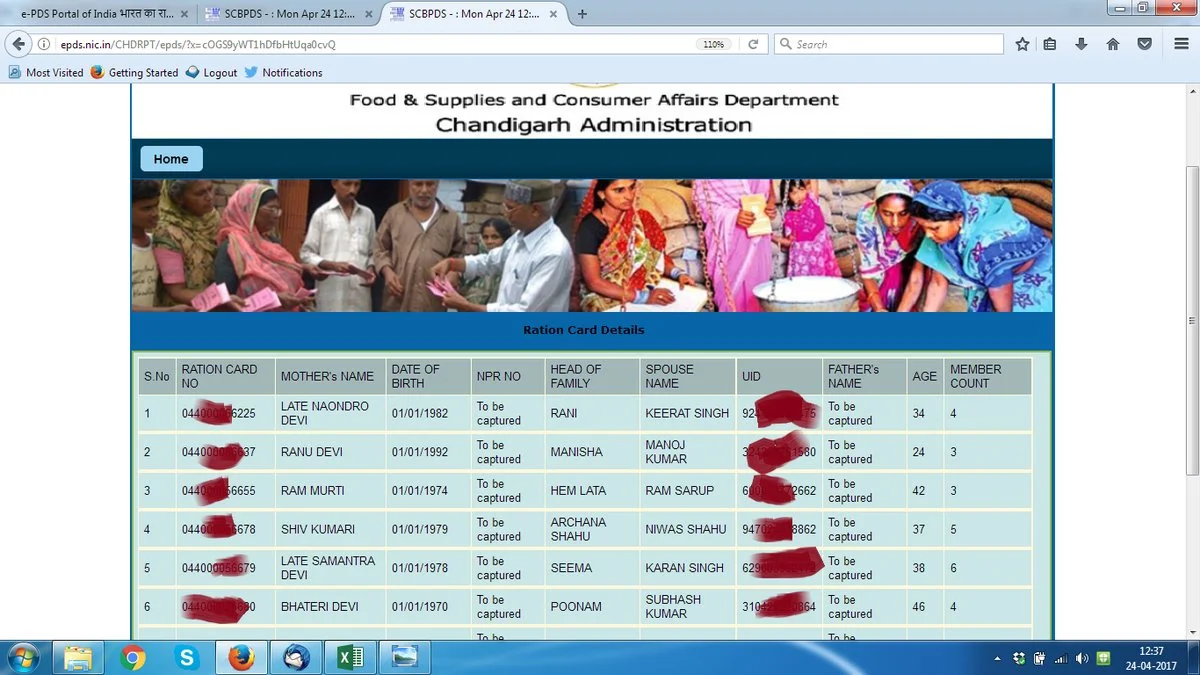
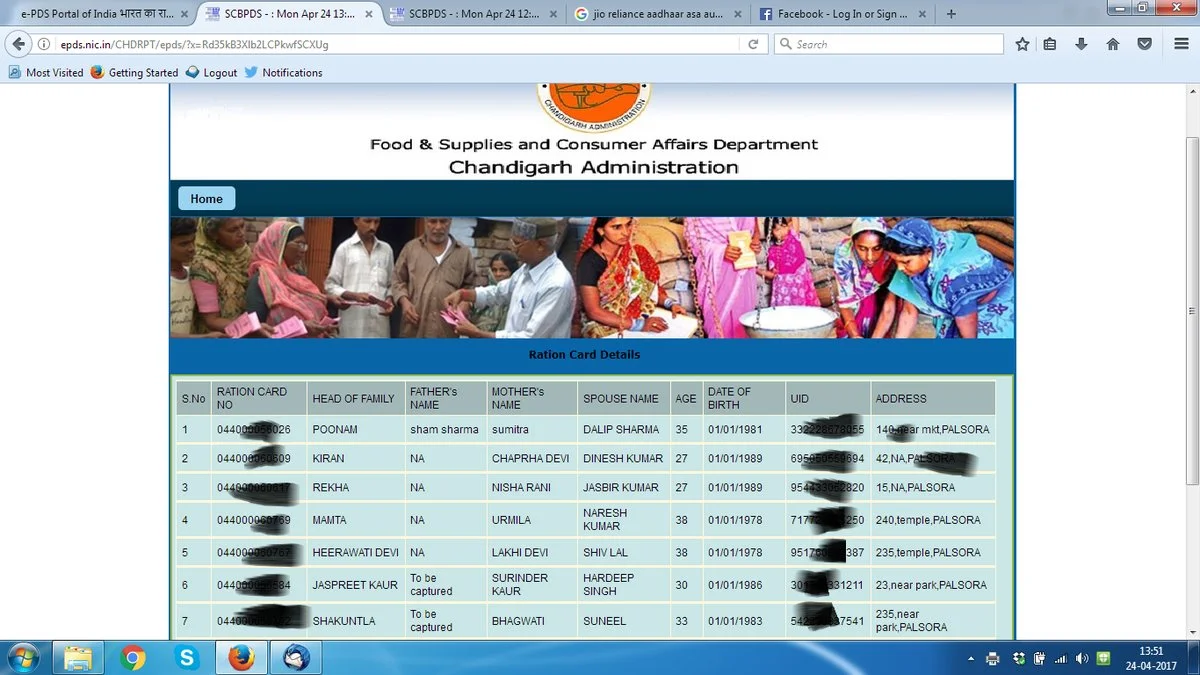 ### 24 Apr 2017 — Kerala Sevana Pension Site
> Source:
Original: https://rethinkaadhaar.in/data-leaks/2017/4/30/kerala-sevana-pension-site
### 24 Apr 2017 — Kerala Sevana Pension Site
> Source:
Original: https://rethinkaadhaar.in/data-leaks/2017/4/30/kerala-sevana-pension-site
Source: https://twitter.com/iam_anandv/status/856300780621447168
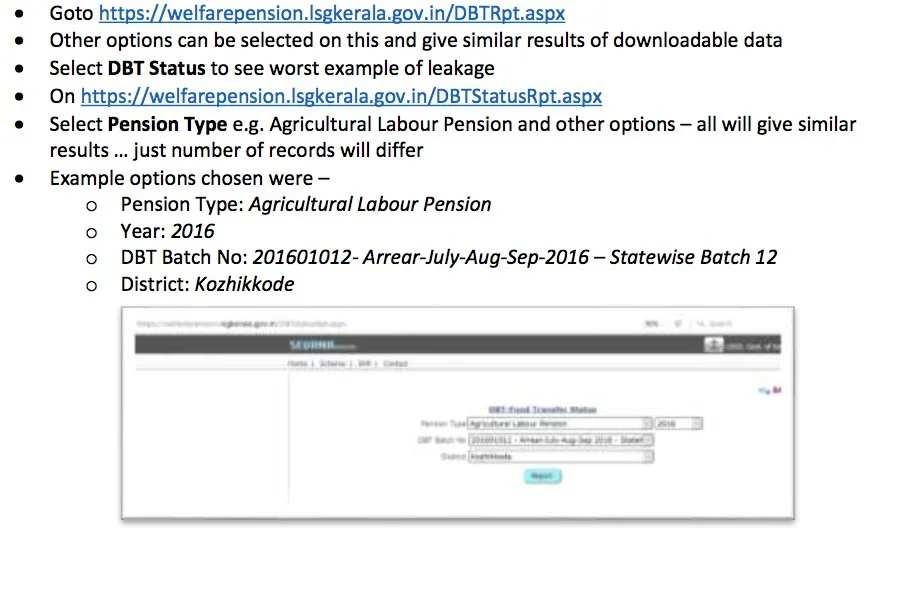
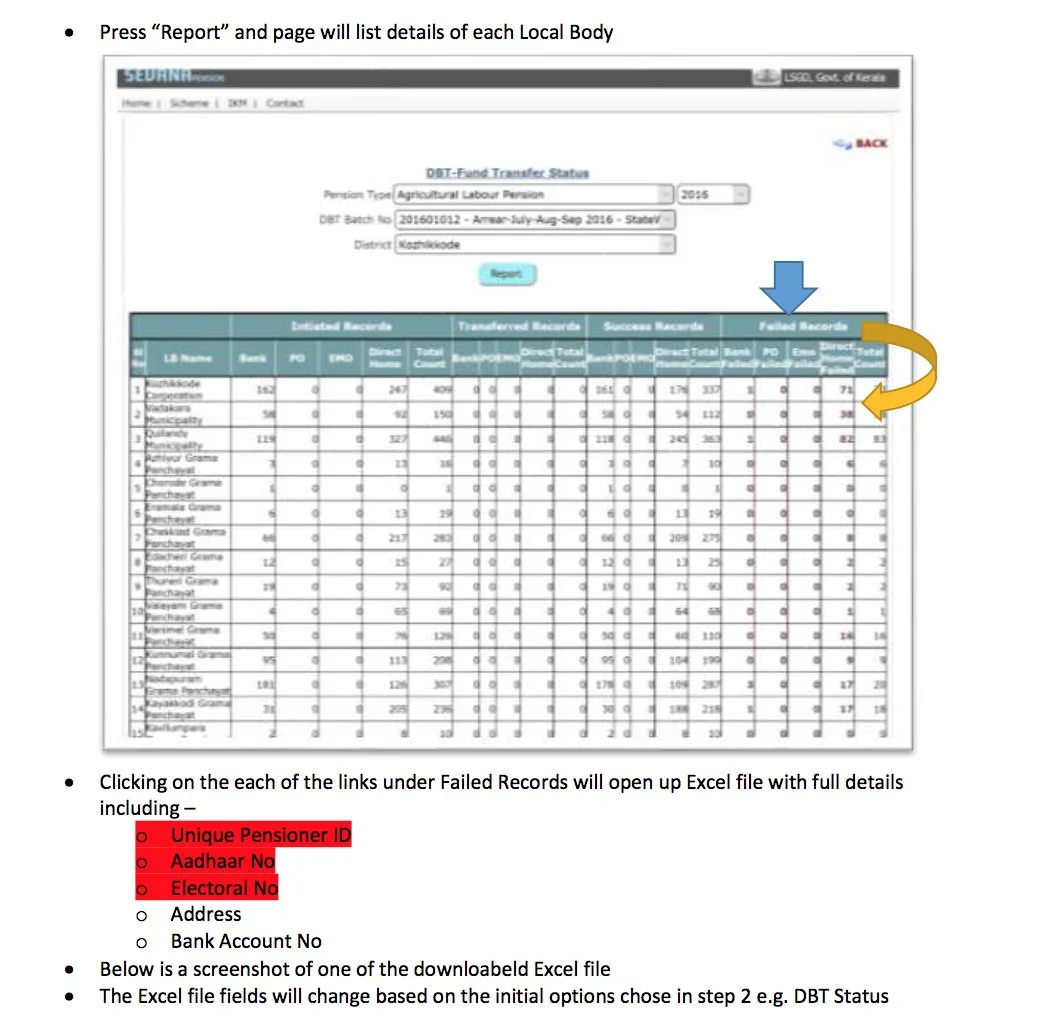 ### 11 Apr 2017 — "Deprived of 10 kilo grains because don't have Aadhaar"
Original: https://rethinkaadhaar.in/testimonials/2017/4/11/deprived-of-10-kilo-grains-because-dont-have-aadhaar
### 11 Apr 2017 — "Does Aadhaar work for the elderly?"
> Surjomati Yadav. an elderly widow, with no immediate family members, in Baghburha village in Raigarh, Chhattisgarh was unable to get 7 kilo grains after Aadhaar made mandatory.
Original: https://rethinkaadhaar.in/testimonials/2017/4/11/does-aadhaar-work-for-the-elderly
### 11 Apr 2017 — "Deprived of 10 kilo grains because don't have Aadhaar"
Original: https://rethinkaadhaar.in/testimonials/2017/4/11/deprived-of-10-kilo-grains-because-dont-have-aadhaar
### 11 Apr 2017 — "Does Aadhaar work for the elderly?"
> Surjomati Yadav. an elderly widow, with no immediate family members, in Baghburha village in Raigarh, Chhattisgarh was unable to get 7 kilo grains after Aadhaar made mandatory.
Original: https://rethinkaadhaar.in/testimonials/2017/4/11/does-aadhaar-work-for-the-elderly
Surjomati Yadav. an elderly widow, with no immediate family members, in Baghburha village in Raigarh, Chhattisgarh was unable to get 7 kilo grains after Aadhaar made mandatory.
### 11 Apr 2017 — "Hands washed, but biometrics don't match" Original: https://rethinkaadhaar.in/testimonials/2017/4/11/hands-washed-but-biometrics-dont-match ### 11 Apr 2017 — Is anyone accountable for Aadhaar errors? > Babu Singh, a construction worker in Jawaja block in Ajmer, and his wife Punni Devi, who has polio, have been "locked out" of food grains because of errors in Aadhaar numbers. Original: https://rethinkaadhaar.in/testimonials/2017/4/11/is-anyone-accountable-for-aadhaar-errorsBabu Singh, a construction worker in Jawaja block in Ajmer, and his wife Punni Devi, who has polio, have been "locked out" of food grains because of errors in Aadhaar numbers.
### 11 Apr 2017 — "No network at ration shop, biometric machine hung on jamun tree Original: https://rethinkaadhaar.in/testimonials/2017/4/11/no-network-at-ration-shop-biometric-machine-hung-on-jamun-tree ### 19 Mar 2017 — What happens when Aadhaar biometrics don't match? > An elderly person in Masuda, Ajmer, Rajasthan attempts to use a biometric authentication machine Original: https://rethinkaadhaar.in/testimonials/2017/3/19/what-happens-when-aadhaar-biometrics-dont-matchAn elderly person in Masuda, Ajmer, Rajasthan attempts to use a biometric authentication machine
### 15 Mar 2017 — No Aadhaar So No Pension, Daakhu Devi > Some of the most vulnerable people have been denied meagre pensions because of errors in linking their details with Aadhaar numbers. Original: https://rethinkaadhaar.in/testimonials/2017/3/15/no-aadhaar-so-no-pension-daakhu-deviSome of the most vulnerable people have been denied meagre pensions because of errors in linking their details with Aadhaar numbers.
### 1 Mar 2017 — Biometrics don't work in winter > A ration cardholder explains how they are unable to get their rations as the biometric machine does not recognize their fingerprints in the winter when the skins of the fingers are dry and develop cracks Original: https://rethinkaadhaar.in/testimonials/2017/3/1/sharing-aadhaar-data-hcnotice-to-centre-relianceA ration cardholder explains how they are unable to get their rations as the biometric machine does not recognize their fingerprints in the winter when the skins of the fingers are dry and develop cracks