We are deeply concerned that efforts are being made to promote biometric identity systems similar to Aadhaar in other countries.
Aadhaar is India’s unique identity number, linked with a person’s biometrics — fingerprints, iris, photograph. Rolled out from 2009 onwards in close collaboration with the IT industry, it was supposed to be voluntary but quickly became as good as compulsory: most social benefits are now out of reach without it.
For our part, we view Aadhaar as a failed and objectionable model that should not be replicated in other countries.
Our main concerns
We are deeply concerned that efforts are being made to promote biometric identity systems similar to Aadhaar in other countries.
Aadhaar is India’s unique identity number, linked with a person’s biometrics (fingerprints, iris and photograph as of now). The number was rolled out with fanfare from 2009 onwards. The use of this number, and of Aadhaar-based biometric authentication (ABBA), was promoted to the hilt by the Indian government in close collaboration with the IT industry. Aadhaar was supposed to be voluntary, but it quickly became clear that living without it would be very difficult for most. Today, it is as good as compulsory. Most social benefits are out of reach without Aadhaar.
Aadhaar was rolled out in an explicitly “evangelistic” mode from day one. In recent years, it has been projected as a grand success by its promoters. Their friends in high places (like Davos, the World Bank, and the B&M Gates Foundation) are on board. There is an attempt, partly successful already, to project Aadhaar as a model and “export” it to other countries.
For our part, we view Aadhaar as a failed and objectionable model that should not be replicated in other countries.
Our main concerns:
- Aadhaar involves the creation of a centralised database that includes biometrics as well as demographic information (e.g. name, gender, date of birth and address). This could turn into a dangerous tool of social control, especially, but not only, in the hands of an authoritarian government.
- The linkage of numerous databases with Aadhaar magnifies the danger of it becoming a tool for profiling, surveillance, exclusion and worse. Centralised databases also pose data security risks by creating a single point of failure.
- While the “core biometrics” (biometrics minus photograph) in the Aadhaar database are supposed to be secure, the rest is freely shared with authorised users of Aadhaar authentication, with minimal safeguards. This is a major infringement of privacy.
- The demographic details attached to Aadhaar numbers in the database are full of errors, partly due to hasty rollout. Yet severe restrictions have been placed on correcting this information. Meanwhile, people are expected to align other documents with this unreliable information. This is causing endless hassles to poor people. Many of them are excluded from some or all social benefits.
-
Biometric failures are another major source of social exclusion, especially for the elderly. Aadhaar was rolled out without any transparency about the reliability of biometric authentication.
-
A significant minority of people, mainly from marginalised groups (including disabled persons), do not have Aadhaar for multiple reasons, and for no fault of their own. They are excluded from most social benefits.
-
If an Aadhaar number is lost, it can be very difficult to retrieve. Poor people have been forced to make long and expensive trips to regional assistance centres for this purpose. Some never managed to retrieve it, and are now deprived of all social benefits.
-
The coercive “seeding” of Aadhaar with endless databases (ration cards, job cards, pension lists, bank accounts, voter lists, what not), associated with function creep, is a monumental waste of time for functionaries and citizens. Seeding sounds simple but it requires biometric or demographic verification. Both can be very cumbersome.
-
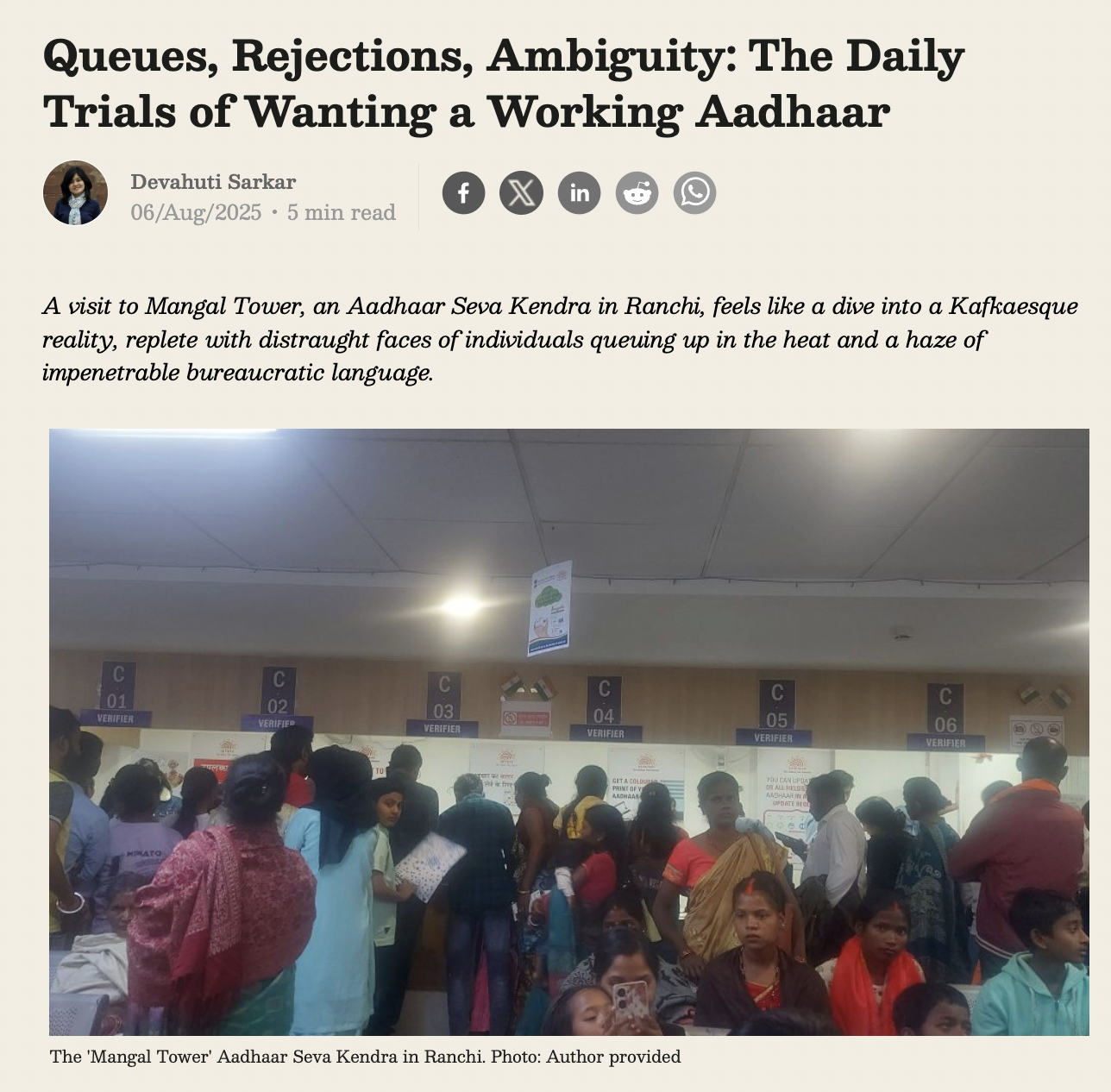
The rush for correction or update of Aadhaar details has led to humongous queues at many assistance centres, where people often wait in line for hours with no guarantee of remedy. There are no facilities for tracking of grievance redressal, continuity of assistance, or other relief. People’s time and money are wasted to no end.
-
Far from rooting out corruption, Aadhaar’s centralised database has enhanced information asymmetries and reduced transparency. Integration of Aadhaar with the banking system has magnified exposure to new vulnerabilities such as identity fraud.
-
At every step, the Aadhaar project has been a law unto itself. It began without any legal backing. Later, the Aadhaar Act was passed by bypassing the Upper House of Parliament. The Unique Identification Authority of India (UIDAI) often violates orders of the Supreme Court of India (e.g., protections for children and against use by private entities). It has enormous power and regularly issues rules that make life difficult for millions, without any serious feedback from affected people. A critical provision for parliamentary oversight of UIDAI was dropped in the final version of the Aadhaar Act.
The promoters of Aadhaar were never able to justify this particular identity model or to explain what ills it is supposed to remedy. Instead, they relied on propaganda to push for it. Many countries have functional identity systems that are less coercive, invasive, exclusionary and unreliable than Aadhaar.
We urge the greatest caution from countries that are considering a replication of the Aadhaar model. We would be happy to facilitate field visits for anyone interested in understanding these problems in more detail.
See the full list of 50+ signatories on the Campaign 2025 page →
A growing list of articles and reports documenting the risks of Aadhaar →