Skip to content

Rethink Aadhaar. Take action now →

Common questions

FAQs

Short answers to the questions we hear most often — from privacy and surveillance to welfare exclusion and how Aadhaar compares to other identity systems.

Q01

Why should you care about privacy when you have nothing to hide?

Privacy matters regardless of lawful behaviour.

What does surveillance have to do with being free?

American abolitionist Wendell Phillips said:
“Eternal vigilance is the price of liberty”.

The right to live freely with dignity and self-determination has been won and lost repeatedly through history. Monarchs, dictators, the military and democratically elected governments have exploited and even oppressed the citizens of their states for thousands of years. I am only the second generation of India’s citizens born free.

So freedom needs to be constantly defended and protected every time a government changes and every time a new technology appears. This is the first reason why we should care about unfettered surveillance. Unfettered, it provides individuals, governments and businesses the opportunity and technology to monitor and interfere with how we spend or don’t spend our money, where we go, whom we visit and talk to, what information we seek, even when we wake and sleep.
I have nothing to hide so why should I care about surveillance?

On March 11, the Aadhaar Bill was passed by 73 of the 545 members of the Lok Sabha, the lower house of Parliament, after three hours of discussion. It sanctions the bulk collection and centralisation of biometric and demographic data by the government and private businesses. Many people argue that the controversial Bill contains inadequate provisions to protect the privacy of Indian citizens.

The debate around Aadhaar highlights the need to evaluate what privacy means to us in the face of continual technological change and to inform our elected representatives of the balance we want to achieve between surveillance and security. Here are my thoughts on the frequently asked questions about surveillance that I have encountered and that have been debated in the media.

1. What does surveillance have to do with being free?
American abolitionist Wendell Phillips said: “Eternal vigilance is the price of liberty”. The right to live freely with dignity and self-determination has been won and lost repeatedly through history. Monarchs, dictators, the military and democratically elected governments have exploited and even oppressed the citizens of their states for thousands of years. I am only the second generation of India’s citizens born free.

So freedom needs to be constantly defended and protected every time a government changes and every time a new technology appears. This is the first reason why we should care about unfettered surveillance. Unfettered, it provides individuals, governments and businesses the opportunity and technology to monitor and interfere with how we spend or don’t spend our money, where we go, whom we visit and talk to, what information we seek, even when we wake and sleep.

You may not be making bombs, hiding weapons, selling illegal drugs or participating in other unlawful activities in your home, but that doesn’t mean you are willing to let the police enter and search it at any time of night or day without your permission, or a good legal reason and a search warrant.

The reason we don’t allow the state and its representatives to enter and search our homes and offices at will is because, one, this is an invasion of our privacy and two, this gives them unrestricted power to interfere with our lives and potentially misuse their authority. Most people would agree that many injustices are witnessed in military states or times of Emergency when these privacy laws are relaxed.

Your phone, your computer, the many private accounts you set up online are an important part of your private home and work life. There is no reason why the same rules of privacy should not apply to these relatively new parts of your personal life as they do to your home and land. The decision is yours to take and you can say “no” to the state and to businesses.

Another way to think about this is as US National Security Agency whistleblower and privacy campaigner Edward Snowden puts it:

“Arguing that you don’t care about the right to privacy because you have nothing to hide is no different than saying you don’t care about free speech because you have nothing to say”.

The fundamental right to freedom of speech is yours and is protected whether you exercise it or not. “Nobody needs to justify why they ‘need’ a right,” said Snowden. “The burden of justification falls on the one seeking to infringe upon the right.” He added: “You can’t give away the rights of others because they’re not useful to you… the majority cannot vote away the natural rights of the minority.”
Government will not bother me because I am unimportant to them, it is only interested in monitoring certain types of people such as terrorists, anti-nationals, spies.

Let’s hope that this remains true. Let’s hope that the government remains uninterested in us. Let’s hope that we never say or do anything that unsettles the government or any of their friends. But if this means that we need to censor what we say so as not to upset the government and its friends, then giving up our privacy will in effect curtail our right to freedom of speech. So how sure are you that the government will not interfere with you no matter what you say? And to what extent are you willing to give up your fundamental right to free speech in order to avoid interference (in the absence of privacy laws)? These are the questions that face every one of us.

What does surveillance have to do with the right to dissent? Why would I need to dissent?

Dissent is not confined to signing public petitions or marching together. Dissent is every time you disagree with something in thought or action. And sometimes that disagreement means taking action that is more personally costly than signing public petitions or expressing your views via social media. Sometimes dissent means that you have to take the government or a business to court for denying you your legal rights. Land disputes when the government acquires land, discrimination at educational institutions, tax and pensions disputes are only a few examples.

With unfettered surveillance, every time you disagree with the state, they can take advantage of the huge imbalance of information between them and you. They can put you under pressure to concede or use information that you did not even know they possessed to embattle you in court. And their story need not be true. The availability of mass data does not automatically reveal the truth. The truth has to be extracted from it. The details of your phone calls, movements, purchases, demographics and social interactions can be used to construct any number of different truths. So how comfortable are you with having the intimate details of your life in the hands of unknown people who can interpret them as they wish?

Governments need to monitor some citizens for reasons of national security so surveillance is necessary, isn’t it?

There are cases where governments might surveil people but to do so they need to provide good reason and obtain time limited warrants. If governments are surveilling us illegally, without good reason and warrants, then they should be held accountable just like anyone else who breaks the law.

This need not be an all or nothing game. Just like the state needs a warrant to enter our homes, we can have laws that say that they should need one to also enter our phones, computers or any other private online accounts. Surveillance can be made a legal option once the state provides good evidence that someone is suspected of wrongdoing. And it can be made time-limited. At the moment we could be subject to mass surveillance indefinitely whether or not we have ever broken the law or been suspected of it.

How come I have never felt the effects of surveillance on my personal life if it has been going on for years?

We are increasingly comfortable assuming that we are being monitored on CCTV cameras or that our movements can be traced via the metadata our mobile phone activity. Have you ever thought twice about performing an innocent educational Internet search on a controversial topic (for instance, on how to make explosives) because you fear attracting the attention of the powers that be? Is such self-censorship an effect of surveillance?

Besides the use of personal data by the state, there is also the question of how our data is used by private businesses. Think of the number of times you have seen a personalised advertisement online, experienced increases in your junk mail when you signed up to a website or made an online purchase, or received unsolicited phone calls or text messages from unknown businesses. Your personal data is already being shared amongst many businesses and organisations. Much of this data may not be used to individually target you but it is being used to analyse and understand large-scale patterns of behaviour and subtly manipulate the information you receive.

Surveillance is becoming more powerful and frequent. The introduction of biometric data collection such as with Aadhaar and the ongoing attempts to legalise and expand surveillance by many governments including in the USA, UK and India attest to that. Surveillance is increasing, not disappearing. The belief that the debates around it do not apply to us and are led by conspiracy theorists and fantasists may prove to be costly self-deception.

Governments have been monitoring citizens for a long time so what does it matter whether I care or not, they are going to do it anyway.

Yes, governments will continue to legally employ mass surveillance if we do not tell them that they cannot. But if we say “no” and demand privacy laws that make their activities illegal then that is the beginning of change.

Just like we have created laws that stop the police from entering our homes without our permission or legal justification, there is no reason to think that we cannot achieve the same with the new technologies we use. The technology to stop the government from snooping on us exists and the more we demand it, not only from the government but also the businesses to which we give our information, the more such encryption and security protocols will be developed and strengthened. Recent reports suggest that Facebook, Google and WhatsApp plan to increase the encryption of user data in light of Apple’s recent conflict with the Federal Bureau of Investigation in the US.

Sure, it is tiring to maintain freedom, but it will be even more tiring to wrest it back once it is lost. The choice is between investing a little of our time and energy into maintaining the rights we have now versus having little control over our time and energy in the future.

(First published by Scroll.in on March 21, 2016.)

Shakti Lamba is an Economic and Social Research Council Research Fellow & Senior Lecturer in Human Behavioural Ecology at the University of Exeter, UK.
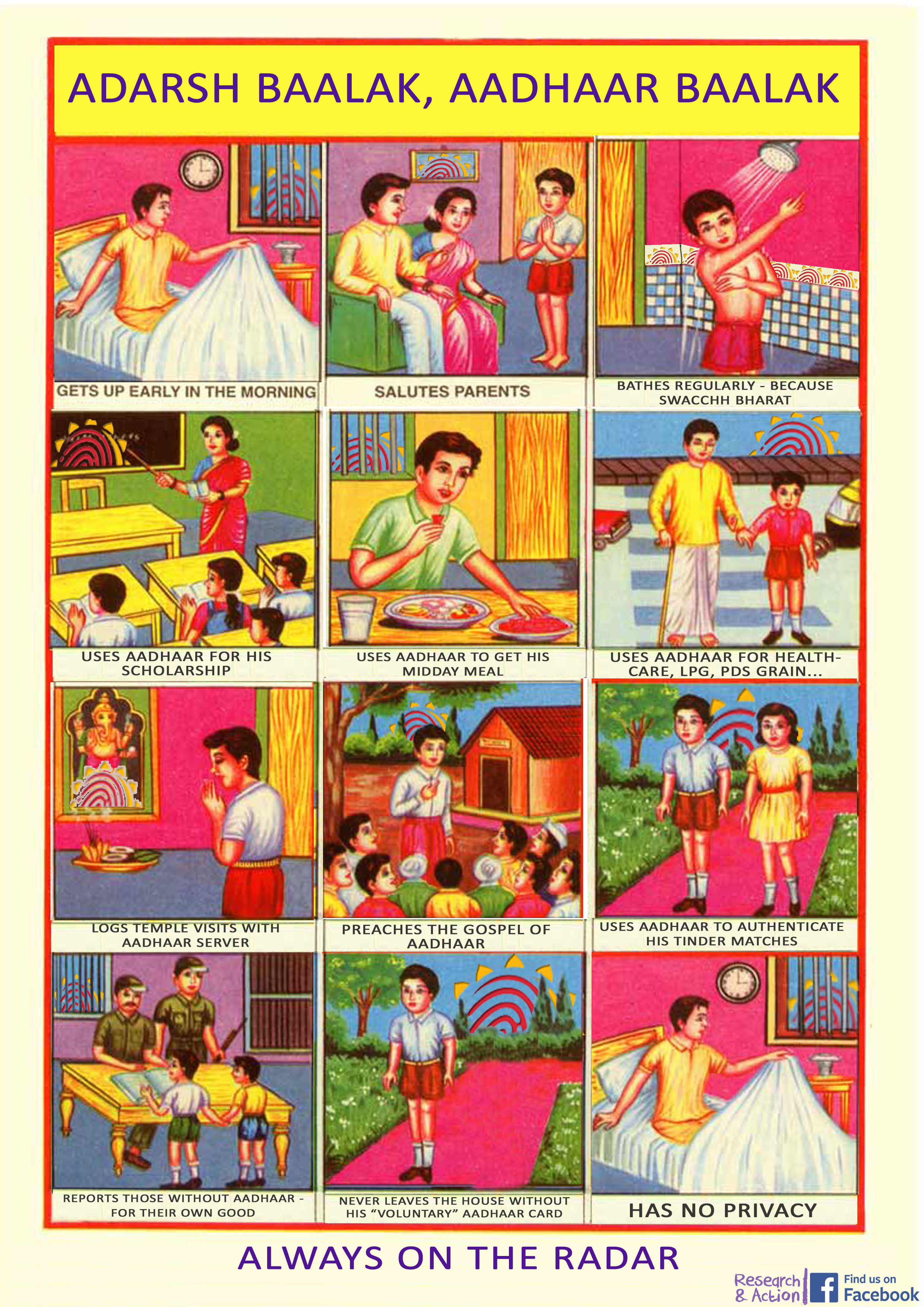
An Ideal Boy - via Research and Action
An Ideal Boy - via Research and Action
Read full answer →

Q02

Does welfare actually need Aadhaar?

Welfare needs Aadhaar like a fish needs a bicycle.

Has Aadhaar given identity to those who lacked one?

One of the claims made by UIDAI and GoI is that Aadhar has empowered people who did not have an ID by providing them one. However, these claims are bogus since Aadhaar ID has been allocated based on existing IDs themselves. To get Aadhaar, one has to submit Proof of identity and Proof of address.

In fact, 99.97% of those who have Aadhaar, used existing identity cards and proof of address to get it.

In response to a Right to Information application in 2015, UIDAI replied that only 0.03% of those who had got the Aadhaar number got it without showing proof of identity and address. The rest had showed two existing proofs of identity and address.

Did the presumed lack of ID prevent access to benefits and subsidies?

One of the most appealing claims of the UIDAI project initially was to enable inclusion of the millions of Indians into various government programmes from which they are wrongly excluded. However, the UIDAI did not provide any data on how many Indian residents are without ID documents. There is no reliable estimate of this even today.

In a small survey of 2200 rural households in ten states in 2013, development economists Reetika Khera and Jean Dreze asked about possession of different identity cards (such as a voter ID, ration card, NREGA job card, etc.). They found between 85-95% of respondent households already had one of these IDs. Just over 80% had either a bank or post office passbook. (At that time, only around 15% had Aadhaar numbers.)

UIDAI’S reasoning that the lack of an identity document is the root cause of social exclusion is not backed by any evidence and is based on a flawed understanding of welfare programs.

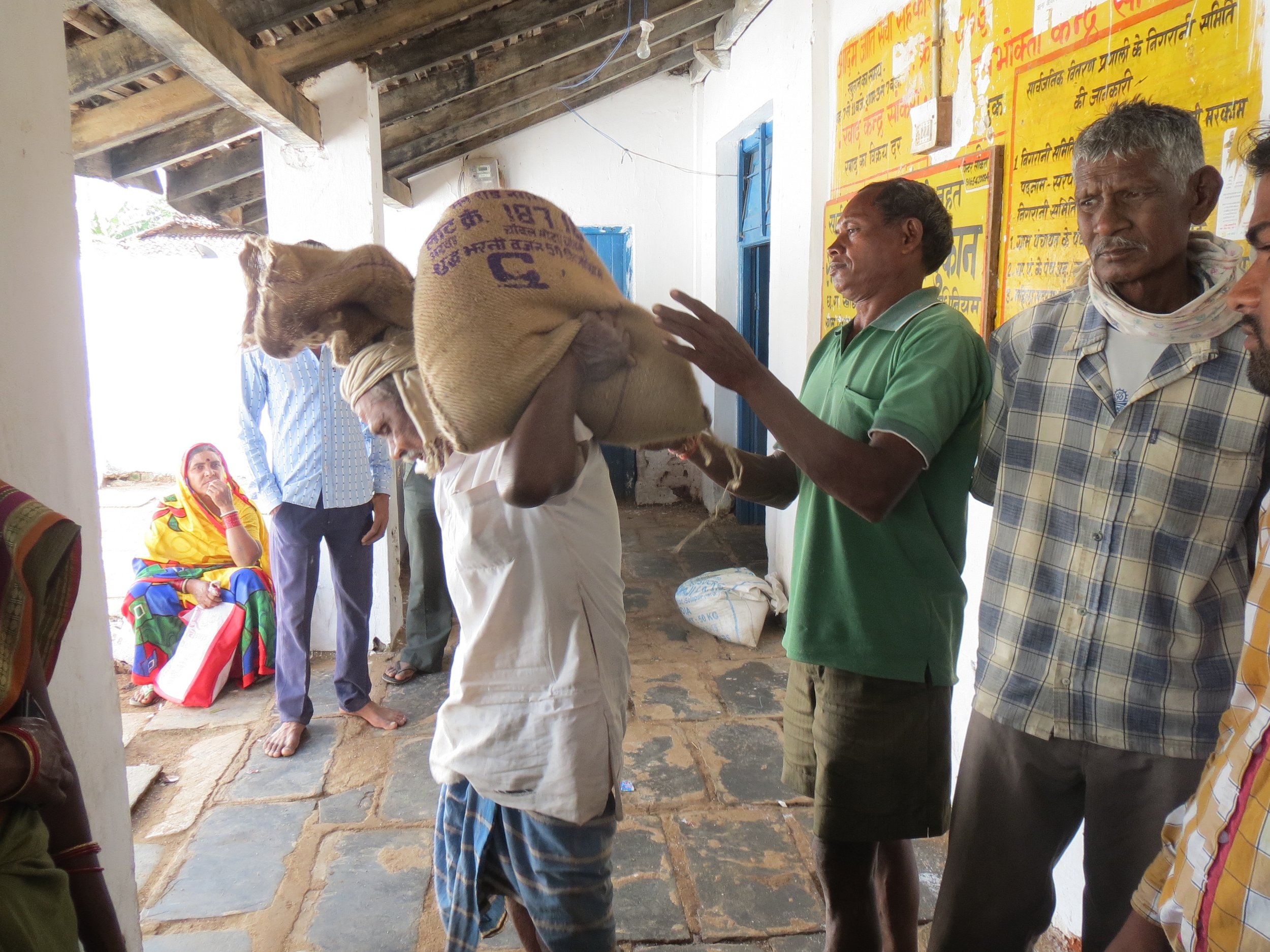
Ram Lal, a ration card holder in Dhamtari, Chhattisgarh takes his ration of 35 kilo rice home.

Ram Lal, a ration card holder in Dhamtari, Chhattisgarh takes his ration of 35 kilo rice home.

Does having an Aadhaar make the poor eligible for welfare?

Possession of any ID, including an Aadhaar now, does not guarantee inclusion into any welfare program.

In fact, every welfare program has its particular eligibility criteria. For example, as per central government norms, to get national old age pension of Rs 200 a month from the central government, the elderly are required to produce proof of age of being over 60 years of age, and of belonging to a household living below the poverty line. A widow is required to show a death certificate of her husband. A widow who, say, has an Aadhaar number, but does not have her husband’s death certificate will continue to be excluded from widow pension even now.

Further, even among those who did have these documents, a major source of exclusion – perhaps more than the lack of ID documents – is that the size of social welfare programmes is capped by the government. Even if a person meets the eligibility criteria and subits all the necessary ID documents, they are put on a “waiting list” instead of being included because the government may have already exhausted its target coverage or quota for that particular scheme.

The Centre’s contribution per pensioner has remained a meagre Rs 200/month since 2006. For widows and disabled, this has stagnated at Rs 300. In principle, the National Social Assistance Programme or social pension is meant to cover all eligible persons in the below poverty line population, but the freezing of the central allotment has meant that even those eligible cannot get pensions. In the financial year 2015-16, social pensions benefits went to 2.3 crore individuals while the elderly in India constitute about 10 crore, making the coverage only about 25% of what it should be.

The cure, then, is to expand these schemes. What the government is doing instead is to additionally make it mandatory for them to enroll into a biometrics-based identity program to get the welfare benefits they are already eligible for.

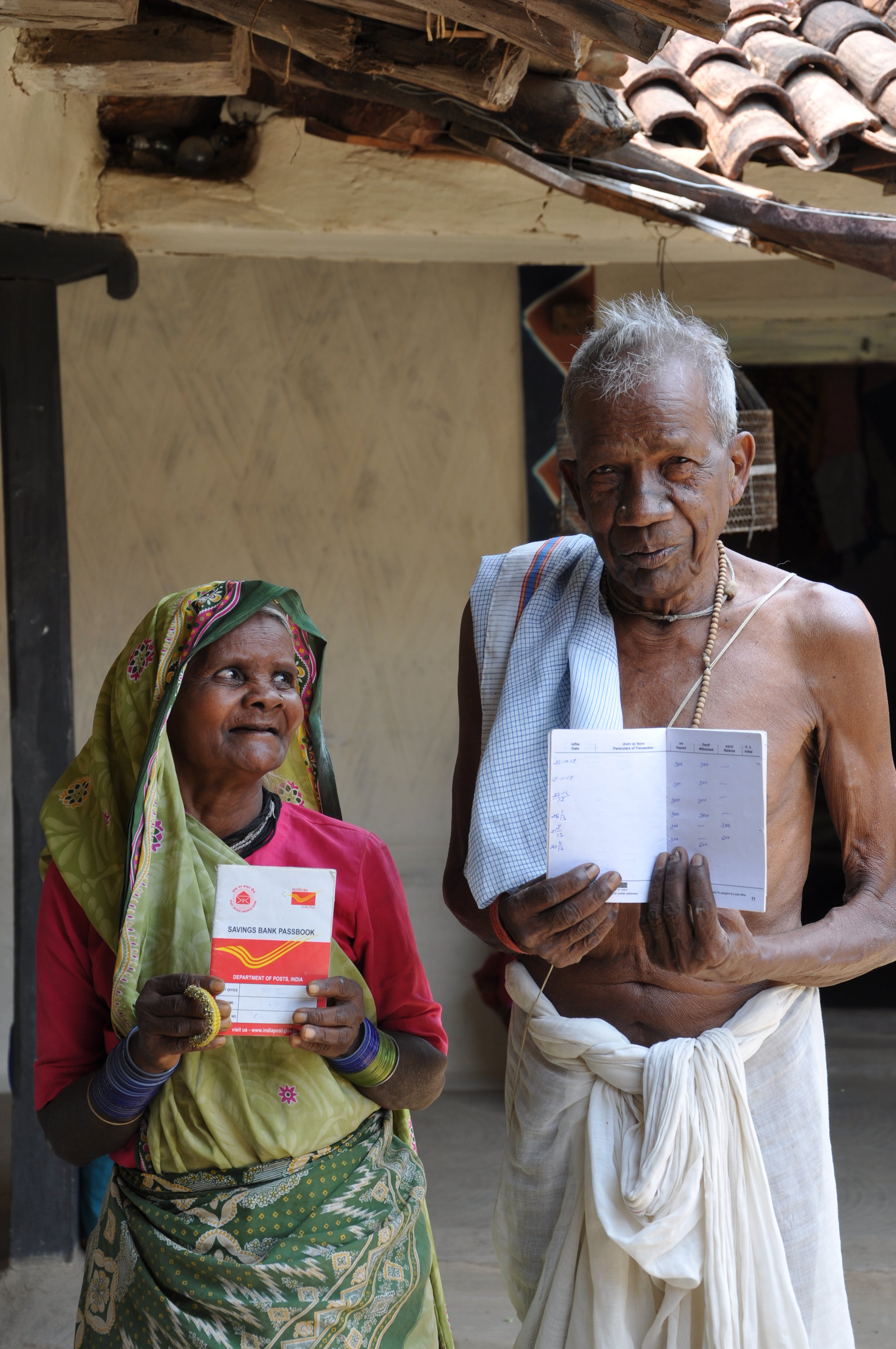
Kunti and Surajman receive monthly pensions of Rs 300 each in Sarguja, Chhattisgarh under National Social Assistance Programme.

Kunti and Surajman receive monthly pensions of Rs 300 each in Sarguja, Chhattisgarh under National Social Assistance Programme. Central government has frozen pension coverage at 25% of what it should be, and not increased its contribution of Rs 200/monthly since 2006.

Is Aadhaar an apt technology for welfare?

This is how the Aadhaar-based system works in welfare: To get Aadhaar, a 12-digit number, residents are required to submit biometrics and demographic information to private enrolling agencies hired by the state governments. Biometrics include the scan of all fingerprints, face, and the iris of both eyes. The demographic information includes name, date of birth, gender, residential address.

The information is then sent to the Unique Identity Authority of India’s Central Information Data Repository where it is compared against every other person who has previously enrolled. This is called “de-duplication”.

When the government requires Aadhaar number in a particular program, the information a resident has provided to the Programme Department (for example, rural development department in case of pensions, or food department in case of rations) along with Aadhaar number is “seeded” or matched with the information that person has provided to UIDAI. After this, every time a resident accesses the welfare program, they are authenticated based on data stored against their Aadhaar number. Under the public distribution system or rations, for instance, a ration beneficiary must place a finger on a “point of sale” machine, which uses the internet to match the individual’s fingerprints against data stored on the centralised Aadhaar database. Once the beneficiary’s identity is confirmed, the ration shop owner hands over the rations at the prescribed rate.

This system requires multiple fragile technologies to work at the same time: the point of sale machine, the biometrics, the Internet connection, remote servers, and often other elements such as the local mobile network. Further, it requires at least some household members to have an Aadhaar number, correctly seeded in the PDS database.

In rural India, especially in the poorest States, even in State capitals, network failures and other glitches routinely disable this sort of technology. Note that Internet dependence is inherent to Aadhaar since there is no question of downloading the biometrics.

In villages with poor connectivity, the Aadhaar-based system is beginning to exclude thousands of users. Biometrics have consistently failed for people who depend on manual labour for a living as their fingerprints get omitted. In Rajasthan, thousands of elderly were wrongly declared “dead”, and their pension stopped because one or many of these technologies did not work well. Many of them are still trying to get the administration to recognise them as “living”. Thousands others were wrongly excluded and denied rations in the middle of a drought earlier this year. Imposing a technology that does not work on people who depend on it for survival is a grave injustice.

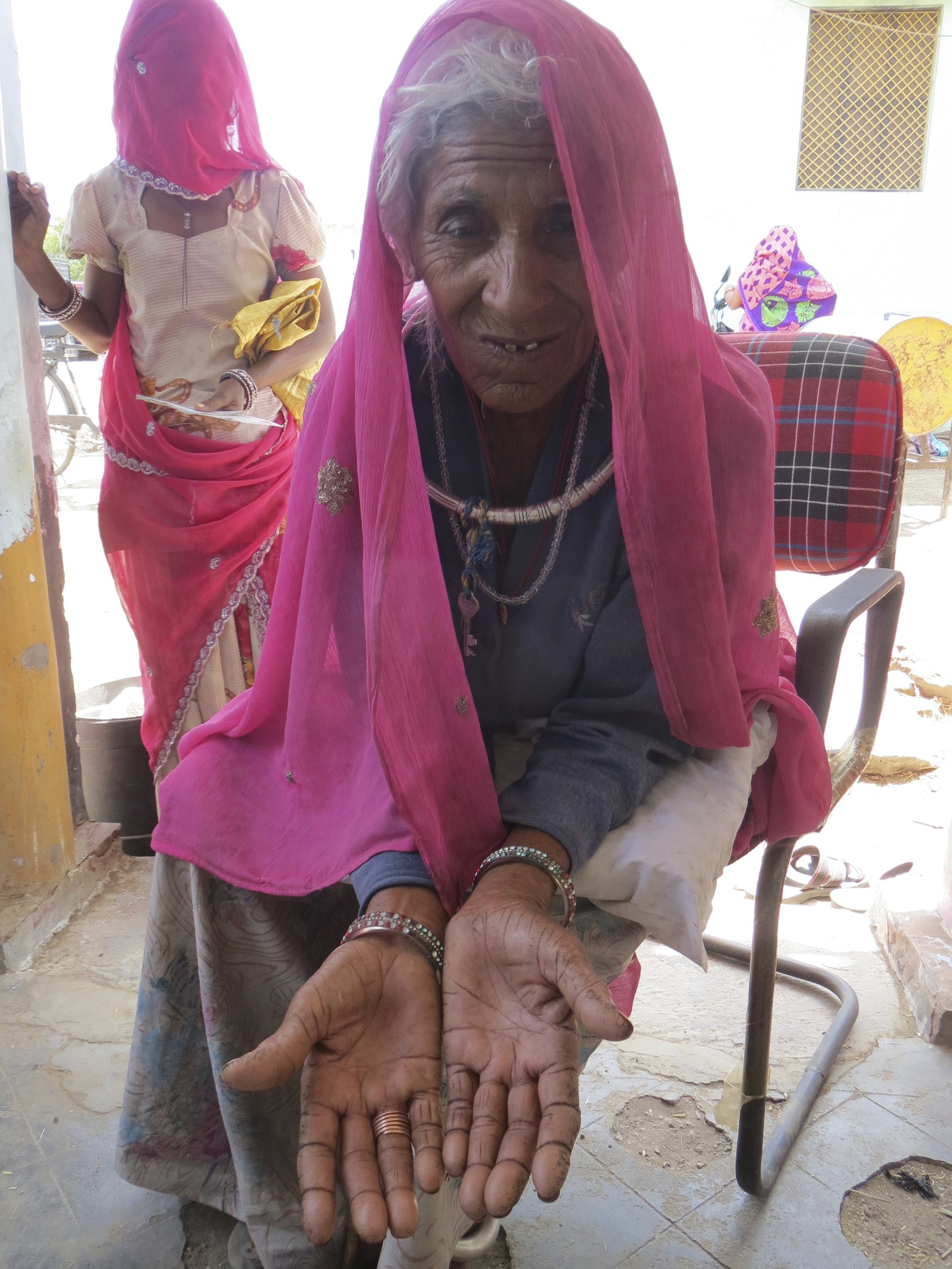
Hanja Devi, a ration card holder in Daulatpura in Ajmer, Rajasthan had made three trips that month to the ration shop in an effort to get her fingrprints authenticated in Aadhaar. Her fingerprints mismatch repeatedly.

Hanja Devi, a ration card holder in Daulatpura in Ajmer, Rajasthan had made three trips that month to the ration shop in an effort to get her fingrprints authenticated in Aadhaar. Her fingerprints mismatch repeatedly.

Is Aadhaar necessary to do Direct Benefit Transfers?

Is Aadhaar is necessary to do Direct Benefit Transfers – subsidies given directly to people through their bank accounts — and will lack of Aadhaar mean lakhs of beneficiaries who are already on it will face severe problems, with their wages, pensions payments adversely affected?

On October 15, 2015, during the Supreme Court on Aadhaar, the government claimed that Aadhaar is used to provide wages to 1 crore workers under the national rural employment guarantee scheme and to reach 30 lakh pensioners.

Disrupting this system now by limiting it to voluntary use, the government claimed, will disrupt payments to a large section of the population. It requested the court to instead permit it to make Aadhaar mandatory in 80 social schemes.

But Direct Benefit Transfers – subsidies given directly to people through their bank accounts – was at that time mostly being carried out through the National Electronic Funds Transfer(NEFT), not through Aadhaar. Even now, Direct Benefit Transfer do not need Aadhaar, they can be done through NEFT very successfully.

In March 2015, 98.3% of MNREGA workers received wages through simple NEFT bank transfers. Only 1.6% of wages were paid through the Aadhaar Payment Bridge System, and 0.1% through another system, called the Public Financial Management System, which again doesn’t require Aadhaar.

For social pensions, the government had made 92.6% of Direct Benefits Transfers through NEFT, and only 5.2% through the Aadhaar Payment Bridge System and it can continue to pay pensions directly into bank accounts without Aadhaar.

Does Aadhaar save time and improve efficiency?

Many people are being deprived of their food rations because they have no Aadhaar number; or because their Aadhaar number has not been correctly “seeded”; or because their biometrics do not work, or simply because the “point of sale” machine returns various error messages.

Even those for whom the system works face huge inconvenience. Often they have to make repeated trips to the ration shop, or send different members in turn, until the machine cooperates. Sometimes schoolchildren are asked to skip classes and try their luck at the ration shop. This unreliable system causes a colossal waste of time for everyone.

Despite this, the Central government continues to push for compulsory Aadhaar-based biometric authentication in ration system in violation of Supreme Court orders. The court did allow the use of Aadhaar in the public distribution, but not making it compulsory for users. Nor can the government invoke the Aadhaar Act to justify this move: the relevant sections of the Act are yet to be notified.

Anada Singh, in Daulatpura, Ajmer, whose Aadhaar authentication does not work reliably.

Anada Singh, in Daulatpura, Ajmer, whose Aadhaar authentication does not work reliably.

Does Aadhaar reduce corruption?

It is not clear to what extent as government does not publish disaggregated data on this even in case of ration system. In several instances, the new system has created more confusion and corruption. Since December 2015, the Government of Rajasthan has tried hard to enforce the system. The use of “point of sale” machines is compulsory and every ration shop has one. Yet, according to official data compiled by the Mazdoor Kisan Shakti Sangathan, only 61 per cent of Rajasthan’s foodgrain allocation found its way through the point of sale system in July 2016, with a similar figure (63 per cent) for August.

The rest is either siphoned off or delivered using the old “register” system — which of the two is hard to say since utter confusion prevails about the permissibility of using registers as a fallback option.

In Jharkhand, after the Aadhaar-based point of sale system was made compulsory, in July 2016, ration cardholders in Ranchi district received less than half of their foodgrain entitlements through that system, according to the state website. The situation was much the same in August.

A “dual system”, where food grains go partly through the point of sale system and partly through the fallback register system, is the worst. Because only dealers know whether and when the manual register system is permissible, and they have no incentive to share that information with the cardholders.

Further, continuing with the ration example, the Aadhaar system fails to check “quantity fraud”: ration dealers often give people less than what they are entitled to, and pocket the rest. Point of sale machines are ineffective in preventing this.

Yet, Aadhaar is proceeding like a juggernaut, without paying serious attention to the collateral damage to welfare systems. Instead, the Central government peddles bogus figures of Aadhaar-enabled financial savings to justify further imposition of Aadhaar technology.

via. Research and Action

via. Research and Action

Read full answer →

Q03

Has anyone actually died because of Aadhaar?

Yes. Aadhaar‑linked exclusion from the Public Distribution System has been documented as a cause in starvation deaths since 2017.

Yes, and this is not a rhetorical claim. The Right to Food Campaign and independent reporters have documented dozens of starvation deaths tied directly to Aadhaar. The first was Santoshi Kumari, an eleven‑year‑old in Jharkhand, in September 2017, after her family’s ration card was cancelled for not being seeded with Aadhaar.

The pattern is recognisable across cases: a fingerprint that no longer reads on the Point of Sale machine, a name spelt slightly differently between the ration card and the Aadhaar database, a server outage at the dealer’s shop, a card de‑duplicated and cancelled without notice. Each of these is, in policy language, a “technical failure”. For the household at the receiving end, it is the loss of a month’s grain, and repeatedly, of a life.

We have collected names, dates and circumstances on our testimonials page. The underlying reports, including the Right to Food Campaign’s investigations, are catalogued in our resources. These deaths are not historical; the most recent cases are from this year.

Read full answer →

Q04

Isn't Aadhaar just like the US Social Security Number?

Aadhaar is not comparable to the SSN. They are very different things.

Social Security Number (SSN), the nine-digit number, which is used widely by government agencies in the US, is often used as an example of an advance economy successfully doing something similar to India’s unique identity project. But there are important differences between the two, starting with the fact that the Social Security Number is, well, not an identity number.

Aadhaar is an identification number. Social Security Number is not.

The Social Security Number has its origins in the years of the Great Depression. During this period of economic recession in the US, the Roosevelt government launched the “New Deal”, a series of programmes to provide relief and employment to the poor.

In 1936, under the Social Security Act, it began using a nine-digit number, the Social Security Number, to track the earnings of workers and compute the amount of social security benefits to be credited to their accounts.

Over the years, the ease of using the number led more government agencies to incorporate it in their records. In 1961, for instance, the Internal Revenue Service began using the Social Security Number for taxpayer identification, similar to the Permanent Account Number in India.

With no legal restrictions on use of the Social Security Number by private companies, several businesses such as credit bureaus started asking individuals for their Social Security Number and storing it.

But in 1977, the Carter administration clarified that while it may used to be verify whether an individual had the legal permit to work, the Social Security Number could not serve as an identification document.

The Social Security Administration website states in a 2009 bulletin: “The card was never intended to serve as a personal identification document – that is, it does not establish that the person presenting the card is actually the person whose name and SSN appear on the card.”

By contrast, Aadhaar has been designed as a single, universal, digital identity number that any registered entity, whether public or private, can use to “authenticate” an Indian resident. Anyone who has lived in India for 182 days can enroll in Aadhaar for proof of identity, while only citizens and those authorised to work in the US can obtain a Social Security Number.

Aadhaar captures biometrics. The Social Security Number does not.

Aadhaar collects biometrics, which include the scan of all fingerprints, face and the iris of both eyes. Aadhaar Act’s section 2(g) states that “other biological attributes” may be collected in the future, a provision that was intensely debated in Parliament.

In contrast, when the Social Security Number was created in the 1930s, the US government decided not to collect fingerprints. “The use of fingerprints was associated in the public mind with criminal activity, making this approach undesirable,” notes the Social Security Administration website. The Social Security Number is thus printed on a small paper card and does not carry even a photograph.

In recent years too, the Social Security Administration has restrained from collecting biometrics of residents. In 2007, when the Intelligence Reform and Terrorism Prevention Act asked the SSA to improve the security of Social Security Number cards, the SSA considered adding the holder’s photograph or biometrics to the card but eventually decided against it.

“A biometric identifier, such as a fingerprint, can be an effective and highly accurate way to establish the identity of an individual, but it can also facilitate a much higher degree of tracking and profiling than would be appropriate for many transactions,” said Marc Rotenberg, the president of Electronic Privacy Information Center, a research organisation, in a testimony to the House of Representatives.

He added: “The problems that will arise when biometric identifiers are compromised are severe. What will happen at the point that your biometric identifiers no longer identify you?”

Around 2011, American authorities considered introducing a new biometrics-linked identity card for work authorisation for residents. Called the Biometric Enrollment, Locally-stored Information, and Electronic Verification of Employment or BELIEVE card, it aimed capture fingerprints or scans of veins on the back of hands.

BELIEVE card supporters presented it as necessary for immigration reform but many opposed it. “We pointed out that a biometrics ID system would be expensive, intrusive and ineffective, and requiring such an ID card would fundamentally transform the information demands the US government places on its citizens,” said Michael Froomkin, a professor of law at Miami University.

Ultimately, the proposal was dropped.

(First appeared in Scroll.in on December 20, 2016.)

Read full answer →

Q05

Didn't the Supreme Court already settle the Aadhaar question?

No. The 2018 Puttaswamy judgment placed real limits on Aadhaar that have been quietly eroded ever since.

The 2018 Constitution Bench judgment in Justice K. S. Puttaswamy v. Union of India did not give Aadhaar a clean bill of health. It struck down Section 57 of the Aadhaar Act, meaning private companies cannot demand Aadhaar, and held that Aadhaar may only be required for benefits and subsidies funded out of the Consolidated Fund of India. It also barred mandatory Aadhaar for school admission, board exams, mobile connections and bank accounts.

In practice, those limits have been worked around. Aadhaar continues to be demanded, formally or informally, for school enrolment, for new SIM cards, for opening accounts, for receiving scholarships and pensions, and now for a growing range of welfare and identity systems. The court’s narrowing has been treated by the executive as an inconvenience to route around, not a constitutional ceiling to respect.

The judgment is also internally divided. The majority accepted Aadhaar’s “minimal” architecture. Justice D. Y. Chandrachud’s dissent, which we view as the more accurate reading, found the entire scheme unconstitutional for the harms it inflicts on welfare entitlements and the surveillance architecture it enables. For the legal background, see the primers in our resources.

Read full answer →

Q06

What is India Stack?

India Stack is Aadhaar plus the rails built on top of it. We view it as a failed and objectionable model that should not be replicated abroad.

“India Stack” is the umbrella term that the IT industry, through iSPIRT and allied actors, uses to brand the bundle of state systems built on top of Aadhaar from around 2012 onwards. The pieces include Aadhaar identity and Aadhaar‑based biometric authentication (ABBA), the UPI and Aadhaar‑enabled payment rails (AePS), e‑KYC, eSign, DigiLocker, the Account Aggregator framework, FASTag (mandatory by law), the Ayushman Bharat Digital Mission, ONDC and a growing list of “Digital Public Infrastructure” (DPI) layers in welfare, health, education and commerce.

We view Aadhaar, and therefore India Stack, as a failed and objectionable model that should not be replicated in other countries. The case is set out in full in our Campaign 2025 statement; in short:

  • A centralised database of biometrics and demographics is a dangerous tool of social control, especially in the hands of an authoritarian government.
  • The coercive “seeding” of Aadhaar into ration cards, job cards, pension lists, bank accounts and voter rolls magnifies the danger of profiling, surveillance and exclusion. It has produced real harm to lakhs of people, including Aadhaar‑linked starvation deaths.
  • Biometric failures and database errors are a permanent source of exclusion: for the elderly, for manual workers whose fingerprints have worn smooth, and for marginalised people who never received a working Aadhaar in the first place.
  • Aadhaar has been a law unto itself, rolled out without any legal backing, passed through Parliament by bypassing the Upper House, and routinely defying Supreme Court orders.

What is being exported under the brand “India Stack” is this same architecture, dressed up in the language of “open public infrastructure”. We urge the greatest caution from countries considering its replication, for the same reasons we resist its use here.

→ Read our full statement: Beware of Aadhaar — A Warning on India’s Biometric Identity Model (Campaign 2025, released on Human Rights Day, 10 December 2025).

→ Further reading on the architectural critique: India Stack Watch — a structured framework (Five Tests, Evidence, Components, Framework) examining India Stack as Digital Public Infrastructure. CC0; fork-able.

Read full answer →

Q07

Can I just opt out of Aadhaar?

Not cleanly. There is no working mechanism to delete an Aadhaar number, but there is plenty you can do, individually and collectively.

There is no statutory route to delete an existing Aadhaar number, and the UIDAI has built no functioning opt‑out mechanism. A child enrolled before turning five can technically be opted out at majority, but in practice the request is rarely entertained. For everyone else, the realistic question is not “how do I delete it” but “where do I refuse to use it, and how do I help others who are being shut out.”

Refusal still matters. Every fresh demand for Aadhaar, at a school, a bank, a hospital, a service counter, is a place to push back, cite the Supreme Court’s limits in Puttaswamy (2018), and ask for the alternative documents that the law continues to recognise. Documenting refusals, denials and exclusions, and making that documentation public, is itself part of the campaign.

The most useful thing most people can do is collective, not individual: sign on, write to MPs, support people who have been excluded from rations or pensions, and amplify the documented harms. Concrete steps are listed on our Take action page.

Read full answer →