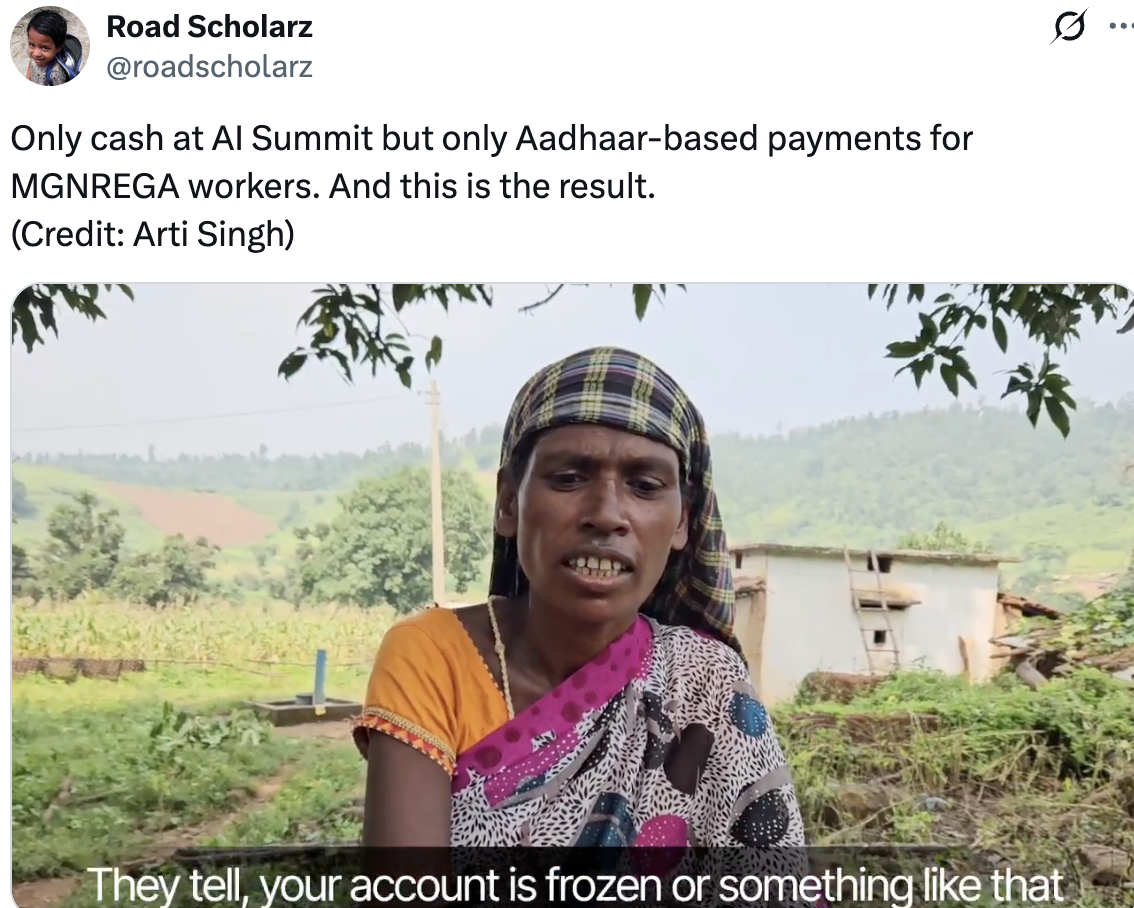
Shanti Devi, from Gotidumar, says her bank account has been frozen over Aadhaar-based payments systems requirements and she can no longer access her NREGA wage or earnings from collecting tendu leaves.
March 2026:
The AI transition in India can disrupt the labour market and have multiplier effects on household income, urban migration patterns and consumption demand. This article makes the case for an "AI Transition Scheme" when AI-led task automation will gradually replace entry-level to mid-skills jobs before new jobs can emerge at scale.
Venkateswarlu Kuruva and Chakradhar Buddha explain in IDR how India’s digital welfare system is producing life-altering exclusions by prioritising administrative control over constitutional guarantees of access and dignity, and how the entire onus of correction is passed on to the people least equipped to bear it.
The Delhi government plans to replace the pink ticket system for women’s free bus travel with the Saheli smart cards. In the absence of public evidence that such a change is needed, this is yet another example of technology-driven welfare that will exclude the people who will benefit the most from affordable transport.
The government’s proposal to pre-install the Aadhaar app to enable a single sign-on feature for all online services that require Aadhaar authentication or identity verification has received resistance from the Manufacturers’ Association for Information Technology (MAIT), an industry body representing manufacturing companies, citing privacy and security concerns and manufacturing and operational ramifications for global smartphone companies.
The draft policy for Responsible Digital Use Among Students, released by the Karnataka government, has a provision for linking social media accounts to Aadhaar to ensure age, authenticity and restrict fake or multiple accounts. This has been criticized by internet advocacy groups because it is not only unconstitutional but also can be used as a tool for extensive profiling of individuals.
The Parliamentary Standing Panel on Rural Development and Panchayati Raj has recommended making the Aadhaar-Based Payment System optional for wage transfers under MGNREGA and shifting to other alternatives because of low biometric authentication success in remote areas and for the elderly.
This article highlights how embedding AI-powered facial recognition into the Integrated Child Development Services (ICDS) is risking the health of pregnant women, lactating mothers, and young children by cutting them off from supplementary nutrition.
This investigation shows that facial recognition systems restricted in Europe are being exported to countries like Brazil with weaker regulations. In Paraná, the technology is used in public schools to track attendance, scanning millions of children daily. Critics argue this raises serious concerns about consent, privacy, and the collection of biometric data from minors. The system has also faced issues with accuracy, potentially affecting access to welfare benefits linked to attendance.
UIDAI has completed Mandatory Biometric Updates (MBUs) for one crore children spanning 83,000 schools across the country. UIDAI has made providing fingerprints and iris information in Aadhaar an essential requirement for children upon crossing the ages of 5 and 15 years. Lack of MBU in Aadhaar can lead to difficulties in accessing benefits under government schemes, registering for competitive exams like NEET, JEE, CUET, etc.
February 2026:
The Indian government is pushing Aadhaar deeper into everyday life through a new app and offline verification support, a step that raises new questions about security, consent, and the broader use of the massive database.
In this blog, Shruti Rajgopalan from the Mercatus Center dives deep to explain the political economy of the AI race.
India is chasing the AI dream, but there are other less visible costs of AI that have grave implications. Data centres will significantly drive up India’s energy and water demands, while generating noise and air pollution and affecting the health of neighboring communities. This comes amid a growing number of studies highlighting the rising environmental, economic and health impacts of data centres in the US. India needs to pave its own way during this AI boom while ensuring transparency, sustainability and efficiency in the whole process.
This report highlights how prominent AI claims obscure information about the benefits and environmental impact of traditional AI versus generative AI models, and how these claims of traditional AI climate benefits often tend to draw on weaker forms of evidence.
In this podcast, Nihkil Dey explains the drawbacks of framing accountability as a technocratic process where people are merely treated as data points. He describes how real accountability can be achieved by publicising important information, as was done by the right to information campaign led by peasants and workers with MKSS.
Authorities in Delhi are planning to shift homeless persons from flyovers, footpaths and central verges across key parts of the city before the AI Impact Summit, citing public safety, sanitation and other concerns about presentability.
This report, funded by the Pulitzer Center, explains how the digitisation of land records is shrinking the landholdings of Jharkhand’s most vulnerable. Digitised land records were intended to deliver conclusive land titles across India. However, Adivasis in Jharkhand complain that their land records have been manipulated through digitisation. The entire process is rigged with errors, where most don't know how to log into the revenue department’s land records website to verify if their land has been correctly recorded.
January 2026:
As per a report in The Times of India, across Uttarakhand, residents are skipping work and school and queuing outside post offices to rectify errors in their Aadhaar cards. The situation worsened after Aadhaar updation was discontinued at several common service centres (CSCs) due to data irregularities. These complications are worse in hill districts and remote villages, where people have to travel to overcrowded district headquarters, where long waits are a routine.
In an article in The Washington Post, Rana Ayyub explains how India has become a laboratory for a massive state digital surveillance system. This has created an information symmetry between those who control the system and those who use it.
In a comprehensive report in The Wire, Anumeha Yadav details the human cost of imposing AI-based facial recognition tools on the elderly. The Rajasthan government’s push for facial authentication for pensioners risks plunging older people into deep financial and physical distress.
In this podcast by The Maybe, Mila Samdub, Astha Kapoor, and Usha Ramanathan discuss the origins of Aadhaar, how it has largely shaped India’s digital public infrastructure and the political implications of this digital IT system.
December 2025:
The government cleared the Digital Personal Data Protection (DPDP) Rules, which dilute the transparency rights and safeguards for investigative journalists and others probing the government. The independence of the body set up to ensure accountability is being questioned, as it will operate under the Ministry of Electronics and Information Technology. The rules can be seen as a way of indirect censorship and surveillance of lawful newsgathering activities.
This article in The Economic Times sheds light on the hidden costs of AI, from its environmental impact to risking the development of cognitive skills in children. Unregulated access and lax data privacy laws further complicate solving the issues.
This report in The Wire explains how the current government weakened MGNREGA before VB-G RAM G was tabled. This can be partially attributed to forced technocracy through in the form of the Aadhaar-based payment system (ABPS) for wage transfers, which has wrongfully excluded multiple people from the system.
A parent from Odisha went to the High Court to challenge the lack of an opt-out clause or the option to refuse consent in the form requesting parents’ consent to create an APAAR ID. The model consent form further states that the information gathered through the APAAR framework will be shared with other entities. The Odisha High Court has directed the State Government to consider amending the form to include an option to opt out or refuse consent. Compiled by: Bhavika Arya