News Update: Harrassed over onerous paperwork after sister's death, Jitu Munda compelled to carry her body to a bank in Odisha
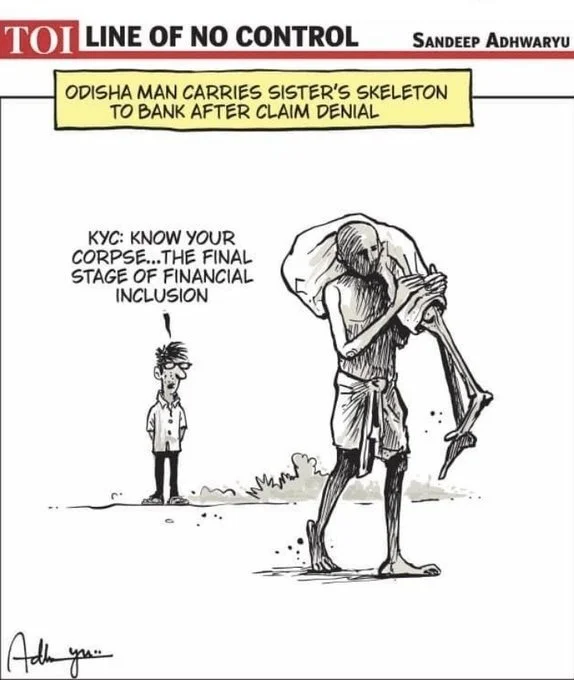
Jeetu Munda, an Adivasi from Odisha’s Mallipasi village in Keonjhar felt no choice but to exhume and carry his sister Kalra Munda’s skeletal remains to prove to the bank that she was no more. Munda’s sister had passed away three months earlier in January. Her husband and child had also died earlier, leaving Munda as the sole surviving relative.
When Munda went to the Odisha Gramin Bank — a regional rural bank sponsored by the Indian Overseas Bank — to withdraw 19,300 rupees his deceased sister’s account, the officials refused to cooperate, and asked him to submit several documents and proof of death. Facing difficulties in meeting banks' onerous paperwork and requirements, Munda felt compelled to carry his sister’s last remains to the bank branch to satisfy their rules to be able to access the savings in her account.
Jeetu Munda was quoted by Press Trust of India as explaining: “I have gone several times to the bank, and the people there told me to bring the account holder to withdraw money deposited in her name. Though I told them that she had died, they insisted on bringing her to the bank.” He added that he exhumed her body “out of frustration”.
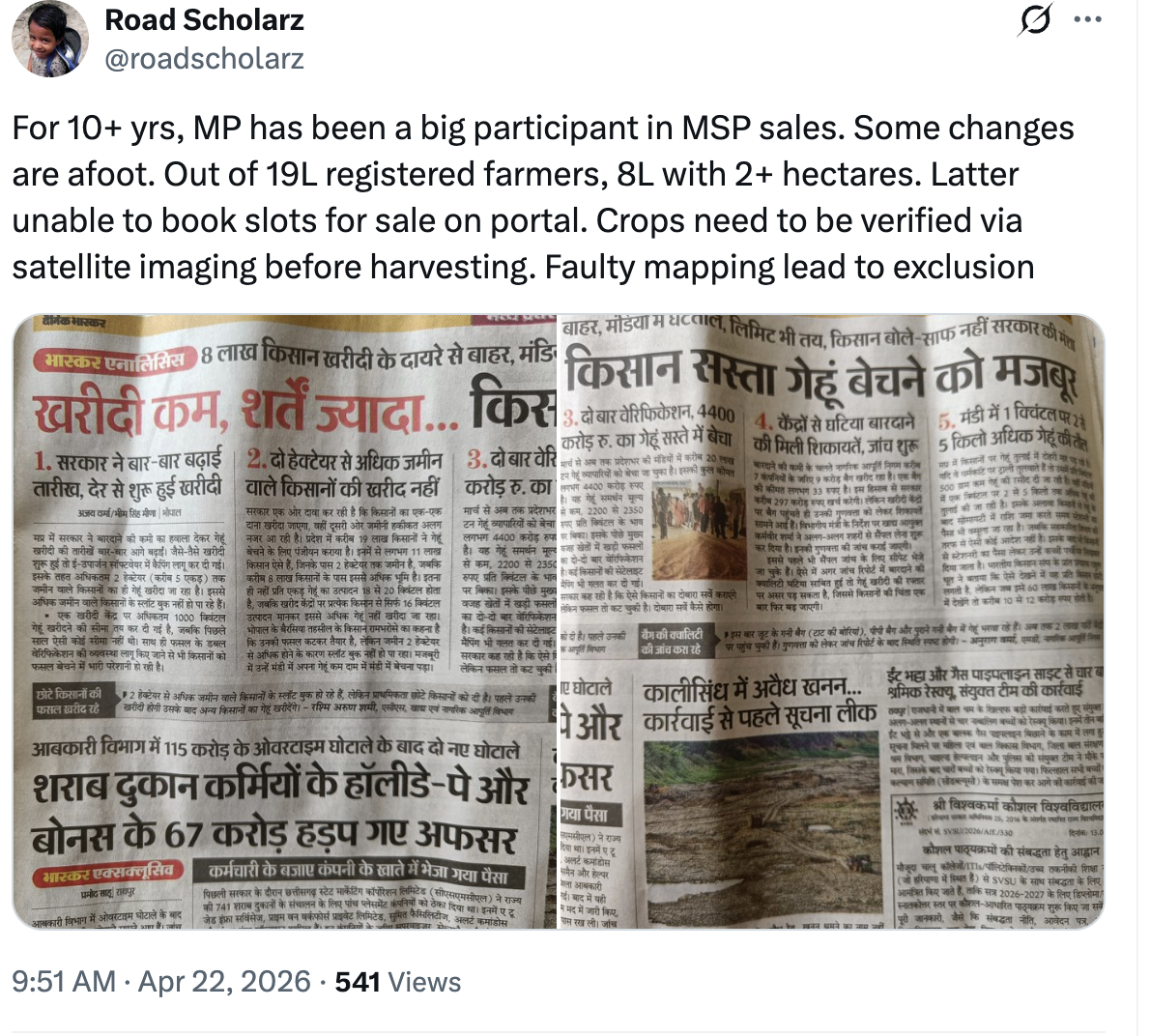
According to a report in The Indian Express, farmers in Haryana are protesting the introduction of a biometric verification requirement at mandis before selling their crops. While the state government argues that the new norms will bring greater transparency and accountability to the procurement system, farmers feel that they have been burdened by rules that demand technical skills and physical presence.
According to a report in The Times of India, 166 tribal children in Karnataka's Chamarajanagar district could not enrol for Aadhaar because they lacked birth certificates. Earlier, most deliveries took place in hamlets, leaving no official records of the dates of birth. Since Aadhaar is now mandatory to gain access to welfare schemes, these students are also being deprived of these benefits.
The Tribune reports that applicants at an Aadhaar centre in Amritsar complain about the lack of adequate arrangements for drinking water and shade outside the office. Applicants have to stand for long hours in this heat for the rectification and updating of existing Aadhaar cards.
The Indian government has decided to drop its proposal to require Apple, Samsung, Google and other leading smartphone makers to pre-install the Aadhaar app on phones. This was the sixth time in two years that the government sought pre-installation of state apps, all of which were opposed by the industry. Smartphone makers flagged device security and compatibility concerns and higher production costs as key issues with the pre-installation proposal.
In this report in The Wire, Venkateswarlu Kuruva and Chakradhar Buddha explain how, instead of delivering on its promise of curbing corruption, the National Mobile Monitoring System (NMMS) is beginning to transform MGNREGA from a guaranteed legal right to one where access depends on digital validation. They point out the inconsistencies in the system that leave room for manipulation, while shifting the focus of scrutiny on workers.
In another report in The Wire, B.D.S. Kishore and Chakradhar Buddha present the case of how the Aadhaar application, portrayed as a one-time process, is often a tedious and unpredictable one in Adivasi areas. While achieving documentation, enrolment and biometric authentication in Adivasi areas is no easy feat, a deeper limitation lies in the system’s lack of continuity beyond enrolment. In Scheduled Areas, institutions such as gram sabhas are constitutionally recognised as centres of governance. Thus, accountability mechanisms should be designed by involving these local institutions to make identity systems more sensitive and locally grounded. \
Compiled by Bhavika Arya