
Newsletter | January - May, 2026
Technology in the first half of 2026 has grown more invasive across nearly every domain, and with it, new forms of exclusion have emerged. This newsletter gathers recent developments, ground reporting, and analyses that illuminate what unfolds behind the headlines: biometric surveillance and facial recognition, the reshaping of labour by AI, and the legal battles now catching up to both. As always, please pass these readings along to your networks.
Two important legal developments recognising our rights:
-
Odisha High Court says APAAR ID is not mandatory for students: A parent from Odisha challenged the lack of an opt-out clause or the option to refuse consent in the form requesting parents’ consent to create an APAAR ID. The model consent form further states that the information gathered through the APAAR framework will be shared with other entities. The Odisha High Court has directed the State Government to consider amending the form to include an option to opt out or refuse consent. For more, please see our previous explainer on Apaar ID here.
-
Bombay High Court intervenes on Aadhaar updation roadblocks: The Bombay High Court issued significant directions to UIDAI about how to deal with complaints of technical or biometric issues with a person’s Aadhaar, specifically directing that UIDAI must “adopt a fair, humane and citizen-centric approach while dealing with cases involving students, senior citizens, persons with disabilities, economically weaker sections and other genuine residents facing technological or biometric difficulties.” The High Court noted that people cannot be left in “indefinite administrative limbo.”
-
The Court was dealing with a common problem: two brothers from Pune who had been enrolled for Aadhaar as minors sought to update their biometrics upon turning 18 in 2022, but instead faced the familiar bureaucratic nightmare that has come to characterise the process. They were forced to make several applications, personally visit the Regional Office in Bombay twice, told that the rules had changed after they duly followed the procedure, and got no responses from UIDAI – leaving them effectively without any remedy over three years. Their higher education hung in the balance as colleges refused to confirm their admission without Aadhaar.
-
The High Court held that (i) whenever a person approaches UIDAI with a grievance about their Aadhaar records, UIDAI must give them a written status update of the record and the correct remedy; (ii) “genuine applicants” should not have to visit the offices repeatedly and should get proper updates about their application; (iii) A permissible fresh enrolment must be facilitated and cannot be rejected merely on the ground that an earlier Aadhaar number was suspended or cancelled; (iv) UIDAI must try to process requests for updation, correction, etc. within four weeks from the application. These directions should be implemented in the right spirit by all UIDAI officials to make the system “citizen-centric”. The full Bombay High Court judgment dated 6 May, 2026 is available here.
However, Aadhaar coercion for everything remains the goal for the government
- The government’s new Aadhaar app which would enable private companies to access people’s data even more than they already do, without any corresponding increase in safety of the database or remedies for breach or misuse. Rethink Aadhaar voiced concerns to TechCrunch in this piece. Fortunately, the government’s proposal that the app should be pre-installed on every mobile phone – a blanket non-consensual invasion of privacy – was rejected.
- Karnataka proposes Aadhaar for social media: The draft policy for Responsible Digital Use Among Students proposes linking social media accounts to Aadhaar to ensure age, authenticity and restrict fake or multiple accounts, and has been criticised for the serious invasion of privacy and surveillance.
- In a rare instance of institutional pushback, the Parliamentary Standing Panel on Rural Development and Panchayati Raj has recommended making the Aadhaar-Based Payment System optional for wage transfers under MGNREGA and shifting to other alternatives because of low biometric authentication success in remote areas and for the elderly. Read more about how MGNREGA was systematically dismantled here.
Listen
- Nikhil Dey explains the drawbacks of framing accountability as a technocratic process where people are merely treated as data points. He describes how real accountability can be achieved by publicising important information as was done by the Right to Information campaign led by peasants and workers with MKSS.
- Mila Samdub, Astha Kapoor, and Usha Ramanathan discuss the origins of Aadhaar, how it has largely shaped India’s digital public infrastructure and the political implications of this digital IT system.
Digital identity verification continues to hurt basic human rights
- Aadhaar enrolment is still impossible for many:
- A report on the hurdles to enrolment in Adivasi areas shows how the system still ignores and neglects the most vulnerable citizens.
- Reports of people braving brutal heat for Aadhaar corrections in Amritsar, and skipping work and school for days in Uttarakhand, reinforces the need to make the rectification and updating process citizen-centric.
- More evidence on how the NMMS app for rural employment attendance hurts workers instead of stopping corruption:
- A report on the working of the National Mobile Monitoring System (NMMS) shows how it has exacerbated the conditions that workers have to meet: “For five hours, around 30 workers stood at a worksite in Raichur district of Karnataka, waiting – not for work, but for their attendance to be recorded. Despite repeated attempts, only one worker’s attendance was successfully captured over nearly 45 minutes. Many eventually left without having their presence recorded.”
- In an absurd story from Telangana, a MGNREGA worker from Komatipalli village stood next to a female co-worker and covered his head using her hair when the NMMS attendance app failed to recognize his face because he had tonsured his head.
- Persons with Disabilities (PWDs) face aggravated burdens: A comprehensive report in The Print details how the Unique Disability ID (UDID) project, which has been mandatory since 2024 for PWDs to access disability schemes, has in fact aggravated the burden of proving disability. Applicants are now forced to go through numerous layers of verification, documentation and medical assessment to acquire the UDID card. Despite being a system created for PWDs, the intended beneficiaries continue to face stigma, unawareness, and inefficient bureaucracy.
- Fact-finding report confirms KYC dehumanization: After Jitu Munda carried the skeletal remains of his sister to a bank in the Keonjhar district of Odisha, a few publications finally highlighted the bureaucratic neglect and state apathy that many from marginalized communities continue to face. (The New Indian Express, The Indian Express, Down to Earth, The Hindu).
- A fact-finding report and press statement released by the Right to Food Campaign and Rethink Aadhaar revealed that in the absence of a biometrics-linked Aadhaar ID, he was denied a ration card and old-age pension. A four-member team visited Dianali village to document a prolonged chain of institutional neglect and how Kalra Munda, Jitu’s sister, had been denied her own funds even during the last few weeks of her illness. The Right to Food Campaign has since urged the Cooperation Department and the Odisha Gramin Bank to issue a standard operating procedure (SOP) for rural branches, including doorstep banking, simplifying nomination procedures, and ensuring humane handling of legal heir claims.
- In a disturbing incident and recurring pattern of denial of right to life, last week Hindi national daily Dainik Bhaskar reported that Ranveer Singh, an elderly man, died after denial of treatment at the Chakri Dadri hospital in Haryana. He was advised to get a CT scan but the hospital staff told him no scan could be done unless he produced his Aadhaar, and he passed away struggling on the hospital floor. Report in Hindi below:
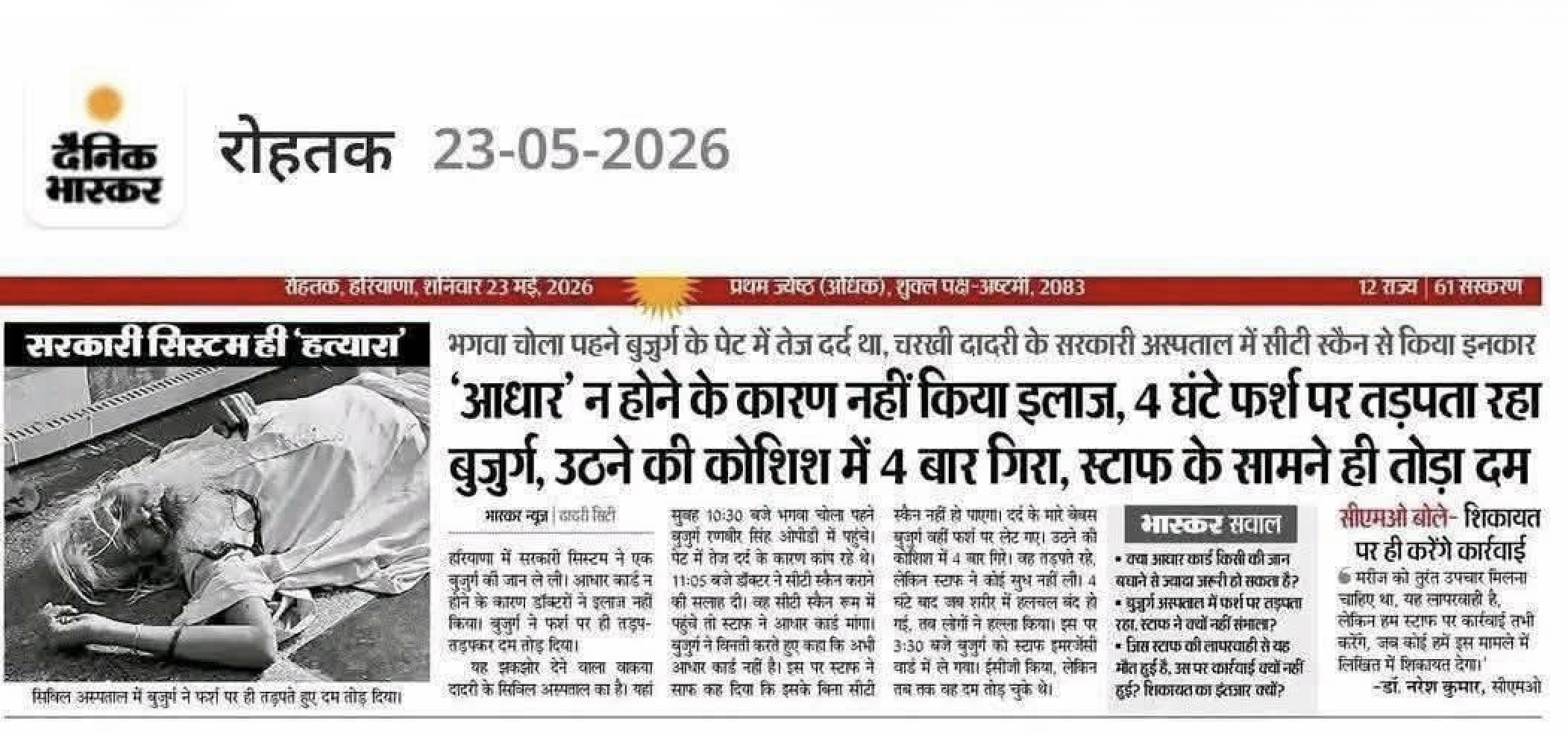
The hospital civil surgeon Narendra Kumar has since contested the allegations and stated that the elderly man had died of cardiac arrest while waiting and de-linked his death from not being able to prove identification.
- Biometric verification at mandis causing unnecessary distress for farmers: Farmers in Haryana have been protesting a new rule requiring Aadhaar-based biometric verification at mandis before selling their crops. With each crop arrival, the farmer’s fingerprint must match with data previously collected and stored on a farm portal, creating barriers in procurement due to mismatches. Additionally, the entire mandi area - including procurement centres and warehouses - is geofenced, meaning that there is a virtual perimeter within which the Government is monitoring crop and vehicle movement. Tractors are photographed and their vehicle numbers recorded, and only registered tractors are permitted to enter, preventing older vehicles from entering.
- This technological process is a hugely disproportionate response to a 2025 scam in which gate passes were issued to tractors not carrying any crops due to collusion with officials: “Samyukta Kisan Morcha (SKM) leader Suresh Koth from Hisar said, “How many times do we have to prove we are genuine farmers? First, we register on the Meri Fasal-Mera Byora portal, then we wait for our turn in the mandi, and once there, we face biometric checks, tractor photos, and endless questions. This has become a Mahabharat for us.”
- Birth certificate barrier to Aadhaar for tribal children: 166 tribal children in Chamarajanagar district, Karnataka were unable to enrol for Aadhaar because they lacked birth certificates. Earlier, most births took place in hamlets, leaving no official records of dates of birth. Since Aadhaar is now mandatory to gain access to welfare, students are unable to access educational and other important state support programmes.
- Facial recognition blocks essential access to maternity healthcare: Embedding AI-powered facial recognition into the Integrated Child Development Services (ICDS) is risking the health of pregnant women, lactating mothers, and young children by cutting them off from supplementary nutrition.
- Anumeha Yadav on the human cost of imposing AI-based facial recognition tools on the elderly, with data on authentication attempts in Rajasthan.
- An overview of how the digital welfare system is resulting in life-altering exclusions by prioritising administrative control over constitutional guarantees of access and dignity.
- Zero record-keeping, zero accountability: Despite these documented instances of suffering, the Government refuses to even acknowledge the failure of authentication and denial of access. In response to two questions in the Rajya Sabha’s Budget Session 2026, the Government repeated that it does not have any “State-wise reports of denial of foodgrains to entitled beneficiaries” due to Aadhaar based eKYC, biometric authentication failure, server downtime, or other digital verification issues.
Over-digitisation in education without safeguards and accountability causes large-scale failures
Recent examples highlight the problems with rushed, large-scale digitisation without any offline options or human intervention:
- The 2026 CBSE class 12 exams have been discredited after it was discovered that the digital system of scanning answer sheets and using software to calculate marks has resulted in serious inaccuracies due to mismatched answer sheets, unevaluated supplementary sheets, and blurry scans. Student researchers have found multiple vulnerabilities in the portal used by CBSE – a clear example of rushed and untested digitisation with serious consequences for children’s education.
- Applications for the 2026 UGC-NET examination were also disrupted by forced digitisation, causing students to request extension of the application deadline. Relying solely on an online portal and forcing verification through Digilocker resulted in applicants being unable to complete the process for no fault of their own.
Artificial intelligence, human costs
- Censorship of reportage on the Hidden Costs of India’s Push for Data Centres: Dalit communities in Andhra Pradesh are being forced to surrender their hard-won farm lands to Google for an AI data center – and the Environmental Reporting Collective’s video report on this story has been blocked on Instagram after it got over 2 million views. The report is still accessible on YouTube.
- The same Google project – which will be the company’s largest outside the United States – raises serious concerns about the environmental impact. The Environmental Clearance issued to the 1 GW data centre does not mention either the source of water for its operations or the amount of water required for cooling, nor does it state the amount of energy it will consume and what proportion will be renewable.
- Protests are ramping up: Local activists and farmers are protesting against the construction of data centres as they continue to face pressure to give up their land. Activists are challenging the opaque land acquisition procedures that have shut out farmers and local self-governance bodies while handing over land to large tech companies.
- Cheap labour and weak worker protections power AI from India: Karen Hao, author of Empire of AI, investigates the hidden workforce that is powering the rise of AI in the US. In India, factory workers wearing head-mounted cameras are recording hours of “egocentric” or first-person data that is being used to train AI systems and robots (See: The Indian Express, Scroll.in, Business Standard, TechCrunch). Cheap labour availability and weak worker protections is making India a hub for such data collection. This raises ethical questions around surveillance and consent while triggering workers’ anxieties that these machines might eventually replace them.
Digitisation of land records raises risks for vulnerable communities
- In Karnataka, the government has updated the Kaveri 2.0 portal to implement a paperless registration system for property in Chamarajanagar district on an experimental basis, to stop the creation and registration of fake documents. The Karnataka State Stamps and Registration Department Authorised Licensed Document Writer’s Union has criticized the move for security loopholes that can enable land grabbing and leave illiterate residents and title-holders prone to exploitation.
- A report in PARI by journalist Sushmita explains how the digitisation of land records is shrinking the landholdings of Jharkhand’s most vulnerable.Digitised land records were intended to deliver conclusive land titles across India. However, Adivasis in Jharkhand complain that their land records have been manipulated through digitisation. The entire process is rigged with errors, where most don’t know how to log into the revenue department’s land records website to verify if their land has been correctly recorded.
For monthly news, see updates on our website for April and March.
We are able to compile these updates because readers send us relevant information. If you think something is worth sharing widely, please send it to us and we will try to include it in the updates. Email: contact@rethinkaadhaar.in Twitter: @no2UID
Until next time!
In solidarity, Rethink Aadhaar.